

What's Behind the San Antonio Spurs' Road Woes?
As the postseason comes into view, the San Antonio Spurs are finding themselves in an unfamiliar situation.
Resulting from their own struggles as well as the unprecedented depth of the Western Conference, the Spurs will likely enter the playoffs with one of the West's bottom four seeds.
For the most part, that's hardly a major blow to the team's chances of repeating. The excess of contender-caliber teams in the conference guarantees that no road to the Finals will be easy.


However, the fact that nearly every Western playoff contender can also make a legitimate run at a ring also ensures that the postseason will see its fair share of Game 7s—something that would hurt San Antonio should it finish in a slot similar to the one it currently holds.
In previous years, home-court advantage has nearly always fallen in the Spurs' favor.
In seventh place with just one-quarter of the season remaining, though, it's unlikely that San Antonio will enjoy that same luxury in the vast majority of its series should it make a deep run.
And given its struggles on the road, that's a very troubling reality.
In general, teams are more successful at home. It's the nature of a home-court advantage. But for San Antonio, the discrepancy between success found at the AT&T Center and on the road has been especially noticeable.
Currently, the Spurs boast a 21-7 record in front of their own fans, while claiming just a 16-16 mark away from home.
They finished with their first ever losing record during their annual midseason Rodeo Road Trip and, as a whole, have looked like an entirely different team when on the road.
Though their defense is statistically worse in away contests, the margin isn't too large. On average, they allow just 2.1 more points than in home games and actually hold their opponents to a lower shooting percentage (by a negligible 0.3 percent difference).
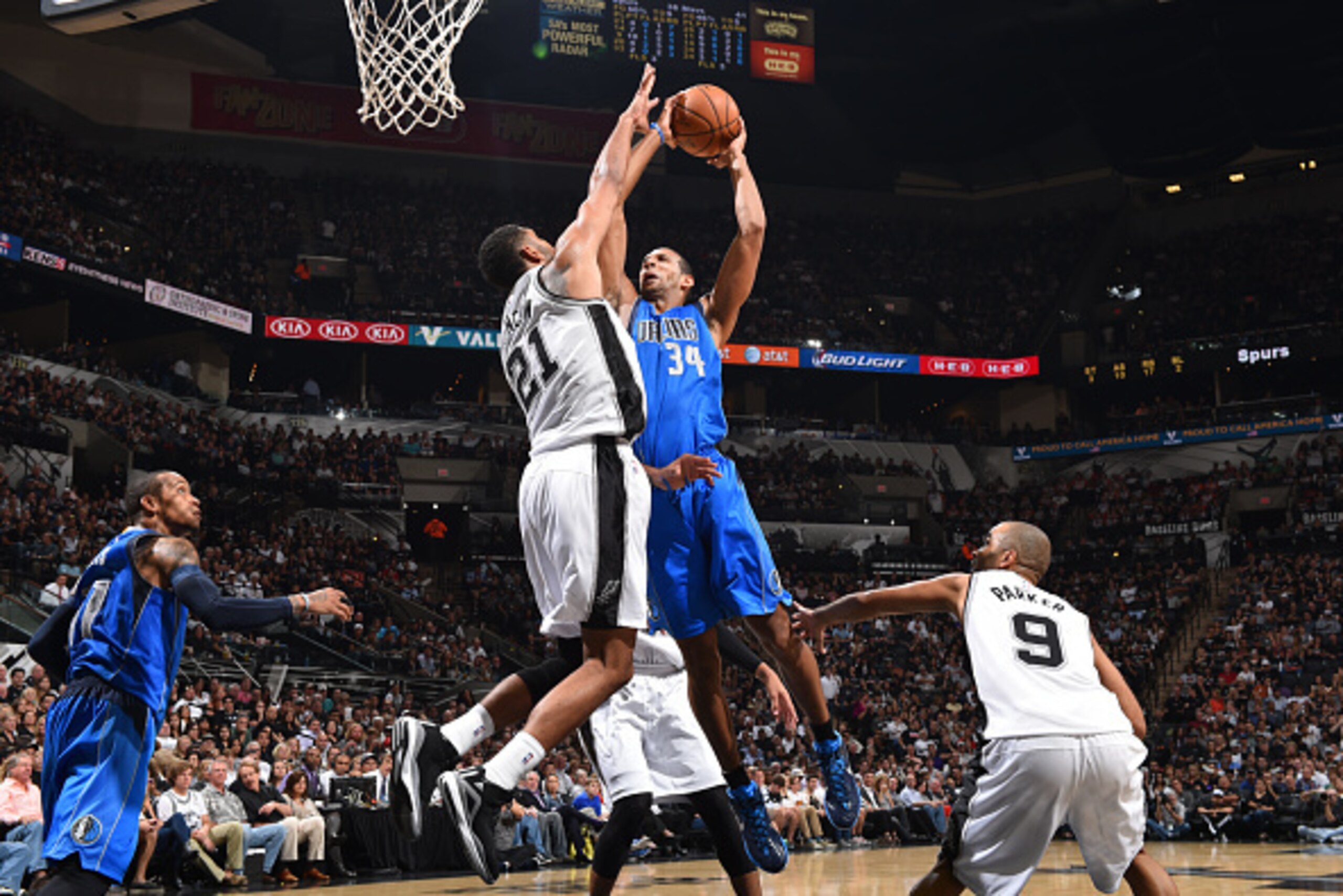
However, the discrepancy between the Spurs' offensive production at home and on the road offers an explanation to their .500 record in the latter situations.
According to ESPN.com, San Antonio averages 104.6 points per game in its own venue, good enough for the sixth-best in the league. Their scoring differential of 7.7 points is second only to that of the Golden State Warriors.
If that pace was maintained on the road as well, their overall offense would produce the league's fifth-most points.
However, the defending champions' ability to get the ball in the basket takes a major hit when they travel. Their field-goal percentage drops from 47.4 to 43.8 and their three-point shooting goes from nearly 40 to 33 percent.
Their 104.6 points per game at home sinks to just 97.4—the league's 14th-worst mark in road contests. Additionally, the point differential sinks to just 0.5, the lowest positive mark in the league.
For the most part, it appears as though the team's scoring struggles on the road are shared mainly by its shooters.
While big men like Tim Duncan and Tiago Splitter shoot a similar clip in each split, Tony Parker, Kawhi Leonard, Manu Ginobili and Danny Green all see massive drop-offs in both production and efficiency when on the road, compared to at home, per NBA.com.
| Home PPG | 15.2 | 16.9 | 12.7 | 13.5 |
| Away PPG | 12.8 | 14.0 | 10.5 | 10.1 |
| Home FG% | 50.0 | 50.3 | 44.9 | 45.5 |
| Away FG% | 41.7 | 42.4 | 39.9 | 39.5 |
The significant discrepancies across the board suggest that blame can—more often than not—be placed on the team's shooting struggles, rather than on offense in the paint or on the defensive end. And, as the stats reveal, it's the team's uncontested shots that have been the biggest problem.
| Phoenix Suns | 35.3 | Memphis Grizzlies | 38.5 |
| Houston Rockets | 24.4 | Washington Wizards | 38.0 |
| Sacramento Kings | 37.5 | Chicago Bulls | N/A |
| Brooklyn Nets | 34.8 | Toronto Raptors | 37.8 |
| Utah Jazz | 35.7 | Los Angeles Clippers | 47.8 |
| Portland Trail Blazers | 44.8 | Golden State Warriors | 48.8 |
| Dallas Mavericks | 42.4 | Utah Jazz | 31.3 |
| New Orleans Pelicans | 52.0 | Portland Trail Blazers | 48.6 |
As the above player tracking data depicts, the Spurs' have shot sub-40 percent when without a defender to contest the shot in the vast majority of their road losses.
Against Portland and Dallas, the Spurs faced an uphill battle from the start playing without Duncan, Parker, Ginobili and Splitter in each contest and Leonard in the latter one. Against New Orleans, they were without Parker which evidently led to less uncontested looks, as San Antonio attempted just 25 shots without a defender in sight.
In the loss to the Clippers, the offense was sound. It was the defense, rather, that led to their 119-115 defeat.
Against Portland, the team shot below 40 percent on contested field goals, which include layups and nearly everything inside.
The Golden State loss is the only true outlier in which the team shot the ball well, but the Warriors' defense on Parker was stifling. Given their place atop the rest of the league, Golden State was expected to win that game.
However, the rest of the games, especially the ones against inferior teams, are characterized by poor shooting on uncontested attempts, which suggests one of two things. One: San Antonio is taking low-percentage shots when given room, or two: they simply aren't hitting looks that had once been the team's collective bread and butter.
As Jesus Gomez of Pounding the Rock noted when reflecting on the Spurs' struggles, the answer is the latter choice.
"Yet through it all, I can't help but think that the big problem, what has caused almost every other issue is incredibly simple to point out: The Spurs are just not making open shots. Last season the Spurs shot 53.3 percent on open two-pointers and 40 percent on open three-pointers. This season they are shooting 48.5 percent and 35.5, respectively. That's a huge dip and that's the stat that is keeping me moderately optimistic. If the shots start to fall, the Spurs should be alright.
"
The shooting woes aren't isolated to away games, but they seem to play an especially big role on the road.
It's a simple conclusion that explains a lot. The Spurs offense features high-powered ball movement designed to get the squad's shooters open looks. But if they struggle to get the ball in the basket, the ball movement and everything else is rendered meaningless.

The issue with that, however, is that there's no quick fix. Shooters are going to be streaky, and it appears as though the venue directly effects that streakiness.
However, with the current playoff format set to put the Spurs on the road to start each series—should the current seeding hold up—the team won't even have a chance to get off on the right foot.
If the beginning two games set the momentum for the entirety of the series, San Antonio could be facing a severely uphill battle.
Nonetheless, the Spurs have nine remaining home games to clean up their act. If they can once again find the bottom of the net consistently regardless of venue, there's no limit to what they can achieve.
Unless otherwise noted, stats are courtesy of Basketball-Reference.com and are accurate as of games entering March 6.




.jpg?w=2560 "Love's Body Already 'Tired'")
.jpg?w=2560 "Tyreek Deal May Come Soon")

.jpg?w=2560 "Ward Nearly Walks Out of Presser ▶️")