

Top Pioneers in College Football History
Where would we be without the pioneers of college football?
Since Princeton and Rutgers played the first-ever college game in 1869, the sport has gone through countless notable changes to the point that if someone from that era checked out a current game it would seem unrecognizable.
Imagine a time traveler from nearly 150 years ago getting two seats on the 50-yard line at the College Football Playoff National Championship game at AT&T Stadium back in January? Assuming the laws of physics had allowed for such a person to survive the trip through the wormhole, odds are their mind would have been blown by what's come of college football.
Not all change has been good, but the vast majority has been great. And while there have been thousands of people over the years responsible for how the game looks today, a handful of so-called college football pioneers deserve the most credit.
As the NCAA's Football Rules Committee is set to meet Thursday to discuss further rule changes, scroll through to see our list of people who have had the greatest impact on college football to this point.
Walter Camp
1 of 8What he did
Walter Camp is a reason for why football has 11 players on each side, why they line up on opposite sides of a line of scrimmage and why each team gets four downs to move the ball. Those are just the tip of the iceberg when it comes to rules Camp helped establish in the late 1800s, when football was still in its fledgling state.
Camp, a player at Yale, also helped create the NCAA and served on its rules committee for decades.
Why it matters
If not for Camp, football might have never come about from the seeds of rugby, the game it branched off from. When Camp played in college more than 130 years ago, he suggested the points system that is still used in the sport today, and his influence on rules and how the game was played continued on until his death in 1925.
Camp also understood the importance of recognizing greatness in college football, coming up with the first All-America team in 1889. It was only fitting that the Walter Camp Foundation was formed in the 1960s to continue the idea of spotlighting top players, and since 1967 the Walter Camp Player of the Year Award is one of the most noteworthy trophies in the game.
LaVell Edwards
2 of 8
What he did
LaVell Edwards took to the air more than any other coach during his 29 seasons at the helm of BYU, popularizing the wide-open passing style that led to modern schemes like the Run-and-Shoot and the Air Raid. From 1972 to 2000, he won 257 games, 20 conference titles, seven bowl games and the 1984 national championship—and all of it was with an aerial onslaught that went against the grain during an era based heavily on the run.
Most college teams were run-based in the 1970s and '80s, operating out of the veer or other forms of the option offense. Edwards decided the better approach was to go up top to move the ball, especially when a team didn't have the size and talent to run the ball effectively.
"The passing game became an equalizer for BYU, making up for personnel deficiencies," wrote Kurt Kragthorpe and Jay Drew for the Salt Lake Tribune in 2012, the 40th anniversary of Edwards' offense getting installed in Provo.
Why it matters
Before Edwards took over BYU, the single-season record for passing yards was 3,464. His quarterbacks re-established that record three times, with Jim McMahon becoming the first 4,000-yard passer in 1980. Ty Detmer then broke the 5,000-yard barrier in 1990.
Since 2000, every FBS passing leader has thrown for at least 4,000 yards, and many of those quarterbacks have come from teams that run an offense borne from what Edwards started. That includes the Air Raid offenses of Mike Leach at Texas Tech and Washington State, as Leach was a graduate assistant under Edwards in the mid-1980s.
ESPN
3 of 8
What it did
The Worldwide Leader in Sports has broadcasted nearly every major sport over the past 30 years, as well as plenty of minor events that you never expected to find on television. But it's bread and butter has always been college football, and since it first aired a live game in 1984 (between BYU and Pittsburgh), ESPN has become more and more involved in the sport.
It's to the point now that ESPN doesn't just show games, it orchestrates them, creating made-for-TV matchups and dictating when and where they play.
"In the chase for money and exposure, college football, once a quaint drama of regional rivalries played out on autumn Saturday afternoons, has become a national sport played throughout the week, intruding on class schedules and even on exams," wrote Steve Eder, James Andrew Miller and Richard Sanomir of the New York Times.
Why it matters
As college football fans, ESPN sets our schedules and makes us arrange family time, errands and all other non-football activities around the games themselves.
As Eder, Miller and Samoir wrote:
"The extent of ESPN's influence over college football is literally displayed on the face of your ticket to next week's game. Tickets to most games are printed with the date and the opponent’s name, but something is missing: the kickoff time. That is because ESPN, under its contracts with conferences, has the right to set kickoff times and wait until 12 days before game day, or in some cases only six, to inform universities.
"
College football is one of the most popular sports in the country, a far cry from the days when it was only one of regional or local interest. This is because of TV exposure, and ESPN has pioneered that coverage.

.jpg?w=2560 "AP Poll Top Five Week 9")
Phil Knight
4 of 8
What he did
Phil Knight made the equipment and apparel worn in college football more than just about function, and in doing so helped elevate the sport to a level of financial prominence it had never seen before.
The co-founder of Nike and Oregon alum wanted to make his alma mater look sleeker on the field, and the Ducks' uniforms became trendsetters that were quickly the envy of all other schools. To be considered a "Nike school" meant taking in millions in revenue to outfit an athletic department's teams, and that money helped lead to advancements in technology and player safety.
It also helped create the so-called facilities arms race that has led to state-of-the-art training facilities and stadiums that most major programs have nowadays.
Why it matters
Without Nike and Knight, the constant desire to be innovative and trendsetting wouldn't be a part of college football. Schools also wouldn't be able to influence high school recruits as effectively, since the look of uniforms and the swagger that comes with that look has been frequently noted by prospects as a reason for choosing a school.
"Recruiters know that gold metallic helmets, pickax number fonts, school seals channeled in the jersey numbers, pitchforks dripping in copper, colors that change depending on what angle you're looking at them from and uniform combinations that calculus majors could only figure out can make a difference," wrote ESPN RecruitingNation's Jeremy Crabtree.
If it were just Nike doing this, maybe it wouldn't have been a big deal. But it's now something that every apparel maker does, and as a result is something that every college football team is immersed in.
Roy Kramer
5 of 8
What he did
Roy Kramer laid the groundwork for how college football determines a national champion, helping to create the Bowl Championship Series in 1998 and overseeing it during its first few seasons.
The SEC commissioner from 1990 to 2002, Kramer teamed up with statistician Jeff Sagarin and SEC media relations director Charles Bloom to create the system that combined computer ratings and human polls to rank college football's top teams and determine which two should play for the title. Previously, bowl contracts and affiliations would steer schools to certain games, often preventing the best teams from facing off against each other and leaving us with far too much controversy over who the national champion was.
"What we were trying to do was strengthen the bowl selection process a little bit," Kramer told Bleacher Report's Charles Bennett. "So we began to look at ways to improve matchups and the bowls, and in that discussion, someone said, 'Well, why can't No. 1 play No. 2 someplace?' So that became part of the discussion as we began to look at how we can improve the selection process."
The BCS would be the system used from 1998 to 2013 and served as the impetus for the new College Football Playoff format.
Why it matters
Prior to 1998, it was a commonality to have multiple teams lay claim to the national title, such as in 1990, 1991 and 1997. Though it wasn't a foolproof system, the BCS created an avenue that made it possible to determine the champion on the field rather than through polls.
The BCS wasn't universally loved, and it needed to have its formula tweaked several times over its 16-year run, but without it we wouldn't have a four-team playoff, and the top teams in college football wouldn't have as much of a desire to put together tough schedules in hopes of being worthy of a shot at the national title.
Rich Rodriguez
6 of 8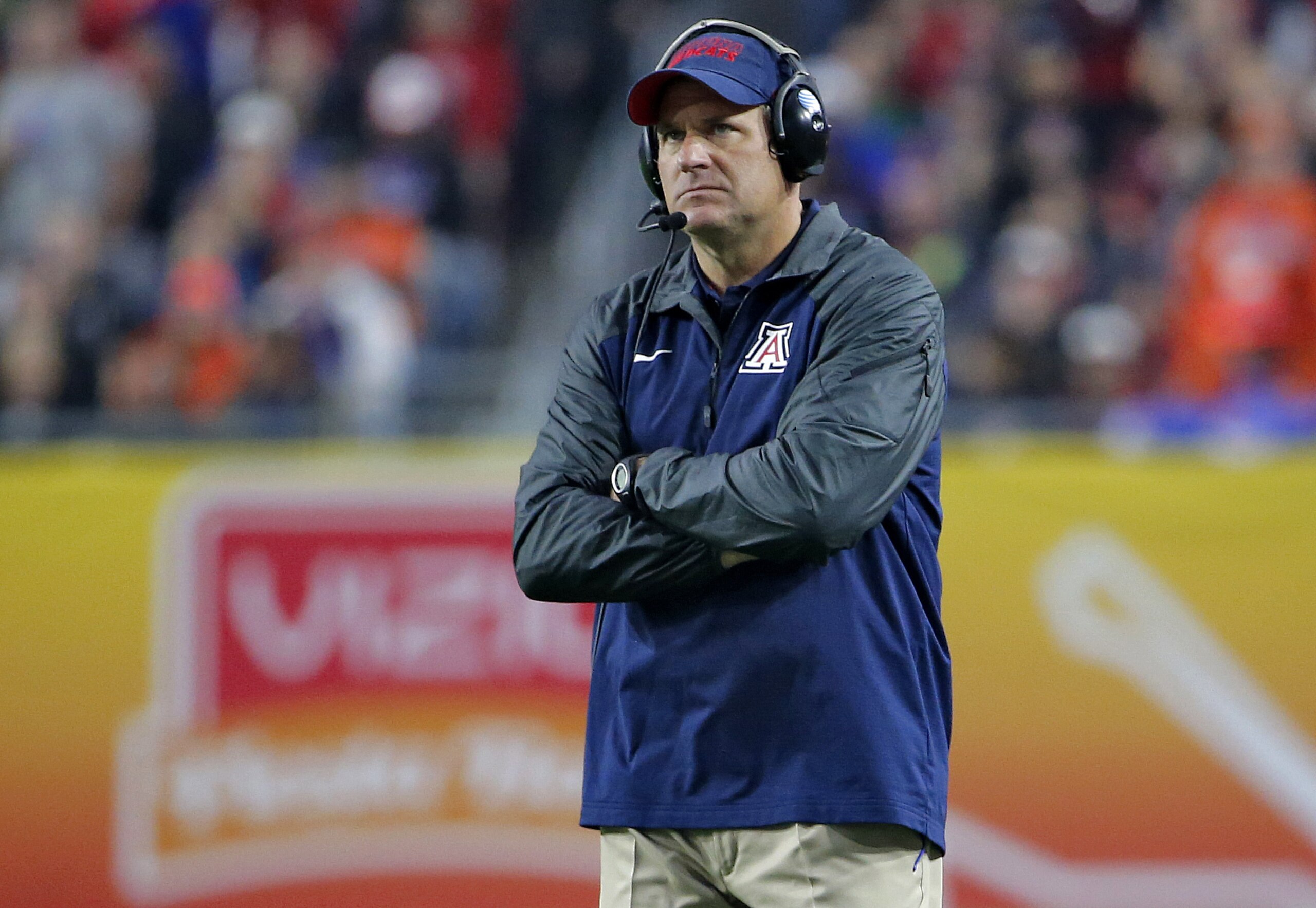
What he did
Similar to how LaVell Edwards balanced the playing field by throwing all over it, Rich Rodriguez went the route of spreading the field out.
Though he didn't invent the spread offense, Rodriguez is frequently referred to as the "Father of the Spread" because of how he's modernized it into an offense that uses the run as much as the pass. By having it be balanced, it made for an insanely difficult scheme to defend since it didn't allow teams to load up on stopping one particular area.
"The hardest thing is to tackle in the open field," Rodriguez told ESPN.com's Ted Miller. "The second hardest thing is to block in the open field, but that was our whole philosophy, make them defend in space and create some conflicts for them."
Rodriguez also changed the game by speeding things up, putting a premium on getting in as many plays as possible so it was even harder for defenses to slow things down.
Why it matters
Speed has always been a big part of college football, but since Rodriguez made it a key element of his offenses—from more than just an individual standpoint—it has revolutionized the tempo of games. The play clock has become almost obsolete, as has the pre-snap huddle, as teams strive to snap the ball as soon after the previous play ends as possible.
Dozens of notable programs run versions of the spread, such as Auburn, Baylor, Ohio State, Oregon and TCU. While it's still the common belief that defense wins championship, fast-paced offenses like the ones Rodriguez helped innovate are starting to tip the scales.
Teddy Roosevelt
7 of 8What he did
The 26th U.S. President is known for far more notable achievements outside of the sports world, but one of his most influential actions was cleaning up college football at a time when its brutality risked making it obsolete.
Roosevelt attended Harvard but didn't play because of poor eyesight, though he saw well enough to recognize that the way football was going was becoming too rough for its own good. To fix this, he fought to implement rules centered around safety and organization, and this laid the groundwork for the game to advance and evolve without constant risky of injury or death.
Why it matters
Player safety remains a tent pole issue in college football, with concussion protocols and rules designed to prevent injury being part of the everyday discussion of the sport. But the game is exponentially safer than it was more than 100 years ago, and Roosevelt's efforts to get the ball rolling in this direction were integral.
Had Roosevelt not used his power and office to intervene during the early 1900s, football might not even exist anymore.
Pop Warner
8 of 8
What he did
As a player and coach, Glenn "Pop" Warner was a captain at Cornell and then went on to win 319 games during a 44-year span at six different colleges. But it was the way Warner shaped and influenced the game with innovation and advancement that made him one of college football's greatest innovators.
Because of Warner, teams punt on fourth down and throw screen passes, and players wear helmets and pads to protect them from injury. And there's an annual influx of talented athletes who are well-versed in the game each season because of his development of youth football leagues in the 1930s.
Why it matters
Pop Warner is the leading youth football organization in the country, and the majority of today's college players got their start at this level. The outfit still bears Warner's name because of the influence he had on making the game clean and fun, principles that continue to be taught to children today.
His willingness to come up with new ideas to make his teams (and the game) better can be seen as motivation for the modern games innovators.
"Warner was an incubator of breakthrough ideas without peer in the early 1900s," wrote James Quiggle of Investor's Business Daily. He was a once-in-a-generation radical innovator who vaporized the game's contented paradigm—the ponderous, plodding offenses."
Follow Brian J. Pedersen on Twitter at @realBJP.


.jpg?w=2560 "Mahomes Told Teammate to Leave Meeting")
.jpg?w=2560 "5 Teams Eyeing Jonathan Taylor")
.jpg?w=2560 "Baker Gets Glove From Rays 🧤")

.jpg?w=2560 "NFL investigating Eagles")
.jpg?w=2560 "Steelers Roll Saints in Paris")
.jpg?w=2560 "Jonathan Taylor Landing Spots 📍")