
Top MLB Prospects Who Won't Make MLB Rosters Even with Huge Springs
It’s always a big deal when a prospect makes an Opening Day roster, and even more so when it’s at least partly the result of a standout performance in spring training.
Unfortunately, those instances are few and far between, as teams traditionally try not to rely on young, unproven players at the onset of the season. Plus, teams usually have more incentive for top prospects to open the year in the minor leagues as opposed to putting them on the active roster, with the main reasons including service time, developmental concerns or a positional roadblock at the highest level.
This means that, for some prospects, they will be headed back to the farm no matter how well they play in spring training.
Here are five prospects to whom that will apply in 2015.
Addison Russell, SS, Chicago Cubs
1 of 5
Addison Russell missed most of the first half of 2014 with a hamstring injury, returning shortly before he was dealt to the Cubs in early July. The now-21-year-old shortstop seemed to enjoy the change of scenery, as he batted .294/.332/.536 with 12 home runs, 11 doubles and 36 RBI in 50 games at Double-A Tennessee.
Russell makes a lot of hard contact thanks to his plus bat speed and innate bat-to-ball skills, and he’s really started driving the ball to all fields over the last year.
His swing will get long at times, but Russell gets the barrel through the zone so quickly that there shouldn’t be a lot of swing-and-miss, and his mature approach and pitch recognition will lead to plenty of walks and high on-base percentages during his career.
The right-handed hitter’s combination of plus bat speed and a deep point of contact should generate upward of 20 home runs at the highest level, possibly more depending on his physical development in the coming years. And given his ability to use the entire field, Russell should always tally a high number of doubles and triples.
On the basepaths, Russell is an above-average runner with the athleticism and instincts to steal 15-20 bags annually but will be significantly less aggressive this season after his injury.
Defensively, Russell still has room to improve, though he already possesses incredible range to both sides and is especially slick when charging the ball. His plus arm strength allows him to make throws from virtually anywhere on the infield, but there also are times when he doesn't set himself properly and uncorks inaccurate throws.
Russell has the makings of an All-Star-caliber shortstop capable of hitting in the middle of a lineup, and he should be ready at some point next season to make his debut in the major leagues.
However, with Starlin Castro and Javier Baez set to open the season at shortstop and second base, respectively, there is probably a zero percent chance he begins 2015 in the major leagues.
That obviously could change in the event of an injury, but even if that were the case, the Cubs would likely target up-the-middle depth elsewhere rather than rushing Russell to the major leagues.
Robert Stephenson, RHP, Cincinnati Reds
2 of 5
Robert Stephenson was challenged over a full season in Double-A in 2014, as the 21-year-old right-hander’s inconsistent command led to an elevated walk rate (4.9 BB/9), and his tendency to pitch up in the zone with his fastball allowed hitters to take him deep 18 times (1.2 HR/9).
However, Stephenson was still young for the level, so the fact that he held opposing hitters to a .224 batting average and fanned 140 batters in 136.2 innings was encouraging.
The 6’2”, 190-pound right-hander boasts a plus-plus fastball in the 94 to 98 mph range and occasionally bumps triple digits. Stephenson’s secondary arsenal is headlined by a potential plus-plus curveball that’s an absolute hammer with sharp downer action.
He also throws a changeup in the high 80s that’s still a bit on the firm side, but his feel for the pitch has noticeably improved in the last year, as he’s been forced to develop it against Double-A hitters.
Stephenson’s athleticism and arm strength suggest front-of-the-rotation potential, but he’ll need to improve his command and refine his changeup to remain a long-term starter.
It wouldn’t be surprising if he returned to Double-A to open the 2015 season, especially if his current shoulder situation causes him to miss time during spring training.
"(He) will most likely be off the mound a couple of days behind because we want to make sure his shoulder is totally strong and he's headed in a great direction," Reds manager Bryan Price said via John Fay of the Cincinnati Enquirer.
Beyond that, the Reds simply have no need to rush Stephenson’s development, as he’d probably be better off spending another full season in the minors.
Joey Gallo, 3B, Texas Rangers
3 of 5
Joey Gallo led all minor league hitters with 40 home runs in 2013 and then improved on that total this past season with 42, finishing one long ball shy of Kris Bryant’s MiLB lead.
The 21-year-old’s impressive campaign began at High-A Myrtle Beach, where his refined approach and shorter swing produced a .323/.463/.735 batting line with 21 home runs and respective strikeout and walk rates of 26.0 and 20.7 percent over 246 plate appearances (58 games).
The slugger hit another 21 dingers in 68 games following a midseason promotion to Double-A Frisco, but his approach was exploited by Texas League pitchers and resulted in a .232/.334/.524 batting line with respective strikeout and walk rates of 39.5 and 12.4 percent over 291 plate appearances.
At 6’5”, 205 pounds, Gallo is a physical specimen with enormous 80-grade raw power. The combination of his quick wrists, explosive bat speed and lofty swing gives him effortless in-game power to all fields, making it easy to envision him being a true 35-home run threat at the highest level.
The 21-year-old will always be a streaky hitter and have a considerable amount of swing-and-miss to his game, but he’s also learning to work counts and take walks, therefore allowing him to see more hittable pitches.
Gallo’s simplified swing played a major role in his improved consistency last season. Specifically, he reduced his pre-pitch load so as to be shorter to the ball, which allowed him to better control the zone and get to many of the pitches he missed the previous year.
The adjustment led to improved strikeout (33.3 percent) and walk (16.2 percent) rates as well as a solid average (.271), and it didn’t come at the cost of sacrificing power (42 HR, .344 ISO).
Gallo has worked to become a quality defender at third base, but his present average range is likely to worsen as he ages due to his 6’5” frame. His athleticism and plus-plus arm strength would also play in the outfield, which is where the Rangers began giving him reps this past fall in instructional ball.
The Rangers rewarded Gallo with his first invitation to big league spring training this year, though it’s incredibly doubtful he makes the Opening Day roster. He knows that, too.
"I know I probably won't make the team right out of spring training, so I'm just going to try and go out there and get as much experience as I can," Gallo said, via Katy Clarke of WFAA Sports. "I want to learn as much as I can, bring it into the season and hopefully get a chance during the year."
Gallo likely will return to Double-A next season to continue refining his swing and approach, but a late-season call-up could be a possibility if he’s able to make more consistent contact in his second tour of the Texas League.


Henry Owens, LHP, Boston Red Sox
4 of 5
Henry Owens may not have an overpowering arsenal, but his combination of an aggressive approach, a deceptive delivery and a feel for changing hitters’ eye levels with three pitches has made him one of the more proficient strikeout artists in the minor leagues.
The 6’6” left-hander’s fastball sits in the 88-92 mph range with sink, and his changeup is a future plus offering thrown in the upper 70s with late sink and fade to the arm side. His curveball flashes solid-average potential when he’s around the plate, and he’s comfortable adding and subtracting with the pitch, but it’s still his least consistent offering.
Owens has proved to be difficult to barrel for the same reasons he consistently misses bats; he knows how to disrupt hitters’ timing, and he throws everything with conviction. He’ll inevitably get hit around more in the major leagues, though that should force him to consistently keep the ball down in the zone.
Lastly, Owens has been more durable than the average high school draft pick, working at least 100 innings in each of his first three pro seasons. More recently, he established a career high in 2014 with 159 innings pitched.
"He's clearly on a relatively quick development path," manager John Farrell said via Jen McCaffrey of MassLive.com. "You walk up next to him, and the physical maturity just by age and growth, he's grown into a big man. Last year I think there were some positive challenges for him when he went to Triple-A. He's right in line with a very good development path."
Owens still projects as more of a mid-rotation starter than staff ace due to his lack of a dominant pitch and slightly below-average command, but there’s still something to be said for his ability to miss bats in what’s been an accelerated rise though the minor leagues.
Owens will be in major league camp with the Red Sox for the second straight year, but the 22-year-old is likely ticketed back to Triple-A Pawtucket to open the season, where he’ll continue to refine his breaking ball and control.
But if all goes as planned, Owens should be ready to make his Red Sox debut at some point during the second half of the season.
Carlos Correa, SS, Houston Astros
5 of 5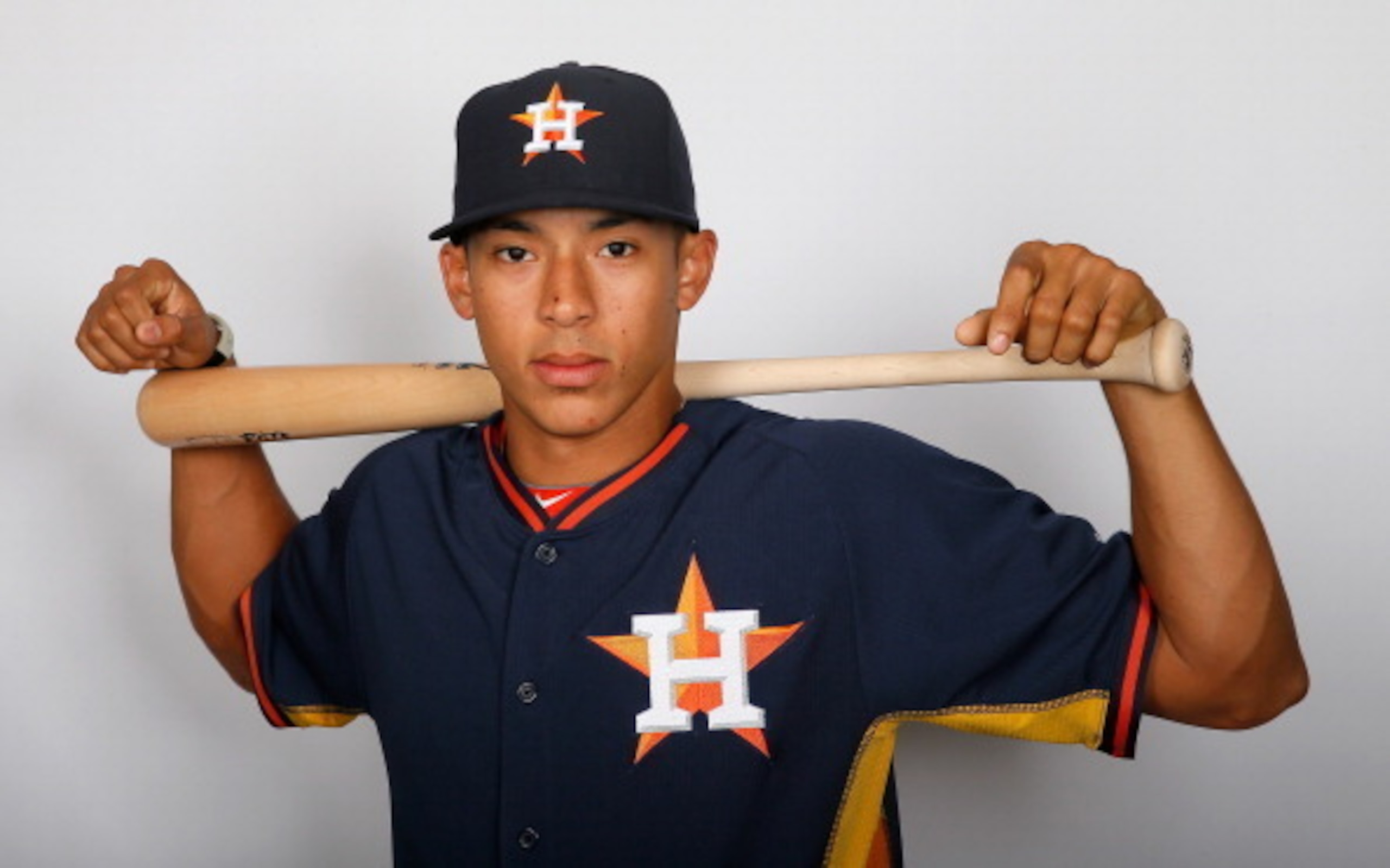
As one of the younger everyday players last year in California League, Carlos Correa continued to blow past all reasonable expectations by batting .325/.416/.510 with 32 extra-base hits, 20 stolen bases and a 45-36 strikeout-to-walk ratio in 62 games.
He seemed bound for a promotion to Double-A before suffering a season-ending fibula injury in late June while sliding into third base. He underwent surgery shortly thereafter and is fully healthy for spring training.
"I'm really anxious, because I want to show them I'm ready and I'm back and my ankle is feeling great," Correa said, via Brian McTaggart of MLB.com.
"In the offseason, I kept working on it and trying to get healthy and trying to get strong and fast and explosive, and I've accomplished it with hard work," Correa continued. "I'm kind of excited to show them I'm ready to play and be the guy I used to be, and even better."
The 20-year-old right-handed hitter has a simple, direct swing that allows him to stay inside the ball and utilize the entire field. He’s batted at least .320-plus at both Class-A levels, while his advanced plate discipline and pitch recognition (12.3 BB%, 15.4 K%) has produced on-base percentages consistently north of .400.
At 6’4”, 205 pounds, Correa possesses plus raw power but doesn’t swing for the fences, instead employing an approach that’s geared toward consistent hard contact and getting on base. Considering Correa’s age, it’s safe to assume that he’ll show more pop as he fills out, with the potential to hit upward of 22-25 home runs in his prime.
Despite his large frame, Correa is an excellent athlete with the tools to stick at shortstop long term, including soft hands, good range and plus-plus arm strength that produces lasers in the mid- to upper 90s across the infield.
Meanwhile, his profile on both sides of the ball could also make him an impact third baseman should he become too thick and/or lose a step, but that won’t be a concern for many years.
Correa is a physically blessed player with present plus makeup and the potential for five average-or-better tools at maturity, and he’s still on the fast track to the major leagues in 2015 despite the ankle injury.
Correa is expected to begin the season at Double-A as long as he’s healthy, which could lead to a call-up with the Astros sometime during the second half of the season.
Astros general manager Jeff Luhnow said the following, via Howard Chen of CBS Houston:
"I would imagine that Double-A would probably be the most logical starting point for him. I don’t see any reason for him to go back to high A. He was days away from getting promoted when he got hurt. I think that Double-A is always a good challenge for players, so I would guess that that’s the lowest level he would start at.
"
In general, the 20-year-old Correa has one of the highest ceilings in the minors, with the potential to be a perennial All-Star and MVP candidate in his prime.


.jpg?w=2560 "Grading WWE Raw 🔠")
.jpg?w=2560 "Viral Rams Coach Vid 🖕")
.jpg?w=2560 "Injury-stricken Seahawks signing veteran RB")
.jpg?w=2560 "Bijan's INSANE 1st Half 🤩")

.jpg?w=2560 "2 NFL Officials Suspended")

