Every Top 25 Team's Fastest 40 Time Ever Recorded at the NFL Combine
Some of college football's best players from last season just got put through the ringer over the weekend at the NFL combine in Indianapolis, where they were poked, prodded, interviewed and observed to see if they would make good pros.
Of all the drills run and measurements taken, the figure that always tends to stand out most is how fast every potential draft prospect runs the 40-yard dash. Though it's translation into on-field performance is sketchy, it's still a number that gets remembered over time.
Former UAB wide receiver and kick returner J.J. Nelson ran the fastest 40 at this year's combine, doing so in 4.28 seconds, while ex-Michigan State cornerback Trae Waynes was clocked at 4.31 seconds. Both times were the fastest-ever by a player from their respective schools at the combine.
Using Bleacher Report's post-signing day top 25 as a guide, we've charted the best 40 time in the books for each ranked team. Some go as far back as the mid-1980s, long before electronic timing made combine numbers far more accurate, but they still count.
Take a look at who holds the record for each top-25 school, what he did in college and what came of that at the professional level.
Note: Times are based on those recorded at NFL combines and listed on NFLCombineResults.com or StatisticBrain.com, unless otherwise noted. For schools with a tie for their fastest recorded 40 time, the player listed is the most recent one to record that time.
25. BYU
1 of 25
Todd Watkins, WR
Time: 4.40
Year: 2006
Draft result: Seventh round, Arizona
After two productive years catching passes for BYU, including a 1,000-yard season in 2004, Todd Watkins headed to the NFL combine, hoping to impress scouts enough to become draft-worthy. After recording the Cougars' fastest time ever in the 40-yard dash, Watkins got taken midway through the final round of the 2006 draft.
Watkins didn't make his NFL debut until 2008, though, spending his first year on the Arizona Cardinals' practice squad and then on Atlanta's practice squad in 2007. In 2008-09, with Oakland, Watkins appeared in 21 games with one start and collected eight receptions for 90 yards.
He also spent some time with the New York Giants during the 2011 offseason but was waived before the season began and has been out of football since.
24. Wisconsin
2 of 25
Michael Bennett, RB
Time: 4.13
Year: 2001
Draft result: First round, Minnesota
Michael Bennett had one amazing season in college, followed by a near-record performance at the NFL combine. A promising first two pro seasons continued his meteoric rise from track star to football phenom, but almost as quickly that career went downhill and swiftly fizzled out.
It was a fittingly whirlwind few years for one of the fastest football players ever.
Bennett ran for 1,681 yards for Wisconsin in 2000 and then turned pro and missed Bo Jackson's combined record of 4.12 seconds by a hundredth of a second. The Minnesota Vikings took him late in the first round of the 2001 draft, and as a rookie he led the team with 682 yards but only scored twice.
In 2002 he made the Pro Bowl after rushing for 1,296 yards, but then over the next three seasons he only had 1,196 yards as injuries cut short his progress. Between 2006 and 2010 he played for four different teams yet never had more than 241 yards in a single season.
23. LSU
3 of 25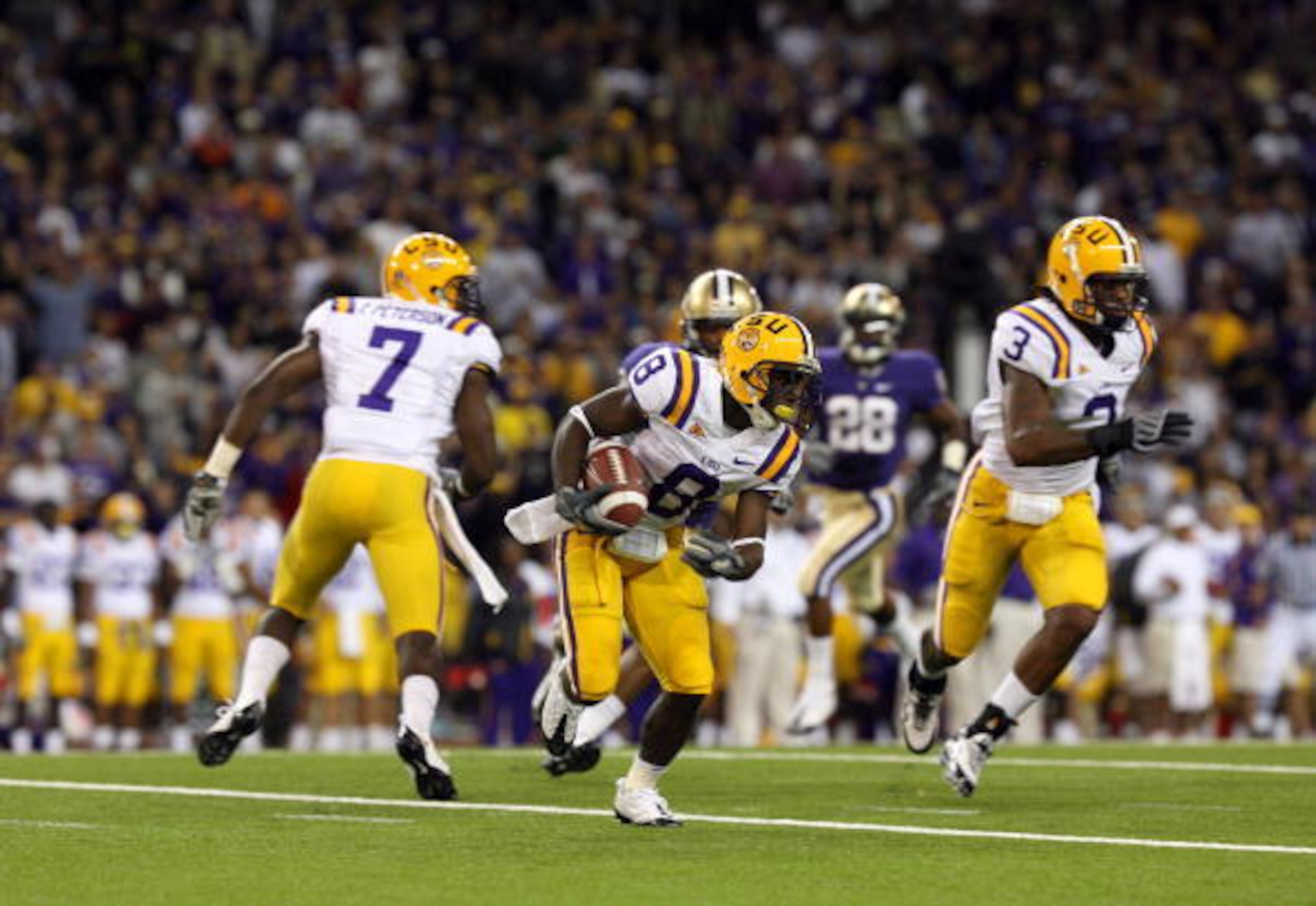
Trindon Holliday, RB
Time: 4.29
Year: 2010
Draft result: Sixth round, Houston
One of the smallest players in college football during the latter half of the last decade was also one of the fastest the game has ever seen. Trindon Holliday's speed was so impressive it more than made up for his 5'5", 162-pound frame.
LSU tried to put Holliday in as many positions to use that speed as possible, giving him carries as a running back and also lining him up as a receiver at times. He also served as the primary punt and kickoff returner during his junior and senior seasons. After a stellar 2010 combine, complete with the fastest time ever recorded by an LSU prospect, the Houston Texans took a flier on him late in the draft.
Holliday remains in the NFL, but he's struggled to hang on. A broken thumb knocked him out of his rookie season, and he only played in one game with Houston in 2011. Holliday caught on as a solid return man with Denver in 2012-13, but last season he split time between Tampa Bay and San Francisco.
.jpg?w=2560)

22. Georgia Tech
4 of 25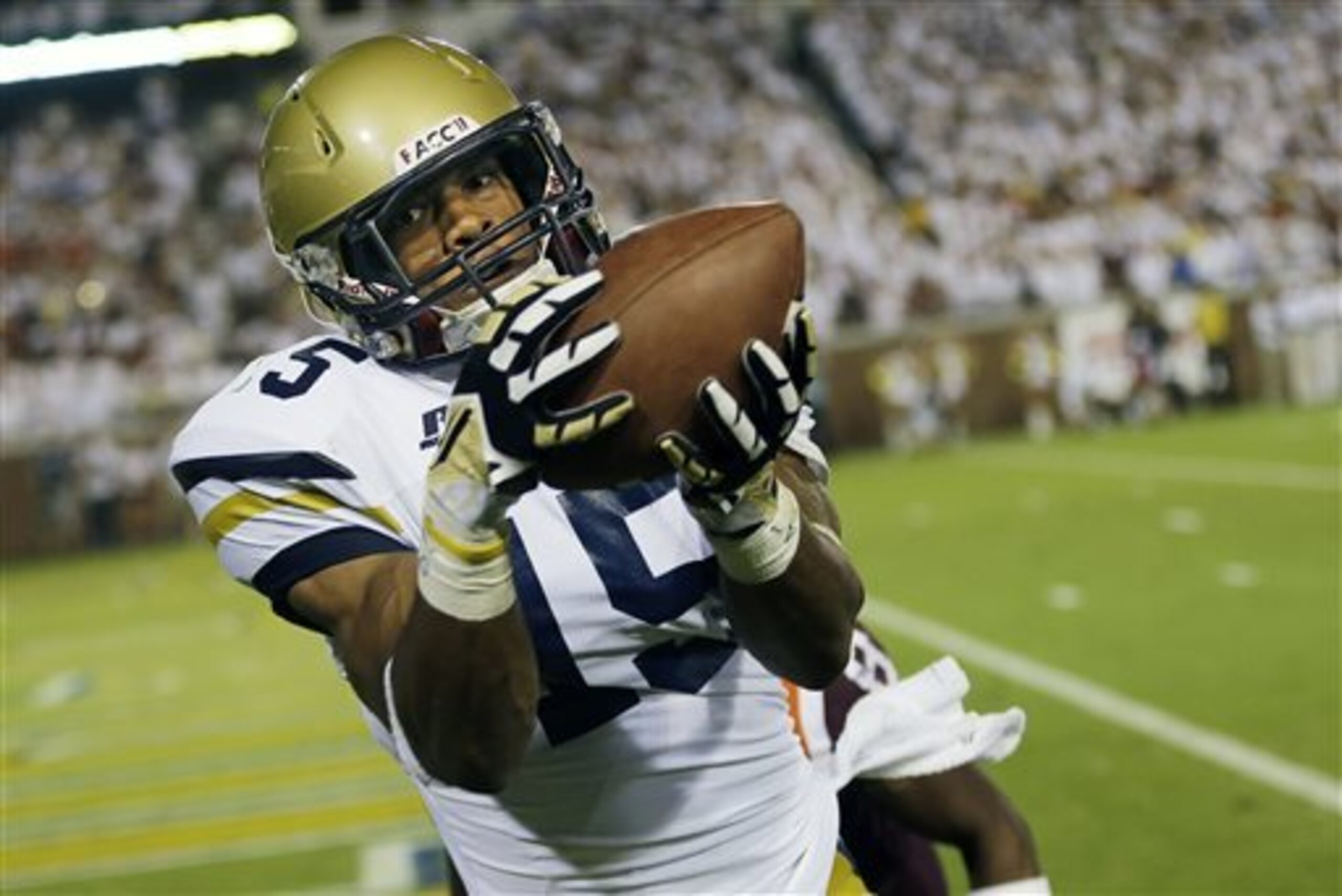
Stephen Hill, WR
Time: 4.30
Year: 2012
Draft result: Second round, New York Jets
Georgia Tech is one of the best rushing programs in college football and has been throughout coach Paul Johnson's seven-year tenure with the Yellow Jackets. But as prolific as their triple-option run game has been, they've also managed to produce some speedy receivers over the years.
The fastest of them all has been Stephen Hill, who after a modest college career—he had 49 receptions and nine touchdowns in three years—gave his draft stock a huge boost at the combine by posting the two best times in 2012. He went for 4.3 and 4.31 seconds, and despite little work at the position with Tech, he found himself far more coveted as a pro prospect.
The New York Jets took him early in the second round, hoping to turn the 6'4", 215-pound project into a star. He started a total of 19 games in 2012-13 but only had 45 receptions and four touchdowns, and the Jets cut him late in the 2014 preseason.
Hill spent last season on Carolina's practice squad but never made the active roster.
21. Oklahoma
5 of 25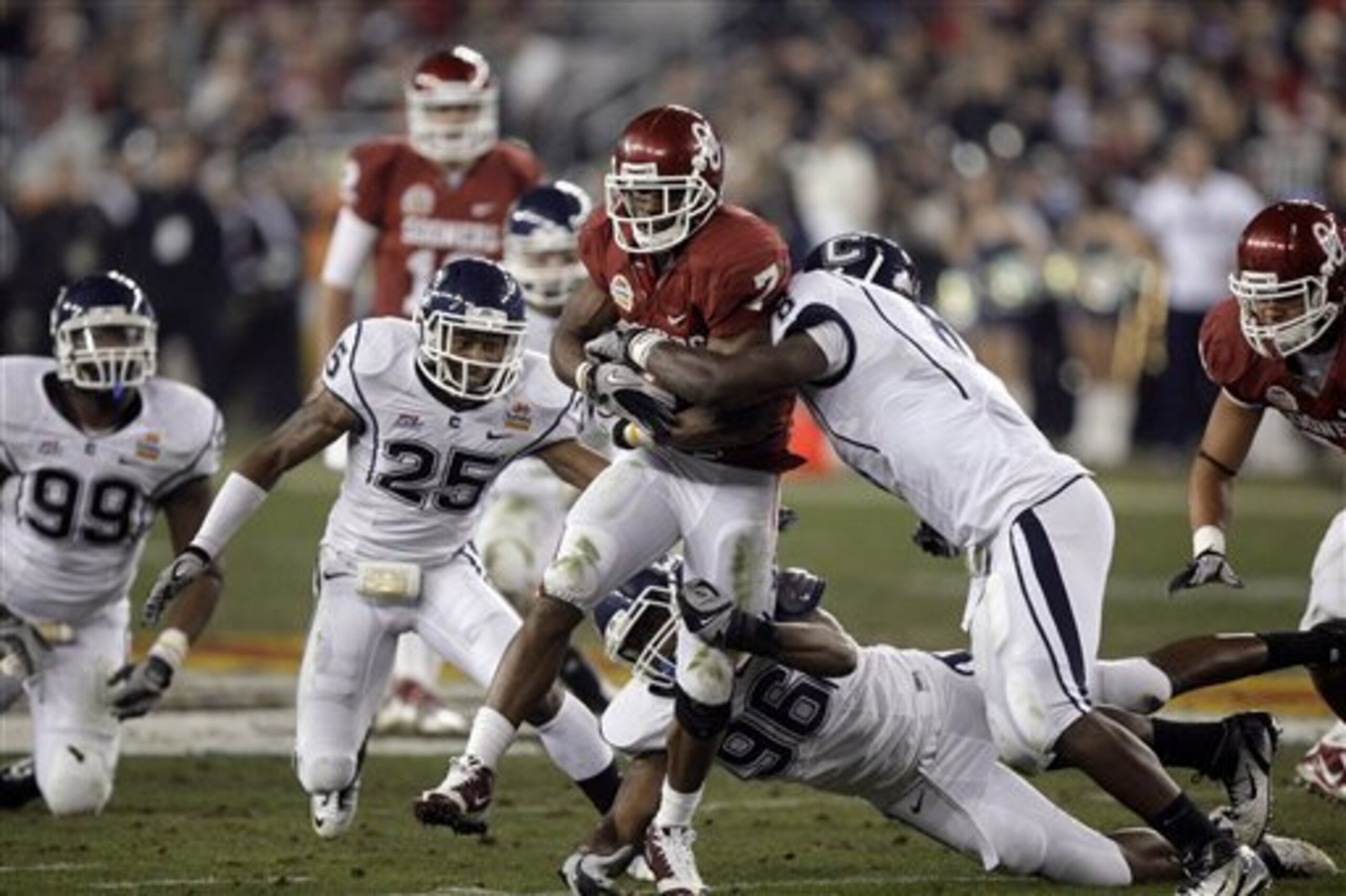
DeMarco Murray, RB
Time: 4.37
Year: 2011
Draft result: Third round, Dallas
In helping the Dallas Cowboys win the NFC East this past season, DeMarco Murray earned rave reviews for his durability and dependability as a workhorse running back by rushing 392 times for an NFL-leading 1,845 yards. Murray was in a similar workhorse role during his senior year of college at Oklahoma, when he ran 282 times in 14 games.
Even with more than 750 college carries on his body, Murray put together a great combine in 2011 that helped him become the sixth running back taken that year. His speed played more of a factor at the collegiate level than in the pros, where he's become as much a between-the-tackles rusher as one who tries to reach the edge.
"The value of being able to hand the ball to someone 25 times per game week in and week out is significant," Cowboys coach Jason Garrett told Frank Schwab of Yahoo Sports.
Murray has run for 4,526 yards in his first four seasons in the NFL, and he could be in line for a major contract extension in the near future.
20. Texas A&M
6 of 25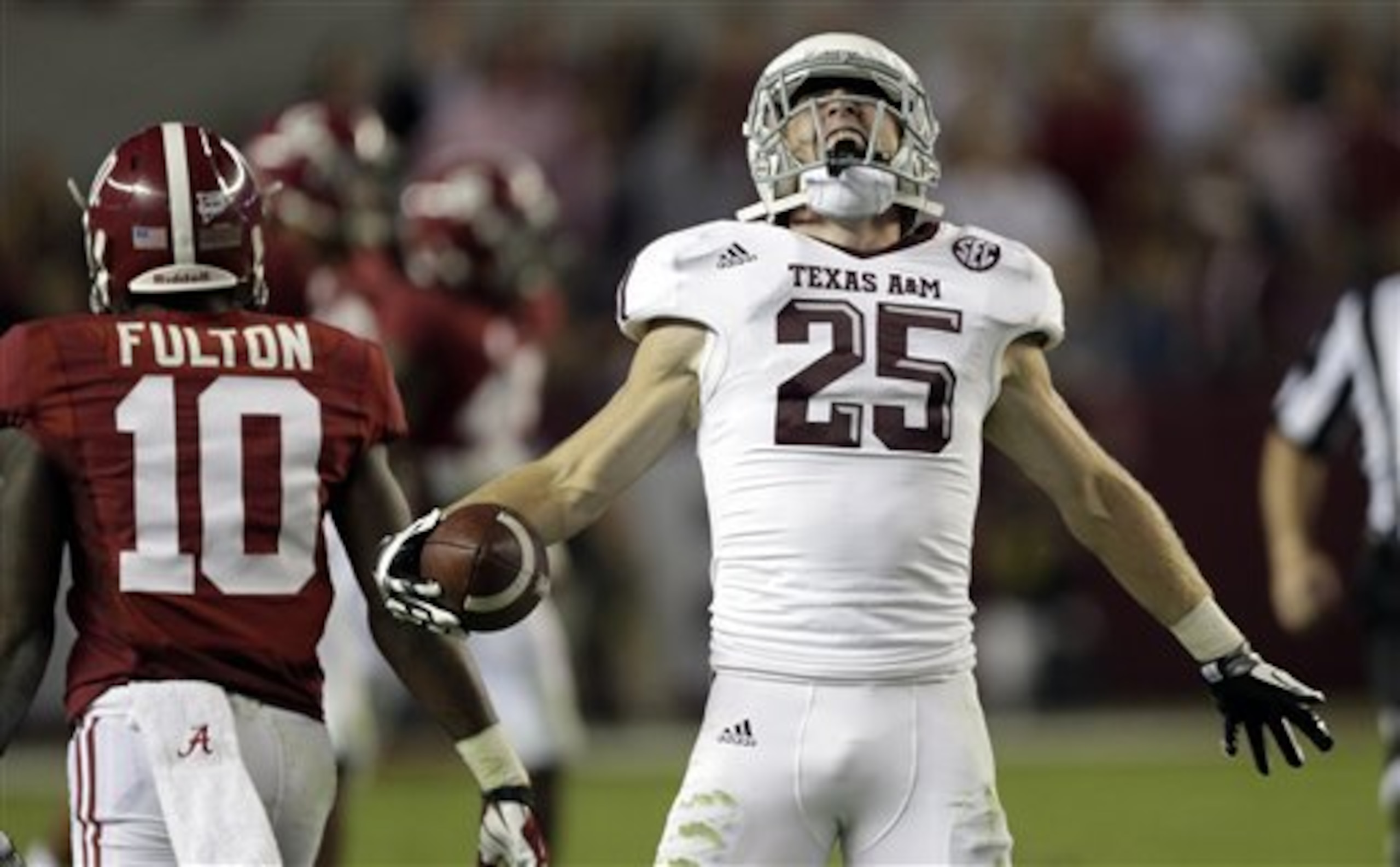
Ryan Swope, WR
Time: 4.34
Year: 2013
Draft result: Sixth round, Arizona
Since taking over the Texas A&M program in 2012, coach Kevin Sumlin has been hellbent on accumulating as much speed at the skill positions as possible. He also inherited a player who currently stands as the fastest Aggie ever, at least by NFL combine standards.
Ryan Swope established single-season school records for receptions (89) and yards (1,207) during his junior year, just before Sumlin came in. As a senior, Swope was the No. 2 wideout behind Mike Evans and posted another strong season, finishing as A&M's all-time leader in receiving yards with 3,117.
Because of a history of concussions in college, Swope was passed over by every NFL team at least five times before the Arizona Cardinals scooped him up in the sixth round in 2013. He never played a game, though, choosing to retire from professional football in July 2013 because of the concussion issues.
"It has been a lifelong dream to play in the NFL, but my long-term health interests outweigh my current goals for football," Swope said in a statement at the time, citing a concussion he suffered in an offseason workout after the draft.
19. Oklahoma State
7 of 25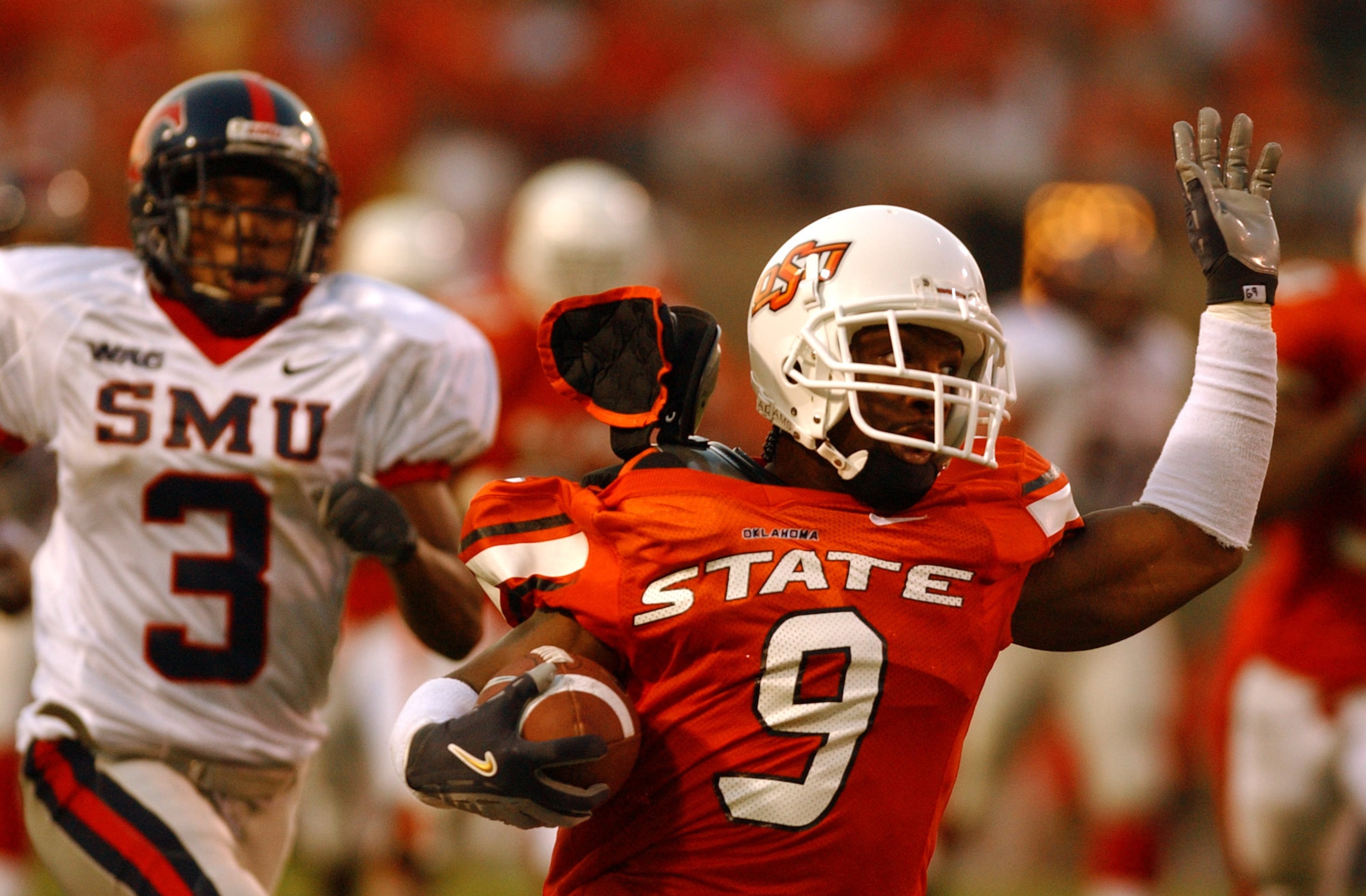
Darrent Williams, CB
Time: 4.30
Year: 2005
Draft result: Second round, Denver
A starter for part of his freshman year and then for the entirety of his next three seasons at Oklahoma State, Darrent Williams fought through a leg injury as a senior to still be among the first defensive backs taken in the 2005 draft. Though small in stature, at 5'8" and 188 pounds, Williams was too fast for the Denver Broncos to pass up.
Williams started 20 games in two seasons with Denver, intercepting six passes, and had a career that was on a major upward track. But his promising future was cut short on January 1, 2007 when Williams was shot to death in a drive-by shooting following an argument at a Denver nightclub.
In 2011, Sports Illustrated published a story (h/t ESPN) claiming that the bullets that killed Williams were likely intended for then-Broncos receiver Brandon Marshall.
18. Tennessee
8 of 25
Donte' Stallworth, WR
Time: 4.22
Year: 2002
Draft result: First round, New Orleans
Donte' Stallworth redshirted during Tennessee's 1998 national championship season, but by the time his career with the Volunteers was over, he had helped get them back to the SEC title game as a junior in 2001. Despite starting only 10 games in three years, Stallworth amassed more than 1,700 receiving yards and scored 13 touchdowns.
Considered a speedster in college, Stallworth was never clocked in the 40 after his true freshman season until it came time for the combine. According to Judy Battista of NFL.com, Stallworth "approached the combine as if it was the Olympics, hoping to run under 4.3 to help his draft stock, although his primary focus was working on route running."
His unofficial 4.22 is the 10th-best ever recorded at a combine, and it prompted the New Orleans Saints to take him 13th overall.
Stallworth had eight touchdown catches as a rookie in 2002, the first of 11 NFL seasons in which he caught 594 passes and scored 35 times.
17. Arkansas
9 of 25
Darren McFadden, RB
Time: 4.27
Year: 2008
Draft result: First round, Oakland
Arkansas' career rushing leader was also, in effect, its quarterback during the late stages of his three seasons with the Razorbacks. Operating out of the Wildcat, Darren McFadden threw seven touchdown passes in addition to the 4,590 rushing yards and 41 TDs he had from 2005 to 2007.
His speed was so essential to Arkansas' success that it made sense for him to touch the ball on every play, and he finished second in the Heisman voting in each of his final two years in Fayetteville. The Oakland Raiders fell in love with his speed, which was officially clocked at 4.33 at the 2008 combine but also featured a 4.27 unofficial time.
McFadden remains with the Raiders, yet in his seven seasons he's been only a traditional running back with just three pass attempts. His best season came in 2010, when he ran for 1,157 yards and seven touchdowns, but an injury midway through 2011 slowed his career. Last year he ran for 534 yards and two scores.
16. Arizona
10 of 25
Mike Thomas, WR
Time: 4.40
Year: 2009
Draft result: Fourth round, Jacksonville
Arizona currently has a talented group of wide receivers on its roster, many of whom are known as much for their speed as their pass-catching ability. But it will take a great time in the 40-yard dash to be officially known as the Wildcats' fastest player ever, a distinction Mike Thomas achieved six years ago at the 2009 combine.
Thomas caught 157 passes for 1,863 yards and 15 touchdowns in two seasons with Arizona while also scoring twice on punt returns and two times as a running back. At 5'8" and 187 pounds he spent most of his time as a slot receiver, where the Jacksonville Jaguars used him mostly during his three-plus seasons there.
Thomas split time in 2012 with Jacksonville and Detroit during his final year in the NFL. In his career he caught seven touchdown passes and returned one punt for a score.
15. Florida State
11 of 25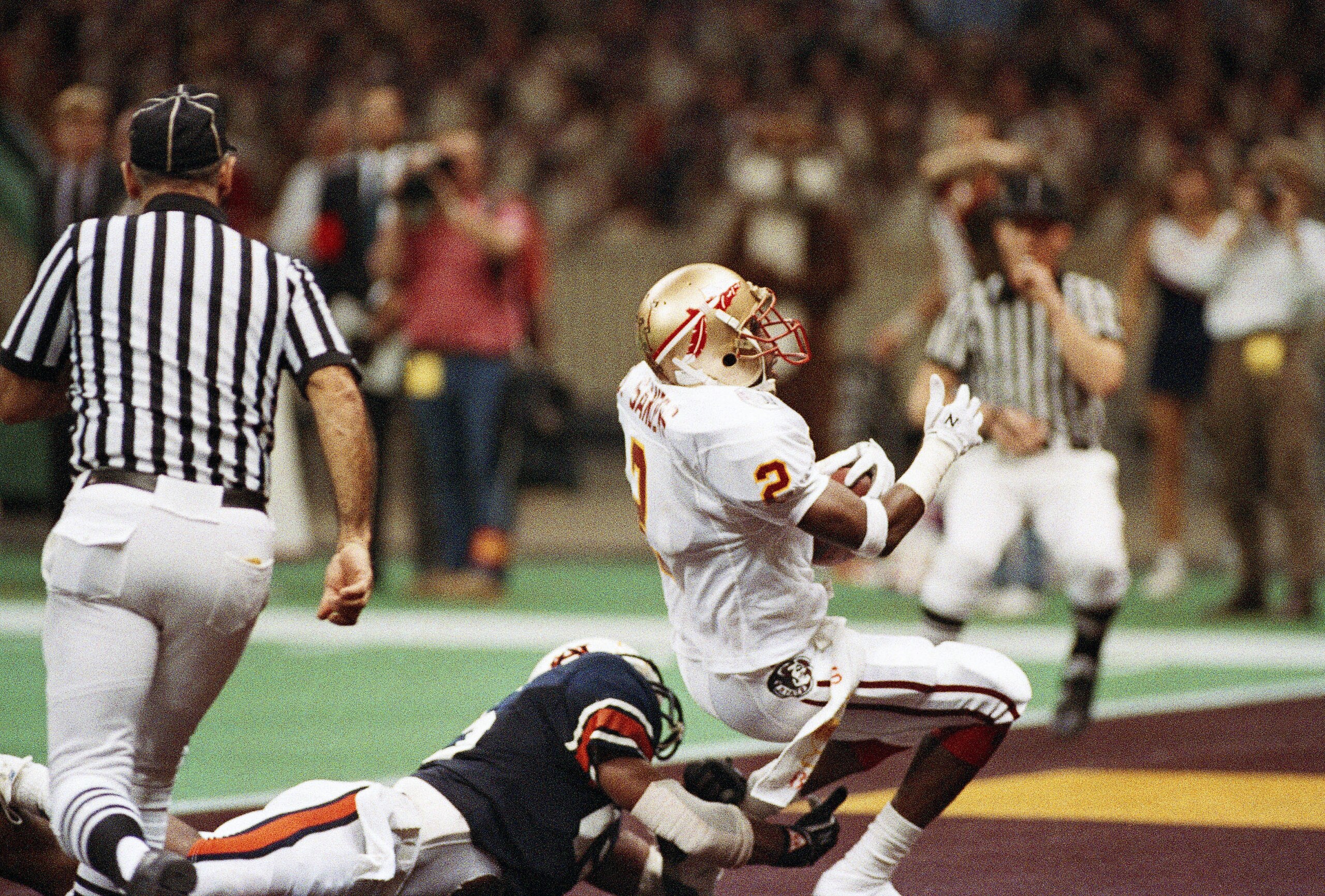
Deion Sanders, CB
Time: 4.21
Year: 1989
Draft result: First round, Atlanta
A three-sport star (baseball, football and track) at Florida State, Deion Sanders was among the flashiest collegiate athletes ever and was never shy about showing off. His high-stepping approach to playing defense and returning kicks made him both a star and a villain with the Seminoles, which fit perfectly with that team's reputation for swagger in the late 1980s.
Sanders intercepted 14 passes in his college career and returned three punts for touchdowns, leading Division I-A in punt return average in 1988 as a senior. That, along with a superb (hand-timed) 40-yard dash performance at the combine helped get him taken fifth overall in the 1989 draft.
That was a year after the New York Yankees drafted him, and his Major League career began in 1989. He played in more than 600 games as a part-time baseball player through 2001, though that career was never as prominent as what he did in the NFL.
Sanders continued to play up his Prime Time image in football, intercepting 53 passes and returning nine kickoffs or punts for touchdowns during a 14-season career with four different teams. He was inducted into the NFL Hall of Fame in 2011.
14. Auburn
12 of 25
Bo Jackson, RB
Time: 4.12
Year: 1986
Draft result: First round, Tampa Bay
The NFL combine has existed since 1982, and the 40-yard dash has been a staple of this event every year. Technological upgrades have made timing this race far more accurate, starting in 1990 when electronic timing was used to measure the end of a race, and then in 2010 the combine went to fully automatic timing.
But back when it was all done by hand with stopwatches is when the fastest-ever combine time was recorded. That distinction belongs to Bo Jackson, whose 4.12 in 1986 was 0.12 seconds quicker than the best official combine time of 4.24 set by Chris Johnson in 2008.
Frank Cooney of NFL Draft Scout wrote that hand-held timing "is not the most accurate method, but remains a source of fabled sprints—such as Jackson's—and the one still used most often in high school and college timings."
Regardless of what Jackson would have run if timed using current methods, there's no denying how much of a stud athlete he was. Besides winning the Heisman for Auburn in 1985 after rushing for 1,786 yards and 17 touchdowns, he also starred for the Tigers' baseball team. He was the No. 1 pick in the 1986 NFL draft but instead played baseball that season and went back into the draft in 1997.
Jackson had some memorable NFL moments in his brief four-year career, all with the Los Angeles Raiders, before injuries ended his time on the gridiron. He continued to play baseball through 1994.
13. Georgia
13 of 25
Champ Bailey, WR/CB
Time: 4.28
Year: 1999
Draft result: First round, Washington
One of the most successful dual-threat players in college football history, Champ Bailey was Georgia's leading receiver as a junior in 1998 while also starring as a cornerback and in the return game. He was in on more than 950 snaps that season, winning the Bronko Nagurski Trophy as the country's top defensive player.
Following a superb combine, Bailey went seventh overall in the 1999 draft to the Washington Redskins, where he began one of the greatest careers of the past 20 years. Though he saw some time as a receiver and in the return game, Bailey primarily played on defense and parlayed that into 12 trips to the Pro Bowl.
He officially retired in November, though he last played in the NFL in 2013. With Washington (five years) and Denver (10), Bailey recorded 52 interceptions including a league-leading 10 picks in 2006.
All that remains now is to see when (not if) Bailey will be elected to the Hall of Fame. He's eligible in 2019.
"Looking back, I think it's a first-ballot career, but I'm not voting," Bailey told Mike Klis of the Denver Post. "I just hope I convinced enough people that it was."
12. Arizona State
14 of 25
Chris McKenzie, CB
Time: 4.32
Year: 2005
Draft result: Not drafted
After starting out in junior college, Chris McKenzie started 20 teams in two seasons with Arizona State and had three interceptions, though despite posting a great time at the 2005 combine he went undrafted. His lack of size devalued the 5'9", 181-pounder's other skills, but the Houston Texans signed him as a rookie free agent.
McKenzie only got into three games with Houston in 2005, recording a sack and two pass breakups as a reserve.
From there, he used his speed to spend two seasons in the Arena Football League and four in the Canadian Football League. He last played in 2012.
11. Ole Miss
15 of 25
Mike Wallace, WR
Time: 4.33
Year: 2009
Draft result: Third round, Pittsburgh
Mike Wallace established himself as a deep threat in college with Ole Miss, averaging 18.9 yards per reception in his three-year career with 15 of his 101 catches going for touchdowns. He also scored two scores on kick returns with the Rebels, and in 2008 he led the SEC with a 20.1 yards-per-catch average.
The Pittsburgh Steelers were coming off a Super Bowl victory over Arizona and were looking for a receiver to serve as an eventual heir apparent to Hines Ward. Wallace quickly found a role with the Steelers, leading the NFL his rookie season in 2009 with a 19.4 yards-per-catch average.
Wallace played four seasons with Pittsburgh before signing with Miami in 2013, where he's spent the past two years. He has 47 career receiving touchdowns and more than 5,800 yards.
10. Clemson
16 of 25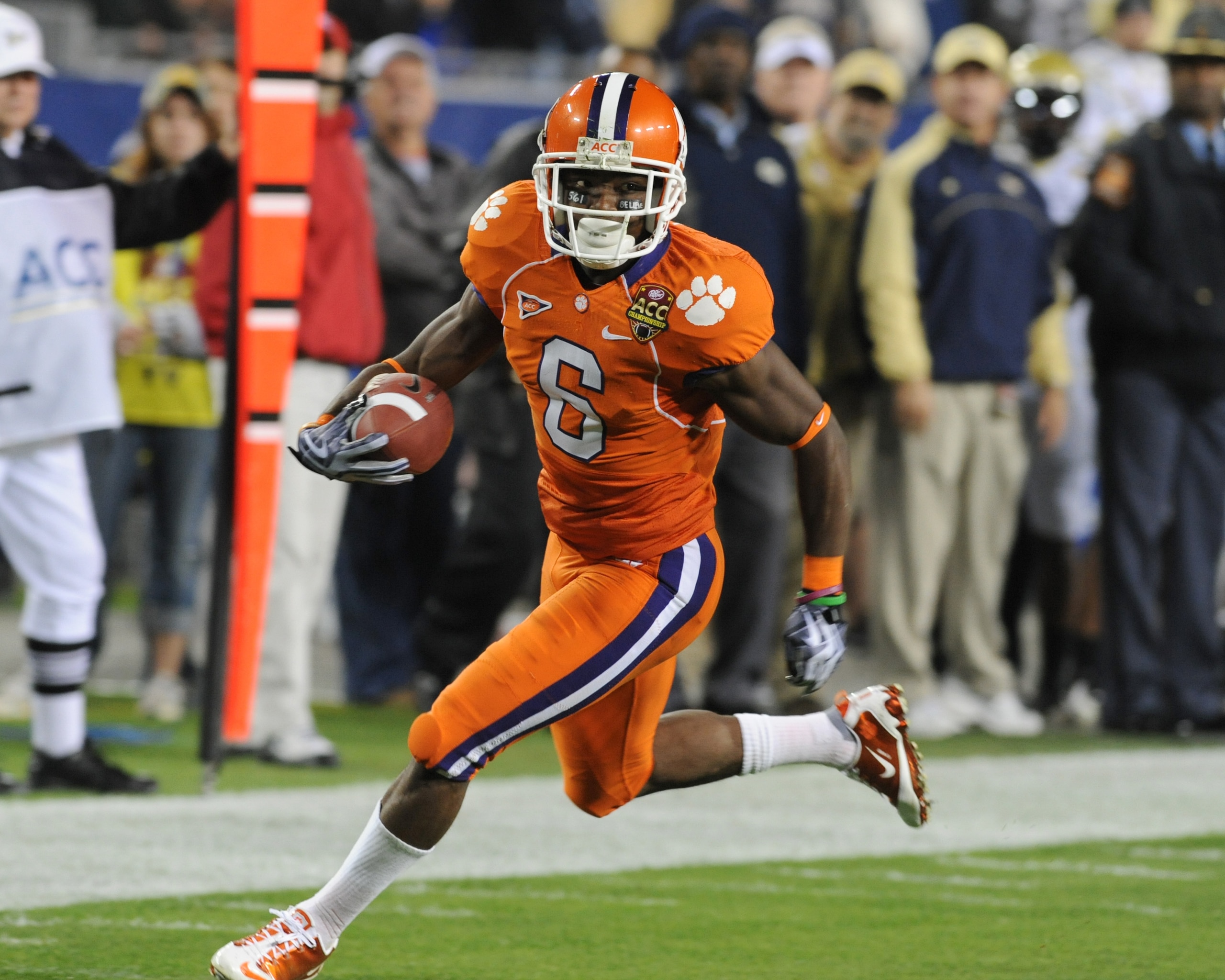
Jacoby Ford, WR
Time: 4.28
Year: 2010
Draft result: Fourth round, Oakland
Tied for the fourth-fastest electronic 40-yard dash time in NFL combine history, Jacoby Ford was one of the darlings of the 2010 combine who used that performance to rise up draft boards. The Oakland Raiders' fondness for speed prompted them to take him in the middle rounds, hoping his late-career surge at Clemson would translate into pro success.
Ford was the Tigers' leading receiver as a senior in 2009, catching 56 passes for 779 yards and six touchdowns while also rushing for two scores and returning a punt for a TD.
He spent four years with Oakland, never catching on as a reliable receiver but scoring four kickoff return TDs in his first two seasons. He missed 2012 with a foot injury, and then after minimal play in 2013 he was not re-signed by the Raiders.
Ford didn't play in 2014, and in January he signed a futures contract with Tennessee.
9. Oregon
17 of 25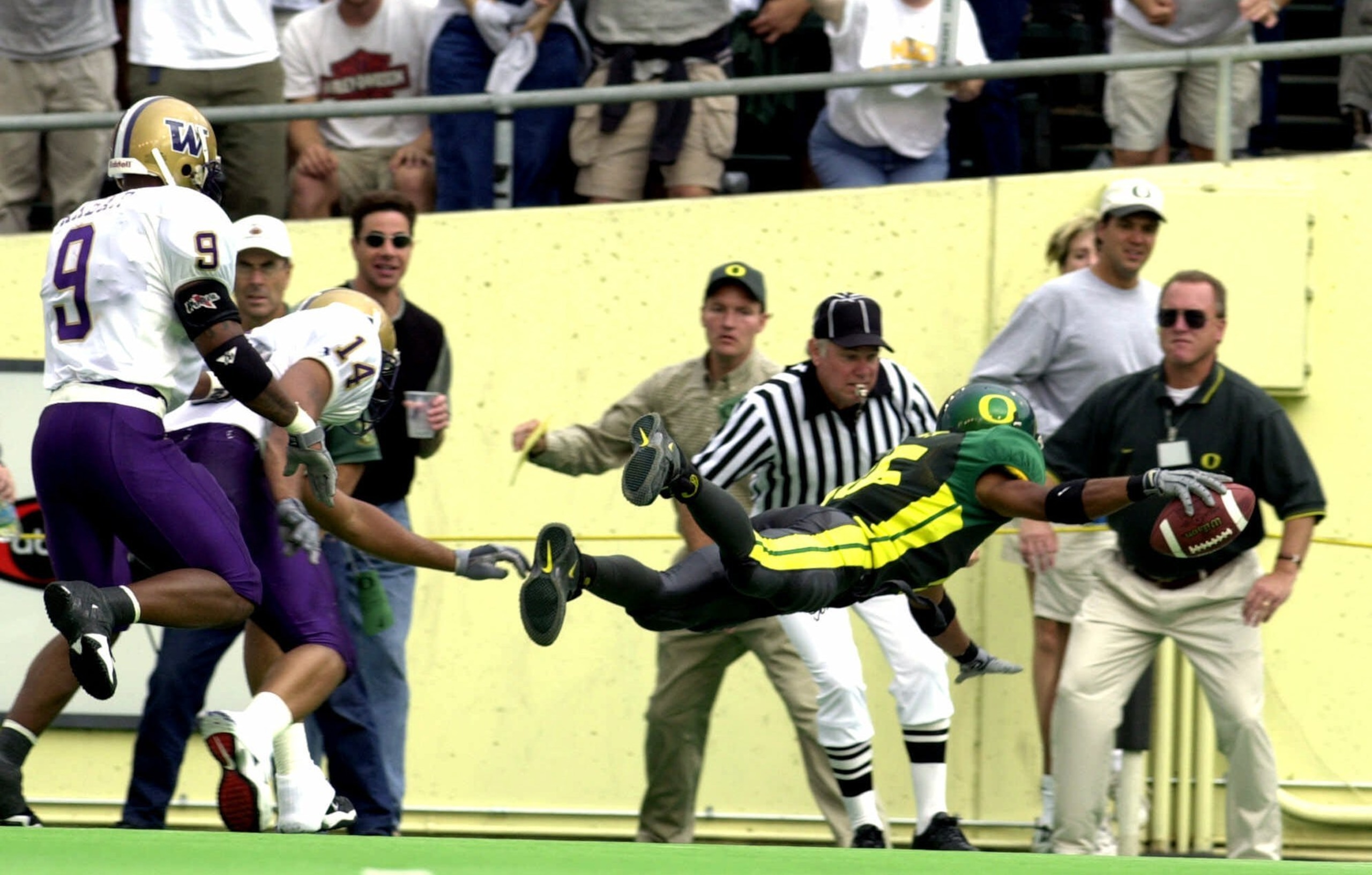
Allan Amundson, RB
Time: 4.34
Year: 2003
Draft result: Not drafted
With all of the speed that Oregon has put on the field over the past decade, maybe it was the flashy uniforms that made everyone look so fast. That's because the Ducks' fastest player, in terms of combine performance, came 12 years ago from a running back who was rarely used in his four seasons in Eugene.
Allan Amundson gained 569 yards and four touchdowns with Oregon. His best season came as a sophomore in 2000 when he rushed for 283 yards and two TDs as the No. 2 back behind Maurice Morris.
His speed at the combine impressed, but not enough to warrant getting drafted. The San Francisco 49ers signed him as a rookie free agent in 2003 as a defensive back, yet he never played in the NFL.
8. Notre Dame
18 of 25
Raghib Ismail, RB/WR
Time: 4.28
Year: 1991
Draft result: Fourth round, Los Angeles Raiders
With a nickname like "Rocket," the expectation of speed was a given for Raghib Ismail. He showed this off throughout his Notre Dame career, finishing second in the Heisman voting in 1990 after record 1,723 all-purpose yards and eight touchdowns. In three years with the Fighting Irish, Ismail scored nine receiving TDs, six on returns and four as a running back.
He was projected as a high draft pick in 1991, but then a lucrative offer from the Canadian Football League's Toronto Argonauts prompted him to sign with that league and play two seasons up north.
Ismail had been drafted by the Los Angeles Raiders in 1991, and he signed with them for 1993 and played three seasons with them before also spending time with Carolina and Dallas. He had two 1,000-yard receiving seasons in nine years in the NFL.
7. UCLA
19 of 25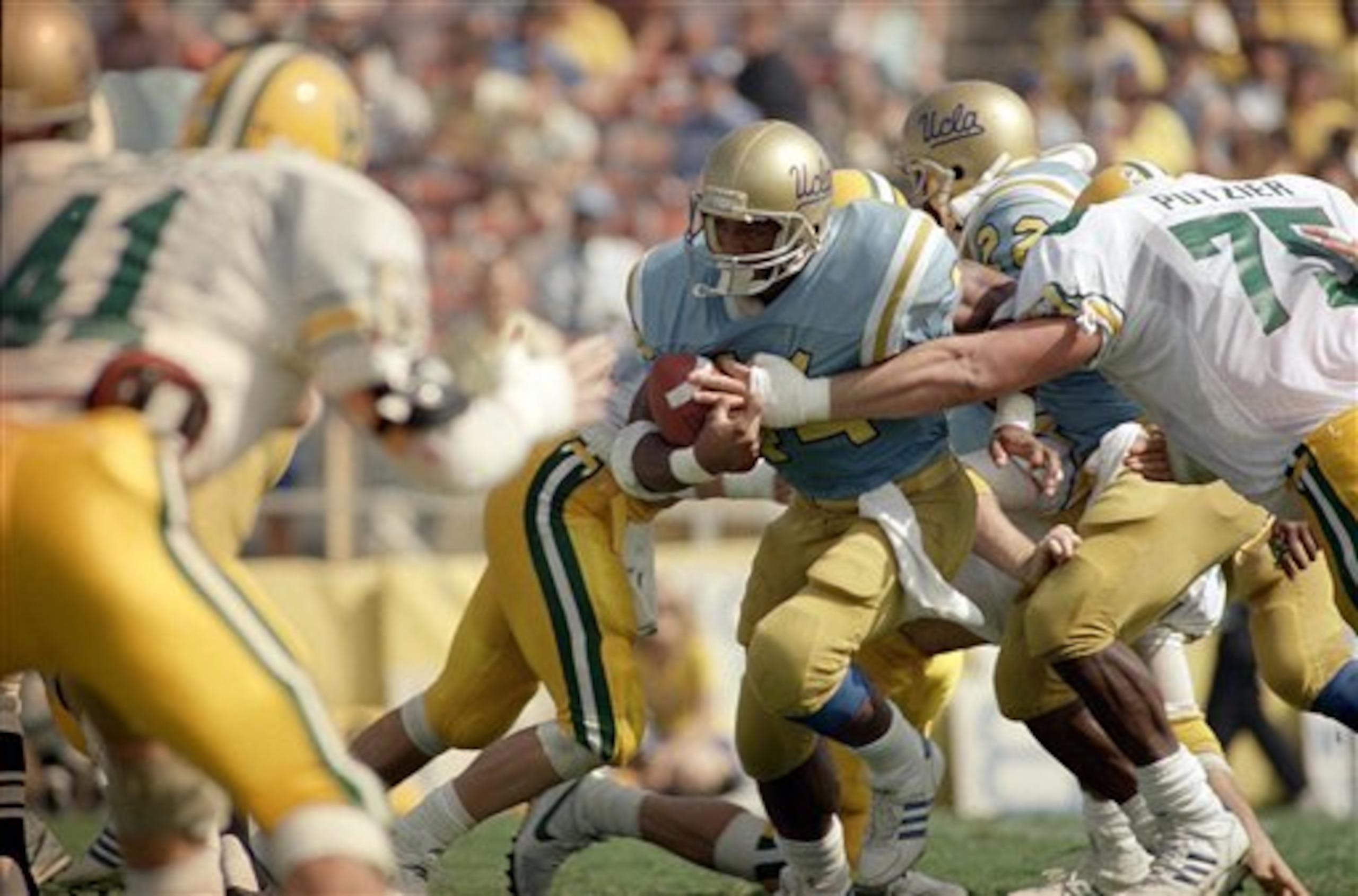
Gaston Green, RB
Time: 4.29
Year: 1988
Draft result: First round, Los Angeles Rams
The second-leading rusher in UCLA history was also its fastest player when clocked in the 40, blitzing to a 4.29 more than a quarter-century ago. Though it was a hand-timed result, it wasn't surprising considering how Gaston Green seemed to run around defenders as much as through them while in college.
Green finished with 3,587 yards and 37 touchdowns for his career, with 2,503 yards and 28 scores coming in his final two seasons.
His pro career wasn't nearly as productive, with Green never catching on in three seasons with the Los Angeles Rams. He went to Denver in 1991, rushing for more than 1,000 yards, but then after gaining 647 yards in 1992 he was out of the league a year later.
6. Michigan State
20 of 25
Trae Waynes, CB
Time: 4.31
Year: 2015
Draft result: TBD
Trae Waynes was already being projected as a first-round draft pick prior to last weekend's combine, but after posting the second-best time in the 40-yard dash of any prospect, he's almost guaranteed to go on that first day.
Bleacher Report's Matt Miller has Waynes slotted as the No. 30 overall pick to Green Bay in his latest mock draft. He described the former Michigan State standout as "the cornerback Twitter wants" because of his time in the 40, but that he has a weak lower body and needs to become better at defending without his hands.
In college, Waynes had six interceptions and 13 pass breakups in the past two seasons, helping the Spartans secondary develop the reputation of having a "No-Fly Zone" back there.
5. Alabama
21 of 25
Dee Milliner, CB
Time: 4.37
Year: 2013
Draft result: First round, New York Jets
Dee Milliner anchored the back line of Alabama's secondary during his sophomore and junior years and then turned pro and showed off his speed at the combine by posting one of the best times for a corner that year. The New York Jets made him their first draft choice, and he got off to a great start to his pro career before injuries got in the way.
Milliner started 12 of the 13 games he played in as a rookie, missing three contests because of a high ankle sprain, and in the Jets' final two games that season he had three interceptions. He started three of the first six games in 2014 before tearing his Achilles tendon, which sent him to injury reserve.
"Rushing out of a three-point stance to block a field goal—he rarely plays on special teams—he crumpled to the turf as soon as he exploded out of his stance," wrote ESPN.com's Rich Cimini. "The rehab period for a torn Achilles tendon generally is six to nine months, meaning Milliner, who has been placed on IR, will miss the entire offseason and possibly the start of training camp."
4. USC
22 of 25
Taylor Mays, S
Time: 4.24
Year: 2010
Draft result: Second round, San Francisco
Much like his college career, Taylor Mays' performance at the 2010 combine looked really good at first but in the end was slightly less impressive after further review.
NFL Network clocked Mays at 4.24 seconds, which would have tied Chris Johnson's mark for the fastest electronically timed performance in combine history. However, the official number ended up being 4.43, which still ended up being the fastest time of any defensive back that season.
Mays had 276 tackles but only five interceptions in four seasons in USC's secondary, with three of those picks coming as a freshman in 2006.
He started six games as a rookie with the San Francisco 49ers in 2010, and then he was traded to Cincinnati just before the 2011 season. He's been with the Bengals since, but in four seasons he's started only four games and spent all of last year as a reserve safety.
3. Baylor
23 of 25
Robert Griffin III, QB
Time: 4.41
Year: 2012
Draft result: First round, Washington
Robert Griffin III put Baylor football on the map, winning the Heisman Trophy in 2011 and helping the school bring in the revenue and donations needed to build a new stadium that opened in 2014. He also went down as one of the fastest quarterbacks, posting the second-best time ever behind Michael Vick's 4.25.
"Robert Griffin III showed why scouts and teams are salivating over his skills for the upcoming NFL draft," Matt Ryan of Yahoo Sports wrote.
This further improved Griffin's draft stock, and the Washington Redskins made him the face of their franchise by taking him second overall in the 2012 after Indianapolis went with Stanford's Andrew Luck. And Griffin instantly made an impact, getting Washington into the playoffs with 4,015 yards of total offense and 27 total touchdowns.
But a knee injury suffered during a postseason loss sent Griffin's career into a tailspin. He played 13 games in 2013 and just nine games last year after suffering further ailments and losing speed and mobility.
2. TCU
24 of 25
Jason Verrett, CB
Time: 4.38
Year: 2014
Draft result: First round, San Diego
TCU had five players invited to this past NFL combine, but none of them fared particularly well in the 40-yard dash. It was going to take a lot to top what Jason Verrett did last year, when he tied for the second-best time by a corner. That solidified him as a first-round pick following a college career that saw him earn Big 12 Defensive Player of the Year honors in 2013.
Verrett had 19 tackles and one interception for the San Diego Chargers last fall in his rookie season, but a left shoulder injury suffered in October required surgery and knocked him out for the rest of the year. He also had surgery on his right shoulder in March 2014.
1. Ohio State
25 of 25
Joey Galloway, WR
Time: 4.18
Year: 1995
Draft result: First round, Seattle
After two productive seasons as Ohio State's top receiver, Joey Galloway tore up the combine and ran the sixth-fastest time ever in the 40. It was before electronic timing, but there was no denying that Galloway was a speedster who had the potential to become a deep threat in the NFL.
The Seattle Seahawks got great production out of him in his first four seasons, when he averaged more than 1,000 yards and caught 36 touchdowns. A contract dispute cut his 1999 season to eight games, and then in 2000 he signed with the Dallas Cowboys and played only one game because of a torn ACL.
For his career, Galloway played 16 seasons with five teams and made 701 catches, which ranks 43rd in NFL history.
Follow Brian J. Pedersen on Twitter at @realBJP.
.jpg?w=2560 "Trevon Diggs Cut by Seahawks")
.jpg?w=2560 "Grading SmackDown 🔠")