

New Washington Redskins Defensive Scheme Must Make Keenan Robinson Focal Point
Hiring Joe Barry to take over the defense wasn't the most popular decision the Washington Redskins have made this offseason. How could it be when far more illustrious coordinators like Wade Phillips and Vic Fangio were both linked with the job?
But the one benefit to hiring a former linebackers coach as coordinator is that he'll know exactly how to use his unit's best player. That distinction belongs to inside linebacker Keenan Robinson.
As impressive as physical cornerback Bashaud Breeland looked as a rookie, as dominant as Ryan Kerrigan was off the edge, it was Robinson's 2014 performances that provide real optimism for the future.

.jpg?w=2560 "Falcons Saints Football")
.jpg?w=2560 "Rams Eagles Football")
A season totalling 13 starts, 109 tackles, 1.5 sacks, three passes defended and one interception is just a snapshot of the 25-year-old's immense potential. Consider this, Robinson played his way to those statistics after missing the entire 2013 season with injury.

Having made zero starts as a rookie in 2012, Robinson was still granted signal-caller duties ahead of last season. Whatever Redskins fans have to say about previous coordinator Jim Haslett, his decision to make Robinson the quarterback of his defense spoke volumes of the linebacker's talent.
Robinson should be the focal point of Barry's new-look D. The new play-caller has come from a scheme that places a heavy burden on its inside linebackers.
He's also established an excellent track record working with young linebackers, good news for Robinson. U-T San Diego reporter Michael Gehlken told B/R's Adam Lefkoe how effective Barry was at helping develop a young linebacker like Manti Te'o:
As an assistant under San Diego Chargers defensive coordinator John Pagano, Barry worked closely with Te'o and Donald Butler. Both were used in a variety of ways to cause problems for offenses.
The foundation of the Chargers scheme was to demand a lot from Butler and Te'o, but also to put them both in positions to make plays and succeed. A look at some of the basic alignments shows how they did it.
One of the main keys to the Chargers approach was to cover up its middle 'backers. This kept them clean from blockers and free to run to the ball.
Views of two plays from San Diego's 38-35 win over the San Francisco 49ers in Week 16 show the theory in practice. The first is from the third quarter:

The first thing to note is how Te'o (squared) was covered up by the one-gap alignments up front. Primarily, end Corey Liuget lined up as a 3-technique in the B gap between right tackle and guard.
Nose tackle Sean Lissemore was positioned as an offset 0-technique shaded toward the left guard. Both Liuget and Lissemore were perfectly positioned to challenge two blockers simply by attacking one gap.
This meant the 49ers wouldn't be able to get a hat on Te'o at the second level. Instead, he was able to flow to the ball and wrap up Frank Gore for no gain.
The same formula worked again in the final period:

This time, Tenny Palepoi was the 3-technique between left tackle Joe Staley and guard Mike Iupati. Lissemore was again shaded, but this time offset in the A gap nearest right guard.
On this play, their ability to lock up double-teams let Te'o pursue laterally and chase the play down unimpeded. He tracked Gore off right tackle and stuffed him for no gain.
These one-gap fronts are the best way to keep blockers off an inside linebacker. Any team with a talented "Mike" has to follow this formula. The Redskins certainly intend to.
Head coach Jay Gruden made that clear when he described what 2015's defense will look like, per Mike Jones of The Washington Post: "There will be some different ideas that we have, as far as it’s not a two-gap 3-4."
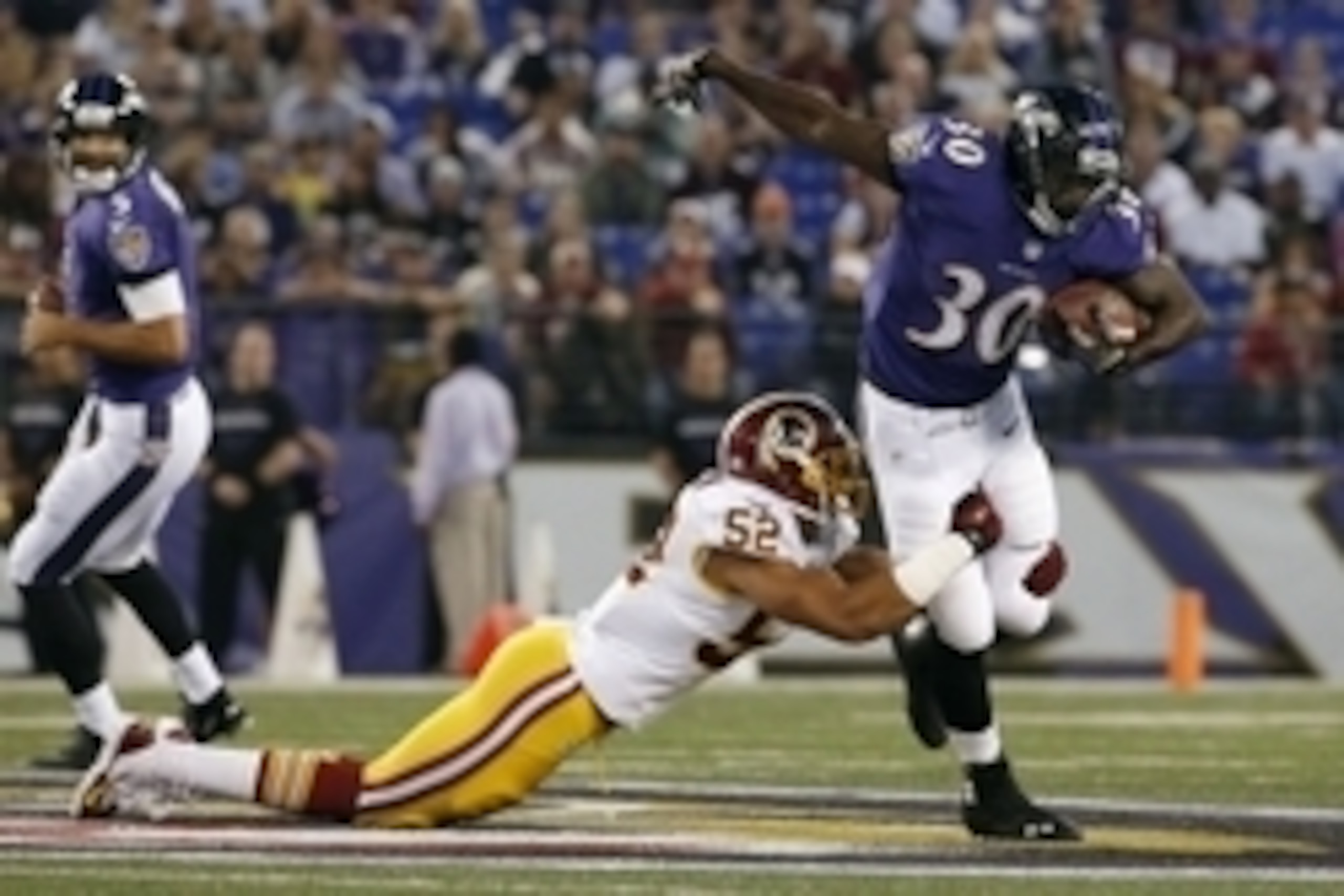
The proposed change in line techniques should lead to a monster year for an aggressive and sure tackler like Robinson. But that needn't be the limit of his impact in Barry's scheme.
Te'o's 2014 season is a good comparison for the template Barry should put in place for Robinson. As a third-year player who missed nine games during his first two years due to foot injuries, Te'o was still given plenty of responsibility in year three.
That even included being tasked with covering Rob Gronkowski one-on-one against the New England Patriots in Week 14. That's the toughest assignment in football for a linebacker, but Te'o met the responsibility superbly.
He began the play aligned as the Mike 'backer in a dime set, another indication of the onus Barry's defense places on its linebackers:

He was directly matched up with Gronkowski, New England's go-to receiver, especially in the red zone:
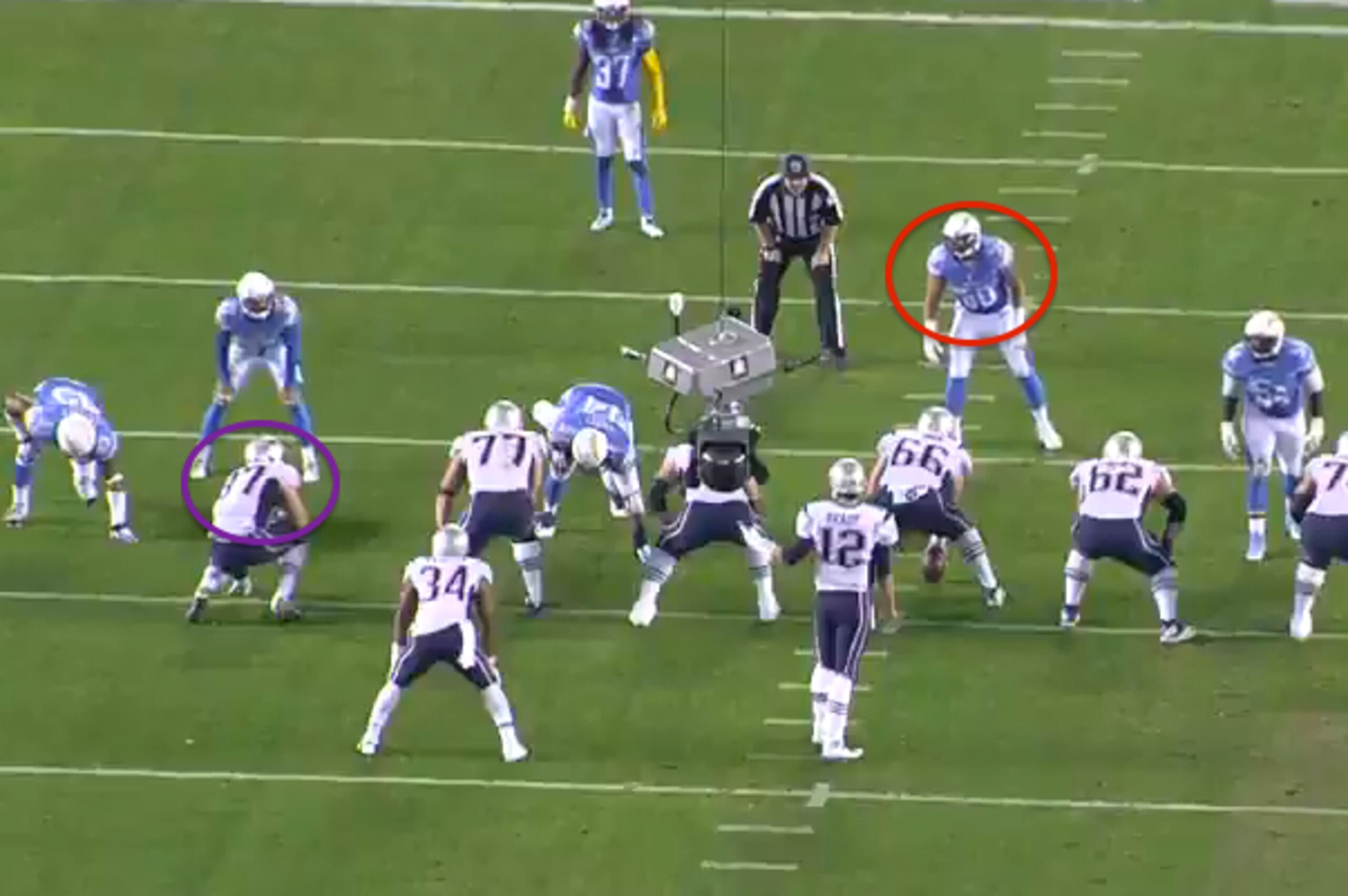
Te'o succeeded in quickly getting hands on Gronkowski:

He was also able to stay clamped on the beefy tight end, something few cover men in the NFL can manage:

Te'o then expertly flipped his head around to eye quarterback Tom Brady's pass. It was a brilliantly timed move:

He was now perfectly positioned between receiver and ball. Te'o promptly snatched Brady's ill-advised pass out of the air:

The play wasn't just a fine example of the technical accomplishment of San Diego's linebackers, although the way Te'o played the pass does serve as a testament to Barry's coaching.
More important though, this well-executed theft is an indication of how Barry's scheme makes its inside linebackers the primary playmakers. It's tough to think of another defense in football that would trust a 'backer in single coverage against Gronkowski.
The same rule applies in zone coverage. Butler gave an excellent example in Week 6 against the Oakland Raiders.
Butler began the play shielded by Liuget. No blocker was going to be able to absorb Butler at the second level:
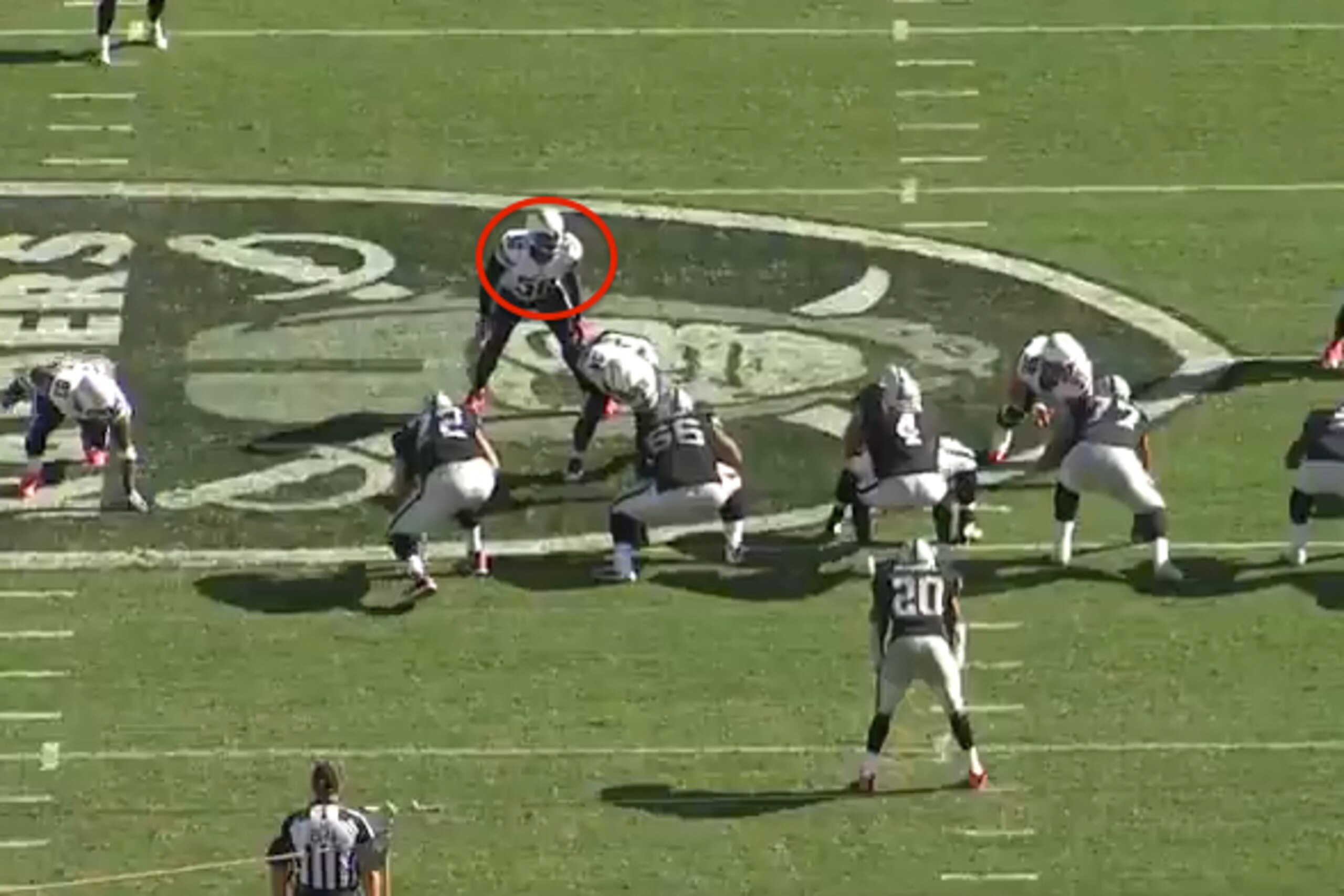
As Butler bailed out into underneath coverage, he kept zone eyes on rookie quarterback Derek Carr:
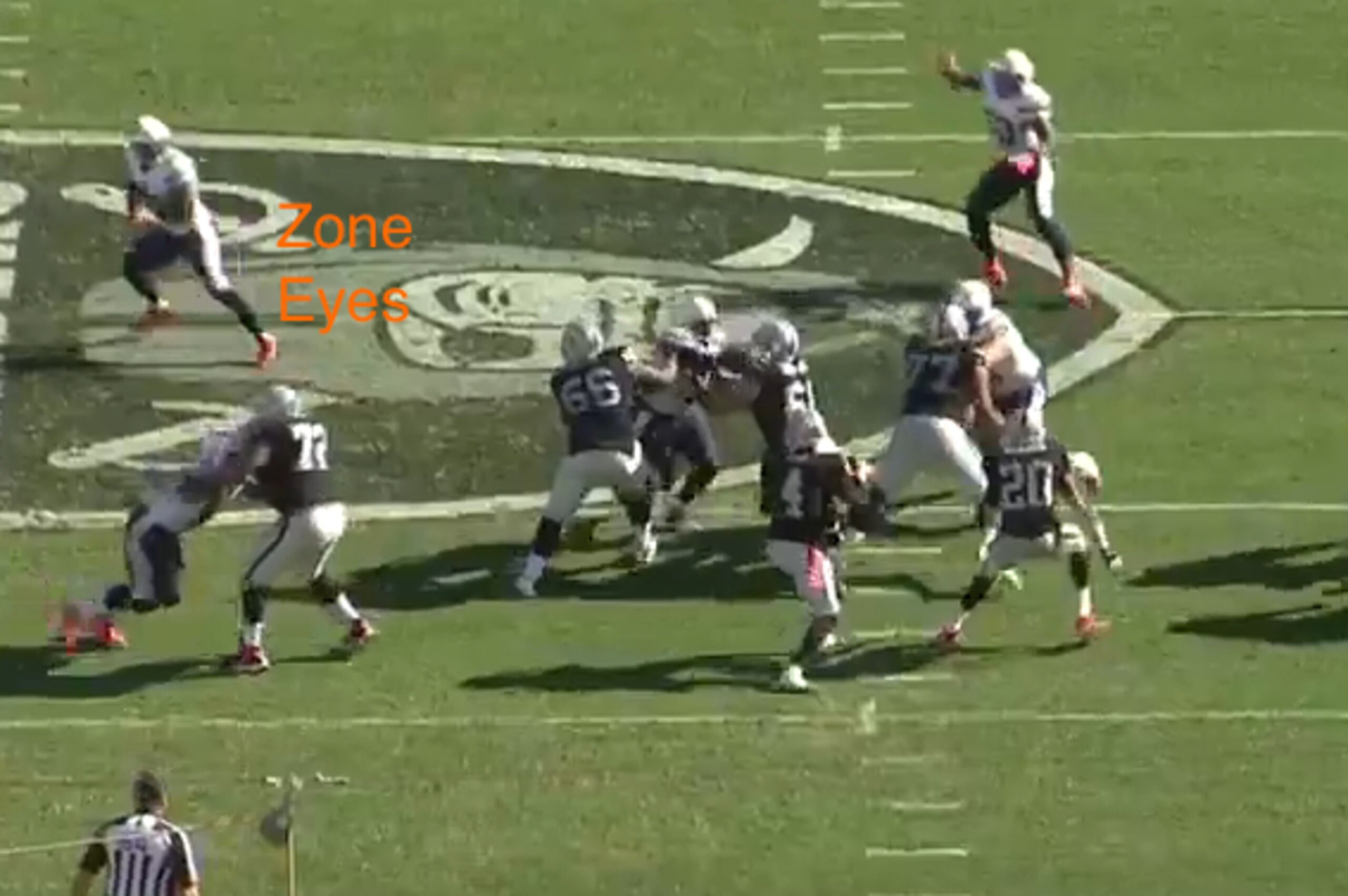
Butler (56) was now positioned as the free man underneath. He was a roving robber able to pattern read in zone before potentially locking up any receiver in man coverage, either in the flat, the hook or the curl zones:

Butler was now perfectly positioned in Carr's throwing lane. He jumped to tip the pass and almost came away with an interception:
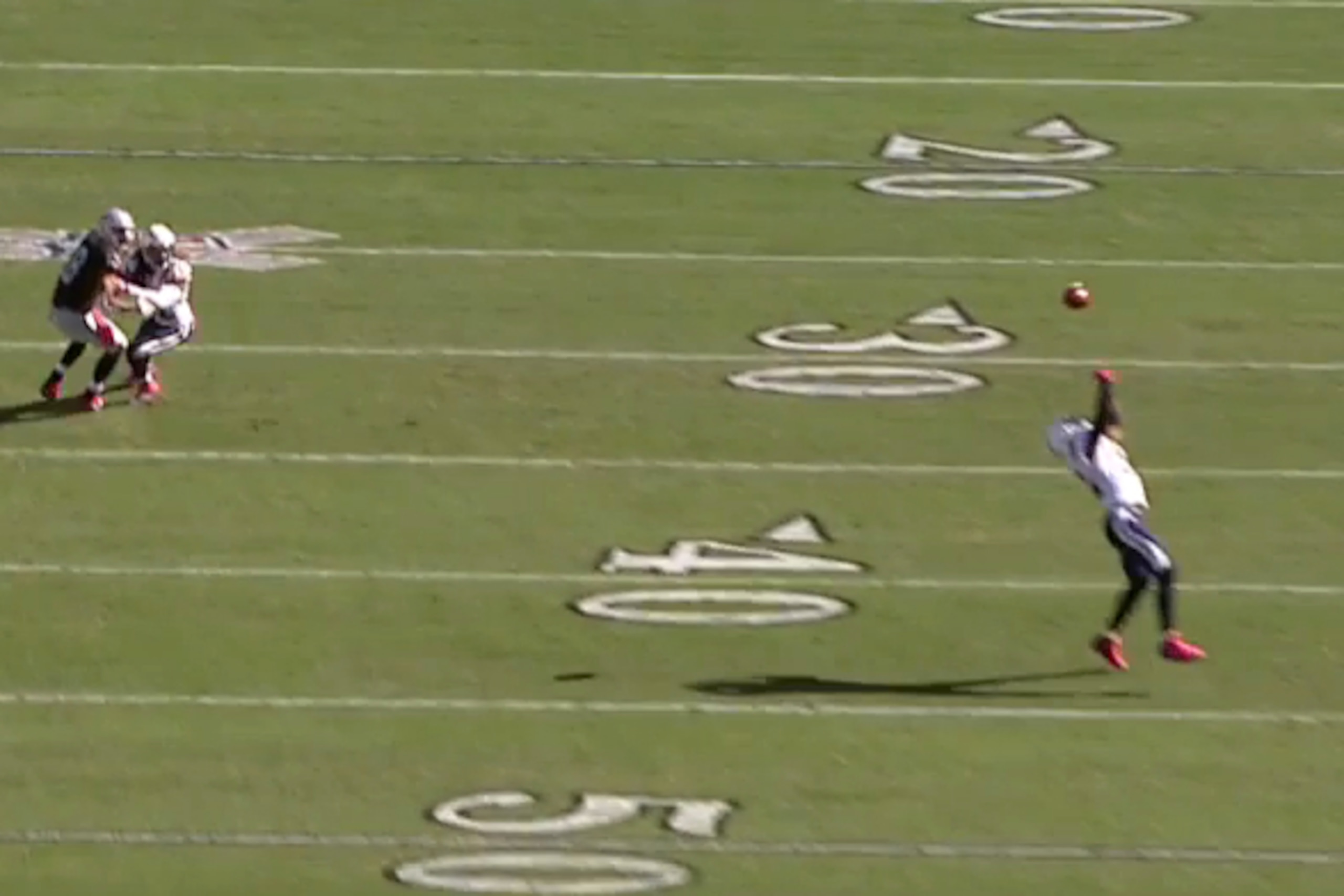
By making Butler the free man underneath, the Chargers again utilized the skills of a talented middle 'backer as the foundation of their scheme. Both Butler and Te'o became every-down linebackers in 2014.
The Chargers risked letting them stay on the field in obvious passing situations because they can be trusted to lock up talented receivers one-on-one. This is one of the main advantages of playing a linebacker-led scheme with better athletes.
The 49ers have done it for years with Patrick Willis and NaVorro Bowman. They are the focal point of San Fran's fearsome defense in a scheme that lets them do everything.
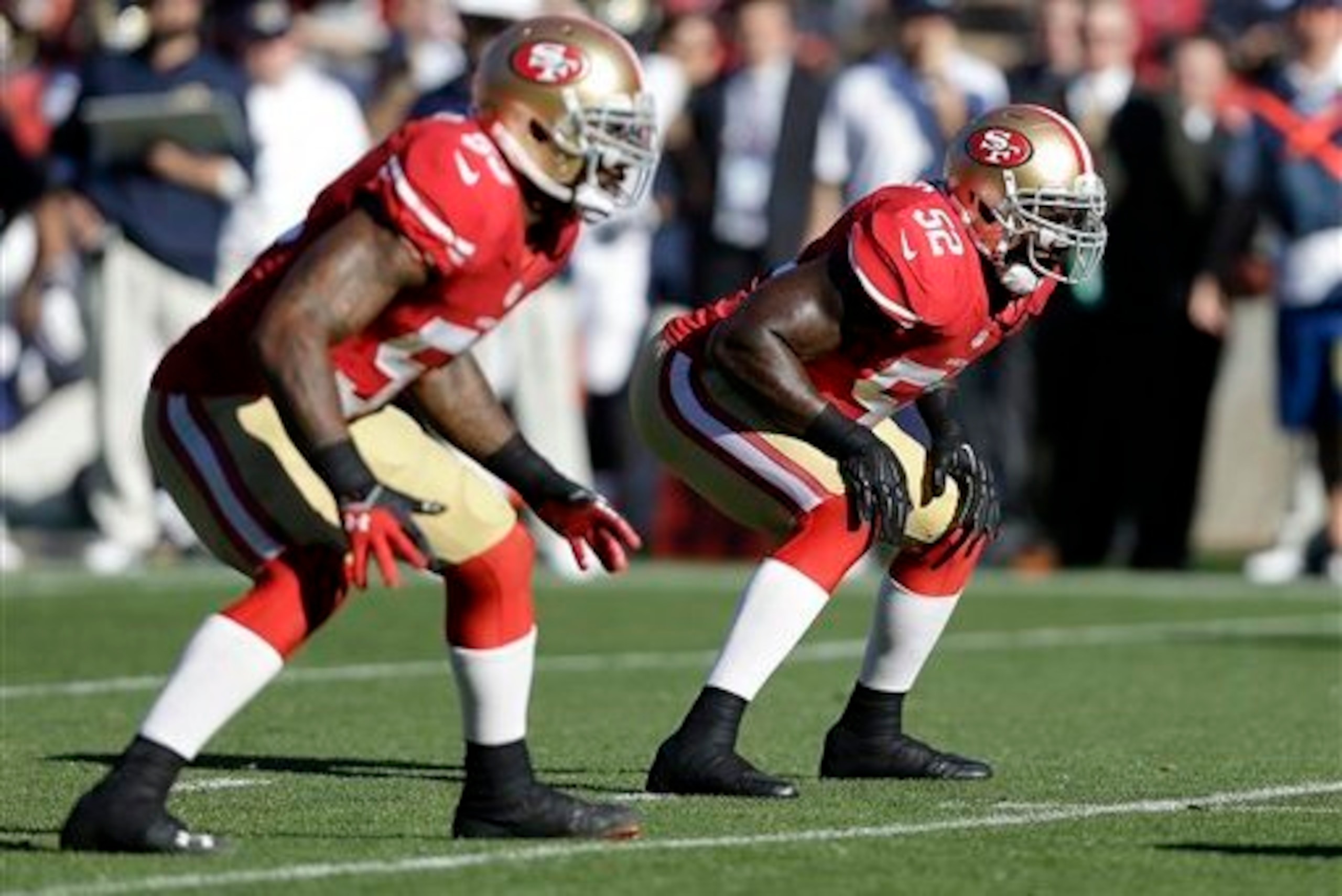
Te'o played all 74 defensive snaps against those 49ers in Week 16, according to U-T San Diego writer Tom Krasovic, an indication of his growing importance as the foundation of that unit.
Robinson has the same complete skill set to act as the focal point of Barry's defense in Washington. His speed, dynamism, hard-hitting physicality and pass-rush talent all demand the same formula the Chargers used.
It's built on two simple principles: Rely on a gifted middle linebacker to make plays at every level and keep him free from blockers and coverage traffic to make sure he can.
It's a scheme that can maximize Robinson's talent and make him a true star in 2015.
All statistics via NFL.com.
All screen shots courtesy of CBS Sports and NFL.com Game Pass.
.jpg?w=2560 "Texans-Mixon Released Football")

.jpg?w=2560 "Grading WWE Raw 🔠")


.jpg?w=2560 "2 NFL Officials Suspended")
