
Mike Rosenbaum's Spring Training Breakout Prospects to Watch
Baseball fans' excitement about prospects always picks up with the start of spring training, as it presents an opportunity to view some of the sport’s future stars playing alongside its current ones. However, with high-profile prospects such as Byron Buxton, Kris Bryant and Corey Seager stealing all the attention in major league camp, it also can be easy to overlook some of the game's less glamorous, under-the-radar young players.
Therefore, I’ve identified a select group of prospects who will be in big league camp—some on a 40-man roster, some non-roster invitees—whom I believe will blow past expectations this spring. None of the players on this list rank as their respective team's top prospect for 2015, though a majority of them are on the major league radar heading into the season. Basically, we're looking at already notable prospects who are strong candidates to become the talk of baseball this spring.
Here’s a look at my spring training breakout prospects to watch in 2015.
Justin O'Conner, C, Tampa Bay Rays
1 of 15Justin O’Conner was a highly touted athlete with loud tools coming out of high school, which prompted the Rays to select him in the first round of the 2010 draft and then convert him to a catcher. However, his professional career didn’t take off as expected, as O’Conner batted just .199 with a 30.7 percent strikeout rate over his first three seasons (641 plate appearances), all of which were spent in the rookie and/or short-season levels.
Granted, it took four years, but the 22-year-old backstop finally enjoyed a long-overdue breakout performance in 2014, hitting for both average and power while also making strides defensively.
The right-handed O’Conner will always have some swing-and-miss to his game on account of his aggressive approach. However, he learned to trust his strong wrists/forearms last season and tightened his pitch selection, which in turn improved his contact rate, trimmed his strikeout rate and allowed him to tap into his raw power and apply it in games.
Defensively, O’Conner’s athleticism and arm strength produce pop times that consistently register in the 1.75- to 1.85-second range, as he manages to get something on every throw (with accuracy) from several different arm slots. He’s also adept at blocking laterally and keeping the ball in front, which allows him to explode from the couch and generate momentum into throws.
O’Conner’s receiving skills—especially pitch-framing—are still developing and lag behind his catch-and-throw skills. However, given the progress he’s made since moving behind the plate, there’s no reason to think he’ll be anything less than a solid-average defender at maturity.
He’s expected to open the 2015 season back at Double-A.
Roberto Osuna, RHP, Toronto Blue Jays
2 of 15Roberto Osuna missed a majority of the 2014 season recovering from Tommy John surgery, but he returned late in the summer to log 22 innings at High-A Dunedin, followed by a trip to the Arizona Fall League.
Working out the bullpen in the AFL, the 20-year-old right-hander showcased a fastball that consistently sat in the 93-95 mph range and topped out at 96 mph. His curveball was inconsistent, which is understandable given the recent elbow surgery, but it had flashes of a potential above-average offering with tight spin and hard biting action. Osuna’s changeup is an intriguing pitch, as it registered roughly 15 mph off his heater at 79-81 mph, with late drop out of the zone.
That the right-hander’s stuff has already returned to pre-surgery form is encouraging, and it’s possible he may be ready to contribute sooner rather than later. Blue Jays assistant general manager Tony LaCava recently discussed Osuna with Shi Davidi of sportsnet.ca:
"Last year was his comeback year, his hang with them year coming back to his normal level of play. He comes from a baseball family, his uncle (Antonio Osuna) pitched in the big-leagues, his dad in the Mexican league, so he’s pretty advanced in how he goes about his business. His stuff is major-league stuff.
"
My best guess is that Osuna opens the season in the bullpen at Double-A, though it’s also possible he’ll return to High-A to keep developing as a starter. Before that, however, he’s a strong candidate to open eyes this spring in major league camp.
Tim Anderson, SS, Chicago White Sox
3 of 15Tim Anderson held his own last season despite an aggressive Opening Day assignment to High-A Winston Salem, as the 2013 first-rounder batted .297/.323/.472 with 31 extra-base hits and 10 stolen bases over 68 games. Anderson missed roughly seven weeks after fracturing his wrist but returned in time to receive a late-season promotion to Double-A Birmingham, where he batted .364 with four extra-base hits over the final 10 games of the season.
Anderson’s best tool is plus speed, and it plays on all sides of the ball. The right-handed hitter’s stick will ultimately determine his level of success; he shows excellent bat speed and barrel awareness, but the approach is super aggressive and has the potential to be exploited by upper-level arms. The 21-year-old’s in-game power comes mostly in the form of doubles and triples at the present, but his above-average raw pop should translate to average over-the-fence power at maturity.
His defense is still raw and too aggressive, like any young shortstop, but Anderson has the tools to be a first-division shortstop. All he needs now is experience.


Pierce Johnson, RHP, Chicago Cubs
4 of 15A pair of leg injuries (hamstring, calf) essentially cost Pierce Johnson the first half of the 2014 season, but the 23-year-old came off the shelf to dominate over his final 12 starts, posting a 1.80 ERA with 42 hits allowed and 69 strikeouts in 65 innings.
The right-hander’s low-90s fastball is difficult to square up—he can reach back for a few extra ticks as needed—as he throws the pitch on a solid downward plane with some late life and sinking action to the arm side. The addition of a cutter last season allowed him to more confidently pitch over the plate so as to generate weak contact.
Johnson’s curveball is his best secondary offering, flashing plus in the low 80s with a good shape and late bite. He also mixes in a changeup that plays well off of his fastball and cutter, though it’s still his least advanced offering and requires refinement.
Where Johnson begins the 2015 season likely will depend on how he looks this spring, as both Double- and Triple-A are equally possible options for the right-hander.
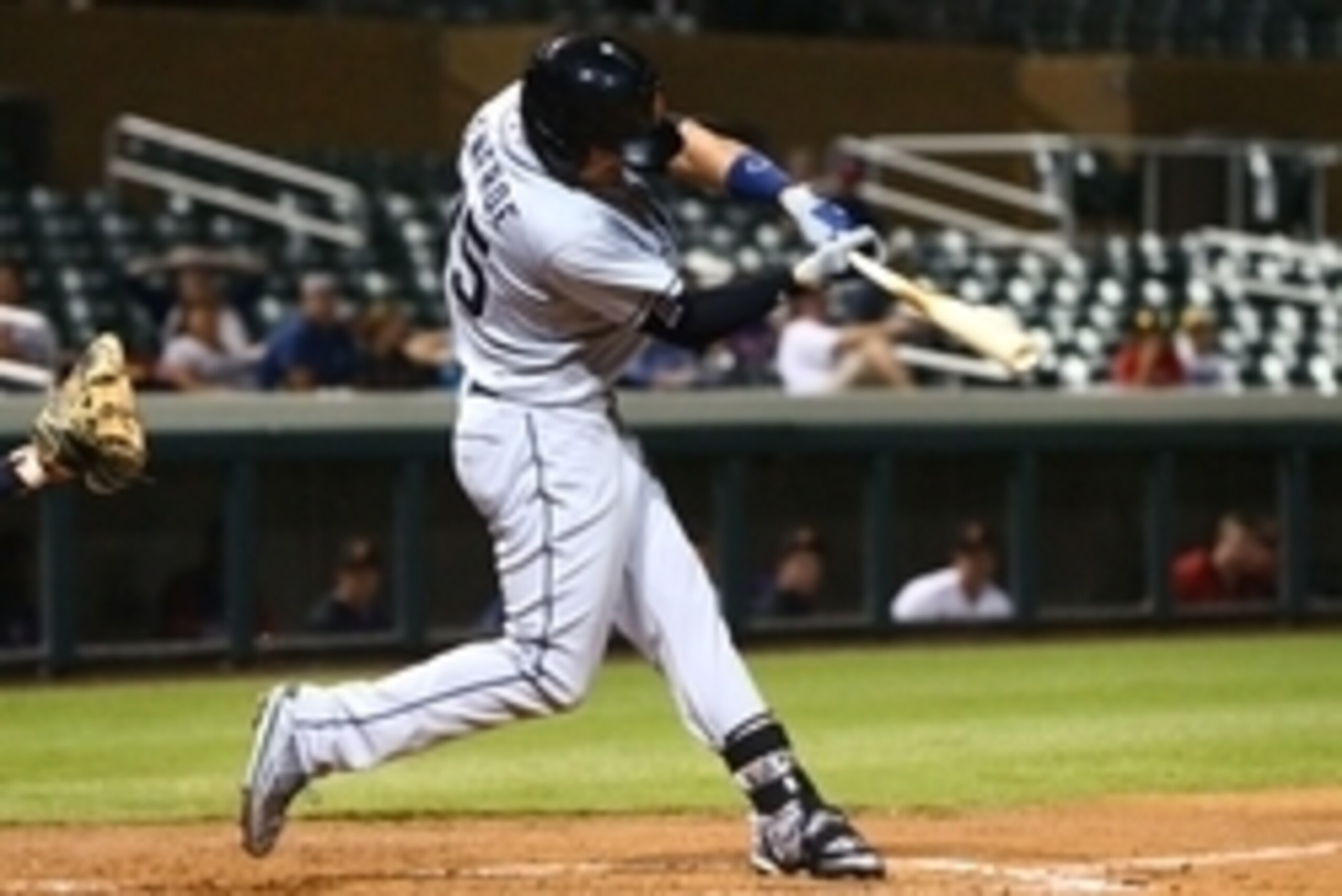
Hunter Renfroe, OF, San Diego Padres
5 of 15Hunter Renfroe made the most of his assignment to the California League last season, as the 2013 first-round pick batted .295/.370/.565 with 40 extra-base hits (16 home runs) in 316 plate appearances, including a .343/.415/.636 line over his final 34 games. However, the 23-year-old’s aggressive approach and swing-and-miss tendencies hurt his power frequency after a midseason promotion to Double-A San Antonio, as he hit just five home runs in 60 Texas League games.
Renfroe stands out for his enormous raw power, which produced six home runs in this year's Arizona Fall League, as well as his ability to punish mistakes. However, he also likes to swing (a lot) and therefore is always going to strike out more than desired. But while his approach needs refinement, he has a true knack for getting the barrel to the ball, and he’s just missing a lot of pitches at this point in his career that he won’t in the future.
While the Padres' acquisitions of Wil Myers, Matt Kemp and Justin Upton during the offseason seemingly hurt Renfroe's chances of reaching the major leagues anytime soon, it also gives the club the freedom to develop him more thoroughly in the upper minors over the next year-plus.
Jason Garcia, RHP, Baltimore Orioles
6 of 15Originally a 17th-round draft pick of the Red Sox in 2010, Jason Garcia returned from Tommy John surgery last season to post a 3.70 ERA with 59 strikeouts in 56 innings while splitting the year between short-season Lowell and Low-A Greenville. The Orioles acquired Garcia from the Astros in December after Houston selected him with the No. 4 pick in the Rule V draft.
According to Steve Melewski of MASN, Orioles general manager Dan Duquette said Garcia fanned 14 of the 18 batters he faced in the Fall Instruction League, showcasing mid- to upper-90s velocity to go along with a quality slider.
Here’s a bit more on Garcia’s eye-opening fall performance courtesy of FanGraphs’ Kiley McDaniel:
"The Orioles have a video system in Sarasota that logs every game at their stadium and when it came time to discuss Garcia for the Rule 5 Draft, they realized they had video of six innings of Garcia from instructs. In those six innings (where he recorded 18 outs), Garcia had 14 strikeouts and a 15th where the batter reached on a dropped third strike, along with a popup, fly out and two groundouts. Orioles execs concede they wouldn’t have been able to make the case to pick Garcia without this video, which included Garcia striking out multiple high level Orioles prospects, like Chance Sisco.
"
Basically, the Orioles are hoping to catch lightning in a bottle with Garcia, gambling on his present velocity and the fact that he’s still working his way back from elbow surgery.
Sean Manaea, LHP, Kansas City Royals
7 of 15There was an argument that Sean Manaea was the top college pitcher in the 2013 draft before a hip injury caused him to drop to the 34th overall pick. The Royals showed faith in the left-hander with a $3.55 million bonus, and he rewarded them in his professional debut with a 3.11 ERA and 146 strikeouts in 121.2 innings (25 starts) at High-A Wilmington.
Manaea, 23, was especially dominant over his final eight outings, with a 1.23 ERA and 55-15 strikeout-to-walk ratio over 51.1 innings, and he capped his pro debut with 12 strikeouts over seven scoreless innings in his final start.
Manaea’s fastball works comfortably in the low 90s, occasionally reaching 94-95 mph, and he uses his height and long arms to create plane. The southpaw’s slider is potentially an above-average pitch, thrown with tilt and late biting action, while his changeup should settle in around average but with a chance to play up with improved fastball command.
His overall command profile is fringy due to some of the effort in his delivery, but at the same time, that effort is also why he’s so deceptive. Plus, I’m willing to bet his command will improve naturally with experience.
Manaea is likely to open 2015 in Double-A after spending his entire professional debut at High-A, and he’ll probably remain there for the duration of the season. The Royals have pitching prospects Kyle Zimmer and Brandon Finnegan above Manaea on the depth chart, so there will be no reason to rush the 23-year-old’s development next season. A midseason debut in 2016 is a more realistic estimated time of arrival in the major leagues.
Braden Shipley, RHP, Arizona Diamondbacks
8 of 15Braden Shipley, the No. 15 overall pick in the 2013 draft, cruised through three levels last year in his first full pro campaign, beginning at Low-A South Bend before moving up to High-A Visalia and then Double-A Mobile. Between all three stops, the 22-year-old right-hander posted a 3.86 ERA and 127-42 strikeout-to-walk ratio over 126 innings (22 starts).
The 22-year-old (soon to be 23) right-hander should continue to move up the ladder in a hurry behind a mid-90s fastball, plus-plus changeup and hard curveball that projects as another plus offering at maturity. More importantly, Shipley demonstrates present command of all three pitches.
He’s still relatively new to pitching, but Shipley already displays an advanced feel for throwing strikes and aggressively attacking hitters throughout the zone. His ability to work down in the zone has steadily improved since turning pro, as has his feel for throwing his curveball for a strike.
Shipley flat-out dominates when working at the knees with his fastball, but he also has a tendency to leave the pitch up in the zone and surrender some extra-base hits. However, he’s likely to always post solid ground-ball rates by keeping hitters off balance with his devastating changeup.
The polish Shipley showed in 2014 was a pleasant surprise given his overall lack of experience on the bump. He still requires considerable projection for that same reason, but it isn’t difficult to envision him developing into a No. 2 or high-end No. 3 starter.
Scott Schebler, OF, Los Angeles Dodgers
9 of 15Scott Schebler was named the organization’s Minor League Player of the Year in 2013 after a breakout season at High-A Rancho Cucamonga in which he batted .296/.360/.581 with 27 home runs in 534 plate appearances. However, the fact that he posted those impressive numbers in the California League meant the 24-year-old outfielder would have even more to prove at Double-A in 2014.
Suffice it to say Schebler legitimized himself as a prospect last season, batting .280/.365/.556 with a career-high 28 home runs at Double-A Chattanooga. On top of that, the left-hand hitter improved his strikeout and walk rates, respectively, against quality pitching in the Southern League.
Though I worry about his aggressive approach and willingness to expand the zone, Schebler has proved he can make enough contact to offset some of his swing-and-miss in his game and hit for a respectable batting average. He’s also a good bad-ball hitter and shows power to all fields during games. Lastly, his speed is better than you’d expect given his stocky, 6’1”, 208-pound frame, as he’s now recorded three straight seasons with double-digit stolen bases while also playing all three outfield positions.
Christian Arroyo, 2B/SS, San Francisco Giants
10 of 15Christian Arroyo struggled to begin the season following an aggressive assignment to the Low-A Augusta, as the 2013 first-rounder batted just .203 in 31 games in the South Atlantic League before suffering a left thumb injury. Arroyo returned to action in mid-June and was moved down a level to the more age-appropriate Northwest League, where the 19-year-old produced an impressive .333/.378/.469 batting line with 21 extra-base hits in 58 games.
A 6’1”, 180-pound right-handed hitter, Arroyo has good strength for his size, especially in his hands and wrists, as well as a natural feel for hitting. He employs an up-the-middle approach in order to stay inside the ball, but he at times falls back on a tendency to pull open with his front and roll over hittable pitches to the left side of the infield. His over-the-fence power is limited to his pull side and projects as below average at maturity, but he should always provide a consistent source of doubles.
Arroyo was a decorated shortstop as an amateur and has continued to undergo development at the position since turning pro. The teenager lacks standout athleticism and is technically just an average runner, but he still moves with fluidity on the infield and possesses both the quickness and instincts to handle the position at higher levels. If he’s forced off shortstop, he'll likely move across the infield to the keystone—where he played mostly last season while at Augusta.
Tyler Danish, RHP, Chicago White Sox
11 of 15In his first full professional season, Tyler Danish, 20, was utterly dominant in his return to the South Atlantic League, posting a stellar 0.71 ERA without surrendering a home run over his first 38 innings (seven starts). He scuffled a bit following an early season promotion to High-A, but he eventually settled in and emerged as one of the Carolina League’s top pitchers over the last two months of the season.
A 6’0”, 205-pound right-hander, Danish has a feel for spotting low-90s fastballs throughout the zone, while his low three-quarters arm slot gives the pitch tremendous sinking action. His slider is above average and at times flashes plus, generating a decent number of whiffs with sweeping break, and he also throws a changeup that has solid-average upside with good fading action.
Danish has the potential to be a solid No. 3 pitcher and the makings of another White Sox pitcher who climbs the organizational ladder very quickly. Should the organization want, the 20-year-old could probably get a taste of the major leagues late next season in a relief role.
Matt Olson, 1B, Oakland Athletics
12 of 15Matt Olson, the No. 47 overall pick in the 2012 draft, ranked second in the Low-A Midwest League in 2013 (his full-season debut) with 23 home runs. This past season, the 20-year-old slugger led the California League and ranked third in all of the minors with 37 home runs. He also paced the league with 111 runs scored, 278 total bases and 117 walks.
The California League is hitter-friendly, but Stockton is slightly slanted toward pitchers, which makes Olson's higher output at home (.262/.402/.591 with 21 homers) as opposed to on the road (.262/.406/.496 with 16 homers) all the more impressive.
Olson projects for an average hit tool, as he already displays good feel for hitting with good patience and a willingness to work deep counts. His 6’4”, 236-pound frame and long limbs leave holes in swing and lead to a fair amount of swing-and-miss; however, it also generates the booming, plus power that has translated to 60 home runs with an extra-base hit rate of 51.2 percent in his first two full seasons.
A third baseman in high school, Olson is an underrated athlete at first base with fluid actions and good footwork around the bag, while his solid-average arm serves him well at the position. But while he may be better defensively than the average first baseman, his future will always be tied to his offensive profile. Luckily, the 20-year-old’s approach and massive power should give him an opportunity to make an impact at the highest level, possibly even earlier than expected.
Chi Chi Gonzalez, RHP, Texas Rangers
13 of 15Chi Chi Gonzalez was promoted to Double-A after registering a 2.63 ERA and 49-16 strikeout-to-walk ratio in 65 innings for High-A Myrtle Beach. His success continued in the Texas League, where he pitched to a 2.71 ERA with 64 strikeouts over 73 frames.
The 23-year-old right-hander’s fastball registers in the 91-95 mph range, at times touching a tick or two higher, and he’s adept at cutting it to create slicing action to the glove side. He has an aggressive approach with the pitch, attacking both sides of the plate while consistently working down in the zone.
Gonzalez’s slider is his best secondary offering, as he throws it with velocity at 84-87 mph and generates good tilt and late break. It’s a plus offering and will serve as his out pitch at the highest level, though he still has room to improve in terms of chasing whiffs outside the zone. He is still developing feel for his changeup, but it projects as a potential solid-average offering that helps keep opposing hitters off his fastball-slider combo.
Gonzalez doesn’t have an especially high ceiling, but I also wouldn’t put it past him to exceed expectations given his overwhelming success last year in his first full season. He should have a spot waiting for him in the Rangers rotation once he’s ready.
Brandon Drury, 3B/2B, Arizona Diamondbacks
14 of 15Brandon Drury hit .300/.366/.519 with 35 doubles and 19 home runs over 107 games with High-A Visalia before a promotion to Double-A Mobile. The 22-year-old continued to rake in the Southern League, posting an .821 OPS with 11 extra-base hits (four home runs) in 29 games.
Drury’s batting practice at this year's Arizona Fall League Fall Stars Game was downright impressive, as he laced sharp line drives to the deepest parts of Salt River Fields—the kind of line drives that make it easy to envision many of his doubles clearing more fences as he develops.
On the other side of the ball, Drury’s improved defense—a product of endless on-field reps—and mobility at third base last season boosted his projection to that of at least a league-average defender. Meanwhile, the Diamondbacks started working him out at second base in the fall to potentially increase his versatility.
Overall, Drury profiles as a solid defensive third baseman who hits .270 with 15-20 homers and 30-plus doubles. The Arizona Diamondbacks will wait to see what they have in Jake Lamb next season, but it wouldn’t be surprising to see Drury in the major leagues by the end of 2015.
Albert Almora, OF, Chicago Cubs
15 of 15Albert Almora overcame a sluggish first half at High-A Daytona to bat .283/.306/.406 in 89 games, but the 20-year-old then struggled in his first taste of Double-A following a mid-July promotion.
The sixth overall pick in the 2012 draft, Almora is a premium athlete with a frame that leaves room for projection and the potential for five average-or-better tools at maturity. The right-handed hitter has a compact swing with preternatural barrel control and a knack for consistently staying inside the ball. His power should develop as he matures, with the potential to be average by the time he reaches the major leagues.
Defensively, Almora has only average speed but demonstrates excellent instincts in center field through his reads, jumps and positioning. In general, he is an incredibly well-rounded player for his age with sneaky All-Star potential, although I’m curious to see how his aggressive approach translates next season back in Double-A.

.jpg?w=2560 "Grading WWE Raw 🔠")

.jpg?w=2560 "Bijan's INSANE 1st Half 🤩")
.jpg?w=2560 "Viral Rams Coach Vid 🖕")
.jpg?w=2560 "Injury-stricken Seahawks signing veteran RB")


.jpg?w=2560 "2 NFL Officials Suspended")
