

Building the Ideal NY Giants Offensive Line
One of the units on the New York Giants that probably everyone can agree is in dire need of an upgrade is the offensive line.
According to Football Outsiders, the Giants offensive line finished 22nd out of 32 teams in run blocking and 10th out of 32 teams in pass protection last season.
While the pass blocking was certainly encouraging, that the Giants couldn’t run the ball with any consistency is a concern—and a big reason why this unit still needs a lot of work before it comes anywhere close to being a strength on the team as the offensive line units of 2007 through 2009 were.
The good news is that the process of rebuilding the offense line actually began last year, and that a case could be made for the unit having four of its five starters already under contract. Also, the starting line doesn’t appear to be too far away from becoming a solid unit.
According to Pro Football Focus’ signature stats, the Giants offensive line’s pass-blocking efficiency score of 81.0 was third in the NFC East—and not too far off from division-leading Dallas, who finished with an 84.1 score.
Still, there is a lot more work to be done, so let’s look at each piece of the Giants offensive line, including the depth, and try to build the ideal unit.
Left Tackle: Will Beatty
1 of 6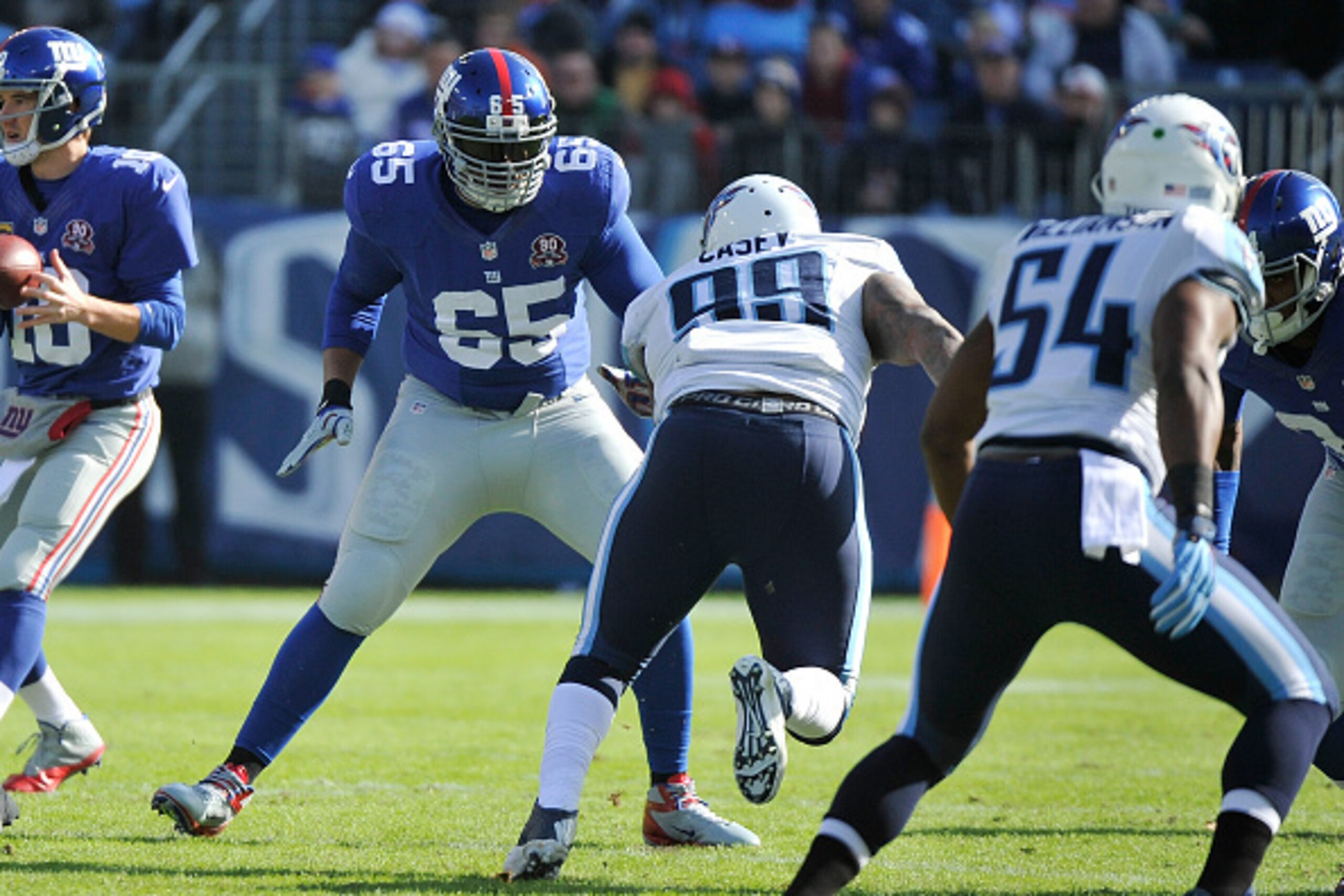
Love him or hate him, Will Beatty will be the team’s left tackle. Beatty, in fact, was the most consistent of the starting offensive lineman and the second-highest rated overall Giant on offense, behind receiver Odell Beckham Jr., according to Pro Football Focus.
How good was Beatty? His 6.1 run-blocking grade was tops of any offensive blocker on the team, as rushers who ran behind him averaged 3.8 yards per carry.
In fact, of the Giants’ 1,603 total rushing yards, 368 (22.9 percent) came behind the left tackle or on the left edge, the latter being where Beatty worked in tandem with either the fullback or a tight end. That was the best mark on the team in 2014.
In pass protection, Beatty also topped his teammates with a 4.3 PFF grade.
Of the Giants' starting guards and tackles, Beatty was credited with giving up three sacks, second-fewest behind Weston Richburg. It should be noted that Beatty almost never received blocking help against opposing pass-rushers.
If there was an area where Beatty was sloppy, it was in the penalty department, where he tied with Pugh for the most flags drawn among the offensive linemen, where, per NFL Game Statistics and Information Systems, he committed eight holding infractions and one false start.
This is something Beatty is going to have to clean up. While it could be argued that there is holding on every play, it seems that once a player develops a reputation among the officials for being susceptible to committing a specific type of penalty, he’s going to be watched more closely.
Left Guard: Justin Pugh
2 of 6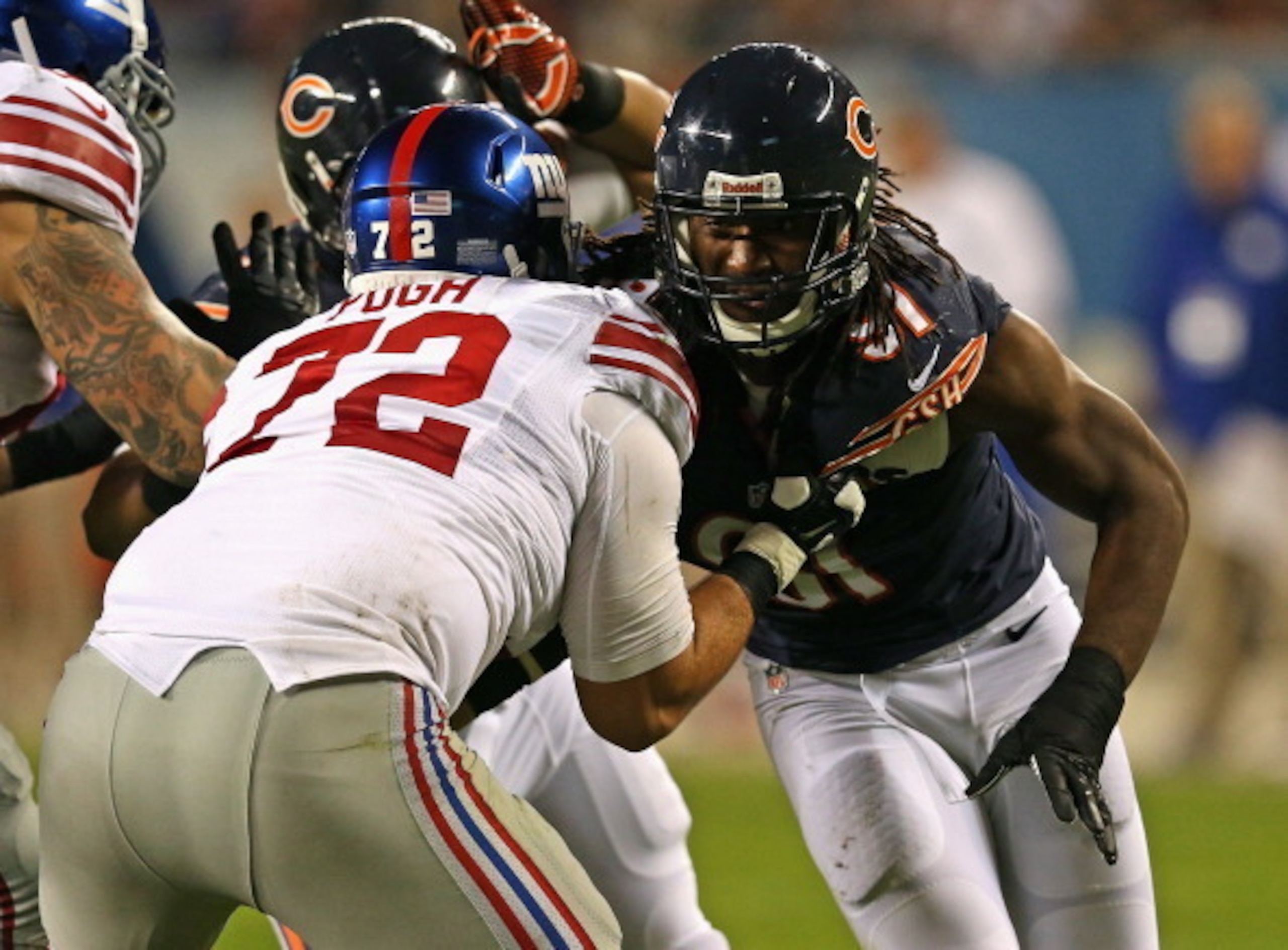
The position that Justin Pugh, the starting right tackle in each of the last two seasons, plays in 2015 is going to be interesting to watch unfold.
Pugh, who was a college left tackle, is versatile enough to play guard or tackle, a point made by general manager Jerry Reese during a radio interview last month with WFAN’s Mike Francesa (h/t CBS New York).
However, the day after the season ended, when the players were packing up their belongings for the offseason, Pugh stood before reporters and emphatically stressed that he is a right tackle.
"I'm the right tackle for the New York Giants," Pugh said in response to a question about possibly moving to guard.
"I really don't like that question. I came here to play tackle. … I think I've done a pretty good job at right tackle and I plan on playing there."
Pugh might not have a say in the matter if the Giants end up signing a free-agent tackle.
Head coach Tom Coughlin, during his interview with Francesa, also confirmed that there was a possibility of Pugh's moving inside to guard, though, like Reese, Coughlin noted that Pugh’s versatility gave the coaching staff options as far as where the former Syracuse star lined up.
Although Pugh’s sophomore season was affected by injuries—he wore an elbow brace earlier in the season and missed two late-season games due to a quad injury—his consistency was an issue.
Per Pro Football Focus, he allowed six sacks, the most of the five starting offensive lineman and one more sack than he allowed as a rookie the year before.
While that’s not a big difference, there were times when Pugh clearly struggled, though again, that could have been due to injuries.
According to PFF’s signature stats, the Giants ran for 171 yards behind the right tackle spot, the second-fewest of the various offensive line positions.
Still, despite insisting during his year-end press briefing with reporters that he was a better player in his second season—he cut down on the number of quarterback pressures (sacks, hits and hurries), allowing 28 this year as opposed to 52 as a rookie—Pugh had his struggles.
The biggest problems for him came in defending the edge, where he was beaten off the snap. He also drew a team-high 10 penalties, nine of which were accepted.
If Pugh does move inside to guard, it will be interesting if the Giants put him on the left side—remember he was a left tackle in college, so he’d be familiar with the mechanics of playing on the left side—or the right side.
Center: Weston Richburg
3 of 6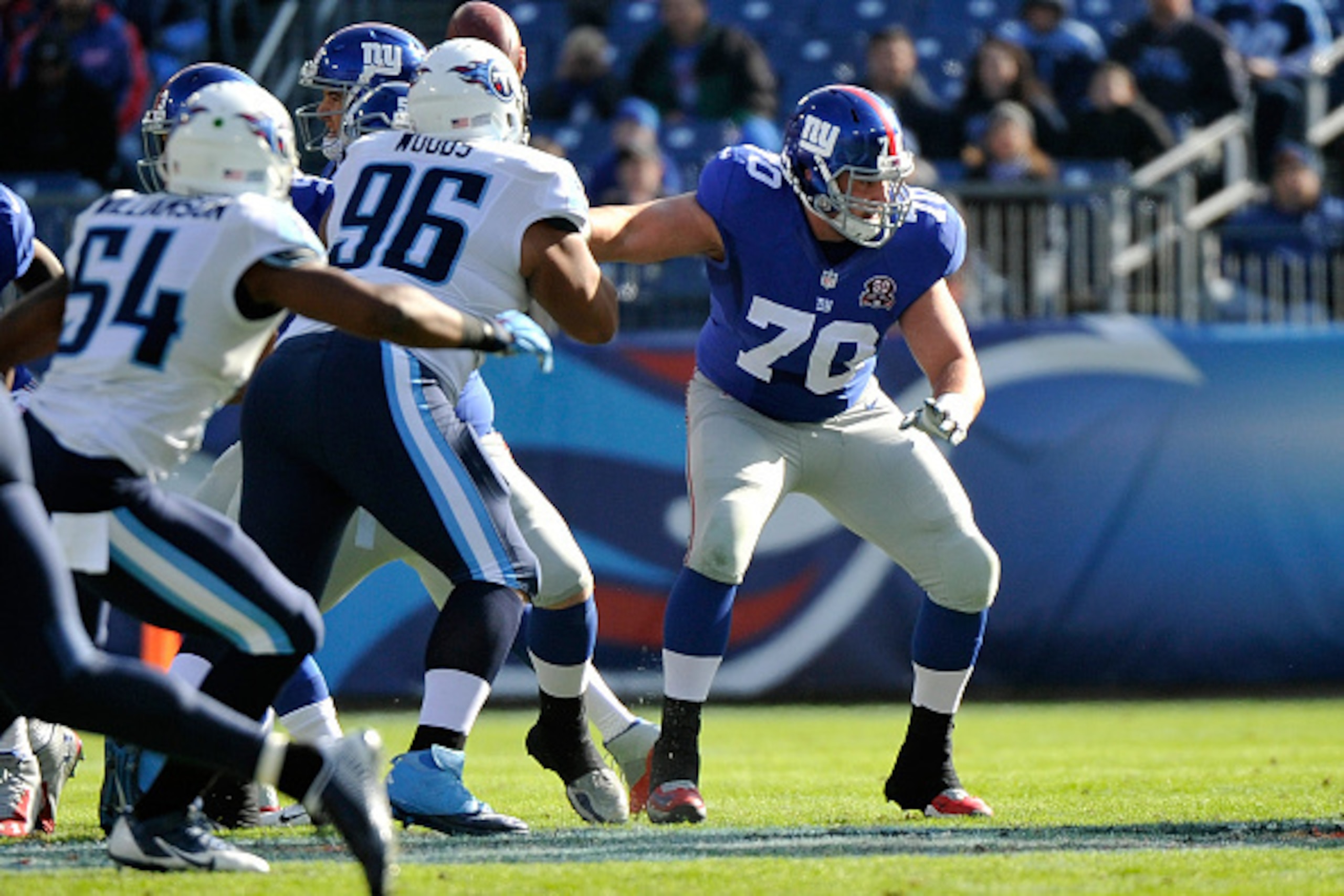
Last year, the Giants drafted their center of the future in the second round, Weston Richburg.
So why didn’t the young man get a chance to play his natural position in his rookie season?
There are a couple of likely reasons.
First, it is possible that Ben McAdoo, the Giants’ new offensive coordinator at the time, wanted a center making the line calls, which is why J.D. Walton got the nod despite not having played football in 2013 due to ongoing issues related to a 2012 ankle injury.
The more likely scenario is that the training-camp injury Geoff Schwartz suffered and the retirement of Chris Snee at the start of training camp, combined with some questionable depth, left the Giants with little choice but to plug Richburg in at a position that might not have been his best fit.
On the plus side, Richburg got his feet wet at the pro level.
However, he struggled at guard, according to Pro Football Focus, who graded the former Colorado State offensive lineman with a minus-14.3 overall mark that included a minus-3.5 in pass blocking and a minus-8.7 in run blocking.
Still, experience proved to be the best teacher for the 6’3”, 298-pound Richburg, who with a year of experience under his belt, will move to his natural position of center, according to what head coach Tom Coughlin told WFAN’s Mike Francesa last month (h/t CBS New York).
.jpg?w=2560 "Rams Raiders Football")

Right Guard: Geoff Schwartz
4 of 6
When Geoff Schwartz was signed last year to a four-year, $16.8 million contract, the Giants’ intent was to move him from right guard to left guard.
The decision, probably in part driven by the team’s hope of having longtime starting right guard Chris Snee back from the injured reserve, was a curious one at time given that Schwartz had been so good playing on the right side.
Prior to suffering a preseason toe injury that landed him on the injured reserve/designated to return list, Schwartz had his share of struggles playing on the left side.
Per Pro Football Focus, he finished with a minus-2.6 preseason grade in 93 snaps, all at left guard, allowing four total pressures, including one sack.
When Schwartz did return to action in Week 12, he was inserted into the lineup at right tackle in place of Justin Pugh, who missed time with a quad injury. In five quarters of play at right tackle, Schwartz looked right at home, grading out with a 3.9 mark in 93 snaps, despite allowing one sack and five quarterback pressures.
It’s unknown if Schwartz would have stayed at right tackle as he suffered a season-ending ankle injury, an injury from which he is still recovering and from. Though he should be over it by the time training camp begins.
Moving forward, it will be interesting to see if the coaches move him back to the right side for a chance to recapture some of that magic he had in 2013, a year in which PFF graded him as the fourth-best right guard in the league.
Right Tackle: Orlando Franklin (UFA)
5 of 6
If the Giants are going to make any splashes in free agency, offensive line (along with safety) should be high on the priority list.
At offensive line, the goal should be to get a right tackle so that Justin Pugh can move inside to guard where his build and skill set might be a better fit.
While the Giants could look to add a draft pick, such as Iowa’s Brandon Scherff, to their offensive line, there’s been some question as to whether Scherff would be better off as a guard. NFL.com’s Lance Zierlein and NFL Network draft analyst Mike Mayock, the latter of whom, on a conference call with reporters, had this to say about Scherff:
"When I look at Brandon Scherff, I see a similar example (to Dallas guard Zack Martin). I see a bigger kid with longer arms. That lends you to believe that [Scherff] could play outside more easily. Again, I believe he can play outside. However, I think his best position, because of his power, his toughness, his football sense, is inside. I think he's an all-pro guard. But that doesn't mean he can't play tackle in the NFL.
"
If the Giants share Zierlein and Mayock’s opinion about Scherff, then it’s possible New York will look elsewhere with the No. 9 pick and try to fill the opening on the offensive line with a veteran free agent in this “win or else” year for head coach Tom Coughlin and company.
That young veteran could be Orlando Franklin of Denver, a 6’7”, 320-pound specimen who was the Broncos’ second-round pick in the 2011 draft.
Although Franklin, whose game was nicely broken down by B/R’s Kevin Boilard, started last year at left guard for Denver, he played his first three seasons at right tackle.
That makes Franklin, like Pugh, versatile enough to give the Giants coaching staff options with different combinations.
Based on size alone, Franklin’s build is similar to former Giants right tackle Kareem McKenzie, who stood 6’6” and weighed 330 pounds during his playing days.
Franklin, who like McKenzie has a long wingspan, is a relentless road grader with fundamentally sound technique and who finishes every play to the whistle.
According to data from Pro Football Focus, he’s allowed just three sacks in the last two seasons, including just one in 2014.
His athleticism allows him to get to the second level, and he is durable, having missed just one game in his career.
The soon-to-be 28-year-old, who played his college ball for the Miami Hurricanes, could really give the Giants' run-blocking game a much needed boost if he is willing to leave Denver for greener (pun intended) pastures.
The Reserves
6 of 6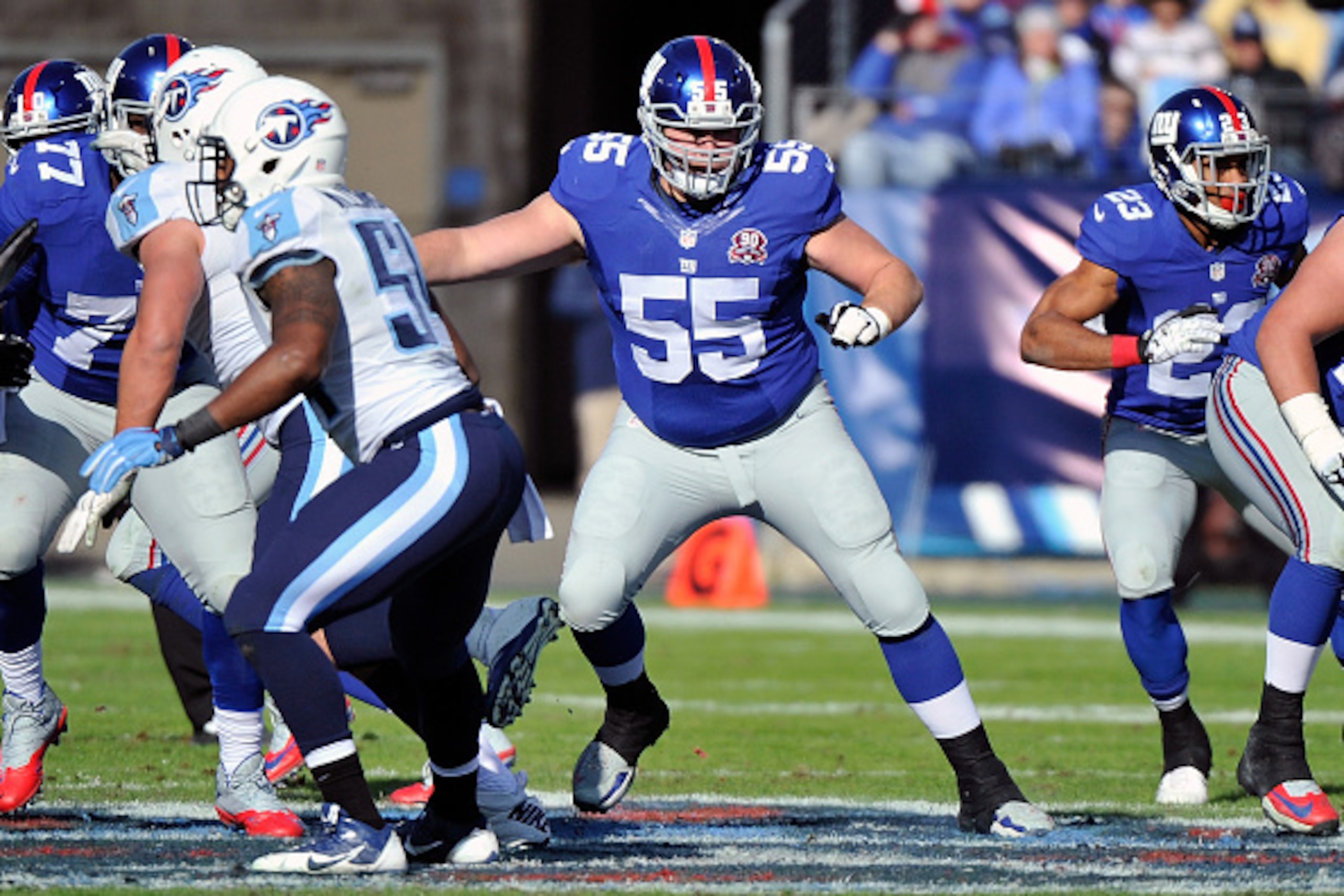
Despite drafting at least one offensive lineman in each of the last four drafts, the Giants have very little in the way of quality backups to show for their efforts these days.
Draft picks such as James Brewer (R4, 2011) and Brandon Mosley (R4, 2012) have been unable to take the next steps in their respective development, as has Eric Herman (R7, 2013), the latter of whom has spent the majority of his two years in the league on the practice squad.
It is time for the Giants to hit the reset button and bring in some new depth. That depth, though, will be a combination of veterans and young players who will hopefully be able to make a seamless transition if called upon to play in the event of an injury to a starter.
Here is a look at some possible depth players and the positions they can play, if needed.
J.D. Walton
While J.D. Walton's return isn't guaranteed—he is going to have to agree to a deep pay cut that lowers his $3.625 million cap figure—last year's starting center still has value as a backup center and guard.
Already familiar with the playbook, Walton would most likely be the first option off the bench if there were an injury at center or guard.
Brett Jones
Brett Jones, the top offensive lineman from the CFL whom the Giants signed earlier this month, is primarily a center, though, he has dabbled at guard.
Although he excelled in the CFL, it will probably take him at least a year to become acclimated to the NFL game. In the meantime, he can sit and learn behind Walton and Richburg, with a goal of eventually moving up as the first off the bench at center or guard in 2016.
John Jerry
Currently an unrestricted free agent, John Jerry is another veteran from whom the Giants should be able to get one more year out of while they break in the kids. Jerry offers experience at both guard—he was the starter at right guard this season—and tackle.
While not historically a top run-blocker—per Pro Football Focus, he graded out at minus-16.4 this season as a run-blocker—Jerry should be serviceable if he has to come in for the short-term.
Ali Marpet
Ali Marpet, a draft prospect out of D-III school Hobart College, has been turning quite a few heads since the Senior Bowl.
He earned the praise of College Football 24/7 analyst Bryan Fischer, who said of Marpet, “He looked quite sound at guard and was able to handle big-time pass rushers as well as—if not better than—some of the more highly touted guys on the interior of the line.”
A projected Day 3 draft pick, Marpet has already caught the attention of Giants scouts, according to Charlie Campbell of Walter Football, who reported that the Giants met with Marpet during Senior Bowl week.
Given the jump in class from D-III to the NFL, Marpet might very well be another yearlong project in the making. But it sounds like he is one who could ultimately pay nice dividends.
Unless otherwise noted, all contract and salary-cap information is via Over the Cap and all advanced statistics are via Pro Football Focus.
Patricia Traina covers the Giants for Inside Football, the Journal Inquirer and Sports Xchange. All quotes and information obtained firsthand unless otherwise sourced. Follow me on Twitter @Patricia_Traina.
.jpg?w=2560 "Steelers Saints Football")



.jpg?w=2560 "🚨 Week 8 AP Top 25 Poll")
