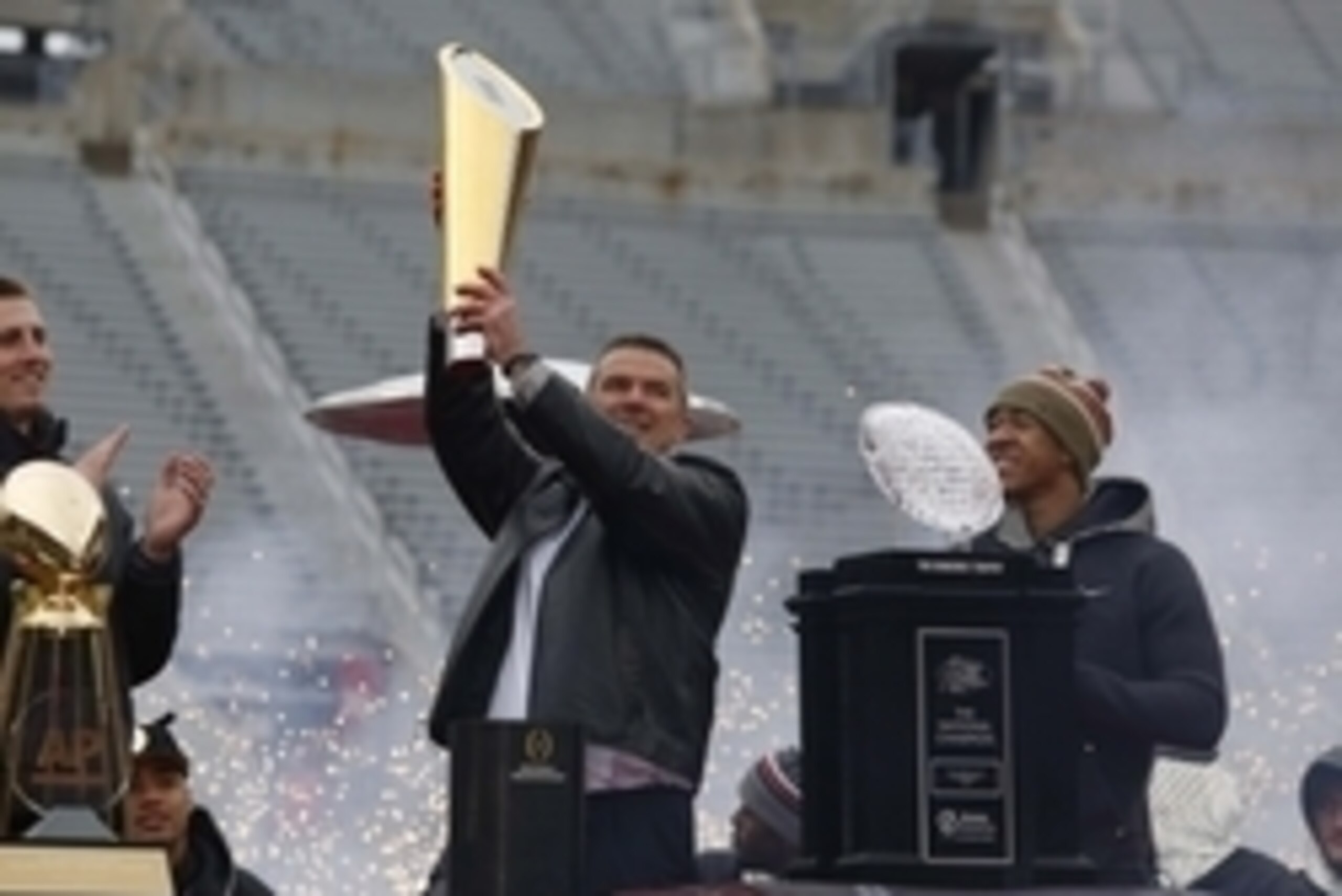

5 Reasons Why Big Ten Football Will Be Best Conference in 2015
Considering all of the adversity the Buckeyes endured in 2014, their accomplishments were nothing short of amazing. But don't let the national media mislead you: The Big Ten has become much more than just one solid team—and 2015 is shaping up to be a banner year for the conference.
As it turns out, the Big Ten isn't a glorified Division III conference. Despite bleak forecasts back in September from non-Midwestern commentators, the Big Ten not only earned a couple of spots in New Year's Six bowl games, but Ohio State managed to secure a berth in the College Football Playoff—and then win the whole darn thing.
Michigan State also won its CFP committee-selected bowl game against Big 12 co-champion Baylor in the Cotton Bowl Classic.
The Big Ten has languished for years as the butt of jokes from the national media and punditry. There was no shortage of predictions almost gleefully anticipating the Big Ten falling flat and missing out on the inaugural College Football Playoff.
Will 2014 finally earn the Big Ten some national respect? Maybe, maybe not (and if you live south of the Mason-Dixon Line almost certainly not). But here are five simple reasons why the Big Ten will emerge as the best conference in the nation in 2015.
The National Media Gets It Wrong
1 of 5
How is it that the national media could be so wrong?
For nearly the entirety of the 2014 college football season, you couldn't turn on any television network—with the exception of the Big Ten Network—without hearing about how great the SEC was, how no one else could compete, how it was a foregone conclusion that there would be two SEC teams in the playoff and how it was about as certain as it could be that one of those two teams would win the first-ever College Football Playoff championship.
Again, we'll ask how the national media managed to miss the mark so badly.
First, it makes for some pretty good television. No one is going to sit through hour after hour of in-depth statistical analysis using quadratic equations and advanced trigonometry to try to accurately determine which teams are better than others. We want raised voices. We want overreactions. We want bold—and usually baseless—predictions.
And that's exactly what we get.
As Graham Couch of the Lansing State Journal accurately pointed out: "What we have here is a failure to properly evaluate."
Couch also opines that the 2014-15 bowl season demonstrated pretty dramatically that the national talking heads "don't actually know how to judge college football teams." Instead, these gurus of football "live on recent history, skin-deep knowledge, biases and emotional reactions." Preach it, Brother Couch.
To be fair, Couch does qualify his criticisms about the national media by admitting that these Saturday prognosticators rely on their biases and emotions "just like most of us." But shouldn't we be demanding more from those paid hundreds of thousands—or even millions—of dollars every year to give us sound analysis?
In the end, we'll probably have to suffer through another summer and fall of being told that 2014 was a fluke season for the Big Ten. If that bothers you, just remember what everyone was saying about the Big Ten last September.
It should help you sleep a little better.
The Numbers Don't Lie
2 of 5
There are plenty of things we could point to in order to illustrate our last point about just how wrong the national media got it last season. But instead of doing a point-counterpoint ad nauseam, we'll highlight a few points that will serve to exemplify the argument.
After Ohio State demolished Wisconsin in the Big Ten Championship Game by a score of 59-0, the Buckeyes were rewarded with a spot in the College Football Playoff. Instantly, football fans in the state of Texas were ready to begin protesting while the media types outside of the Big Ten's traditional footprint cooked up some healthy conspiracy theories.
Isn't it funny how it seems as if the SEC-philes of the world retort that "money has nothing to do with it" for years and years—until that argument works in their favor? Now all of the sudden, the Big Ten only gets a team in because it made financial sense for the CFP. But we digress...
Maybe Wisconsin wasn't all that good. Maybe the Badgers just played a terrible game. Maybe the Big Ten's East Division really is that dominant. Surely that 59-0 score only serves to illustrate just how bad the rest of the conference is, and surely Ohio State can't point to that victory as a "quality win," right?
Except Wisconsin proceeded to beat a team from the almighty SEC in the Citrus Bowl. Auburn, which incidentally led Alabama after three quarters in the Iron Bowl, was unceremoniously knocked off by a team that was not only humiliated by Ohio State in the Big Ten title game, but was playing without its head coach.
So if Ohio State destroys a team that can knock off a team that nearly beat Alabama, why is it so hard to believe that Ohio State isn't at least deserving of a shot?
And what about Michigan State?
Remember how the Spartans' season was all but over after losses to Oregon and Ohio State? Remember how that doomed the Big Ten's chances? Remember how Baylor was supposedly screwed out of a playoff spot that went to Ohio State?
If Baylor really is as good as everyone says, what does that now say about Michigan State?
The Spartans Aren't Going to Simply Go Away
3 of 5
Michigan State seems to perpetually be the program no one remembers. Heck, even Mark Dantonio's Cotton Bowl Classic press conference devolved into a back-and-forth about Jim Harbaugh's arrival in Ann Arbor.
Slowly but surely, however, MSU is developing into a national power. No, really, it is.
College football powerhouses aren't built overnight. Dantonio knows this, and he certainly never fooled himself into thinking the Spartans would instantaneously become the quintessential college football team. But inch by inch, Michigan State has become one of the winningest programs in recent history.
Compare the Spartans' win-loss record to any FBS program over the past two seasons, and you'll see Michigan State hanging right in there with names like Oregon, Ohio State and Alabama. In fact, Michigan State's 24-3 mark puts the Spartans ahead of Oregon, Alabama and Baylor in terms of win percentage, and only two teams—Ohio State and Florida State—have more victories.
Michigan State is also winner of four straight bowl games, including the Rose Bowl Game and Cotton Bowl Classic. The other two bowl wins came against TCU and Georgia—not exactly pushover programs.
While the focus is rightly directed at the College Football Playoff and the teams that earn a spot in the four-team tournament, don't expect Michigan State to be content with being "almost" good enough for very long.


Jim Harbaugh
4 of 5
A good Michigan team doesn't mean the Big Ten is the greatest football conference in the nation. But it certainly doesn't hurt.
Harbaugh has seven years of collegiate head coaching experience plus four in the NFL. He's been a winner everywhere he's been, putting together a combined 102-46-1 record (58-27 in college and 44-19-1 in the NFL). All three teams he has led (FCS San Diego, Stanford and the San Francisco 49ers) have had winning records under Harbaugh, and all three teams have won a championship of some kind.
Add in his familiarity with his alma mater with his unyielding respect for Michigan tradition, and you suddenly have a perfect recipe for returning the Wolverines to relevance, not only in the conference, but nationally.
So how does this help the conference?
The Michigan-Ohio State rivalry was once the unquestioned leader on any list of greatest sports rivalries. Barely a year went by where "The Game" didn't directly impact the Big Ten title and resulting trip to Pasadena, and national championship dreams were often on the line for at least one of the schools.
Ohio State has now won 10 of the last 11 meetings and 12 of the last 14. Over the past seven seasons, the two rivals have met just once with both teams sporting a Top 25 ranking. In the meantime, the Iron Bowl between Alabama and Auburn has supplanted Michigan-Ohio State as the quintessential season-ending rivalry game.
If Harbaugh can do what many expect him to do—return Michigan to its winning ways in relative short order—fans around the nation will once again be treated to a Michigan-Ohio State showdown that actually has an impact on the national landscape.
Youth
5 of 5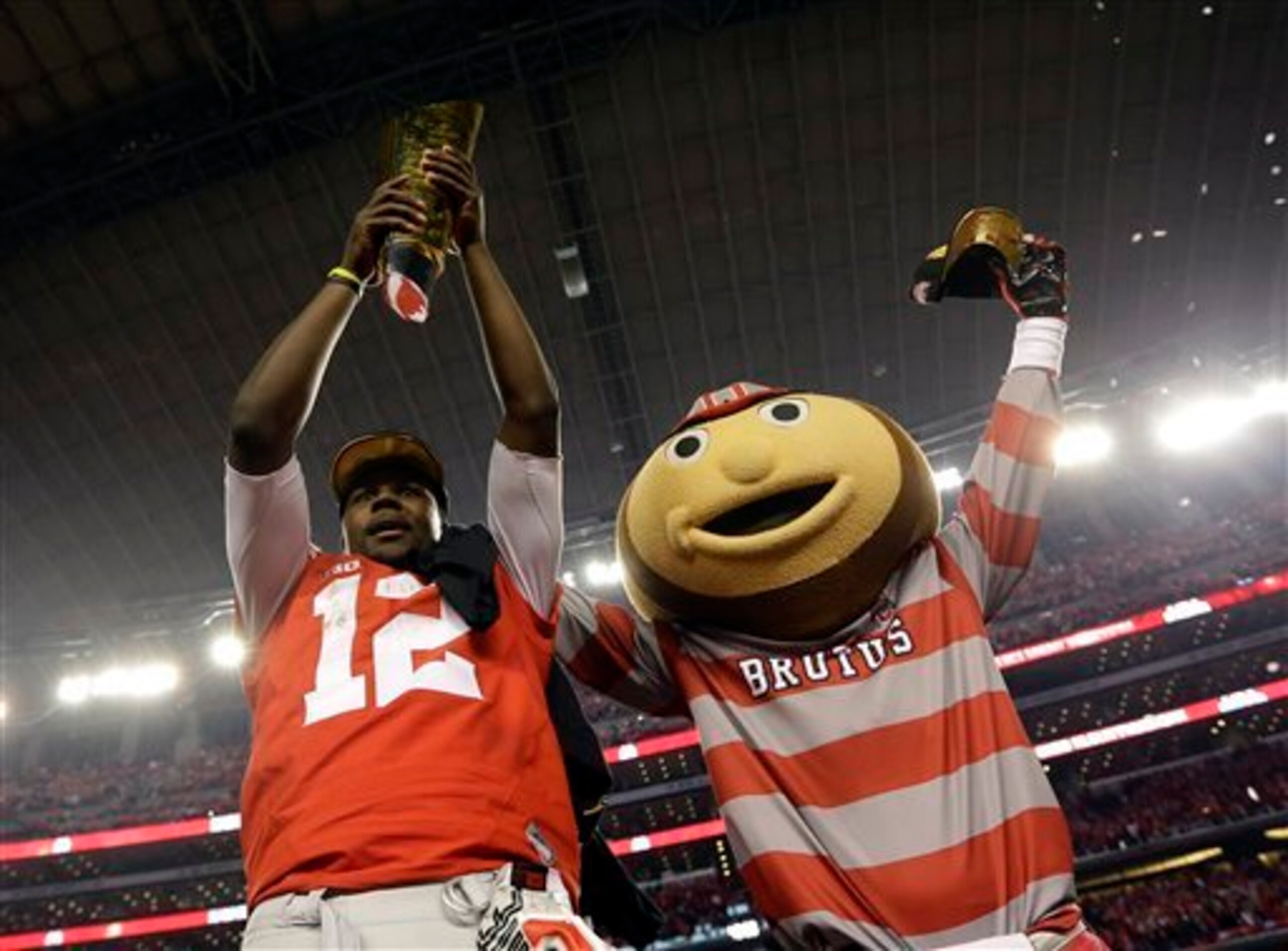
Everyone expected Ohio State to compete for a national title, but most of us expected it to happen next season. Instead, Ohio State showed just how good its young cast of characters really is by winning the first College Football Playoff title a year ahead of schedule.
So now that we're closing in on the year we all expected Ohio State to win it all, the question now becomes whether the Buckeyes can do it all over again.
The Buckeyes will start from a pretty favorable position. For 2015, the Buckeyes are returning 99.6 percent of their passing yards and 97.0 percent of their rushing yards. Heck, even the 64.9 percent of receiving yards production coming back next season isn't too shabby.
Ohio State grew up before our very eyes in 2014. From a rocky start that saw the Buckeyes trail Navy at halftime and lose to a bad Virginia Tech team in Week 2, the Buckeyes matured every week after to become not only giant-killers, but a giant in their own right.
A program as well-coached as Ohio State doesn't often regress, and the entire nation is going to have to contend with the Buckeyes—and the rest of the much-improved Big Ten—in 2015.
Follow Bleacher Report National College Football Featured Columnist David Luther on Twitter.
_0.png?w=2560)


.jpg?w=2560 "Grading WWE Raw 🔠")

.jpg?w=2560 "Viral Rams Coach Vid 🖕")


.jpg?w=2560 "Injury-stricken Seahawks signing veteran RB")
