

How the Portland Trail Blazers Can Go from Very Good to Finally Great
The Portland Trail Blazers know two things about their quest for NBA supremacy.
The first is that they're on the right path, a fact evidenced by last season's success (54 wins and a second-round appearance) and the subsequent strides they've made in 2014-15 (better defense, more depth and an improved winning percentage).
But they also understand the final hurdle on this obstacle course is the hardest to clear. It takes a lot for a team to be good, or, in Portland's case, very good. But chasing greatness is a different type of challenge.
TOP NEWS

LeBron's Special Helicopter Deal

MJ Makes Record-Setting Donation 🙌
Shams: KAT, Hart Could Be Trade Names
Despite some recent setbacks—eight losses over their last 11 games—the Blazers haven't sealed off their window to championship glory. But there are several steps remaining if they hope to capitalize on their towering ceiling.
Avoid the Injury Bug
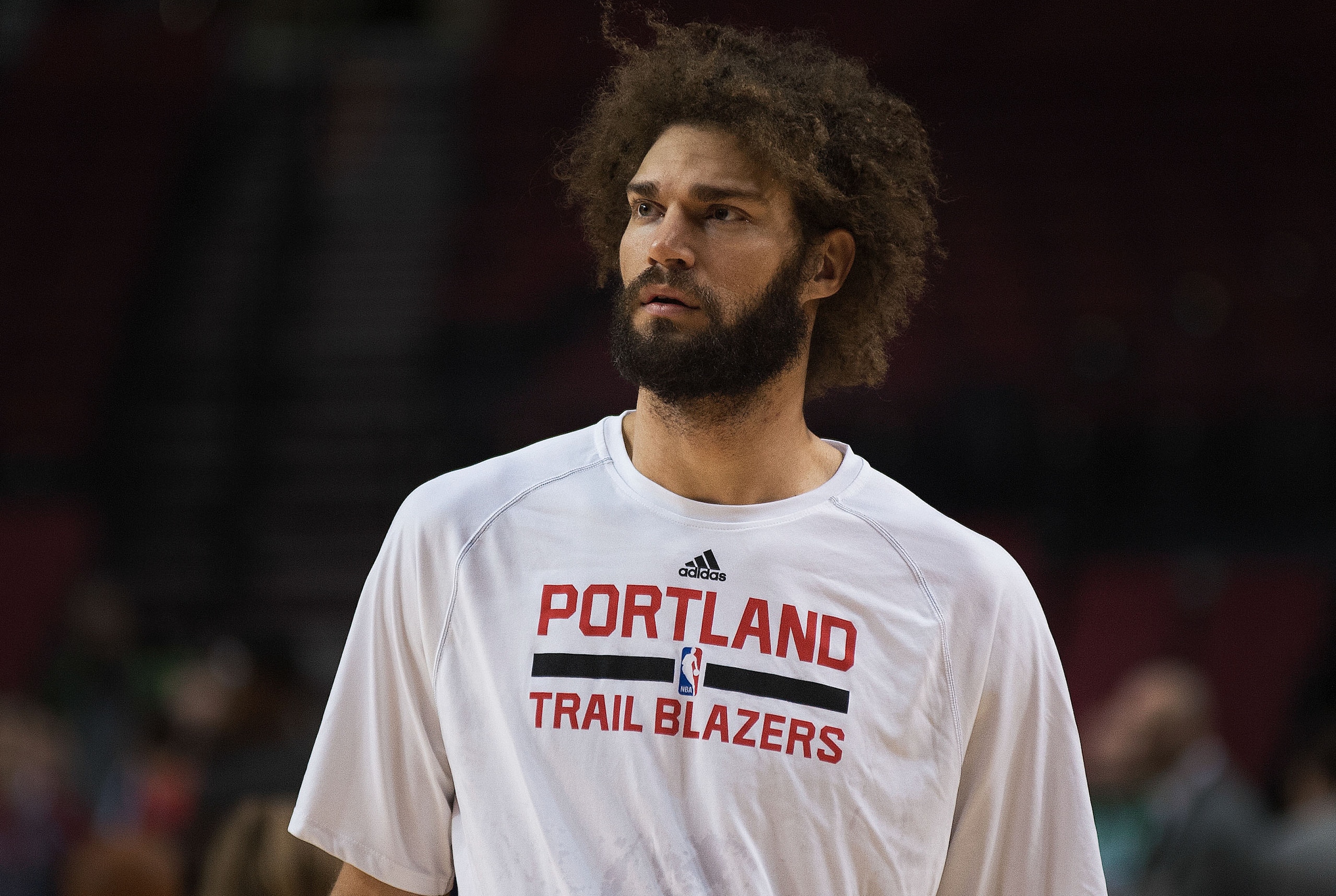
It's entirely possible that Portland's current starting five is the most complete group the franchise has ever fielded. And that's saying a lot considering this organization's storied past includes a world title in 1977, two other trips to the NBA Finals and three additional appearances in the Western Conference Finals.
When this group is whole, the pieces fit together like a jigsaw puzzle.
Damian Lillard and LaMarcus Aldridge rank among the league's very best two-man tandems. Wesley Matthews and Nicolas Batum are long, athletic defenders who do their fair share of damage at the opposite end. Robin Lopez brings a duct-tape skill set to the frontcourt, holding everything together with energy and activity.
In the 442 minutes those five have shared the floor, the Blazers have outscored their opponents by 11.3 points per 100 possessions. To contextualize that number, only the West-leading Golden State Warriors have a better net efficiency rating this season.
But Portland hasn't been able to field that entire starting five lately. Lopez's 25 minutes during the Blazers' 103-102 win over the Utah Jazz on Tuesday were the first he'd played since fracturing his right hand on Dec. 15.
Although the big guy's numbers didn't fly off the page—11 points, six rebounds and two blocks—his presence provided an obvious lift to the players around him.
"His presence just makes me more comfortable and more confident for our team," Lillard said, per Comcast SportsNet's Peter Socotch. "I think everybody was more comfortable just knowing that we had him out there."
Lopez is the garbage man of the group, the guy who puts his body on the line to crash the offensive glass, hit the deck in pursuit of loose balls and provide a defensive deterrent around the rim. The Blazers went just 13-10 over the 23 games he missed and have been 4.8 points per 100 possessions better this season when he's on the floor.
But this isn't about Lopez or, really, any individual on the team. What the seven-footer really provided was the continuity the Blazers had been missing and the serenity that comes along with it.
"Not only does he help the starting unit, he just helps the team altogether because it sets rotations," Matthews said, per Anne M. Peterson of The Associated Press. "Everybody is back to what they're accustomed, where they've been playing for so long."
Last season, the Blazers had Lopez for all 82 regular-season games and fielded the same starting five in 69 of those contests. It's next to impossible to replicate the rhythm those five have when even one of them is missing, and Portland knows that as well as any team.
Despite offseason efforts to beef up their bench (namely, the signing of veterans Steve Blake and Chris Kaman), Portland still employs one of the NBA's least productive reserve units. The Blazers bench ranks 28th in scoring (25.4 points per game), 18th in rebounding (15.2) and 15th in assists (6.8), per HoopsStats.com.
That's why Lopez's injury was so noticeable, why the torn ligament in Aldridge's left thumb still has Rip City walking on eggshells and why Batum's season-long struggles are so worrisome. The versatile forward has struggled to the point that it looks like he could use a lengthy layoff to let his ailing right wrist heal.
But that bridge hasn't been crossed yet and quite possibly never will be. As much as the Blazers would like a healthy Batum, they'd still rather have the current version instead of reshuffling the rotation to find his replacement.
"I've just got to suck it up. I can't give up on those guys," Batum said, per Joe Freeman of The Oregonian. "I know a lot of these losses are because of me. I know that."
Portland has to hope that either Batum's wrist fixes itself, or he learns how to deal with it in a way that pulls his numbers out of a nosedive. The Blazers can't afford to have anything interrupt the progression of their starters as an elite NBA force.
Injuries are a pain for any team and never anything that can be controlled. But if Portland has a path to the podium, it starts with keeping its strongest five out on the floor.
Get Back to the Basics

There is no secret for the Blazers to get themselves back on track. They need a change about as badly as supermodels need plastic surgery.
For Portland, this is all about remembering the things that started its NBA ascension. As Matthews put it, per Mike Richman of The Oregonian, the Blazers just need to rediscover their swagger:
"It's about getting better, It's about winning, it's about playing the right way, it's about getting back to what we were and who we were when we were feared.
We're not feared right now. I don't think teams come into the Moda Center and fear a game. I don't think teams know that when they wake up and have shootaround at their place that the Trail Blazers are in town. That was like that earlier in the season. We've got to get that back and we can.
"
This has always been a confident group. The Blazers attempt 27.6 threes a night, the second-highest average in the league. That level of perimeter activity isn't seen from a team lacking self-assurance.
Perhaps this 11-game stretch came with copious amounts of humility, but digging deeper into that span shows it's hardly a sign for panic. Of those eight losses, only one came against a team sitting outside the current playoff picture. And even that was only a one-point loss to the feisty Boston Celtics, a game that Lopez and Aldridge both missed.
The NBA's 82-game marathon is always a grind, and not every part of it is going to be pretty.
"Bugs pop up in the course of a season," wrote The Oregonian's Jason Quick. "With the Blazers right now it's allowing offensive rebounds and late-game execution."
On the season, the Blazers have the league's fourth-best efficiency rating in clutch situations, the last five minutes of games where the margin is five or fewer points. But since Jan. 14, Portland has posted a minus-11.8 net rating in those spots, which ranks 20th during that stretch.
The Blazers have gone from closing the coffin on others to being buried in that box themselves.
Part of the problem stems from defensive breakdowns this system is built to avoid. Blazers coach Terry Stotts has been very specific about the things he wants to take away from opposing teams.
"The Blazers system isn’t rocket science—they want to take away the most efficient shots on the court, particularly threes, and force teams more into the mid-range," wrote NBC Sports' Kurt Helin.
That hasn't been happening of late. Despite leading the league in three-point percentage against (31.4), the Blazers rank 29th in that category over their last 11 outings (39.3). They've been uncharacteristically picked apart in the short corners, allowing 2.5 of those makes on 42.9 percent shooting during this stretch, well above their season averages of 1.5 and 33.8, respectively.
Lopez's absence could have contributed to those numbers, as Portland's perimeter defenders may not have felt as safe to stay glued to a shooter without that seven-foot insurance policy behind them. But the big man's return couldn't prevent Utah from converting 46.2 percent of his three-point looks, albeit on only 6-of-13 shooting.
At the opposite end, Portland needs to diversify its late-game attacks.
With a closer like Lillard, who leads the league with 301 fourth-quarter points, it's tempting to keep drawing from the same well. But over his last 11 outings, he's shooting just 35.1 percent from the field and 22.5 from deep in the clutch.
The Blazers need to keep others involved down the stretch to keep opposing teams guessing. Lillard must remain a part of Portland's closing process, but he can't be the only one. Not when Aldridge and Matthews are continuing to expand their offensive arsenals.
The Blazers' last nine losses have been decided by an average of 6.2 points. By cleaning up their fourth-quarter offense and tightening their perimeter defense, Portland could start shifting those games back in its favor.
Check off those boxes, stay healthy and the last challenge will be the one every team has faced throughout the history of sports.
Embrace the Cliches

Despite our insistence on treating this as a results-driven business, the reality is wins and losses don't matter nearly as much as the manner in which those outcomes are decided.
That's why coaches speak in a language that's become predictable to the point of sounding mundane. Teams don't look ahead or live in the past. They center their focus on making game-by-game improvements, growth that isn't seen from anything closer than the macro level.
"I send out quotes to our guys every day and the last two or three have been about the process," Stotts said, per Helin. "It’s not result oriented. I think that’s one thing we’ve done a good job at is staying in the moment and doing the things that are fundamental to us."
The Blazers are right on the brink of where they need to be. They are tied for fifth in both winning percentage and net efficiency rating. They play championship-level defense and have an incendiary offense capable of striking from anywhere on the floor.
Subtle tweaks could be enough to push this team over the top.
If it could grab some wing depth for cheap at the deadline, the move would pay instant dividends. But even without a transaction, the Blazers can keep themselves in the championship hunt by keeping their core off the injury report, running teams off the three-point line and utilizing more weapons late in games.
It's about doing the things that brought the team this far, but doing them better and more consistently to vault over the final hump.
Unless otherwise noted, statistics used courtesy of Basketball-Reference.com and NBA.com.


.jpg?w=2560 "Grading WWE Raw 🔠")
.jpg?w=2560 "Viral Rams Coach Vid 🖕")
.jpg?w=2560 "Bijan's INSANE 1st Half 🤩")
.jpg?w=2560 "Injury-stricken Seahawks signing veteran RB")
.jpg?w=2560 "2 NFL Officials Suspended")
