

49ers Should Return to Their Offensive Roots with a Focus on Read-Option Plays
San Francisco 49ers owner Jed York sat in Arizona a few days after his team promoted Geep Chryst to fill its offensive coordinator vacancy. He was there for Super Bowl week, which doubles as a week-long commercial and NFL convention. Goods and services are sold, awful movies are pushed on the unsuspecting public and many of the league’s richest men are under the same roof.
York had a microphone in his hand during an NFL Network interview, and he was asked the inevitable question about the 49ers’ sputtering offense in 2014. Is fixing quarterback Colin Kaepernick the priority for Chryst and a new coaching staff?

.jpg?w=2560 "Falcons Saints Football")
.jpg?w=2560 "Rams Eagles Football")
“It’s not about fixing Kaepernick,” York said. “I think Kap is an unbelievable player. He’s a young guy who continues to grow and mature.”
He wasn't wrong, but he was also only half right.
Kaepernick doesn’t need to be entirely rebuilt. It needs to be determined where exactly his growth is headed and how best to reach that final destination. The solution, it seems, is to enhance Kaepernick’s natural skills instead of trying to reshape him and failing.
Now the 49ers will likely work with what Kaepernick is rather than what he isn’t and shift back to a read-option-oriented offense. That approach led to three straight NFC Championship Game appearances.
It’s a necessary step to ensure the Kaepernick experiment doesn’t crumble, because, historically, running is something he does well.
The message tied to three internal promotions to fill top coaching positions has been screamed loudly. After striking out on other top candidates, York craved both control and continuity.
The latter taste is odd at first for the offense and Kaepernick. San Francisco went from averaging 25.4 points per game in 2013 (11th) to 19.1 in 2014 (25th). The status quo would seem to mean more failure—and maybe another year without a fourth-quarter touchdown pass from Kaepernick.
But if a transition back to Kaepernick’s read-option offensive roots is brewing, as outlined by Matt Barrows of The Sacramento Bee, then the 49ers can move forward by first looking backward.
Barrows explored what shape the 49ers offense will take in 2015 and how new head coach Jim Tomsula—and, by extension, Chryst—will revive a unit that scored fewer than 20 points in eight games during Jim Harbaugh’s final season. Early rumblings are the new offense will look familiar, but in a good way.
“A significant change in 2015 figures to be a return to the read-option,” wrote Barrows. “The degree to which it will be used is unknown, but coach Jim Tomsula and CEO Jed York have mentioned in recent interviews that the 49ers will take better advantage of Kaepernick’s legs.”
Shuffling off the field needs to include getting Kaepernick a downfield threat to match his immense arm strength, and pending free agents Frank Gore and Michael Crabtree may end up playing their football elsewhere.
But schematically, the offensive structure in place needs to give Kaepernick comfort instead of forcing him to find it in a system that felt foreign.
The 49ers can still have it both ways with Kaepernick, though, which is ideally the goal.
They can have a quarterback who’s uniquely athletic and thrives within an offense that highlights his strengths as a runner and mobile passer. They can also have a quarterback who’s more fundamentally sound in the pocket and can properly scan the field to make better decisions.
That passer isn’t some dream creation available only with a special request wherever quarterbacks are sold. The 49ers can look within their own division to the Seahawks’ Russell Wilson and see a quarterback who, like Kaepernick, is often more comfortable being elusive as a runner but can still function in the pocket when needed.
Kaepernick becoming more Wilson-like first rests with his development, which is the aim of an offseason retreat to the Kurt Warner school of quarterbacking. Kaepernick is working with Warner in Arizona, and the four-time Pro Bowler told CSN Bay Area’s Matt Maiocco that his student’s field vision will be a primary focus.
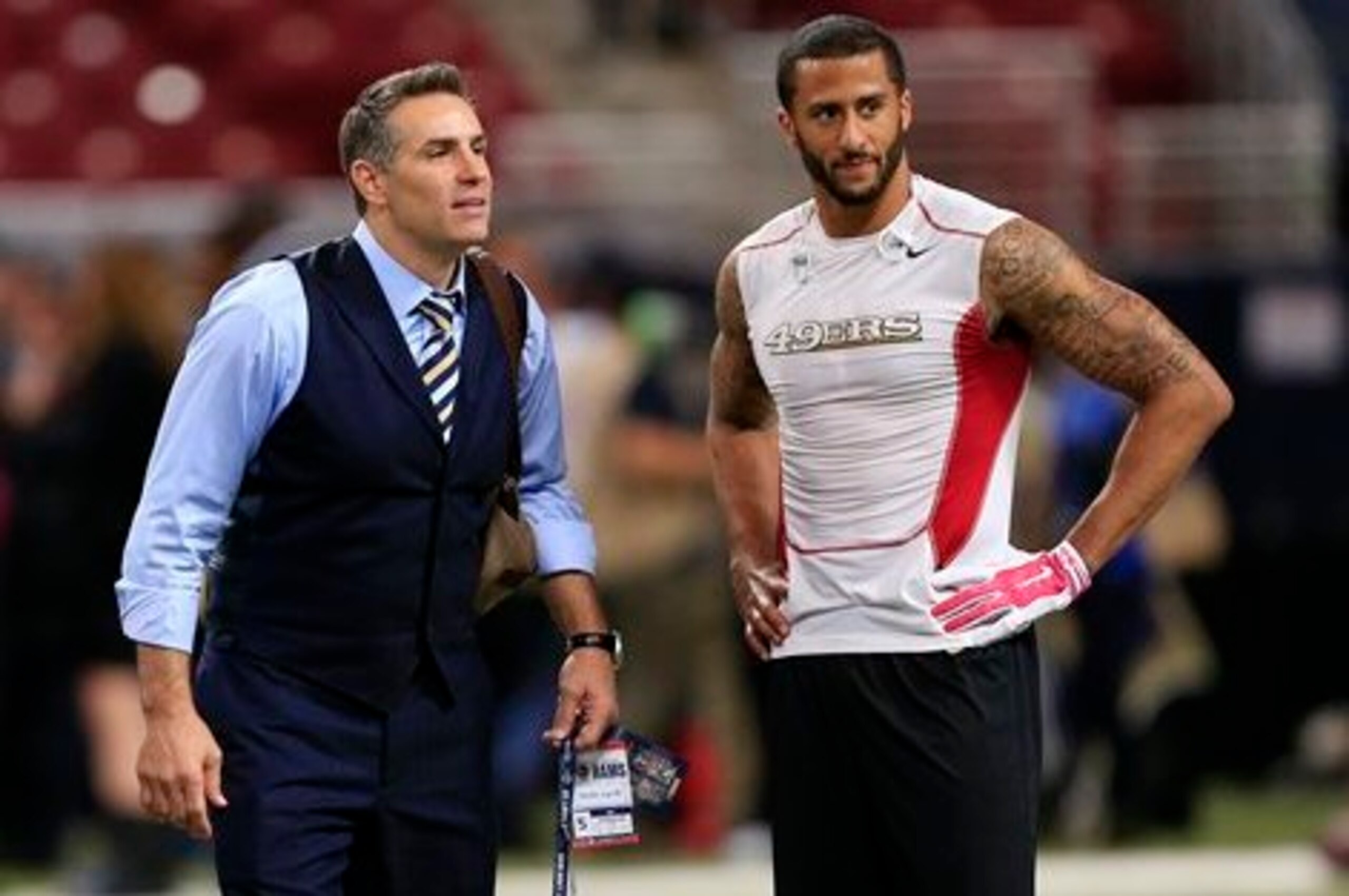
“I’m just a firm believer that regardless of how talented you are physically, you have to be able to make the easy plays at the quarterback position to be successful,” Warner said. “You have to know what you’re seeing.”
That’s critical in the process of making Kaepernick the hybrid quarterback San Francisco wants and needs. But more confidence from the pocket doesn’t mean he should be slotted into that quarterback box, with the door slammed shut forever.
Kaepernick ran for a career-high 639 yards in 2014, doing his gazelle imitation with those long, bounding strides in the open field for an average of 6.1 yards per attempt.
We know about Kaepernick, and we know him well. But most of those rushing yards came when he scrambled after plays broke down. The designed runs and read-option plays faded, and often so did the 49ers’ power-running punch.
As Scott Kascmar from Football Outsiders observed prior to 2014, Kaepernick kept the ball only sporadically on read-option plays throughout his first two seasons. That’s because, just as it is for Wilson, sudden burst and the element of surprise are central to Kaepernick’s success:
The mere threat of Kaepernick gliding to the outside creates opportunities for the running game as a whole. In 2013, the 49ers averaged 7.1 rushing yards while using the read-option, according to John McTigue of ESPN Stats & Information.
When the read-option is minimized, a significant concern for the defense evaporates, along with a multipronged attack.
Passing concepts also stem from the read-option often, and that can put Kaepernick in a position to control chaos while using his slipperiness as a runner.
During Kaepernick’s first full season as a starter in 2013, the 49ers leaned on play action far more often. He finished with the league’s fourth-highest play-action passer rating (116.4), according to Pro Football Focus.
When that usage fell in 2014, so did his play-action completion percentage.
| % of play-action dropbacks | 21.1 | 28.1 |
| Play-action comp % | 51.6 | 61.3 |
| Play-action interceptions | 2 | 1 |
| Play-action passer rating | 89.5 | 116.4 |
| Non-play-action comp % | 62.7 | 57.2 |
| Non-play-action interceptions | 8 | 7 |
| Non-play-action passer rating | 85.6 | 81.6 |
Comfort is the central theme here, and the team needs to find it for Kaepernick.
There’s always injury risk with the read-option. Washington Redskins quarterback Robert Griffin III has become the shining/shattered example, and Kaepernick was sacked a career-high 52 times in 2014. Eventually, that danger has to be embraced, though, because the alternative is a stationary square peg.
Kaepernick’s long-term growth rests with being more multidimensional and functioning within the pocket. But no amount of practice reps or whiteboard time with Warner will erase his natural instincts.
The 49ers have a decision then: Either continue to mold a mobile quarterback into something he may never completely become, or develop his pocket presence but still put him in an offensive environment that feels natural.
Thankfully, it looks like a new coaching staff is moving in an old direction.
.jpg?w=2560 "Texans-Mixon Released Football")

.jpg?w=2560 "Grading WWE Raw 🔠")


.jpg?w=2560 "2 NFL Officials Suspended")
