Redskins Free Agents: Ranking Re-Sign Priorities for Washington
A pair of quarterback-friendly pass-catchers and three members of the defensive front seven form the five free agents the Washington Redskins should make it a priority to re-sign.
That doesn't mean new general manager Scot McCloughan signing a blank check for any member of the group. But it does mean these are the players he should think twice about before letting go.
Last season's defense needs every impact player it can find up front, including incumbents. Any outside help should be dedicated to fixing a perennially porous secondary.
Meanwhile, whomever gets to play quarterback for this team in 2015 will need short-range, move targets to make the game easier.
Here are the free agents the Redskins should be least willing to let walk away this offseason.
5. Chris Neild, NT
1 of 5
Staying healthy is Chris Neild's trouble. Performing like a quality two-gap nose tackle is not. In fact, the former West Virginia standout is the closest thing this team has to a true 3-4 nose tackle.
That means Neild is still valuable despite appearing in just 24 games in four seasons. Yet on the few occasions the 2011 seventh-round pick has seen the field, he's always managed to look impressive.
Neild generates good push on the middle of the line of scrimmage and has shown an ability to lock up multiple blockers. Those are precious qualities in a three-man front defense like the one Washington runs.
Of course, staying healthy is still the main issue with Neild. ACL surgery wiped out his 2014 campaign before it even began. It was the second time he has torn his ACL since entering the pros, per Mike Jones of The Washington Post.
That means Neild won't command a major deal in Washington or anywhere else. An appearance-related "prove-it" deal for a year would make a lot of sense.
Neild is the best fit for the most important position on this defensive front seven. The position was a revolving door last season. It's time to give Neild one more chance to provide some stability in the middle.
4. Jarvis Jenkins, DE
2 of 5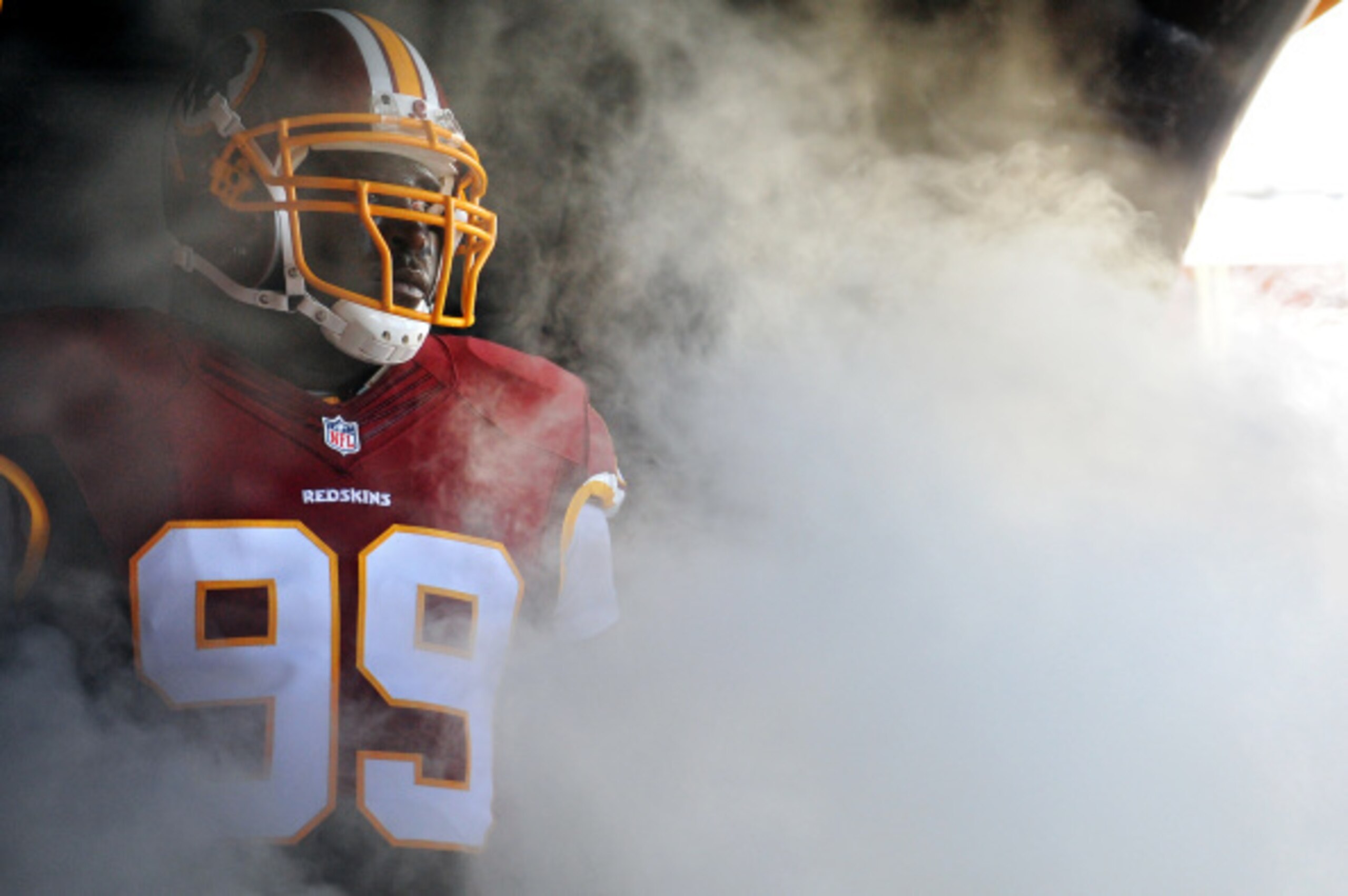
Like Neild, Jarvis Jenkins is another young, injury-hit lineman the Redskins should still consider bringing back. The 6'4", 315-pound ex-Clemson ace is tough to move inside.
While he hasn't developed as a pass-rusher, logging just two sacks in three seasons, Jenkins knows how to two-gap. He wouldn't fit a one-gap, slant-and-go, attacking style of 3-4 defense.
But if Washington keeps its more traditional look under new coordinator Joe Barry, Jenkins can be an asset. He's certainly a positive factor against the run.
In fact, Jenkins' best long-term position might be over the center. Playing nose tackle would emphasize his core power and wide frame while masking his lack of quickness and pass-rushing dynamism.
Using Jenkins and Neild together in a two-man rotation would be a cost-effective way of solving the issues this defense has at its most important position.
But just like Neild, Jenkins would have to prove he can stay healthy. In fairness, he's missed just four games the last three years following the ACL injury that wrecked his rookie campaign in 2011.
Keeping Jenkins around would help Washington get younger up front. It would also give McCloughan the option of dumping some bloated contracts.
Specifically, he could sever ties with 30-year-old Barry Cofield Jr., who is set to earn $4.6 million in 2015, per Spotrac.com. The same site shows another 30-year-old, Stephen Bowen, set to make $5.4 million in base salary next year.
McCloughan is reportedly "very wary" of relying on players 30 or over, per Real Redskins blogger Rich Tandler. That has to make Bowen and Cofield candidates for the axe.
Keeping Jenkins and Neild, a pair of 2011 draft picks, would reduce the age up front. It would also let the team work the market without two heavy cap hits to carry.
3. Brian Orakpo, OLB
3 of 5
Brian Orakpo's future can be a contentious issue among certain fans who believe he hasn't lived up to his potential. Admittedly, there's more than some justification for that view.
He's missed 25 games in six seasons since being Washington's first-round pick in 2009. His production has also been streaky. Orakpo has never posted back-to-back double-digit sack seasons, although the inconsistencies owe a lot to his injuries.
Yet at his best, Orakpo is a natural, game-changing pass-rusher. That's a invaluable commodity in any NFL era. For all the talk of his failings, Orakpo has still notched 40 career sacks.
Granted, he disappointed playing under the franchise tag last season before injury again struck. But he's not the first to find the tag an uncomfortable fit.
Despite registering just half a sack in seven games last season, the Redskins shouldn't be too keen to walk away from Orakpo's talents.
When healthy, he's the natural bookend star outside linebacker Ryan Kerrigan needs. The other members of the current rotation rate as huge question marks.
Trent Murphy, Washington's top pick in the 2014 NFL draft, hardly impressed when rushing the passer. He notched just 2.5 sacks as a rookie.
While it's far too early to write Murphy off, it's also too risky to enter the season taking a significant improvement for granted. Similarly, undrafted rush end Jackson Jeffcoat has potential, but at this stage that's all it is.
Yes, there are options on the market. Players such as Jerry Hughes and Akeem Ayers stand out. But they carry similar risks.
How would Hughes function away from the Buffalo Bills' fearsome D-line? Could Ayers turn his core pass-rushing skills into consistency, or would he resemble the player the Tennessee Titans let walk? At the moment, Ayers' best fit seems as a situational pass-rusher.
Perhaps Washington could pursue a starter in this year's draft. But that would likely mean using the fifth overall pick. That choice surely must go toward addressing either line or the woeful secondary.
If the Redskins can work out a reasonable deal with Orakpo, he's worth keeping around. He's rarely disappointed when healthy.
.jpg?w=2560 "Seahawks Chiefs Football")


2. Roy Helu Jr., RB
4 of 5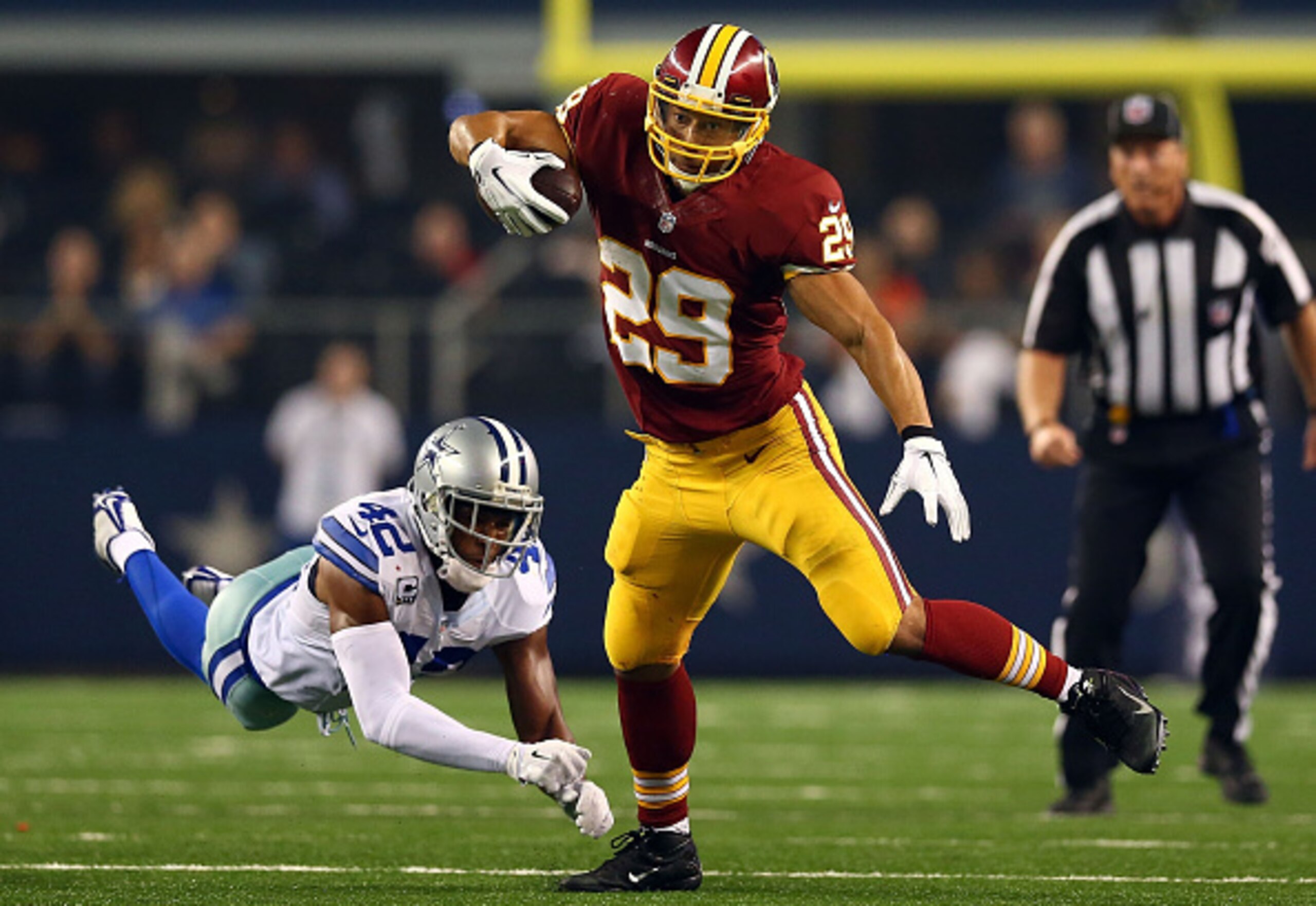
Roy Helu Jr.'s presence ensures the team's 2011 draft class is very well represented on this list. But that's not why the running back merits his spot.
He's someone Washington's front office should bring back because of the extra dimension he adds to the offense. Namely, he brings speed to the running game and excellent receiving skills to the pass attack.
The latter may be his most vital contribution. Helu is an easy target out of the backfield, one who can turn short passes into big gains.
He has natural third-down back qualities. Many, including B/R analyst Chris Simms, have speculated head coach Jay Gruden would prefer a more "electric" option for that key role.
But it's worth noting that Helu had his second-best season receptions-wise in 2014. He also posted the highest yards-per carry average of his career. Had he not missed three of the final four games through injury, his numbers would have been even higher.
When he did return, in the season-finale against the Dallas Cowboys, Helu carried the ball six times for 42 yards and caught four passes for 41.
He actually became a bigger part of the offense under Gruden and coordinator Sean McVay. It would be a mistake to let him go now.
Helu's role could expand further in 2015. If the team transitions to more power-style blocking in the running game, a distinct possibility, he could thrive running sprint draws and sweeps that take advantage of his quickness.
He can ease the burden on workhorse Alfred Morris and give defenses a different kind of threat to worry about. The 2011 fourth-rounder can also be counted on to remain an underrated factor in the passing game.
Keeping him may not be easy considering Helu thinks he can "shoulder the responsibility of playing on every down for some team in the league," per Zac Boyer of The Washington Times.
But just by ensuring Helu will get more touches in an expansion of his rotational role, Washington can convince him he still has tremendous value in D.C.
1. Niles Paul, TE
5 of 5
It would be very foolhardy to let Niles Paul go after he enjoyed a breakout campaign in 2014. The converted wide receiver and special teams player emerged as Washington's most reliable option at tight end.
He became a roving weapon, one able to win from a variety of alignments. Paul snagged 39 catches for an impressive 507 yards, averaging out to 13 yards per reception.
He picked up the slack when dynamic youngster Jordan Reed suffered yet another injury and experienced significant inconsistency. It's Reed's issues that should make keeping Paul a priority.
This offense needs more than one tight end who can pose matchup problems. Reed could be a star in that role, but his other issues mean he may never make the grade.
By contrast, Paul, while not nearly as naturally gifted, has worked hard to learn and hone his craft at a new position. That makes him the kind of player a rebuilding team should want around.
You'll notice the players on this list are generally young with plenty left to prove. They also each have clear value in specific roles.
This group can help form the foundation for what the rebuilt roster should look after McCloughan's first offseason running the show.
All statistics via NFL.com.
.jpg?w=2560 "Raiders Saints Football")