

Van Gaal's Changes Rescue Win as QPR and Manchester United Show Same Problems
LONDON — As Harry Redknapp paced around his technical area barking orders at his players on Saturday evening, Louis van Gaal sat back in his seat, analysing the game more dispassionately.
Their managerial methods might be different, and their respective clubs might be divided both by their Premier League position and ongoing aspirations this season, but the two men are united in the same struggle to get their side playing with any sort of consistency and creativity—a conundrum that both are clearly still wrestling with even as United ultimately edged to a 2-0 win.
This was another difficult game to assess, as many of United’s seem to have been this season. They were outplayed in parts, uninventive in others, yet ultimately came away with another valuable three points—something only two teams had previously managed at Loftus Road this season.


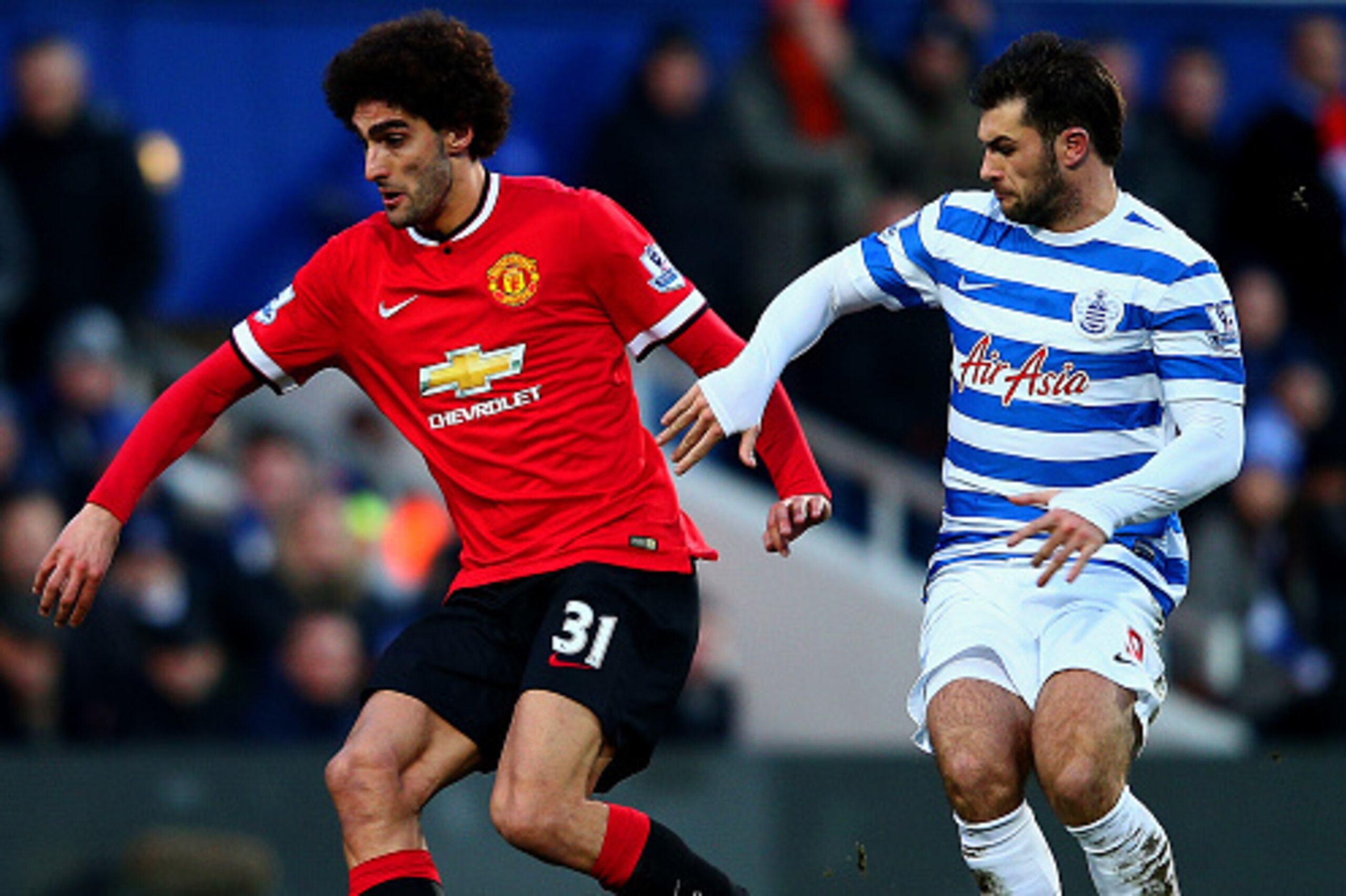
Marouane Fellaini, who Van Gaal had brought on at half-time for the ineffectual Juan Mata, grabbed the opener just before the hour-mark with a thumping finish, before another substitute, James Wilson, swept home a second deep into injury time to give the scoreline a lopsided look that did not fully reflect a turgid 90 minutes.
In the first half, United—who once again opted for a 3-5-2—dominated possession without doing anything with it. There were few noteworthy moments right up until Fellaini opened the scoring: David de Gea made two standout saves to deny Charlie Austin from long range, while at the other it was not until the second half that Radamel Falcao asked Rob Green to produce similar heroics from a close-range header.
The fact the crucial first goal came just moments after Van Gaal had changed the team’s shape, back to something more akin to a 4-4-2, will lead many to believe that the three centre-back system of the first half was the problem, although the Dutchman insisted it was not quite as simple as that.
“We have played in the first half like Queens Park Rangers wanted,” Van Gaal noted. “We did the same thing—through the air, long balls—and QPR are better at that.
“We have to play along the floor, and despite the fact the ground is not so good here you have to do it. In the second half we changed the shape also, and that helps us [too].”
The Dutchman acknowledged that QPR had perhaps been better in some areas, although he was at pains to point out that the same thing happened to his side against Southampton the previous week. “The best team does not always win," he stated, utterly unapologetically.
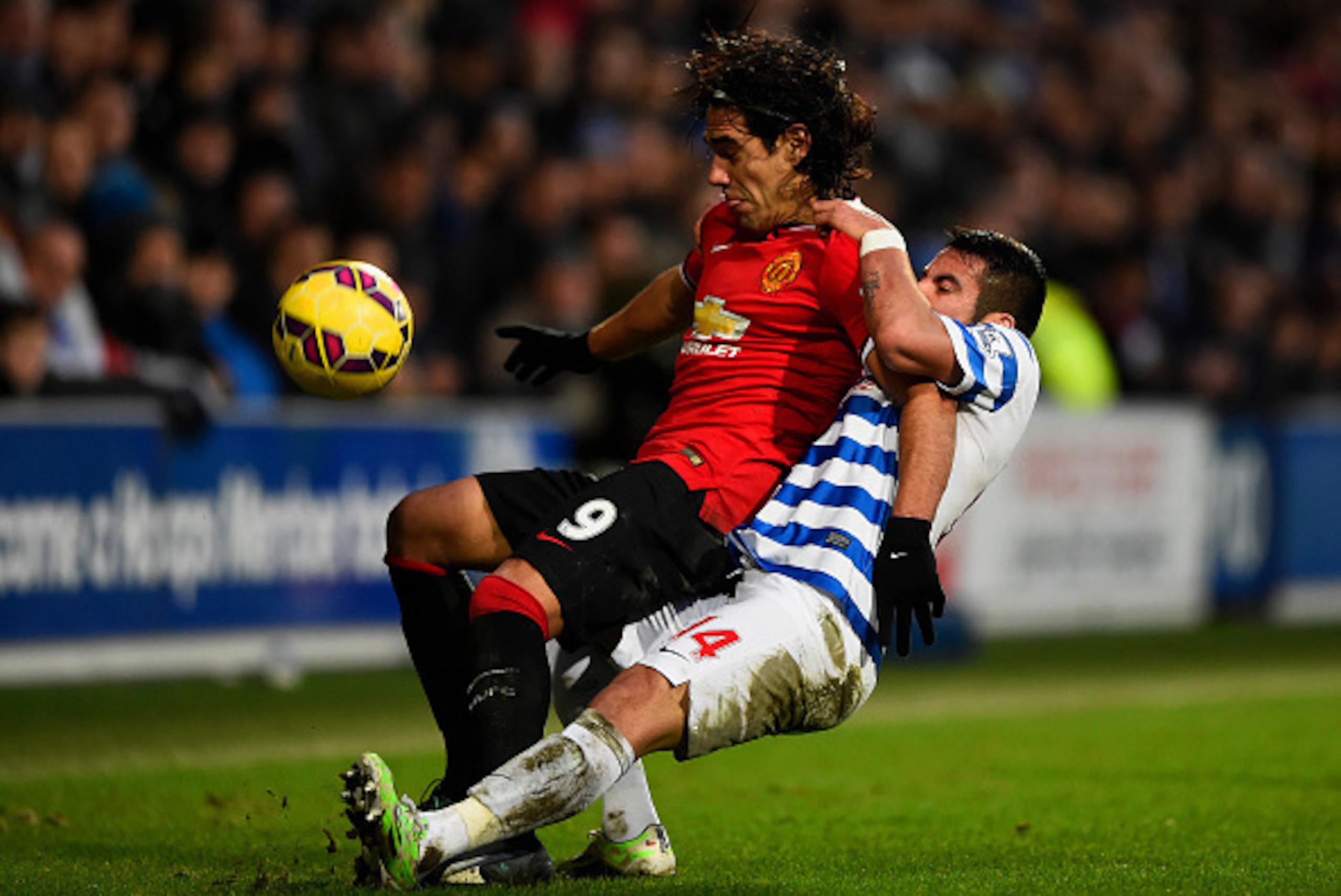
For Redknapp, however, it was a difficult pill to swallow. Much like United, QPR have been maddeningly unpredictable this season, albeit in a more predictable way. Better-than-solid at Loftus Road, the Hoops have lost every single game away from home—a shocking, almost unprecedented run of poor form that saw one player get into an angry exchange with supporters last weekend following defeat at fellow strugglers Burnley.
QPR have the ninth best home record this season, but their away disasters mean they are currently 19th in the overall table, one point from safety.
“The players have worked hard for me,” Redknapp said by way of defence. “We’ve tried different systems away from home, and none of them have really worked. Maybe we are not a very good counter-attacking team, because we lack pace in the team, and that is a problem. We need some pace in the team.”
Van Gaal arguably offered a tacit endorsement of that explanation, revealing that he started Angel Di Maria in attack again this game—a decision that certainly did not seem to work—precisely because he needed that speed to open up the game for his team.
“We have to stretch the pitch, because when you are not stretching it with your strikers then your opponents make it compact,” he said. “So then when I changed Di Maria to midfield, then I have to put on Wilson to stretch the pitch.”
A counter-attacking threat was not the problem on this occasion for QPR, however, although Eduardo Vargas did waste his side's best opening of the game after United's defence gave the ball away.
Redknapp reverted to the Charlie Austin-Bobby Zamora attacking axis that has often proved very effective. Both men impressed with their willingness to press opponents high up the pitch, although Austin was limited to speculative efforts at goal—robbing him of a chance to impress the watching England manager Roy Hodgson.
“Our home form has been great because we’ve played a certain way, and Bobby and Charlie have been vital to that,” Redknapp said. “I didn’t think it was right to change that. It was working well in the first half.
“Charlie had a couple of great strikes. He’s done ever so well, he’s improving and his attitude is first-class. He works hard, trains hard. He deserves to continue to be successful.”
Whether Redknapp deserves to continue to be successful, or just to continue to be employed, is once again a matter of heated debate. After one newspaper this week published a story claiming club owner Tony Fernandes was a game away from sacking his manager, this loss could see him unemployed by Monday.
"I spoke to Tony Fernandes this week five times, and he never said anything to me,” Redknapp said, when asked about the speculation. “Who do you believe: The insider, who might be trying to cause a problem, or the chairman?
“It’s up to them, I can only continue to do my best. At the bottom, there’s nothing in it. I still think we have as big a chance as anyone.”
Redknapp may remain confident, but it is increasingly evident that he is running out of room to manoeuvre. The money faucet appears to have been turned off for now (in his programme notes, it was made clear that loan deals are all Redknapp is hoping to do this month), which is always going to be a warning sign for a manager who hates to be characterised as a wheeler-dealer, but loves to dip into the transfer market nonetheless.
There was also conspicuously no vote of confidence for Redknapp from chief executive Philip Beard in his own notes, although it is perhaps dangerous to read too much into that. Nevertheless, the use of the once outlawed Adel Taarabt as a second half substitute indicates that, if Redknapp is going to sort out QPR’s troubles, he will have to find the answer among his current resources, even those he has previously tried to ostracise.
“In bits and pieces he did okay, he showed some skill,” Redknapp said of Taarabt. “I told him afterwards, ‘get yourself fit.’ He’s got an amazing talent.”
Van Gaal has no such problems, with money believed to be there to spend at Old Trafford once again this month. Whether he deserves to be handed the chequebook at the moment can be debated—on this occasion, he started with five players that have been signed since Sir Alex Ferguson left for huge sums, yet their value was not clear to see on the pitch.
It must be remembered that this is a hugely expensive XI (of the starting side, only Jonny Evans did not cost multiple millions), yet for large parts of the game they struggled to string passes together and barely created a shot on goal against one of the worst teams in the league. It is a familiar complaint; United are doing OK in the standings, but rarely seem to actually play well on the pitch.
Perhaps that is a result of injuries—no wonder David de Gea has been the club’s standout player this term, he seems to be the only one who has been consistently fit—but perhaps, too, United are slowly discovering that they are throwing money at a problem that cannot be solved that way.
Van Gaal believes things are still progressing and asserts that he is being deliberately pragmatic in his tactics to ensure results are acceptable. That makes sense, but it is still a fine line: If United had failed to win this game, then many in the press box were waiting eagerly to question the first-half sight of Phil Jones taking a corner, using it as a jumping-off point to more general complaints about shape and approach.

“When we play with four midfielders in a diamond we create more chances, but then the balance of the team is also weak—because the other team have also created chances,” Van Gaal said. “We have to decide every week how we are going to play.
“We lost the last game, at home [against Southampton], and we were the better team but we don’t create any chances. [Today], in the first half I think we created one chance that Falcao has to score, but in the second half Falcao was three times [presented] with big chances, and we scored two goals.
“Then with the other system we play against Tottenham, we created six or seven chances more than today and we don’t score.
“It is always the question, ‘Are you effective enough?' In football it is not always the better team who wins.”
United were not the better team on Saturday. But they were (belatedly) the more effective. Even though Redknapp and Van Gaal are still wrestling with many of the same issues with their respective sides, it is the Englishman who now faces an uncomfortable few days reflecting on his next move.
All quotes obtained firsthand.

.jpg?w=2560 "Chiefs, Steelers Eye WR Trades")






.jpg?w=2560 "Raiders Sticking with Cousins")