Quad Injury No Excuse for Poor Play from Peyton Manning, Broncos
In his press conference Tuesday, general manager John Elway dismissed the idea that Peyton Manning’s partially torn quad was the reason the Denver Broncos lost, 24-13, at home the Indianapolis Colts. The team didn’t go out “kicking and screaming,” according to Elway, and he was disappointed they “didn’t play with more fire.”
Manning’s decision-making, the play-calling, the game plan and the performances of his teammates were all bigger factor's than the team’s "fire" or Manning’s quadriceps. While Manning’s thigh may have affected his play, it was certainly not the primary reason why the Broncos played so poorly.
TOP NEWS

New NFL Power Rankings 📊
.jpg?w=2560 "Seahawks Chiefs Football")
Chiefs, Steelers Eye WR Trades
Predicting Five Potential Shocking Trades 😲
In the end, head coach John Fox got the blame for all of it when the Broncos parted with him due to philosophical differences. If scheme was the problem, it’s odd that Elway would announce that both offensive coordinator Adam Gase and defensive coordinator Jack Del Rio are candidates to replace Fox.
Although Elway declined to get into his differences with Fox, it’s clear that the problem was more style than substance. If Elway is correct, the team will improve under a more forceful head coach, even when a lot of the evidence suggests their competitive drive wasn’t the problem.
Manning’s Decision-Making
Up 7-0 in the first quarter, the Broncos had a chance to add to their lead after the Colts punted twice on their first two drives. They’d have to start deep in their own end, but even a field goal would have been a success.
After running back C.J. Anderson ran for 22 yards on first down, the Broncos ran three plays and punted. After Anderson lost two yards, Manning threw two passes that landed incomplete. The key play was on 2nd-and-12. Converting on 3rd-and-long in the NFL is difficult, so the Broncos needed to gain a chunk of yards back at worst.
Manning threw deep down the left sideline to wide receiver Emmanuel Sanders. Incomplete. Cornerback Vontae Davis—one of the best cornerbacks in the league—was in coverage. It was one-on-one with the safety out of position to make a play, so it doesn’t seem like a horrible decision until you consider the circumstances.
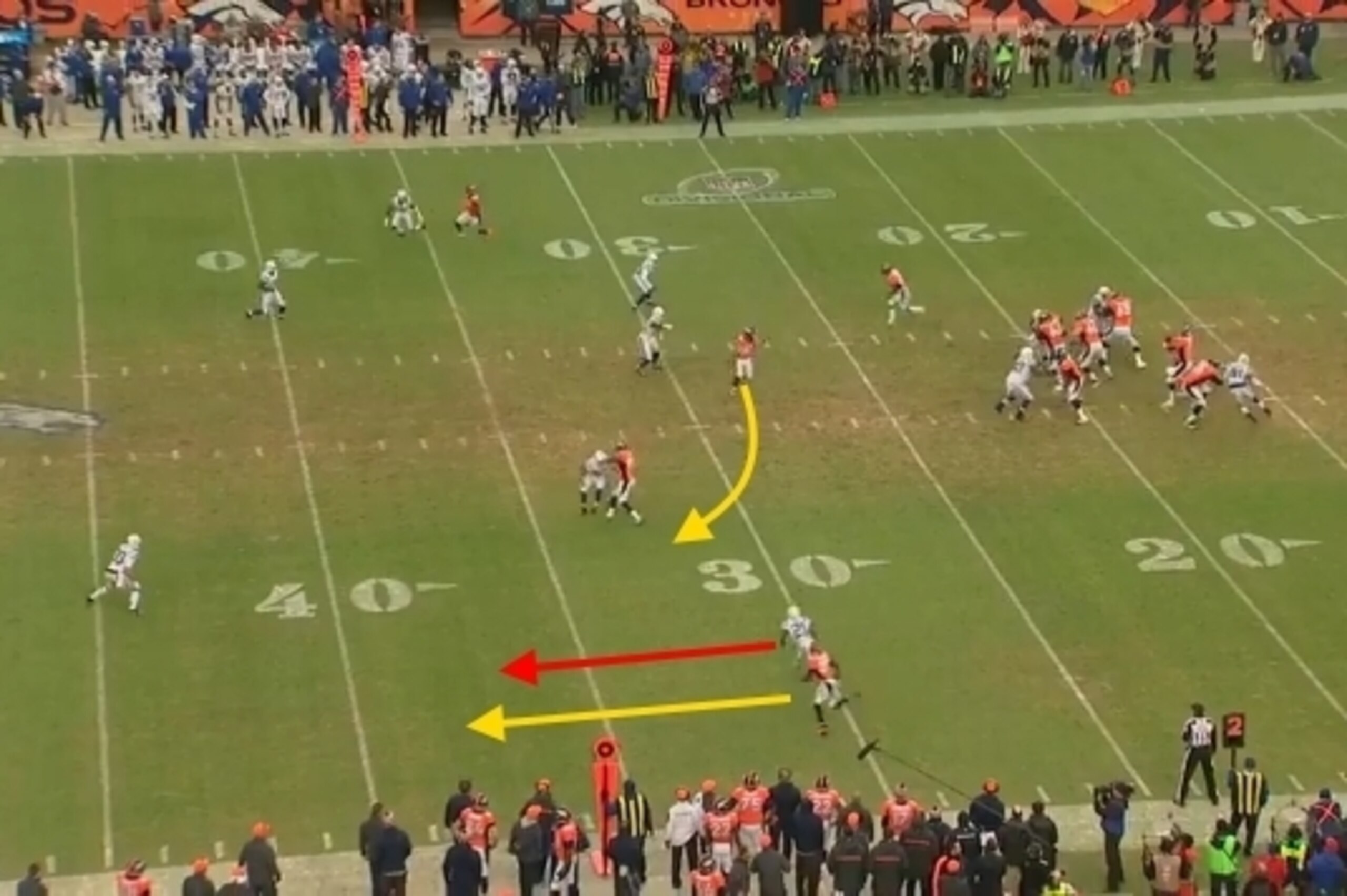
It was 2nd-and-12, Davis was in coverage and the Broncos needed positive yards to make third down manageable. In this situation, Manning should have taken the safer play if it was there—especially if there was any doubt that he could get the ball deep. Manning wasn’t aware of his own limitations and underthrew a low-percentage pass that was broken up.
Slot receiver Wes Welker drew the coverage of a linebacker on the play, so he was wide open for a gain of at least five yards had Manning seen him. Welker had room to run, and had he picked up a block, he could have turned it into a sizable gain.
Manning’s usually impeccable decision-making failed him on this play and many others. After miscommunication on third down, the Broncos punted, and the Colts scored a touchdown to tie the game on the ensuing drive.
What’s worse is that Manning made a similar mistake on the next drive—also on 2nd-and-12. Manning predetermined a throw to tight end Julius Thomas down the left sideline, and the pass fell incomplete with safety LaRon Landry in coverage.
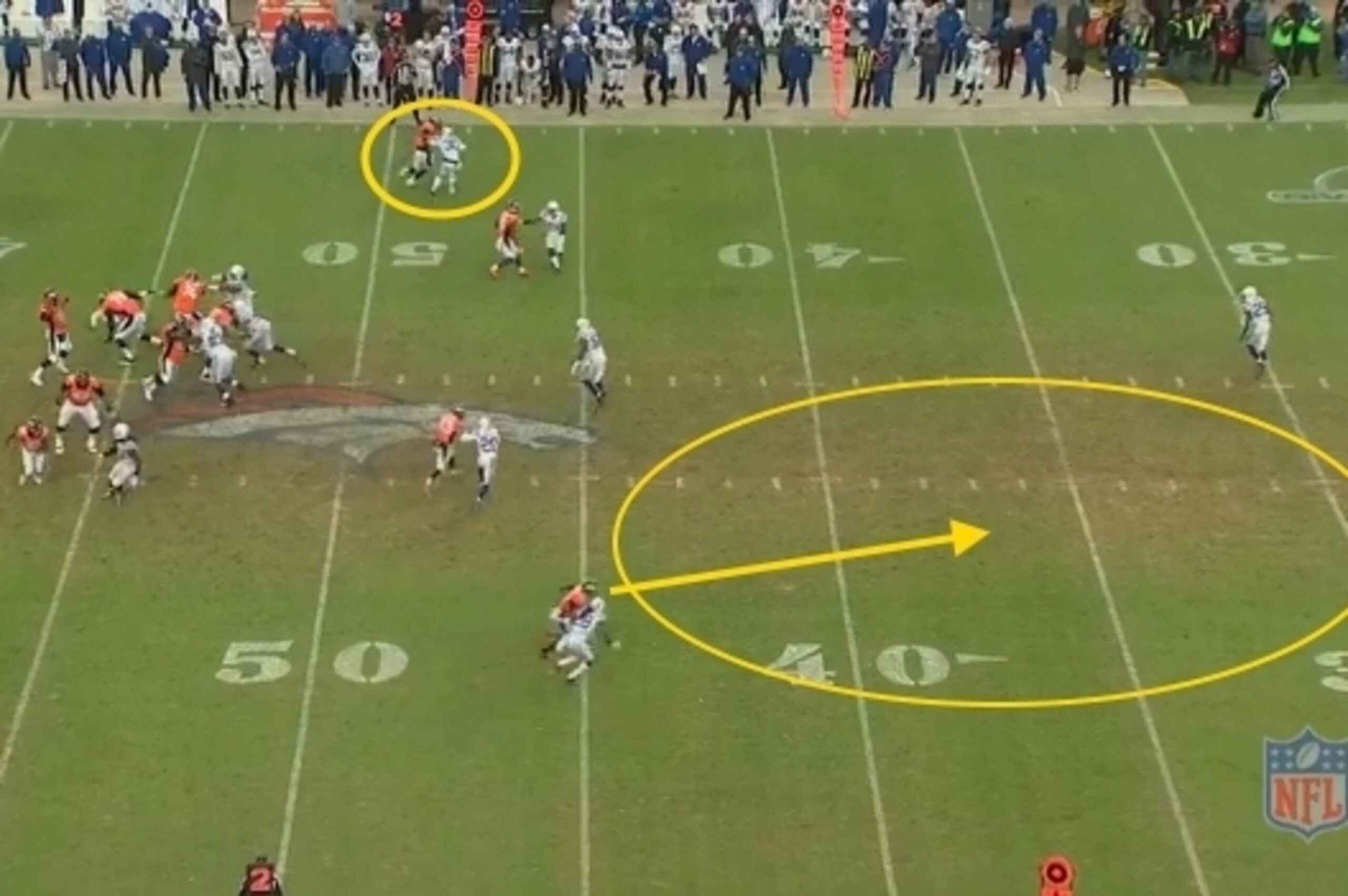
Only difference on this play was that Manning didn’t have a short pass to Welker open; he had Sanders in one-on-one coverage with cornerback Greg Toler. That’s a huge mismatch, and one Manning should have seen pre-snap.
Toler graded out (subscription required) as the worst Colts defender and one of the worst cornerbacks in the entire league in coverage. To predetermine a throw to Thomas in that situation with the defense cheating to that side of the field was just a bad decision on Manning’s part.
The incomplete pass on 2nd-and-12 also set up the 3rd-and-12, and Manning was sacked and fumbled. The Colts drove the field to take a 14-7 lead and never looked back. Notable on that play was a big mistake by left tackle Ryan Clady, who blocked the wrong defender, and Julius Thomas failing to get open on a clear-out route designed to get him the ball.
The Broncos made an adjustment on the next drive and tried to go deep to Sanders over Toler twice, but Manning didn't make the throws accurately. How much the thigh injury affected those throws is impossible to know, which is why we can’t blame the injury.
Manning picked a bad day for his worst game of the season, but his struggles date back to Week 9 against the New England Patriots. The thigh only compounded his issues if it was an issue at all.

Despite these mistakes, the Broncos still had a chance to get back into the game. On 3rd-and-2 with about three minutes to play in the first half, Manning threw incomplete for Wes Welker, but a defensive holding penalty away from the play gave them a first down.
Three plays later, the Broncos still punted. However, on the incomplete pass to Welker, running back C.J. Anderson ran a wheel route from the slot. Thanks to a natural block from Julius Thomas, Anderson had nothing but green grass in front of him.
The decision to throw to Welker wasn’t necessary a bad one given the safety had cheated over, but the margin of error was still significantly smaller than the pass to Anderson. Since Manning had already missed several deep throws, that margin of error was not insignificant in this case. It wasn’t necessarily a bad decision by Manning, but a better one was available and could have saved the drive.
On the first drive of the third quarter, Manning had the opportunity to run for a first down. Manning decided instead to throw a mid-range sideline pass to Sanders, who couldn’t get both feet down in bounds.
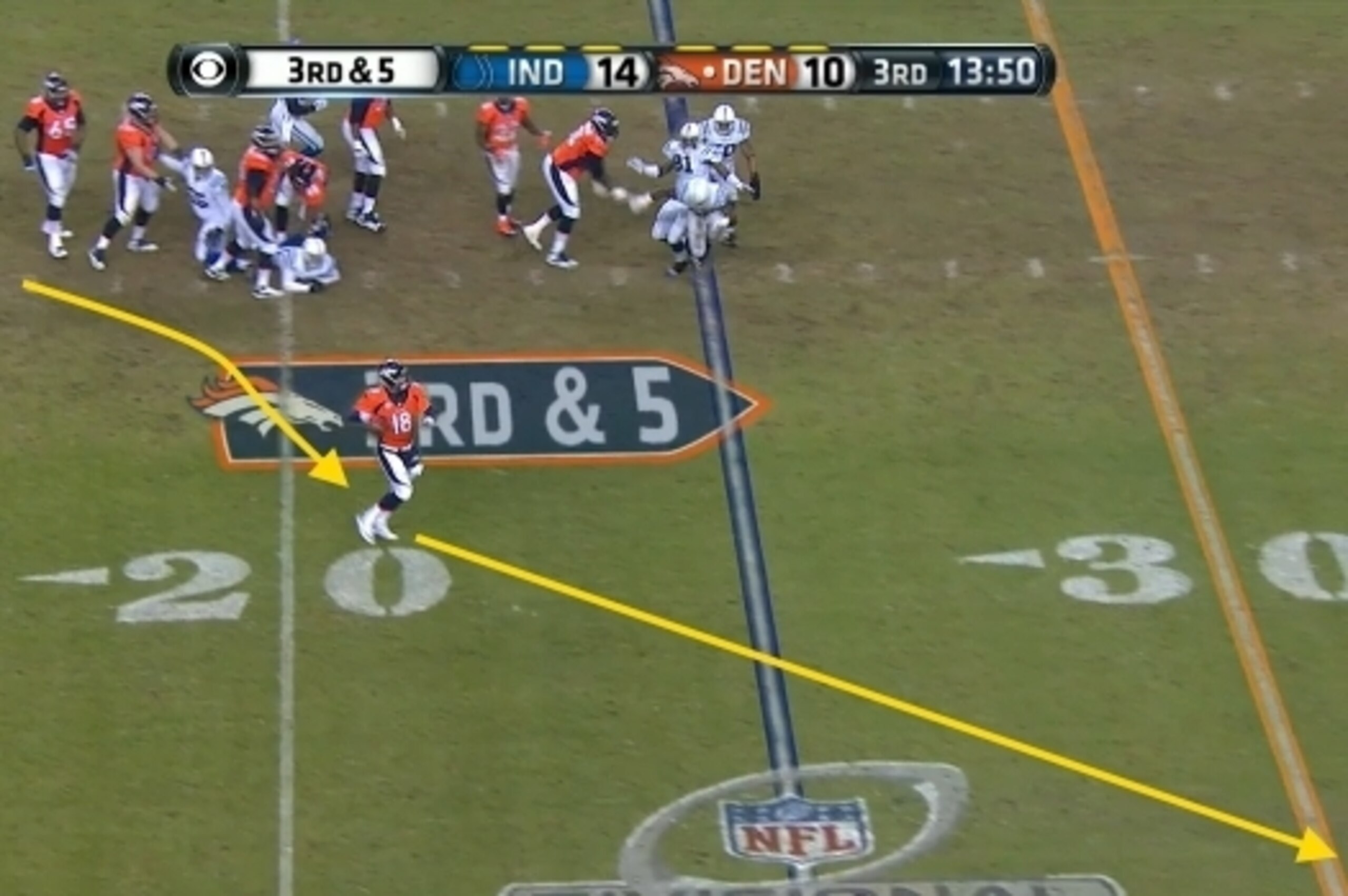
Many have pointed to the quad injury as reason why Manning didn’t run for the first down on this play, but he had already scrambled five yards out of the pocket, and it wasn’t the first time in the game he had done so. Manning has so much space, he could have probably walked and picked up the first down, and he should have.
By the time the Broncos would get the ball back, they’d be down, 21-10. Once the Broncos had to abandon the run, the Colts did an even better job in coverage on Denver’s wide receivers.
When the Broncos did drive down the field for a field goal, they were limited to mostly short passes. Manning was no longer testing the Colts deep, which meant dinking and dunking their way down the field with the use of the no-huddle.
Still with plenty of time left to make a comeback, Manning threw incomplete for Sanders on 3rd-and-5 in the fourth quarter. Sanders was in single coverage, but Darius Butler was in good position to make a play.
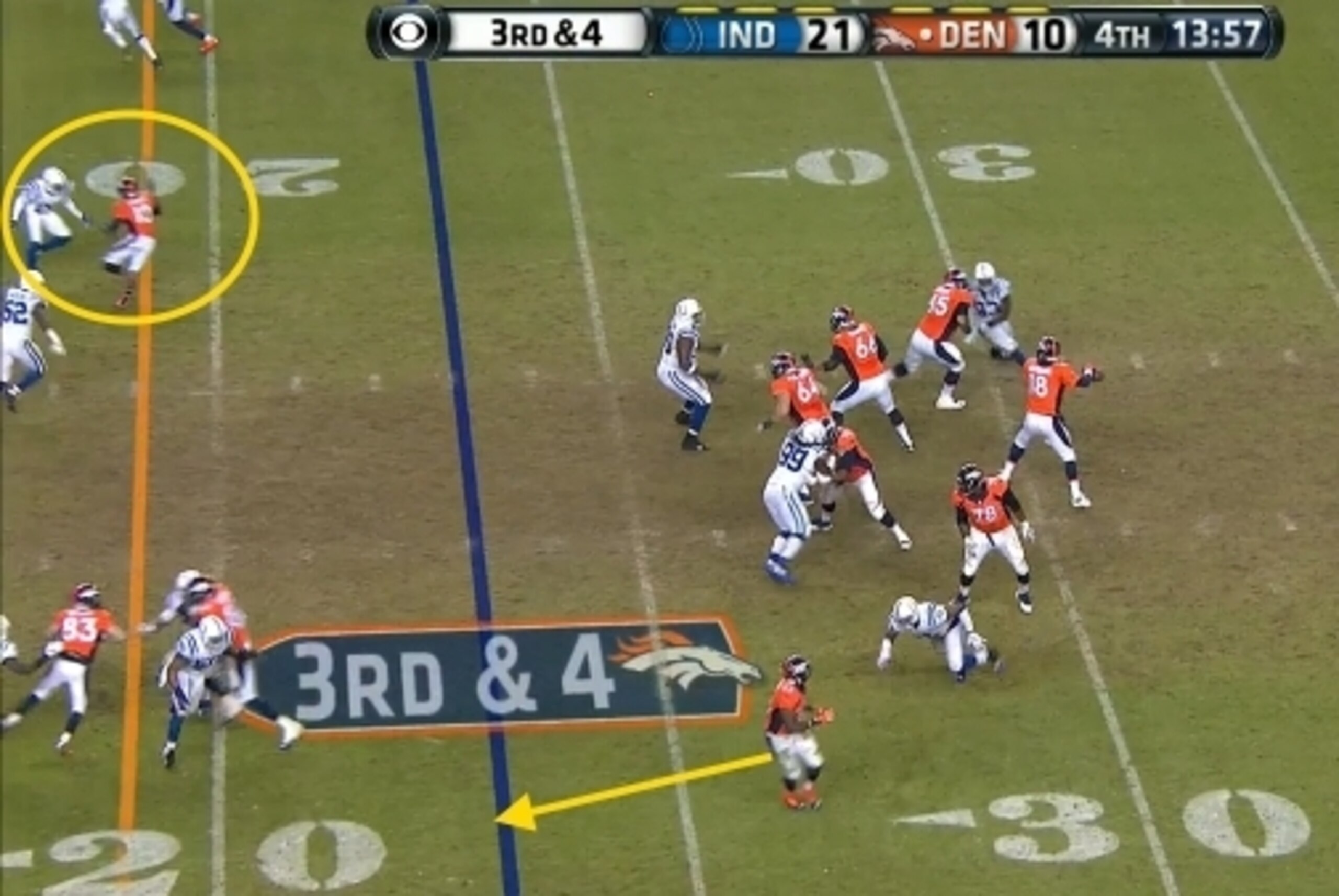
Had Manning come off Sanders, he had Anderson open in the flat to the left. There was no guarantee that Anderson makes the first down, but why not give him the chance? Anderson had just broken three tackles behind the line of scrimmage to gain seven yards on 4th-and-1 to extend the drive three plays earlier. Again, Manning didn’t make a very good decision.
As Manning knows well, the margin for error in the playoffs is incredibly thin. The difference in a game can be inches or throwing to a guy that’s more open than another guy.
On the next drive, Manning threw a pass to Sanders on 3rd-and-5 that Davis was again able to get a hand on. The Broncos went three-and-out on that drive, and any hopes of a comeback basically died there.

Manning had running back Ronnie Hillman wide open in the flat on that play. The defender—linebacker Jerrell Freeman—had to fight through traffic and would have had to chase down the speedy Hillman from a bad angle. One cutback and Hillman would have made the first down. Manning decided to try to hit Sanders in coverage against one of the best cornerbacks in the league instead.
If it seems like many of the mistakes came on third down or 2nd-and-10-plus, you’re right. The Broncos converted just four of their 16 third-down attempts and lost too much yardage on early downs to make them manageable.
The Game Plan
The Broncos’ plan was clearly to exploit Toler and the safeties deep, but when Manning couldn’t complete those passes, they didn’t have a good backup plan. The most success they had all day after the first drive was using the short passing game out of the no-huddle, but even that wasn’t pretty.
"Fox on deep balls: "We probably went to that well too many times."
— gregg rosenthal (@greggrosenthal) January 12, 2015"
Anderson and Hillman averaged a combined 4.4 yards per carry, but on just 20 carries. After the inexplicable decision to use cornerback Aqib Talib on T.Y. Hilton, the Broncos got behind, and the running game became an afterthought.
According to Lindsay Jones of the USA Today, Cornerback Chris Harris Jr. has answered every question he’s been asked in his four years in Denver, and he didn’t want to talk about not covering Hilton Monday. It was obvious to everyone but the Broncos that Harris would have been a better choice than Talib against Hilton.
Talib’s performance covering Hilton was lackluster and contributed in the Broncos falling behind early in the game. It wasn’t entirely his fault because Hilton is a smaller, shifty wide receiver and tough for anyone to cover—especially a big cornerback like Talib. If the Broncos had made a key defensive stop or two early in the game, it may have allowed the Broncos to use the running game to find some kind of an offensive rhythm.
With Manning’s poor decision-making, inability to throw the deep ball accurately, a bad game plan on defense, two drops by Demaryius Thomas and a sack fumble, it was the Broncos, not Manning’s injured thigh that didn’t get it done. The Broncos desperately needed their wide receivers and tight ends to get open in the short passing game, and they routinely failed to do so.
Elway made Fox the scapegoat, but it was the roster—including the quarterback Elway would like to have back next year—that lost the game. It wasn’t injuries or a lack of "fire" that Fox failed to get out of them that caused them to lose the game, they just got beat.
That’s disappointing for the team and for fans, but that’s how it goes in the NFL playoffs. Leave Manning’s quad out of it, and don’t blame Fox.
Unless otherwise noted, all statistics and grades via Pro Football Focus (subscription required).
.jpg?w=2560)