
Lessons Learned from First-Ever College Football Playoff
The confetti has barely been cleared from the field at AT&T Stadium following Ohio State's victory over Oregon in the national championship game, the first crowned via college football's new playoff system. The Buckeyes are still fully in celebration mode, yet the freshness of what just happened makes this a perfect time to start looking ahead to what could happen next year.
This first-ever four-team competition was meant to eliminate all doubt and controversy, yet it brought about its own arguments. The College Football Playoff will be around for quite some time, however, based on how well it's been received during its first year.
It can get better, and we can better enjoy it, based on certain lessons learned from the initial offering.
It Was a Rousing Success
1 of 6
There are going to be small complaints about any system, especially one that's new and involves radical change. But when all is said and done, the first College Football Playoff can't be considered anything but a monumental success.
From the anticipation that built throughout the regular season to the games themselves, the playoff was a constant topic of discussion throughout the past few months. Though it only doubled the number of teams involved from the previous BCS format, it felt like the impact the playoff had on college football increased exponentially. And not surprisingly, this translated into huge ratings.
The Rose Bowl and Sugar Bowl each drew more than 28 million viewers, according to TVLine.com's Matt Webb Mitovich, increases of 51 and 150 percent from the 2013-14 versions, respectively. The overnight numbers from Monday's title game were equally huge, with ESPN reporting an 18.5 rating that was 21 percent better than for the final BCS championship in 2014.
"It looks like ESPN is well on their way to their third record-setting performance in the last 12 days," wrote Matt Yoder of AwfulAnnouncing.com, noting that the championship and the semifinals will end up ranking as ESPN's three highest-rated telecasts in its long history.
All three games had huge in-person crowds as well, reversing the trend seen in other bowls with declining attendance. Throw in the massive footprint the playoffs made on social media and elsewhere, and it's hard to make a compelling argument that the new system doesn't deserve high marks across the board.
Three Games Are Better Than One
2 of 6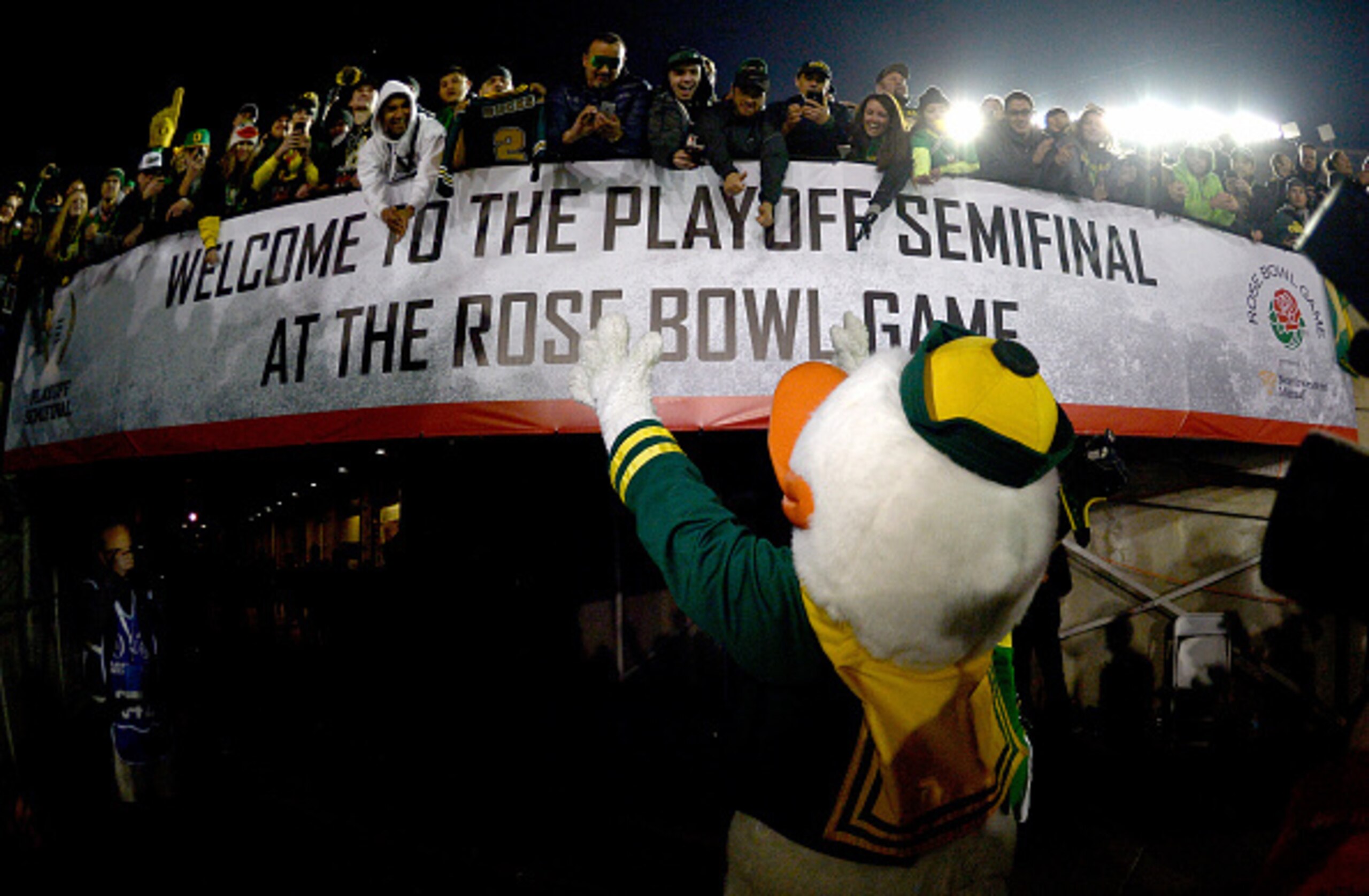
For 16 years, the BCS told us which teams would play for the national championship, and we were told to accept that.
If the matchup turned out to be a mismatch—the final margin was 20-plus points in five games, and several others weren't as close as their scores would indicate—it often left us wondering if there was another team worthy of that title game appearance. In many years, there were more than two viable contenders, yet the system only called for that lone clash to decide the title.
Now, we have three games that determine one champion, which at the very least means three times as much action and triple the opportunities to have a clear victor rise to the occasion.
Ohio State showed this over the past two weeks, shaking off its No. 4 seeding to knock off the first- and second-ranked teams on the way to its first title since 2002-03. And by doing this, it took away much of the doubt that came with a lone contest deciding everything.
This opinion would make it seem as though expansion would make the playoffs even more exciting and conclusive. Although contrastingly, it could end up watering down the product.
New Year's Day Was Made for Playoff Football
3 of 6
Last year, the lineup of bowl games on New Year's Day included staples like the Rose and Fiesta but also interlopers like the Heart of Dallas. On the same day that Michigan State beat Stanford in a classic in Pasadena, we saw North Texas blow out UNLV in a matchup of schools that both hadn't been bowling in a decade.
The infiltration of lesser bowl games onto a day previously reserved for the big ones had been going on for years, but the College Football Playoff fixed that. Combined with the three games held on New Year's Eve and the Cotton Bowl on Jan. 1 (along with solid games in the Citrus and Outback bowls), we had two days of nothing but top-notch football.
It was far better than having all of the big games spread over four or five days, with the other games meant to tide us over.
The six-game rotation for the semifinals and host bowls will be on these same two days for more than a decade, but there is a quirk in several upcoming years that fans need to be prepared for: In four of the next five seasons, the semifinal games will be on Dec. 31 instead of New Year's Day.
Why? Simply put, the deal agreed upon with the included bowls locks the Rose Bowl and Sugar Bowl on Jan. 1, regardless of whether they serve as the semifinal games. The only exception are in years when New Year's Day falls on a Sunday, such as in 2017.
"It will absolutely change New Year's Eve in this country," College Football Playoff Executive Director Bill Hancock told Bleacher Report's Barrett Sallee. "When we go to New Year's Eve parties, they better have a television because we're going to have to be watching college football."
Next year, we'll get the semifinals before most of the other big games, rather than having the non-semifinals serve as appetizers. And with New Year's Eve being a Thursday, and likely a workday for most fans, it could have a significant impact on ratings.

Weekly Rankings Might Be Too Much
4 of 6
Unlike the BCS, which combined human polls with computer rankings to determine its title game participants, we now have a selection committee. What began as a 13-member committee was whittled down to 12 after Archie Manning had to back out because of health concerns, but the group was still large and diverse enough to give us an educated and thorough selection process.
But those weekly rankings the committee released? That might need some tweaking.
The intrigue that existed prior to the initial rankings in late October eventually turned to skepticism as each subsequent Top 25 came out. Committee chairman Jeff Long helped popularize a new metric, known as "game control," while constantly declaring that the committee started with a clean slate each week and didn't use the previous rankings as a baseline for the new list.
This led to teams making major jumps up and down from week to week, culminating in TCU falling from No. 3 to No. 6 despite winning its final game by 52 points.
The College Football Playoff's committee was meant to mirror the one the NCAA uses to determine and seed its 68-team field for college basketball. The major difference, though, was the weekly rankings, which made for great debate but also a lot of confusion and contempt.
Family Travel Benefits Are a Huge Step in the Right Direction
5 of 6
From the outset, the College Football Playoff has had the goal of being innovative and progressive. This continued even as the games were being played, most notably with the decision to provide financial assistance to players' families to help with travel to Monday's national championship game.
The CFP covered up to $1,250 of travel costs per parent or guardian for each Oregon or Ohio State player, though a waiver approved by the NCAA made it possible for each family to get as much as $3,000 in travel and meal aid. It's part of a pilot program the NCAA plans to extend to families who have children competing in the men's and women's basketball Final Fours in April.
"Every little bit helps," Ohio State linebacker Joshua Perry told ESPN's Heather Dinich. "A lot of families will definitely appreciate it."
With TV driving most decisions in college sports nowadays, the move to help student-athletes in this way is a great step in the right direction. While discussions continue on whether players deserve to be paid for their athletic services (beyond scholarships and accompanying living expenses), benefits like these can help set a precedent for future compensation.
We should only see more of this as we move forward, especially if there's any serious talk about expanding the playoffs to eight or more teams. It will be hard enough for fans to afford attending two or more postseason games around the holidays. For many players' families, it would be next to impossible.
There Is No Perfect System
6 of 6
Ohio State's players and coaches were handed the requisite championship shirts and hats just moments after the clock hit all zeroes at AT&T Stadium, and this year's slogan was a simple one: Undisputed National Champions.
Wishful thinking.
There's always going to be debate and dissension; it's what makes sports so entertaining and addictive. To think there's a perfect system that would eliminate all naysayers is foolish, short-sighted and, frankly, not much fun. We like conflict and contention—some might say we thrive on it—and as much as we say we'd like to see it go away, this isn't really true.
What we do want, however, is something that minimizes the major controversies, which the College Football Playoff has done. It just doesn't make them go away completely.
The four-team playoff gets us as close as we've ever been to having a system that removes doubt, but some still exists. Just ask TCU, which felt it was deserving of a playoff bid when the pairings were announced and now, after watching Florida State lose by 39 to a team that lost to Ohio State by 22, probably feels it has an even better case.
"First of all, four is simply not a good number," wrote Matt Charboneau of The Detroit News. "Not when you have five conferences in the mix. If there is, truly, a Power Five, then winning that conference should get you something, regardless of how that conference determines its champion."
Does this mean we expand to eight teams? If that happens, be prepared for the ninth-ranked team to declare it was robbed of a chance to play for a championship.
Follow Brian J. Pedersen on Twitter at @realBJP.
.png?w=2560)
.png?w=2560)
.jpg?w=2560 "Chiefs, Steelers Eye WR Trades")