

Reconsidering Expectations for Vince Carter with the Memphis Grizzlies
Vince Carter is underwhelming as a perimeter shooter off the bench in his first season with the Memphis Grizzlies. The man who sustained his career by specializing in that area has remained unproductive, even after shaking off early-season discomfort.
The 6'6", 220-pound small forward averages just 6.5 points in 17.2 minutes per game while shooting 34.6 percent from the field and 30.3 percent from long range, the lowest clip since his rookie year.
Carter's taking a greater share of his shots from beyond the arc, 8.1 per 36 minutes and 55.6 percent of his attempts—1.3 and 9.9 percent more, respectively. Such a heavy focus on the three may result from the Grizzlies' smaller array of outside shooters compared with those in Dallas.
TOP NEWS

J-Dub, Wallace May Miss Entire Season
Melo's Quote on Confidence 😎
Celtics at Fault for JT-JB Beef? 🤔
My preseason expectations projected that the 37-year-old would be near his 2013-14 form when he scored 11.9 per game on 40.7 percent from the field and 39.4 percent from three-point range.
The Grizzlies had signed the 17-year veteran in the offseason to be a spark plug off the bat as a perimeter-shooting sixth man.
But he hasn't strung together a long run of successful outside shooting, and, as his NBA.com shot chart shows, he's generally subpar beyond 15 feet, where he takes more than 70 percent of his attempts.
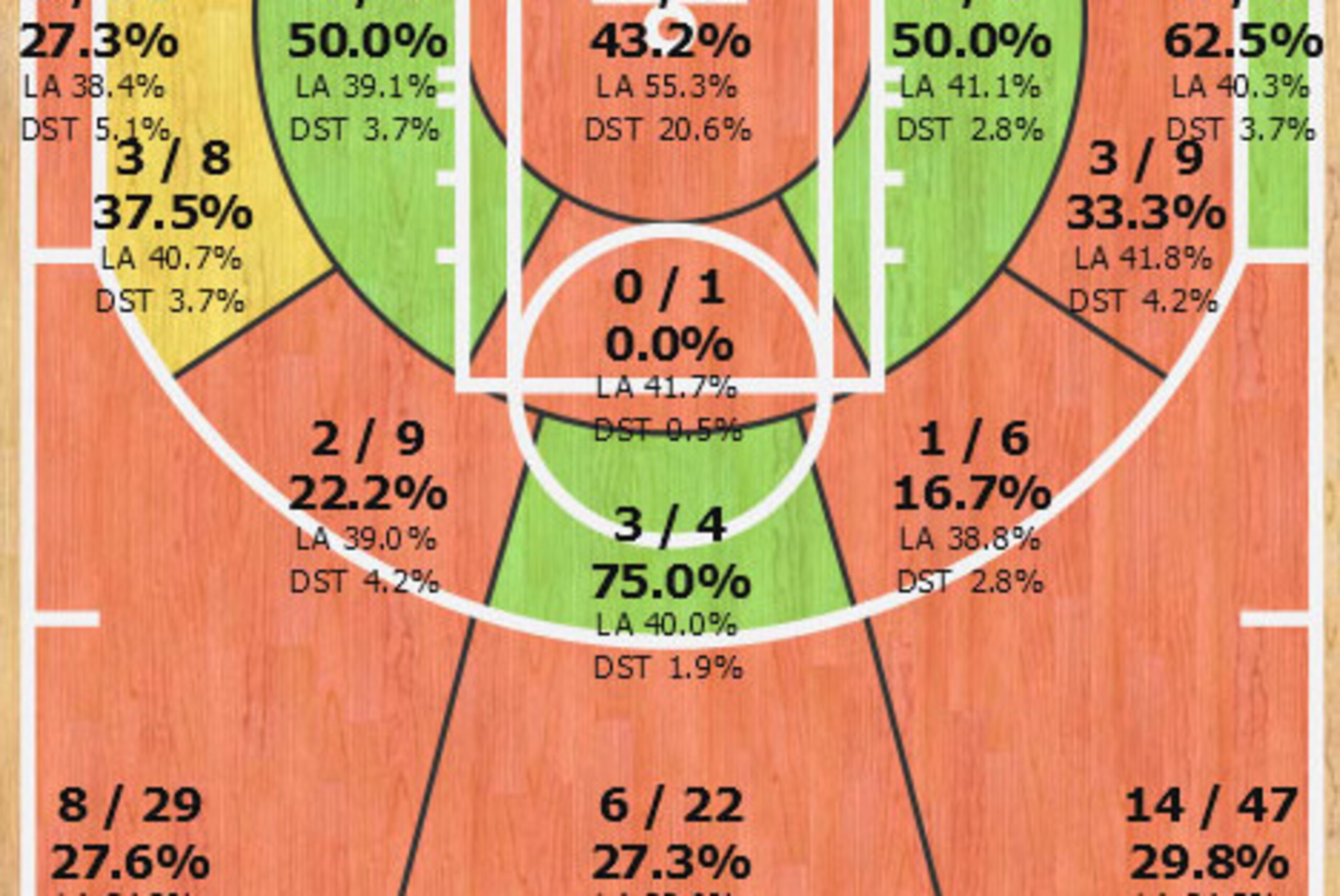
Comfortable, yet ineffective
Carter had surgery in May to remove bone spurs in his right ankle and was limited in the preseason while recovering. That may explain his rough start, but he informed The Commercial Appeal's Ronald Tillery (subscription required) in early December that he felt healthy.
Tillery quoted Mike Conley as observing Carter shooting comfortably, saying, "He's got his legs under him. With his injury, it's taken a while for him to get his legs under him and now he's knocking down shots and feeling comfortable."
But that comfort hasn't kept him shooting effectively. After making 13 of 26 in three-point land from Dec. 12 to 17, Carter is 5-of-29 in the past seven games.
He's largely taking catch-and-shoot threes, and the rhythm doesn't seem solid.
As Carter told Tillery in the aforementioned article, he's not willing to change mechanics during the season to get it right.
"It's one thing when the shots are just off. It's another thing when they go in and out. It's like 'Are you serious?' You're right there. I just continue with the same approach. I stick with my routine. It wasn't back to the lab and let's tweak something. I wanted to continue shooting knowing it was going to turn around.
"
The Memphis Flyer's Kevin Lipe faulted Carter for having poor shot selection throughout the season.
Eventually, the 37.6 percent career three-point shooter will progress to the mean. Indeed, he shot 33 percent from downtown in his first 21 games last year before connecting on 41.5 percent the rest of the season.
A strong second half could see him hit near 40 percent from long range.
This season, Carter may simply need more time finding his stroke while playing in a much slower system than the Mavericks' high-tempo offense he navigated for two years.
While he's waiting for his shots to fall, Carter should maintain his recent run as a passer. From Dec. 21 to Jan. 2, he often looked to distribute, averaging 2.6 assists per game. On Dec. 17, he set up Courtney Lee for a three to put the Grizzlies ahead of the San Antonio Spurs late in the second overtime.
Lowering the bar for scoring
Before the season, it was hard to see anyone other than Carter lead Memphis' bench players in scoring. The Grizzlies' two leading scorers from last season, James Johnson and Mike Miller, signed elsewhere.
The current cast of reserves weren't known for instant offense. Beno Udrih typically didn't score much when playing off the bench. Tayshaun Prince was destined for a more isolated role after experiencing the worst year of his career.
Because of how the Grizzlies' bench players responded to Carter's early struggles, the balance of points has changed. Udrih is the second unit's glue, averaging 7.5 per game. Prince is utilizing the three more than his first year-and-a-half in Memphis while registering 7.1 per game.
Currently, Carter's the No. 3 bench scorer, an odd place for someone who dumped 20 per game in 10 straight seasons. If he catches fire in the second half, he'll bounce back into the lead.
However, he could still finish averaging single digits for the first time ever. With the balance of reserve shooters between Udrih, Carter, Prince and Jon Leuer, the veteran might not take over often enough.
Defense
Carter has given a strong effort patrolling the perimeter throughout his career. He's fully integrated into the aggressive Grizzlies attack, demonstrating that he can still stop opponents at his age. He's allowing 105 points per 100 possessions.
While he was never known to force many turnovers, Carter's grabbing 1.6 steals per 36 minutes and has a 2.4 percent steals rate.
Lipe remarked via Twitter about how Carter is helping the Grizzlies' second-unit defense.
Carter not only shows greater energy than Miller did on that end but has greater discipline.
That Carter has managed to fulfill himself on that end alleviates the disappointment with his shooting struggles. Such defensive work ensures that he'll be at least somewhat helpful in the Grizzlies' hunt for a high playoff seed.
Statistics are current through Jan. 4 games. Unless otherwise noted, advanced metrics come from basketball-reference.com.

.jpg?w=2560 "Chiefs, Steelers Eye WR Trades")





.jpg?w=2560 "Raiders Sticking with Cousins")