B/R CFB 250: The Overall Top 250 Players in College Football
Bleacher Report's CFB 250 is an annual ranking of the best players in college football. Brian Leigh and Kynon Codrington have studied, ranked and graded the top athletes in the country based on specific criteria, narrowed that list down to 250 and sorted by position. Today, we present the top 250 players.
Other CFB 250 Positions
- Top 22 Pro-Style Quarterbacks
- Top 13 Interior Linemen
- Top 20 Dual-Threat Quarterbacks
- Top 21 Cornerbacks
- Top 12 Offensive Tackles
- Top 20 Safeties
- Top 25 Running Backs
- Top 17 Outside Linebackers
- Top 12 Defensive Tackles
- Top 25 Defensive Ends
- Top 15 Tight Ends
- Top 16 Inside Linebackers
- Top 32 Wide Receivers
After breaking down it by position, we've finally reached the end: the top 250 players in college football.
In cases where two or more players had the same final grade, a subjective call was made by the authors. This call was based on an abstract "Wins Above Replacement" formula: Which players most exceed a replacement-level starter at their position?
Also keep in mind that these players were graded as college athletes, not on how they project to the NFL.
Targeted skills such as QB arm strength are important at both levels, but there is a difference between college arm strength and professional arm strength. If a quarterback slings it well enough to hit his marks in the SEC or the Big 12, it doesn't matter that he can't stretch the field against the NFC North. At least not here, it doesn't.
This is all about his college performance.
Note: Rankings and scores were made prior to conference championship games; they do not reflect what happened after.
Nos. 250-242
1 of 110
250. Gary Nova, QB, Rutgers
Accuracy: 19/25; Arm Strength: 16/20; Pocket Presence: 6/10; Mobility: 5/10; Football IQ: 15/20; Leadership: 12/15
Gary Nova used to be a punch line but earned some fans with a scrappy senior season. He is willing and able to push the ball downfield, but he misses so many easy throws and commits so many boneheaded turnovers that it’s hard to ignore the bad for the good.
249. Davis Webb, QB, Texas Tech
Accuracy: 20/25; Arm Strength: 16/20; Pocket Presence: 6/10; Mobility: 5/10; Football IQ: 16/20; Leadership: 11/15
Davis Webb has great size (6’5”) and flashed impressive arm strength as a freshman in 2013. Before the season, Texas Tech head coach Kliff Kingsbury called him "one of those top-five pick talents," per Bruce Feldman of FoxSports.com. But as a sophomore, Webb regressed in terms of accuracy and confidence and ended the season on the sideline with an injury. He will have to win his job back from freshman Patrick Mahomes next season.
248. Patrick Towles, QB, Kentucky
Accuracy: 20/25; Arm Strength: 16/20; Pocket Presence: 6/10; Mobility: 6/10; Football IQ: 16/20; Leadership: 11/15
Patrick Towles is a 6'5" athletic specimen who proved against Mississippi State that he can compete with the best in the country. He is still learning how to sustain that level of performance, but once he does, Kentucky has a chance to emerge in the SEC East.
247. Sefo Liufau, QB, Colorado
Accuracy: 20/25; Arm Strength: 15/20; Pocket Presence: 6/10; Mobility: 6/10; Football IQ: 16/20; Leadership: 12/15.
Sefo Liufau showed promise as a freshman in 2013 and improved across the board as a sophomore. He’s an underrated athlete with a good arm, but he doesn’t have a great feel for the pocket and commits too many turnovers.
246. E.J. Bibbs, TE, Iowa State
Hands: 20/25; Route Running: 15/20; Blocking: 15/20; Release: 14/20; Speed: 11/15
E.J. Bibbs has been a reliable receiver for an otherwise unreliable offense. He needs to get stronger and improve his hand placement as a blocker, but he is one of the best pure pass-catchers at the position.
245. Mario Edwards, DE, Florida State
Pass Rush: 34/50; Run Defense: 36/40; Motor: 6/10
When he’s on, Mario Edwards can be special. The former blue-chip recruit played the best game of his career in the 2014 BCS National Championship Game and followed with a few standout performances this season. But those “few” were also few and far between. He is simply not consistent enough to rank any higher than he does. He has the physical tools to be a menace—especially against the run—but hasn’t shown the mental faculties.
244. Kevin Ellison, QB, Georgia Southern
Accuracy: 19/25; Arm Strength: 15/20; Pocket Presence: 7/10; Mobility: 8/10; Football IQ: 15/20; Leadership: 12/15.
Kevin Ellison is a mostly unknown commodity, but as a sophomore, he led Georgia Southern to an 8-0 Sun Belt record in the Eagles' first FBS season. He's built like a quintessential triple-option quarterback (6'0", 183 lbs) but has more juice in his arm than people give him credit for.
243. Gunner Kiel, QB, Cincinnati
Accuracy: 21/25; Arm Strength: 17/20; Pocket Presence: 6/10; Mobility: 5/10; Football IQ: 16/20; Leadership: 11/15
Gunner Kiel continues to tantalize. He has a great frame (6’4”) and a big arm, and he proved early in the season that he could manage a high-scoring offense. But he doesn’t always move well in the pocket and had his first real college season derailed by a nagging rib injury.
242. Brandon Doughty, QB, Western Kentucky
Accuracy: 21/25; Arm Strength: 16/20; Pocket Presence: 6/10; Mobility: 5/10; Football IQ: 16/20; Leadership: 12/15
Brandon Doughty spins an accurate ball and had a great senior season under first-year head coach Jeff Brohm. Doughty has good size (6'3") and will go down as one of the best quarterbacks in Western Kentucky history, as Marshall would surely attest.
Nos. 241-226
2 of 110
241. Keenan Reynolds, QB, Navy
Accuracy: 19/25; Arm Strength: 15/20; Pocket Presence: 7/10; Mobility: 8/10; Football IQ: 16/20; Leadership: 12/15
Keenan Reynolds is one of the most prolific triple-option quarterbacks ever. He doesn't have a great arm, but he's a tough, shifty runner with a mastery of Navy's offense.
240. Gerald Christian, TE, Louisville
Hands: 20/25; Route Running: 15/20; Blocking: 16/20; Release: 15/20; Speed: 11/15
Gerald Christian is a big, hulking athlete (6’3”, 250 lbs) who is quick off the line and moves well in space. He is limited as a route-runner but has the potential to improve and already makes an impact with his blocking.
239. Trevor Knight, QB, Oklahoma
Accuracy: 20/25; Arm Strength: 15/20; Pocket Presence: 7/10; Mobility: 7/10; Football IQ: 16/20; Leadership: 12/15
Trevor Knight is a good athlete with sound mechanics and every other tool one could want in a dual-threat quarterback. His ceiling is high (see: the 2014 Sugar Bowl), but he's a different player every week and struggles with repetitive accuracy.
238. Arie Kouandjio, OG, Alabama
Strength: 15/20; Pass Protection: 23/30; Run Blocking: 34/40; Explosion: 5/10
Arie Kouandjio has a picture-perfect frame for a left guard: 6’5”, 315 pounds, with long arms and prodigious upper-body strength. He is weaker with his legs and needs to work on his burst, but he gets the job done overall. There’s a reason Alabama runs so many plays to the left, where Kouandjio and left tackle Cam Robinson do their business.
237. Hutson Mason, QB, Georgia
Accuracy: 22/25; Arm Strength: 15/20; Pocket Presence: 6/10; Mobility: 5/10; Football IQ: 17/20; Leadership: 12/15
Hutson Mason is what he is: a game manager. He is accurate enough to make a defense pay for stacking the box against the run, but he doesn’t have the arm to stretch the field or stick the ball into tight windows.
236. Josiah Price, TE, Michigan State
Hands: 21/25; Route Running: 15/20; Blocking: 16/20; Release: 15/20; Speed: 10/15
Josiah Price goes overlooked in Michigan State’s offense, but the sophomore tight end has played a big role in the Spartans’ improvement. At 6’4”, 241 pounds, he is one of Connor Cook’s favorite targets in the red zone but has also shown that he can stretch the field and make plays between the 20s.
235. Montravius Adams, DT, Auburn
Pass Rush: 30/40; Run Defense: 41/50; Motor: 6/10
Montravius Adams had a nice sophomore season despite playing without his partner in crime, defensive end Carl Lawson, who tore his ACL during spring camp and missed the entire year. He doesn’t do the dirty work against the run but has great burst for a player his size (6’4”, 307 lbs) and is a constant source of negative plays. The introduction of defensive coordinator Will Muschamp—one of the nation’s premier motivators—should do wonders for Adams’ development.
234. Jake Waters, QB, Kansas State
Accuracy: 21/25; Arm Strength: 15/20; Pocket Presence: 6/10; Mobility: 7/10; Football IQ: 16/20; Leadership: 13/15
Jake Waters is a scaled-down version of Collin Klein, but that is not the worst thing to be. He doesn't present the same physical rushing threat as Klein, but he's a slightly better passer and an equally tough competitor.
233. Marquise Williams, QB, North Carolina
Accuracy: 20/25; Arm Strength: 16/20; Pocket Presence: 7/10; Mobility: 8/10; Football IQ: 16/20; Leadership: 11/15
Marquise Williams has the tangibles of an All-ACC quarterback, and at times he performs at that level. But he has never sustained good play for long enough to be considered among the best in his conference.
232. Keevan Lucas, WR, Tulsa
Hands: 21/25; Route Running: 16/20; Blocking: 2/5; Release: 16/20; Speed: 11/15; Run After Catch: 12/15
Keevan Lucas came from nowhere to become one of the most productive receivers in the country—and at Tulsa, of all places. The 5'10" slot receiver is shifty in space and has a knack for finding open spots in coverages.
231. Taylor Heinicke, QB, Old Dominion
Accuracy: 21/25; Arm Strength: 15/20; Pocket Presence: 6/10; Mobility: 6/10; Football IQ: 17/20; Leadership: 13/15
Taylor Heinicke won the FCS version of the Heisman Trophy (the Walter Payton Award) as a sophomore in 2012 and gave Old Dominion a pulse during its FBS transition. He doesn’t have great size (6’1”) or arm strength, but he knows how to run an offense.
230. DaeSean Hamilton, WR, Penn State
Hands: 22/25; Route Running: 15/20; Blocking: 2/5; Release: 16/20; Speed: 11/15; Run After Catch: 12/15
Not much went right for Penn State's offense this season, but one of the few things that did was the emergence of freshman receiver DaeSean Hamilton. He isn't quite Allen Robinson—and no one is saying he should be—but he's a dangerous weapon for Christian Hackenberg to target downfield.
229. Bo Wallace, QB, Ole Miss
Accuracy: 21/25; Arm Strength: 16/20; Pocket Presence: 7/10; Mobility: 7/10; Football IQ: 15/20; Leadership: 12/15
Good Bo Wallace is a 6'4" athlete with above-average accuracy and moxie. Bad Bo Wallace is a 6'4" enigma who invents new, creative ways to commit turnovers each week. Good Bo showed up more often than Bad Bo in 2014, but Bad Bo was present enough to make a difference.
228. Jacoby Brissett, QB, North Carolina State
Accuracy: 20/25; Arm Strength: 18/20; Pocket Presence: 7/10; Mobility: 6/10; Football IQ: 15/20; Leadership: 12/15
Jacoby Brissett had some great moments during his first season at NC State. The Florida transfer has Ben Roethlisberger tangibles—6’4”, strong arm, sturdy frame, good mobility—but his accuracy cannot be trusted, and neither can his decision-making.
227. Devin Funchess, WR, Michigan
Hands: 22/25; Route Running: 16/20; Blocking: 3/5; Release: 15/20; Speed: 11/15; Run After Catch: 11/15
Devin Funchess is a converted tight end who at times looks like an All-American. He's been plagued with consistency issues, and he does not have the speed one typically looks for on the outside, but he's a smooth athlete for a player his size.
226. Sean Mannion, QB, Oregon State
Accuracy: 21/25; Arm Strength: 17/20; Pocket Presence: 7/10; Mobility: 5/10; Football IQ: 17/20; Leadership: 12/15
Sean Mannion struggled without Biletnikoff Award winner Brandin Cooks, a first-round NFL draft pick in 2014. Regardless, his mixture of size (6’5”), arm strength and his resume of production over the past three years are things only a few active QBs can compete with.
Nos. 225-210
3 of 110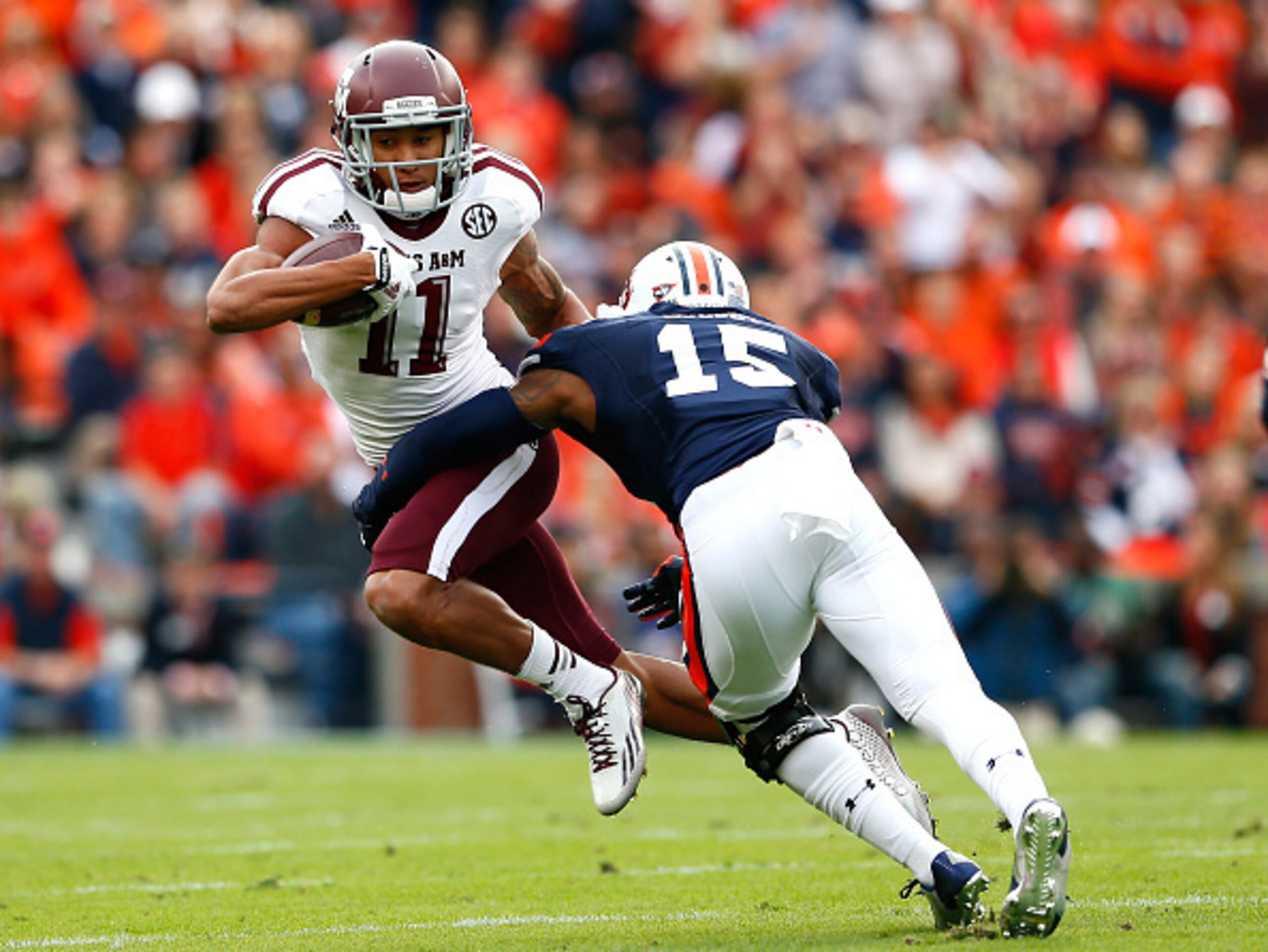
225. Jordan Payton, WR, UCLA
Hands: 22/25; Route Running: 16/20; Blocking: 2/5; Release: 16/20; Speed: 11/15; Run After Catch: 12/15
Jordan Payton has quietly emerged as the No. 1 receiver at UCLA, teaming with quarterback Brett Hundley to give the Bruins an explosive (and strangely underrated) offense. Payton doesn't have great pure speed, but he's a fluid athlete who does all of the little things well.
224. Justin Thomas, QB, Georgia Tech
Accuracy: 21/25; Arm Strength: 16/20; Pocket Presence: 7/10; Mobility: 8/10; Football IQ: 15/20; Leadership: 12/15
Justin Thomas has had no trouble running the triple-option offense. The former Alabama commit, whom the Tide wanted to use as a defensive back, has caught defenses by surprise with his strong arm on deep passes.
223. Brian Walker, CB, North Carolina
Speed: 16/20; Ball Skills: 16/20; Run Defense: 13/20; Coverage: 34/40
Brian Walker did all he could to keep North Carolina afloat during another slow start to the season. The 5’11” sophomore is one of the biggest reasons UNC reached a bowl game, and he might have helped his coach, Larry Fedora, avoid a summer filled with hot-seat whispers.
222. Rakeem Cato, QB, Marshall
Accuracy: 21/25; Arm Strength: 15/20; Pocket Presence: 7/10; Mobility: 6/10; Football IQ: 17/20; Leadership: 13/15
Rakeem Cato has etched his name alongside Marshall greats such as Byron Leftwich and Chad Pennington. He lacks ideal size (6'1"), arm strength and competition-played-against, but he reads defenses like a pro, hits his marks and knows how to lead an offense.
221. Nelson Spruce, WR, Colorado
Hands: 21/25; Route Running: 16/20; Blocking: 3/5; Release: 16/20; Speed: 11/15; Run After Catch: 12/15
Nelson Spruce is a reliable possession receiver with a knack for getting open despite average physical tools. NFL scouts will yawn, but there's something to be said for posting consistent numbers when defenses are tailored to stop you.
220. Jimmay Mundine, TE, Kansas
Hands: 22/25; Route Running: 16/20; Blocking: 15/20; Release: 15/20; Speed: 11/15
Jimmay Mundine came on late in the season and gave Kansas a pulse under interim head coach Clint Bowen. He is a capable target in the intermediate passing game, beating defenses up the seam and making catches between the linebackers and safeties.
219. Grant Hedrick, QB, Boise State
Accuracy: 22/25; Arm Strength: 15/20; Pocket Presence: 7/10; Mobility: 7/10; Football IQ: 16/20; Leadership: 12/15
Grant Hedrick has been an upgrade since relieving Joe Southwick in 2013. Yes, he's only 6'0", but he's accurate and shifty with the ball in his hands. He also led the country in completion percentage (70.9) during the regular season.
218. John Harris, WR, Texas
Hands: 22/25; Route Running: 16/20; Blocking: 3/5; Release: 16/20; Speed: 11/15; Run After Catch: 11/15
John Harris has given Texas a much-needed boost on the outside. The fifth-year senior will not amaze you with his size, speed, length or any other measurable, but he’s tough as nails, understands the nuance of the position and has a reliable pair of hands.
217. Anu Solomon, QB, Arizona
Accuracy: 21/25; Arm Strength: 17/20; Pocket Presence: 6/10; Mobility: 7/10; Football IQ: 16/20; Leadership: 12/15
Anu Solomon earned the starting job at Arizona after a wild quarterback battle that at one point featured six contenders. He did so despite being a redshirt freshman, but he quickly proved in 2014 that the coaching staff was right to trust him. He finished the season poorly, but part of that can be attributed to injuries, and part might be the proverbial "freshman wall."
216. Josue Matias, OG, Florida State
Strength: 16/20; Pass Protection: 23/30; Run Blocking: 34/40; Explosion: 6/10
Josue Matias is one of the most versatile offensive linemen in the country. At 6’6”, 325 pounds, he has the build of a tackle (a position he is capable of playing) but does his best work getting physical in the A-gap or pulling as a lead blocker in the open field. With a small bit of technical refinement, he could turn into something special.
215. Dylan Thompson, QB, South Carolina
Accuracy: 21/25; Arm Strength: 17/20; Pocket Presence: 7/10; Mobility: 5/10; Football IQ: 16/20; Leadership: 13/15
Dylan Thompson went from solid backup to quality starter in 2014, helping South Carolina stay competitive despite fielding one of the worst defenses in America. He has a thin frame but one of the biggest arms in the SEC.
214. Leonard Floyd, OLB, Georgia
Tackling: 29/35; Pass Rush: 18/20; Run Defense: 15/20; Pass Coverage: 18/25
When he’s on, Leonard Floyd is as difficult to block as any player in the country. He has rare size (6’4”, 230 lbs) and long arms to get after QBs off the edge. If he rounds out his game by playing stronger against the run and shows up on a more consistent basis, there is nothing stopping him from becoming an All-American. He missed the Belk Bowl with a shoulder injury, which was a shame since he could use the extra reps.
213. Devontae Booker, RB, Utah
Ball Security: 7/10; Power: 17/20; Vision: 16/20; Hands: 13/15; Speed: 16/20; Agility: 11/15
Devontae Booker came to Utah from junior college and gave the Utes precisely what their offense needed: a tough, physical, downhill runner who eats up solid chunks of yardage, moves the chains and keeps their defense resting on the sideline.
212. Vince Mayle, WR, Washington State
Hands: 22/25; Route Running: 16/20; Blocking: 3/5; Release: 16/20; Speed: 12/15; Run After Catch: 11/15
Vince Mayle is a former basketball player who didn't make the full-time switch to football until 2012. At 6'3", 219 pounds, he is already one of the best red-zone threats in the country and possesses a goldmine of untapped potential.
211. Kevin Johnson, CB, Wake Forest
Speed: 14/20; Ball Skills: 16/20; Run Defense: 16/20; Coverage: 34/40
Kevin Johnson is an underrated player with the size (6’1”, 175 lbs), fluidity and toughness that defensive coaches love. He doesn’t have the matching speed or quickness, but physical cornerbacks such as Johnson are en vogue right now.
210. Josh Reynolds, WR, Texas A&M
Hands: 21/25; Route Running: 16/20; Blocking: 3/5; Release: 16/20; Speed: 12/15; Run After Catch: 12/15
He's not Mike Evans—at least not yet, he isn't—but Josh Reynolds is a 6'4" target with enough speed to stretch the field in Texas A&M’s offense. If the former JUCO transfer can fill out his frame and play with more physicality next season, he has a chance to become a superstar.
Nos. 209-194
4 of 110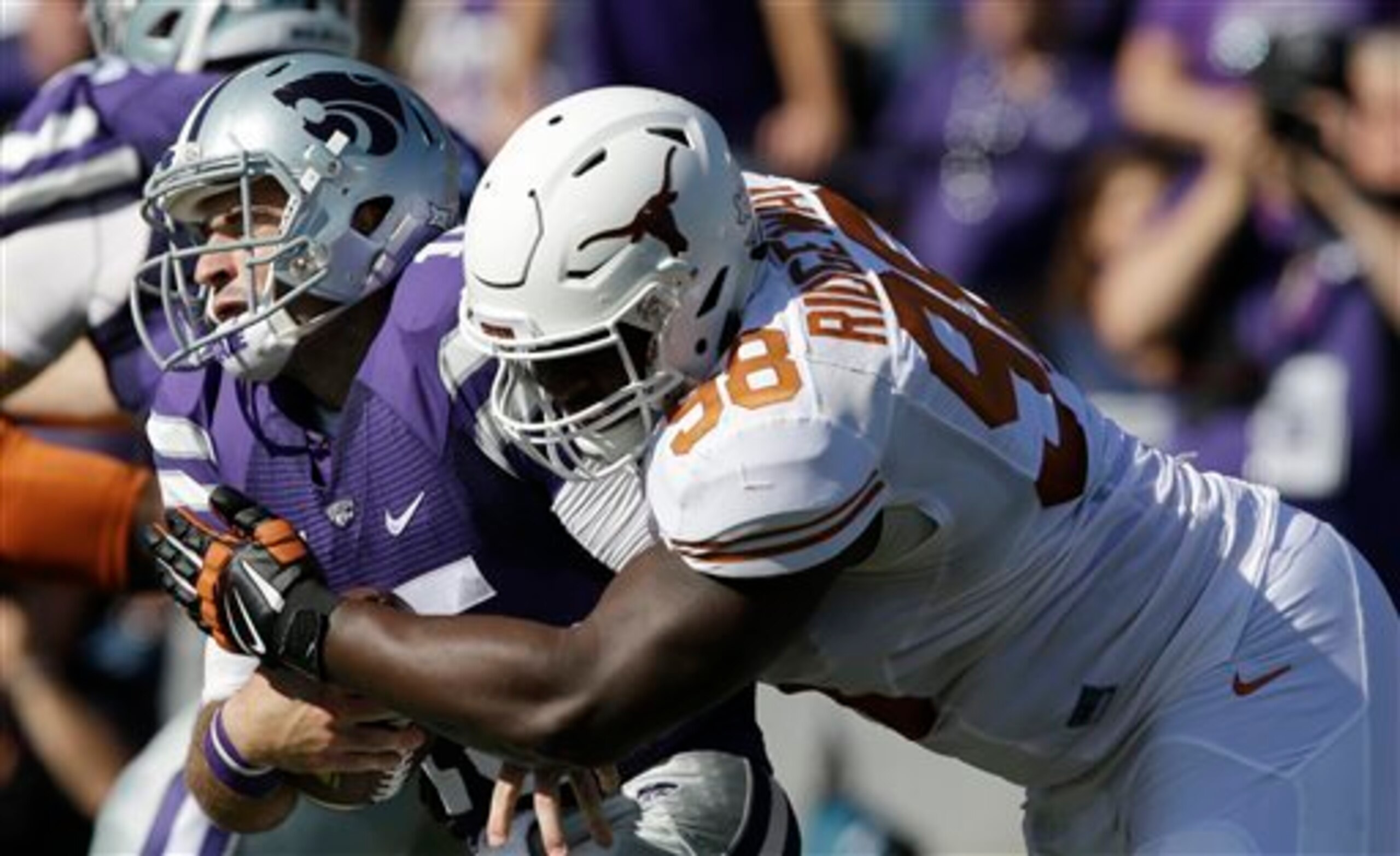
209. Jeff Heuerman, TE, Ohio State
Hands: 20/25; Route Running: 17/20; Blocking: 16/20; Release: 16/20; Speed: 11/15
Jeff Heuerman is an important part of Ohio State’s offense, even if he doesn’t flash on tape. He does consistent work in the trenches as a blocker and is good enough as a receiver that the defense has to pay attention to him. He just doesn’t have the speed or playmaking ability to rival the top guys on this list.
208. David Cobb, RB, Minnesota
Ball Security: 8/10; Power: 17/20; Vision: 16/20; Hands: 12/15; Speed: 16/20; Agility: 11/15
David Cobb does not do anything exceptionally well, but he doesn't struggle a lot either. He is a reliable back with a sturdy frame (5’11”, 220 lbs) and a proven ability to carry an offense to a win, running just as hard in the fourth quarter as he does in the first.
207. Antwan Goodley, WR, Baylor
Hands: 21/25; Route Running: 15/20; Blocking: 3/5; Release: 17/20; Speed: 12/15; Run After Catch: 12/15
Antwan Goodley is a perfect fit in Baylor's offense: the type of player who explodes off the line and gains immediate separation. With so many other weapons to worry about, defenses cannot afford to roll coverage in Goodley's direction, which allows him to turn that immediate separation into sustained separation down the field.
206. Clint Trickett, QB, West Virginia
Accuracy: 22/25; Arm Strength: 16/20; Pocket Presence: 7/10; Mobility: 5/10; Football IQ: 17/20; Leadership: 13/15
Clint Trickett bounced back from a rough junior season to salvage his career with a nice year in 2014. He is smart and accurate with the football and might have saved head coach Dana Holgorsen’s job by guiding West Virginia to a resurgent season.
205. Eli Harold, DE, Virginia
Pass Rush: 40/50; Run Defense: 33/40; Motor: 7/10
Eli Harold is a bouncy defensive end with rare length and athleticism. He has the ideal frame for a pass-rusher: 6’4”, 250 pounds with long arms and electric burst. He doesn’t play as physically as one would like, sometimes struggling to get off blocks in run support, but it’s not as if he’s a liability on the ground. And when he flashes, he looks like an All-American.
204. Mike Williams, WR, Clemson
Hands: 22/25; Route Running: 16/20; Blocking: 3/5; Release: 16/20; Speed: 12/15; Run After Catch: 11/15
Mike Williams looks like the next great Clemson receiver, even though quarterback issues deflated his stats in 2014. He doesn't stretch the field like Sammy Watkins or Martavis Bryant, but he's a 6'4" specimen with strong hands who is dangerous against man coverage.
203. Phillip Dorsett, WR, Miami (Fla.)
Hands: 20/25; Route Running: 15/20; Blocking: 2/5; Release: 17/20; Speed: 14/15; Run After Catch: 13/15
Arguably the fastest player in college football, Phillip Dorsett gives new meaning to the platitude about "being a threat to score from anywhere." The technical aspects of his game need refinement, but his speed and quickness make him a headache for defenses.
202. Pharaoh Brown, TE, Oregon
Hands: 22/25; Route Running: 15/20; Blocking: 15/20; Release: 17/20; Speed: 12/15
Pharaoh Brown missed the end of the year with a leg injury that could not have come at a worse time. He is a tantalizing athlete with great size (6’6”, 250 lbs) who was finally starting to reach his potential before going down. He wasn’t always the most consistent player, but when he was on, Brown was the closest thing to a dominant tight end in this year's college football season.
201. Tre' Jackson, OG, Florida State
Strength: 16/20; Pass Protection: 24/30; Run Blocking: 35/40; Explosion: 6/10
Tre’ Jackson did not have the same year in 2014 that he did in 2013. He regressed in pass protection and had curious lapses in judgment, which led to occasional pressures against Jameis Winston. Still, the 6’4”, 330-pound guard helped guide Florida State to a second straight year of national title contention, coming up big when the offense most needed a play.
200. Connor Cook, QB, Michigan State
Accuracy: 21/25; Arm Strength: 17/20; Pocket Presence: 7/10; Mobility: 6/10; Football IQ: 17/20; Leadership: 13/15
Connor Cook has turned a stale Michigan State offense into one of the best units in the Big Ten. He has great size (6’4”), a strong arm and all the qualities one looks for in a leader, but misses too many throws he should make.
199. Adrian McDonald, S, Houston
Ball Skills: 17/20; Tackling: 23/30; Run Support: 20/25; Pass Coverage: 21/25
Adrian McDonald is the leader of a Houston defense that had to overachieve in 2014. His solid overall coverage, highlighted by five interceptions, helped the Cougars stay afloat despite offensive regression.
198. James Conner, RB, Pittsburgh
Ball Security: 8/10; Power: 19/20; Vision: 16/20; Hands: 11/15; Speed: 16/20; Agility: 11/15
James Conner is an old-school running back: a 6’2”, 250-pound bruiser who lowers his head and dives between the tackles, daring safeties and undersized linebackers to tackle him. There is no deception to his or Pittsburgh’s running game, which makes it all the more impressive when it works (which is often).
197. Casey Pierce, TE, Kent State
Hands: 22/25; Route Running: 16/20; Blocking: 16/20; Release: 16/20; Speed: 11/15
Not a lot of people were watching, but Casey Pierce was a week-in, week-out factor in 2014, leading all FBS tight ends with 5.5 catches per game. At 6’4”, 235 pounds, he doesn’t cut the same frame as Kent State’s most famous tight end (Antonio Gates), but he knows how to slip between zone coverage and has a sticky pair of hands.
196. Taylor Kelly, QB, Arizona State
Accuracy: 21/25; Arm Strength: 16/20; Pocket Presence: 7/10; Mobility: 7/10; Football IQ: 17/20; Leadership: 13/15
Taylor Kelly is a smart, athletic, instinctive player who has won a lot of games the past three seasons. Nothing about him makes your jaw drop, but the aggregate of his tools makes for a pretty good college quarterback.
195. Markus Golden, DE, Missouri
Pass Rush: 41/50; Run Defense: 32/40; Motor: 8/10
Markus Golden and Missouri’s other starting defensive end—whom we’ll get to later on in this list—combine to form the best pass-rushing tandem in the country. Golden came on strong at the end of the year and used his speed to make consistent plays in the backfield. He is an athletic freak who plays hard and only needs some small mechanical tweaks to become a superstar.
194. Hassan Ridgeway, DT, Texas
Pass Rush: 34/40; Run Defense: 41/50; Motor: 6/10
Hassan Ridgeway came from nowhere to become one of the best defensive players in the Big 12 this season. Only a sophomore, he has great size for the position (6’4”, 307 lbs) and enough quickness to shoot through gaps. The only thing that lacks is his motor. He doesn’t play angry enough. “If he ever gets mad...he will hurt somebody,” said defensive coordinator Vance Bedford, per Taylor Gaspar of Bleacher Report. “My man could be a beast.”
Nos. 193-178
5 of 110
193. Deshaun Watson, QB, Clemson
Accuracy: 22/25; Arm Strength: 17/20; Pocket Presence: 8/10; Mobility: 7/10; Football IQ: 15/20; Leadership: 12/15
From the moment Deshaun Watson took over in the first half of the Florida State game, it was clear Clemson had found something special. Injuries cost him the better part of the season, derailing what had the potential to be a memorable freshman year, but Watson showed enough in limited reps to force his way onto this list.
192. Henry Anderson, DE, Stanford
Pass Rush: 40/50; Run Defense: 34/40; Motor: 7/10
Henry Anderson is the consummate Stanford front-seven player. He is big (6’6”, 287 lbs), strong, tough and underrated. He bullies opposing linemen with his physical nature and refined technical skill set. Whether he’s collapsing the pocket against the pass or setting the edge against the run, he’s the type of player winning teams rely on.
191. David Andrews, OC, Georgia
Strength: 15/20; Pass Protection: 24/30; Run Blocking: 36/40; Explosion: 6/10
David Andrews is a three-year starter at center who helped Georgia overcome the loss of running back Todd Gurley. As great as Nick Chubb was in the backfield, it was Andrews’ heady play in the middle of the offensive line that kept the Bulldogs plowing through defenses all season.
190. Christian Hackenberg, QB, Penn State
Accuracy: 21/25; Arm Strength: 19/20; Pocket Presence: 6/10; Mobility: 6/10; Football IQ: 17/20; Leadership: 12/15
Christian Hackenberg was being talked about as a future No. 1 overall draft pick after starting as a true freshman and finishing the season strong. A new coaching staff and a porous offensive line led to drastic regression in 2014, but Hackenberg still cuts the figure of an All-American quarterback if he can work out some of the kinks. All eyes will be on him this offseason.
189. Xzavier Dickson, DE, Alabama
Pass Rush: 42/50; Run Defense: 32/40; Motor: 7/10
Xzavier Dickson is a complete defensive lineman who lacks the big-name or highlight-reel reputation of his former Alabama teammates but played a heck of a season in 2014. He has speed to rush the passer from the outside and strength to push the pocket from the inside, and he played a huge role in landing Alabama the No. 1 seed in the College Football Playoff.
188. Nate Andrews, S, Florida State
Ball Skills: 16/20; Tackling: 24/30; Run Support: 20/25; Pass Coverage: 21/25
Nate Andrews had an inconsistent season but at times looked like a superstar, which in some ways makes him a microcosm of the entire Florida State defense. If he learns to play the ball a little better in the air, he could turn into something special.
187. Everett Golson, QB, Notre Dame
Accuracy: 20/25; Arm Strength: 18/20; Pocket Presence: 7/10; Mobility: 8/10; Football IQ: 16/20; Leadership: 12/15
Everett Golson looked like a Heisman Trophy contender for most of the season, but turnover issues played him out of the conversation. Still, he righted the ship for a Notre Dame offense that was stale with Tommy Rees under center in 2013 and lost its projected No. 1 receiver (DaVaris Daniels) to an academic suspension in fall camp.
186. Jamison Crowder, WR, Duke
Hands: 21/25; Route Running: 16/20; Blocking: 3/5; Release: 16/20; Speed: 12/15; Run After Catch: 13/15
Outside of head coach David Cutcliffe, no one has been more responsible for Duke's resurgence these past two years than Jamison Crowder. The do-it-all receiver is one of the best punt returners in college football and has seared his name into the ACC record book.
185. Curt Maggitt, DE, Tennessee
Pass Rush: 42/50; Run Defense: 31/40; Motor: 8/10
Curt Maggitt was one of the best stories of the 2014 season, returning from a torn ACL to lead Tennessee in sacks (11). More than 12 months of rehab did not take a toll on his explosiveness, which remained intact as he shot off the edge and tormented SEC linemen with his speed rush.
184. Ben Koyack, TE, Notre Dame
Hands: 22/25; Route Running: 16/20; Blocking: 18/20; Release: 15/20; Speed: 11/15
Ben Koyack will not go down alongside Tyler Eifert and Kyle Rudolph as one of the great modern tight ends at Notre Dame. But he shouldn’t be too far behind them. He does not stand out in any one area, but he is a solid player who helps as much on the ground as he does through the air.
183. Drew Ott, DE, Iowa
Pass Rush: 41/50; Run Defense: 33/40; Motor: 8/10
Drew Ott played third fiddle behind Carl Davis and Louis Trinca-Pasat on Iowa’s defensive line, but he was just as good as his teammates during 2014. He is a scrappy pass-rusher with a high motor who flashes more downs than he doesn’t. And because of his size (6’4”, 270 lbs), he is strong enough to crash the edge and funnel tailbacks back inside against the run.
182. John Miller, OG, Louisville
Strength: 17/20; Pass Protection: 24/30; Run Blocking: 35/40; Explosion: 6/10
John Miller stands a little short for the position (6’2”) and isn’t a freak athlete to compensate. What he is, though, is durable, consistent, technical, tough and one of the smartest interior linemen in the country—and it shows.
181. Leonte Carroo, WR, Rutgers
Hands: 22/25; Route Running: 16/20; Blocking: 3/5; Release: 16/20; Speed: 12/15; Run After Catch: 13/15
Leonte Carroo helped Rutgers get off to a hot start in 2014, and even when that hot start turned cold during Big Ten play, he continued to post good numbers. He is big (6'1"), physical, fast enough to get downfield and adept at beating coverage that's geared to stop him.
180. Jean Sifrin, TE, UMass
Hands: 23/25; Route Running: 17/20; Blocking: 15/20; Release: 16/20; Speed: 11/15
Jean Sifrin chose UMass over offers from Oklahoma and USC in large part because he wanted to play for Mark Whipple. Whipple was Miami’s offensive coordinator in 2009 and 2010 and helped turn Jimmy Graham into the player he is today. Sifrin, like Graham, has physical tools that are rare and impossible to teach. He obviously isn’t there yet, but he’s on his way. If he stays in school next season, watch out.
179. Dalvin Cook, RB, Florida State
Ball Security: 7/10; Power: 16/20; Vision: 17/20; Hands: 12/15; Speed: 18/20; Agility: 12/15
Dalvin Cook broke out in the second half of the season and at times looked like the go-to guy in Florida State's offense. It is rare for a true freshman to become the primary option in an offense so talented, but Cook is a rare type of talent. The Seminoles would not have made the playoff without him.
178. O.J. Howard, TE, Alabama
Hands: 21/25; Route Running: 15/20; Blocking: 15/20; Release: 17/20; Speed: 14/15
Alabama does not target O.J. Howard as often as fans think it should (and almost any other team in the country would). But that does not devalue how good he has been when called upon. The constant threat of his presence does a lot to open up the Crimson Tide offense.
Nos. 177-162
6 of 110
177. Mike Davis, RB, South Carolina
Ball Security: 8/10; Power: 18/20; Vision: 16/20; Hands: 13/15; Speed: 16/20; Agility: 11/15
Injuries hobbled Mike Davis during the early part of the season, but he still had enough big moments to carry South Carolina (and its historically bad defense) to a bowl game. Despite his height (5’9”), he breaks copious tackles and flashes strong hands to make an impact in the passing game.
176. Lorenzo Doss, CB, Tulane
Speed: 16/20; Ball Skills: 17/20; Run Defense: 14/20; Coverage: 35/40
Lorenzo Doss lacks ideal size (5’11”, 187 lbs) and speed, but he does not lack for coverage instincts. He always happens to be around the ball, which is no coincidence. And he knows what to do once he gets his hands on it.
175. Jeremy Langford, RB, Michigan State
Ball Security: 9/10; Power: 17/20; Vision: 16/20; Hands: 12/15; Speed: 16/20; Agility: 12/15
Jeremy Langford is as steady as they come, continuing the long tradition of workhorse running backs in East Lansing. He doesn’t have the power of a Le’Veon Bell, but the converted defensive back is a decisive runner with long strides who gets better as the game wears on.
174. Jon Feliciano, OG, Miami (Fla.)
Strength: 16/20; Pass Protection: 25/30; Run Blocking: 35/40; Explosion: 6/10
Jon Feliciano has been a rock up the middle of Miami’s offensive line. He and center Shane McDermott give the Hurricanes a solid pairing in the A-gap, paving holes for running back Duke Johnson and helping true freshman quarterback Brad Kaaya avoid interior pressure.
173. Josh Robinson, RB, Mississippi State
Ball Security: 9/10; Power: 17/20; Vision: 16/20; Hands: 13/15; Speed: 16/20; Agility: 11/15
Josh Robinson has been described as a bowling ball, and there is no more apt way to describe him. The stocky tailback with the round backside became a fan favorite—and an opponent’s worst nightmare—with his low center of gravity and his never-ending leg drive. He refuses to give up on a play until it is officially whistled dead.
172. Brad Kaaya, QB, Miami (Fla.)
Accuracy: 23/25; Arm Strength: 16/20; Pocket Presence: 8/10; Mobility: 6/10; Football IQ: 16/20; Leadership: 13/15
Miami was forced to play Brad Kaaya as a true freshman after injuries, dismissals and slumps wiped out the middling group of players in front of him. In the process, it found more than just a quarterback of the future; it found a quarterback of the present, too.
171. Corey Coleman, WR, Baylor
Hands: 22/25; Route Running: 16/20; Blocking: 2/5; Release: 16/20; Speed: 13/15; Run After Catch: 13/15
Corey Coleman became the No. 1A receiver in Baylor's offense this season, utilizing his running back-like frame to earn extra yardage on short receptions. Like all Baylor receivers, his route running has been called into question, but his explosiveness is hard to deny.
170. Jarvion Franklin, RB, Western Michigan
Ball Security: 8/10; Power: 17/20; Vision: 17/20; Hands: 12/15; Speed: 16/20; Agility: 12/15
Jarvion Franklin made a lot of high school scouts look foolish with his breakout freshman season at Western Michigan. The 6’0”, 220-pound workhorse was ranked outside the top 1,900 players in the 2014 recruiting class, according to 247Sports, but established himself as a dangerous weapon with a knack for eating yardage in big, consistent chunks.
169. Trey Flowers, DE, Arkansas
Pass Rush: 41/50; Run Defense: 33/40; Motor: 8/10
Trey Flowers was the emotional heartbeat for an improved Arkansas defense. When the Razorbacks got hot at the end of the season, upsetting LSU and Ole Miss in back-to-back weeks to make a bowl game, Flowers was in the middle of everything. He is a sound, strong, disciplined pass-rusher and a fantastic leader along the line.
168. Kurtis Drummond, S, Michigan State
Ball Skills: 16/20; Tackling: 25/30; Run Support: 20/25; Pass Coverage: 21/25
Michigan State’s defense took a step back in 2014, which was expected after losing so many pieces. But it didn’t take a huge step back, and for that Kurtis Drummond deserves credit. Despite the revolving door of safeties lining up next to him, he played well as the leader of Pat Narduzzi’s crew and helped Sparty reach 10 wins for the fourth time in five years.
167. Alex Collins, RB, Arkansas
Ball Security: 7/10; Power: 17/20; Vision: 17/20; Hands: 12/15; Speed: 17/20; Agility: 12/15
Alex Collins knew since he was in high school that he wanted to play for Bret Bielema, no matter what school that meant he would attend. Two years into his college career, it is not hard to see why. Splitting carries with Jonathan Williams has deflated his overall numbers, but it has not stopped Collins from making an impact with his shifty, slashing, low-to-the-ground running style and his toughness in the hole.
166. Laken Tomlinson, OG, Duke
Strength: 17/20; Pass Protection: 23/30; Run Blocking: 36/40; Explosion: 6/10
Tomlinson is every coach’s dream: a model student, a four-year starter and one of the best offensive guards in the country. Running often through holes that Tomlinson created, freshman tailback Shaun Wilson averaged an ACC-best 7.97 yards per carry during the 2014 regular season.
165. Frankie Sutera, S, Utah State
Ball Skills: 16/20; Tackling: 25/30; Run Support: 21/25; Pass Coverage: 21/25
Frankie Sutera is a complete safety who can tackle running backs, cover slot receivers and rush the quarterback. He was a rock on the back end of a Utah State defense that was—once again—among the best-kept secrets in the country this regular season.
164. Jonnu Smith, TE, Florida International
Hands: 23/25; Route Running: 16/20; Blocking: 16/20; Release: 16/20; Speed: 12/15
Jonnu Smith is more agile than fast, but the way he plays makes the former more important. He is difficult to mirror off the line and has quickness to get open underneath. His straight-line speed isn’t as impressive but still lands high on the bell curve for tight ends.
163. Adam Shead, OG, Oklahoma
Strength: 16/20; Pass Protection: 25/30; Run Blocking: 35/40; Explosion: 7/10
Adam Shead gets second billing behind the bigger-name tackles on Oklahoma’s offensive line. But don't let the billing order fool you. Perine and the Sooners' rush offense would have looked substantially worse without Shead leading the way all season.
162. Jake Ryan, ILB, Michigan
Tackling: 30/35; Pass Rush: 10/15; Run Defense: 26/30; Pass Coverage: 17/20
Jake Ryan began his career as an outside linebacker and played pretty well in that role. But after kicking inside this season, it became clear that he was out of position. If not for his tenacity in the middle of Michigan’s defense, the Wolverines might have finished even worse than 5-7, and Brady Hoke might have been canned long before December.
Nos. 161-146
7 of 110
161. Mike Hilton, CB, Ole Miss
Speed: 16/20; Ball Skills: 16/20; Run Defense: 17/20; Coverage: 34/40
Mike Hilton began the year at cornerback before injuries forced him to oscillate between cornerback and safety. Either way, the 5’9” junior is a menace against the run and plays an integral role in the “Landsharks” defense.
160. Shane Carden, QB, East Carolina
Accuracy: 22/25; Arm Strength: 17/20; Pocket Presence: 8/10; Mobility: 6/10; Football IQ: 17/20; Leadership: 13/15
Shane Carden had East Carolina ranked and flirting with a New Year’s Day bowl for most of the season. Things spiraled out of control in the final month, but that is not enough to make us forget how good he was in getting the Pirates to that position in the first place.
159. Hayes Pullard, ILB, USC
Strength: 30/35; Pass Rush: 10/15; Run Defense: 26/30; Pass Coverage: 17/20
Hayes Pullard has been through a lot during his time at USC. Three head coaches and four defensive coordinators in four years made it hard for him to find a consistent rhythm. But Pullard found a way to fit into all sorts of different schemes, leading the Trojans in tackles the past two seasons after finishing second in 2011 and 2012. There may not be a more malleable linebacker in the country.
158. Samaje Perine, RB, Oklahoma
Ball Security: 9/10; Power: 18/20; Vision: 16/20; Hands: 12/15; Speed: 16/20; Agility: 12/15
Samaje Perine did his best Adrian Peterson impression as a true freshman at Oklahoma, barreling through Big 12 defenses with his vicious running style. The 5’11”, 243-pound tailback set an FBS record with 427 rushing yards in one game against Kansas and rushed for 200-plus yards in two other conference games.
157. B.J. Finney, OC, Kansas State
Strength: 18/20; Pass Protection: 23/30; Run Blocking: 36/40; Explosion: 6/10
B.J. Finney is the quintessential Bill Snyder superstar: underrecruited, unheralded and underrated. He went from former walk-on to Rivals.com Freshman All-American in 2011 and has started in the middle of Kansas State’s offense ever since. It’s no coincidence that the Wildcats, as a team, have enjoyed so much success during that run.
156. William Fuller, WR, Notre Dame
Hands: 21/25; Route Running: 17/20; Blocking: 3/5; Release: 17/20; Speed: 13/15; Run After Catch: 12/15
William Fuller blossomed into a No. 1 receiver as a sophomore in 2014, filling the void left by suspended star DaVaris Daniels. He is a lanky 6'0" with speed to burn and the ability to take the top off a defense.
155. Darian Thompson, S, Boise State
Ball Skills: 17/20; Tackling: 25/30; Run Support: 20/25; Pass Coverage: 21/25
Darian Thompson is one of the best rovers in the country and someone who plays up to competition. His seven interceptions were tied for third-most in the country during the regular season, and six came against bowl teams (Ole Miss, Colorado State, Nevada, BYU and Utah State).
154. Donnel Pumphrey, RB, San Diego State
Ball Security: 8/10; Power: 15/20; Vision: 17/20; Hands: 12/15; Speed: 18/20; Agility: 13/15
Donnel Pumphrey is the perfect fit for San Diego State’s offense—one of the most consistent producers of running-back talent in the country. Whatever he lacks in size, he makes up for with quickness, speed and home-run ability.
153. Pharoh Cooper, WR, South Carolina
Hands: 21/25; Route Running: 17/20; Blocking: 3/5; Release: 16/20; Speed: 13/15; Run After Catch: 13/15
Pharoh Cooper does a little bit of everything for South Carolina. He catches passes. He throws passes. He carries the ball. He returns punts. Anything the Gamecocks can do to get him the ball, they do it. And it's hard to argue with the 2014 results.
152. Ramik Wilson, ILB, Georgia
Tackling: 31/35; Pass Rush: 11/15; Run Defense: 26/30; Pass Coverage: 15/20
Ramik Wilson is a terrifying blend of size (6’2”, 235 lbs), speed and motor. He isn’t the most fluid athlete, which makes him a liability on passing downs, but he does enough things well on standard downs that he cannot be omitted from this list.
151. Jarvis Harrison, OG, Texas A&M
Strength: 16/20; Pass Protection: 24/30; Run Blocking: 36/40; Explosion: 7/10
Harrison is the prototypical guard for a spread offense. It is rare to find a player his size with so much athletic ability—a combination that gives Kevin Sumlin and Jake Spavital a ton of play-calling flexibility.
150. Robert Nkemdiche, DT, Ole Miss
Pass Rush: 32/40; Run Defense: 44/50; Motor: 7/10
Robert Nkemdiche outperforms his stats and might just be the most physically gifted player in college football. He has insane power for a 3-technique (R.I.P Leon Brown), but also enough speed that Ole Miss used to play him at running back. Consistency is the only thing weighing Nkemdiche down. A player with such immense physical advantages should be dominating every week—not just when the Rebels play on national TV.
149. Royce Freeman, RB, Oregon
Ball Security: 9/10; Power: 18/20; Vision: 16/20; Hands: 12/15; Speed: 16/20; Agility: 12/15
Freeman has given Oregon a true downhill power back for the first time since LeGarrette Blount. He was supposed to back up Byron Marshall and Thomas Tyner, but played so well as a true freshman that Marshall moved to receiver and Tyner moved into a supporting role.
148. Connor Halliday, QB, Washington State
Accuracy: 23/25; Arm Strength: 17/20; Pocket Presence: 8/10; Mobility: 6/10; Football IQ: 16/20; Leadership: 13/15
Halliday ended an up-and-down career with a decidedly “up” senior season. His 2014 campaign was cut short by a gruesome leg injury, but before that, he was posting some historic passing numbers.
147. Max Valles, DE, Virginia
Pass Rush: 43/50; Run Defense: 33/40; Motor: 7/10
Max Valles is a linebacker/end hybrid who can rush both with his hand down or standing up. He is 6’5”, 240 pounds and knows how to use his long frame to rip past offensive tackles. After an impressive sophomore season (in which his final two games were two of his best), Valles is a player to keep an eye on in 2015.
146. A'Shawn Robinson, DT, Alabama
Pass Rush: 31/40; Run Defense: 45/50; Motor: 7/10
A’Shawn Robinson is a man-child—seriously...how was this guy born in 1995?—and the key member of Alabama’s run defense. He didn’t record a sack in 2014 after logging 5.5 as a true freshman, which is troubling, but that had more to do with the role Alabama asked of him following Brandon Ivory's departure. He is versatile enough to play 0-technique, 3-technique or 5-technique and will surely land on some preseason All-America lists next season.
Nos. 145-132
8 of 110
145. Tank Jakes, OLB, Memphis
Tackling: 30/35; Pass Rush: 16/20; Run Defense: 17/20; Pass Coverage: 20/25
When defensive lineman Martin Ifedi missed time at the beginning of the season, Tank Jakes was called upon to step up and become the star of Memphis' defense. And that is precisely what he did. Even though he doesn’t have great size (5'11", 227 lbs), he is bursting at the seams with toughness and has a gift for making plays in the backfield.
144. Vince Biegel, OLB, Wisconsin
Tackling: 29/35; Pass Rush: 16/20; Run Defense: 17/20; Pass Coverage: 21/25
Vince Biegel is a microcosm of Wisconsin’s entire defense. He played fairly well at the start of the year, slowly improved during conference play, peaked at the right time and finished the season with an impressive resume. He’s only a sophomore, too, which means the best should be yet to come.
143. Shaq Thompson, OLB, Washington
Tackling: 31/35; Pass Rush: 15/20; Run Defense: 16/20; Pass Coverage: 21/25
Shaq Thompson is a linebacker/safety/running back hybrid and probably the best big-play defender in the country. Once he finds a permanent position—no matter which position that might be—and sharpens some of his raw tools into technical skills, he will make the leap from being very good to great.
142. Reggie Ragland, OLB, Alabama
Tackling: 32/35; Pass Rush: 13/20; Run Defense: 18/20; Pass Coverage: 20/25
Reggie Ragland is an old-school downhill thumper and a perfect fit on the weak side of Alabama's defense. At 6'2", 254 pounds, he is the last player opposing running backs want to see charging through a hole. His motor has made an big impact on the Crimson Tide in 2014.
141. Leonard Fournette, RB, LSU
Ball Security: 8/10; Power: 18/20; Vision: 17/20; Hands: 11/15; Speed: 17/20; Agility: 12/15
Fournette came to LSU with impossible-to-meet expectations, including comparisons to Adrian Peterson. He wasn’t the best freshman running back in a decade, but the No. 1 overall recruit from 2014 has held his own (and then some) against the strongest division in the country.
140. Pete Robertson, OLB, Texas Tech
Tackling: 31/35; Pass Rush: 19/20; Run Defense: 16/20; Pass Coverage: 18/25.
Texas Tech is one of the worst defenses in college football, which makes it easy to overlook one of the best outside linebackers. But make no mistake about it: The Red Raiders could (and would) be a whole lot worse without Pete Robertson terrorizing quarterbacks off the edge.
139. Antonio Morrison, OLB, Florida
Tackling: 33/35; Pass Rush: 15/20; Run Defense: 18/20; Pass Coverage: 18/25.
Antonio Morrison has had a…um…complicated off-field tenure at Florida. But between the sidelines, Gators fans know he is someone they can count on. The big-bodied junior had the best season of his career in 2014, hammering, splattering and finishing plays in the hole and proving, once again, that he is one of the best run defenders in the country.
138. James Sample, S, Louisville
Ball Skills: 16/20; Tackling: 26/30; Run Support: 21/25; Pass Coverage: 21/25
James Sample gets overshadowed by one of his teammates, whom we’ll get to later on this list, but had a solid season in 2014. On the rare occasion that Louisville’s run defense cracks, he is always around to clean things up.
137. Montres Kitchens, S, Troy
Ball Skills: 17/20; Tackling: 25/30; Run Support: 20/25; Pass Coverage: 22/25
Montres Kitchens is a roamer with great instincts and ball skills. His six interceptions were the most in the Sun Belt, but he also contributed against the run, leading Troy with 88 total tackles. The next-closest player had 57.
136. Bryce Hager, ILB, Baylor
Tackling: 32/35; Pass Rush: 10/15; Run Defense: 26/30; Pass Coverage: 16/20
Bryce Hager spent a long time carrying bad Baylor defenses to respectability. This year, the unit around him improved, which made it harder for his own performance to stand out. But don’t let that fool you: Hager is still an effective run defender who understands his role and is capable of taking over when the situation calls for it, as Oklahoma would sadly attest.
135. Blake Sims, QB, Alabama
Accuracy: 21/25; Arm Strength: 17/20; Pocket Presence: 7/10; Mobility: 8/10; Football IQ: 17/20; Leadership: 14/15
Sims was an afterthought in Alabama's quarterback competition, a placeholder until Coker did the inevitable and won the job. But the redshirt senior competed hard in practice, earned the right to start against West Virginia and never looked back from there, playing as well as any quarterback Saban has coached in Tuscaloosa.
134. T.J. Clemmings, OT, Pittsburgh
Hands: 20/25; Power: 12/15; Lateral Quickness: 23/25; Pass Protection: 22/25; Run Blocking: 7/10
T.J. Clemmings is a converted defensive lineman who might, at some point, end up being the best player on this list. He has a unique mixture of size (6’6”, 315 lbs) and athleticism, and he's come along fast in terms of technical development and discipline. He just needs a little more fine-tuning.
133. D'haquille Williams, WR, Auburn
Hands: 21/25; Route Running: 17/20; Blocking: 4/5; Release: 17/20; Speed: 12/15; Run After Catch: 13/15
Williams has lived up to the hype with which he arrived at Auburn. The top JUCO prospect in the country used his size, strength and athleticism to become one of the SEC's most dangerous weapons.
132. Dakota Cox, ILB, New Mexico
Tackling: 32/35; Pass Rush: 10/15; Run Defense: 26/30; Pass Coverage: 16/20
Dakota Cox missed the final three games of the season with a torn ACL. But before that, he was starting to put together a truly remarkable year. The true sophomore is a maniac against the run who finished with an FBS-best 12.89 tackles per game, improving across the board from a season that saw him make the FWAA Freshman All-America Team.
Nos. 131-116
9 of 110
131. Lorenzo Mauldin, DE, Louisville
Pass Rush: 42/50; Run Defense: 34/40; Motor: 8/10
Lorenzo Mauldin had big shoes to fill after AAC Defensive Player of the Year Marcus Smith left for the NFL this offseason. But the drop-off from one to the other was negligible, and the same could be said for Louisville’s defense as a whole. Mauldin led the charge with 13 tackles for loss in 11 regular-season games as the Cardinals made their ACC transition look smooth.
130. Dak Prescott, QB, Mississippi State
Accuracy: 22/25; Arm Strength: 18/20; Pocket Presence: 7/10; Mobility: 8/10; Football IQ: 16/20; Leadership: 13/15
Mississippi State went from also-ran to contender in 2014, and Prescott was the man behind the wheel. He refined his passing to complement his running, which has made him a true dual threat. He is one of the most well-rounded players in college football.
129. Eddie Goldman, DT, Florida State
Pass Rush: 32/40; Run Defense: 45/50; Motor: 7/10
Eddie Goldman is a safety pin up the middle of Florida State’s defense, holding together a unit that might otherwise break apart. The Seminoles needed every ounce of Goldman’s production to run the table this regular season, relying on their massive tackle (6’4”, 314 lbs) to occupy double-teams, disengage from blockers and wreak general havoc against the run.
128. Daryl Williams, OT, Oklahoma
Hands: 21/25; Power: 13/15; Lateral Quickness: 20/25; Pass Protection: 21/25; Run Blocking: 9/10
Daryl Williams is a snowplow in the running game, clearing the streets for Oklahoma’s backfield. He is not an off-the-charts athletic specimen, but at 6’6”, 329 pounds, he does enough things well that he doesn’t have to be.
127. Nick Chubb, RB, Georgia
Ball Security: 8/10; Power: 18/20; Vision: 17/20; Hands: 12/15; Speed: 17/20; Agility: 12/15
Chubb was asked to replace early Heisman candidate Todd Gurley in the middle of his true freshman season. Almost anything he did would have felt like a drop-off in comparison. Somehow, he played well enough that no one seemed to mention a letdown of any sort. If he’s this good now, how good might he be in two years?
126. Reese Dismukes, OC, Auburn
Strength: 17/20; Pass Protection: 25/30; Run Blocking: 36/40; Explosion: 6/10
Dismukes is the engine that makes Auburn’s offense go. A complex, deception-oriented system such as Malzahn’s requires a cerebral athlete in the middle of the action. Dismukes has been precisely that.
125. Bryce Petty, QB, Baylor
Accuracy: 22/25; Arm Strength: 17/20; Pocket Presence: 7/10; Mobility: 7/10; Football IQ: 17/20; Leadership: 14/15
Petty did not attain the personal success of Robert Griffin III at Baylor, but he led the team to heights even RGIII never flirted with. He will go down as one of the better—if not most underrated—quarterbacks in Big 12 history.
124. D.J. Foster, RB, Arizona State
Ball Security: 9/10; Power: 16/20; Vision: 16/20; Hands: 14/15; Speed: 17/20; Agility: 12/15
Foster was a running back/receiver hybrid in 2013, catching 63 passes to go with 93 carries. Even after a full-time move to the backfield in 2014, he remained an essential part of Arizona State’s passing game despite having his rushing workload doubled. He tormented defenses with his unique versatility.
123. Aaron Davis, OLB, Colorado State
Tackling: 33/35; Pass Rush: 14/20; Run Defense: 17/20; Pass Coverage: 21/25
Aaron Davis was the best defensive player on a Colorado State team that finished with its best record since 2000. A cousin of Marques Tuiasosopo, Davis doesn’t jump off tape with his physical tools but always seems to be around the ball against the run and holds his own in coverage.
122. Kentrell Brothers, OLB, Missouri
Tackling: 32/35; Pass Rush: 15/20; Run Defense: 17/20; Pass Coverage: 21/25
Shane Ray and Markus Golden steal the headlines—and with good reason—but Kentrell Brothers played just as big a role in leading Missouri to the SEC East title. One of the few carryovers who started for last year’s Tigers too, Brothers has a big, square frame (6'1", 240 lbs) and isn’t afraid to take on blockers in the hole.
121. Myles Jack, OLB, UCLA
Tackling: 32/35; Pass Rush: 13/20; Run Defense: 17/20; Pass Coverage: 23/25
Jack became a household name for his ability to play running back and linebacker as a true freshman in 2013. But even if you ignore his offensive skills, he is good enough that he deserves to be recognized. He might be the best overall athlete in the country.
120. Tyler Boyd, WR, Pittsburgh
Hands: 22/25; Route Running: 17/20; Blocking: 3/5; Release: 17/20; Speed: 13/15; Run After Catch: 13/15
Boyd was the best freshman receiver in the country last season and posted similar numbers in a run-first offense as a sophomore. His game brings back memories of former Pittsburgh receiver Larry Fitzgerald—and no, that is not hyperbole.
119. Tre'Davious White, CB, LSU
Speed: 18/20; Ball Skills: 16/20; Run Defense: 15/20; Coverage: 36/40
Tre’Davious White is the latest in a long line of great LSU cornerbacks, having already accomplished much in his two years with the program. He does not pose the physical presence of his teammate, Jalen Collins, but he’s an explosive athlete with freaky speed who is way ahead of the curve in terms of coverage.
118. Jeremy Cash, S, Duke
Ball Skills: 16/20; Tackling: 27/30; Run Support: 21/25; Pass Coverage: 21/25
Jeremy Cash teams with DeVon Edwards—the latter of whom just barely missed this list—to give Duke one of the best safety tandems in the country. Few defensive backs are better than Cash at forcing negative plays in the backfield.
117. Steve Edmond, ILB, Texas
Strength: 32/35; Pass Rush: 11/15; Run Defense: 26/30; Pass Coverage: 16/20
Steve Edmond is a versatile inside linebacker. Like all Charlie Strong and Vance Bedford products, he is equally capable of stuffing a run in the A-gap or putting his hand down and rushing off the edge. Since 2008, Emmanuel Acho is the only other Texas linebacker to finish a season with 100-plus total tackles and 10-plus tackles for loss.
116. Damian Swann, CB, Georgia
Speed: 16/20; Ball Skills: 17/20; Run Defense: 16/20; Coverage: 36/40
Damian Swann was picked on in 2013 after breaking out as a sophomore one year prior. No one was quite sure what to expect from him this season, but new defensive coordinator Jeremy Pruitt got the most out of his fallen star, turning him back into an All-SEC-type player.
Nos. 115-101
10 of 110
115. Justin Hardy, WR, East Carolina
Hands: 22/25; Route Running: 18/20; Blocking: 3/5; Release: 17/20; Speed: 12/15; Run After Catch: 13/15
Hardy caught 110 passes in 2014, enough to pass Ryan Broyles as the all-time FBS receptions leader with 376 for his career (pre-bowl game). He is the ideal slot receiver and one of the best third-down weapons in college football.
114. Josh Forrest, ILB, Kentucky
Tackling: 32/35; Pass Rush: 11/15; Run Defense: 26/30; Pass Coverage: 16/20
Josh Forrest was one of the biggest breakout players in the SEC, leading the conference with 64 solo tackles during the regular season. Kentucky has a long way to go on defense, especially with Za’Darius Smith and Bud Dupree set to graduate, but Forrest (provided he returns for his senior season) gives the Wildcats a run-stopping presence to build around.
113. Jared Tevis, S, Arizona
Ball Skills: 15/20; Tackling: 27/30; Run Support: 23/25; Pass Coverage: 20/25
Jared Tevis is a tackling machine on the back end of Arizona’s defense. His contributions have been overshadowed by linebacker Scooby Wright—and with good reason—but he was the second-most impressive player on a defense/team that blew past expectations.
112. Alex Carter, CB, Stanford
Speed: 15/20; Ball Skills: 16/20; Run Defense: 17/20; Coverage: 37/40
Alex Carter is a microcosm of the entire Stanford defense: physical, disciplined, relentless. He refuses to give an inch off the line of scrimmage, compensating for average speed with the best press-coverage technique in the country.
111. Paul Perkins, RB, UCLA
Ball Security: 9/10; Power: 17/20; Vision: 17/20; Hands: 13/15; Speed: 17/20; Agility: 12/15
Perkins is not a household name, but he should be. After a year in which UCLA failed to replace Johnathan Franklin, the big-play sophomore has paired with Brett Hundley to give the Bruins one of the best backfields in the country.
110. Louis Trinca-Pasat, DT, Iowa
Pass Rush: 34/40; Run Defense: 43/50; Motor: 8/10
Carl Davis entered the season (and remains) the bigger name, but Louis Trinca-Pasat was the best player on Iowa’s defensive line. The Romanian lacks ideal size (6’3”, 290 lbs) but has quickness to spare and a motor that doesn’t quit. His blue-collar attitude makes him an easy player to fall in love with when one sits down with Iowa tape.
109. Jeff Luc, ILB, Cincinnati
Tackling: 32/35; Pass Rush: 12/15; Run Defense: 26/30; Pass Coverage: 15/20
Jeff Luc is the best player on a not-so-good Cincinnati defense and one of the biggest reasons the Bearcats won nine games for the seventh time in eight years. He is a force near the line of scrimmage and a frequent source of big plays (for a unit that relies on them). His five forced fumbles were tied for second most in the country.
108. Tyeler Davison, DT, Fresno State
Pass Rush: 34/40; Run Defense: 44/50; Motor: 7/10
Davison flies under the radar but has quietly put together a nice career. He made the All-Mountain West first team in 2012 and 2014 and the second team in 2013. Fresno State took a step back as a team during his senior year, but Davison ensured that it didn't fall too far.
107. Jonathan Jones, CB, Auburn
Speed: 17/20; Ball Skills: 18/20; Run Defense: 15/20; Coverage: 35/40
Jonathan Jones is one of the few (only?) Auburn defenders who did not disappoint this season. Despite his size (5’10”), he played lockdown coverage on the outside and finished No. 2 in the SEC with six interceptions.
106. Deon Bush, S, Miami (Fla.)
Ball Skills: 17/20; Tackling: 26/30; Run Support: 21/25; Pass Coverage: 21/25
Deon Bush is the most important player on Miami’s defense. When he was healthy in 2014, the Hurricanes played better than they had in years. When he was banged up, they got gashed by Virginia and Pittsburgh. The 6’1” junior does not do anything exceptional (other than forcing fumbles), but neither does he struggle in any area.
105. Garrett Grayson, QB, Colorado State
Accuracy: 23/25; Arm Strength: 16/20; Pocket Presence: 8/10; Mobility: 7/10; Football IQ: 18/20; Leadership: 13/15
In 2009, Grayson was a 2-star recruit with limited college offers despite having showed well on the high school camp circuit. Five years later, he’s a redshirt senior leading one of the most efficient offenses in the country. He never let that chip off his shoulder and morphed into a top-five pocket QB.
104. Preston Smith, DE, Mississippi State
Pass Rush: 43/50; Run Defense: 34/40; Motor: 8/10
Smith came on strong at the start of the season, becoming the first player in conference history to win three consecutive SEC Defensive Lineman of the Week awards. He didn’t maintain that pace in the latter three-fourths of the year, but he still played well enough to crack the top 15 defensive ends. He was a big part of Mississippi State’s resurgent year.
103. Sterling Shepard, WR, Oklahoma
Hands: 23/25; Route Running: 17/20; Blocking: 3/5; Release: 17/20; Speed: 13/15; Run After Catch: 12/15
Shepard played second fiddle to Jalen Saunders in 2013 but was up to the task of replacing him—and then some—as a junior. Oklahoma's offense was lost when he missed the Baylor game with an injury, and that was no coincidence.
102. Hroniss Grasu, OG, Oregon
Strength: 15/20; Pass Protection 25/30; Run Blocking 37/40; Explosion 8/10
Grasu is the heart and soul of Oregon's offensive line, which might be the most important unit on the team. When the blockers play well, the Ducks play well. And the key to the blockers playing well is the man in the middle.
101. Cameron Artis-Payne, RB, Auburn
Ball Security: 9/10; Power: 17/20; Vision: 18/20; Hands: 12/15 Speed: 16/20 Agility: 13/15
In 2013, Artis-Payne was the power complement to Tre Mason. With Mason gone, he emerged as an every-down back capable of carrying Auburn’s offense. More than just a "system" runner, Artis-Payne proved his worth on frequent occasions and will be missed in 2015.
100. Eric Striker, OLB, Oklahoma
11 of 110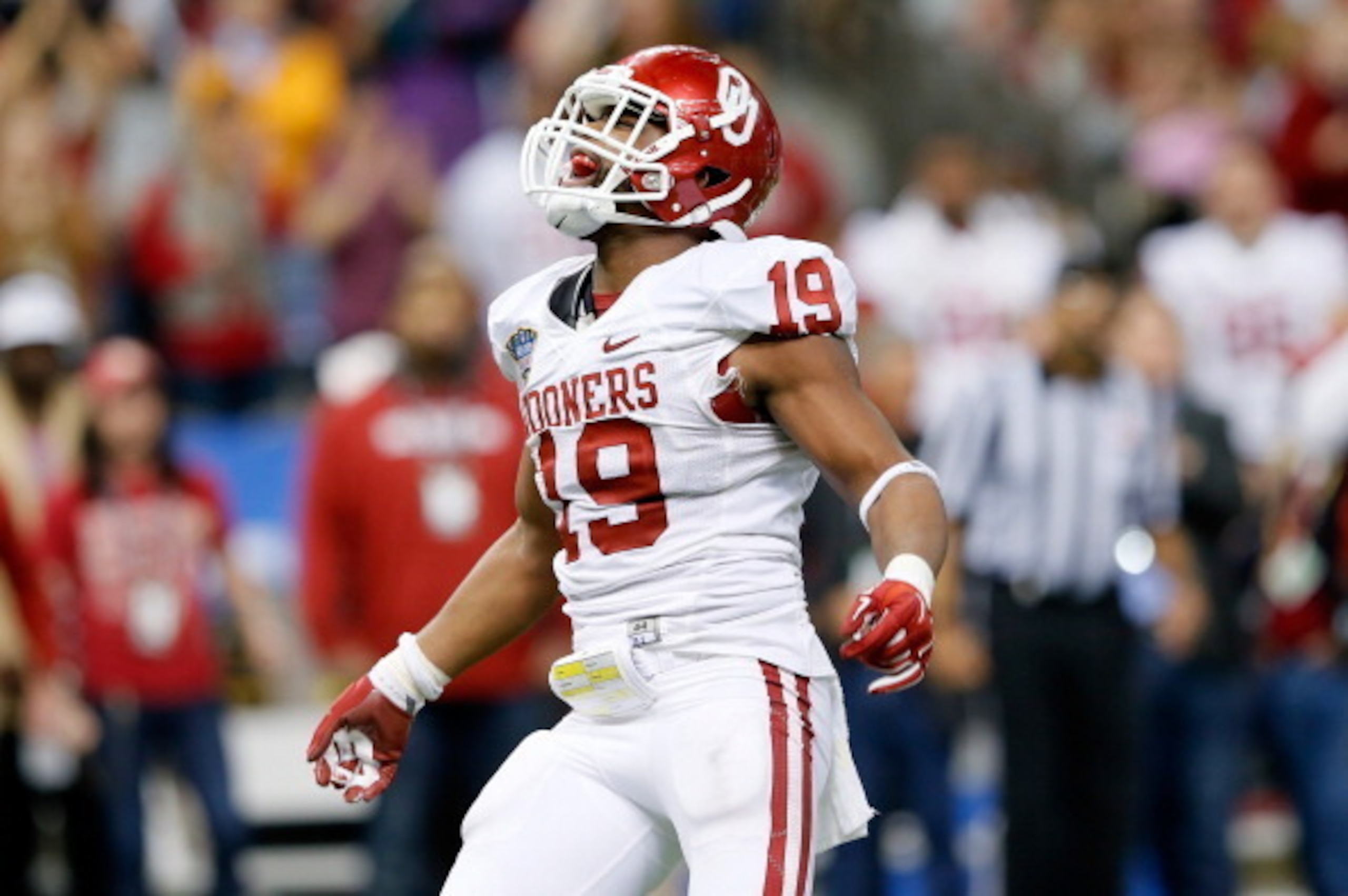
Tackling
Eric Striker is built like a safety (6'0", 221 lbs) and has the speed to cut down angles in space. However, that same undersized build makes him a liability in tight areas, where he struggles to fight away from blocks or make an impact as a downhill tackler.
Pass Rush
He didn’t post All-America numbers, as many expected he might, but Striker proved in 2014 that he can get around the edge with the best of them. He is still learning how to keep his balance and avoid getting knocked off his line, but the raw burst and timing are plain to see on tape, allowing him to blitz from different depths and angles.
Run Defense
Striker defends the run well, considering his physical limitations. He doesn’t have the strength to play the hammer, but he never stops moving. He tracks the ball well and runs around with a chip on his shoulder, disrupting a high number of plays in rush defense.
Pass Coverage
Oklahoma has played Striker at nickelback, on occasion, because he is athletic enough to turn his hips and run with just about anyone. He is still working on the little things—gaining good depth, learning when to jump versus when to sink, etc.—but the raw tools are hard to ignore.
Overall
Striker—in addition to having the best name for a linebacker—is one of the last players quarterbacks want to see bearing down before they snap the ball. He followed up his breakout game in the 2014 Sugar Bowl with a season that was just as impressive as advertised.
99. Martrell Spaight, OLB, Arkansas
12 of 110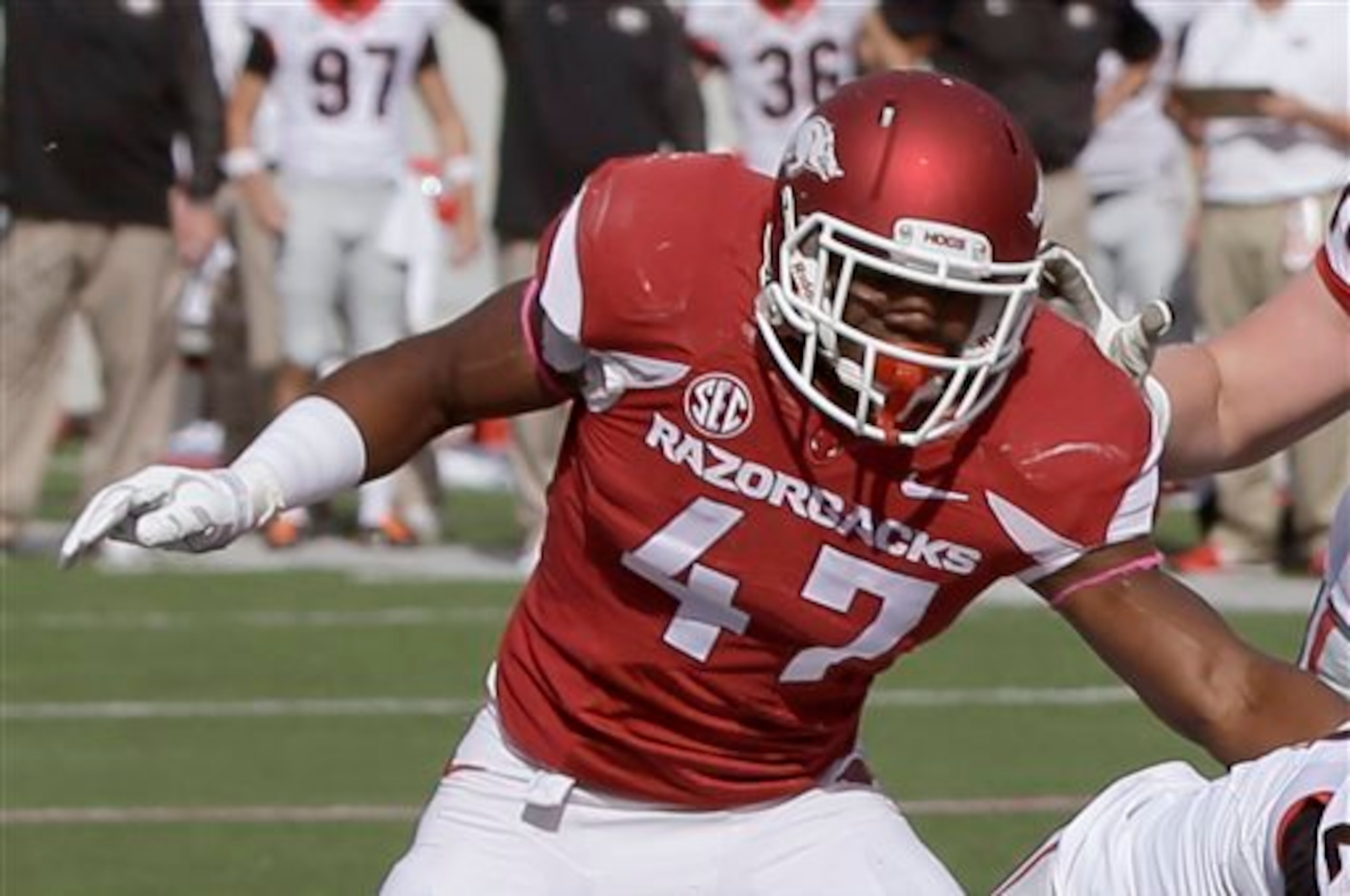
Tackling
Martrell Spaight led the SEC in tackles during the regular season, averaging more than 10 per game. He does not have outrageous speed, especially for a player who is slightly undersized (6'2", 231 lbs), but he’s fast enough to close on the ball and play the frontside bounce.
Pass Rush
Arkansas did not ask Spaight to rush the passer very often until the last few games of the year. There’s a reason for that. Even though he blitzes with authority, punishing at least one blocker each rep, he does not have the quickness or wiggle to consistently get through the line.
Run Defense
Spaight is a versatile run defender who does his best work as a run-through linebacker but can also splatter blockers and take on the Power O. He sets a hard edge to force runs back inside but also has the skills to disengage and go make a play for himself.
Pass Coverage
Spaight is a viable three-down linebacker who can cover in the slot when necessary. He gets his hands out on his man and reroutes him over the middle. In zone coverage, instincts help him conceal a lack of natural fluidity (although he’s also not what one could call "stiff").
Overall
Spaight led a resurgent Arkansas defense in the second half of the season, showing up with bigger and bigger plays each week. Injuries derailed him in his first year over from JUCO, but the former two-time NJCAA All-American paid huge dividends for the Hogs in 2014.
98. P.J. Williams, CB, Florida State
13 of 110
Speed
P.J. Williams doesn’t pop off the tape with his speed, but he’s fast enough to do his job. He’s a long athlete who covers a ton of ground in man coverage and doesn’t let receivers separate on drags and slants. Prior to the Rose Bowl, Oregon offensive coordinator Scott Frost called Williams “the fastest defensive back [we have] played all season,” per Andrew Grief of The Oregonian.
Ball Skills
Williams is a coordinated player with great timing and decent athleticism. He doesn’t have incredible hands (only one interception 2014), but makes himself disruptive with long arms and field awareness. He has a good sense for diagnosing plays in zone coverage and can blow things up before they get started.
Run Defense
Williams is a fighter in the run game who actively sheds blocks on the perimeter. He was especially impressive in the ACC Championship Game against Georgia Tech, where his second-half contributions played a big role in stopping the triple option. He is not a consistent tackler—often he leads with his shoulder instead of wrapping up—but he understands the nuance of team run defense.
Coverage
One of the purest cover corners in the country, Williams excels in man-to-man situations, where his length and physicality are on full display. He suffered a couple of mental lapses in 2014, breakdowns that led to big plays or points, but was great on a down-to-down basis. If he can fix the tiny blemishes in his game, he has a chance to be special.
Overall
Williams is an ideal man-coverage corner with fluid hips, good speed and enough size (6’0”, 196 lbs) to blanket most receivers on an island. He wasn’t as consistent in 2014 as he was the year prior, but regardless, few cornerbacks can lock up one side of the field as well as Williams.
97. Maxx Williams, TE, Minnesota
14 of 110
Hands
Maxx Williams is a big, dependable target who rarely drops a pass. He doesn’t have a huge catch radius, but he grabs the ball with conviction and secures it through contact. More than that, he is a spry athlete who contorts to make circus catches at weird angles (something that playing with Minnesota’s quarterbacks has always required).
Route Running
Williams has a thick, muscular frame (6’4”, 250 lbs) and knows how to use it. He stems defenders to the inside on short routes, opening up throwing windows for his quarterback, and understands how to find the open space against zone coverage.
Blocking
Minnesota is a run-first (and -second) (and -third) team that wouldn’t keep Williams on the field if he didn’t do the dirty work. He showed promise as a freshman last season and capitalized on that promise with an even better year in 2014. He is strong enough to move bodies near the line of scrimmage and athletic enough to keep blocking down the field.
Release
Williams has a good short-area release. He dips off the line, stays low and gets through traffic. In space he makes sure the defense sees an outside path before moving back inside.
Speed
Williams is not the type to gain big yards after the catch, in part because he isn’t very quick. His straight-line speed is better than his agility but also no better than average. Despite this, he manages to crack the occasional big play, getting over the top if a defense doesn’t show him respect.
Overall
Williams is the No. 1 receiving option on a team that has won eight games in each of the past two seasons. Especially for a redshirt sophomore, that means something. He is a gifted physical specimen who seems to care about getting better, which should land him on some preseason All-American teams this summer if he stays in school.
96. Ishmael Adams, CB, UCLA
15 of 110
Speed
Ishmael Adams is fast because he has to be; there’s no other way for a 5’8” cornerback to see the field. His agility helps him mirror receivers in man coverage and break on the ball in zone coverage. Go ask Arizona State—against whom Adams had a 100-yard kick return touchdown and a 95-yard interception return touchdown—how dangerous his speed can be.
Ball Skills
Adams has above-average ball skills that don’t always show up on paper. He only had four pass breakups in each of the past two seasons, but he does many of the little things that don’t lead to so-called “breakups.” Taller receivers can exploit Adams for obvious reasons, but he’s a bouncy athlete who does a decent job overcoming his height.
Run Defense
Adams is a tough, confident defender who is willing to mix things up on the edge. Because he’s such a twitchy athlete, he is able to shed blocks and funnel runs back inside. He’s not the greatest tackler in the country, but he’s serviceable enough in that regard.
Coverage
Best described as an instinctive corner, Adams plays better in zone coverage than in man. He can read quarterbacks’ eyes and is a constant threat to jump routes and take his interceptions to the house. But his aggressive tendencies can also backfire and lead to occasional coverage breakdowns.
Overall
Adams is the best player in a polarizing UCLA secondary. He, like his teammates, must work on playing with more consistency from week to week, but when he’s on, the undersized Adams can be a game-breaker in the defensive backfield and as a kick returner.
95. Travin Dural, WR, LSU
16 of 110
Hands
Travin Dural has freaky proportions—hands included. He makes some hard-to-believe catches on the perimeter but hasn't shown the ability to make difficult catches in traffic over the middle.
Route Running
Dural is a perfectly average route-runner. He does his best work on simple patterns such as fly routes, relying more on physical tools than precision to gain separation.
Blocking
If you play for Les Miles, you're going to do some run blocking. Dural gives solid effort on the edge but doesn't have the strength to consistently lock up defenders.
Release
Dural can get off the line in multiple ways. The speed and burst that most young players rely on are his preferred weapons, but he also has long, lanky arms to engineer release moves and win shoulder position.
Speed
Dural was a high school track star who won the Louisiana state title in the 200-meter dash. His track speed translates to the football field, where he's a threat to catch a long touchdown each time he gets off the line.
Run After Catch
If it's not one-cut-and-go, Dural probably won't bust a big play. He has speed to turn the corner and make a short gain a long one, but he's not great at breaking tackles or finding creative running lanes.
Overall
Dural burst onto the scene as one of the best big-play receivers in the country this season. His numbers tailed off as LSU's quarterback play went to the dogs, but he still showed some flashes of stardom.
94. Jared Goff, QB, California
17 of 110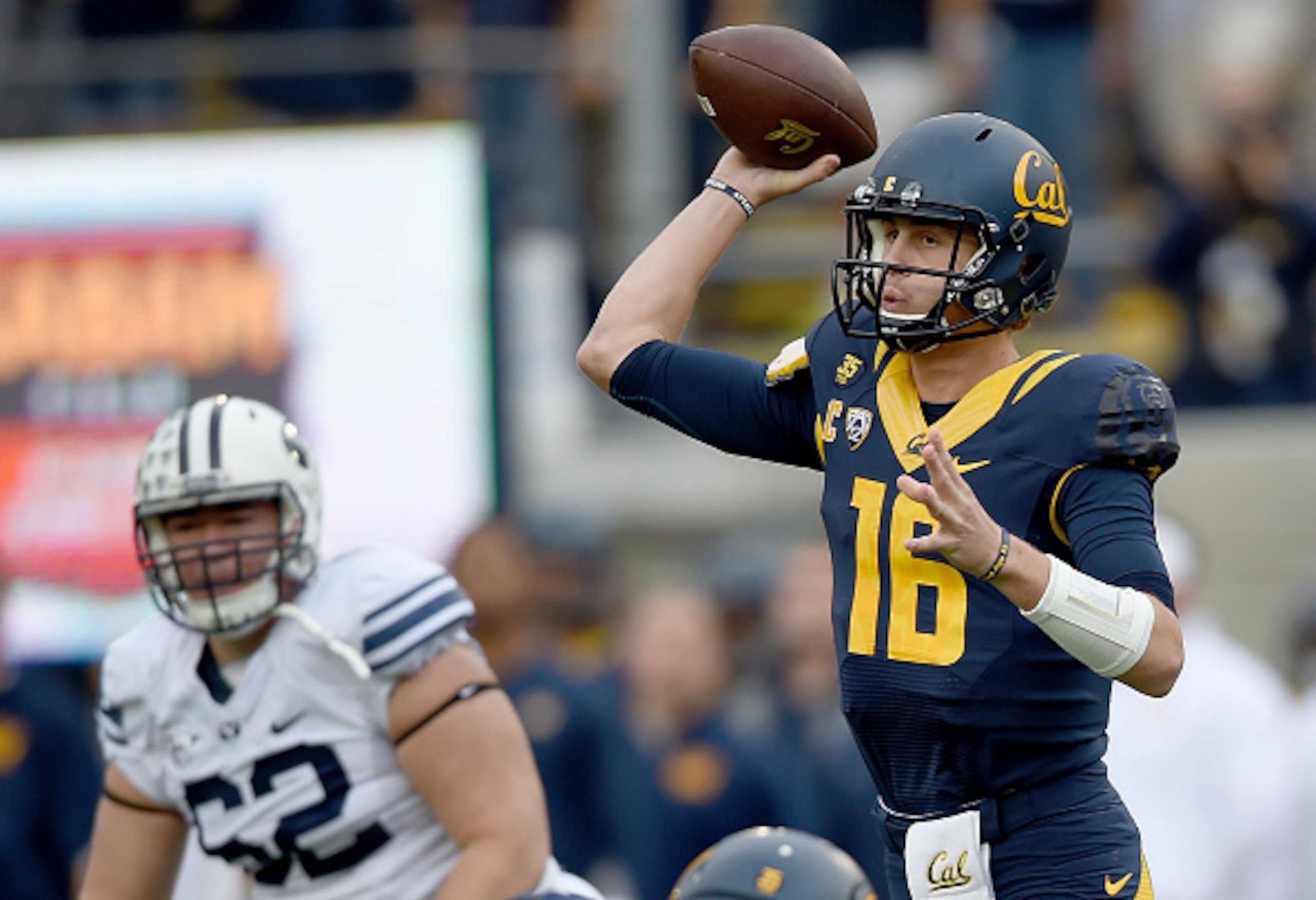
Accuracy
Jared Goff has been a quick study in Sonny Dykes’ spread offense, hitting his marks at all levels of the field. He doesn’t play overly conservative but still ranks toward the top of the country in interception rate, having thrown just seven picks on 509 attempts this season. When his receivers get a step, he sprinkles enough touch on the ball to get it over the defensive back but not too far for his intended target.
Arm Strength
Goff his a wiry arm that isn’t overpowering but gets the job done. He is 6’4”, 210 pounds and should continue getting stronger as he spends more time in a college weight program. He can stretch the field vertically or to the sidelines, powering the ball with a tight spiral and good zip.
Pocket Presence
Cal does not allow many sacks despite dropping back to pass with regularity. A big part of the credit there goes to Goff, who has a great feel for the position and knows when to get the ball out of his hands. He isn’t perfect, but he’s far ahead of the learning curve for a player his age.
Mobility
Goff can move the pocket but isn’t a threat as a runner. He has long, skinny legs and is not difficult for defenders to tackle. Backup Luke Rubenzer relieves Goff in select packages, when the Bears want to use a more mobile QB.
Football IQ
Underclassmen have succeeded in Dykes’ offense (and other variants from the Mike Leach coaching tree), but few have done so in more impressive fashion than Goff. He was the less-touted QB from his recruiting class but beat Zach Kline for the job as a true freshman because he picked up the system so quickly. That Cal commits so few turnovers despite playing an attacking brand of offense is a testament to Goff's football IQ.
Leadership
Goff engineered a nice turnaround in his sophomore season after the Bears went 1-11 in 2013. Goff inspires confidence in his teammates and nearly led Cal to a bowl game when doing so seemed impossible. He did enough to win on the road against a good Arizona team before a last-second Hail Mary by the Wildcats.
Overall
Goff has an arm worth raving about and plays in the ideal offense for his skill set. Only a true sophomore, he is on pace to compete for some of the FBS career passing records as an upperclassman—but only if the NFL doesn’t snatch him up first.
93. Cody Prewitt, S, Ole Miss
18 of 110
Ball Skills
Cody Prewitt does his best work in two-deep or single-high safety looks, roaming around the deep third and making plays on vertical throws. He has soft hands and great timing to bring balls down at their highest point.
Tackling
Receivers know to keep their head on a swivel against Ole Miss, lest they end up Internet famous for all the wrong reasons. But Prewitt does more than simply lay people out. He also breaks down and makes solid wrap-up tackles, although his consistency in this regard took a step back in 2014.
Run Support
Prewitt is a willing run defender who floods to alleys and doesn’t mind getting a lick on his helmet. However, he sometimes lets running backs come to him instead of sprinting through the play, which allows the offense to pick up small chunks of extra yards.
Pass Coverage
Prewitt is a good straight-line athlete with long limbs and superior coverage instincts. He is quick to see the play as it develops and knows where he must go to disrupt it. He does not, however, possess the fluid hips to mirror receivers. He is only useful in zone coverage schemes.
Overall
Prewitt is the emotional leader of an Ole Miss defense that played as well as any unit in the country this season. His big hits have gone viral, but he is more than just an in-the-box thumper looking for the next slot receiver to hit. He does a little bit of everything on the back end of that vaunted “Landsharks” defense.
92. Evan Engram, TE, Ole Miss
19 of 110
Hands
Evan Engram has soft hands and knows to catch the ball away from his body. He sees the ball into his grip and does not break stride to haul it in. This last point is important, separating Engram from similar athletic specimens who don’t post the same production.
Route Running
No tight end in the country runs better routes than Engram. Defenses pair him against safeties and their best coverage linebackers, but he still gets open time and time again. He works routes equally well to the inside and the outside, which keeps defenders guessing.
Blocking
Engram is a liability in the running game. There is no way around it. He doesn’t have the size (6’3”, 227 lbs) to get a push when he lines up off tackle, and he doesn’t seal the edge on cutback plays or end-arounds. Hopefully, this will change if/when he adds weight.
Release
It is difficult to grade Engram’s release as a tight end, since he is basically a wide receiver. Playing from the slot, though, he does a good job gaining separation, winning the inside shoulder with hand combat.
Speed
The play is not over when Engram catches the ball. He has agility to make the first (and second) man miss and speed to turn a crease into a long gain. His three receptions of 50-plus yards this regular season were the most among FBS tight ends. Only 22 receivers had a higher total.
Overall
Engram was an overlooked but vital piece of Ole Miss’ 2013 recruiting class. Eighteen future Rebels graded higher than him—highlighted by productive 5-stars Robert Nkemdiche, Laremy Tunsil, Laquon Treadwell and Tony Conner—but Engram’s contributions have been just as important as any of his classmates’.
91. Jake Fisher, OT, Oregon
20 of 110
Hands
Jake Fisher has an active punch and solid hands. He is both powerful and quick when he engages defenders, keeping them at arm’s length in pass protection and moving them aside on running plays. He’s a senior and a three-year starter, and his experience shows in terms of hand placement; it’s clear he has been coached up in this regard.
Power
Not quite an imposing specimen (6’6”, 300 lbs), Fisher displays adequate power. He has broad shoulders and understands how to win with leverage, which is good, but he’s simply too thin to overwhelm bigger opponents.
Lateral Quickness
Like all Oregon offensive linemen, Fisher feels comfortable in space. He can get downfield as a lead blocker when his backs get to the second level, and he moves well enough to impede safeties and linebackers. His quick feet also aide him in pass protection, as he proved against blitzing defensive back Jalen Ramsey in the Rose Bowl.
Pass Protection
Fisher doesn’t stand out in any one area of pass protection, but he always seems to get the job done—and he does it against NFL-caliber opponents. Namely, he controlled the line against Shilique Calhoun of Michigan State and Mario Edwards of Florida State in two of Oregon’s biggest games this season. His long arms and hand usage were imperative in both of those performances; once he had his target latched, he didn’t let him get away.
Run Blocking
Fisher excels as a run-blocker in a scheme that he fits like a glove. The Ducks play to his strengths by asking him to get downfield or turn defenders out of their comfort zones. The lack of raw power impedes him from grading any higher, but it’s not like he struggles in short-yardage situations. And the fact that he’s so versatile should be viewed as a positive.
Overall
Fisher proved to be a linchpin—if not the linchpin—in Oregon’s explosive offense. When he missed two games with a knee injury during the middle of the season (against Washington State and Arizona), the Ducks fell apart. As soon he returned, they put themselves back together.
90. Shilique Calhoun, DE, Michigan State
21 of 110
Pass Rush
Shilique Calhoun is not a high-volume sack producer, but he understands his role in the pass rush. He squeezes the pocket and occupies his assignments to free up the rest of the defense in blitz packages. He has the length and hands to disengage from a tackle and finish a broken play.
Run Defense
Here is where Calhoun excels. He has a big, thick frame (6’5”, 256 lbs) and the strength to hold the edge, which opens tackling lanes for Michigan State’s linebackers. But he also has the long arms and explosiveness to split gaps and make plays in the backfield. As a cherry on top, he has the speed and coordination to catch running backs on the edge or from behind.
Motor
Calhoun plays with the angry, chip-on-his-shoulder edge that typifies all Spartans defenses. He sprints through the whistle and rarely takes a play off. Whether he’s chasing the ball 20 yards downfield or suplexing a player in the backfield, he knows how to finish each down with conviction.
Overall
Calhoun broke out with three touchdowns in two games at the start of the 2013 season, and even though he hasn't scored since, he has parlayed that into a pair of fine seasons for Sparty. His stats are ho-hum, but they do not tell the story of how much he does for this defense. He is one of the most complete defensive linemen in the country.
89. T.J. Yeldon, RB, Alabama
22 of 110
Ball Security
Fumbling was T.J. Yeldon’s biggest issue in 2013, when he put the ball on the rug five times and lost four of them. He was better this season but still holds the ball away from his body when it should be tucked high and tight.
Power
Yeldon doesn’t have the pure power of his forerunners (Eddie Lacy, Trent Richardson, Mark Ingram, Glen Coffee), but he knows how to finish runs. He is 6’2”, 221 pounds and makes assured downhill cuts in Alabama’s zone-blocking offense. He sizes up smaller defenders in the open field and is willing to take them on physically.
Vision
The ability to see the field allows for everything Yeldon does as a running back. At the line, he reads the frontside and the backside, perceiving the hole and the cutback lane. In the open field, he attacks off-balance defenders in a way that enables extra yardage.
Hands
Yeldon is a threat in the passing game whom Alabama leans on often. His size, hands and fluid running style make him a tailback in a receiver’s body. He runs smooth routes out of the backfield and even moonlights in the slot and on the perimeter.
Speed
Yeldon has better acceleration than long speed, which is not necessarily a bad thing. He goes from zero to 60 in a blur, surging through the hole before it swallows him. His initial speed is enough to blow past linebackers and slow-footed safeties, although he does not have the breakaway speed of similar-style running backs (e.g. former Arkansas star Darren McFadden).
Agility
Yeldon has deceptive agility. His stutter moves and jump cuts look awkward because of his upright running style, but they are effective. When defenders break through the line, he is slippery enough to turn a negative play into small, positive gain.
Overall
Yeldon is a proven commodity who makes difficult plays look easy. He never took off and became the super-duper megastar it looked like he’d become after his freshman season (2012), but he’s always been a versatile running back who plays his best in the biggest games.
88. Jacoby Glenn, CB, Central Florida
23 of 110
Speed
Speed is one of the core tenets of Jacoby Glenn’s game. He is 6’0”, rangy and can cover ground with long, bounding strides. Speed allows him not just to track receivers downfield on vertical routes, but also to close on open receivers in zone coverage. It is one of the main things that makes him so valuable.
Ball Skills
Glenn is a gifted athlete with impressive body control. He can go up and make plays in the air or stick his hand between the man and the ball on slants. He has 26 pass breakups the past two seasons and led the American Athletic Conference with seven interceptions in 2014.
Run Defense
Glenn is a willing but ultimately average run defender. He doesn’t have the innate sense for run fits and tracking a ball-carrier that he has for patterns and tracking a receiver. He does, however, use his frame well as a tackler; he is capable of finishing plays on the edge.
Coverage
Glenn does his best work in zone coverage, where his reaction time, closing speed and field awareness combine to make him one of the best in the country. He doesn’t have the technique to consistently dominate in man coverage, but he’s no slouch in that regard either. And the tools are there for him to keep getting better.
Overall
Glenn has made a name for himself as one of the best big-play cornerbacks in America. The ahead-of-the-curve sophomore played a big role in taking UCF to the Fiesta Bowl last season and continued making strides despite his team's regression in 2014.
87. Landon Feichter, S, Purdue
24 of 110
Ball Skills
Landon Feichter does not waste opportunities to make big plays for his team. He led Purdue with four interceptions in 2012 and finished tied for No. 2 in the Big Ten with five in 2014. He only had one pick in 2013, but that can be forgiven; he did, after all, play part of that season with two broken hands.
Tackling
Yes, his stats are inflated by the weakness of Purdue’s front seven, but Feichter is one of the best tackling safeties in the country. Bar none. Anything he lacks in top-end speed, he makes up for with solid form tackling and conviction in the open field.
Run Support
Purdue calls Feichter into the box against run-heavy opponents, relying on its leader to execute run fits and never back down from a challenge. It is rare that he lets his team down. Six of his 10 solo tackles against Wisconsin came against Melvin Gordon, highlighted by consecutive possessions in which he stripped the All-American running back (and recovered the fumble), then stuffed him for no gain on a 4th-and-1.
Pass Coverage
Feichter doesn’t have the closing speed or length to be a shutdown center fielder, but he makes the most of what he has. He patrols against underneath passes and has fluid enough hips to tag most slot receivers.
Overall
Feichter is not a household name, because no one on Purdue is a household name. But after a brief benching in 2014, the season he’s enjoyed has been right on par with any other safety in the country. He is solid in every sense of the word.
86. Trevone Boykin, QB, TCU
25 of 110
Accuracy
Trevone Boykin can run hot and cold. When he's hot, he leads his targets well, putting them in position to gain yards after the catch. When he's cold—as he was in a near-loss at West Virginia—TCU's offense barely moves. Fortunately, the cold stretches have seldom occurred in 2014.
Arm Strength
Boykin has never lacked for arm strength, even before his breakout year. His ability to push the ball downfield keeps defenses honest, and he gets real zip on intermediate throws.
Pocket Presence
Despite his speed, Boykin does not rely on his legs when he doesn't have to. He trusts his arm and is inclined to beat the blitz the easy way instead of getting antsy and breaking the pocket. The tendency to tuck and run is common for mobile quarterbacks, but Boykin makes shrewd decisions.
Mobility
Before he was a CFB 250 quarterback, Boykin was actually a pretty capable slot receiver. And you can't excel in the slot without top-end quickness and lateral agility. Boykin has both, and he has not been afraid to flaunt those athletic gifts when TCU has most needed a play.
Football IQ
Boykin has done a good job letting the offense come to him, rarely trying to "do too much." He gets through his reads with haste and improvises when the situation calls for it. One could argue that this is his most improved area.
Leadership
TCU was rudderless under former quarterback Casey Pachall. Boykin has taken over full-time and given the Horned Frogs a backbone. A great deal of credit goes to Sonny Cumbie and Doug Meacham, but Boykin is the one going out there and making plays. He has lifted this team to new heights.
Overall
Boykin looked more natural at receiver than he did at quarterback in 2013. But the introduction of a spread offense prompted him to play like a Heisman contender this season, during which TCU went 12-1. The Horned Frogs are back to being national contenders, and Boykin is the biggest reason why.
85. Clive Walford, TE, Miami (Fla.)
26 of 110
Hands
Clive Walford has a good-looking catch radius and the big hands needed to secure all types of passes. He does not wait for the ball to come to him, instead snatching it out of midair.
Route Running
Miami runs a pro-style offense that calls for Walford to run a fairly complex route tree. He struggled in previous seasons but made marked improvements as a senior, learning how to sell his breaks and take advantage of slow-footed defenders.
Blocking
No part of Walford’s game has impressed more than his blocking this season. He isn’t huge but has good thickness (6’4”, 258 lbs) and is comfortable moving defensive ends in zone. He also has the speed to get downfield and block at the second level.
Release
Walford uses arm technique to win releases up the seam. He swims to the inside after taking a big outside step, which earns him separation over the middle, and has enough strength to rip past down linemen in the short area.
Speed
Walford is not a burner, but he proved against Florida State that he is fast enough to take it to the house. His long speed might never be a strength, but it will never be a weakness either. And his short-area burst and quickness are most definitely considered strengths.
Overall
Walford parlayed an average first three years into a wonderful senior season. He became a week-to-week contributor. True freshman quarterback Brad Kaaya benefitted greatly from having Walford as a safety net.
84. Nick Marshall, QB, Auburn
27 of 110
Accuracy
Nick Marshall has made striking improvements as a passer. Last season, he was timid throwing intermediate and vertical routes, doing most of his damage on screens. This season, he has missed fewer open receivers and shown confidence stretching the field. He is still less consistent than the players above him, but he's getting there.
Arm Strength
Marshall throws a fireball despite having a smaller, wiry frame (6'1", 210 lbs). He generates power from his upper body, which allows him to rocket the ball down the field from various angles. The ball comes off his arm a lot like it does Michael Vick's, albeit with slightly less steam.
Pocket Presence
The system Marshall plays in and the offensive line he operates behind do not require that he face a ton of pressure. When he has, he's shown flashes of brilliance mixed with occasional lapses in judgment. Still, he is as slippery as they come eluding pass-rushers.
Mobility
Marshall is a converted defensive back who probably could have played any skill position on the field. He has staggering lateral agility and makes more defenders miss than any other quarterback in the country. The home run speed is there, but his best trait isn't breaking long runs as much as turning small gains into chunk plays.
Football IQ
Auburn runs a highly effective but not overly complicated offense. Marshall leads the unit well, though, especially with the ball in his hands on the read-option. His decision-making is above average, but he showed some holes in the first half against Mississippi State.
Leadership
The Tigers know they are never out of a game when Marshall is under center. He has led them to some incredible, dramatic wins the past two years and took them to the national title game on the heels of a 3-9 season. However, he also got dismissed from Georgia for disciplinary reasons in 2012 and had to miss the first half of the season opener against Arkansas because of an offseason marijuana citation.
Overall
Marshall went from "athlete who plays quarterback" to "very athletic quarterback" in 2014. The distinction there is subtle but important. If he wanted to, he could lead the SEC in rushing. But his arm improved so much this year that he didn't have to.
83. Javorius Allen, RB, USC
28 of 110
Ball Security
Javorius “Buck” Allen is a tactful runner who keeps the ball tight and shields it through contact. He lost a garbage-time fumble inside USC’s 10-yard line against Washington State but has otherwise been reliable.
Power
Even though he isn’t a vicious runner, Allen uses his size (6’1”, 220 lbs) to break tackles in the open field. His legs—the main source of his power—never stop churning, even when a group of defenders is trying to bring him down. If he ran with more fire and/or a lower pad level, he would finish even higher in this category.
Vision
Allen strings out runs with patience, reading his blockers and letting the play develop. When the cutback lane appears, he finds it—every time. In 2014, he posted big numbers with a pair of true freshmen on the offensive line. Even though those youngsters played well, Allen's vision made them look even better than they were.
Hands
USC’s offense relies—and has always relied—on a running back who can slip out of the backfield and make a play. Allen is no Reggie Bush in terms of route-running and explosiveness, but he’s a reliable safety valve with strong hands on screens and checkdowns.
Speed
Allen has good burst for a 220-pounder, firing out of the backfield at the first and second level. He doesn’t maintain that speed in the open field, where defensive backs are able to track him down from behind, but his acceleration makes him a wellspring for chunk yardage.
Agility
Allen is more fluid than agile, which is a subtle but important distinction. He has good balance and makes smooth cuts but doesn’t have the short-area quickness to dance around defenders. He runs through defenders more than he makes them miss.
Overall
Playing running back at USC is hallowed ground, like playing linebacker at Penn State. After a few rough years without a star, the Trojans found a gem in Allen, whose well-rounded game has made him precisely that.
82. Dante Fowler Jr., DE, Florida
29 of 110
Pass Rush
Dante Fowler Jr. is technically a “Buck” linebacker but does his best work with his hand down as a 6-technique. He is 6’3” and 261 pounds with long arms and a rare blend of speed and power that makes him difficult to handle off the edge. More than that, though, he is a hand-to-hand technician with a deep array of pass-rushing moves who knows how to get to the quarterback. He wins with leverage and has the body control to dip around offensive tackles.
Run Defense
Fowler has the strength to occupy blockers and the hands to rip away and make plays on his own. But he also has a tendency to play over-aggressive to the point of recklessness, which at times has cost Florida in run support. If he learns to stay true to his assignments, he can turn into a high-level run defender. Until then, his gap discipline weighs him down.
Motor
Even when his offense has struggled, Fowler has maintained a consistent high energy level and refused to give up on a game. He is deranged in the most flattering way, willing to sacrifice his body for the good of the team. Frequent three-and-outs from the Gators offense have tested Fowler’s endurance, resolve and motor the past three seasons. To say he’s passed those tests would be an understatement.
Overall
Fowler is a special athlete with a high motor and the will to keep improving. He got better each year he was in Gainesville and will be missed as he transitions to the NFL. He was a perfect fit for Will Muschamp's multiple-front defense because he can line up anywhere along the front seven. Not many players can say that.
81. Ereck Flowers, OT, Miami (Fla.)
30 of 110
Hands
Ereck Flowers has good but not great hands. He is eager to initiate contact, which in most cases proves to be a positive, but he can sometimes jump the gun and screw up his hand placement. That, however, is admittedly a minor quibble; Flowers still packs a strong punch and keeps defenders engaged through the play.
Power
Flowers has insanely long arms and knows how to translate that to power. He is a strong inline blocker who can also seal the edge against bigger ends and smaller tackles. His strength is not what one would call “overwhelming,” but it’s good enough to get the job done.
Lateral Quickness
No part of Flowers’ game has surprised more than his lateral quickness. He doesn’t look like a nimble athlete at first glance, but he is light on his feet and capable in the open field. He mirrors speed-rushers from side to side and rarely gets beat with pure burst. That's not bad for a 6’6”, 324-pounder.
Pass Protection
Flowers has a rare blend of size and fluidity that makes him a capable pass-blocker. He is too big for most ends to bull rush but too athletic for most ends to blow past. He doesn’t have perfect mechanics, but that can be chalked up to experience. If he puts in the time to shore that up, the raw tools suggest a dominant pass-blocker.
Run Blocking
Flowers does a few things well in run blocking. He is quick to reach the second level and always plays through the whistle, searching for a new man to hit. He also uses his long arms and power to seal the edge and open running lanes between the guard and tackle. The only thing he’s missing is the raw power to finish plays with consistency. It’s rare to see him get a defensive lineman to the ground.
Overall
Prior to injuring his knee against Virginia Tech, Flowers was enjoying a career year at left tackle for Miami. He played through pain the rest of the way, and even though he wasn’t quite as impressive, he still ate up defensive linemen with his long arms, broad shoulders and deceptive foot speed for a man so exceptionally massive.
80. Tony Lippett, WR, Michigan State
31 of 110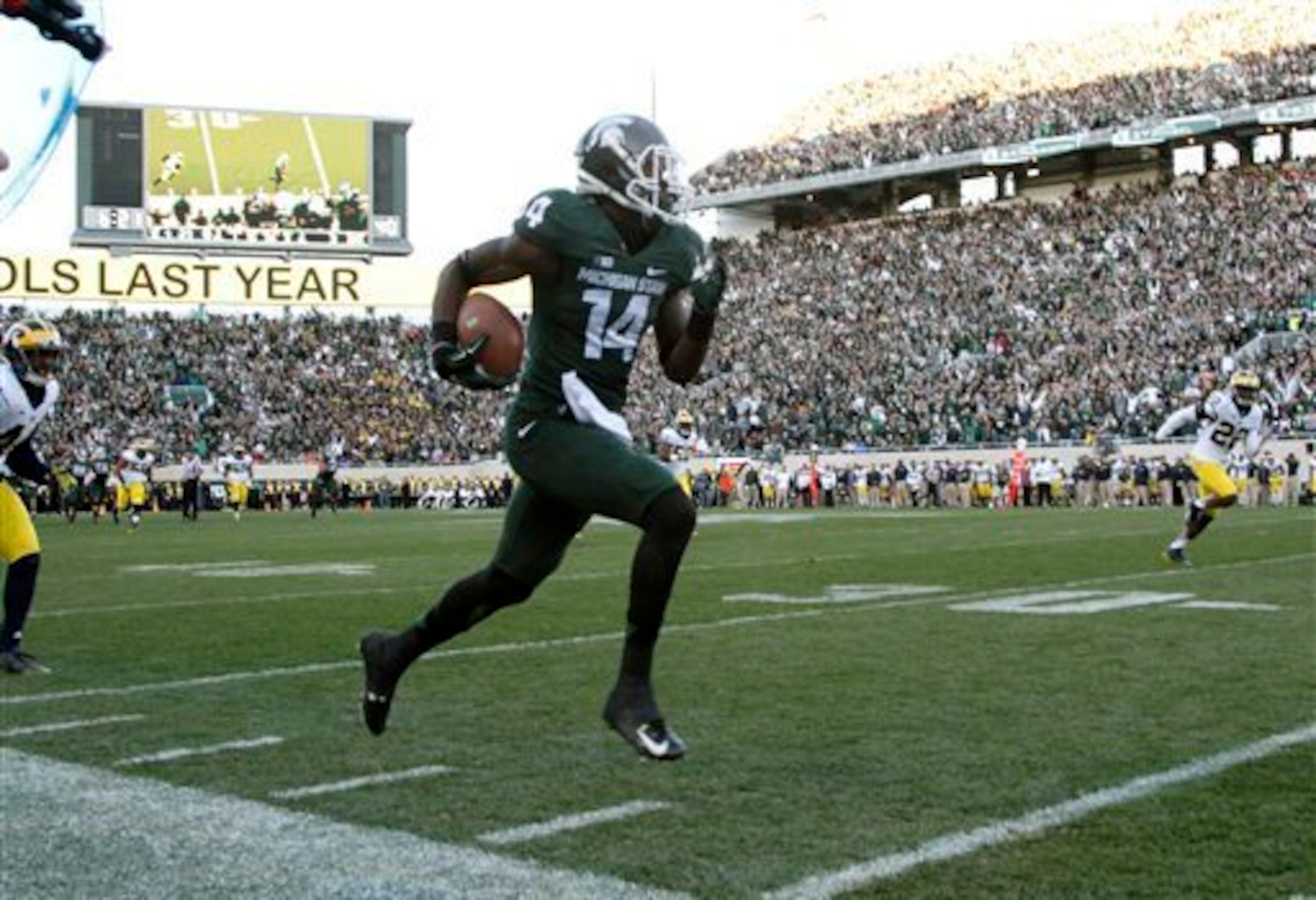
Hands
Tony Lippett catches passes of seemingly every type, looking most impressive when he controls his body, adjusts to a deep throw and somehow comes down with the ball. He casts a wide catch radius thanks to his instincts and the strength of his hands.
Route Running
No part of Lippett's game has improved more than his route running. He fires out of his breaks. He calibrates his speed. He always sells his patterns to defensive backs. He is a difficult matchup because he can beat you with so many routes.
Blocking
Lippett does not have the strength to be a dominant blocker, but he does have the attitude to be a useful one. Even during games in which he struggled, he stayed active and engaged by working his tail off as a downfield blocker.
Release
It's hard to be a high-level route-runner unless you have a strong release. Lippett does his best work against off-man coverage, setting up the defender and gaining the inside or outside shoulder. He has not been as good against press coverage, though, and will need to refine his arm technique (or simply get a lot stronger) to combat that in the future.
Speed
Lippett makes plays down the field in spite of his speed, not because of it. His longest gains have come on plays in which he burns the coverage and glides into the end zone. There are varying opinions on how Lippett will test in the 40-yard dash, but on tape he does not appear fast.
Run After Catch
Considering his physical limitations—lack of ideal strength/speed—Lippett actually does a good job after the catch. He has a mean stiff-arm and never gives up on a play until he hits the ground.
Overall
Lippett was average for three years but morphed into a No. 1 receiver this season. His ability to get open against man-to-man coverage made him a frequent target of Connor Cook and helped turn Michigan State into a team with a legitimate offense. That he did it, at the end of the season, while also starting at cornerback makes it all the more impressive.
79. J.T. Barrett, QB, Ohio State
32 of 110
Accuracy
J.T. Barrett throws an accurate ball with advanced touch. He drops passes into small windows, excelling where most players his age struggle: on passing downs. That he moves the chains against defensive-back-heavy sets is a testament to his ball placement.
Arm Strength
He doesn't have the same arm strength as Braxton Miller (who scored a 14/15 in that category on last year's CFB 250), but Barrett stretches the field well enough to function in Urban Meyer's offense. He has shorted a few deep comebacks to the sideline, but for the most part he has hit all his marks.
Pocket Presence
Barrett has made massive strides in this department since the first two games of the season. His offensive line improved too, but not as much as Barrett improved at feeling the rush and getting the ball out quickly.
Mobility
As a runner, Barrett falls somewhere between Miller and Kenny Guiton (Ohio State's backup in 2013). He plays from the pocket more often than Miller but proved against Michigan State and Minnesota that he can make defenders miss and has enough speed to break long runs.
Football IQ
Barrett has shown a quick learning curve in 2014, grasping what he did wrong in the first two games and fixing those errors. He has in many ways been an upgrade from Miller in terms of reading defenses and anticipating throws.
Leadership
At first it looked like Barrett might have to be carried through the season. By October, he was the one doing the carrying. He played his best game of the season in Ohio State's most important matchup, leading the Buckeyes to six consecutive touchdown drives at Michigan State. He was an easy figure for his teammates to rally behind.
Overall
Barrett was pressed into starting duty after Miller, the two-time Big Ten Offensive Player of the Year, injured his shoulder in fall camp. The early returns were predictable for an ill-prepared freshman QB, but Barrett made quick improvements and guided Ohio State back to national contention. He missed the Buckeyes' last three games with an ankle injury, but that doesn't discount the work he did in willing OSU that far.
78. Shawn Oakman, DE, Baylor
33 of 110
Pass Rush
Shawn Oakman is a solid pass-rusher, but that is a disappointment. There is no reason he shouldn’t be great. His size (6’9”, 280 lbs) and athleticism are a rare combination—players this big and strong are rarely this controlled and fluid—but he doesn’t have the technique to make consistent plays. His pure strength is too much for many tackles to handle, but some know how to deal with him.
Run Defense
Oakman does a lot of things well against the run. He is strong enough to hold the edge despite his size (i.e., high center of gravity) and violent enough to shed blocks when need be. He has also shown a penchant for making plays in the backfield, recording 8.5 non-sack tackles for loss in 12 regular-season games. Baylor was one of six teams in the country to hold opponents under three yards per carry during the regular season.
Motor
The biggest knock on Oakman is his motor. He doesn’t have the temperament of a down-to-down wrecking ball, taking plays off with regularity. He relies on size and strength to mask his effort and is fine with playing “well” instead of dominating. When he flashes, he looks like no other lineman in the country. But he doesn’t flash as often as he should.
Overall
Oakman is a frustrating player to evaluate. It is hard to divorce what he is from what he should be. What he is, however, is still one of the best linemen in the country. His ceiling is so much higher, but it’s not fair to hold that against him. He was still the star of a very good Baylor front seven. And he still made quarterbacks quiver in their cleats on every play.
77. Michael Bennett, DT, Ohio State
34 of 110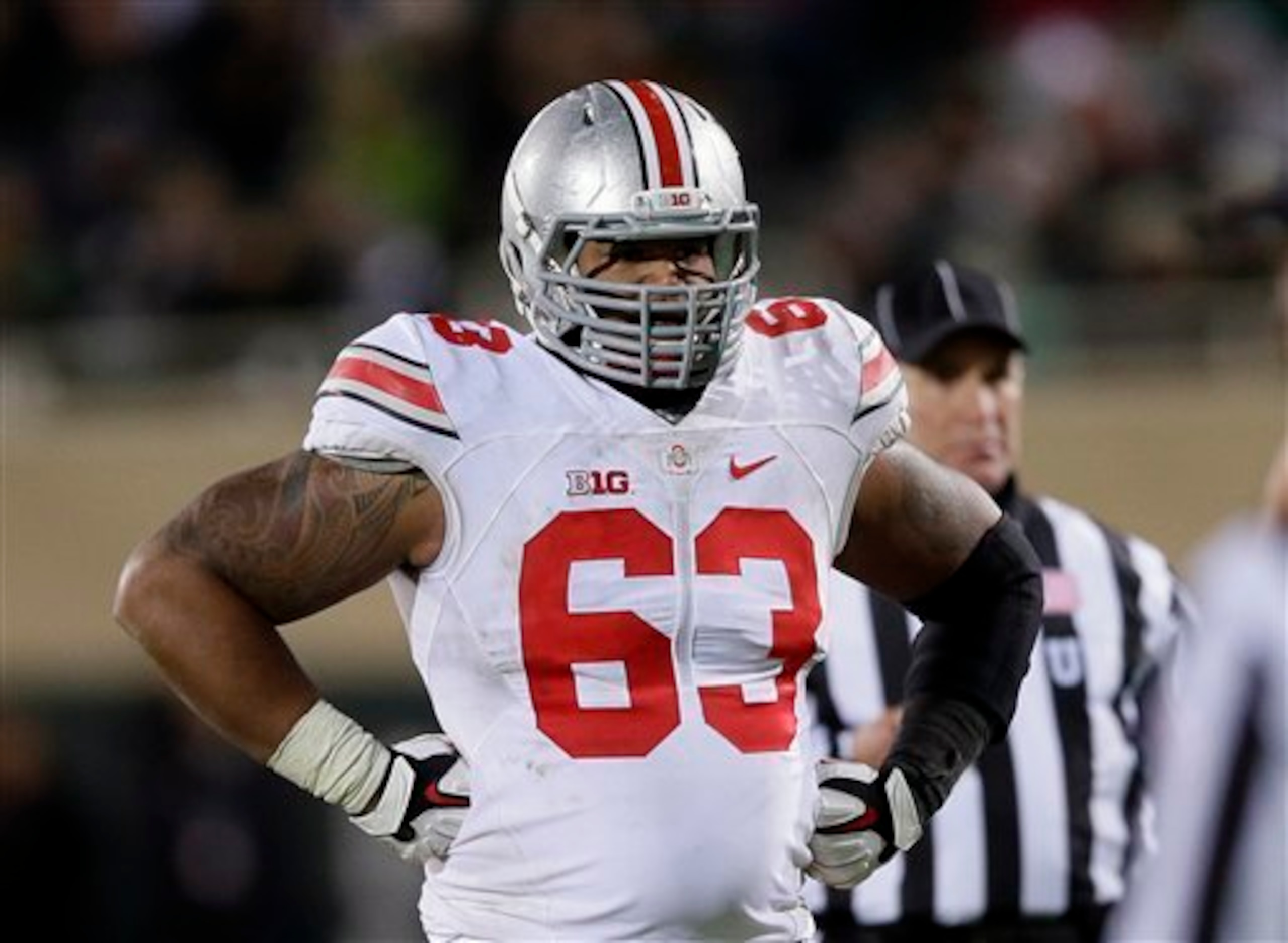
Pass Rush
Michael Bennett is a great interior pass-rusher who slumped at the start of the season but came on strong in the biggest moments. His numbers are not a true reflection of his productivity, as he often lines up as a 1-technique and is not asked to attack the quarterback. However, when the Buckeyes let him loose as a 3-technique, he has the quickness and hand skills to shoot past blockers, push the pocket and make plays.
Run Defense
The reason Ohio State plays Bennett as a 1-technique is because he’s so good against the run. He can occupy two gaps and free up his linebackers or slip through and make a tackle himself. Even though he isn’t the biggest defensive tackle (6’2”, 288 lbs), he is powerful enough to eat space and make larger offensive linemen work.
Motor
Starting the season slowly was not a good look for Bennett, who at times did not give max effort. When you play next to an end like Joey Bosa, it is easy to tell when you’re slacking. But the way Bennett finished the season was a testament to how hard he can play when he wants to. His performance in the Big Ten Championship Game, in which he played with a heavy heart following the death of teammate Kosta Karageorge, was one of the best and most memorable games by a defensive player all season.
Overall
Bennett gets second billing behind Bosa when people talk about Ohio State’s line. Back when Noah Spence was still eligible, he was often mentioned third. But the man in the middle has in many ways been the keystone of this defense. When he’s on, Ohio State can drop seven players into coverage and still feel good about winning the point of attack.
76. Jaelen Strong, WR, Arizona State
35 of 110
Hands
Jaelen Strong's hands are…well…strong. His huge frame (6'3"), body control and basketball-player leaping ability allow him to high-point passes in coverage. He keeps the ball away from his body and is the best back-shoulder target in college football, bar none.
Route Running
Strong has a complex route tree and executes his patterns like a veteran. He sells his breaks and gets in and out of cuts with precision. He is equally effective running short and deep routes, although the latter is what makes him most valuable.
Blocking
Blocking is an area of neither strength nor weakness. Strong is a willing blocker with long arms that allow him to engage, but he doesn't stand out for his work on the outside.
Release
Whatever Strong may lack in long speed, he makes up for with initial quickness. He has an excellent release in which he bursts off the line and creates separation with his long, bounding strides. He uses his body to shield defenders for inside and outside position.
Speed
Strong is not a burner, but he has enough speed to maintain the separation he creates off the line. He is a Brandon Marshall type who can get vertical but won't track down an overthrown ball.
Run After Catch
Strong does not have great elusiveness. He is long and bony, which makes it easy for defenders to get a hand on him. But he's physical and willing to lower his head and run through contact, which has helped him gain consistent small chunks of yardage after the catch.
Overall
Strong has been a gem for Arizona State. One of the biggest matchup problems in college football (literally), he helped the Sun Devils stay afloat in the College Football Playoff discussion with his Hail Mary reception against USC, then followed that up with general, week-to-week dominance.
75. Cody Kessler, QB, USC
36 of 110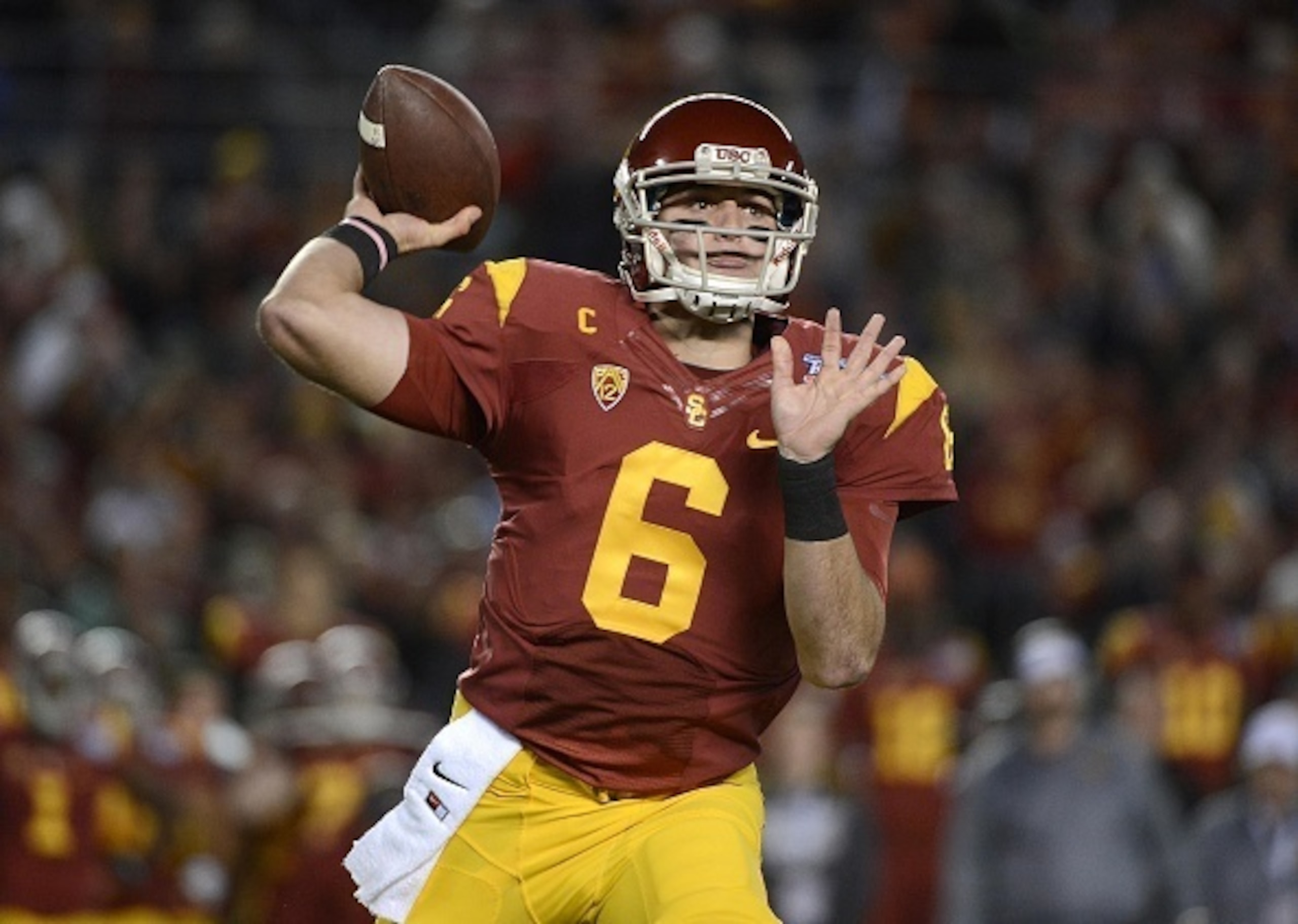
Accuracy
Cody Kessler ranks No. 2 in the country in completion percentage (70.7) despite playing in a pro-style system that does not rely on short, high-percentage routes. He is especially good down the middle of the field, where he places the ball high enough to mitigate risky throws.
Arm Strength
Kessler’s accuracy needs to be up there with the best in the country because he doesn’t have a big arm. He is undersized for the position (6’1”, 210 lbs) but doesn't generate torque a la Drew Brees or Russell Wilson. Even intermediate-length passes tend to float on him.
Pocket Presence
Here is where Kessler has made the biggest improvement. He was antsy when he first won the job as a sophomore in 2013, but now he has a strong command of the pocket. He feels the rush well and is shifty enough to avoid pressure and throw from difficult angles.
Mobility
Kessler has good footwork in the pocket but isn’t what anyone would call “mobile.” He’s a decent athlete (in terms of coordination); he’s just not very fast or smooth.
Football IQ
Timing is one of the most difficult things for a quarterback to master, and Kessler has it down cold. He gets the ball where it needs to be (see: accuracy), when it needs to be there. He anticipates where his receivers are going and knows how to throw them open.
Leadership
Kessler has been through a fair amount of schematic upturn the past two seasons, but he has never looked any worse for it. Former head coach Lane Kiffin and current head coach Steve Sarkisian were assistants together under Pete Carroll, but it still takes a dependable leader to bridge the gap between two coaching regimes. A few small breaks are all that separated USC (8-4) from a nine- or 10-win season.
Overall
Kessler struggled to gain his footing at the start of 2013 but improved under interim head coach Ed Orgeron and took off when the new regime came down from Washington this season. He’s a departure from the strapping, huge-armed template of most USC quarterbacks but brings his own set of unique abilities to the position.
74. Alvin Dupree, DE, Kentucky
37 of 110
Pass Rush
Alvin Dupree is one of the most versatile pass-rushers in the country. His signature trait is explosiveness—beating tackles off the edge with a lightning first step—but he converts his speed to power and has an underrated bull-rush move. He has a decent frame (6’4”, 264 lbs) and is athletic enough to stand and play outside linebacker in a 3-4 alignment.
Run Defense
Dupree is solid but unspectacular against the run. He is strong enough to hold his own at the point of attack but is sometimes overwhelmed by bigger tackles. He doesn’t occupy space and free up linebackers as well as some of the other ends on this list, but he makes up for that with his speed and ability to make plays on his own. He finished second on Kentucky with 74 tackles this season.
Motor
Dupree led by example the past two seasons, helping Kentucky’s defense improve—however slowly—by playing hard on every snap. He is a relentless pass-rusher who learned from his time as a linebacker to never give up on a play and chase ball-carriers from sideline to sideline.
Overall
Kentucky’s defense has been unremarkable for most of the past decade, but Dupree and fellow end Za’Darius Smith gave it a pulse the past few seasons. His numbers were impressive as they were and might have been even better if not for offenses scheming around him. He is a rare athlete and a terrific leader whose influence on the younger Wildcats should be felt in Lexington long after he departs for the NFL.
73. Nick O'Leary, TE, Florida State
38 of 110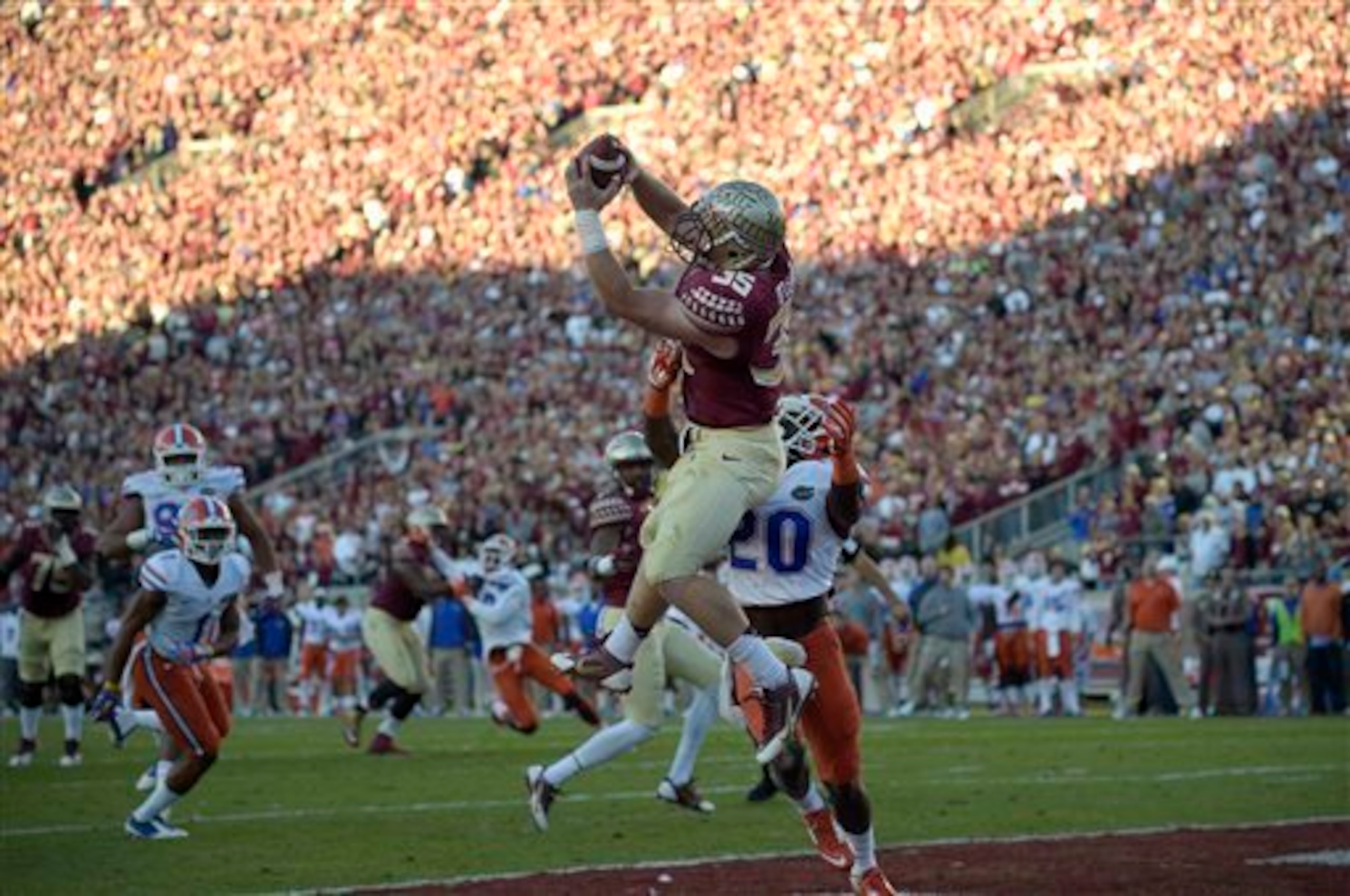
Hands
Nick O’Leary is a sure-handed target whom Jameis Winston relies on in the red zone and on third downs. He does not have a huge wingspan, which limits his catch radius, but he makes the plays he’s supposed to make. (And he definitely gets bonus points for doing it bare-handed.)
Route Running
O’Leary is a polished route-runner who understands the nuance of his position. He does not have the quickness to sell defenders on fakes or plants, but he reacts to what he is given and understands how to drop into open space.
Blocking
He doesn’t have ideal size (6’3”, 247 lbs) for an in-line blocker, but O’Leary compensates with proper hand placement and maximum effort. He moves his feet well, gets his pads downhill and moves defenders off their spots in the running game and also fares well in pass protection.
Release
O’Leary is a savvy player with a savvy release to match. He wins the inside when he’s supposed to and keeps his pads low to disguise his route from defenders. This can cause the linebacker to drop a step and open up room for O’Leary to make a play underneath.
Speed
It’s rare to see O’Leary in the open field, so his speed is a bit of a question mark. He is fast enough that his speed doesn’t hinder him, but it’s hard to call him anything more than “above average.”
Overall
O’Leary is a valuable part of Florida State’s offense, even if he goes overlooked. The grandson of Jack Nicklaus has made a name for himself as a viable receiver, a great blocker and a player one should hide from when he gets rolling downhill.
72. Jaylon Smith, OLB, Notre Dame
39 of 110
Tackling
Jaylon Smith overran too many tackles at the start of last season, failing to harness his natural speed. But he slowly figured out what he was doing as a freshman and made wild improvements in 2014, keeping his head behind the ball to become one of the rangiest tacklers in America.
Pass Rush
The raw tools are there for Smith to become a great pass-rusher. Unfortunately, he has thus far failed to put all of the pieces together. The only move he has is a speed rush, which is, as you might imagine, deadly. But he gets pushed off course too easily and doesn't have an innate sense for how to track a quarterback.
Run Defense
Smith defends the run with an edge that endears him to coaches, especially from a former 5-star recruit (per 247Sports). He brings a high motor to everything he does, and his burst allows him to split defenders, get into the backfield and bury a play for negative yardage.
Pass Coverage
Don’t be fooled by the size (6'3", 235 lbs): Smith is fast and fluid enough to cover just about anyone. He is still learning the nuances of zone coverage and working to refine his ball skills, but as a pure cover linebacker he is special.
Overall
Smith was one of Notre Dame’s best players as a true freshman in 2013 and improved in a leadership role this season. He couldn’t keep the ship from sinking when the depth chart was ravaged by injuries, but he still performed well. NFL draftniks will fall in love with him this summer.
71. Richard Leonard, CB, Florida International
40 of 110
Speed
Speed and quickness are the lynchpins of Richard Leonard’s game. He gains ground on receivers in coverage and makes lightning-fast breaks on the ball. He is also one of the top returners in the country and scored three touchdowns of 60-plus yards this season (three defensive, one punt return). FIU head coach Ron Turner, who coached Devin Hester in his prime with the Chicago Bears, told the Miami Herald that he’s "never seen anything like it" with regard to Leonard’s game-breaking tendencies. Woah.
Ball Skills
Leonard gets a knock for his height (5'9"), which impedes him from extending to break up well-placed throws to taller receivers. But that’s about the only fault one can find with his ball skills. And even that is mitigated by his explosive vertical leap and his timing when he lunges at a pass.
Run Defense
Leonard is a physical defensive back who plays with an edge but doesn’t stand out in run support. You can tell that he wants to be better than he is, but he doesn’t have the strength to consistently shed blocks on the perimeter. He also needs to shore up his tackling.
Coverage
On a down-to-down basis, Leonard displays good coverage instincts and technique. He has rare quick-twitch agility, which allows him to mirror receivers and execute step-and-go breaks on comeback routes. The only problem with his coverage is consistency, as lapses in awareness or technique will lead to occasional (but not infrequent) breakdowns.
Overall
Leonard missed 2013 for academic reasons after a solid year in 2012. Suffice it to say that rust was not an issue. Most fans have never heard of him, but the do-it-all corner showed up play after play after play in his return to the field this season.
70. Joshua Perry, OLB, Ohio State
41 of 110
Tackling
Joshua Perry is a downhill run-stuffer with great size (6'4", 254 lbs) that allows him to make clean tackles. He works in the run-through lane, tracks the ball-carrier and doesn’t let him bounce to the edge.
Pass Rush
There is an obvious drop-off from last year's Buckeye superstar, Ryan Shazier, to Perry. But it’s not as big as it looks on paper. Ohio State simply doesn’t ask much from Perry in terms of getting pressure, relying more on the strength of this year’s defense, the front four.
Run Defense
Perry has been relentless in pursuit and showcased plus athleticism against the run. Last year’s defense was about hammering plays toward Shazier, but this year’s defense has been more of a balanced, assertive attack from all three linebackers.
Pass Coverage
Perry does a few things well in coverage, impressing with his ability to diagnose and blow up screen passes. However, because he carries so much mass, he sometimes struggles to transition from his drop into matching receivers.
Overall
Each of Ohio State’s starting linebackers had his moments in 2014, but none was as consistently great as Perry. Was he Shazier? No. But Perry played as well as anybody could have asked in replacing Shazier on the weak side.
69. Spencer Drango, OT, Baylor
42 of 110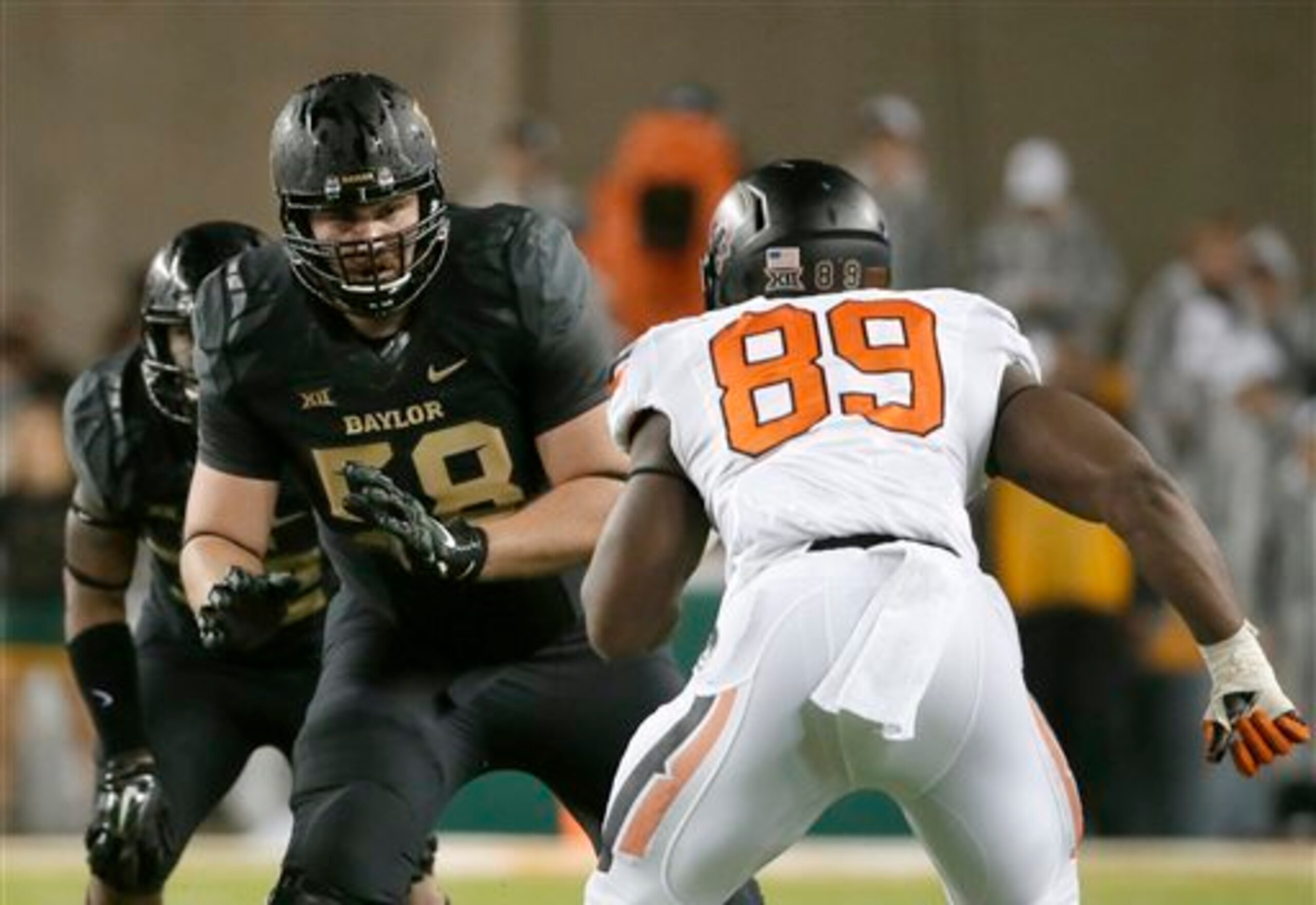
Hands
Spencer Drango is a mauling offensive tackle who uses big, thick hands to control his assigned lineman. He has the strength to latch and hold on the rare occasion he doesn’t drive his opponent backward. His heavy hands are on display when he reaches the second level, too.
Power
Drango has a thick base in pass protection and is able to absorb bull rushes. He can pancake an opponent in the running game as well. The only concern here is footwork, which at times mitigates his natural strength. He needs to keep himself on balance to maximize his power.
Lateral Quickness
Drango has one of the quickest first steps in the country, gaining great depth off the line in pass protection or firing to seal the edge on running plays. He has an effortless kick-slide and does solid (albeit unsensational) work tracking smaller players at the second level.
Pass Protection
There is no true blueprint for beating Drango, who fared better against the speed rush in 2014 than he had in prior seasons. He is a complete pass-blocking tackle with strong hands, sound mechanics and advanced field awareness. He keeps his wits about him and his player in front of him, rarely falling victim to a mental lapse against complex blitz schemes.
Run Blocking
Drango displays better balance in the running game than he does at times in the passing game; he understands how to win with strength and leverage. He is not the nimblest athlete, which limits what he can do in terms of pulling and getting downfield, but he is adequate in both of these regards and makes up for a lack of raw speed with maximum effort.
Overall
Drango anchors a Baylor offensive line that goes overlooked each season. But don’t get it twisted: The 6’6”, 310-pound monster protecting quarterback Bryce Petty’s blind side is just as important to this offense as Petty and all of those skill players he throws to. He forewent the 2015 NFL draft and will likely land on numerous preseason All-America teams.
68. Gerod Holliman, S, Louisville
43 of 110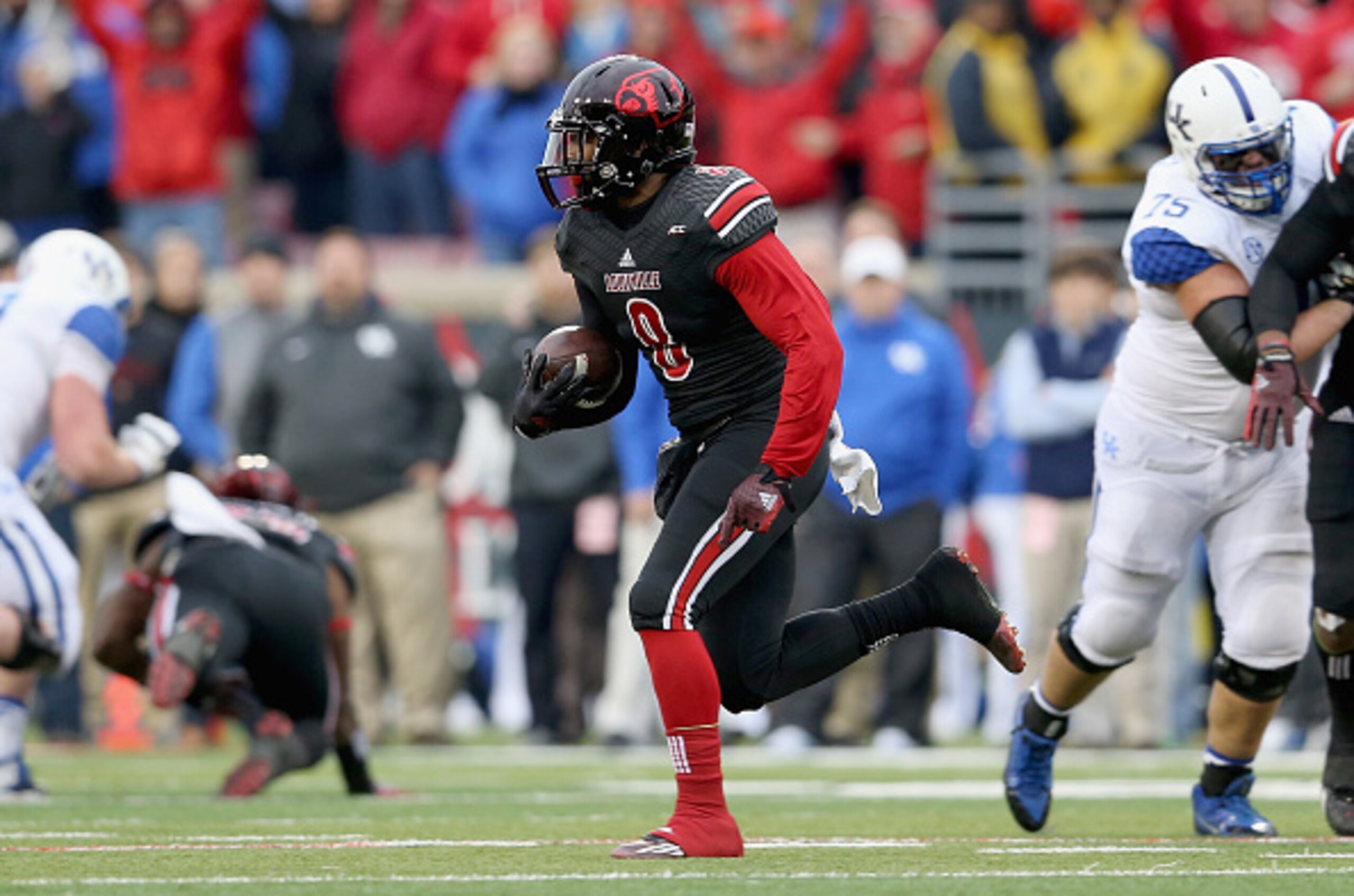
Ball Skills
What more could you possibly ask for? Gerod Holliman is the quintessential ball hawk who reads quarterbacks’ eyes, tracks throws through the air and finishes plays with interceptions instead of pass breakups. His 14 picks this regular season tied a 46-year-old NCAA record.
Tackling
Holliman does not break down, wrap up and bring offensive players to the ground. When he makes a tackle, it is often after dropping his shoulder and laying a form-deficient hit. He must learn to implement the fundamentals of tackling if he ever wants to become a complete safety.
Run Support
Holliman is just as bad in run support as he is as an overall tackler. Oftentimes, those flaws overlap. He is timid in the box and struggles to diagnose plays, leading to instances where running backs escape from bad situations. It is not just that he struggles in run support but that he seems to have no interest in participating.
Pass Coverage
Here, again, is where Holliman makes up for his flaws in run support. He understands the nuance of pass coverage, of how to recognize and mirror different route concepts. He is a fluid athlete who reads his keys and almost never gets beat over the top.
Overall
Holliman intercepted passes at a historic rate in 2014, drawing such lofty comparisons as Ed Reed from Matt Miller of Bleacher Report. He helped a Louisville defense that lost two first-round NFL draft picks, and its head coach and coordinator from last year’s team remain just as dominant this season.
67. Amarlo Herrera, ILB, Georgia
44 of 110
Tackling
Amarlo Herrera flows to the ball and knows how to finish plays. He looks smaller but plays bigger than his listed size (6’2”, 231 lbs), and he’s an active finisher of gang tackles.
Pass Rush
He didn’t log a sack in the final 10 games of the regular season, but Herrera proved against Clemson and South Carolina that he can rush the quarterback. He has vision to attack the creases and knows how to disengage from guards with hand boxing.
Run Defense
Herrera likes to throw his body around and does a good job hammering and splattering runs. He is a downhill player with an insatiable motor who never stops moving until the whistle.
Pass Coverage
Georgia leaves Herrera on the field on passing downs, in part because he’s an effective blitzer but also because he can cover. After flashing in the A-gap—i.e., making the quarterback think he will rush—he gains depth dropping into zone and is able to execute a spy without losing track of his assignment.
Overall
Ramik Wilson is bigger and more athletic (and might be considered the better NFL prospect), but Herrera is the best inside linebacker at Georgia. He is heady, instinctive and almost never seems to make a mistake.
66. Dadi Nicolas, DE, Virginia Tech
45 of 110
Pass Rush
Dadi Nicolas is a freak athlete and one of the hardest players to block in the country. He has a light frame (6’3”, 231 lbs) but explodes off the line and is able to rip and dip with speed around the edge. He “only” had nine sacks during the regular season but made his impact felt with an absurd 25 QB hurries. Even when he didn’t bury the quarterback, he found a way to leave his mark on a play.
Run Defense
Nicolas is a hard worker who understands leverage and makes himself a viable run defender. He gets his hands beneath opposing tackles’ shoulder pads and fights to set the edge. He is also a savvy play-diagnoser who stays at home instead of crashing when he shouldn’t. All of this helps Nicolas combat his lack of size in run support. He will never shed blocks or push the pile well enough to excel in this area. But he has been coached well enough to not struggle, either.
Motor
Nicolas plays well under bright lights. He had two sacks against Ohio State and five QB hurries (to go with one sack) against Virginia. He is an intense competitor who doesn’t drain his energy in the first three quarters so he can play his best football in the fourth.
Overall
Nicolas is one of the most underrated players in the country and a big reason for Virginia Tech’s success—on defense!—the past two seasons. He tweeted in December that he will return for his senior year, which is huge news for Frank Beamer, Bud Foster and the rest of the Hokies coaching staff (and fanbase). If he gains some weight this offseason but doesn’t sacrifice any of his explosiveness, he’s an early favorite to lead the nation in sacks in 2015.
65. Zack Sanchez, CB, Oklahoma
46 of 110
Speed
Zack Sanchez has functional speed but not ideal speed. He can tag most receivers down the field, but he doesn’t accelerate as fast as one might like. Kevin White of West Virginia made Sanchez look slow-footed on a deep touchdown in September.
Ball Skills
Quarterbacks have to think twice (and are smart to think a third time) before throwing the ball near Sanchez. He tracks passes like a free safety, especially in zone coverage, and has superlative hands. He intercepted a pass in each of the first four games of the season, a streak that gave him six picks in seven games dating back to 2013.
Run Defense
Sanchez is an OK run defender but a terrible tackler. He knows where he fits into the defense and is willing to mix things up, but he doesn’t finish the job by getting players to the ground. He is better near the line than he is in the open field, but opponents still have him circled as a player to target on the ground.
Coverage
In coverage, Sanchez is good but inconsistent. The freelancing tendencies that define him—the things that make him so valuable—can sometimes backfire and lead to big plays for the offense. Better discretion should come with experience, and once it does, he will have all the technical skills and physical tools needed to be a great cover corner.
Overall
Sanchez has made a name for himself with his aggressive, ball-hawking ways. He is not the safest cornerback to leave on an island without safety help, but he makes more good things happen for his defense than just about anyone.
64. DeVante Parker, WR, Louisville
47 of 110
Hands
DeVante Parker is a big (6'3"), strong target with a catch radius to match his dimensions. He struggled with drops at the start of his college career but mended those issues as an upperclassman.
Route Running
Parker does not have the most advanced route tree, but the routes most responsible for his production—slants, comebacks, etc.—are routes he runs as well as anyone. He does this not with precision, necessarily, but with a nuanced understanding of how to use his frame to his advantage.
Blocking
It's wrong to say that Parker struggles as a blocker. He doesn't. But he doesn't block as well as one expects from a player his size. Whether that's a product of technique or of effort is difficult to answer, but it's something Parker definitely needs to work on.
Release
Parker can beat press coverage on simple patterns, and his release technique improved in 2014. In past years he would struggle with the timing of his release, tipping the direction of supposedly complex routes, but now he is able to bait receivers one way and beat them the other.
Speed
Parker matches great size with close-to-great speed. He is fast enough to run under the deep ball but doesn't have the breakaway speed to outpace defensive backs with the ball in his hands.
Run After Catch
Parker improved after the catch more than any other area as a senior. He had always finished runs by falling forward but is now able to slip and shed tackles altogether.
Overall
Parker missed the first half of the season with an injury but ignited Louisville's offense when he returned. He is one of the most complete skill players in the country. Good luck trying to find a weakness in his game.
63. Derek Barnett, DE, Tennessee
48 of 110
Pass Rush
Derek Barnett is a gifted young pass-rusher with the speed to give offensive linemen problems. He fires off the line and dips his shoulder to get around the edge and make plays. He has a big frame (6’3”, 267 lbs) but doesn’t have a deep array of power moves. He is at his best working outside-in.
Run Defense
Barnett is a big-play run defender. He led the SEC with 10.0 non-sack tackles for loss this regular season, using the aforementioned speed to knife through the line and make plays. He is not as useful on a down-to-down basis, struggling at times to shed blocks or anchor the edge. If he adds strength to his frame this offseason, he should improve. But for now, he is a little "boom or bust."
Motor
Barnett has a motor that doesn’t quit. He plays as well (if not better) on the road as he does at home, and he gets stronger as the game wears on. He spearheaded Tennessee’s comeback win at South Carolina with a third-down sack at the end of the fourth quarter and a crucial sack in overtime. If he senses a tired opponent, he attacks.
Overall
Tennessee’s 2014 recruiting class was supposed to be the group that changed the program. Barnett was supposed to be a contributor in that, but he wasn’t supposed to be the star. His freshman season, though, stacks up with the best by a defensive player in SEC history. He is already good enough for the Vols to build their defense around, and he only stands to improve with added time around college coaches.
62. Myles Garrett, DE, Texas A&M
49 of 110
Pass Rush
Myles Garrett broke Jadeveon Clowney’s SEC freshman sack record (11.5 in 13 games), needing only nine games to register 11 sacks. He has a massive, chiseled frame (6’5”, 255 lbs) and converts power to quickness on rip moves and spin moves. His numbers, however, are inflated by level of competition. Eight of his 11 regular-season sacks came against Lamar, Rice and Louisiana-Monroe. He was a fraction too slow to beat bigger, better tackles off the edge and not quite strong enough to rely on his power moves with consistency. But all of that should come with time and experience.
Run Defense
Garrett was billed as a pure pass-rusher who might need time to become an early down run defender. But he was better than his billing in this regard, playing well on the edge and crashing down in run support. The Aggies struggled to execute their run fits behind him, but Garrett did his job to occupy blockers and had the speed to make some plays on his own. He still plays a little too high, which mitigates his pure strength, but that, again, should come with time and experience.
Motor
It’s nice to see a highly regarded freshman who doesn’t read his press clippings. Garrett plays as hard as any member of the Aggies defense, earning the respect of his teammates with more than just his 5-star billing. He chases quarterbacks through the duration of his pass-rushing snaps but also runs downfield to make tackles in run support.
Overall
Garrett was the No. 2 overall player (and top-ranked defender) on the 247Sports composite rankings and did not take long to justify that title. He is a fully grown man in the trenches, which is scary because he appears to still be growing. If he learns to stay low and hones the minor flaws of his technique, he can make the All-America team as soon as next season. If he doesn’t, he’s already an All-Conference-type performer.
61. Will Likely, CB, Maryland
50 of 110
Speed
Will Likely is fast. Very fast. It may not show that way in testing, but it shows that way on film. He rarely gets beat with pure speed down the field, and he makes plays whenever he gets the ball in his hands. He scored three touchdowns in 2014 including a 69-yard punt return against West Virginia and an 88-yard interception return against Syracuse.
Ball Skills
In a vacuum, Likely has some of the best ball skills in the country. He tracks passes through the air, gravitates toward the action and catches every ball in his orbit. The only demerit is for…well…his height (5'7"), which prevents him from playing the ball despite perfect coverage against certain big receivers.
Run Defense
Despite his stature, Likely is one of the highest-volume tacklers at his position. There was a six-game stretch between the end of 2013 and the start of 2014 in which he posted seven or more solo tackles four times. He understands his role in the running game, stays home when he needs to, slices into the backfield when he’s supposed to and wraps up opponents’ legs to bring them down in the open field.
Coverage
For everything he has done well this season, Likely’s coverage has been patchy. He is good for long stretches but has not been as consistent as his instincts and technique suggest he should be. The biggest problem is a tendency to play overly aggressive, biting hard and allowing receivers to get over the top.
Overall
Likely was only a 3-star prospect. Despite his speed, his heart, his grit, the fact that he was the 2011 Florida Gatorade Player of the Year, etc., major college programs only saw one thing: his height. But Likely proved in 2014 that height is not the only thing that matters, breaking out on defense and special teams to become one of the best all-around players in the Big Ten.
60. Tyler Lockett, WR, Kansas State
51 of 110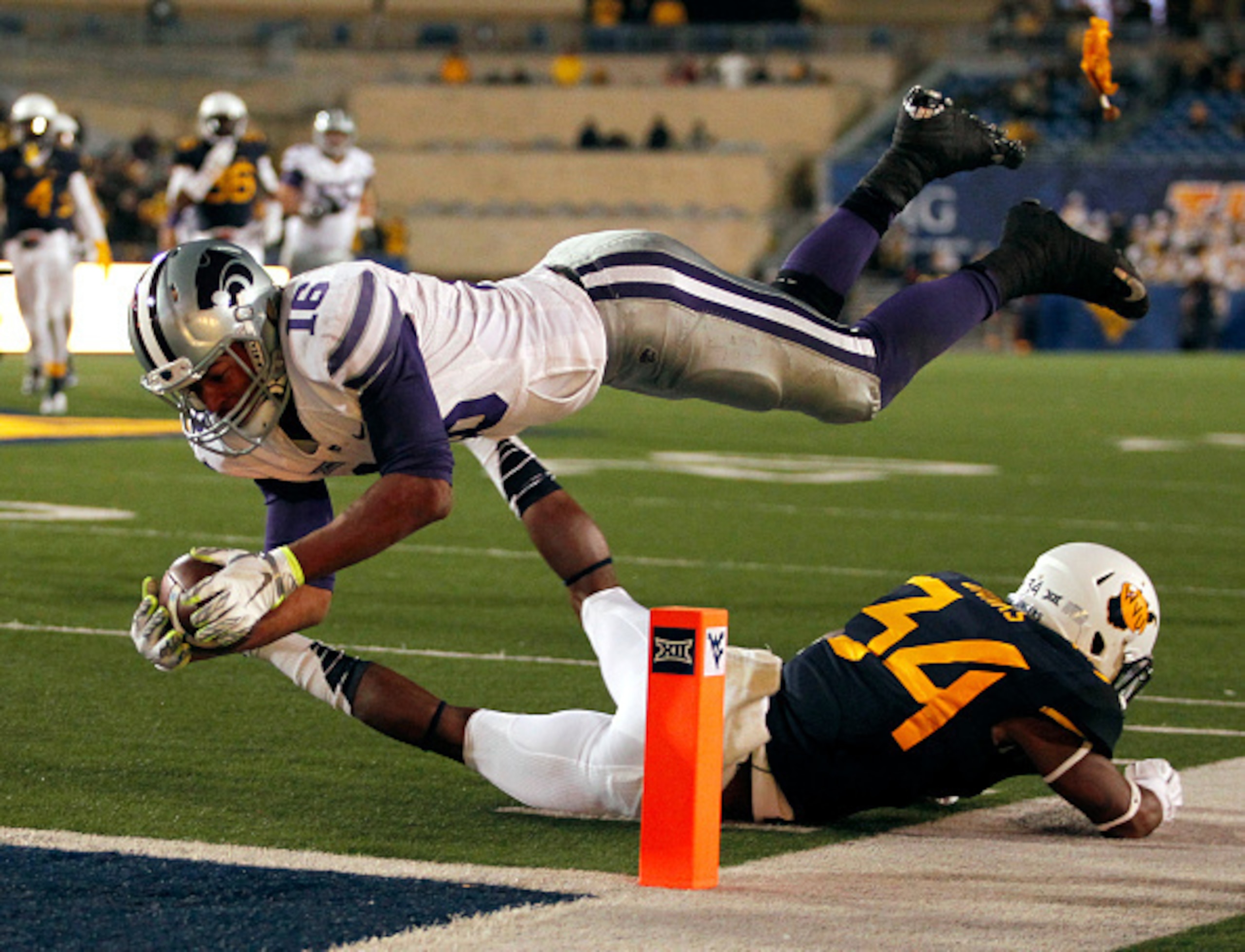
Hands
Tyler Lockett is a smaller receiver (5'11") with smaller hands to match. He does not have what one would call a drop "problem," but he does drop more passes than most of the receivers on this list. However, he atones for that by adjusting well on deep passes and making athletic plays in traffic.
Route Running
Lockett runs a deadly post-corner with one of the best double moves in the country. That is his bread and butter—and it's a good bread and butter to have—but he struggles in other areas of route running, such as not losing speed through his breaks.
Blocking
Lockett blocks better than one would expect for a player his size, but not by much. He's a fighter who works hard on every down, but physical defenders are able to rip past him.
Release
There are nuances to Lockett's release that need fine-tuning, but for the most part he is one of the best in the country. His three-step footwork provides a quick advantage against man coverage.
Speed
Quickness and burst are Lockett's biggest assets. He prefers to beat defenders off the line, but he can also gain separation at the intermediate and deep levels. Even if a cornerback is stride-for-stride when the ball is thrown, Lockett will turn on the jets at the last second.
Run After Catch
Lockett is dangerous with the ball in his hands, whether on short passes or punt returns. He sets up his blockers, waits for the hole to develop and runs with great speed and vision.
Overall
Lockett is one of the best offensive players in Kansas State history—a history that includes some pretty good ones. He is a threat to score from anywhere on any given play, and he has done so on the biggest stages.
59. Anthony Harris, S, Virginia
52 of 110
Ball Skills
Anthony Harris has innate coverage instincts that exceed most college safeties. He reads and reacts in an instant, breaking on the ball and making plays in the air. With soft hands and firm body control, he is always a threat to come down with an interception.
Tackling
Harris is a sure tackler who closes space on offensive players in the open field and never lets them out of his grasp. He finished with 10 or more total tackles five times in a six-game stretch during ACC play.
Run Support
Virginia trusts Harris to play in the box and function as an extra linebacker, a role he has proved capable of filling. He has a clear understanding of run fits and takes good angles to funnel or pursue ball-carriers.
Pass Coverage
Harris makes judicious coverage decisions, playing aggressively when the situation calls for it but rarely burning the team with over-aggression. He is a senior with quick hips and good long speed that allows him to cover vertical routes.
Overall
Harris was the bright spot for a bad Virginia team in 2013 and a big reason for the Wahoos’ improvement this season. He didn’t match last year’s gaudy interception total—an FBS-leading eight—but was an even better player across the board.
58. Tevin Coleman, RB, Indiana
53 of 110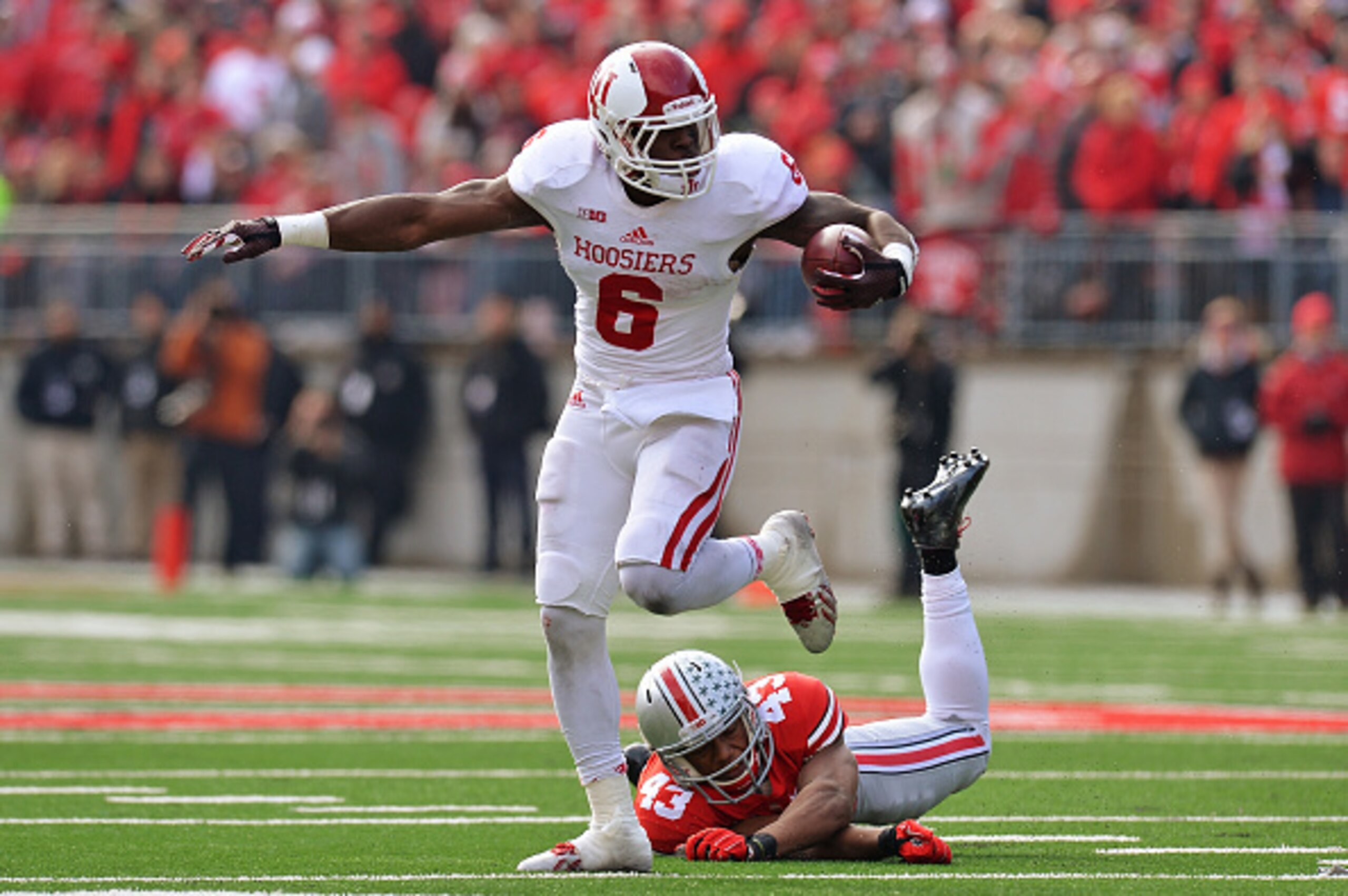
Ball Security
Tevin Coleman does not have chronic fumbling problems like some of the other big names on this list, but he could stand to be a little more protective of the ball. He was infamously benched for three series after fumbling twice in the first quarter against Michigan.
Power
You wouldn’t know it looking at his explosiveness numbers, but Coleman is built like a power back. He is 6’1”, 210 pounds and has a thick lower body that allows him to grind out extra yards. His upright running style prevents him from becoming a between-the-tackles workhorse, but he’s strong enough to fall forward on most runs.
Vision
Coleman has boom-or-bust vision. He creates big plays out of holes that many running backs might have missed but sometimes tries to force the issue and sacrifices positive yards. Still, his ability to hit the home run makes this much more of a strength than a weakness. He's like a really good power hitter with a mediocre batting average. Think Ryan Howard, circa 2008.
Hands
Coleman does not have an advanced route tree, typically only catching checkdowns and screens. But he has performed well in those situations, flashing a soft pair of hands and the ability to turn and get upfield.
Speed
When Coleman finds a crease, he’s gone. Long gone. His straight-line speed can rival that of any running back in the country. It’s impressive how he hits the hole, too, with his unique blend of size and speed combining for a powerful gush of momentum.
Agility
Coleman doesn’t have a ton of wiggle. He is more prone to running past defenders than around them. But he does have an abnormally quick first cut, which speaks to his agility despite his lack of secondary moves in space.
Overall
Coleman was a beast in 2013, but because he missed the last three games of the year with an injury, nobody seemed to notice. After 2014, he could no longer be ignored. Even though he plays for Indiana, the nation got on board with Coleman this season, accepting him as an All-America candidate despite the sad state of his team.
57. Jay Ajayi, RB, Boise State
54 of 110
Ball Security
Jay Ajayi holds the ball away from the body with little regard for its safety. He fumbled five times in the first 10 games this season, losing three of them. This is the area of his game that demands the most improvement.
Power
Ajayi is a solid downhill runner who seeks contact between the tackles. He bounces off smaller defenders and holds his own against bigger ones. At 6’0”, 216 pounds, he has the beef to grind out positive yards on each carry, although his lower body needs to catch up with his upper body in terms of strength.
Vision
This might be the best (and is definitely the most underrated) part of Ajayi's game. He sees the field and squeezes through small holes better than almost any other running back his size. He keeps his head on a swivel when he gets to the second level, assessing the layout of his blockers to decide on the optimal route.
Hands
Fine, I take it back. This is the best part of Ajayi’s game. After mostly running checkdowns in 2013, he expanded his repertoire with flares and angle routes this season, displaying natural hands and a feel for how to get open. He caught 12 passes for 93 yards and a touchdown against Ole Miss.
Speed
Ajayi is faster than people give him credit for, although he’s not what one would call a “burner.” On inside runs, he accelerates through the hole and is often too quick for the linebackers. On outside runs, he can typically win the corner. But don’t expect him to gash you with 40- or 50-yard runs.
Agility
Whatever Ajayi lacks in breakaway speed, he makes up for with lateral agility. He has the legs of a smaller, nimbler player, which allows him to cut on a dime and make defenders miss in space. He also has a pretty killer juke move.
Overall
Ajayi is the latest—and probably the best—in a long line of great Boise State running backs. One look at him in street clothes says he’s a power back, but the more you watch him play, the more you realize he’s a nuanced, shifty runner who does a little bit of everything well.
56. Anthony Zettel, DT, Penn State
55 of 110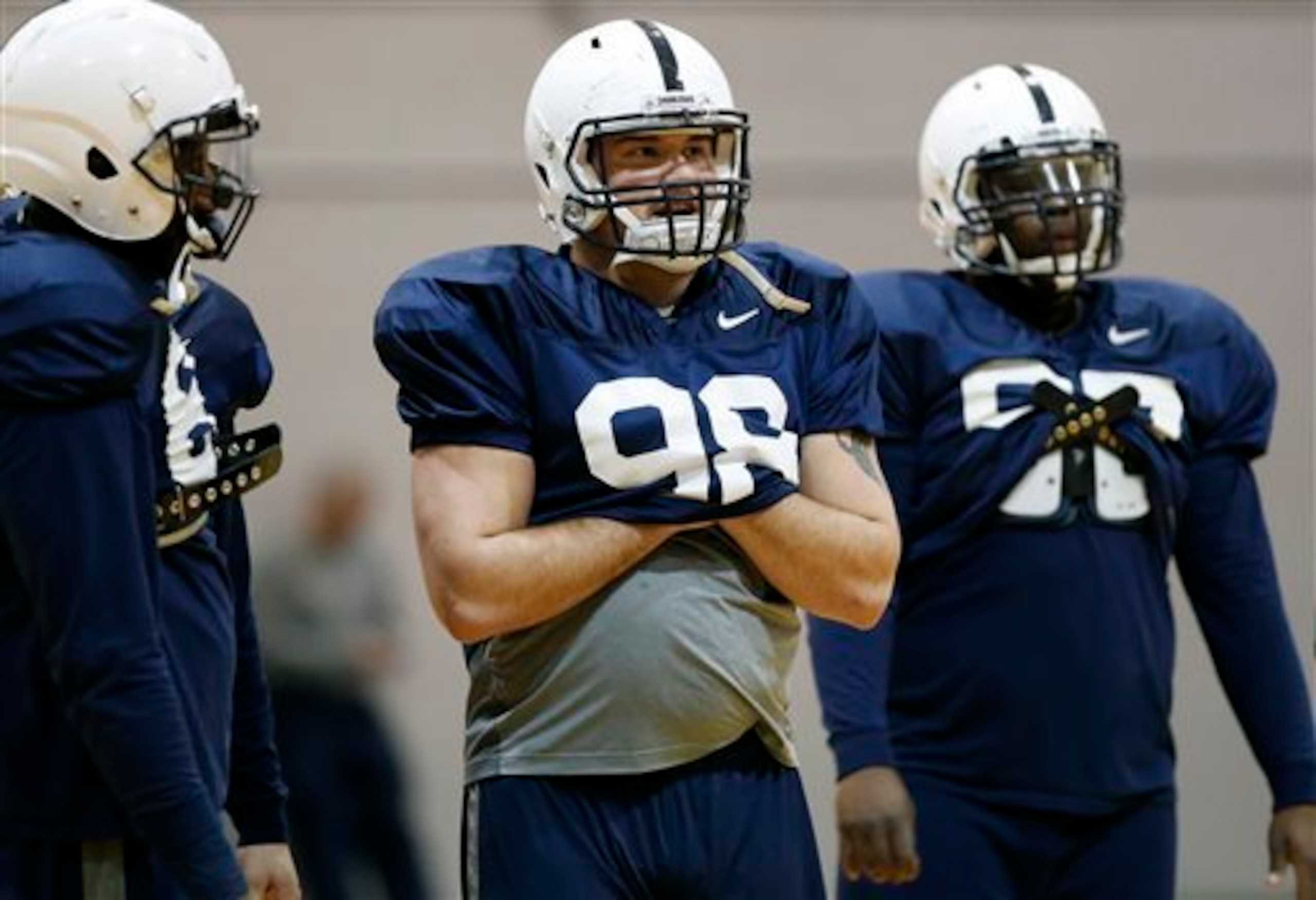
Pass Rush
Anthony Zettel is a converted defensive end with a smaller frame (6’4”, 274 lbs) than most at his new position. However, he knows how to use this to his advantage as a pass-rusher, knifing between small blocking gaps as a 3-technqiue tackle. The technical skills he learned during his time on the outside make him a difficult matchup for stone-footed guards and centers. He led Penn State with eight total sacks during the regular season, ending the year on a stretch in which he recorded one sack in five of six games.
Run Defense
Zettel does not have the mass of his former teammate, 318-pound tackle DaQuan Jones, but he does everything in his power to compensate for his size during run support. He can’t hold the point of attack against double-teams without getting moved off the ball, but he is quick enough to get into the backfield and make negative plays on his own. According to the S&P+ ratings at Football Outsiders, Penn State finished the regular season with the No. 3 run defense in the country, which speaks well to Zettel’s work up the middle.
Motor
One of the fieriest players in the Big Ten, Zettel stands out for his passion and his will to compete each down. Even when he’s overmatched by size, he uses leverage and burst to get underneath a guard or center and avoid being paved out of the gap. He is a relentless fighter who never stops scraping until the final whistle.
Overall
Zettel made the move from end to tackle look easier than he had any right to, especially given his size. He took quickly to Bob Shoop’s system and gave the Nittany Lions a rock at a position of need. The defense carried Penn State to a bowl game this season, and Zettel helped solidify the unit. Without him, the team might have lost seven or eight games.
55. A.J. Cann, OG, South Carolina
56 of 110
Strength
A.J. Cann has remarkable strength that is distributed through his hands, arms, hips and midsection, allowing him to overpower defenders in myriad ways. He is 6’3”, 313 pounds, and does his best work in the short area.
Pass Protection
The most valuable thing Cann does against the pass rush—and something that is easy to overlook—is recognize different pressure packages. He is a four-year starter with great field awareness who identifies and reacts to all sorts of stunts, twists and blitzes and rarely lets a free man run up the middle. Functionally, his powerful punch, flexible knee bend and overall core strength make him a solid pass-blocker who can easily withstand a bull rush.
Run Blocking
Cann is at his best opening holes in the power-running game. He uses strength and leverage to clear defenders away from their assignments and has such strong hands that they cannot disengage from his latch. He does not, however, make much of an impact at the second level, where his lack of mobility renders him a non-factor.
Explosion
As a run-blocker, Cann does a good job firing out of his stance and initiating the point of contact. As a pass-blocker, he is decent but does not explode with the same urgency, which sometimes leads to an immediate defensive pressure up the middle.
Overall
He doesn’t get the credit he deserves—offensive guards rarely do—but Cann was the best player on a South Carolina offense that ranked among the best in the SEC this season. His thick, square frame and his insatiable urge to hit people make it seem like he was bred to be a lineman.
54. Ameer Abdullah, RB, Nebraska
57 of 110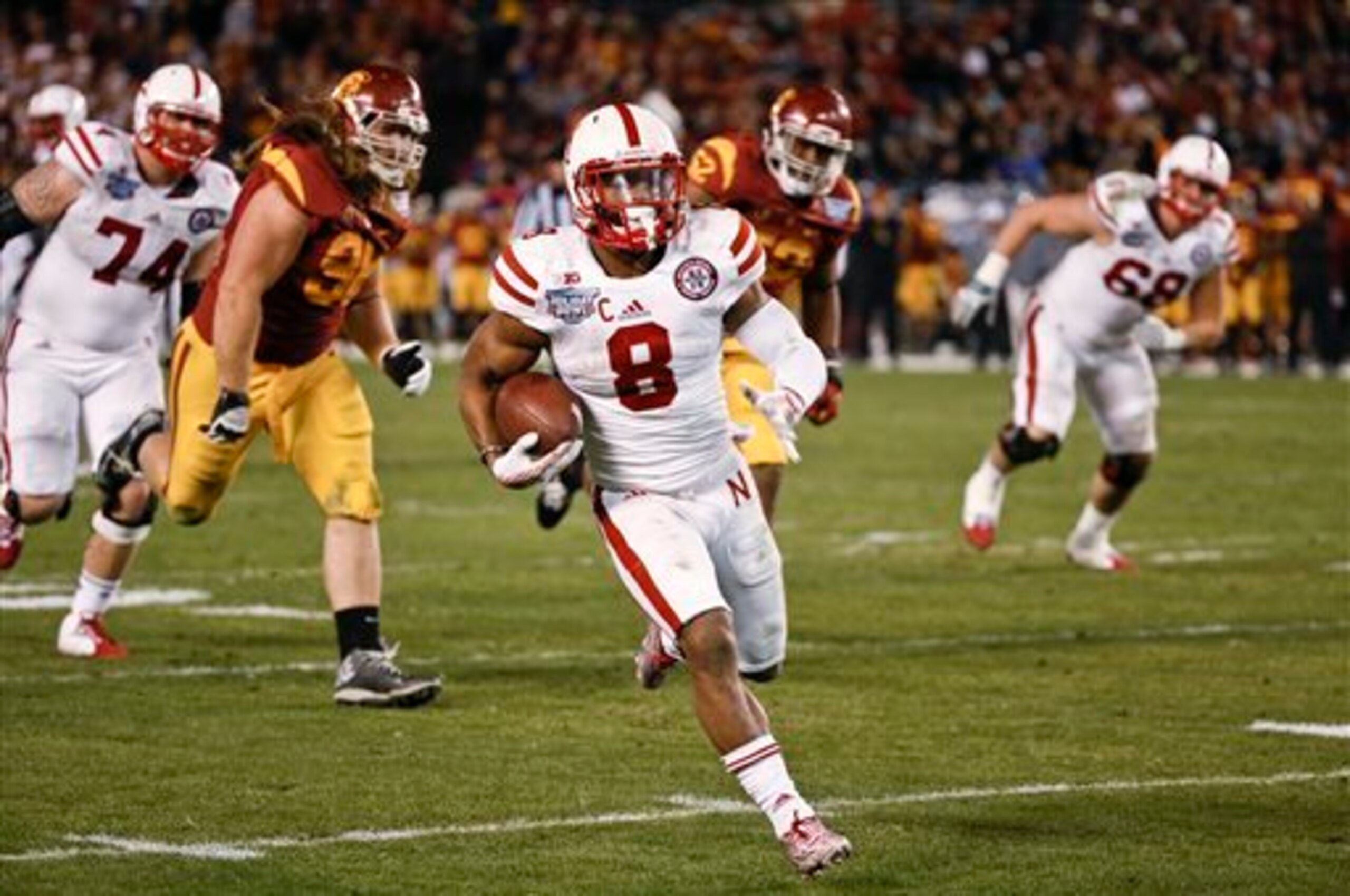
Ball Security
The weakest component of Ameer Abdullah’s game is ball security. For a player with so many reps under his belt, he puts the ball on the ground…a lot. He fumbled 20 times in his first three seasons and appeared to fix the problem in 2014 but relapsed in the biggest game of the season at Wisconsin.
Power
Abdullah has functional power. He is a high-motor runner who gains occasional yards after contact, but he is tougher than he is strong. He won’t move the pile in a goal-line setting, but he’s forceful enough to gain yards after contact between the 20s.
Vision
Abdullah is a smart runner who sees holes before they open up and hits them at just the right moment. Cynics will say he’s “running to his scheme,” which he is, but it takes a back with good vision to run to his (or any) scheme this well. Plus, when the initial assignment is not there, he has shown the ability to identify the optimal cutback lane.
Hands
Nebraska doesn’t overuse Abdullah out of the backfield, saving him for the biggest possible moments. When he has been targeted, though, he has proved to be a serviceable pass-catcher who snatches the ball away from his body and doesn’t let the reception break his stride.
Speed
Abdullah is a bullet with strong legs and breakaway speed. He turns the corner on stretch plays, finishes long runs with touchdowns and consistently gains yardage on kick returns. The most impressive part of his speed might be his stamina, which essentially allows him to "hold the turbo button" throughout the duration of the play.
Agility
No college running back has better agility than Abdullah. He sets up would-be tacklers with his balance on side-to-side cuts, changing direction on a dime. He also has a deep arsenal of open-field moves that constantly stump defenders trying to figure out how to stop him during tape study.
Overall
Abdullah capped a long, fruitful career with an outstanding senior season in which he carried Nebraska’s offense. The 5’9” I-back is a potent ball of energy and one of the best non-quarterback leaders in the country.
53. Ben Heeney, ILB, Kansas
58 of 110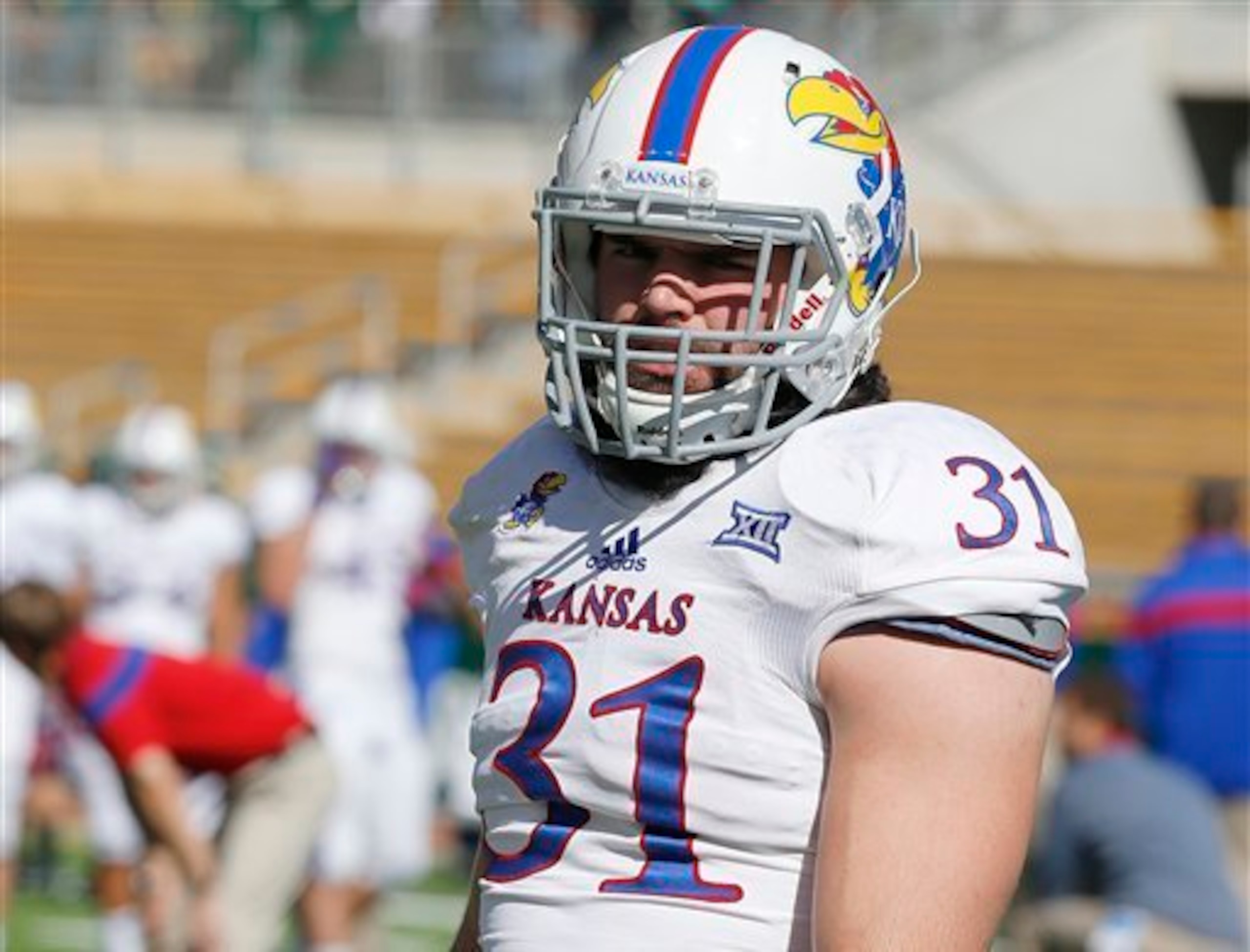
Tackling
Ben Heeney is a physical tackler who seeks and destroys opponents. That is not to say he’s a huge hitter—just that when he wraps up an opponent, he almost never lets him go. He also takes smart pursuit angles to chase down players in space.
Pass Rush
Heeney is a traditional inside linebacker—i.e., not the type to get after the quarterback. His pass-rushing snaps are limited because he doesn’t have the size (6’0”, 230 lbs) or quickness to consistently burst through protection.
Run Defense
Despite his lack of measurables, Heeney is a force against the run. He is a max-effort player who flows from the inside out and finishes when plays are funneled toward him. However, it would be remiss not to mention that Samaje Perine set an FBS record with 427 rushing yards when Kansas played Oklahoma. That is an ugly stain for Heeney to have on his resume.
Pass Coverage
Heeney is a useful defender in man coverage. He is quick enough to turn his hips and run with receivers up the field. In zone coverage he reads the quarterback’s eyes, breaks well on the throw and has the ball skills to make a play.
Overall
Heeney has been the lone standout player at Kansas for, well, pretty much his entire career. But a lack of team success should not devalue the impact he has made in Lawrence (and on the Big 12) as one of the best defensive players in program history.
52. Rashard Higgins, WR, Colorado State
59 of 110
Hands
Rashard Higgins has a massive catch radius and does a great job high-pointing passes. He attacks instead of waiting for the ball to reach him, which allows him to come down with 50-50 throws.
Route Running
For a sophomore, Higgins runs advanced routes and has a sophisticated feel for defenses. He knows where to plant and drop against zone coverage, and he sets up cornerbacks for double moves down the field.
Blocking
Despite having a lean frame (6'2", 188 pounds), Higgins does not shy away from his physical obligations. He does not have the raw strength to consistently hold the edge, but he gets downfield when a teammate hits the second level and helps them turn long gains into huge ones.
Release
Opponents started playing press against Higgins as a means of limiting his after-the-catch abilities. But he improved his release throughout the season and eventually became quite good at fighting for separation off the line.
Speed
Higgins has breakaway speed that allows him to turn one missed tackle into a huge gain. Even when defensive backs take smart pursuit angles, he is fast enough to beat them to the corner and turn upfield.
Run After Catch
Here is where Higgins goes from being a solid receiver to a superstar. He is light on his feet and has superior vision, which allows him to dance through defenders and break short completions for 40- or 50-yard plays.
Overall
Higgins was one of the breakout stars of the season, posting huge game after huge game for Colorado State. Only a sophomore, he will return in 2015 and have an even bigger load to bear without quarterback Garrett Grayson.
51. Laremy Tunsil, OT, Ole Miss
60 of 110
Hands
Laremy Tunsil has strong, quick hands and delivers a strong punch. He has a firm grapple and doesn’t let defenders break his blocks. The only demerit comes for hand placement, which Tunsil occasionally struggles with. If he learns to keep his hands inside—something that should, in theory, come with coaching and experience—he has a chance to keep improving as a junior.
Power
Tunsil gets explosive power off the ball, which makes him a useful blocker on short-yardage runs. He is one of the few members of Ole Miss’ line that Hugh Freeze and his staff feel comfortable running behind when they need a yard or two.
Lateral Quickness
You can’t teach this type of quickness to a 6’5”, 305-pound tackle. In pass protection, that manifests with his ability to stay in front of speed-rushers. In the run game, he is mobile enough to get downfield and coordinated enough to engage would-be tacklers.
Pass Protection
Tunsil gains depth with his first step and has the fluid hips to mirror pass-rushers off the edge. He also has the strength to set a heavy anchor and is rarely pushed back by a bull rush. He does not have a weakness in pass protection, and he’s only growing better and more consistent.
Run Blocking
Tunsil is a hardworking run-blocker with quickness to seal the edge and strength to push defenders back. He is not as good on the ground as he is against the pass, in part because of the aforementioned hand-placement problems, but he is far from a liability. Still, it would be nice to see Ole Miss establish a half-decent rush offense one of these seasons.
Overall
Tunsil was slowed by a shoulder injury at the end of the regular season and broke his fibula in the Peach Bowl, but injuries are about the only thing that can slow him down. After starting at left tackle and allowing only one sack as a true freshman in 2013, he continued to improve in his second season at Ole Miss, justifying his rating as a top-five player in the 2013 recruiting class.
50. Ifo Ekpre-Olomu, CB, Oregon
61 of 110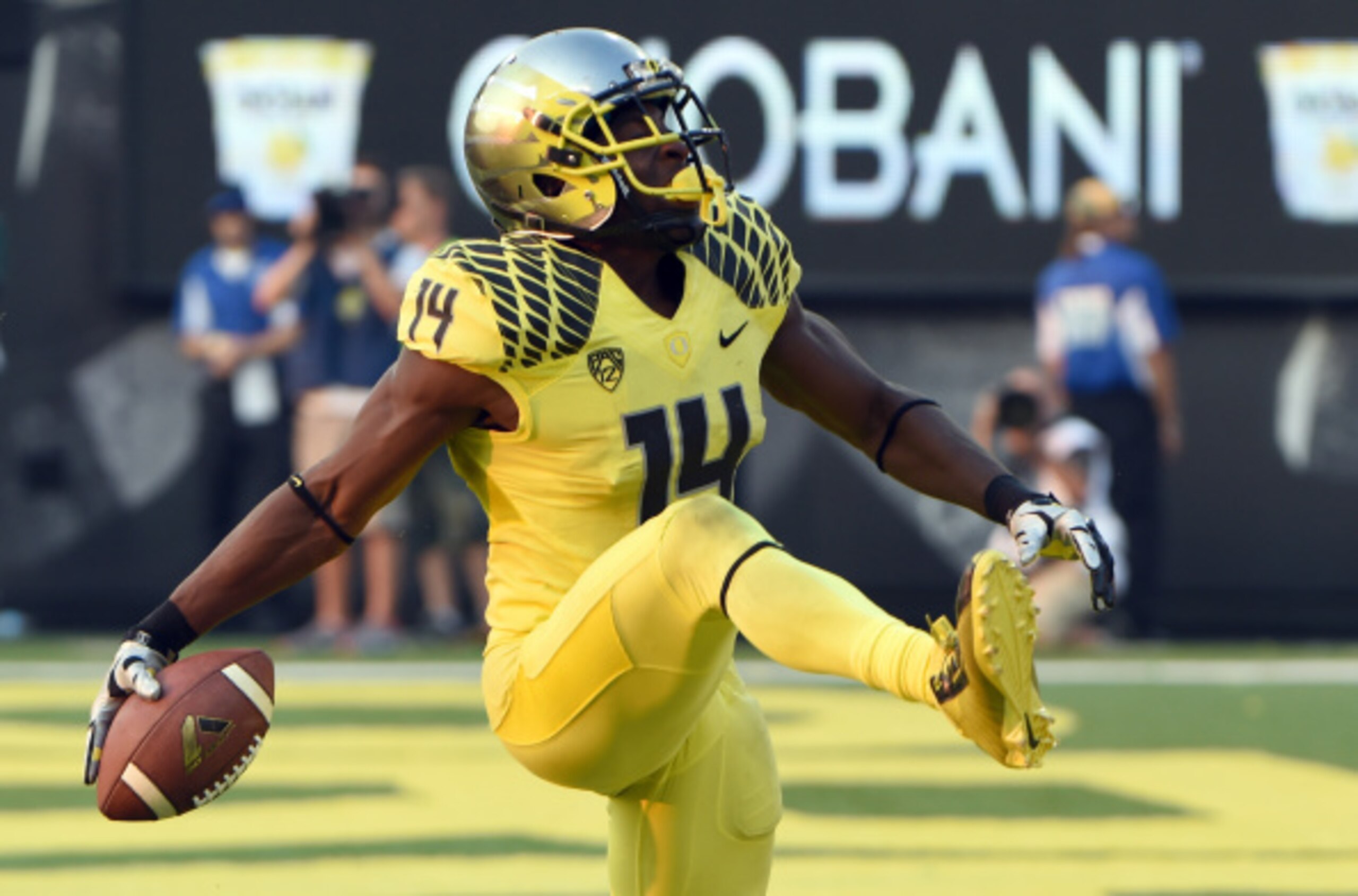
Speed
More quick than fast, Ifo Ekpre-Olomu relies on agility more than speed to stay with receivers. He has fluid hips and maintains pace when he changes directions, which helps him compensate for lacking ideal top-end speed.
Ball Skills
Ball skills are another way Ekpre-Olomu compensates for lacking ideal height (5’10”) and speed. He has exceptional timing and coverage instincts. His reaction time allows him to make up ground, and his hands and run-after-catch ability (Ekpre-Olomu also returns punts for the Ducks) make him a dangerous big-play weapon.
Run Defense
Ekpre-Olomu is willing to throw his body around and do anything his defense asks from him in run support. He does not get caught sleeping and is able to shed blocks and become a force player, although his tackling regressed a bit in 2014.
Coverage
Normally a great cover corner, Ekpre-Olomu showed some cracks in the armor this season. He has the athletic ability and ball skills to overcome his height against taller receivers but does not recognize fade patterns as quickly (or defend them as well) as he should. Washington State burned Ekpre-Olomu for three touchdowns when it played the Ducks.
Overall
Ekpre-Olomu gives Oregon a defensive superstar to pair with its offensive talent. The quick-footed cornerback suffered some lapses in coverage this season, but for the most part he helped the Ducks field a playoff-worthy defense.
49. Nick Vigil, OLB, Utah State
62 of 110
Tackling
Nick Vigil has good size (6'2", 230 lbs) and enough strength to stop players in their tracks. He is more of a gang-tackler than a solo-stopper, but his willingness to stick his nose into the hole, combined with his speed to track players along the outside, makes him the sort of linebacker one can count on to destroy plays.
Pass Rush
Nick is a better athlete than his brother, Zach, which is why Utah State likes to play him off the edge. He doesn’t have the lanky frame one imagines for a pass-rusher, but he is slippery enough to avoid hand engagement and dart into the backfield.
Run Defense
Vigil moonlights at running back, and the instincts he uses on offense have translated to the other side of the ball. He is able to sift through the wash and make a play in traffic or set the edge and force a run back inside.
Pass Coverage
Here is where Vigil needs some work. He is more of an explosive athlete than a fluid athlete, and it shows when he tries to turn his hips in coverage. He is still figuring out how to get to his landmarks without taking his eyes off the play.
Overall
Vigil has emerged, alongside brother Zach, to give Utah State a promising piece for the future. After first-round NFL draft prospect Kyler Fackrell tore his ACL this season, Vigil made sure the Aggies were no worse for his absence.
48. Erick Dargan, S, Oregon
63 of 110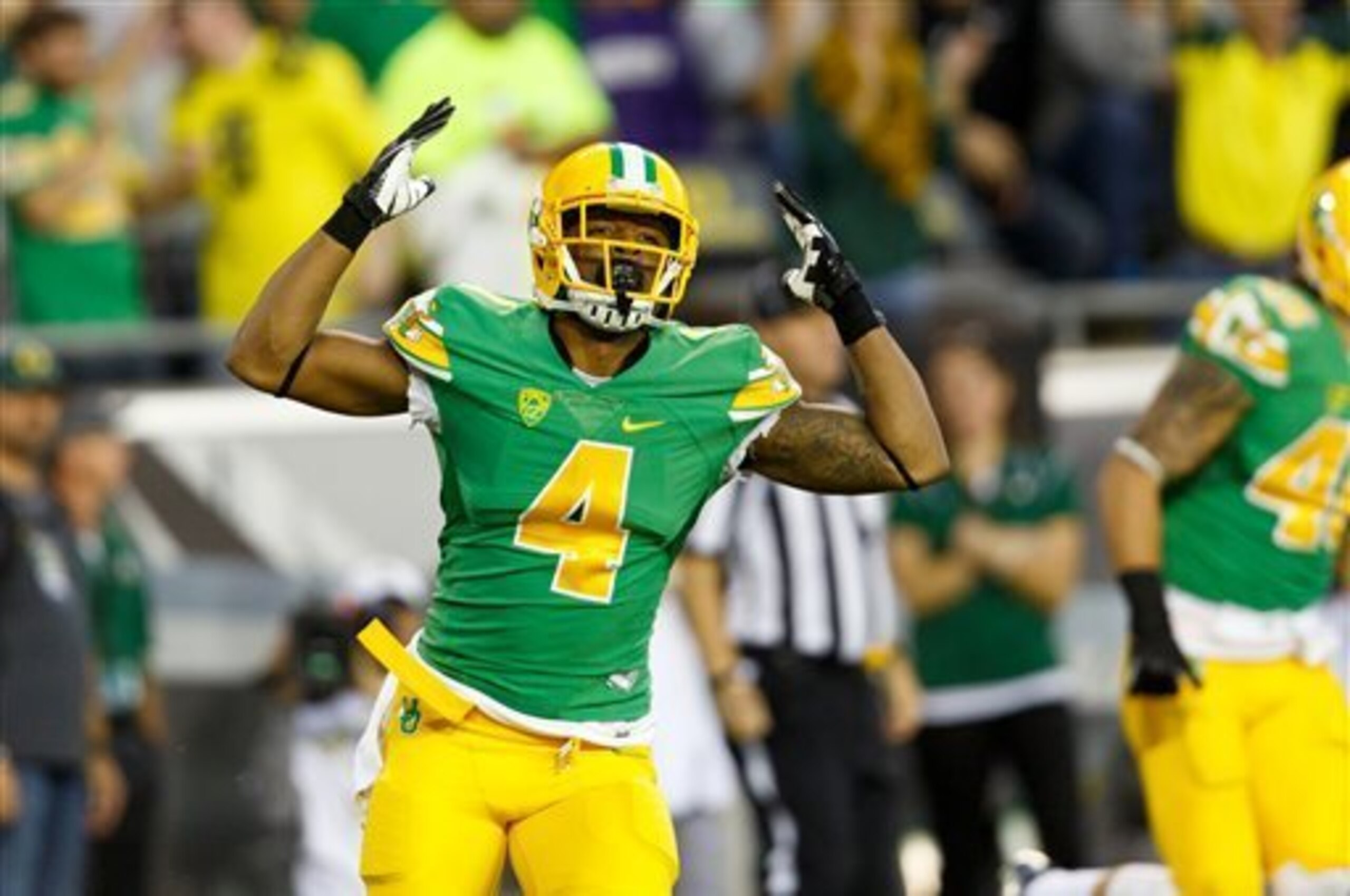
Ball Skills
Erick Dargan has a nose for the ball and always finds his way into the action. He led the Ducks with five interceptions as a reserve in 2012 and again with six this season. He is the "leading thievery guy" on this team, no doubt, and one of the best overall in the country.
Tackling
Dargan is a clean wrap-up tackler who is comfortable making plays in space. He led the team with 82 total tackles in the regular season, highlighted by a 10-solo-tackle performance against UCLA and a nine-solo-tackle performance against Stanford.
Run Support
Although he does his best work in the open field, Dargan is also a willing run defender in the box. He mixes things up around the line of scrimmage and is willing to stick his head into traffic and plug a hole.
Pass Coverage
Dargan combines strong-safety tackling skills with free-safety coverage skills. He is 5’11” with fluid hips to turn and run with vertical assignments. He is not quick enough to mirror slot receivers, but very few safeties are.
Overall
Dargan stepped into the starting lineup in the middle of 2013 and quickly made his mark on Oregon’s defense. He only got better in 2014, matching and in many ways surpassing the production of his All-American teammate, Ifo Ekpre-Olomu, in the secondary.
47. Cedric Ogbuehi, OT, Texas A&M
64 of 110
Hands
It is vexing to watch Cedric Ogbuehi struggle with his hands, knowing that he is capable of being so much better than he is. His punch is inconsistent, his placement is hit-or-miss and his decisions are often reactionary. He does, however, have very good hand strength that allows him to control a defender once he gets a solid grip on them.
Power
Power is not the crux of Ogbuehi’s game, but it’s an underrated part of what makes him successful. He started all 13 games at guard during Johnny Manziel's Heisman Trophy season in 2012, exhibiting enough strength to hold his own—and oftentimes win—against the biggest, strongest, meanest interior defensive linemen in the SEC.
Lateral Quickness
Ogbuehi is the quickest offensive tackle in college football and might be one of the quickest to ever play the position. He is incredibly light on his feet and moves like a tight end in space. Even when he’s beaten off the snap, he is athletic enough to recover.
Pass Protection
Physical tools make Ogbuehi one of the better pass-blockers in college football. The ability to play loose and flexible, the foot speed, the aforementioned recovery time: all of it helps him make plays that other tackles can’t make. Unfortunately, he can’t rise any further up these rankings until he improves his upper-body technique.
Run Blocking
Again, Ogbuehi’s physical tools make him one of the better run-blocking tackles in college football, despite a lack of technical refinement. His power and ability to get upfield—both of which are staples of Texas A&M’s running game—make him a valuable contributor, and maybe even a great one. But he could still be so much better if he ever started playing with a mean streak or refrained from coming too high off the ball.
Overall
Ogbuehi was not one of the six best offensive tackles in the country this season—but only because he spent most of it playing out of position. The switch from right tackle to left tackle did not go as smoothly as anticipated, but once Ogbuehi moved back to his natural spot, he reminded folks of his talent. He is not as good as he should be, but he's still pretty darn good.
46. Trae Waynes, CB, Michigan State
65 of 110
Speed
Speed runs in Trae Waynes’ family. His mother, father and brother all ran track in college, and even though Trae took the football route, the singlet did not fall far from the tree. He has the speed to turn and run with receivers on the rare occasion that they get a clean release.
Ball Skills
Waynes is tall (6’1”) and rangy and uses his length to play the ball in coverage. He is flagged for a fair amount of pass-interference penalties, but that is a welcome side effect of Pat Narduzzi’s scheme. He isn’t a huge ball hawk in terms of interceptions, but he proved he could make plays in traffic against Stanford in last year’s Rose Bowl and snagged two interceptions against Nebraska in 2014.
Run Defense
Waynes is a strong, physical tackler but not a great all-around run defender. He struggles at times to diagnose what he sees, waiting an extra beat before shooting inside or shirking his blocker on the edge.
Coverage
It’s rare to find a cornerback as comfortable as Waynes is on an island. He wins with length, technique and physicality in man coverage, jamming receivers off the line and funneling them to the sideline. He has great coverage instincts, knows when to break on the ball and does a smart job reading quarterbacks’ eyes in the backfield.
Overall
The second half of last year’s “No Fly Zone” secondary, Waynes was every bit as vital to the Spartans’ Rose Bowl run as Thorpe Award winner Darqueze Dennard. He didn’t take the giant leap forward that some expected him to take in 2014, but he was still one of the most reliable shutdown corners in the country.
45. Laquon Treadwell, WR, Ole Miss
66 of 110
Hands
Laquon Treadwell has vise-grip hands that allow him to snatch the ball out of the air. He is not afraid to run across the middle, take a hit and come down with a catch in traffic. His strength makes it difficult (impossible?) for defenders to separate his body from the ball.
Route Running
Treadwell shows a precocious understanding of route concepts, excelling in the technical aspects of getting open. He separates not just with his physical gifts (size, speed, strength, etc.) but also with cuts, fakes and precise footwork.
Blocking
Because of his size (6'2", 229 pounds), Treadwell sometimes functions like a tight end in the running game. He is powerful at the point of contact, capable of driving defensive backs to whatever spot he wants.
Release
Treadwell fights through contact against press coverage, using his physicality to gain an advantage. His first step is not the quickest, but he is so good at the point of attack that it often doesn't matter.
Speed
Treadwell is a remarkable athlete but not necessarily a burner. He doesn't pose a threat going vertical, doing his best work in the short and middle thirds. In 22 career games, he has only caught one pass for 40-plus yards.
Run After Catch
Even though he doesn't break long runs, Treadwell is a monster after the catch. He turns short gains into medium gains and medium gains into chunk plays by lowering his frame and powering through defensive backs.
Overall
Treadwell blossomed as a sophomore after working behind Donte Moncrief as a possession receiver in 2013. A gruesome (and tragically timed) ankle injury ended his season in the Auburn game, but he's expected to return as an All-American candidate next fall.
44. Doran Grant, CB, Ohio State
67 of 110
Speed
Doran Grant was named the “Fastest Man on Ohio State’s Campus” after winning a runoff this summer, and he did not failed to live up to that title. He may not ever clock the fastest 40 time, but on tape, he has the juice to tag receivers from behind.
Ball Skills
Despite his average height (5’11”), Grant has the athletic ability and ball skills to hang with any receiver in man coverage. He posted a 41.2-inch vertical during SPARQ testing as a high school senior in 2011, and he puts those skills to use on 50-50 throws down the field.
Run Defense
Grant does not defend the run as well as his former teammate, Bradley Roby, but it’s clear that he took notes when he and Roby were playing together. He keeps his eyes in the backfield and is willing to come up and fill space once he recognizes the run.
Coverage
Grant has made drastic improvements in man coverage after getting toasted in the Big Ten Championship Game and Orange Bowl last season. His hips have looked smoother, and his field awareness has been smarter. Tony Lippett dropped some passes when Ohio State beat Michigan State in East Lansing, but for the most part it was Grant who held the Spartans' best player in check.
Overall
Grant was the lone returning starter from an Ohio State secondary that underachieved (to put it lightly) in 2013. His own performance was a big reason for that underachievement, but the addition of co-defensive coordinator Chris Ash and the promotion to a leadership position awakened Grant to have a career season in 2014.
43. Quin Blanding, S, Virginia
68 of 110
Ball Skills
Quin Blanding is a natural interrupter who finishes plays in coverage. His hands are still improving in terms of making interceptions, but he is 6’4” with long arms that enable him to disrupt and break up passes.
Tackling
Less than one year removed from high school, Blanding is already one of the best tacklers in the country—at any position. He uses every fiber of his long, lean frame to bring offensive players to the ground and finished with 123 total tackles in 12 games.
Run Support
Blanding does a lot of things well in run support, especially filling alleys on interior runs. He does not lose sight of the ball-carrier amid a forest of blockers and linebackers. It would, however, be nice to see him shoot some more gaps and make more plays in the backfield.
Pass Coverage
Blanding has the long legs, speed and range that typify a great deep safety. He is able to take away the back end of the field in zone coverage. He does not have the technique to mirror precise route-runners in man coverage, but that should come with time and coaching.
Overall
Blanding submitted one of the best true-freshman seasons by a defensive player since...ever? Probably since ever. He was the No. 6 overall prospect in the 2014 recruiting class, per the 247Sports composite rankings, and did not wait long to become a superstar at the college level.
42. A.J. Johnson, ILB, Tennessee
69 of 110
Tackling
A.J. Johnson is a high-volume tackler with speed to make plays on the edge and quickness to slide through the line. He posted 80 tackles as a freshman in 2011, 138 tackles as a sophomore the following season and never failed to post 100 tackles in the subsequent two years.
Pass Rush
Tennessee does not ask Johnson to participate in the pass rush. He is better served in coverage than he is getting after the quarterback and has only recorded three sacks in 46 career games (although he does have 16 QB hurries).
Run Defense
Johnson has good instincts and is willing to do the little things: get downhill and plug the hole, track the ball on the backside, replace the vacated gap, etc. He struggles at times to shed blocks, but that’s about the only fault to find in his run defense.
Pass Coverage
It’s rare to find a player with Johnson’s mass (6’2”, 245 lbs) who can also move his hips in coverage. He is built like a two-down linebacker but plays like a true three-downer. He walls off the middle and has improved at reading quarterbacks, although his ball skills leave a bit to be desired.
Overall
Johnson’s regular season—and potentially his career—came to an abrupt end when the school suspended him pending a sexual assault allegation. Because he has only been suspended, though, we have given him the benefit of “innocent until proven guilty” and included him on this list. He is one of the most productive inside linebackers of the past decade.
41. Landon Collins, S, Alabama
70 of 110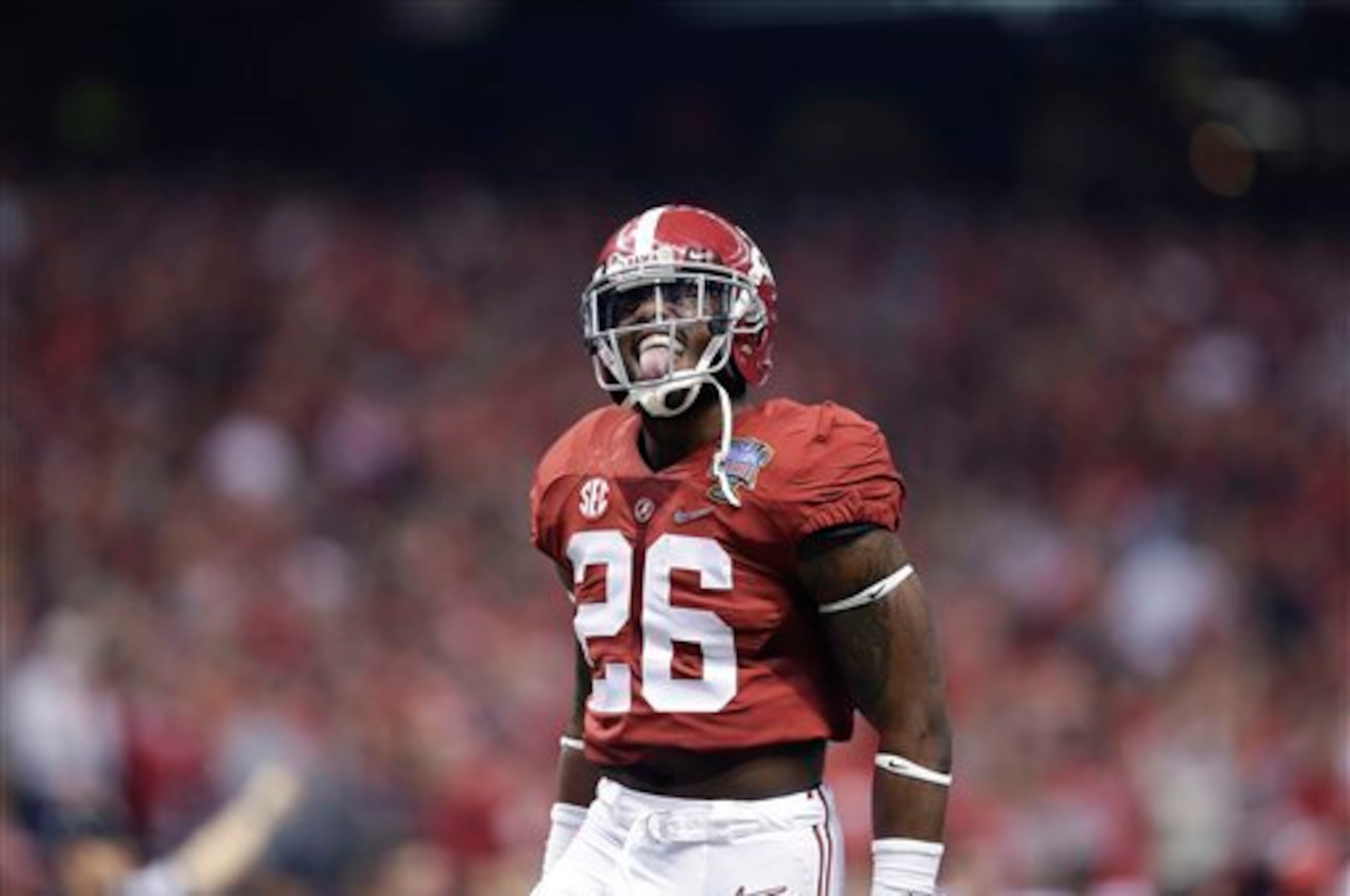
Ball Skills
Landon Collins has good but not great ball skills. He makes quick breaks in short zone coverage but doesn’t play deep throws as well, something Auburn was able to exploit in the Iron Bowl. Most of his breakups and interceptions have come against teams with questionable passing games.
Tackling
Collins is a hunter in the open field whose closing speed and tackling help limit yards after the catch. He seeks and destroys near the line of scrimmage, too, and has even earned some brownie points by covering kicks.
Run Support
Last year, Collins eased into his role against the run, slowly figuring out the proper angles and fits. This year, he has made impressive strides but is still a notch below the best run defenders at the position. The physical tools are there, he just needs a slightly better feel for play diagnosis.
Pass Coverage
Collins is a Gold Glove center fielder in the deep third, patrolling the back line of Alabama’s defense with closing speed and range. He has struggled at times with field awareness (especially during Alabama’s loss at Ole Miss) and is a bit unrefined in man coverage, but overall he’s a plus pass defender.
Overall
Another year, another dominant Alabama safety. Collins paired with Ha Ha Clinton-Dix to give the Tide an imposing back line in 2013 and improved with added leadership responsibilities as a junior. It’s amazing how Nick Saban and Kirby Smart keep consistently churning these guys out.
40. Andrus Peat, OT, Stanford
71 of 110
Hands
Andrus Peat does not have the strongest hands, at times letting rushers shed his grapple and continue their progression toward the quarterback. But he doesn’t have weak hands either, and he combats his lack of raw grip-strength with smart hand placement.
Power
Because of his “thinner” frame (6’7”, 316 lbs), Peat does not generate the same power as some of the other tackles on this list. He overextends his upper body and does not utilize leverage well enough to compensate for his relative lankiness.
Lateral Quickness
Considering his long, 316-pound frame, it is almost unfair for Peat to have the quickness and coordination he possesses. He moves side to side with natural balance that allows him to mirror and stay in front of oncoming rushers.
Pass Protection
Peat uses the quickness mentioned above to protect the blind side of his quarterback, gaining great depth with his drop and forcing defensive ends to take wide angles. He has a dirty little habit of lunging, though, and needs to learn to play with more patience.
Run Blocking
Despite lacking the power that is typical of dominant run-blockers, Peat grades out fantastically well in the ground game. He doesn’t always drive opponents backward, but he occupies them long enough to open holes off the line of scrimmage. More than that, though, he has the quickness, speed and preternatural blocking instincts to get downfield and excel as a lead blocker.
Overall
Peat was the lone holdover from a Stanford offensive line that dominated in 2013. The group as a whole did not live up to expectations in 2014, and even Peat struggled, on certain occasions, to match his previous production. But for the most part, he continued to play at a level that few in college football can match.
39. Randy Gregory, DE, Nebraska
72 of 110
Pass Rush
Randy Gregory is a tall, lanky pass-rusher (6’6”, 240 lbs) with some of the longest arms in the country. He doesn’t have great quickness off the edge but is so good with his arms that he doesn’t need it. His power is unique for a player so long, and he understands how to disengage from a tackle with hand placement. He sets up his opponent, then rips inside or outside and gets to the quarterback.
Run Defense
Gregory is solid but flawed as a run defender. He has the power to shed blocks and the speed to track most running backs around the edge, but he struggles with play diagnosis. Opponents take advantage of his mental flaws by beating Nebraska on misdirection plays, neutralizing his physical advantage by forcing him to think. He must learn to watch the play instead of the ball if he ever wants to be a true three-down lineman.
Motor
That Gregory does not win with burst is sometimes a product of effort. He plays hard most downs but has a tendency to take plays off. Some of this might be attributed to injuries, which nagged him his entire junior season, but it still raises minor concerns. He is too good to finish the regular season with seven sacks in 10 games (even if he also recorded 10 QB hurries).
Overall
Gregory has been a productive college player but is probably best suited for the NFL, where he won’t command as many double-teams and has a chance to become a superstar. His power, arms and pass-rushing technique are rare to see from a player so inexperienced. If he works on his motor and his game awareness—two things that fall distinctly under the purview of “coachable traits”—there will not be a good way to stop him.
38. Denzel Perryman, ILB, Miami (Fla.)
73 of 110
Tackling
Denzel Perryman makes tackles that almost no other college linebacker can make. His unique blend of speed and power enables him to track down and terminate players at all levels of the field. The only thing he needs to work on is wrapping up. For all of his highlight-worthy tackles, he lets a few too many easy ones slip away.
Pass Rush
Miami does not ask Perryman to get after the passer, knowing that his size limitations (6’0”, 242 lbs) make him better suited to coverage on passing downs. He had two sacks and zero quarterback hurries during the 2014 regular season.
Run Defense
Perryman is a downhill wrecker who actively seeks contact. He throws his body around to plug up holes and finish plays. He is strong enough to shed blocks from meaty offensive linemen but quick enough to sift through traffic and find creative routes to the ball.
Pass Coverage
Few inside linebackers defend the pass as well as Perryman. He is quick to pick up on routes and has the fluid hips and speed to cover running backs, slot receivers and tight ends in man coverage. He also takes affront to any opponent who thinks, however tacitly, that being covered by a linebacker gives him a matchup advantage. That is an attitude coaches and fans love to see in their defensive stars.
Overall
Perryman is a big hit waiting to happen. He doesn’t have the size of certain former Hurricanes linebackers (some of which also wore No. 52), but his energy, his speed and his capacity to end up on SportsCenter will leave a lasting mark in Coral Gables.
37. Ty Montgomery, WR, Stanford
74 of 110
Hands
Ty Montgomery catches the ball away from his body and rarely drops a pass, although he did struggle with drops in a rain-soaked game at Notre Dame. He is 6'2" and has the colossal hands of an even bigger player.
Route Running
Stanford has relied on Montgomery to run a multitude of routes the past few seasons, some of which have exposed his weaknesses. He is a technician in the short area but does not always keep his pace on breaking routes.
Blocking
Montgomery is a willing blocker who does not take plays off and works hard to seal the edge. He does not have the strength or leverage to combat bigger defenders, but for the most part he gets the job done.
Release
Any cornerback who struggles with his first step will have difficulty guarding Montgomery. He has great acceleration and instincts, which allow him to get defenders off balance. He does not, however, have advanced hand-to-hand release moves, which will sometimes result in getting stuck against a jam.
Speed
Montgomery is one of the most fluid runners in college football. His long speed allows him to get over the top of secondaries and track down lofted deep balls. He has also been utilized as a running back and punt returner because of his ability to turn the corner.
Run After Catch
Stanford gets the ball to Montgomery as often as it can, in a variety of ways, because it knows how dangerous he is after the catch. He is shifty in the open field, makes decisive cuts and has a realistic chance to score on any play.
Overall
Montgomery has been Mr. Everything for Stanford's passing game. He is a shifty runner and punt returner who has blossomed into a No. 1 receiver despite maddening play from his quarterback.
36. Quandre Diggs, CB, Texas
75 of 110
Speed
Quandre Diggs is a terrific athlete but does not have great pure speed. When Texas plays a team with a track star at receiver (e.g., Mario Alford of West Virginia), Diggs will play the opposite man so Duke Thomas can cover the burner. Still, as long as a team does not have two track stars at receiver, Diggs does not have trouble staying with his assigned man.
Ball Skills
Diggs likes to play aggressive and does a good job breaking up passes. His instincts allow him to jump routes and defend a high number of balls. Unfortunately, he also has frying-pan hands that have cost the Longhorns some easy interceptions over the years.
Run Defense
It’s hard to find a college cornerback who defends the run better than Diggs. Whether he’s on the outside or in the slot, his understanding of the finer points of run support—slipping blockers, funneling the ball inside, etc.—make an already stout Texas defense even harder to penetrate.
Coverage
Diggs is not that big, long cornerback du jour who can blanket receivers in press-man coverage, but he finds other ways to contribute. Specifically, he reads the quarterback in zone coverage and has the instincts, closing speed and power to break on open receivers at the last second and separate the ball from the man. His NFL future lies in the slot, but in college he is well-equipped to play wherever his coaches need him.
Overall
Diggs capped a successful four years in Austin with the best season of his career in 2014. The younger brother of former Longhorn Quentin Jammer does not have ideal size (5’10”) or speed but contributes to the defense in myriad ways.
35. Emmanuel Ogbah, DE, Oklahoma State
76 of 110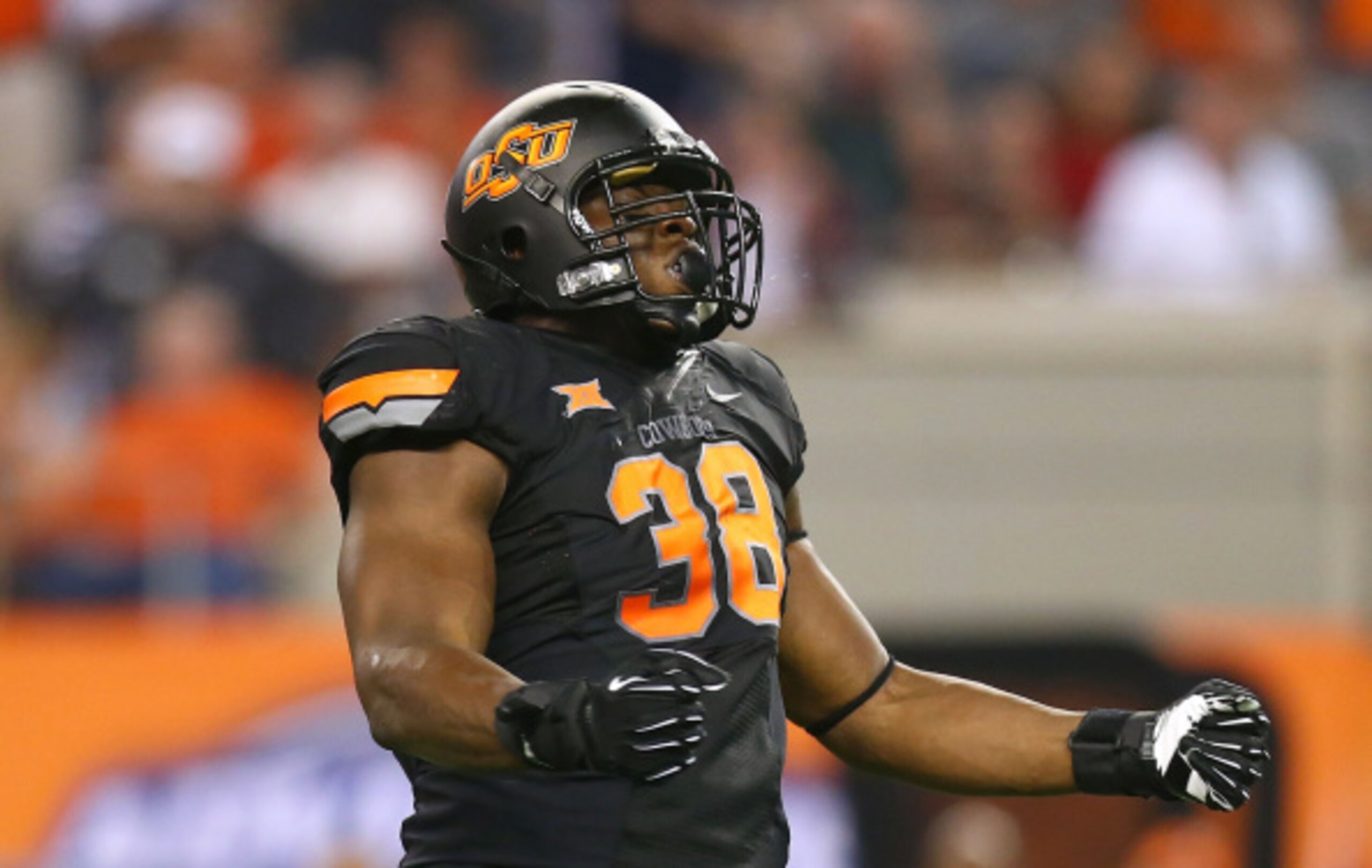
Pass Rush
Emmanuel Ogbah wins with quickness and power. He is a difficult mismatch for most offensive linemen because he knows how to use both skills. At 6’4”, 270 pounds, he has the size and strength to bull rush a tackle or even get pressure from inside. But he also has the long arms and explosiveness to disengage and get around the edge. He finished second in the Big 12 with 11 sacks and first with 78 sack yards this regular season.
Run Defense
Ogbah is not the greatest run defender, but he’s useful for his versatility. He is strong enough to hold the point of attack or set the edge but also has the speed to make plays on his own. He is still raw and learning how to use leverage, which can sometimes get him into trouble. But for the most part, he does his job.
Motor
When he’s feeling it, Ogbah is a machine who can’t be stopped. He channeled his inner Hulk against Florida State in Week 1 and later in the season against Kansas. He feeds off making early plays, growing stronger with each sack, hurry, hit or tackle for loss. If he could bring that same intensity each week, he would rank even higher.
Overall
Ogbah was a valuable rotational lineman in 2013 and stepped into a leadership role this season. The defense on the whole regressed, but that was to be expected given how many players Oklahoma State lost (pretty much everyone). He was a deserving recipient of the Big 12 Defensive Lineman of the Year award, which is scary because he hasn’t reached his ceiling. A little more fine-tuning could turn him into an All-American.
34. Jack Conklin, OT, Michigan State
77 of 110
Hands
Jack Conklin has heavy hands that drive defenders backward. Because of this, he packs a powerful punch in pass protection. In the run game, his hand placement needs a little bit of refinement, as he doesn’t always gain inside position. But once he does, his hands are strong enough to maintain control of his man.
Power
Conklin dropped 30 pounds of fat from his body this offseason but did not sacrifice much (if any) of his power. At 6’6”, 303 pounds, he has long arms and a precocious understanding of leverage that allows him to hold up against defensive ends of any size. He distinctly got the better of Joey Bosa when Ohio State played Michigan State this season.
Lateral Quickness
The weight Conklin dropped this offseason did wonders for his lateral agility. He has a quick reach step that allows him to attack the end man on the line of scrimmage on outside running plays, and he has no trouble moving side-to-side against speed rushers.
Pass Protection
According to most sources, Conklin has never given up a sack. Ever. In 25 career starts, the only debatable play was one in which Connor Cook ran into the defender against Maryland. Either way—zero sacks allowed or one sack allowed—the way Conklin uses his hands, feet and arms to size up and fend off defenders has made him the premier pass-blocker in college football.
Run Blocking
Conklin improved as a run-blocker in 2014 and is a versatile part of Michigan State’s ground game. He is at his best pulling across the line and executing kick-out blocks, using his mobility to excel where many great pass-blockers struggle.
Overall
A former walk-on whose father played ball at Michigan, Conklin has spent the past two years making bigger-name schools look foolish. He was a Freshman All-American in 2013 and only got better as a redshirt sophomore this past season, anchoring the blind side for a resurgent Michigan State offense.
33. Su'a Cravens, S, USC
78 of 110
Ball Skills
Su’a Cravens’ ball skills were a minor point of dispute after 2013, when he intercepted four passes but only recorded one pass breakup. This year, though, he proved he could play like a ball hawk, breaking up eight passes and returning an interception for a touchdown against Oregon State.
Tackling
Cravens makes plays that few other safeties can make. He has the closing speed of a tall cornerback but the size (6’1”, 225 lbs) of a small linebacker, allowing him to both catch and tackle offensive players who reach the second level.
Run Support
No part of Cravens’ game has improved more than his run defense. His timing, awareness and willingness to get physical all took major leaps forward in 2014. USC even experimented with Cravens at linebacker—a brief stint that helped him finish toward the top of the country with 11 non-sack tackles for loss.
Pass Coverage
Cravens has been a quick study in pass coverage. He plays on instinct (as opposed to following his assignment) more than some coaches might be comfortable with, but his instincts are so good that he can get away with it. With fluid hips and ideal closing speed, he is able to make up ground on the rare occasion that his instincts lead him wrong.
Overall
Cravens made big strides as a sophomore in 2014, which is scary considering how well he played as a freshman the previous year. He checks every box for a modern safety and proved he could adapt to multiple systems after USC replaced defensive coordinator Clancy Pendergast with Justin Wilcox.
32. Jordan Hicks, OLB, Texas
79 of 110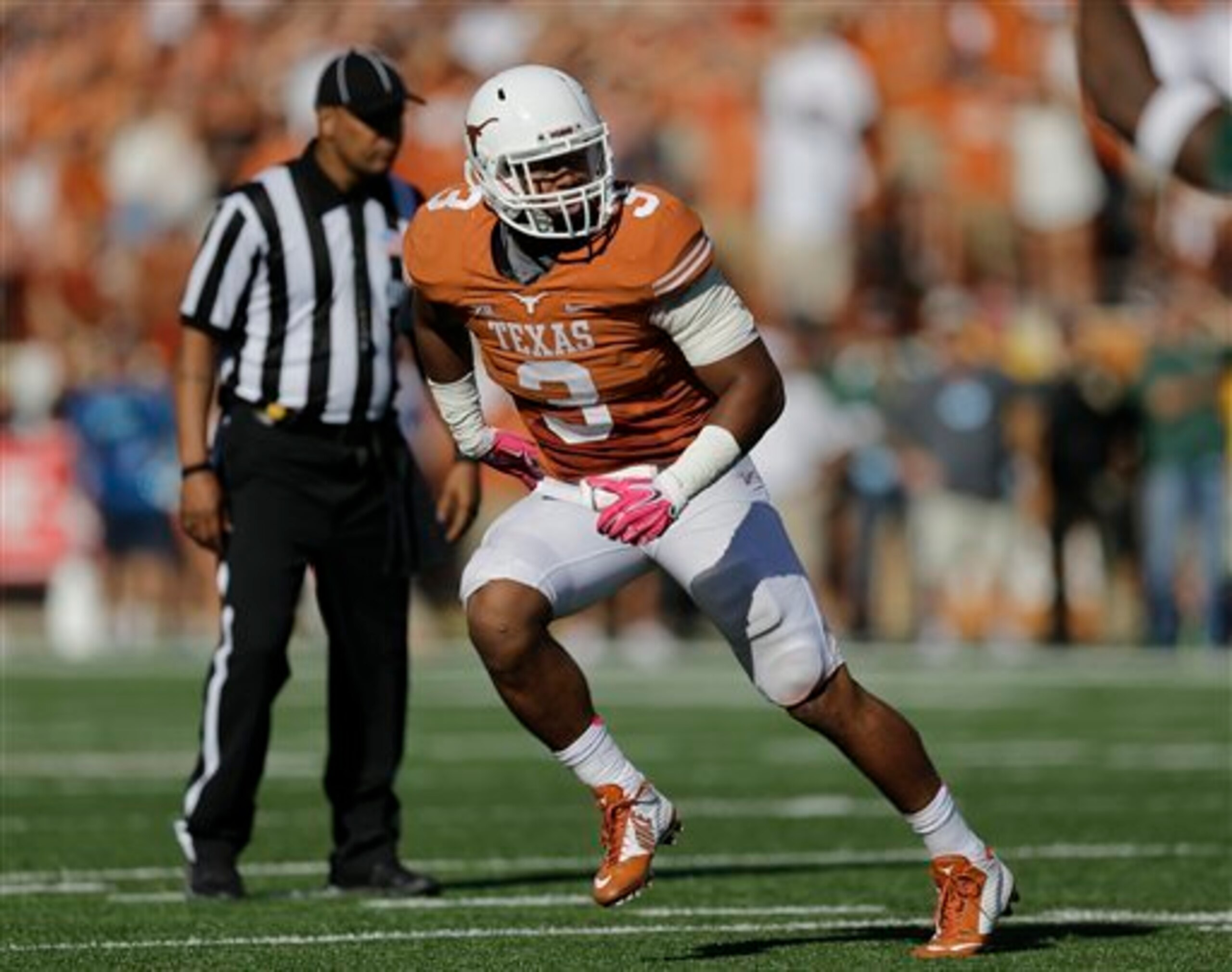
Tackling
Jordan Hicks is a thumper with the size, strength and toughness to blow things up in the A-gap. He moves well for a player coming back from an achilles injury, and the speed with which he recovered makes him a dangerous pursuit tackler in space.
Pass Rush
Hicks has the long build and relentless motor to be a better pass-rusher than he is. There are moments (such as the TCU game this Thanksgiving) when he puts his tools together and makes his presence felt in the backfield. But those moments are far too infrequent.
Run Defense
Run support used to be Hicks’ weakness. This year, it evolved into a strength. His aggressive tendencies were coached up by Charlie Strong and Vance Bedford, who taught him proper run fits, and he got better at shedding blocks.
Pass Coverage
Hicks does not excel in coverage but is good enough to stay on the field on passing downs. He gets depth off the line of scrimmage and sees the field well enough to hold his zone while also spying the quarterback.
Overall
Hicks returned from a hip injury in 2012 and an Achilles injury in 2013 to finally stay healthy and put together a memorable season. Even if we weren’t rooting for him, though, it would have been hard to miss how well he played in Strong’s aggressive defense.
31. Kevin White, WR, West Virginia
80 of 110
Hands
Kevin White has strong, reliable hands that function like pincers. He clamps down on the ball and never lets go. Because his hands are so big and strong, he is able to make otherwise difficult catches look routine.
Route Running
White has improved his route running in 2014, although he is still one tier behind the most polished players on this list. He fights his way open on slants and runs a dangerous curl, the latter finding success because defenders overplay him going vertical.
Blocking
When he's not getting flagged for holding, White is up there with the best perimeter blockers in the country. His big frame (6'3", 210 pounds) allows him to body up cornerbacks and seal them away from the action.
Release
White is physical off the line of scrimmage, which allows him to beat press coverage. He has an NFL-ready chop move that wins space on both outside and inside releases.
Speed
White has great speed for a player with his proportions. He has long legs and a powerful lower body that allow him to get over the top. He might not post the fastest 40 time, but he has functional speed that translates to the field.
Run After Catch
This is not the strongest part of White's game, but he has shown flashes. He doesn't break long runs with regularity, but when he does, he breaks them in a way that is unique. He has quick feet and picks up extra yards by running through smaller defenders.
Overall
White went from unknown to superstar in 2014, breaking out as the next great receiver in Dana Holgorsen's offense. He is big, athletic and physical and had his best games against the best teams on his schedule.
30. Jalen Ramsey, S, Florida State
81 of 110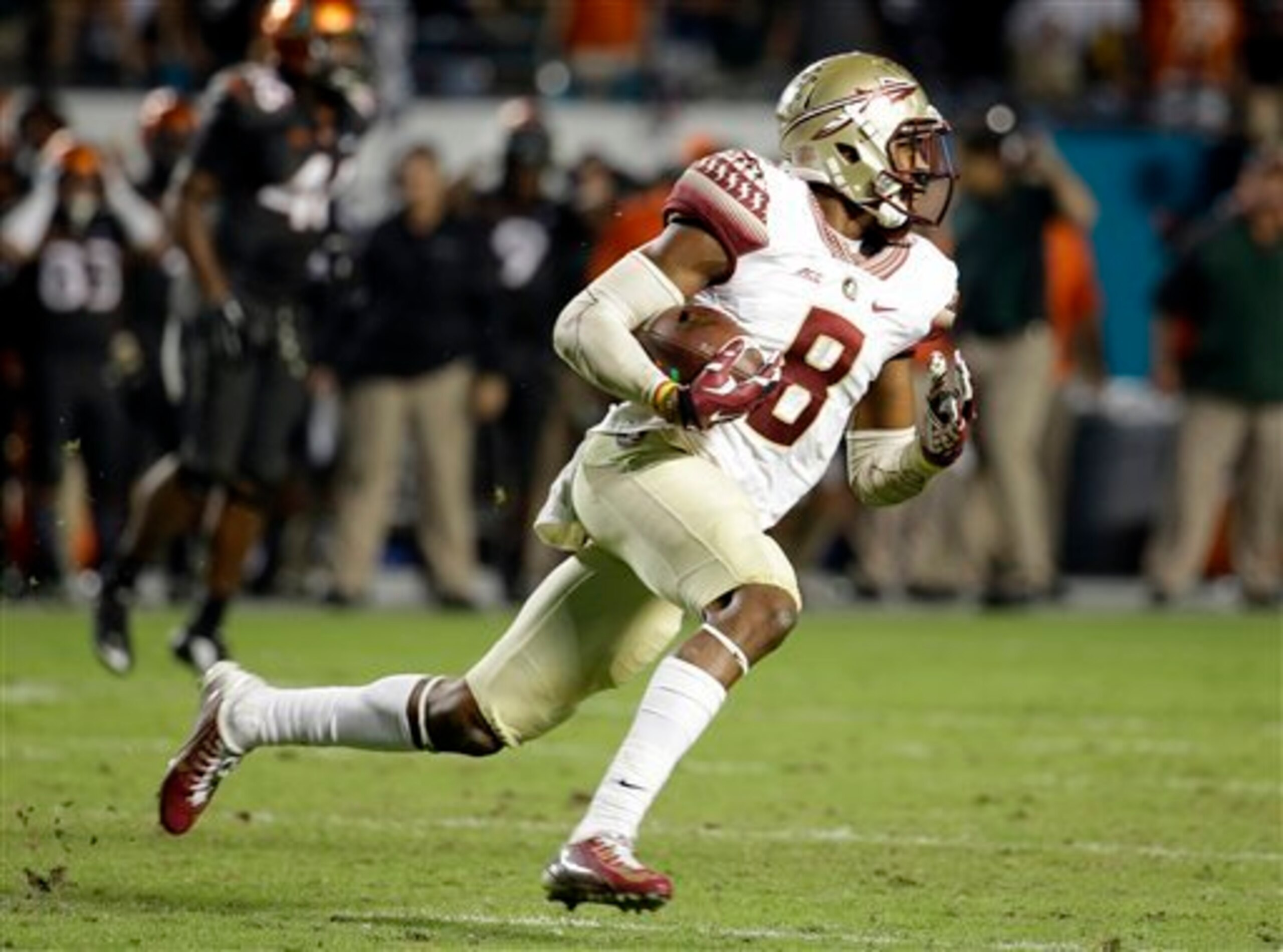
Ball Skills
Jalen Ramsey is the consummate pest. He invites himself into the action and is always around the ball. He is light on his feet and trusts his instincts, which enables him to break on a quarterback’s first read and make a play.
Tackling
Ramsey was ahead of the curve as a tackler last season, and even though he didn’t improve as a sophomore, the fact that he didn’t regress means he still gets high marks. He is smaller than most safeties (6’1”, 204 lbs) but uses his compact frame to his advantage, staying low and winning with leverage.
Run Support
Here is where Ramsey still needs work. He is slow to diagnose running plays and does not have the size or strength to compensate by shedding blocks. When he does diagnose the play, however, he will finish with a strong tackle or funnel the runner back to his teammates.
Pass Coverage
Ramsey began his career at cornerback; in 2013, he became the first Florida State true freshman since Deion Sanders to start his first career game at the position. He has since moved to nickelback (by way of free safety) and continued to blanket receivers with his smooth hips, speed and anticipation.
Overall
Ramsey played an integral role on last year’s defense and was a leader on this year’s solid (albeit underachieving) group. When the ‘Noles most needed a play, he was always the one who made it. Tape from the Notre Dame and Miami games will go on his NFL draft reel if/when he declares in 2015.
29. Malcom Brown, DT, Texas
82 of 110
Pass Rush
Malcom Brown is a big-bodied tackle with impressive size (6’2”, 320 lbs) and surprising burst. He made great strides this season in terms of upper-body strength and quickness, allowing Texas to play him everywhere from 1-technique to 5-technique. As a result, he led the Longhorns with 6.5 sacks during the regular season and also recorded five quarterback hurries.
Run Defense
Run defense is Brown’s specialty. He has no trouble occupying blockers, holding them at the point of attack until his linebackers can flood and make a play. He is a plug in the middle of running lanes with the raw strength to slap and shuck his way out of blocks and make tackles when the ball comes his direction.
Motor
Brown is the rare 300-pounder who will chase a play from sideline to sideline. Part of that has to do with his underrated mobility, but most of it has to do with heart. He benefited greatly from playing under Charlie Strong and Vance Bedford—two of the best defensive motivators in the country—this season.
Overall
Brown parlayed a very good sophomore season into a magnificent junior campaign, making the leap from an All-Conference-type player to that of an All-American. He was the anchor of a Texas defense that lifted its team to a bowl game after a slow start. If he forgoes the 2015 NFL draft, he will be a preseason favorite for the major national defensive awards.
28. Chris Hackett, S, TCU
83 of 110
Ball Skills
Chris Hackett is the sweeper of TCU's secondary. He makes momentum-shifting plays in big moments against quality opponents. All six of his interceptions this regular season came against power-conference teams, including a nifty red-zone pick in the fourth quarter against Oklahoma.
Tackling
He’s not the thickest safety in college football (6’2”, 195 lbs), but Hackett is an active tackler who cleans up messes at all levels of the field. He presses the ball-carrier and does not get caught lunging. He finished second on the team with 88 tackles in 2013 and made a similar impact this season.
Run Support
Hackett does a lot of the little things for TCU’s run defense. He sets the edge when he has to and does not let shifty running backs bounce around him on the outside. He is a swarming, active safety who enjoys mixing things up near the line of scrimmage as much as policing the back end.
Pass Coverage
Defensive coordinator Dick Bumpas and head coach Gary Patterson rely on their safeties to make coverage calls—a job that requires great field awareness. Hackett is a paragon of this concept and is rarely found out of position. He has good range on the back end but is quick enough to line up in the slot or play the intermediate zones too.
Overall
Hackett kept TCU’s pass defense near the top of the national rankings (No. 9 in opposing QB rating) despite the loss of cornerback Jason Verrett and safety Elisha Olabode. His playmaking on the back end of Bumpas’ 4-2-5 scheme has played an important role in the Horned Frogs’ success.
27. Brett Hundley, QB, UCLA
84 of 110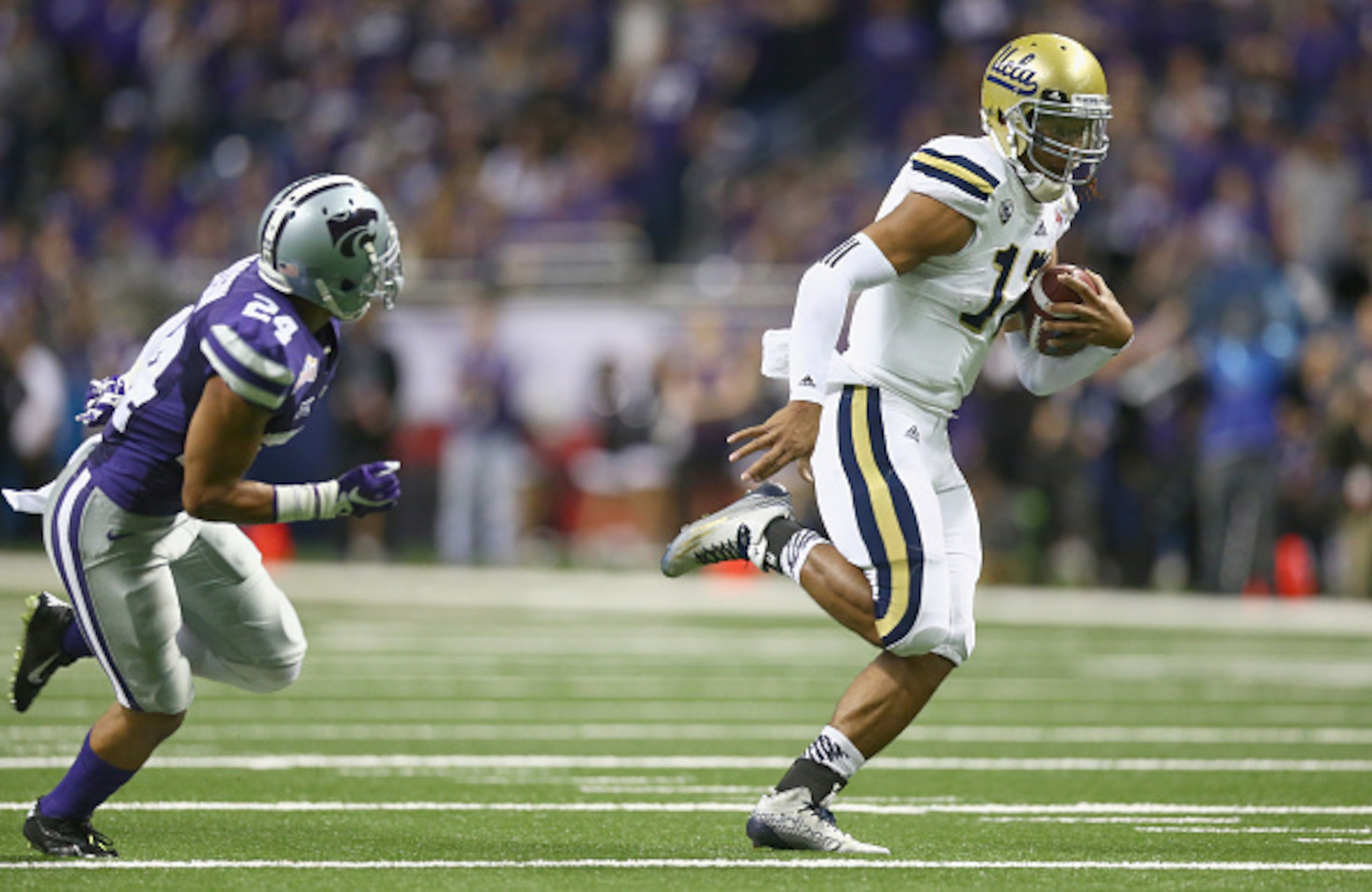
Accuracy
Brett Hundley throws a catchable ball with a tight spiral and smart placement. Deep accuracy used to be a problem area, but he has since turned it into a strength. He completed more than 70 percent of his passes in the regular season, averaging more than eight yards per attempt.
Arm Strength
Hundley has the strongest arm of any dual-threat quarterback and is right on par with Jameis Winston and Christian Hackenberg. He drives the ball into tight windows on slants and can push it down the length of the field.
Pocket Presence
The biggest knock on Hundley is how he fares against pressure. Some of that is warranted—he has a tendency to hold on to the ball too long and take unnecessary sacks—but he has not been as bad as some have made him out. Despite a leaky offensive line, UCLA is one of the most efficient offenses in college football.
Mobility
Hundley is a dangerous runner who can handle a 15- to 20-carry workload without looking any worse for it. He spent the early part of the season trying to "prove" he could be a pocket passer for NFL scouts, but he got back to his strengths during Pac-12 play.
Football IQ
Jim L. Mora is a former NFL head coach with a sophisticated college offense. Hundley picked it up well enough to start as a redshirt freshman (and rewrite much of the FBS freshman record book) and has steadily improved the past two years.
Leadership
UCLA was not the playoff contender some expected this season, but there is no shame in going 9-3. When an injury forced him to leave the Texas game, Hundley was active and engaged on the sideline, leading the team despite not being able to play. He came back for the Bruins' next game and had his best performance of the season in a 62-27 win at Arizona State.
Overall
Hundley is a divisive quarterback. He has led UCLA to one of the best three-year runs in program history, but it still feels like he's underachieved. It only feels that way, however, because the number of tools he brings to the table are so rare to find in one player. We want him to be better than he is because he can be. And that is not true of very many players.
26. Mike Hull, ILB, Penn State
85 of 110
Tackling
Mike Hull finished the regular season with 134 total tackles, leading the Big Ten by more than 20. He is decisive and has the speed to track ball-carriers around the edge or into the open field.
Pass Rush
Hull has a small frame (6’0”, 232 lbs) and didn’t make an impact as a pass-rusher even before he kicked inside from his previous role as an outside linebacker. He does, however, keep opponents honest with his pre-snap activity, freeing up those who do plan to rush by flashing before the play.
Run Defense
He doesn’t have the size or strength to be a true downhill run defender, but Hull does all the little things at a very high level. His transition to inside linebacker was made seamless by his instincts, which allow him to diagnose plays and read and fill cutback lanes. The burst with which he attacks the line of scrimmage is unique.
Pass Coverage
Hull is a solid pass defender. He is fluid enough to cover running backs on angles and circles, and he is savvy enough to check for run and then sink into zone. Once there, he has solid pass-recognition skills and is competent enough to make plays on the ball.
Overall
Penn State’s offense was a train wreck in 2014, and that’s putting it kindly. There is no way the Nittany Lions would have qualified for a bowl without a dominant defense, and there is no way they would have fielded such a dominant defense without Hull, the latest interior standout at Linebacker U.
25. Ronnie Stanley, OT, Notre Dame
86 of 110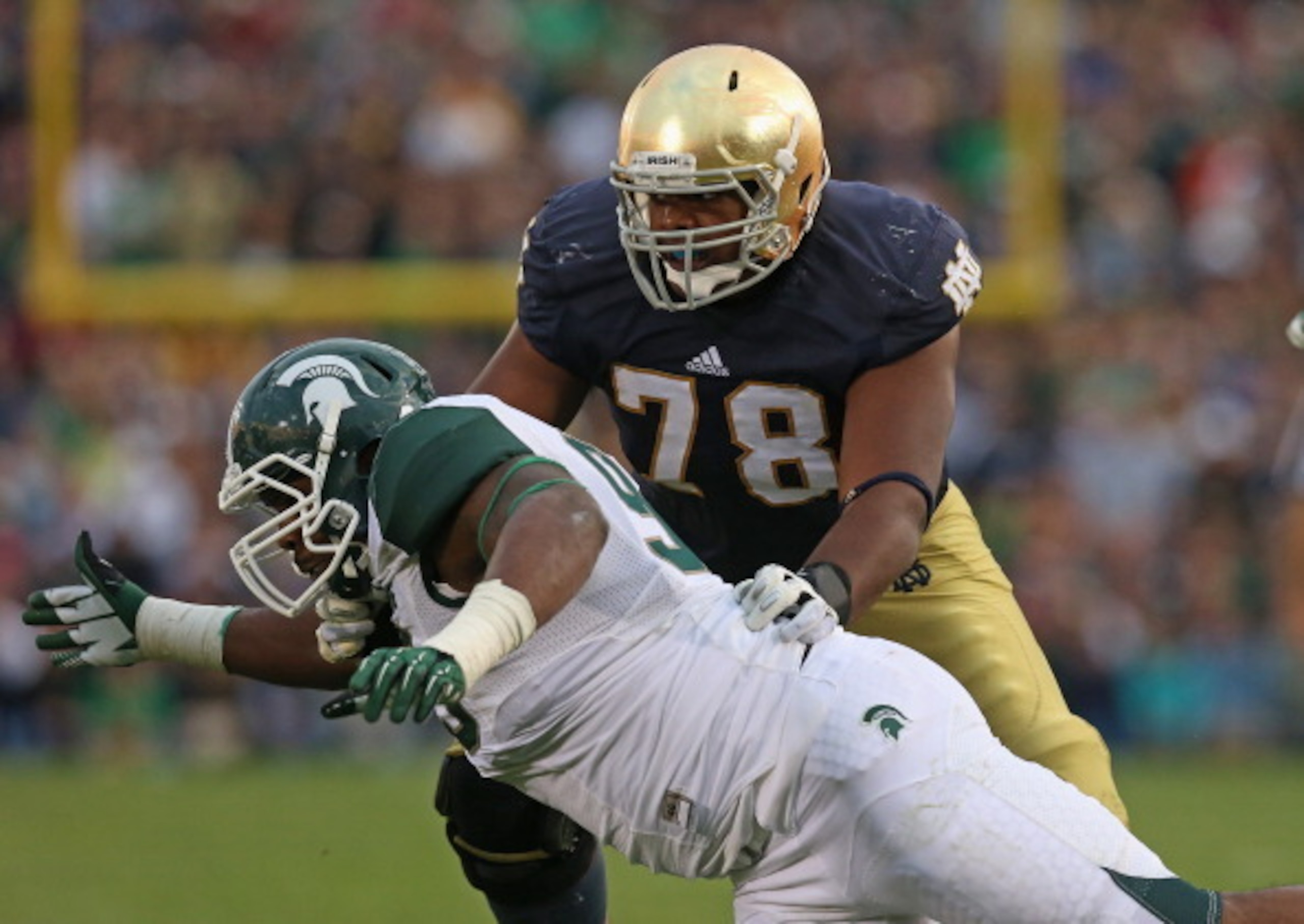
Hands
Early in the season, Ronnie Stanley struggled to affect defenders at the point of contact. But with time he grew into his new position (left tackle) and developed an assertive punch. Overall, he has strong, heavy hands that allow him to control defenders through the duration of the play.
Power
Stanley lacks the power of his former teammate, Zack Martin, but is powerful enough to get by. He is more determined than strong as a run-blocker, displaying the grit and toughness needed to turn average raw power into better-than-average results.
Lateral Quickness
Stanley is a former basketball player with impressive balance, agility and lateral quickness for an athlete his size (6’5.5”, 315 lbs). He plays on the balls of his feet and demonstrates the proper knee bend to anticipate and react to different types of pass-rushers.
Pass Protection
With long arms and fluid athleticism, Stanley has become one of the best pass-blockers in college football. He did not allow a single pressure in the three games graded by Pro Football Focus, shutting down future NFL defensive linemen against Stanford, Florida State and Arizona State. He has a useful blend of foot speed, hand placement, work ethic and competitiveness that should only improve as he earns more reps at left tackle.
Run Blocking
Stanley comes off the ball smoothly and has the aforementioned nastiness that is refreshing to see in a run-blocker. He also has the mobility to get downfield. If he works on adding strength to his lower body, he could soon become a wrecking ball in the ground game.
Overall
Notre Dame would have been OK with a small drop-off after losing Martin, a first-round NFL draft pick, at left tackle. Instead, Stanley flipped from right tackle to the blind side and gave the Irish way more than a small drop-off. He gave them a moderate improvement.
24. Nelson Agholor, WR, USC
87 of 110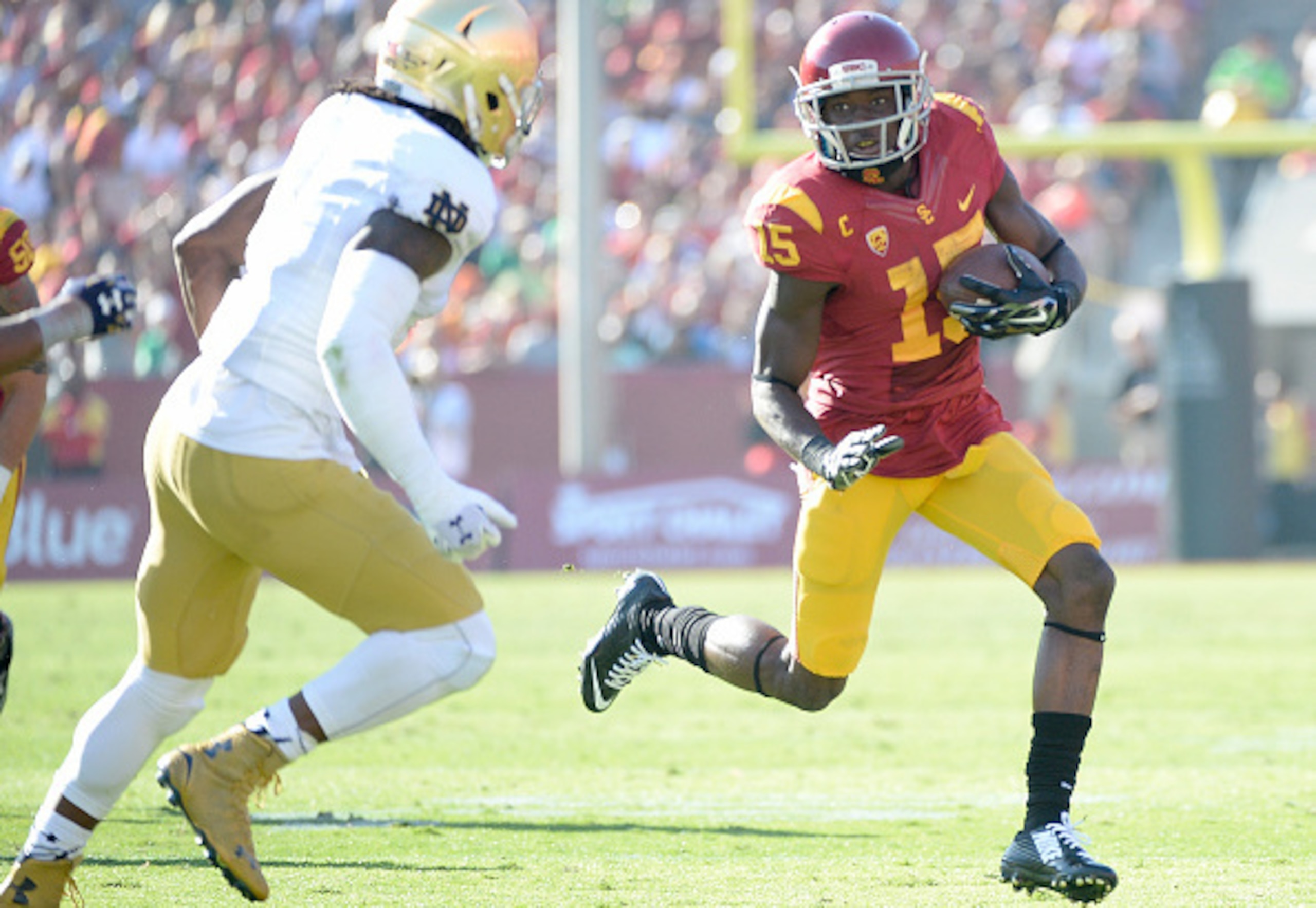
Hands
Nelson Agholor catches most passes cleanly, away from the body, then secures the ball and heads upfield. He is a lanky athlete with good arm extension who is not afraid to make plays over the middle.
Route Running
You won't find many smoother route-runners than Agholor. He is a fluid athlete who gets in and out of breaks and has an advanced route tree, thanks in large part to the pro-style systems he has played in at USC.
Blocking
Agholor does not have the upper-body strength to seal bigger defensive backs on running plays. But he makes up for this with great effort as a downfield blocker, where he can be seen running in front of ball-carriers, searching for a defender to engage.
Release
Agholor uses arm extension to fight his way off the line and foot speed to gain space against press coverage. When he earns an inside release, he takes smart angles through coverage to make himself an open target.
Speed
Speed is the most important part of Agholor's game. He has long speed to stretch the field as a vertical threat, but he also has stop-and-start speed to deceive would-be tacklers and defensive backs.
Run After Catch
Agholor is at his best after the catch—a product of the speed discussed above. He can hit the hole and go on shorter timing routes, reading blockers like a veteran running back, and has the gumption to reverse fields when the defense overpursues.
Overall
Agholor is the latest in a long line of great USC receivers. He learned from—and in many ways played better than—former Biletnikoff winner Marqise Lee in 2013 before letting his own star shine this season. But once he did, that star shone big and bright.
23. Kendall Fuller, CB, Virginia Tech
88 of 110
Speed
Kendall Fuller is not the fastest straight-line runner, but he’s not far off. Where he really excels is with closing speed, which helps both in coverage and run support. Coming out of high school, Bleacher Report compared Fuller to Asante Samuel, which seems like an apt description of his speed and raw athleticism.
Ball Skills
Fuller plays the ball well in man and zone coverage, using his length to get between the ball and the man. He led the country with 10 pass breakups in August and September (five games) and jumped a Mitch Trubisky slant for a pick-six against North Carolina in October.
Run Defense
Run support is an underrated aspect of Fuller’s game, and actually one of his strongest. He’s physical, he sheds blocks, and he’s willing to mix things up along the edge, all of which make him a valuable component of the Hokies rush defense. He is also a dangerous run-blitzer who disguises his intentions and does a good job timing his break.
Coverage
In man coverage, Fuller uses length and physicality to knock receivers off their line and harry them down the field. In this respect, he is a lot like former Hokies star Brandon Flowers. But Fuller has also shown great field awareness in zone coverage, picking when and where he’ll take chances based on whether he has help over the top.
Overall
Fuller is the final Fuller progeny to play at Virginia Tech, and there’s a good chance he’ll wind up the best. That is high praise after brother Kyle became a first-round NFL draft pick in 2014, but Kendall is further ahead as a sophomore than almost any cornerback in recent memory. Kyle included.
22. Duke Johnson, RB, Miami (Fla.)
89 of 110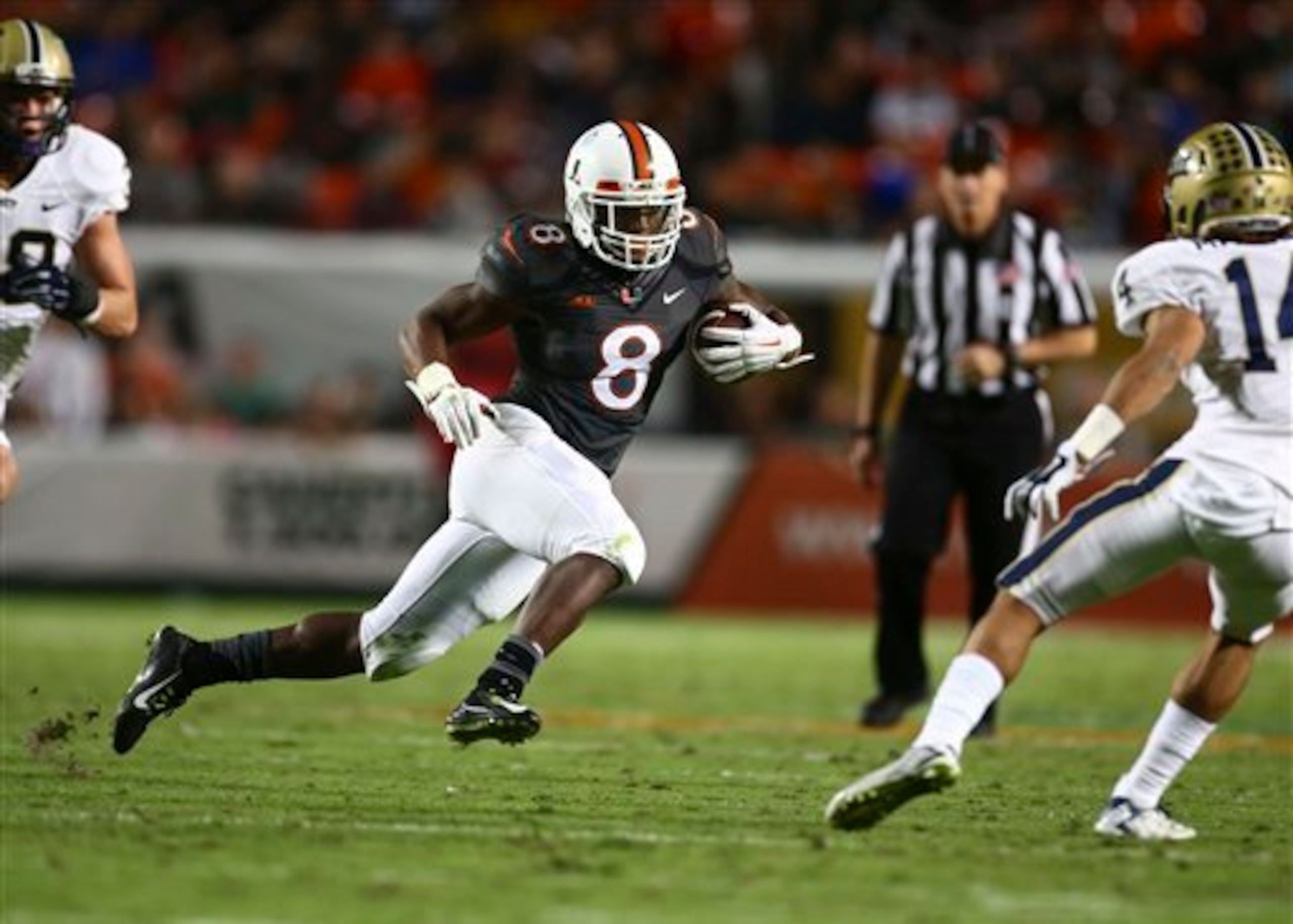
Ball Security
The biggest knock on Duke Johnson is the way he carries the football. He is surprisingly good between the tackles but does not maintain proper form in the open field. Specifically, he loosens his grip on the ball when he attempts to make people miss, focusing too hard on the defender and not enough on himself.
Power
Johnson is short (5’9”) but compact (206 lbs) and does an effective job running between the tackles. He runs with a low pad level to absorb contact and bounce off defenders and has a powerful stiff-arm. Despite this, he has a penchant for getting tripped up at his ankles, which is something he needs to work on.
Vision
Johnson is a patient runner with preternatural vision that allows him to gain maximum yardage. He strings out stretch plays until he sees a lane to shoot through, but he knows to take the sure yardage when the defense has defended him well. He turns around defenders in the secondary and does a smart job reading downfield blocks.
Hands
Miami throws to Johnson as an extension of the running game, utilizing his speed with quick flares and screens. He is also a capable route-runner who can deke linebackers with angles and wheels. Most underrated of all, he is a strong pass-blocker who punches defenders with his hands to keep the quarterback upright on passing downs.
Speed
Johnson’s second gear was a bone of contention before the season, but he proved critics wrong with long gain after long gain after long gain. He is lightning at the second level, separating from defensive backs with a short-legged, powerful stride.
Agility
This is the money-maker. Johnson has a quick, natural jump cut and is able to change direction without breaking stride or losing speed. He puts defenders on their heels and explodes past them as they attempt to regain their balance.
Overall
After a breakout freshman season and an injury-shortened sophomore season, Johnson fully realized his potential in 2014. His low-to-the-ground running style and ability to help in all phases of the game make him the best scatback in the country.
21. Hau'oli Kikaha, DE, Washington
90 of 110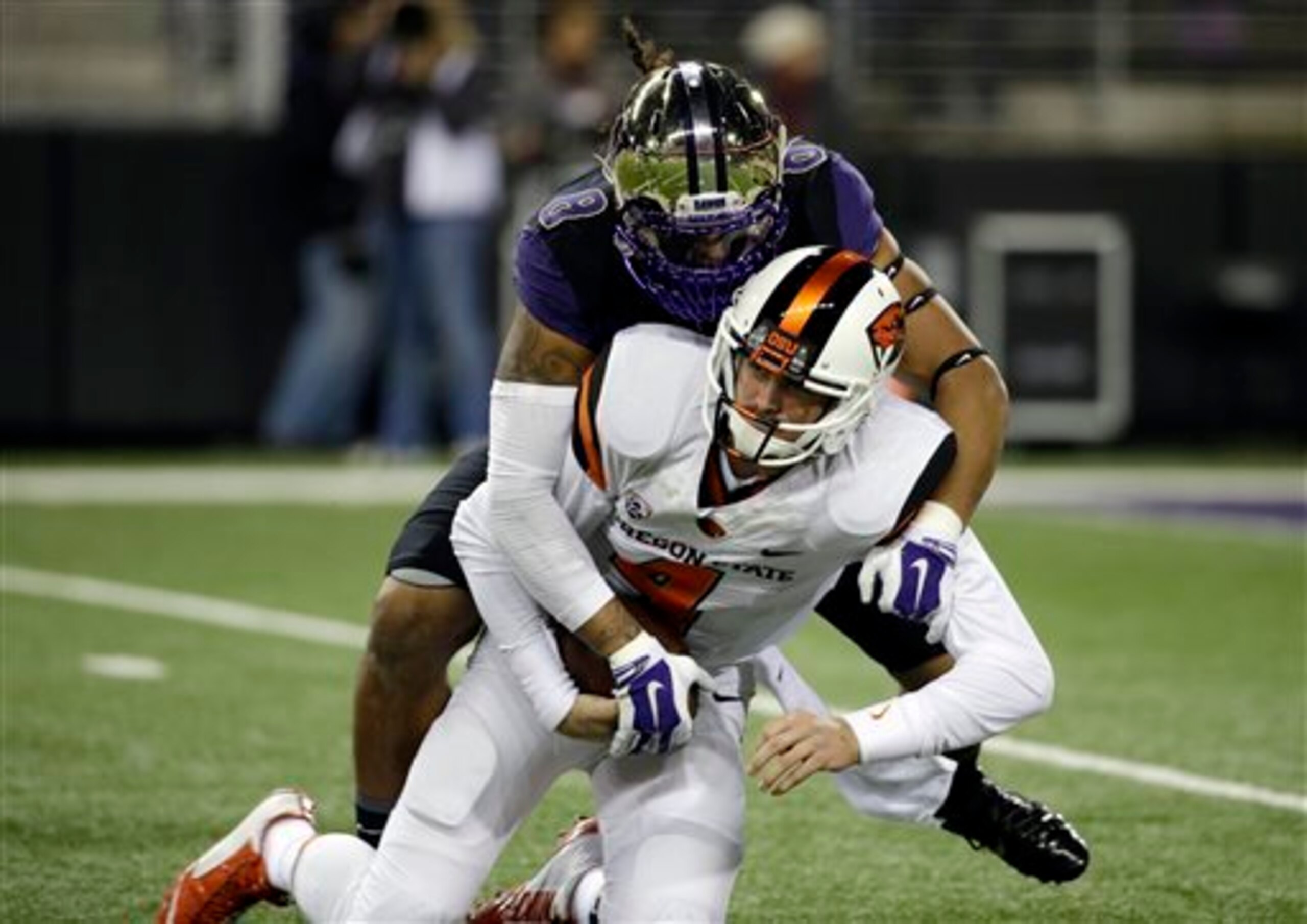
Pass Rush
Hau’oli Kikaha is the best pure pass-rusher in the country. He led the nation in sacks (19) during the regular season but looked even more impressive on tape than on paper. He comes flying off the ball and often turns the corner before the tackle even gets a hand on him. And even when the tackle can get a hand on him, he has functional power and knows how to rip or swim through the block and get to the quarterback.
Run Defense
Kikaha does not play the run as well as the pass. Washington lets him stand up and play linebacker—which is technically how he’s listed on the depth chart—but no matter where he lines up, he struggles to shed downhill blockers in space. He compensates by making so many plays in pursuit, but it is still something he must work on.
Motor
Kikaha is a violent competitor with a nonstop motor. He feeds off the energy of the home crowd but also gets fired up for electric road environments (e.g., recording 2.5 sacks at Oregon in 2014). The bigger the moment, the harder Kikaha plays.
Overall
For a while it looked like Kikaha might be star-crossed. He tore his ACL in 2011, rehabbed it all offseason, then tore it again in fall camp the following year. But he stayed on the field in 2013, then came back in the best shape of his life as a senior. He is an easy player to root for and a not-so-easy player to go up against.
20. La'el Collins, OT, LSU
91 of 110
Hands
La’el Collins has big, strong hands that allow him to latch onto defenders and never let them out of his grip—provided he engages them high enough. He does, however, sometimes let his hands drop too low, inviting rushers to swim over the top with a counter.
Power
At 6’5”, 321 pounds, Collins has a thick base and rare natural power that allows him to drive opponents off the line. It is rare to see him pushed back in pass protection or even trifled with against the run.
Lateral Quickness
Collins has more quickness than people give him credit for. He is not a rare athlete in a vacuum, but his feet are uncommon for a 321-pounder. He gets depth off the line with a quick-trigger kick-slide against speedier defensive ends.
Pass Protection
Collins is a solid pass-blocker whose best traits are sometimes his worst. Specifically, the aggressive tendencies that define him as a tackle sometimes get him off balance and leave him susceptible to countermoves. For the most part, though, those aggressive tendencies are a positive more than a negative, as is Collins’ pass blocking on the whole.
Run Blocking
Opposing defenses know that LSU wants to run the football but still can’t seem to stop the run. A big part of that is a testament to Collins, who dominates the line of scrimmage and makes SEC defensive linemen look like they belong in the MAC. As good as he is at the point of attack, what makes Collins so special is his ability, as a tackle, to get to the second level.
Overall
Collins was the No. 3 overall prospect in the 2011 recruiting class and developed into everything LSU hoped he would be. He played guard in 2012 before moving to left tackle as an upperclassman and becoming the best all-around blocker in the SEC.
19. Melvin Gordon, RB, Wisconsin
92 of 110
Ball Security
Once considered a strength of Melvin Gordon’s game, ball security has quickly become an issue. He went 322 carries without a fumble at the start of his career but coughed one up against Bowling Green in September and two in his record-setting game against Nebraska.
Power
Gordon does not receive enough notoriety for his power. He is 6’1”, 213 pounds, doesn’t appear to have a single ounce of fat on his body and never stops pumping his legs. He lowers his pads to pick up extra yards in the hole and shrugs off arm tackles in the open field.
Vision
Gordon is a decisive runner with great in-line vision. He spots small, negligible creases and gets there with a single cut. Once he gets to the second level, he either sees and exploits off-balance defenders or calculates the pursuit angle and beats them to the edge.
Hands
Wisconsin does not ask Gordon to do much in the passing game, leading to obvious questions about his hands. Whenever it has thrown him the football, though, he has not shown an obvious deficiency. But he’s so unproven that it’s hard to grade him any higher.
Speed
Gordon has better acceleration than long speed, but penalizing him for his long speed would be nitpicking. He is a long, forceful strider who can sprint through the linebackers and peel out from safeties for huge gains.
Agility
Gordon moves from side to side as easily as he stops and starts. It is one thing for a player to identify small creases in a defense; it’s another for him to cut and slide his way through said creases. Gordon is a master at contorting his body without losing balance.
Overall
Gordon did not inherit the role of a lead back until his junior season in 2014, even though it was clear what kind of talent he possessed. However, even with the bigger workload, he maintained one of the highest per-carry averages in FBS history, gashing defenses for chunk plays on a consistent basis.
18. Zach Vigil, ILB, Utah State
93 of 110
Tackling
Zach Vigil had 105 tackles as a sophomore in 2012 and slowly improved that total to 125 in 2013 and 145 this regular season. He is a tireless worker who never gives up on a play—cue the refrain about being a former walk-on—and has the strength to wrap players up and bury them in the dirt.
Pass Rush
Vigil does a great job getting after the quarterback, especially for a player with the size of a 4-3 inside linebacker (6’2”, 240 lbs). He has the strength to run through running backs and move tight ends and the quickness to slip by clunky offensive linemen.
Run Defense
Since Vigil became the starter in 2012, Utah State has finished No. 7, No. 2 and No. 16 in the country in yards-per-rush allowed. That is not a coincidence. Vigil is one of the rare inside linebackers who can get downhill and finish a play with power but also shed blocks or track runners on the perimeter.
Pass Coverage
Here is where Vigil needs to make the most improvement. He isn’t a bad pass defender necessarily. But his hips are a little stiff, and he sometimes looks lost in zone coverage, struggling to sink into his spot after checking the run.
Overall
Utah State had a good season despite losing its offensive leader (quarterback Chuckie Keeton) and its best defensive player (outside linebacker Kyler Fackrell) to torn ACLs. A lot of the credit for that goes to redshirt senior Vigil, who kept the defense toward the top of the national rankings with the best season of his already impressive career.
17. Jameis Winston, QB, Florida State
94 of 110
Accuracy
Jameis Winston has not been as accurate in 2014 as he was in 2013, but he’s made enough good throws to score well. He leads receivers down the field on vertical routes, dropping the ball where they and only they can catch it. He trusts his arm enough to attack small windows in big moments, which has helped Florida State engineer some memorable comebacks.
Arm Strength
Winston has a cannon, plain and simple. He is 6’4”, 230 pounds and gets every square inch of that frame behind his throws. Scouts will say his motion is elongated—that he has a “baseball release”—but he doesn’t have a problem getting velocity against pressure. He clocks a 97 mph fastball for the Seminoles baseball team.
Pocket Presence
Good luck trying to blitz FSU. Winston has the rare, innate ability to stand in the pocket until the last possible second and deliver an accurate throw. He is willing to take a hit when necessary, and he sets his shoulders well on designed rollouts.
Mobility
247Sports classified Winston as a dual-threat QB coming out of high school, but he hasn’t run with frequency at Florida State. His running style is awkward and clunky but serviceable, not unlike that of Ben Roethlisberger. He isn’t what one would call “fast,” but he’s an athlete capable of making defenders miss in space.
Football IQ
Winston has thrown (a lot) more interceptions as a sophomore than he did as a freshman. The difference has been a slight regression in his decision-making; too often he tries to make something happen instead of opting for a safer throw. Still, he sees the field as well as any college quarterback, especially in the deep third. He learns from mistakes and adjusts to what a defense gives him, which has led to some huge second halves.
Leadership
Florida State has won the first 26 starts of Winston’s career. Before him, the most consecutive wins by a QB at the start of his career was 19. His off-field antics landed him a suspension against Clemson, but even though he wasn’t allowed to play, he was vocal and supportive on the sideline. The father of Winston’s backup, Sean Maguire, credited Winston for the role he played in prepping his son to start, per Natalie Pierre of AL.com.
Overall
Winston is one of the most successful players in college football history. What else do you want us to say? His off-field issues are myriad, but between the stripes he is a proven winner with a firm place in the mythology of the sport.
16. Nate Orchard, DE, Utah
95 of 110
Pass Rush
Nate Orchard is a disruptive pass-rusher whom Utah counts on in multiple roles. But he’s at his best when he plays the Wide 9 and is allowed to focus on attacking the quarterback. He is a daunting blend of size (6’4”, 255 lbs) and quickness who understands how to convert speed to power. His 1.46 sacks per game led the nation during the regular season.
Run Defense
Orchard reinvented his body during his four years at Utah, filling out his frame to become a viable run defender. He added 60 pounds of muscle after beginning his career as a wide receiver and now has the mass to hold his own at the point of attack. He doesn’t diagnose running plays as well as one would like and only had 2.5 non-sack tackles for loss during the regular season, but he does enough things well to earn high marks.
Motor
Utah has a high-motor defense, and Orchard is its unquestioned leader. The rest of the unit looks up to him and draws its passion for the game from his. He was a team captain in 2014 and proudly wore the “C” below his left shoulder. It’s hard to find a player more deserving of that honor.
Overall
Orchard helped Utah make its first bowl game as a member of the Pac-12, and he did it in impressive fashion. He had four sacks in a road win at UCLA and 3.5 sacks in a road win at Stanford, toppling two of the league’s most established powers. He is a heat-seeking missile on passing downs who beats blockers in multiple ways and does not shy away from the burden of leadership.
15. Vernon Hargreaves III, CB, Florida
96 of 110
Speed
Vernon Hargreaves III has easy speed that allows him to cover the fastest receivers in the country on an island. He is a glider who never looks like he’s sprinting as fast as he can but keeps up on vertical routes with long, bounding strides.
Ball Skills
Hargreaves is only 5’11” but plays bigger than his height because he has long arms and a nose for the football. He attacks when the ball is in the air but is careful not to get flagged for pass interference. He had three interceptions in the first four games of his career, and even though the well has dried up since, and despite the fact that opposing teams have tried to avoid him, he continues to rank among the SEC leaders in passes defended.
Run Defense
Tackling has long been a strength of Hargreaves’ game, and nothing about that has changed. There may not be a better tackler at the position in the country. What has changed, though, is the way Hargreaves factors into the other aspects of run support. He has gotten stronger as a help defender and does a better job shedding blocks and sticking his nose into the pile.
Coverage
Hargreaves has all the tools requisite to be a shutdown corner. Beyond the obvious physical gifts, he has the mental acuity, the aggressive temperament and the technical prowess to defend the pass in man and zone coverage. His father, Vernon II, is the linebackers coach at Houston and a 30-year veteran of the coaching industry. It is not hard to tell that Vernon III comes from football stock when you consider how seldom he blunders.
Overall
Hargreaves III was a top-five recruit in the 2013 class and justified that ranking by turning in an All-SEC season. With expectations even higher in 2014, the rangy sophomore improved across the board, locking down receivers despite the distraction of his team’s record and Will Muschamp’s job status.
14. Brandon Scherff, OT, Iowa
97 of 110
Hands
Brandon Scherff packs a powerful punch and is judicious with his hand usage. He waits for the defender to get close before attacking in one quick motion, not unlike a Venus flytrap. He understands proper hand placement and is able to control oncoming rushers.
Power
Videos of Scherff hang-cleaning 437 pounds went viral this offseason and do not belie how powerful he is on the field. He drives defenders out of the hole against the run and does not give an inch of slack against a bull-rush.
Lateral Quickness
If there’s anything Scherff struggles with, it’s quickness. He shifts his weight well but has tight hips and is sometimes caught off-balance against a speed rush. Overall, though, this isn’t an area of weakness so much as an area of not-strength. For a 6’5”, 320-pound lineman, he has surprisingly nimble feet.
Pass Protection
Scherff is not a lockdown left tackle against the pass, but he’s not far off. He sometimes gets caught playing on his heels and lets a defensive end slip by for a hurry. Those missteps, however, do not happen very often, and Scherff makes up for them with his blitz pickup.
Run Blocking
Scherff is the type of lineman that a team can build a running game around. He is the best drive-blocker in college football, controlling his area and pushing defenders to whatever spot he pleases. His passion, strength and snap-to-snap toughness make him such a good run-blocker that NFL teams have consideredmoving Scherff to guard.
Overall
Scherff is the latest in a long line of great Iowa tackles, and some think he might be the best. He overcame an injury scare at the start of the 2014 season to play even better than advertised, mauling Big Ten linemen in the passing and (especially) running games.
13. Paul Dawson, OLB, TCU
98 of 110
Tackling
Paul Dawson has great speed—a staple of TCU linebackers—and is able to pursue running backs or wide receivers over the middle and make plays. He compensates for having a smaller frame (6'2", 230 lbs) by wrapping up and driving players to the ground.
Pass Rush
Because he is a 4-2-5 outside linebacker, Dawson is not asked to rush the passer as often as his peers. When he’s been given the green light, however, he has shown timing and burst to get after the quarterback. He just doesn’t have the body type or technical skills to consistently beat tackles off the edge.
Run Defense
Dawson has good strength for a player his size that allows him to take on blockers. He is not one to back down from a challenge, and he rarely makes a mistake. More than that, he has innate read-and-react instincts to sense when a hole is opening and burst through or plug the gap.
Pass Coverage
The outside linebacker in TCU’s defense is tasked with guarding all sorts of players: running backs, tight ends and—most importantly—slot receivers. Dawson has quick feet, fluid hips and enough speed to hang with each type of pass-catcher, and he also has the instincts and hands to intercept passes and make plays when he drops into zone.
Overall
Dawson combined with Marcus Mallet to form a dangerous linebacking duo in the middle of TCU’s 4-2-5 defense. The senior showed up on a play-to-play, week-to-week basis, making his presence known by forcing big turnovers and playing sound in the run game.
12. Shane Ray, DE, Missouri
99 of 110
Pass Rush
Shane Ray is a one-dimensional pass-rusher who doesn’t need a second dimension. His speed is so good that right now, he doesn't need to improve on winning with power. He has an explosive first step that makes it difficult for tackles to get in front of him, and even on the rare chance they do, he counters with a lightning-fast spin move.
Run Defense
Ray is an active run defender who makes plays, once again, with his speed. He is great in pursuit or knifing through the line to blow up a tailback for negative yards. His frame (6’3”, 245 lbs) limits how well he can set the edge and impedes him from playing 5-technique, but he is actually quite strong for a 7-tech. According to Mike Huguenin of NFL.com, Ray can bench press 430 pounds.
Motor
Ray is a hustle guy at heart who wears a scowl on his face and plays angry. He is relentless in pursuit, whether it be a quarterback or running back he’s after. He was ejected from the SEC Championship Game after a targeting call on QB Blake Sims, although the play, while properly flagged, is not what one would call “dirty.” His motor is a nine out of 10, but he needs to learn to keep it in check.
Overall
Ray was a productive backup in 2013 and was expected to play at a high level this season. But no one could have foreseen the leap he made from productive backup to conference Defensive Player of the Year. He and Markus Golden formed an even better duo than Kony Ealy and Michael Sam and are the biggest reason for Missouri’s back-to-back SEC East titles.
11. Scooby Wright, ILB, Arizona
100 of 110
Tackling
Scooby Wright moved from strong-side linebacker to the middle of Arizona’s defense this season, in large part because of his nose for the football and ability to tackle. He is a magnet who blows past blockers and has the heft (6’1”, 246 lbs) to bring down an opponent of any size.
Pass Rush
Arizona takes advantage of Wright’s versatility—i.e, the fact that he has also played outside linebacker—by lining him up on the edge and letting him get after the passer. It is rare for a player this good at roaming the middle to also excel at ripping past offensive linemen and chasing opposing quarterbacks.
Run Defense
Wright is a side-to-side run-stuffer with innate football instincts that allow him to shoot through the line and make negative plays in the backfield. He does his best work as a run-through defender but can also scrape to the edge or fill gaps like a cork in a bottle.
Pass Coverage
Coverage is the weakest part of Wright’s game, although he slowly improved this season. He has the athleticism to be better than he is but needs to work on his awareness and dedicate as much time and effort to pass defense as he does to playing in the box.
Overall
Wright introduced himself to the world when he intercepted Marcus Mariota on the first play of Arizona’s upset over Oregon in 2013. But 15 minutes of fame were not enough for the now-sophomore linebacker, who has only gotten better—and more well known—over the subsequent year and a half.
10. Leonard Williams, DT, USC
101 of 110
Pass Rush
Leonard Williams has the size (6’5”, 300 lbs) to play defensive tackle and the speed to play defensive end. He oscillates between those roles for USC and is the Trojans’ best pass-rusher from both the interior and the edge. When he’s playing 3-technique, he uses his burst and athleticism to dart past interior blockers. When he’s playing 5-technique, his strength is often too much for tackles to handle.
Run Defense
Again, Williams’ blend of size and quickness makes him a force against the run. He can knife into the backfield and make plays on his own, but he can also get under a tackle and set a hard edge. When USC’s defense goes heavy, and Williams gets to play alongside other 300-pounders, it almost always wins the point of attack.
Motor
Williams is a max-effort player who showed toughness by playing through an ankle injury (that many thought would keep him out of the lineup) in September. “You always worry about motor with defensive linemen,” an anonymous professional scout told NFL.com, “but I have zero concerns with Leonard Williams’ motor.” Neither do the rest of us.
Overall
Williams would be a bigger name if USC had won more games the past two seasons. But even though his team underachieved—relative to its own lofty standards—he will go down as one of the most gifted players in program history. And when you play for the Cardinal and Gold, that means something.
9. Rashad Greene, WR, Florida State
102 of 110
Hands
Rashad Greene sees the ball through the catch and almost never has a lapse in concentration. He is a possession receiver at heart, using strong hands and arm extension to make difficult catches in traffic.
Route Running
Greene sets up defenders as well as anybody. He pushes to their inside shoulder, then explodes to the outside for separation. He has found a way to get open with regularity in 2014 despite playing with a young supporting cast (i.e., having defenses game-plan around him).
Blocking
Despite lacking ideal size (6'0", 180 pounds), Greene is one of the better blocking receivers in college football. He sticks his nose where it doesn't belong and blocks with maximum effort.
Release
Greene uses short-area quickness to earn separation against cornerbacks. His hands and feet work in synchronicity, allowing him to bait and then explode past press coverage.
Speed
Greene does not have former-track-star burners, but he's close. His agility is better than his long speed, but the latter is good enough that he consistently takes the top off defenses.
Run After Catch
Here more than anywhere is where Greene's agility shines. He is slippery in the open field, and he knows how to read and set up blocks. Running after the catch is the strongest part of Greene's game.
Overall
Greene led Florida State in receiving for the fourth consecutive season in 2014, a rare feat for a player in the modern era. He is not a physical specimen like his former teammate, Kelvin Benjamin, but he's smart, fast, reliable and prone to making big plays in big moments.
8. Senquez Golson, CB, Ole Miss
103 of 110
Speed
Senquez Golson can match any receiver stride-for-stride down the field. Even Sammie Coates of Auburn, who allegedly runs a sub-4.25 in the 40-yard dash, could not separate from Golson on deep routes and had to use his size to make highlight-reel catches against Ole Miss. Golson plays at something near a 4.43 40-time himself, per NFLDraftScout.com.
Ball Skills
No cornerback in America plays the ball better than Golson, who led the SEC with nine total interceptions and picked off six passes in five games during the heart of conference play. He is a former outfielder for the Ole Miss baseball team (and draft pick of the Boston Red Sox) with innate tracking instincts and the timing and athleticism needed to compensate for being 5’9”.
Run Defense
Golson is a valuable contributor for an Ole Miss run defense that ranks near the top of the country. He is a four-year starter who understands where he fits against the run, sheds blocks and breaks down to tackle bigger players. He had eight solo tackles against Boise State in Week 1, three of which came against powerful running back Jay Ajayi.
Coverage
Golson has tremendous instincts that show up mostly in zone coverage but also when he’s matched up in man. In zone coverage, he reads the quarterback and has rare quick-twitch agility to break on the ball based on what he sees. In man coverage, he has the technical skills to mirror receivers and match their patterns down the field.
Overall
Interceptions made Golson a household name in 2014, but there is more to what he does than creating turnovers. A lot more. The 5’9” senior has overcome size limitations and blossomed into the nation’s best cornerback.
7. Vic Beasley, DE, Clemson
104 of 110
Pass Rush
Vic Beasley is a unique athlete who wins with speed off the edge. He plays with his hand down and surprises offensive tackles with his burst off the ball, shooting past their outside shoulder and into the backfield. He has the frame of a 3-4 outside linebacker (6’3”, 235 lbs) with long arms to disengage and rip, and he even added some power stuff to his game in 2014.
Run Defense
Beasley added muscle to his frame this offseason, and the improved strength showed up in run support. He was solid but inconsistent in 2013, winning tackles for loss with his speed but getting moved off the point against power-running concepts. This year, though, he set a harder edge and helped Clemson shut down every running back it saw (sans Todd Gurley). The Tigers allowed just 2.78 yards per attempt during the regular season.
Motor
Not long ago, Clemson was known for having a soft, low-motor defense. Beasley is one of the main instigators who flipped that reputation. He plays hard on every snap and is willing to track a quarterback once he leaves or steps up in the pocket. His conditioning was a (small) problem in 2013 but did not present an issue this season.
Overall
Beasley’s numbers took a small drop in 2014, but after an All-America season in 2013, that can be forgiven. And even though it didn’t always show up in the box score, he was a better all-around player as a senior than he was the year prior. Where once he only won with speed, he now wins with a little bit of everything. He is the physical and emotional leader of what might have been the best defense in the country.
6. Eric Kendricks, ILB, UCLA
105 of 110
Tackling
Eric Kendricks is one of the most prolific tacklers in college football history. He holds the UCLA record for career tackles with 471 (before the bowl game), the 12th-highest total by an FBS player since 2000. He brings ball-carriers down with brute force, rarely needing an assist from a teammate.
Pass Rush
UCLA does not ask Kendricks to rush the passer often, but when it does, he has proved himself capable. His agility, balance and natural football instincts help him identify gaps and elude would-be blockers.
Run Defense
NFL scouts will say Kendricks is too small (6’0”, 228 lbs) to defend the run, but size has never been an issue in college. He flows to the ball and has read-and-react instincts that are difficult to quantify but easy to see on tape. He also has the speed to pursue faster players and make tackles from behind or on the edge.
Pass Coverage
Kendricks has fluid hips and plus speed and is comfortable carrying receivers down the field. He had a pick-six in Week 1 against Virginia but was even more impressive on the plays in which his man/zone wasn’t targeted. Although he can sometimes get handsy, he falls squarely into the new breed of undersized inside linebackers who can cover.
Overall
Kendricks came to UCLA in the shade of his brother’s shadow. Mychal Kendricks, now with the Philadelphia Eagles, was the Pac-12 Defensive Player of the Year at Cal in 2011. But the younger Kendricks has done more than simply match his older sibling’s production. He has in many ways become the best linebacker in the family.
5. Joey Bosa, DE, Ohio State
106 of 110
Pass Rush
Joey Bosa is a violent pass-rusher who overwhelms tackles with power. He has the frame of an undersized 5-technique (6’5”, 278 lbs) but the speed and quickness of a 7-technique. He excels playing the “longstick” and consistently beats blockers on the edge. It is rare for a player this young (true sophomore) to have such a deep arrangement of pass-rushing moves.
Run Defense
Bosa sets a hard edge, winning with leverage to control and command his blocker. He gets a solid push off the line to force the running back inside. But his best attribute is the ability to shed blocks and split defenders and make plays in the backfield. As well as he plays team run defense, he plays individual run defense even better.
Motor
Motor is the first thing that comes to mind when one brings up Bosa's strengths. He is a mad man who plays with an endearing amount of heart. He also has a habit of playing well on the biggest stages, whether it be the 2013 Big Ten Championship Game or an overtime nail-biter at Penn State.
Overall
Bosa came on strong at the end of his true freshman season and parlayed that into a dominant sophomore year. You would be hard-pressed to find a more advanced underclassman in the country—even if you stretch back a decade. He is the type of player one can build a defense around, which is precisely what Ohio State has done.
4. Todd Gurley, RB, Georgia
107 of 110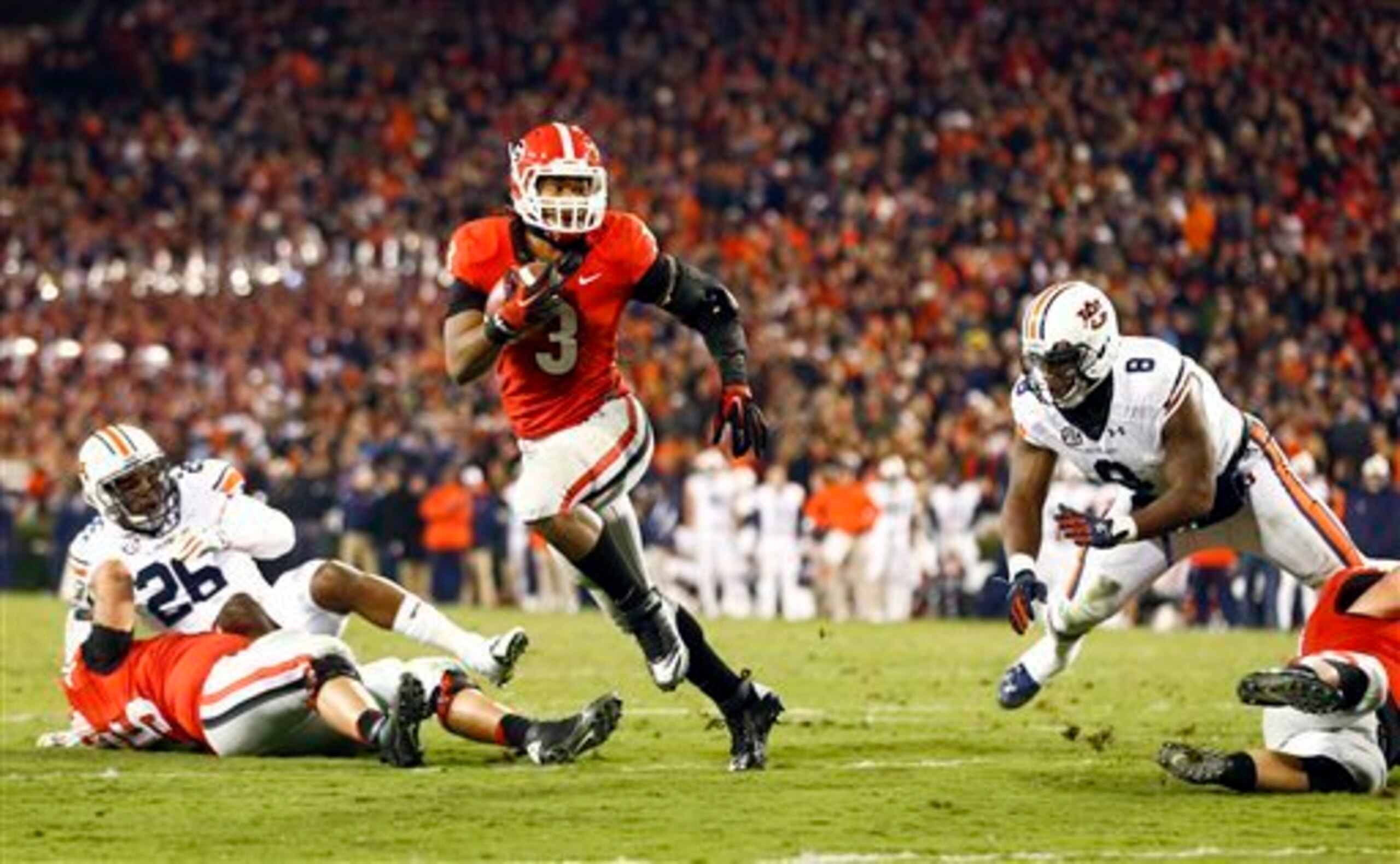
Ball Security
Todd Gurley keeps the ball high and tight, no matter the situation. Even when he makes sharp cuts, the ball stays glued to his chest. A high-volume runner with a violent downhill style is required to hold on to the football, and Gurley does it better than anyone.
Power
Gurley is built like a safety (6’1”, 226 lbs) and runs like a small locomotive. He drops his head to absorb contact and almost never gets tackled by one player. If he breaks into the second level of a defense, the best a defensive back can hope for is to grab him, hold him, slow him down and wait for help to arrive.
Vision
At his best, Gurley is making one cut and getting upfield as fast as possible—something that does not require great vision. When that first hole is not available, however, he identifies the cutback lane and attacks it with conviction. Defenses that over-pursue against Gurley will be hoisted by their own petard.
Hands
It is hard to find a “power back” with better hands than Gurley. He catches the ball cleanly and turns up the field in one fluid motion, as if he just accepted a handoff. His ability to contribute in the passing game makes him a true three-down running back.
Speed
Speed is the source of Gurley’s power. He reaches top gear in a heartbeat, bursting through the line like he was just shot out of a cannon. If you think this grade seems high, see if you can track down footage of Gurley getting caught from behind. Whether it’s a handoff, a catch or a kick return, he is gone as soon as he hits the open field.
Agility
Gurley has good agility and is able to circumvent defenders (even though he prefers to go through or past them). His footwork and balance are rare for a player his size, separating him from NFL tales of caution such as former Alabama running back Trent Richardson.
Overall
A four-game suspension and a torn ACL limited Gurley to six games in 2014. But when he was on the field, he was exactly as good as advertised. Maybe even better. He is the best college running back since Adrian Peterson.
3. Amari Cooper, WR, Alabama
108 of 110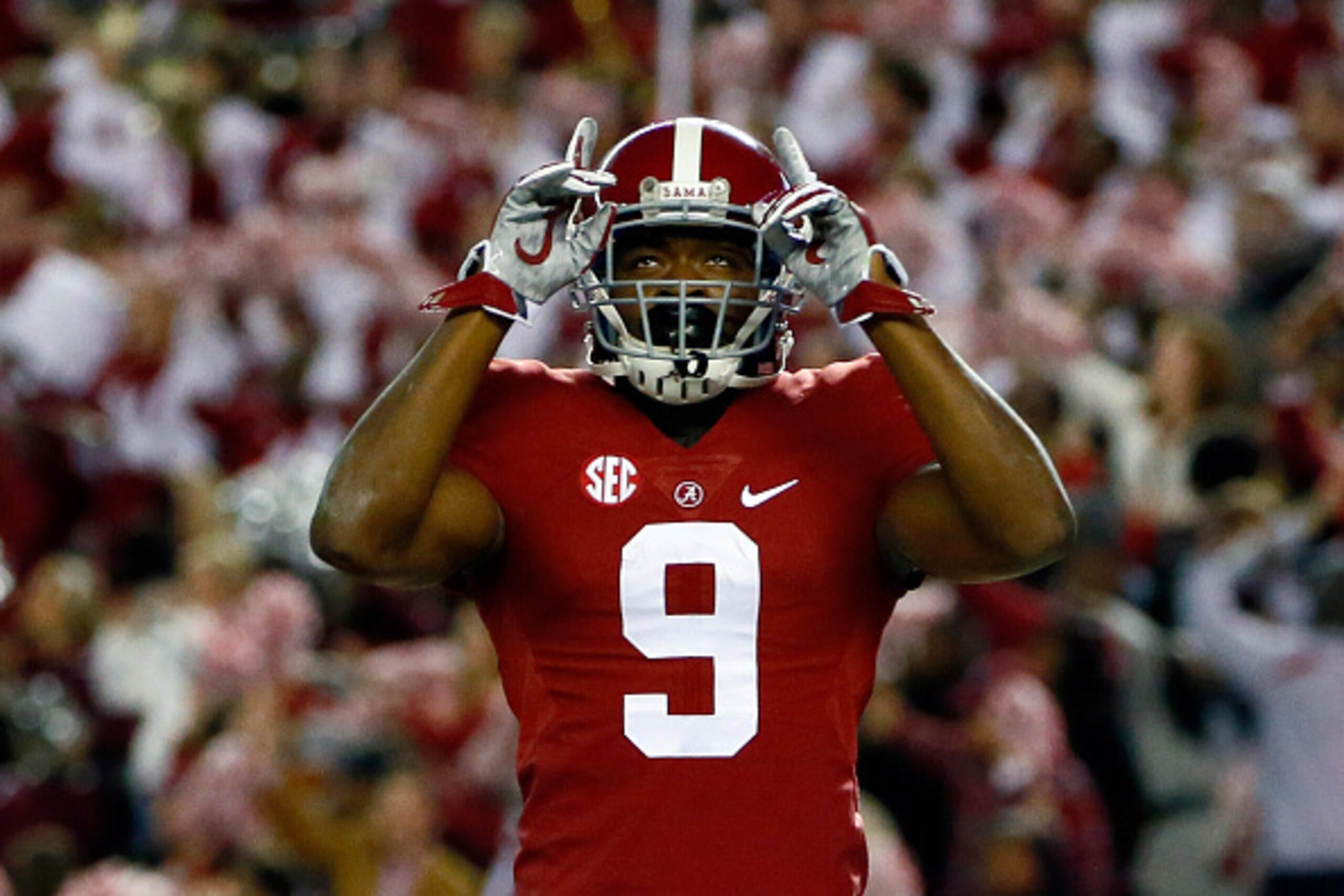
Hands
LSU game notwithstanding, Amari Cooper has fantastic hands. He catches the ball away from his body and tucks it in one smooth motion, and he's willing to fight through traffic.
Route Running
Cooper knows how to gain separation on a variety of routes. Critics will knock the percentage of bubble screens he catches, but even those are set up by defenders respecting his route running and giving him added slack.
Blocking
Cooper is not a great blocker, but he's a good one. He is willing to mix it up and get physical but sometimes whiffs on blocks because he is overexerting himself. His effort is typically good but comes with occasional lapses.
Release
No one in college football gets off the line as well as Cooper, a quick-twitch athlete with excellent technical proficiency. "He just does a lot of releases," LSU cornerback Tre'Davious White told The Advocate about guarding Cooper. "You never know what he’s going to come with."
Speed
Cooper is a burner. He can beat defenses over the top with a deep route or take it to the house after one missed tackle. He claims he ran a 4.31 40-yard dash after Alabama's pro day in March, and his tape validates that time.
Run After Catch
More than just his speed, Cooper's vision makes him the most dangerous run-after-catch receiver in college football. He reads blocks like an NFL veteran, changes direction on a dime and accelerates to burst through the hole.
Overall
Cooper had 1,000 receiving yards as a true freshman in 2012 but slumped as a sophomore in 2013. With questions about which Cooper would show up in 2014, the speedy receiver submitted an All-American type of season, carrying Alabama's offense in its first year under coordinator Lane Kiffin.
2. Danny Shelton, DT, Washington
109 of 110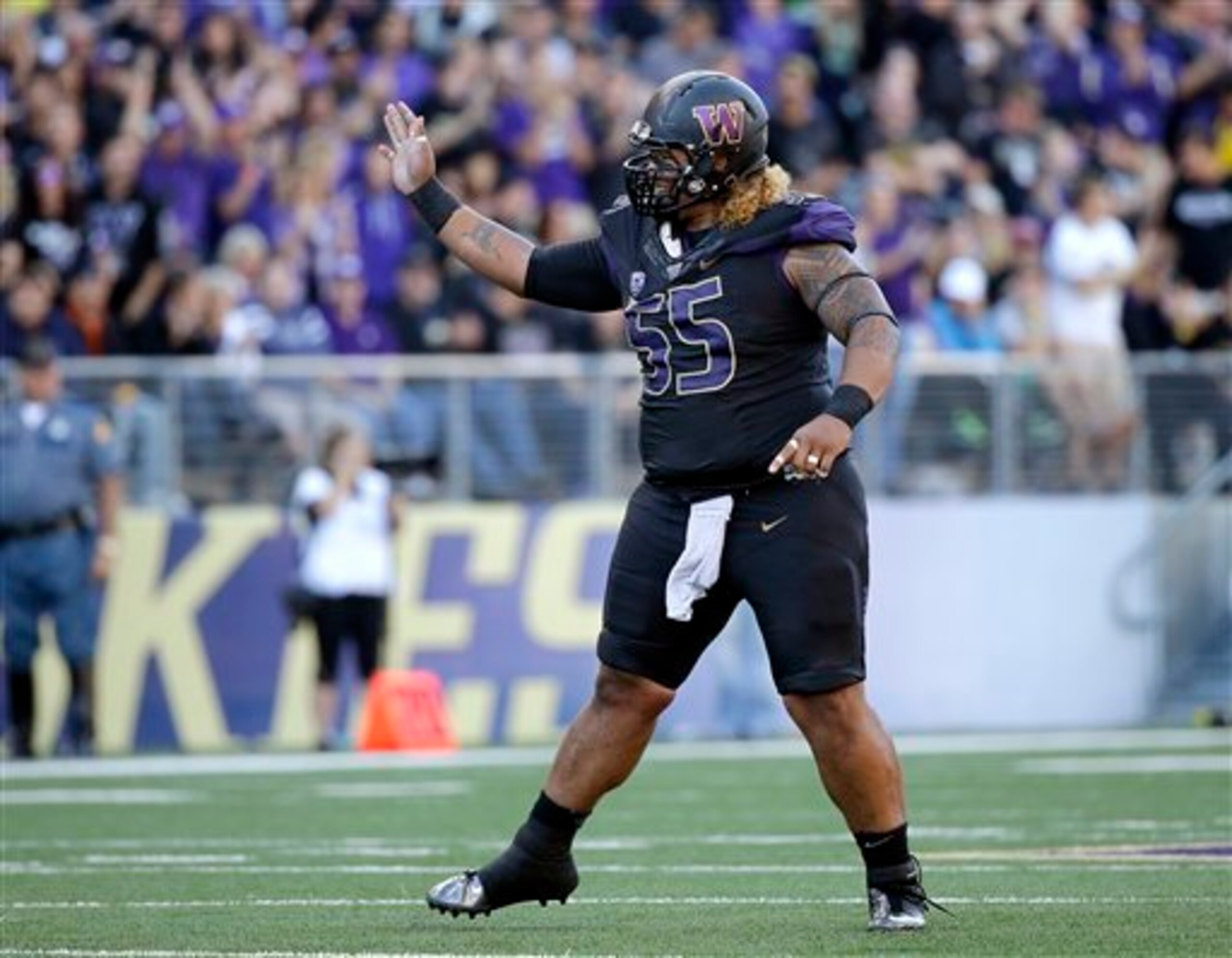
Pass Rush
Danny Shelton is explosive for a player so humongous (6’2”, 339 lbs). He has in-line speed to shoot the gaps and get to the quarterback and enough stamina to hunt the QB down and finish the play. And even when he doesn’t beat his blockers off the line, he uses his size to bull-rush offensive linemen and get pressure—sometimes after a pre-snap barrel roll.
Run Defense
Shelton separates himself from most nose guards with his ability to make tackles on his own. Despite his size, he has quick feet, speed and instincts. When he gets into the backfield, he can swallow up a running back himself instead of simply forcing the run outside. And even when he’s not making plays himself, he will occupy multiple blockers and free up lanes for linebackers to come down and make tackles.
Motor
You won’t see many linemen play as hard as Shelton does. He wears his weight well and does not stop moving until the whistle. Even if that means chasing a running back 30 yards downfield, he will do it. He’s as wild as his hair makes him seem.
Overall
Shelton presents a mismatch for almost every blocker he faces. He is too big and strong for most guards and centers but too quick and explosive for the few who can handle his strength. He is the hardest interior lineman to block in the country—and frankly, it’s not all that close.
1. Marcus Mariota, QB, Oregon
110 of 110
Accuracy
Marcus Mariota is an accurate passer at all levels of the field. He hits receivers in stride on timing routes and drags, allowing them to gain yards after the catch. When he has a man open deep, he puts the ball on a string and drops it right into the basket.
Arm Strength
Mariota doesn't have a huge arm, but he does have a pretty big one. He relies on accuracy and touch more than velocity, but he can push the ball downfield when one of his receivers gets over the top. His arm strength is particularly impressive once he gets outside the pocket.
Pocket Presence
Injuries along the offensive line forced Mariota to dance around the pocket and escape some impossible pressures this season. For the most part, he passed those tests with ease. His ability to keep plays alive saved the Ducks in some of their biggest moments.
Mobility
Mariota is 6'4", 219 pounds and runs like a wide receiver. He is a long strider with great acceleration who can see when a hole is developing and burst through it. Oregon doesn't call as many designed runs for Mariota as it did some of its previous quarterbacks, but when it does, he makes them count.
Football IQ
Oregon's offense is dangerous because it beats you without beating itself. Mariota's historically low interception rate is the most meaningful illustration of that concept. He mitigates the risk on otherwise risky play calls, allowing Oregon to stay aggressive and turn small leads into big leads, and big leads into huge ones.
Leadership
Mariota is not a fiery, scream-in-your-face type of leader, but that is not the only way to lead a team. Instead he leads with a cool composure, a charm that says "we got this" in the biggest moments. He is an intense competitor who stood on his head to hold the Ducks together when their season was jeopardized by injuries.
Overall
Mariota is the quintessential Oregon quarterback and a prospect NFL scouts have been drooling over since 2012. Big, fast, skilled, smart—he checks every box.
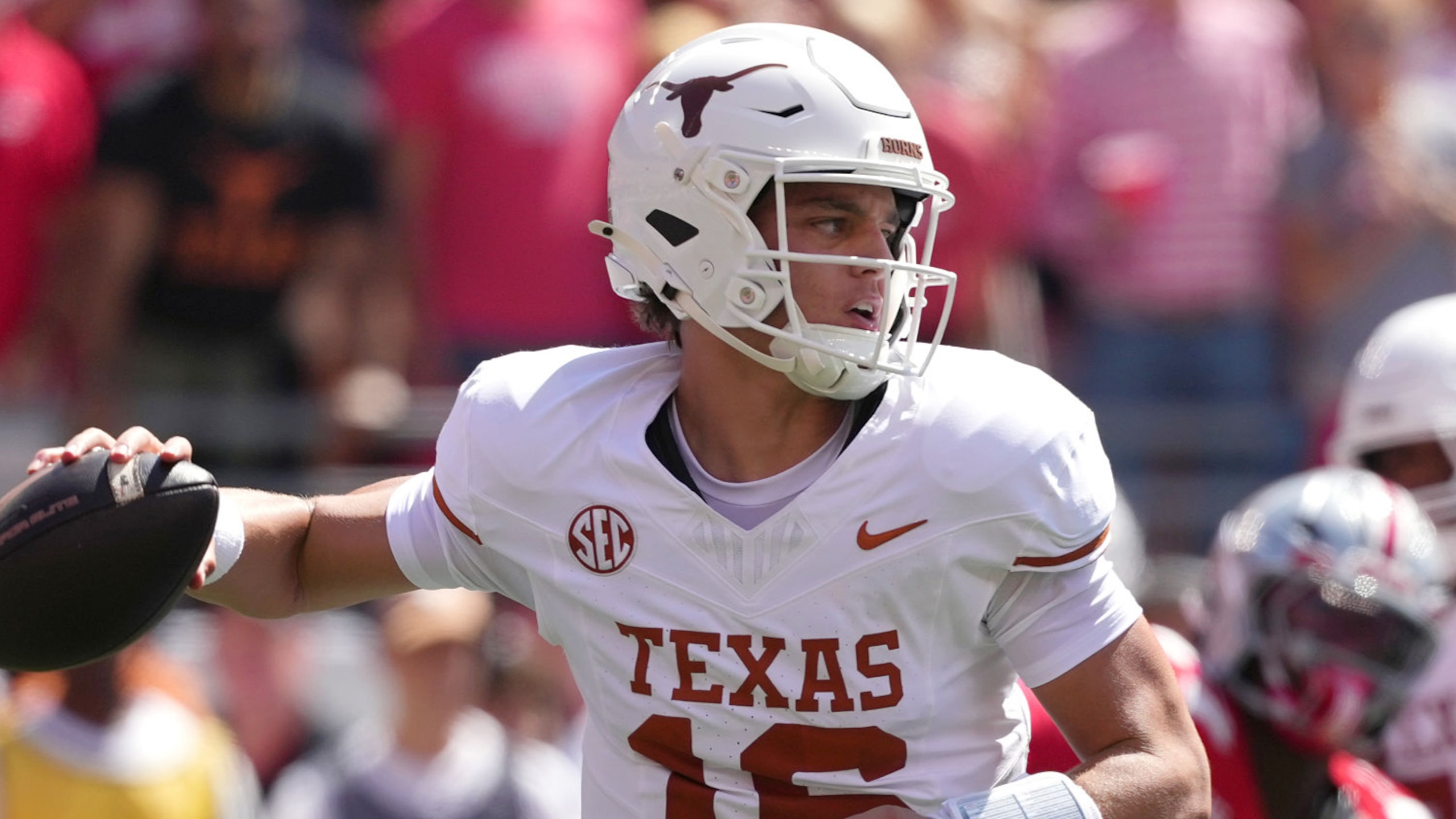
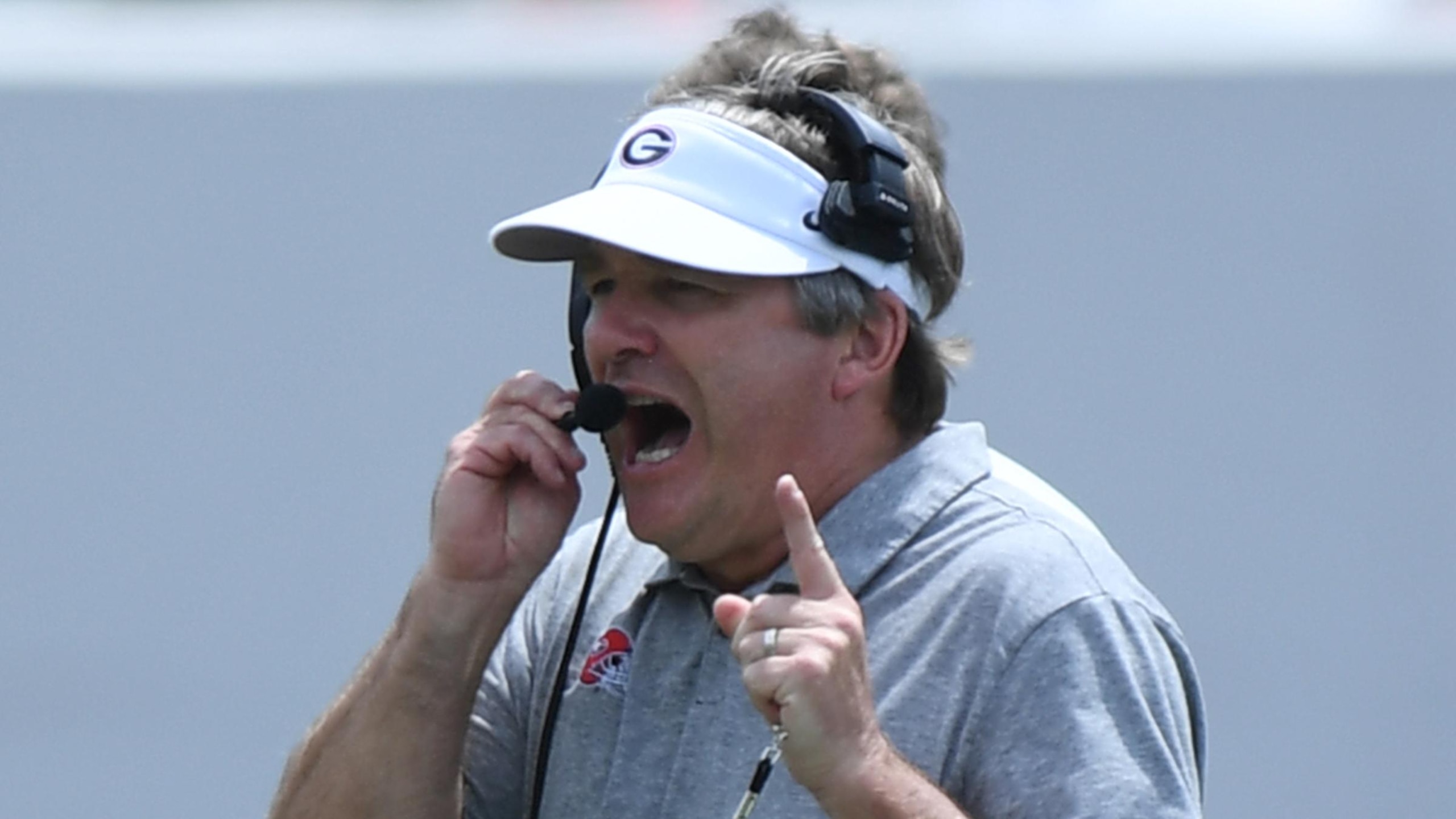
.jpg?w=2560 "NFL made $14.5B in revenue for 2025 season")
.jpg?w=2560 "WWE NXT Live Grades 🔢")