


A one-time minor league baseball player who struck out 37 times in 39 at-bats in his former life just managed to thank his offensive and defensive line for his individual success in a span of three minutes.
In our specialized football world, this wouldn’t translate. But in Shaq Thompson’s limitless biosphere—one that has included professional baseball, track, linebacker, running back, quarterback, safety and even punter—it perfectly encapsulates the vast array of weaponry the Washington linebacker and running back has in his arsenal.
“He was what I call a ‘shotgun’ projection,” 247Sports national college football recruiting analyst JC Shurburtt said. “Meaning you could spray a number of positions out there like a shotgun and hit on him. Running back, receiver, linebacker, safety—heck, he could play corner or line up with his hand down and rush the passer. Shaq was one of the most versatile players I've ever covered.”

In many instances, these multitalented, stopwatch-shattering prospects don't pan out. The buffet of athletic gifts simply doesn't translate, and all that's left is a recruiting ranking and forgotten promise. That has not been the case for Thompson.
He has met his potential with room still to grow and flourish. He has surpassed the hype. Following a unique path with multiple stops, he has become an irreplaceable piece for the Huskies and a one-of-a-kind talent worth celebrating well beyond the Northwest. And head coach Chris Petersen doesn't hesitate to sing the all-purpose star's praises, via Adam Jude of The Seattle Times:
"Hey, I don’t get a chance to watch everybody around the country. But I do see a lot. And I haven’t seen a better football player out there than that guy.
A better, flat-out football player – in your words, ‘best football player’ in college football. There might be somebody who’s the same, all those type of things, but a football player? I know there are some good ones out there, but what this guy does in terms of special teams and offense and defense and all those things, I haven’t seen a better one.
"
At 6"1' and 228 pounds, Thompson is an outlier, a physical specimen operating with an abundance of physical attributes. This past season, he used those attributes to score six touchdowns, doing so in three different ways.
On defense, he returned three fumbles for scores, headlined by a 100-yard return against Cal in early October. Thompson also added a touchdown on an interception in Week 3 against Wes Lunt, taking his pass back 36 yards to the house. Following his two-touchdown performance against Illinois, Thompson was named Walter Camp National Defensive Player of the Week.
During that same game, Thompson also logged three carries for 16 yards. The week prior, he carried the ball three times for 66 yards and a touchdown.
Already an adaptable player on the defensive side, it was at this moment that he stated his case for the Paul Hornung Award—the hardware handed out to the nation’s most versatile player. He was announced as the winner in mid-December. Stacked up against other fabulous players, this was an easy decision.
It wasn't just about the versatility. It was about the production that came with playing two different roles for a team that desperately needed it. In doing so, Thompson showcased his talents in another capacity, something he craved before he signed with the program.
“The opportunity that I wanted since my freshman year was really coming true,” recalled Thompson on playing offense. "That was something I wanted to do when I came in.”
Listed as a safety and athlete in the 2012 class, Thompson was rated the No. 6 player overall by 247Sports, the No. 2 safety—behind only Alabama’s Landon Collins—and the No. 2 player in California. He was also a track star in high school, calling himself a “200-meter guy.”
His seventh-place finish in the state meet, closing with a time of 21.77 seconds at more than 210 pounds would indicate an accurate self-assessment.
A star at Grant Union High School in Sacramento, California, Thompson bounced around positions throughout his four years.
His senior year, he threw for nearly 900 yards and eight touchdowns, averaging just under 20 yards per completion. His junior year, he ran for almost 1,900 yards and 25 touchdowns while averaging well over 11 yards per carry. That same year, he caught 18 passes, averaged 19-plus yards per reception and scored three touchdowns.
At the same time, he moved up and down the defensive side. He sacked quarterbacks and intercepted passes, logging snaps at every level of the defense. Thompson also played a significant role on special teams, where he returned punts, returned kickoffs and even punted.
Over three seasons, he averaged a respectable 37.4 yards per boot.
“I was average,” Thompson said about his punting. “I can tell you that.”
In almost every other area, however, he was anything but. Although his smorgasbord of talent was a high school coach’s dream, it also made him difficult to evaluate. It obviously wasn’t too difficult—he was the nation’s No. 6 player, after all—but projecting him was not a simple task.
“We obviously loved Shaq's athleticism and versatility and had him ranked really high, but in one sense, his versatility hurt him,” 247Sports director of scouting Barton Simmons said. “We never really gave him strong consideration as the No. 1 player in the nation because we weren't really sure what his position would be. Was he a big safety? Was he an athletic linebacker? Was he an offensive guy? We thought there was a good chance he'd land at linebacker, but that ‘tweener’ label limited him in the discussion for No. 1 overall.”
As you might imagine, Thompson’s unique skill set drew offers from coast to coast: the California product had interest from Alabama, Notre Dame, Oregon, Utah, Arizona State, USC, UCLA, Cal and others.
Additionally, he caught the eye of Washington, where ace recruiter Tosh Lupoi—who moved from Cal to Seattle at the tail end of the recruitment—also pursued Thompson while head coach Steve Sarkisian led this push. Ultimately, it was one visit that swayed Thompson. After originally committing to the Bears, Thompson decided on Washington.
“I came to the Washington-Cal game and I remember the great environment. They showed me so much love,” Thompson recalled of his recruitment. “At times I wanted to stay in California, but I needed to branch out. I needed to be on my own.”
Around this same time, the Boston Red Sox took him in the 18th round of the 2012 MLB amateur draft. The opportunity came quickly, and Thompson made his Gulf Coast League debut that summer despite logging limited at-bats in high school. Between sixth grade and his senior year, he rarely even picked up a baseball. And even then—with only a .272 career average—his athletic potential was too much for professional baseball teams to ignore.
His minor league stint turned out to be both short and memorable. In all but 10 of his plate appearances, Thompson went down on strikes. His final AB was a lineout to right field—the only time a ball left the infield. He headed to Washington shortly thereafter, ready to shift his focus.
“It was a lot of time you had to put in,” Thompson said on his baseball experiment. “And my mind was on football.”
Thompson arrived in Washington for fall practice and contributed the moment he stepped on the field, and the two were simultaneous. His versatility carried over.
He returned punts and kickoffs while also playing a significant role on defense, finishing fifth in overall tackles as the team’s starting nickelback during his freshman season.

The next season, he moved to linebacker. Although he logged three interceptions as a freshman, his 80-yard pick-six against Oregon State provided a glimpse of the future and present.
He didn’t move like a linebacker in the open field; that’s because—in reality—he was different.
“I came in with a pretty open mind,” Washington defensive coordinator Pete Kwiatkowski told Bleacher Report of Thompson. “I knew he was a really dynamic player when he had the ball in his hands. I knew he was a highly recruited kid out of high school. But usually with those guys, there’s some attitude. He’s a great young man.
“Besides being a great football player, he’s a good dude.”
When Steve Sarkisian left for USC and Washington lured Chris Petersen away from Boise State last offseason, Kwiatkowski joined him on the defensive side as coordinator, inheriting a unit ripe with talent and experience.
Along with Thompson, Kwiatkowski coached linebacker Hau'oli Kikaha and defensive linemen Andrew Hudson and Danny Shelton in 2014. All three finished with at least nine sacks this year.
“They never had a bad game,” Thompson said of his teammates. “They just really helped me as a person and player. They were like my big brothers.”
In Thompson, however, Kwiatkowski had a new toy.
“For a big guy, he’s very athletic,” Kwiatkowski added. “He’s got great acceleration and closing speed.”
Making this brief introductory period slightly more complicated was Thompson’s evolving role. With Petersen at the helm and the offense in need of a spark, Thompson was inserted into the offense.
Similar to what UCLA did with Myles Jack during his freshman season—someone Thompson is friendly with and with whom he exchanges texts every now and then—Washington tested out its prized defender at running back.
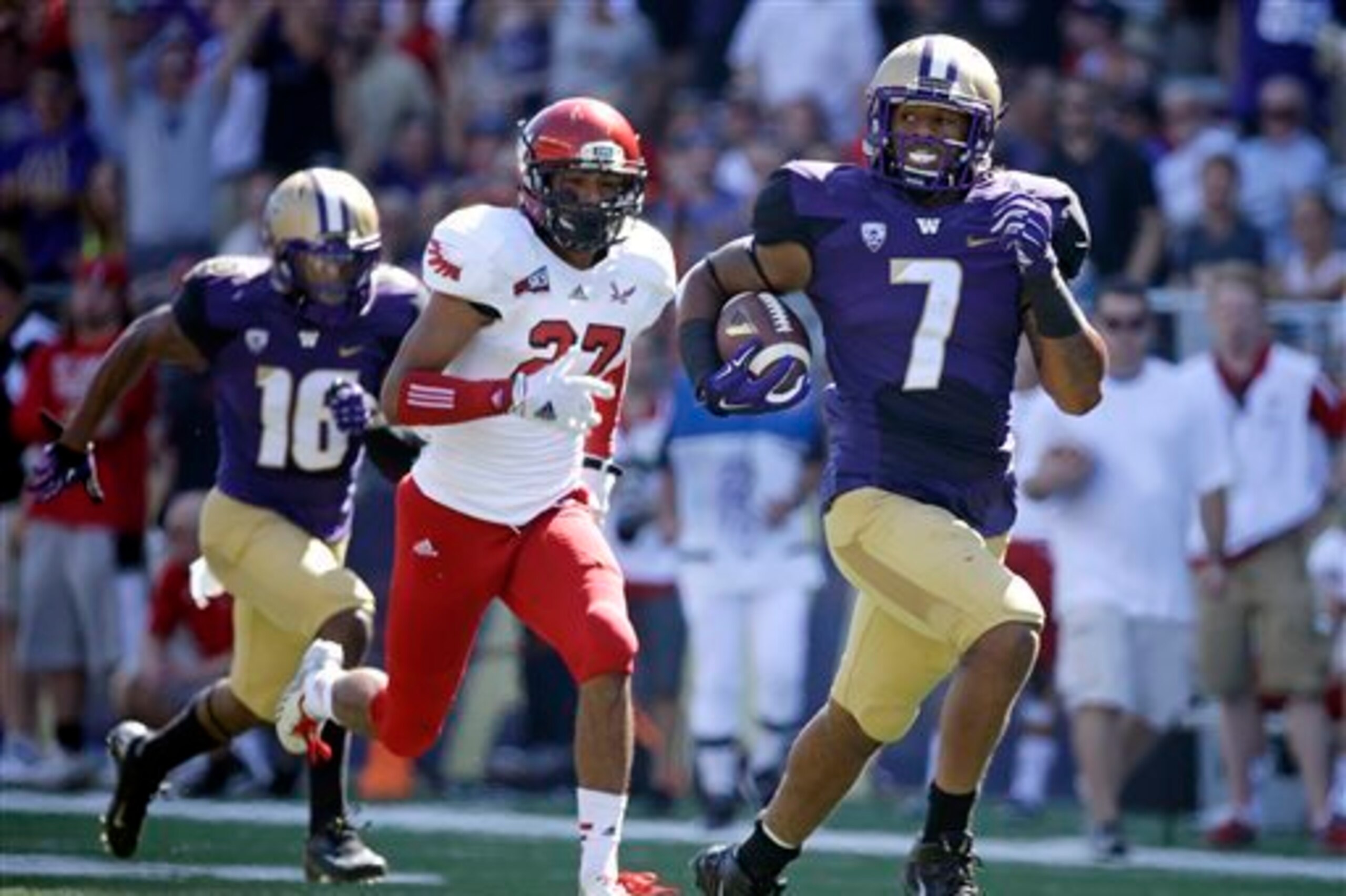
After carrying the ball twice for nine yards against Eastern Washington, Thompson’s third carry resulted in a 57-yard touchdown. He didn’t carry the ball again that game.
“Whatever coach wanted,” Thompson said. “I would do.”
Over the next month, Thompson’s offensive touches were limited. Even so, he still managed to gets his hands on the ball, scoring four defensive touchdowns this season. It was the most defensive scores by an individual player in the last decade.
In late October, however, Thompson’s role in the offense began once more in earnest. In a stretch of three games—a stretch Thompson referred to as “solid,” which was rare personal praise—No. 7 carried the ball 52 times for 372 yards, good for an average of more than seven yards per carry. His 174 yards rushing against Colorado were a season high for the team.
“As a player, it’s hard to get into a flow of your positions if you’re changing positions, but he handled it,” Kwiatkowski said. “A lot of it just comes back to natural ability. He’s got some natural gifts that help him make that transition rather easily.”
Aside from sheer athleticism, Thompson used an unconventional approach when handed the football. He found familiarity in an unfamiliar setting, turning a unique viewpoint into something closer to home.
“I had a defensive mindset when I was on offense,” Thompson said. “It wasn’t an offensive mindset. I was focused on reading the defensive line and the linebackers. I would ask myself what I would do if the ball was coming this way. All credit goes to my offensive line.”
Being 230 pounds and faster than just about everyone else didn’t hurt, either.
“He likes to hit and come downhill. You saw that when he ran the ball with the way he dropped his shoulder and just ran through arm tackles,” Kwiatkowski said. “Pair that with his ability to put his foot in the ground and accelerate and you see what he can do.”
When you put it all together, Thompson delivered a season unlike any in recent memory. There were players with more tackles and sacks—some of whom he played alongside. There were running backs with more carries, yards and touchdowns. But the rare combination is what makes this so special, and the makeup of the athlete—an Atlas statue with a rocket engine—is why box scores don't do him justice.
As they did when he came out of high school, questions will again surround Thompson regarding his next step. After Washington faces off against Oklahoma State on Friday in Tempe in the TicketCity Cactus Bowl, Thompson will be free to enter the NFL draft if he so desires.
With three collegiate years completed, and spectacular results to match athleticism that doesn’t surface often—something that will ultimately send Thompson surging up draft boards following workouts—the junior will garner serious interest after a sensational season.
“I’m not thinking about it right now,” Thompson said on the NFL. “I’m trying to get this bowl win.”
Whenever he decides to leave—even if Tempe is the last we see of this special talent at the college level—there is a place for him in the NFL. What that place is will likely depend a lot on where he lands.
“He has the skills to play on Sundays,” Kwiatkowski said. “It just comes down to the team that drafts him and where they see him playing. He could be a weak-side linebacker or a safety at the next level. The teams looking at him and studying him will have to make that decision.”
While Thompson has cherished the ride, the stops along the way in a variety of arenas and his forays at numerous positions, his heart remains in one place.
“Defense,” he said, stopping short of any superfluous justification. No further explanation was needed.
Like his time on the track and the baseball diamond or his moments at other positions on the football field, Thompson’s various roles over the past three years have emerged out of necessity. He didn’t beg for these opportunities, but he embraced each and every chance, thanking those who have made it possible.
With every tackle, carry, recovery, interception, sprint, strikeout, score and “average” punt, Thompson put on one fabulous, unprecedented show. It didn’t result in national championships or Pac-12 titles but can be entirely appreciated nonetheless.
Whether that show continues at Washington for one more season is something he and his family will explore in relatively short order. Regardless of his next move, Thompson isn't focused on his next great endeavor. For the first time in seven years, he's ready to settle down.
“Nah, I’m good,” Thompson said, when asked about his next position. “I think I'll stick to linebacker.”
Unless noted otherwise, all quotes obtained firsthand. All NCAA stats courtesy of CFBstats.com. Recruiting information via 247Sports and MaxPreps.
.png?w=2560)

.jpg?w=2560 "Chiefs, Steelers Eye WR Trades")

.jpg?w=2560 "WWE Raw Live Grades 🔠")
.jpg?w=2560 "Multiple NFL Trades Predicted")

