Breaking Down Washington Redskins' Protection Issues
There can't be many, if any, Washington Redskins fans who don't want to see the team dedicate serious resources to fixing its offensive line this offseason. After all, it's been a major problem position for far too long.
Things are so bad that even a resolution to the team's quarterback situation, whatever that might look like, won't count for much until things improve up front.
To give you an idea of just how bad the situation is, Washington has already yielded 53 sacks this season. Worse still, there are two games left and next up are the Philadelphia Eagles, owners of the second toughest pass rush in the NFL.
.jpg?w=2560 "Commanders 49ers Football")
.jpg?w=2560 "Colts Football")
.jpg?w=2560 "DOLPHINS-AIKMAN")
Before taking on the Eagles, the Redskins have widespread protection issues to solve. The first is twofold: losing one-on-one matchups due to a lack of quality among both the starters and their depth.
Aside from maybe left tackle Trent Williams, the Redskins don't possess a single marquee lineman. In fact, they barely possess a capable one.
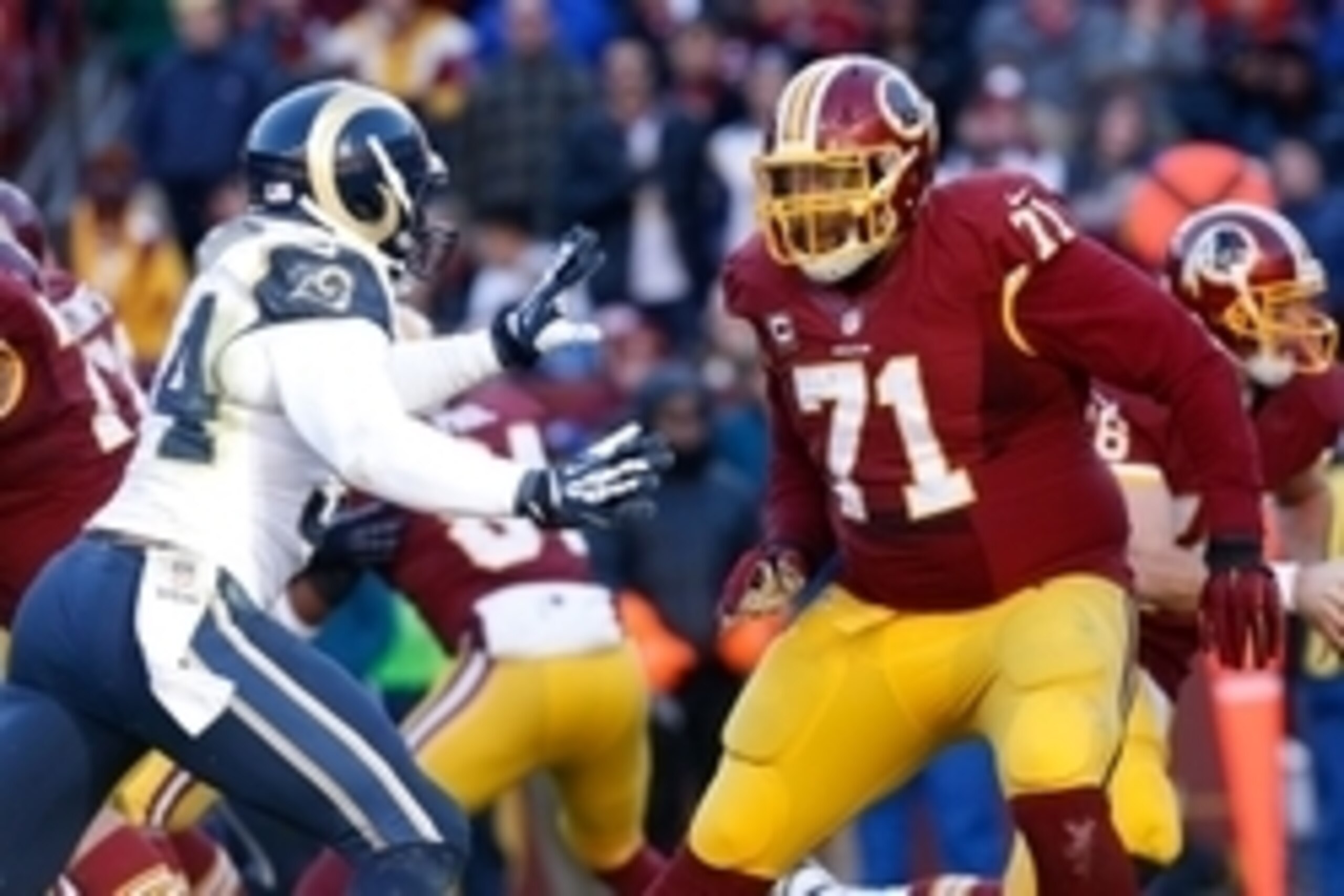
Williams has been playing hurt recently and finally succumbed to injury in Week 15's 24-13 loss to the New York Giants. That meant Tom Compton shifted to the left side.
Compton, a 2012 sixth-round pick, had only been playing right tackle in the wake of Tyler Polumbus being benched. Williams' injury meant Polumbus returning to the lineup.
That left the Redskins vulnerable in one-on-one matchups at both edges of the line. It proved costly on this sack in the fourth quarter.
Compton and Polumbus were matched up with rush ends Jason Pierre-Paul and Damontre Moore, respectively:
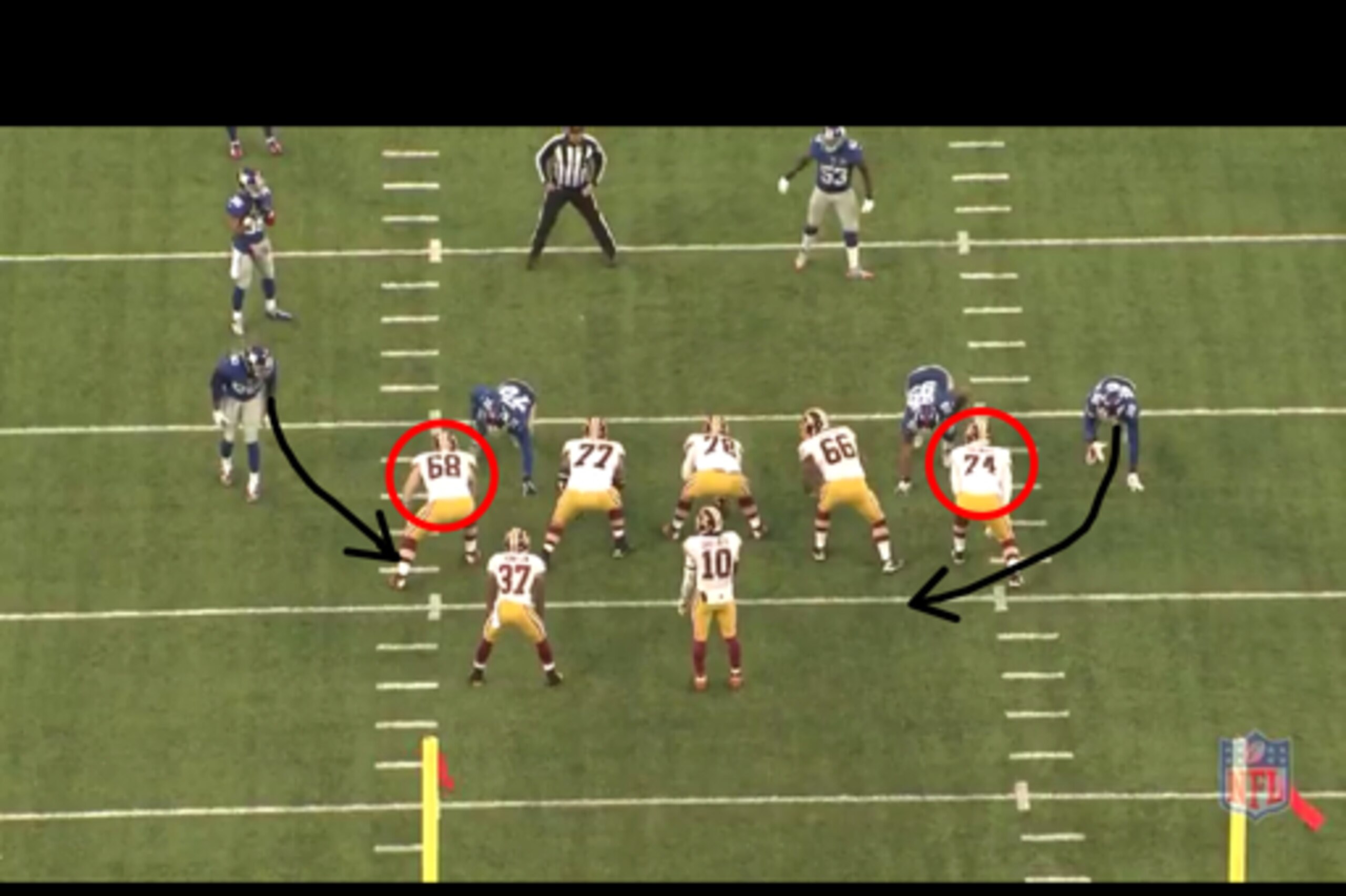
Both tackles were immediately beaten to the corner. Compton in particular needed help against Pierre-Paul.
But he didn't get any assistance from running back Chris Thompson. The pocket-edition speedster should've chipped on Pierre-Paul before releasing on a pass pattern:
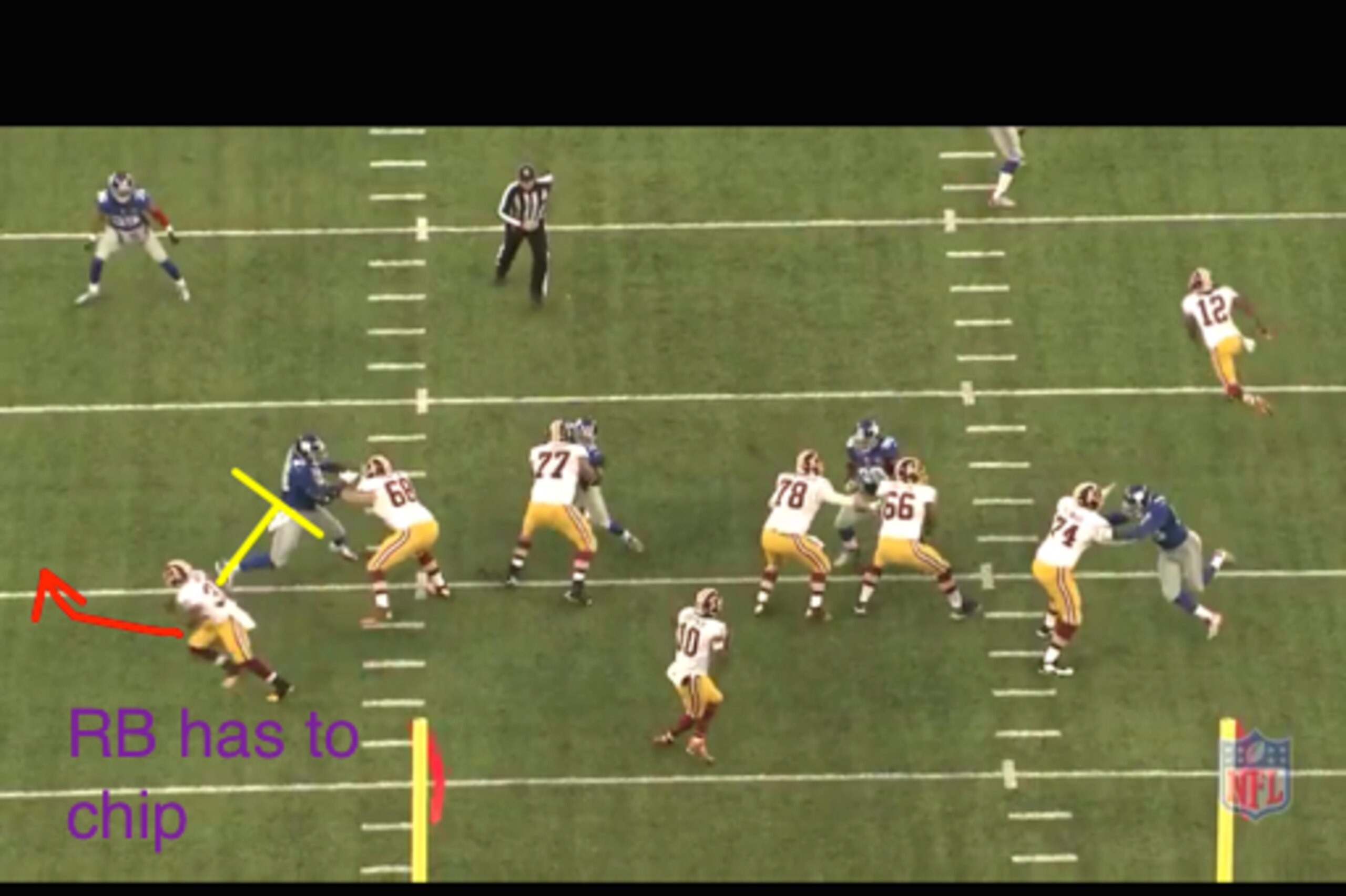
Left on their own, neither Compton nor Polumbus could hold up on the edge and prevent the pocket from crumbling around quarterback Robert Griffin III:

With both edges collapsed around him, Griffin had no means of escape as the pressure closed in:
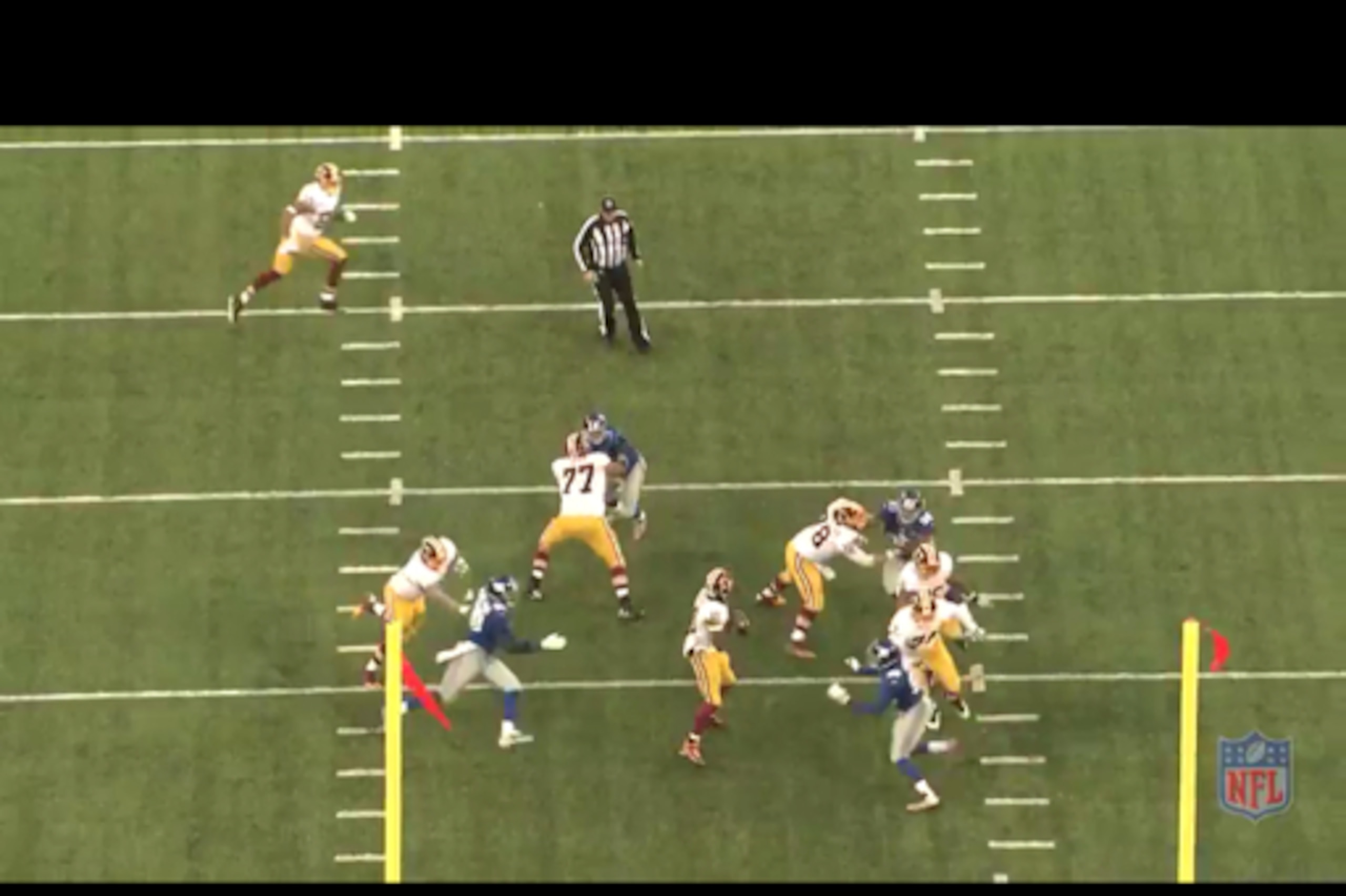
Pierre-Paul took Griffin down before the passer even had chance to cock his arm to throw:
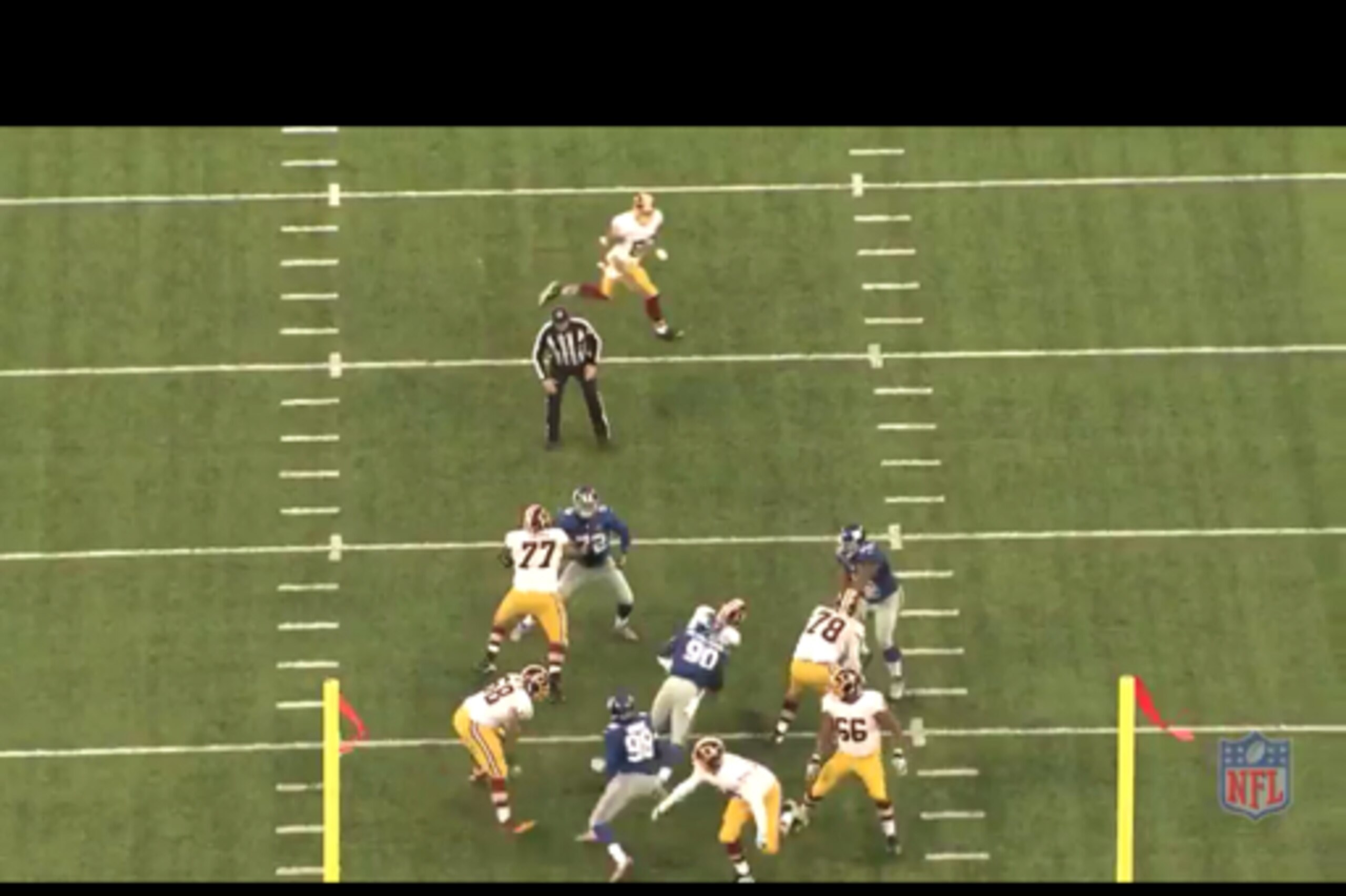
Pierre-Paul and Moore combined for three sacks against Washington's feeble bookends. That's a worrying omen prior to facing the Eagles, especially when Philly can unleash edge-rushers the caliber of Connor Barwin and Brandon Graham.
Washington's issues holding up on the edge don't just negatively impact the man under center. They undermine the entire offense, from the play-calling level to on-field execution.
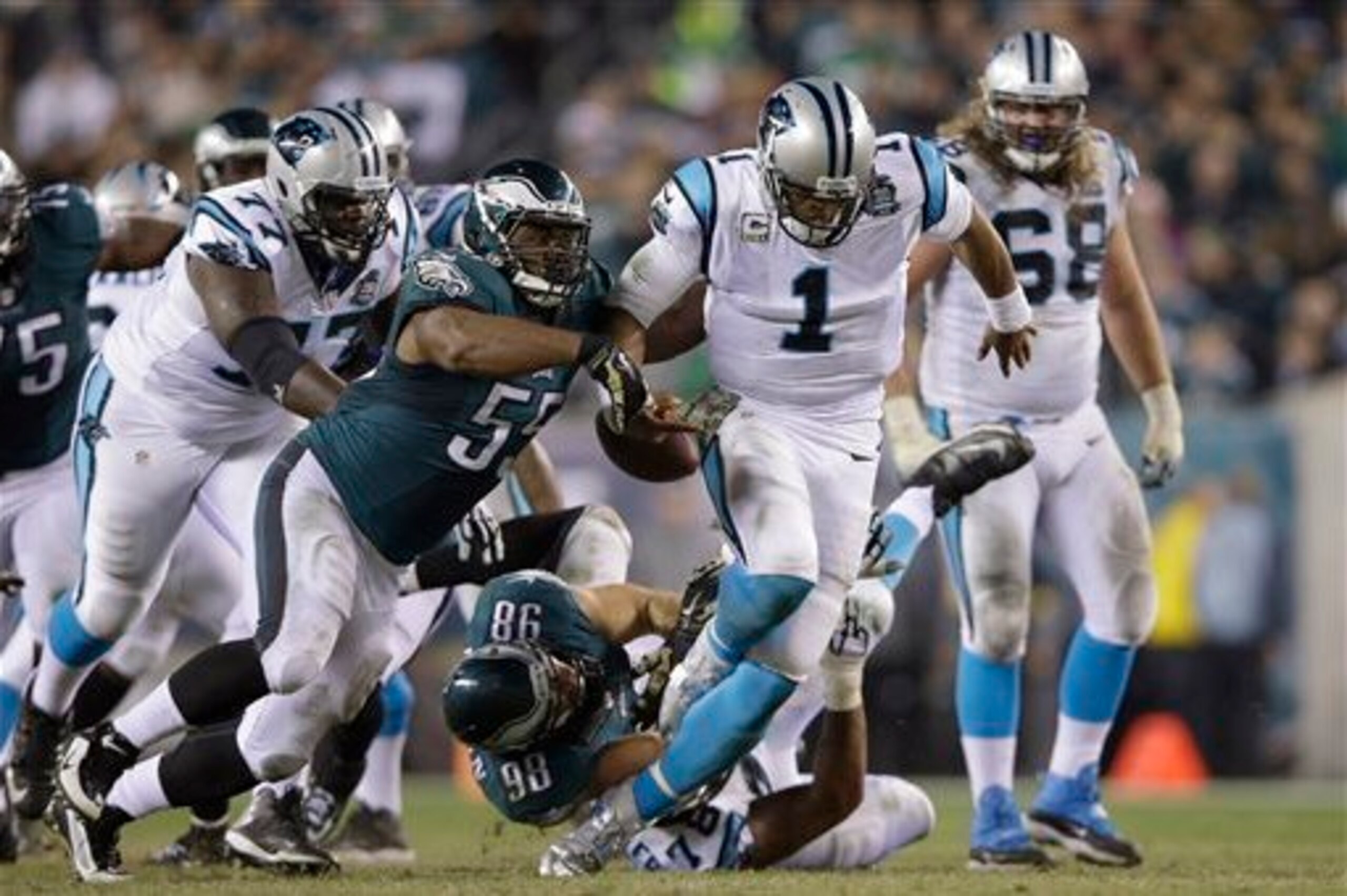
Because the Redskins have so much trouble winning individual battles in the trenches, auxiliary blockers are constantly called into protection duty. Not only does this put players who aren't naturally adept blockers into pass protection, it also takes away potential receivers and checkdowns for a quarterback.
This damaging ripple effect was brutally demonstrated on a 2nd-and-10 play near the New York goal-line.
Faced with Big Blue's nickel defense and a fairly basic coverage and pressure look, Washington was still forced to supplement its O-line. That meant tight end Niles Paul and running back Alfred Morris staying in to block.
This technically gave the Redskins a seven-on-four advantage along the front. But even when they have a numbers advantage, Washington's blockers can't make it count:
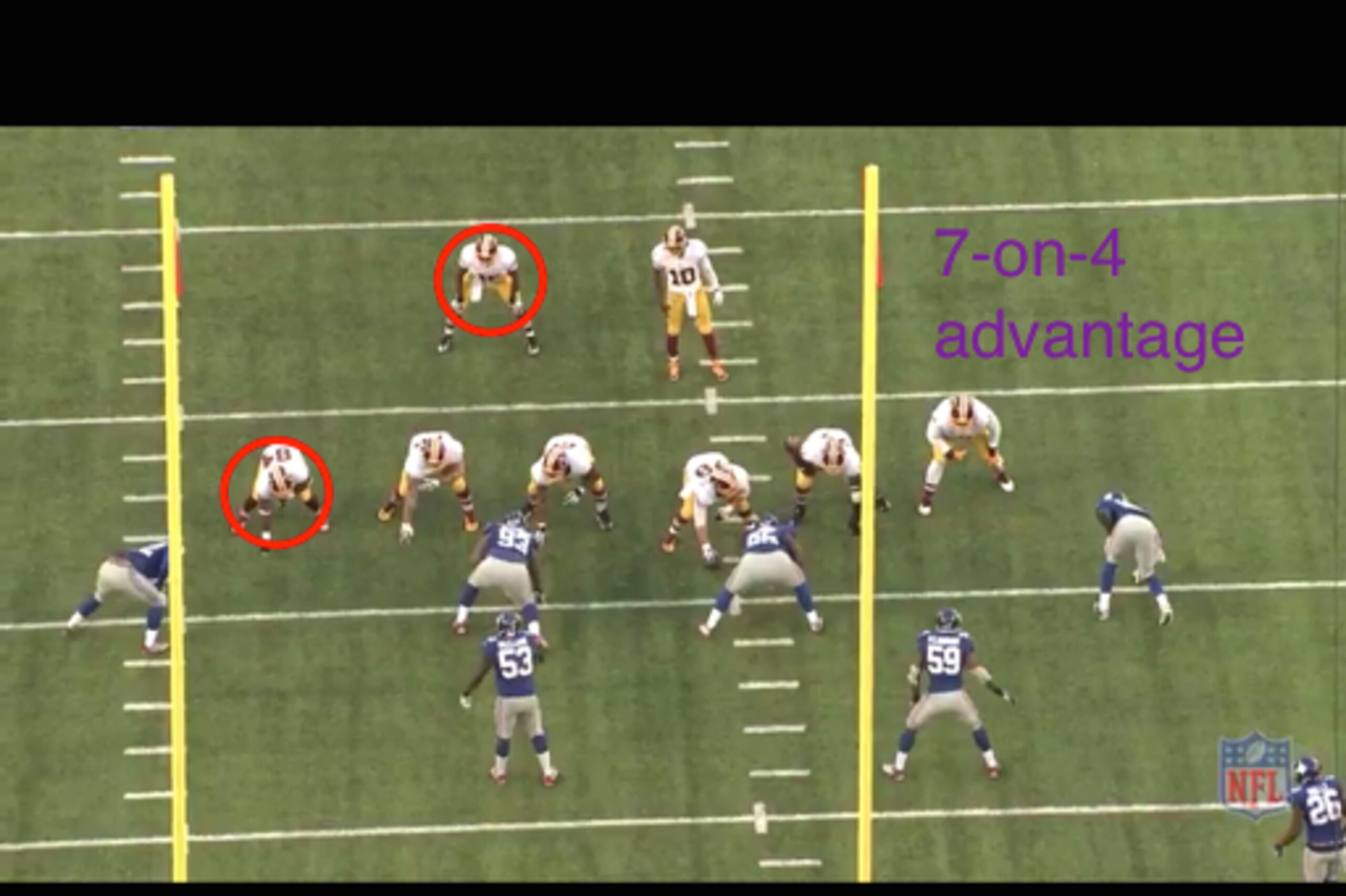
Resorting to a version of maximum protection reduced the number of potential receivers in this passing situation. Looking at the overview, you'll see Griffin aiming for just three pass-cathcers against Big Blue's four-strong secondary and three linebackers:

Even for a quarterback without Griffin's flaws and struggles, finding a receiver in this situation would be difficult. It didn't help that without his running back or tight end breaking free, Griffin had no quick outlet throw to beat pressure.
At the snap, the apparent numerical superiority took shape as both Paul and Morris helped out on each defensive end. But problems soon developed:

Take a look further inside and you'll seen another example of Washington's struggles to win one-on-one matchups and the damage that problem causes. The Redskins doubled both defensive tackles, something that left a tight end isolated against a D-lineman. That's a win for any defense.
If right guard Chris Chester was more solid, Compton wouldn't have to slide inside to help. But these are the kind of things that force unskilled blockers into playing key roles in pass protection.
The fact that neither Morris or Paul are skilled or stout enough to effectively repel capable pass-rushers soon cost the Redskins. Both Pierre-Paul and Kerry Wynn began to collapse the edges and close in on Griffin:
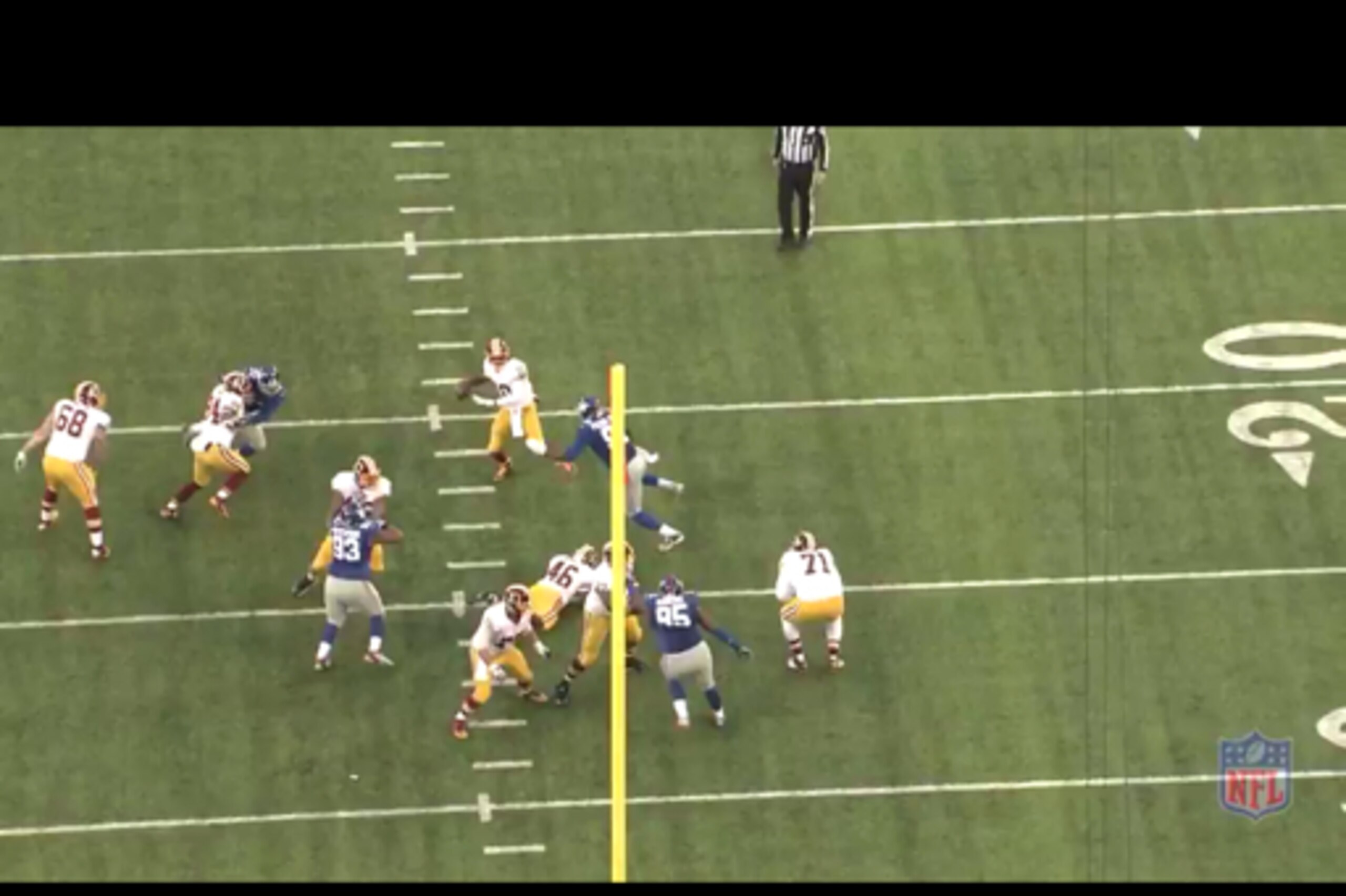
Morris was easily tossed aside by Pierre-Paul, a glaringly obvious mismatch. Meanwhile, Paul was simply pushed back by Wynn's speed and strength.
Again, Griffin was prevented from stepping up into his throw. Instead, he was soon sandwiched by both outside pass-rushers. The hit caused an incomplete pass:

Everything was wrong with the protection on this play. First, Washington blew a major numbers advantage against a defense content to only rush four.
Next, you have to question the communication that lets a tackle double-team inside, leaving a tight end stranded on the edge. Finally, the all-too familiar weaknesses in single battles meant yet another big hit on the quarterback.
Communication problems and not being technically sound enough to make numbers count really show up when Washington's O-line reacts to blitz pressures.
In Week 14, the St. Louis Rams brutally exposed these flaws. The best example came on a sack by safety Mark Barron.
The Rams showed Washington a 33 nickel, or 3-3-5, look and planned to blitz both Barron and linebacker Alec Ogletree off the same side:
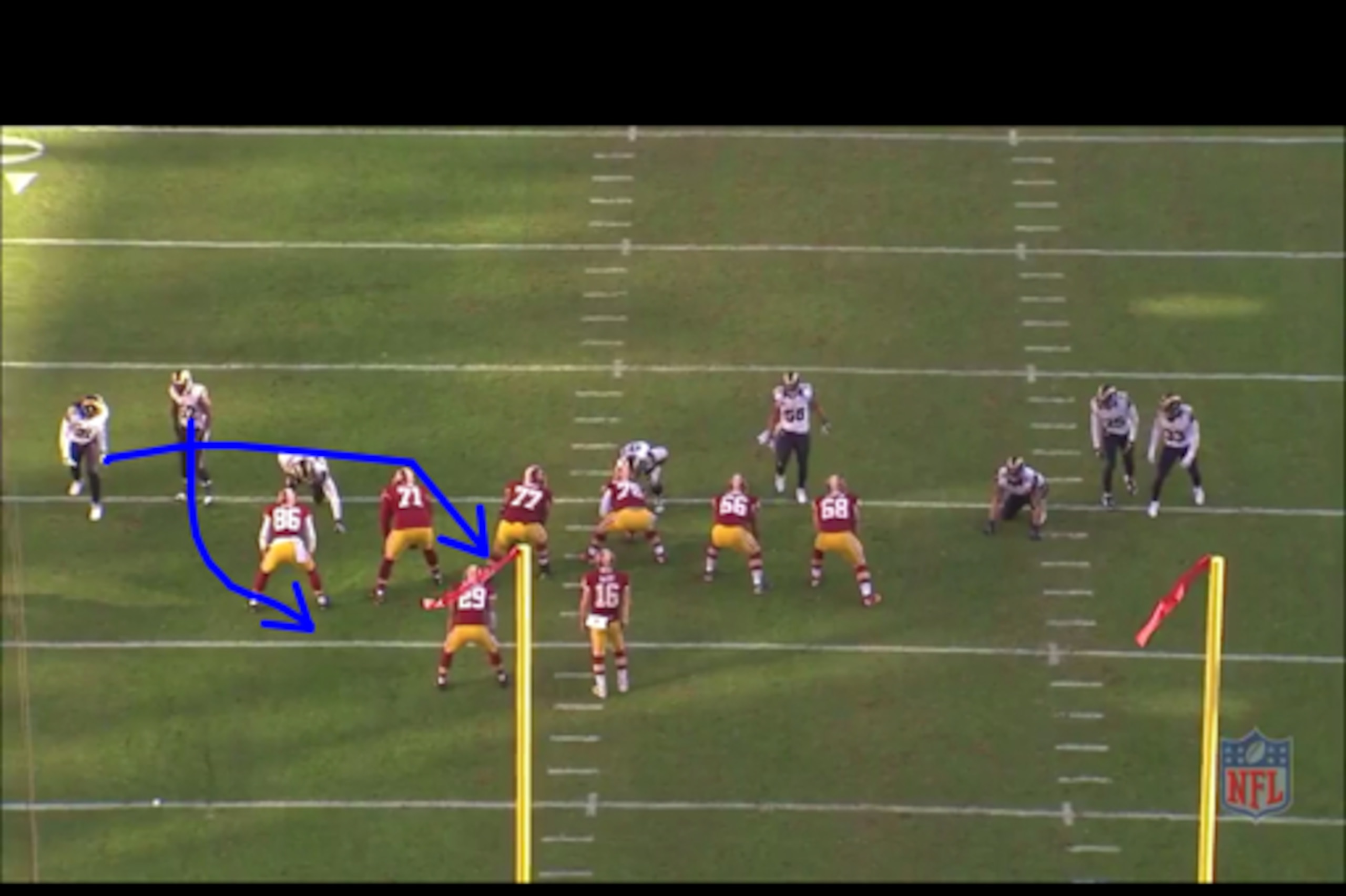
This would force both tight end Jordan Reed (86) and, specifically, running back Roy Helu Jr. to block.
However, with both Reed and Helu engaging in blitz pickup, the Redskins had the numbers to successfully account for and neutralize this pressure. At least they did in theory.
With Reed chipping, Williams free to block either Ogletree or Barron and Helu available to account for whichever man Williams didn't take, Washington had three blockers against two blitzing defenders:

However, once again the offense couldn't make its numbers advantage count. It didn't help that D-tackle Aaron Donald instantly drew a double-team inside from left guard Shawn Lauvao and center Kory Lichtensteiger:
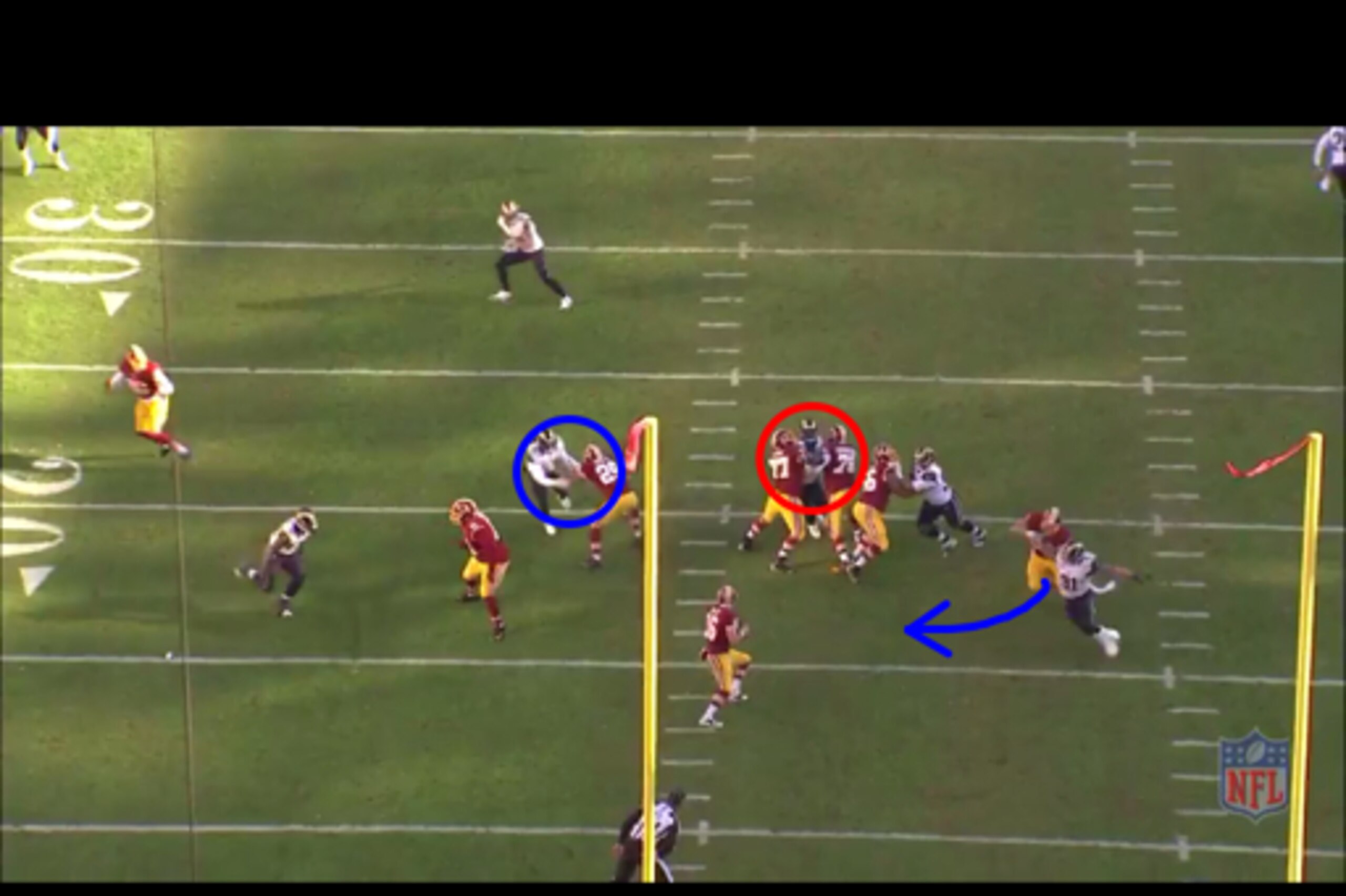
Had Lichtensteiger been able to subdue Donald by himself, Lauvao could've slid off and absorbed Barron. Quarterback Colt McCoy was also forced into the direction of the blitz because Chris Long beat Compton too easily off the right corner. There's those problems in one-on-one situations again.
Those issues meant Helu had to make his block count. Sadly, poor blocks have been common from Washington's running backs this season.
Barron simply swatted Helu aside. This was far too easy for the safety:
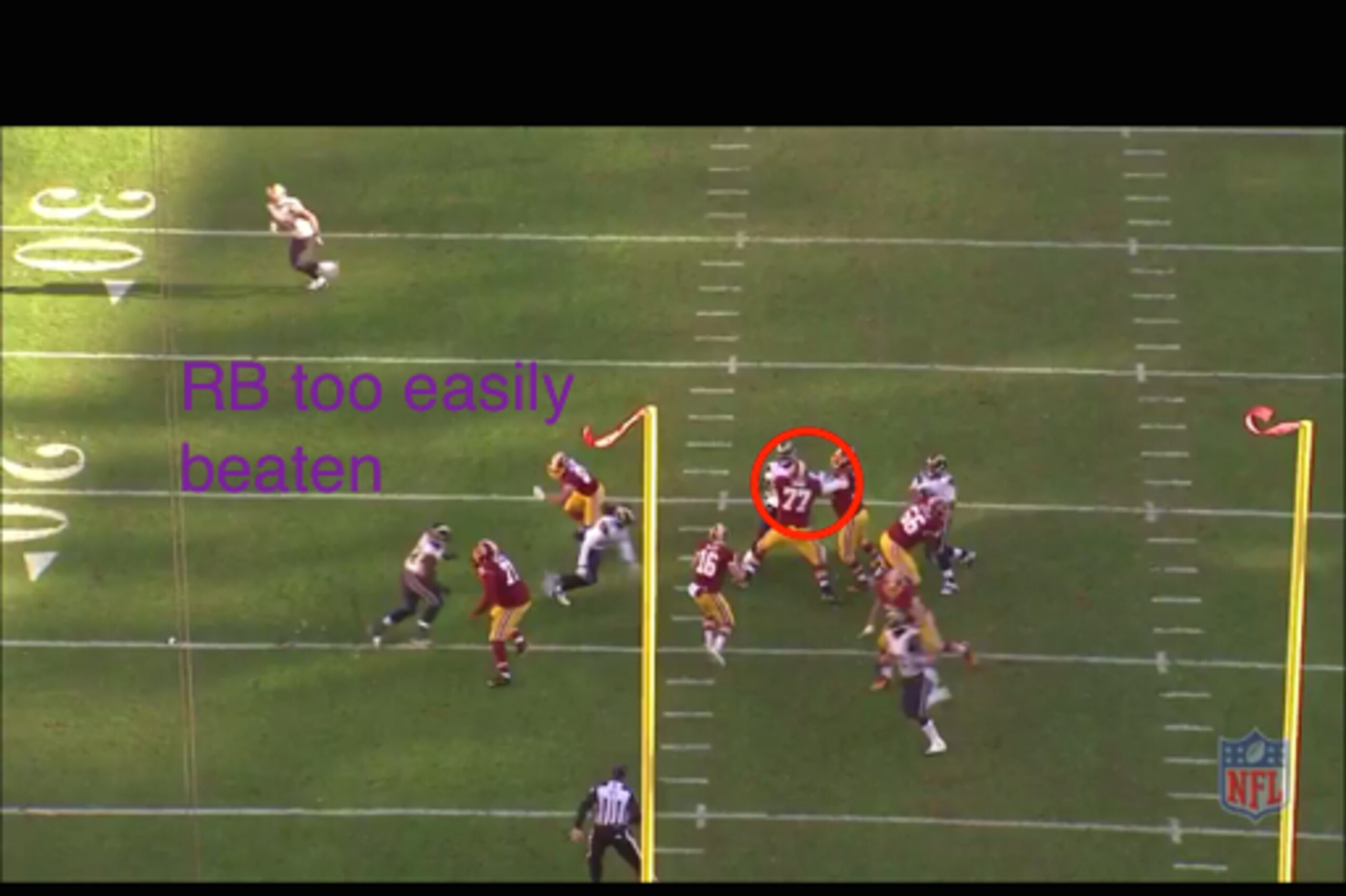
He soon engulfed McCoy to create a big loss:

This play was a reminder of the value of able supplementary blockers. Neither Helu nor Morris, Reed or Paul have fit that description this season.
But the real issues always come back to the same depressing reality: Washington's linemen simply aren't talented enough to win the individual battles that make up trench warfare.
The talent is lacking because recent draft picks—such as 2014 third-rounders Morgan Moses and Spencer Long, along with a player like Compton—have been underwhelming. Worse still, free agents like Lauvao and Chester haven't come close to delivering.
Until there's a proper commitment to recruiting top-notch players at these positions, both via free agency and the draft, Washington's feeble line will continue to be the bane of the offense.
All statistics via NFL.com.
All screen shots courtesy of Fox Sports and NFL.com Game Pass.
.jpg?w=2560)
.jpg?w=2560 "NFL Paris Football")

.jpg?w=2560 "Malik Beasley Negotiating Plea Deal (AP)")