

San Francisco 49ers: Why Doesn't Greg Roman Use Joe Staley and Mike Iupati?
Here’s a memo, either to Greg Roman or whoever replaces him as offensive coordinator for the 2015 San Francisco 49ers—run left. Hand the ball to your running back—whoever it is, be it Carlos Hyde or Frank Gore for one more season—and have him run behind Joe Staley and Mike Iupati.
This was something the 49ers had gotten away from in recent weeks. Against Oakland, they only had seven rushes marked to the left in the official game charting, and on Thanksgiving night, they had just four, two of which were scrambles by Colin Kaepernick. When you have blocking weapons like Staley and Iupati on one side, and are dealing with Jonathan Martin on the other, that’s a very questionable decision.
TOP NEWS
.jpg?w=2560 "Titans Giants Football")
OBJ Calls Out Giants After Release
Lamar Jackson Day-to-Day

Live Live: Updates from every NFL game
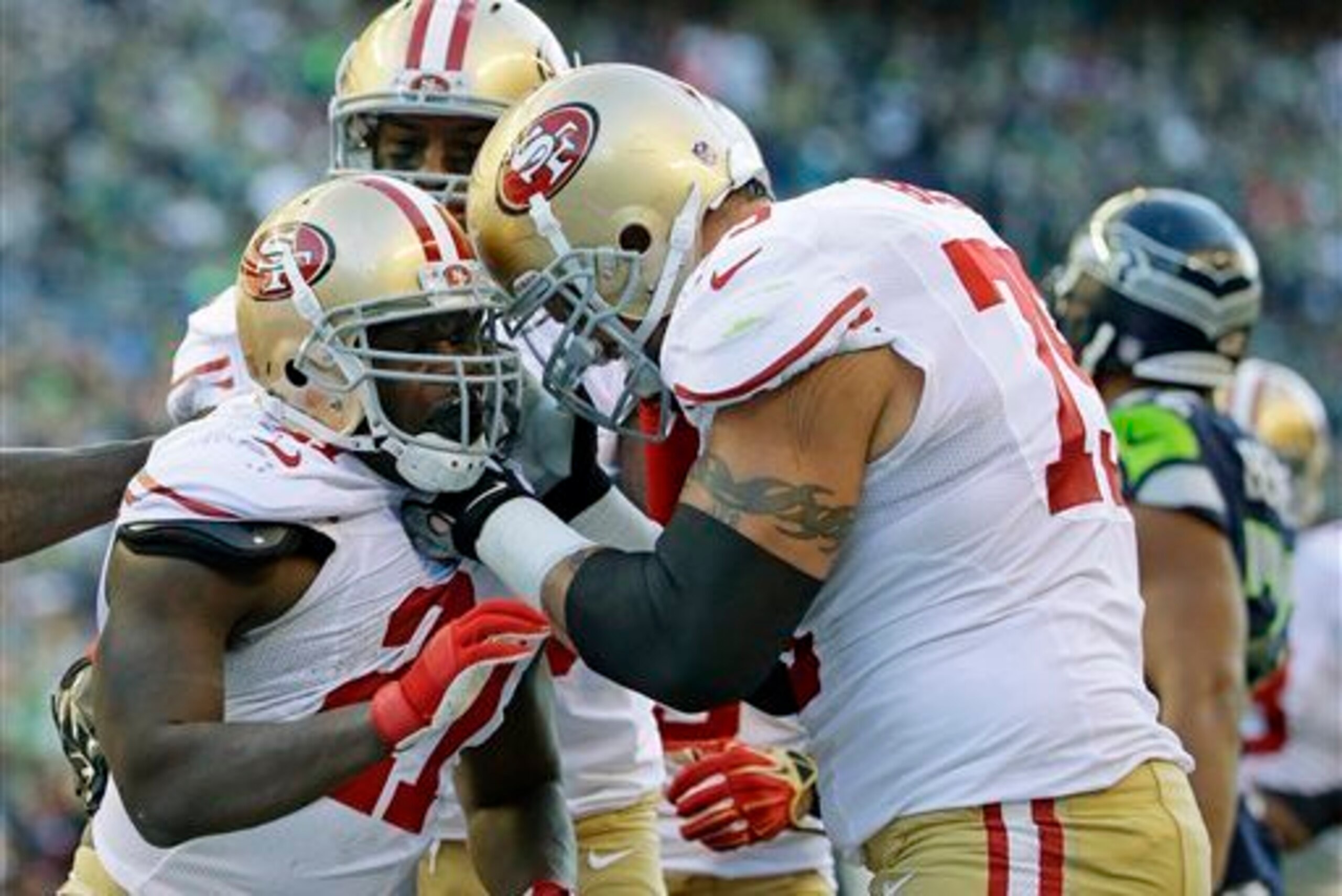
The 49ers countered by running 12 times to the left against Seattle this time, and wouldn’t you know it, the offense looked the best it has in nearly a month—or, at least it did until both Frank Gore and Carlos Hyde went out with injuries.
Hyde ran the ball five times to the left for 50 of his 55 yards. Gore ran it four times for 23 of his 29 yards. They were absolutely thrashing the Seahawks’ front seven in the run game for the entire first half, when they had actual NFL-caliber running backs playing the position, rather than Alfonso Smith, who is essentially a warm body at the NFL level.
You can look at almost any rushing play from the first half to see the effectiveness of the left side of the line, but let’s focus on Frank Gore’s touchdown run early in the second quarter. Not only did the 49ers make the right decision to actually try to put a touchdown on the board rather than kick yet another chip-in field goal in the red zone, they also made the right play call and went to what was working in the first half. Watch as:
- Left guard Mike Iupati takes defensive tackle Kevin Williams to the ground and entirely out of the play.
- Left tackle Joe Staley stones defensive tackle Tony McDaniel, keeping him stationary at the line of scrimmage and allowing Gore to run right by him.
- Right guard Alex Boone pulls to the left through the clean backfield that Iupati and Staley have created, blocking cornerback Byron Maxwell and keeping him from making a touchdown-saving tackle.
- Fullback Bruce Miller seals the other end of the hole by taking on defensive end Cliff Avril, creating a wide running lane for Gore to go through.
- Even the tight ends get in on the action—Asante Cleveland stops linebacker K.J. Wright from going anywhere, and Vernon Davis puts enough of a block on free safety Earl Thomas to at least slow him down and guarantee the first down, though Thomas fights through it and nearly takes Gore down at the goal line.
It’s nothing fancy, and it’s nothing super-complicated—it’s the bread-and-butter-type running play that the 49ers have used game in and game out throughout their recent run of success. You get your three best offensive linemen and your fullback carving out a hole and you run through it for lots of yardage. It’s not rocket science, it’s basic X's and O's.
That’s why it confuses me so much that the 49ers have gotten away from it some this year. Last year, they ran 176 plays to the left, for an average of 4.65 yards per carry, compared to only 4.48 yards per rush on all other running plays. That’s 44 percent of all their rushing plays, cranking out hard to the left.
This year, they’re averaging 4.66 yards per carry on their 146 runs to the left, so just as good as they were last season. They’re only averaging 3.88 yards per carry on all their other runs, so it’s the right side that’s collapsed.
That makes sense, considering Anthony Davis has been hurt, they’ve broken in three new centers now, and Alex Boone started off slow, thanks to his holdout. So, you’d assume they’d recognize this trend and spend more time behind Iupati and Staley on the left.
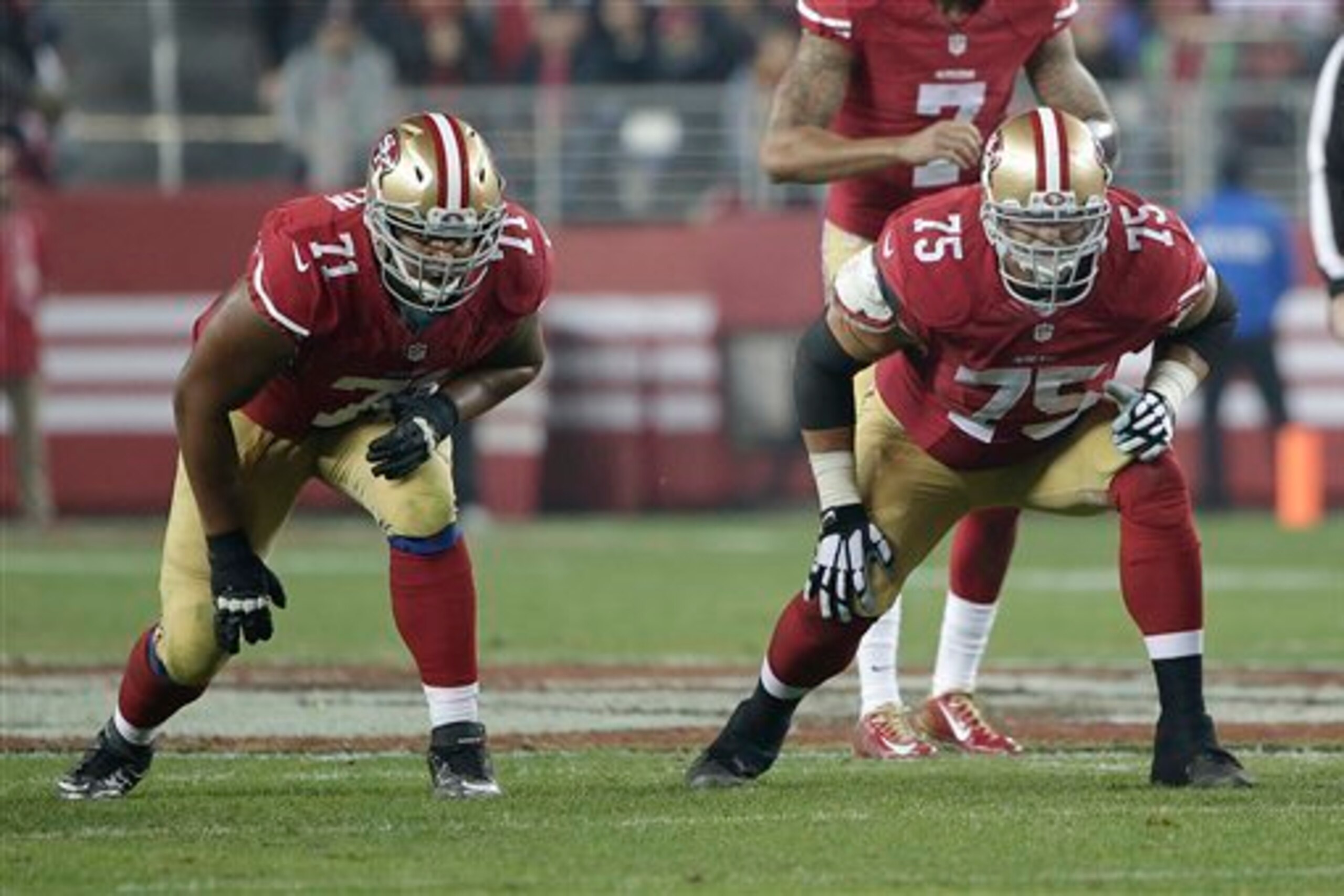
But that’s not the case—in fact, it’s the exact opposite. Only 39 percent of San Francisco’s runs this season have been called to the left, five percentage points off last year’s mark. Greg Roman and the 49ers’ play-callers have seen that the 49ers are still as strong on one side of the line and weaker on the other—and have decided to call more plays toward the weaker side of the line.
Obviously, you can’t just run all your plays in one direction; balance is important. But surely, if one side is nearly 0.8 yards per carry better, you should be trending more toward that side. There are only seven directions the NFL records in the game book; you’d think random chance would have about 43 percent of runs marked to the left.
Knowing that runs to the left are the 49ers’ strong point, that leaves us with a very odd conclusion—the 49ers run-game play-calling literally makes less sense than picking a direction at random. Yes, it’s more complex than picking a direction and telling people to run that way, but it’s also not that difficult of an optimization problem—and it’s one that Roman and his staff have mishandled.
It gets even harder to understand when you see the pattern of play-calling in wins, as opposed to losses. I looked at how many runs to the left were called in each 49ers game, to see if I could find a pattern. I then looked at how many runs to the left were called in one-score games, to help filter out noise of running to drain clock or throwing to desperately catch up. Here are results:
| Dallas | 9 | 34 | 0 | 0 | Win |
| Chicago | 13 | 85 | 5 | 21 | Loss |
| Arizona | 5 | 16 | 5 | 16 | Loss |
| Philadelphia | 17 | 145 | 15 | 134 | Win |
| Kansas City | 15 | 80 | 15 | 80 | Win |
| St. Louis | 7 | -3 | 2 | -2 | Win |
| Denver | 5 | 5 | 2 | 5 | Loss |
| St. Louis | 7 | 32 | 7 | 32 | Loss |
| New Orleans | 22 | 115 | 15 | 92 | Win |
| NY Giants | 11 | 12 | 11 | 12 | Win |
| Washington | 12 | 26 | 12 | 26 | Win |
| Seattle | 4 | 14 | 1 | 10 | Loss |
| Oakland | 7 | 35 | 7 | 35 | Loss |
| Seattle | 12 | 84 | 9 | 73 | Loss |
| WINS | 93 | 408 | 70 | 342 | Win |
| LOSSES | 53 | 271 | 36 | 192 | Loss |
In wins, the 49ers ran to the left an average of 5.7 more times a game than in losses, gaining an average of 20 more yards. Some of that, of course, happens when the 49ers are already winning and draining the clock, but the trends hold up when you just look at the game when the score is close—the 49ers run 4.9 more times a game in wins, for about 21 more yards.
This isn’t an example of the run-to-win fallacy, because it holds up when you look at the patterns just in close games, rather than including situations where teams have to run or pass based on the score and the time remaining.
It does, I admit, hold up stronger when the 49ers are leading by one score as opposed to when they are trailing by one score, and some of it can be explained by the team in general simply playing better on days when they win, but the numbers seem to back up the eye test—the 49ers’ play-calling in losses has been circumspect at best.
Even if the play-calling trends did only hold up when the 49ers are trying to hold onto a lead, that’s still problematic in and of itself!
The 49ers ran 31 plays when tied or up by one score in the loss in Arizona; only four were runs to the left. They ran 17 plays in those situations against Chicago; only two were runs to the left. In total, of 158 plays when holding onto one-score leads in losses, the 49ers ran 22 runs to the left—13.9 percent. Of 201 plays when holding onto one-score leads in wins, the 49ers ran 47 runs to the left—23.3 percent.
The faults of the 49ers' run game are not all on the players. It’s certainly not on the backs of Joe Staley, who’s been as good as ever, or Mike Iupati, who should be re-signed this offseason.
You have to go back to the play-calling and wonder why the 49ers have moved away from running behind their two best offensive linemen. That has to fall squarely on the shoulders of the play-calling and the coaching staff. That, more than anything else, is why the 49ers need a new offensive coordinator for 2015.
Bryan Knowles is a featured columnist for Bleacher Report, covering the San Francisco 49ers. Follow him @BryKno on Twitter.




.jpg?w=2560 "Saquon Out for Game")