Short Passes Will Be Key to Getting Colin Kaepernick Back on Track
Long, downfield passes have been the Achilles' heel for quarterback Colin Kaepernick over the 49ers' recent four-game stretch.
It's a compound problem that has a myriad of influences. The offensive line has not blocked well in 2014, which has given Kaepernick less time to wait for receivers to get open. But then those receivers lack the speed necessary to create separation. Without any speed on offense, opposing safeties can cheat forward without having to worry about giving up the big play.
Then there is Kaepernick.
TOP NEWS
.jpg?w=2560 "Titans Giants Football")
OBJ Calls Out Giants After Release
Lamar Jackson Day-to-Day

Live Live: Updates from every NFL game
His accuracy, decision-making and the ability to read through his progressions have all been weak spots on the season, which leads some—like CBS Sports' Pete Prisco—to question whether or not Kaepernick has progressed at all in 2014.
At 7-6, and with a seemingly impossible task to knock off the Seattle Seahawks on the road, the 49ers' prospects for a playoff berth are all but nonexistent. Add that to the widespread consternation within the organization, and Kaepernick's poor play is simply a reflection of all that has gone wrong with San Francisco.
Yet Kaepernick is still the 49ers' guy under center. Calls for him to be cut stand in contrast to the notion that the front office still wants Kaepernick as its franchise quarterback. 2015 may be the ultimate test, but putting the third-year pro into a situation that utilizes his strengths will be a necessary part of the fix.
"Trade Harbaugh to raiders (#1 pick) , fire OC Gregg Roman, release or trade Kaepernick. draft Marriota. Bam Super Bowl next year.
— Effy (@Efrain_valdez75) December 8, 2014"
Kaepernick has a cannon for an arm. But it's not accurate. His pocket presence is also not the best. Yet there is a way in which the 49ers' play-calling can utilize an offense that ultimately benefits Kaepernick's abilities.
Instead of consistently relying upon big plays—hoping for miracle catches in tight coverage—the 49ers would be wise to shorten the offense. This unit can't stretch the field, so why try? Short, high-percentage attempts would not only act as an extension of the running game but would also help to restore the broken confidence Kaepernick has in his own abilities.

Breaking Down the Numbers
The last four weeks have provided more than ample evidence regarding Kaepernick's difficulties under center.
In three of those four games, Kaepernick passed for less than 200 yards. Additionally, those three contests saw the quarterback complete less than 60 percent of his passes. Over that same stretch, Kaepernick has tossed just two touchdowns against five interceptions.
All five of those picks came on attempts of 15 yards or more. ESPN Stats & Info provides a detailed look at what the 49ers signal-caller has done with passes of 15 yards or more since Week 11:
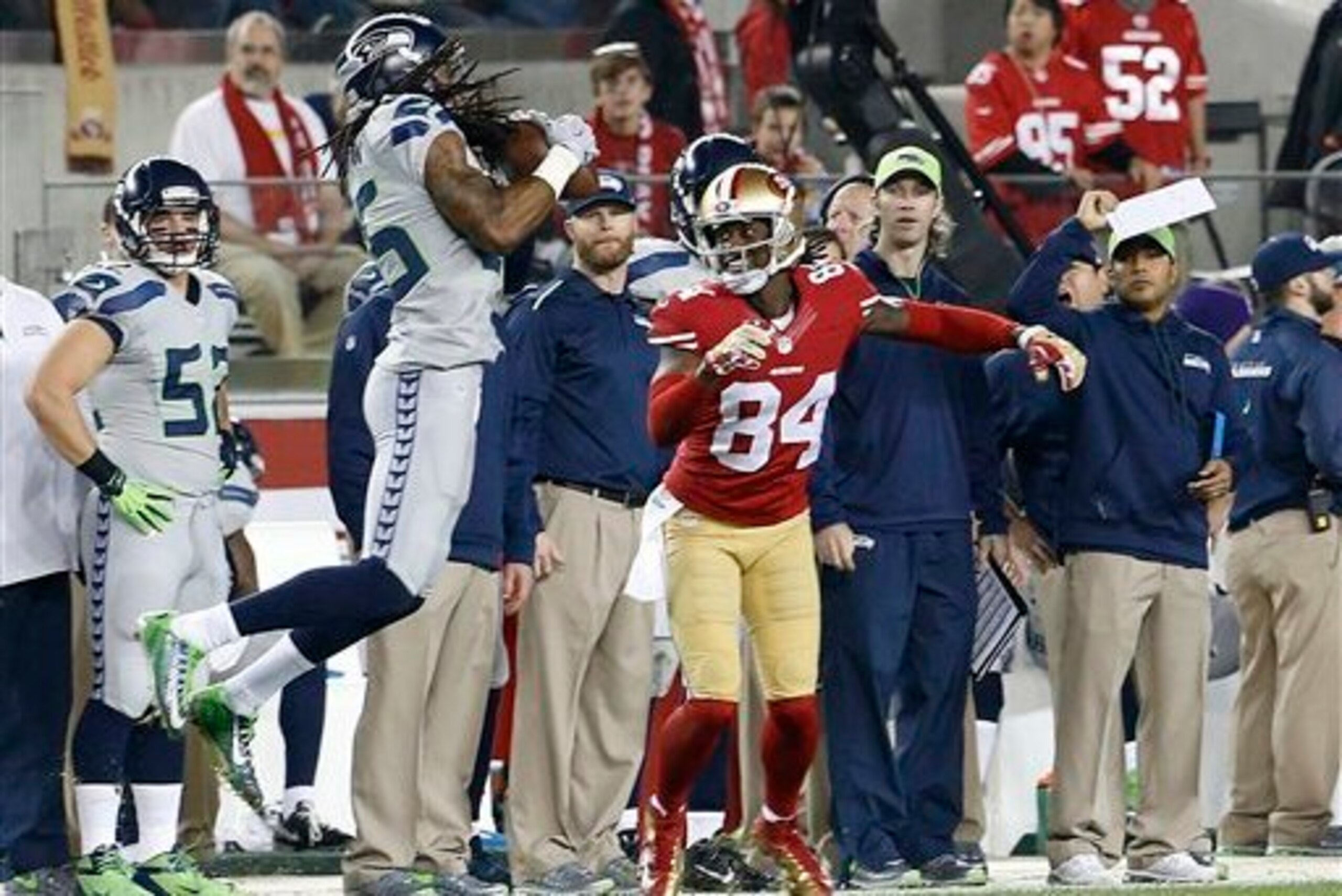
The numbers aren't pretty. Fans can recall Seahawks cornerback Richard Sherman's two interceptions off Kaepernick in Week 13. The subsequent picks by the Oakland Raiders the following week also revealed the quarterback's ineffectiveness at accurate downfield passes.
| Week 11 | @ New York Giants | 15 | 29 | 51.72 | 1 | 0 | 84.4 |
| Week 12 | vs. Washington Redskins | 20 | 29 | 68.97 | 1 | 1 | 93.5 |
| Week 13 | vs. Seattle Seahawks | 16 | 29 | 55.17 | 0 | 2 | 36.7 |
| Week 14 | @ Oakland Raiders | 18 | 33 | 54.55 | 1 | 2 | 54.4 |
| Total | 69 | 120 | 57.5 | 3 | 5 | 67.25 |
Kaepernick has a 74.0 passer rating on plays requiring 10-plus yards for a first down. He has five touchdowns against seven interceptions in this area and boasts the lowest completion percentage (58.82) compared to any other situation.
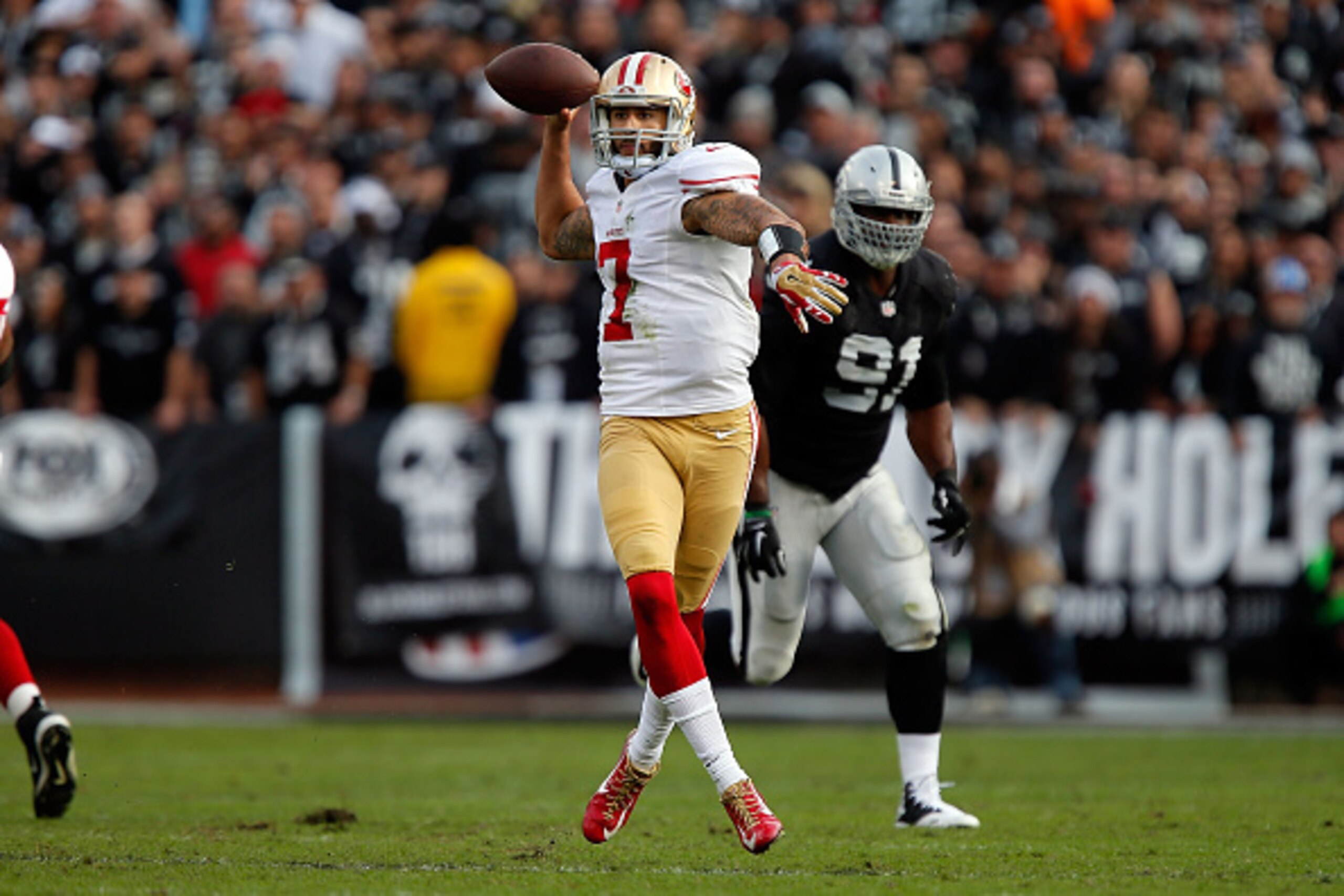
Now, the 49ers aren't suddenly going to get faster in Week 15. Kaepernick probably won't display more poise and pocket awareness by that time either.
So what can San Francisco's coaching staff do in the meantime? It can put Kaepernick and the offense in a better position to be successful by emphasizing this unit's strengths—an approach that has largely eluded the offense over the course of this season.
Breaking Down the Film
The combination of poor decisions and inaccuracy can spell disaster for any quarterback.
Kaepernick has, unfortunately, displayed this relationship all too well in back-to-back weeks. Both of his interceptions thrown against Seattle were bad decisions in which other options were available. Both passes were off the mark.
We know the results.
But Kaepernick repeated these same mistakes against Oakland the following week—one of which revealed his errors on the 49ers' first offensive play of the contest.
Kaepernick will attempt a deep pass intended for wide receiver Michael Crabtree. Crabtree is at the top of the screen and will attempt to come back to his quarterback before moving deeper into the secondary. Fullback Bruce Miller (yellow at far left) will move into the right flat, while the Raiders defender will break off from initial coverage.
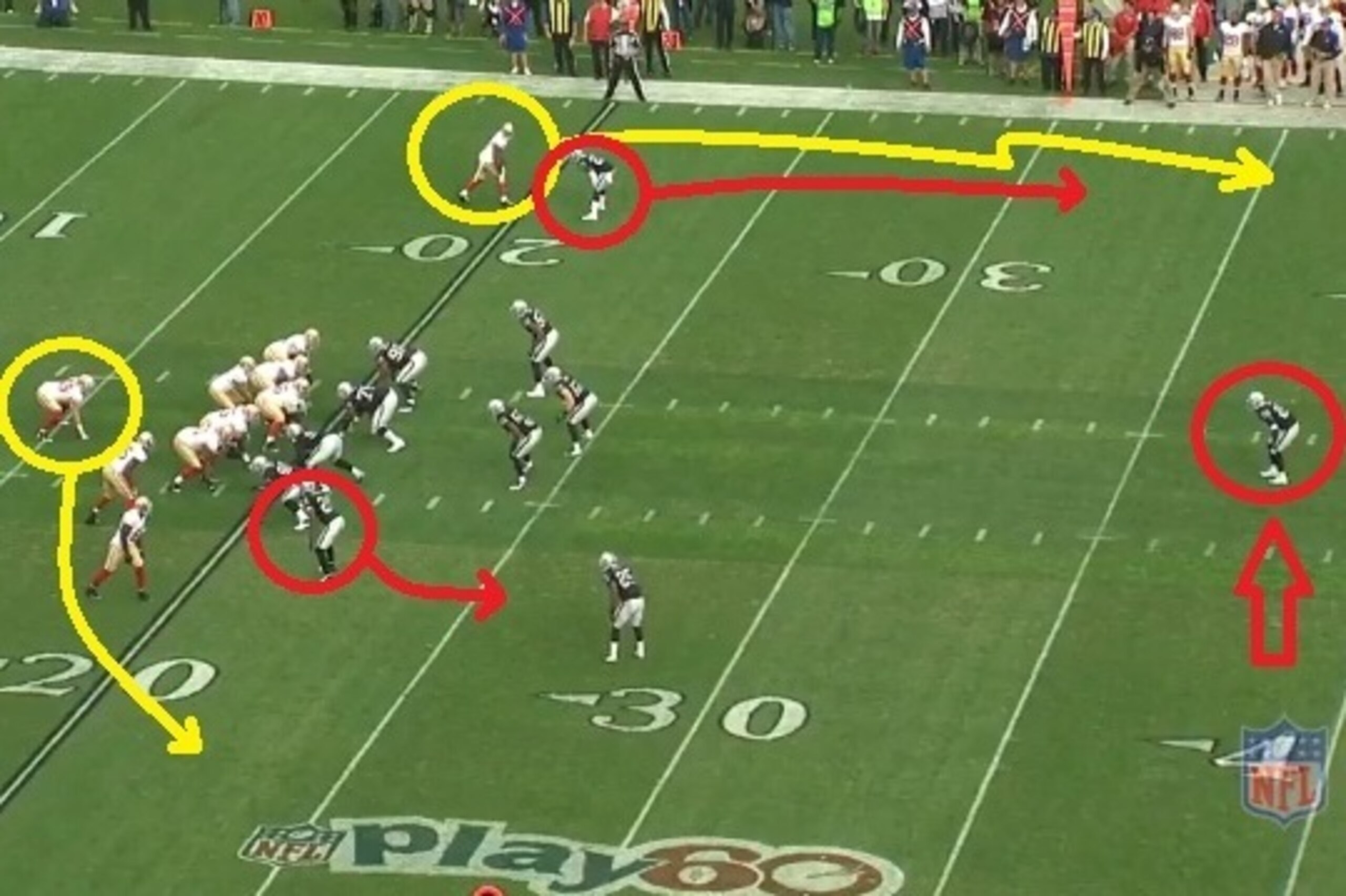
In this shot, Kaepernick's vision is entirely focused on Crabtree's side of the field. Kaepernick fails to notice how open Miller is to his right. A completed pass here would have likely picked up a decent six-plus yard gain. Kaepernick doesn't react and is flushed out of the pocket from Oakland's pass rush and locks onto Crabtree the entire way.
Note how defensive back Brandian Ross (red at far right) switches direction to provide coverage over the top.
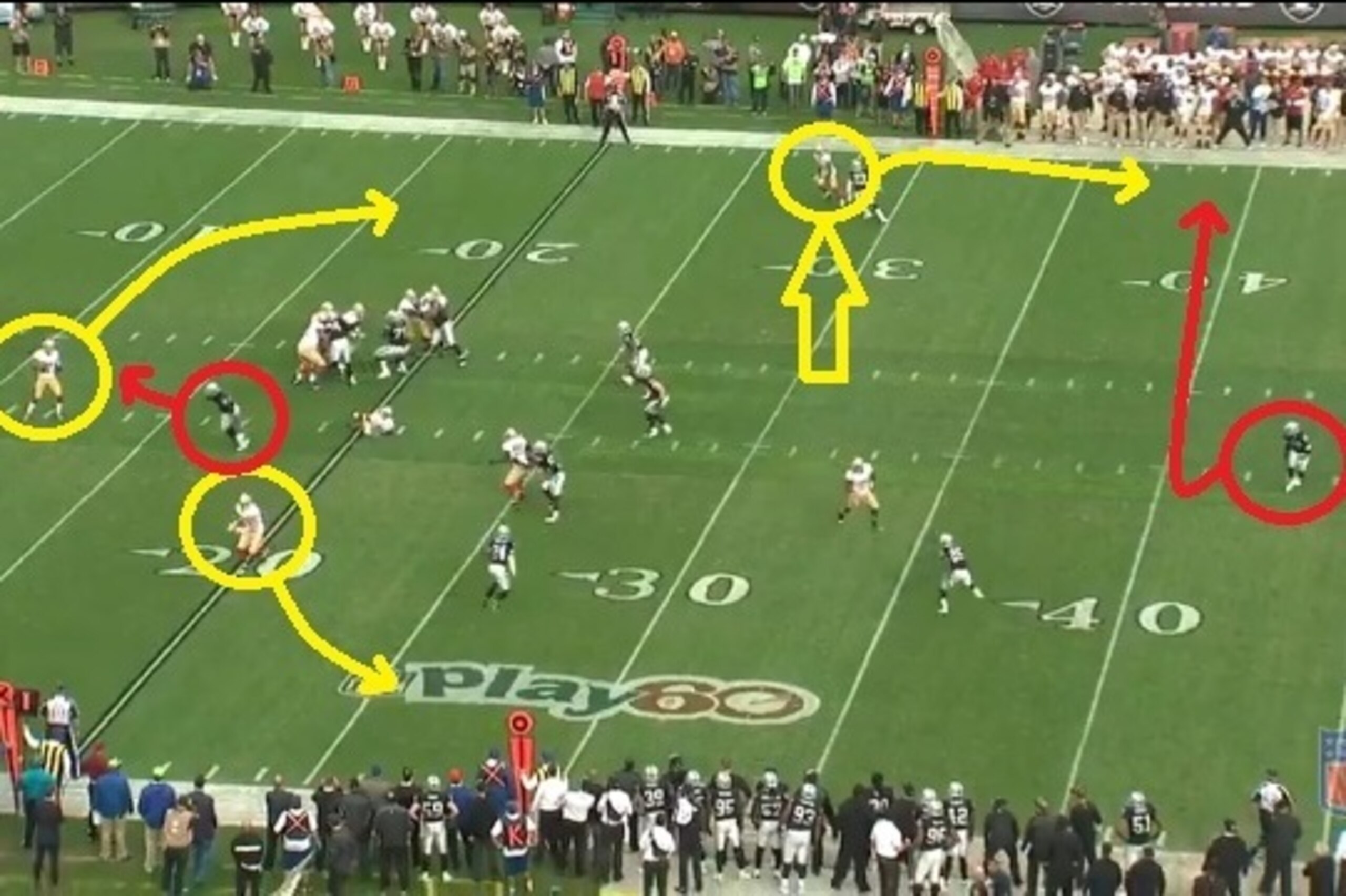
Kaepernick's pass sails over the head of Crabtree, and Ross is able to jump the overthrown ball and come away with an easy pick.
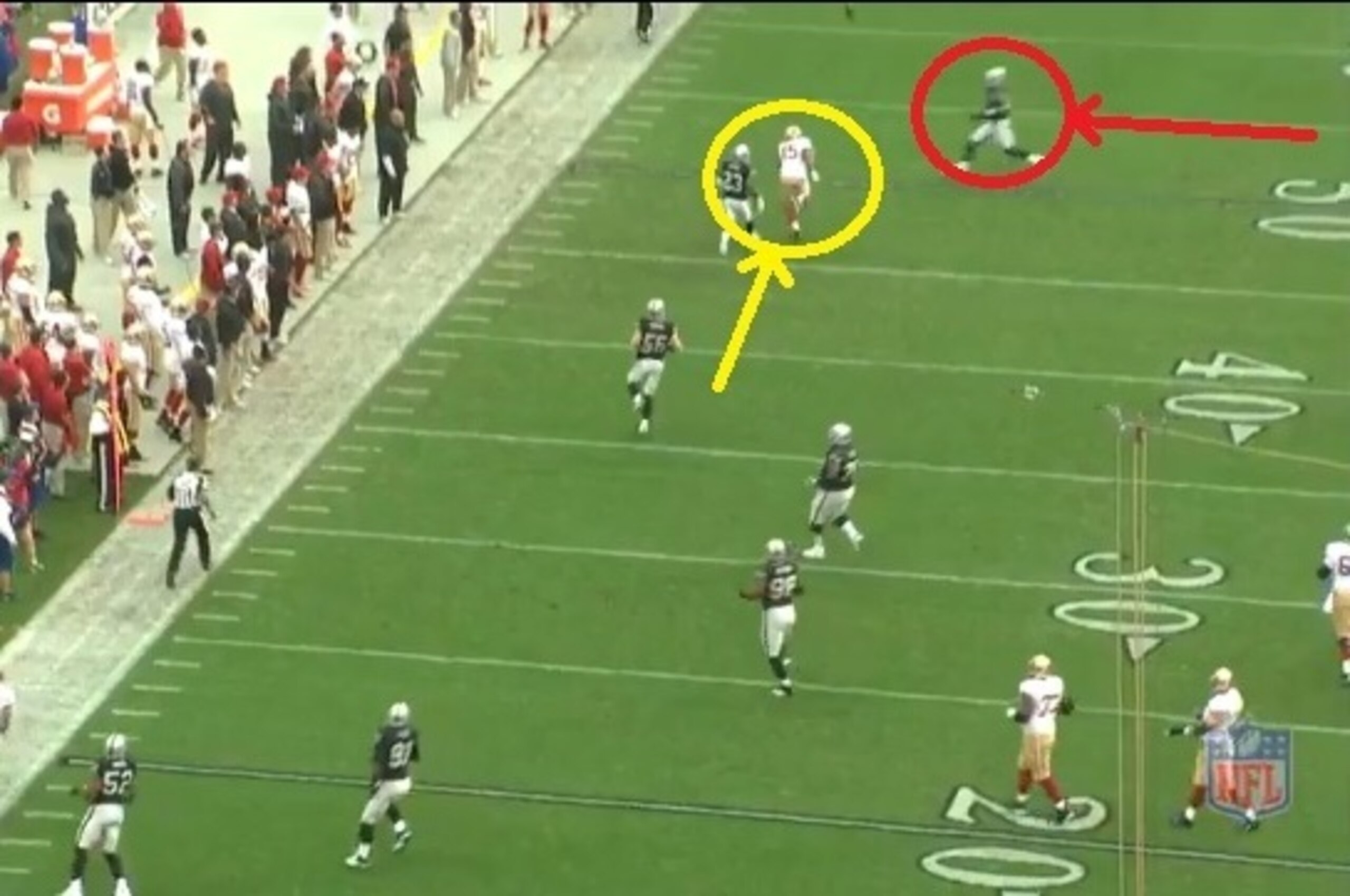
Poor reaction, bad decision-making and an inaccurate throw resulted in this interception on the 49ers' first play from scrimmage. Had he reacted quicker, Kaepernick could have utilized a short pass to his fullback in the flat. This would have resulted in a modest first-down gain, setting up additional options for the play-calling.
Kaepernick's second interception came in the fourth quarter at the 2:42 mark—a point where the 49ers found themselves trailing 24-13. Tight end Vernon Davis will be the target. Notice how the O-line will do a good job in pass protection on this particular play.

The pass will be forced to Davis (lower-right in yellow). Davis is coming back to his receiver but is also contending with tight coverage from the Raiders defender. Kaepernick fails to notice safety Charles Woodson (red circle), who is able to jump the route and haul in the underthrown pass.
But the other options reveal Kaepernick's poor decision-making on this play. Crabtree is coming back to help out at the top of the photo. Even more revealing is how open running back Carlos Hyde is at the 19-yard line.

And pressure wasn't the issue. The O-line continued to hold its blocks throughout this play. True, San Francisco was fighting the clock, but almost anything would have been better than Kaepernick's choice here.
"VIDEO: Colin Kaepernick picked off by Charles Woodson http://t.co/EfQu4kR88Q #SFvsOAK pic.twitter.com/ob6ARX255f
— NFL Now (@NFLNow) December 8, 2014"
Forcing passes, especially those that are inaccurate, are not working for Kaepernick right now. Instead, the 49ers should be calling plays that rely more on short, high-percentage efforts that methodically move the ball down the field. San Francisco lacks the breakaway speed to do otherwise.
Kaepernick and the offense did show this capability in what otherwise was a poor showing on Sunday.
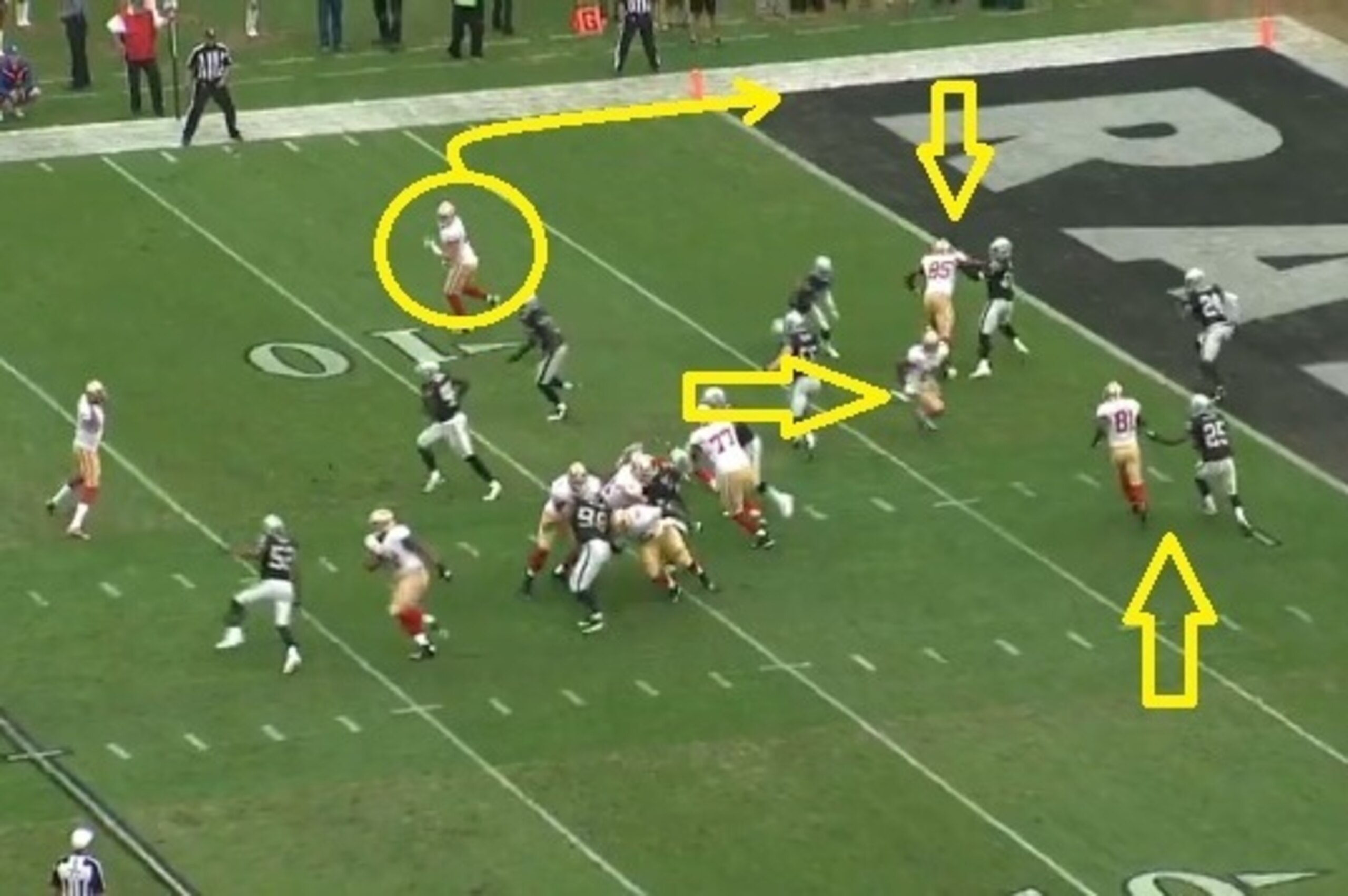
It came on the 49ers' lone touchdown during the effort: an eight-yard touchdown reception by Miller at the 2:00 mark of the first quarter.
A red-zone touchdown? We haven't seen many of those.
Miller (yellow arrow) is lined up in a standard I-formation. Davis motions to the right and will move toward the center of the end zone, drawing coverage in his direction. Crabtree and Anquan Boldin will cross just behind the Raiders' defensive front.

The commotion in the center of the field allows Miller to move out uncovered. Oakland reacts too late, and the fullback is able to scoot in easily for the score.

Making Quick Offensive Adjustments
For all the hype and controversy that has surrounded Harbaugh and offensive coordinator Greg Roman, the likelihood is that neither will be dismissed from duty before season's end. There aren't going to be any drastic changes in personnel at this point.
Like it or not, this is what the 49ers offense will look like over the remaining three games. Therefore, it falls upon the coaches and players to implement a game plan that will best give San Francisco a chance to correct the recent offensive woes.
Kaepernick will continue to be a primary factor regardless of his shortcomings—problems that were described further by NFL Films Senior Producer Greg Cosell on KNBR 680 (h/t Matt Maiocco of CSN Bay Area):
"I wouldn't call him a precise thrower even at his best. He's not necessarily a guy that puts it right there. ... Something that is a concerning issue, particularly since he's started more than 40 games, he still struggles to relate the route concepts to the coverage and to quickly isolate where to go with the ball. At this point, I think he needs to be able to do that better.
I have no idea how he's coached, I couldn't answer that. But he remains predominantly a predetermined thrower. If the throw that he wants, which is the primary, is not there -- he has a tendency to break down in the pocket, drop his eyes and look to move.
"
Why try to force something he is not good at? Downfield, tight-window passes are not Kaepernick's forte in spite of his strong arm—at least not now. This aspect isn't helped by the lack of speed or elongated pass protection from his O-line.
The long-term solution may solve this via drafting a speedy target. Attempts to develop Kaepernick into a better pocket passer also won't happen within a week.
Instead, the 49ers would be better off presenting Kaepernick with opportunities in which he can succeed. Short passes—fueled by slant patterns, out routes and hitch plays—have a higher probability of working than what the offense has attempted of late. Swing passes and screens also have their places in this type of approach.
Danny Kelly of SB Nation points out how teams have utilized this type of offense against defenses that are succeeding with the pass rush. Pressure has forced the 49ers' hand; their 43 sacks allowed speak to this.
And it wouldn't hurt to utilize more of what made Kaepernick successful in the first place: read-option plays executed at the right moment.
Ultimately, this falls upon Roman and the offensive coaches to scheme up game plans that focus more on what Kaepernick and the offense in general can do more effectively. Whether or not the play-calling involves this approach has yet to be determined.
But with the season almost over, it wouldn't hurt to change up the offensive attack just a bit.
Heck, anything would be better than what has been witnessed lately.
All statistics, records and accolades courtesy of Pro-Football-Reference.com unless otherwise indicated.
Peter Panacy is a featured columnist for Bleacher Report, covering the San Francisco 49ers. Be sure to check out his entire archive on 49ers' news, insight and analysis.
Follow him @PeterPanacy on Twitter.



.jpg?w=2560 "Saquon Out for Game")