Who Is Most to Blame for the 49ers' Rushing Issues?
The San Francisco 49ers' running game is trending down. And I'm not just talking game by game. I'm talking year by year.
In 2012, the 49ers averaged the fourth-most rushing yards per game in the NFL with 155.7. Last year, they stayed in the top five with 137.6 yards per game on the ground.
This season? They're 12th in the league at 114.8. Worse yet, their yards-per-carry total has dropped from 5.1 in 2012 to 4.4 in 2013 to 4.0 in 2014.
.jpg?w=2560 "Titans Giants Football")

They hit rock bottom last week against the Seattle Seahawks. The 49ers had just 64 rushing yards, giving them a two-week total of 130.
Any time a running game is struggling, the quarterback, running back, offensive line and coaches are put under the microscope. Of these four parties, which is most to blame? Let's investigate.
Frank Gore/49ers running backs
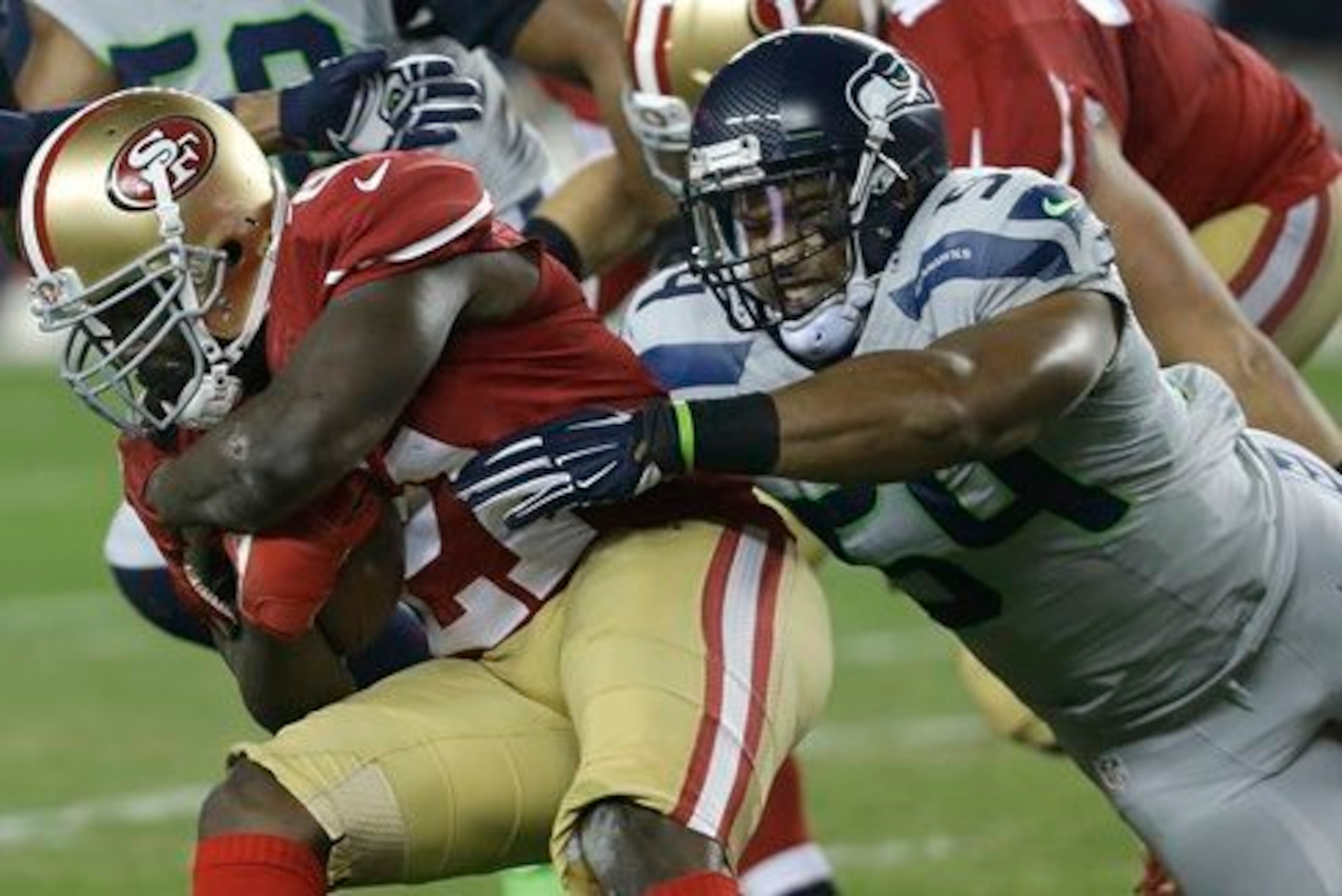
It might be a stretch to say Frank Gore is absolved of all blame, but he's the least guilty of the central figures.
Because he's not a threat to stretch defenses from side to side, opponents often stack the middle of the field with several linebackers and safeties. This means the 49ers, who run up the middle more often than not, are usually running right into the teeth of the defense.
However, the 49ers have thrived running the ball despite Gore's lack of breakaway speed since Jim Harbaugh took over the 49ers in 2011.
Teams have attempted to shut down the 49ers' running attack by suffocating the middle of the field for years, but to no avail—until this year.
Maybe Gore has lost a step (which I haven't noticed), but that's missing the bigger picture.
Even if he is slower, it's not like he's suddenly lost his best quality: his vision.
When there's been a hole to run through, Gore has consistently found it. The problem is there are fewer holes than in years past.
Sure, Carlos Hyde and Gore aren't the most physically gifted running backs in the league. But it seems silly to blame them for not being something they never were.
Offensive line
Injuries have taken their toll on the offensive line's performance. Tackle Anthony Davis has only appeared in five games. Center Daniel Kilgore suffered a season-ending injury against the Denver Broncos in Week 7. Guard Mike Iupati missed the Denver game.
But poor performance has been an even bigger problem for the unit.
Look at the difference in Pro Football Focus grade (subscription required) for San Francisco's four returning starting linemen from 2012 to 2014:
| Staley | Iupati | Boone | Davis | |
| 2012 | +37.5 | +22.5 | +24.6 | +19.0 |
| 2013 | +24.3 | +2.6 | -1.2 | 7.2 |
| 2014 | +14.5 | +9.4 | +0.2 | -7.4 |
All four have regressed immensely since 2012. Davis, in particular, has had a miserable 2014 season, while Alex Boone's offseason holdout has done no favors to his performance. Only Joe Staley is consistently playing at an above-average level.
Not listed in the graphic are Jonathan Martin and Marcus Martin. They've been the unit's two worst performers.
Jonathan Martin has played in 237 more snaps than Davis. The results for the backup right tackle have been horrendous, as he's allowed 18 hurries and a team-high six sacks, per PFF.
Marcus Martin, meanwhile, is already a minus-7.0 on PFF in just five games.
Yet, despite the struggles of the Martins and the regression of Davis, the 49ers are PFF's third-highest-rated run-blocking team in the NFL.
The unit has played worse this year than it did last year, but its regression is undoubtedly tied to (caused by?) poor quarterback play and coaching.
Colin Kaepernick

Teams consistently defend the 49ers with eight players in the box on first and second down. The idea is to take away Gore and Colin Kaepernick's running ability.
But the strategy also gives Kaepernick favorable passing looks. He frequently fails to take advantage of them.
After the 49ers' 17-13 win over the Redskins in Week 12, CSN Bay Area's Matt Maiocco reported San Francisco had surrendered an NFL-high 15 sacks on first-down plays. That total is up to 17 after the 49ers allowed two more against the Seahawks.
Kaepernick's tendency to take sacks on first-down plays is killing this offense. When teams stack the box, he's inevitably going to have single coverage on his wide receivers. There's no reason for him to be holding the ball in these situations.
When defenses aren't concerned with a quarterback's ability to beat their blitzes and stacked boxes, they'll keep bringing a safety near the line of scrimmage. It's on Kaepernick to soften the defense to set up the rushing attack.
He hasn't done that, which in turn limits the space he and Gore need to run.
Maiocco reported the 49ers average just 3.59 yards per carry on 1st-and-10 running plays, which is the 10th-worst average in the league.
So, to recap, the 49ers are running into walls and taking sacks on first down, which is supposed to be the most advantageous down for offenses.
Kaepernick has to be better, but this clearly suggests San Francisco's coaches are being outsmarted, too.
Coaching staff
I've long believed coaches have more control of what happens in football games than they do in games of most other North American professional sports, which is why I'd be a hypocrite not to acknowledge the coaches' part in all of this.
Bad execution will make any coach's job impossible. But bad play-calling will severely hamstring a player's ability to execute. The 49ers are guilty of both.
An important part of play-calling is installing new plays from year to year that work. The 49ers haven't done that.
It's been glaringly noticeable against NFC West teams. Earlier this year, the Cardinals, Rams and Seahawks played the Greg Roman/Jim Harbaugh offense for the seventh or eighth time in the last four seasons.
They all shut down San Francisco's rushing attack:
| Opponent | RB yards | Kap yards | Total | YPC |
| @ ARZ | 28 | 54 | 82 | 3.6 |
| @ STL | 52 | 37 | 89 | 3.0 |
| vs. STL | 66 | 14 | 80 | 3.8 |
| vs. SEA | 47 | 17 | 64 | 3.6 |
After the Seahawks ripped the 49ers 19-3 on Thanksgiving Day, Seattle cornerback Richard Sherman talked about his familiarity playing San Francisco, per Terry Blount of ESPN.com.
"We know them so well it’s like playing against your brothers," Sherman said. "You know all their moves and what they’re going to do, so it comes down to will against will."
At times, it seemed like the Seahawks knew the 49ers' plays before the snap.
Maybe the 49ers need to feature more tosses. Maybe they need to run the ball out of spread formations more. Maybe they need to utilize Kaepernick's running ability more to open rushing lanes for their running backs.
Instead, we're seeing the same running plays we've seen since 2011. The rest of the NFC West has evidently caught on.
And the winner is...
It's a three-horse race between Kaepernick, the offensive line and coaches. You could make a good case for any of the three, but I'm putting most of these issues on the coaching staff.
It's not like the offensive linemen suddenly aged out of their primes. They're all young and talented. For whatever reason, the coaches haven't unlocked their talents as well as they did in 2012, when the 49ers were the most dominant running team in the NFL.
The coaches have also tried to make Kaepernick a pocket passer. They've gone away from read-option runs almost entirely. Kaepernick seems less inclined to scramble, which must be a relief to opposing defenses.
In the NFL, it all comes back to coaching. If Harbaugh and Roman stay one step ahead of opposing coaches, San Francisco's offense has shown it can be efficient enough to win games.
Getting one step ahead is the tricky part. Especially with rematches with Seattle and Arizona's defenses on the horizon.
Rest assured, if the 49ers don't fix their running game, they will not make the playoffs.
Joseph Akeley is a San Francisco 49ers featured columnist. Follow Jakeley_BR on Twitter.