He looks like the bat boy. He looks like the skateboard dude next door. Now, Tiny Tim Lincecum looks like he might be off to the most brilliant start of any great pitcher in history.
Lincecum has been called "The Freak," "The Franchise," and "Seabiscuit." Could he be on his way to becoming "The Ace of Diamonds," the greatest pitcher of them all?
A great pitcher is measured by his earned run average, his wins and losses. Also by the rate at which he allows hits, walks, home runs, and walks plus hits (WHIP). An additional factor is how often he strikes out batters. That often is sizzle to the pitcher's steak.
TOP NEWS

MLB Commissioner Defends Salary Cap

Miz Sets WS Record Already ⛽
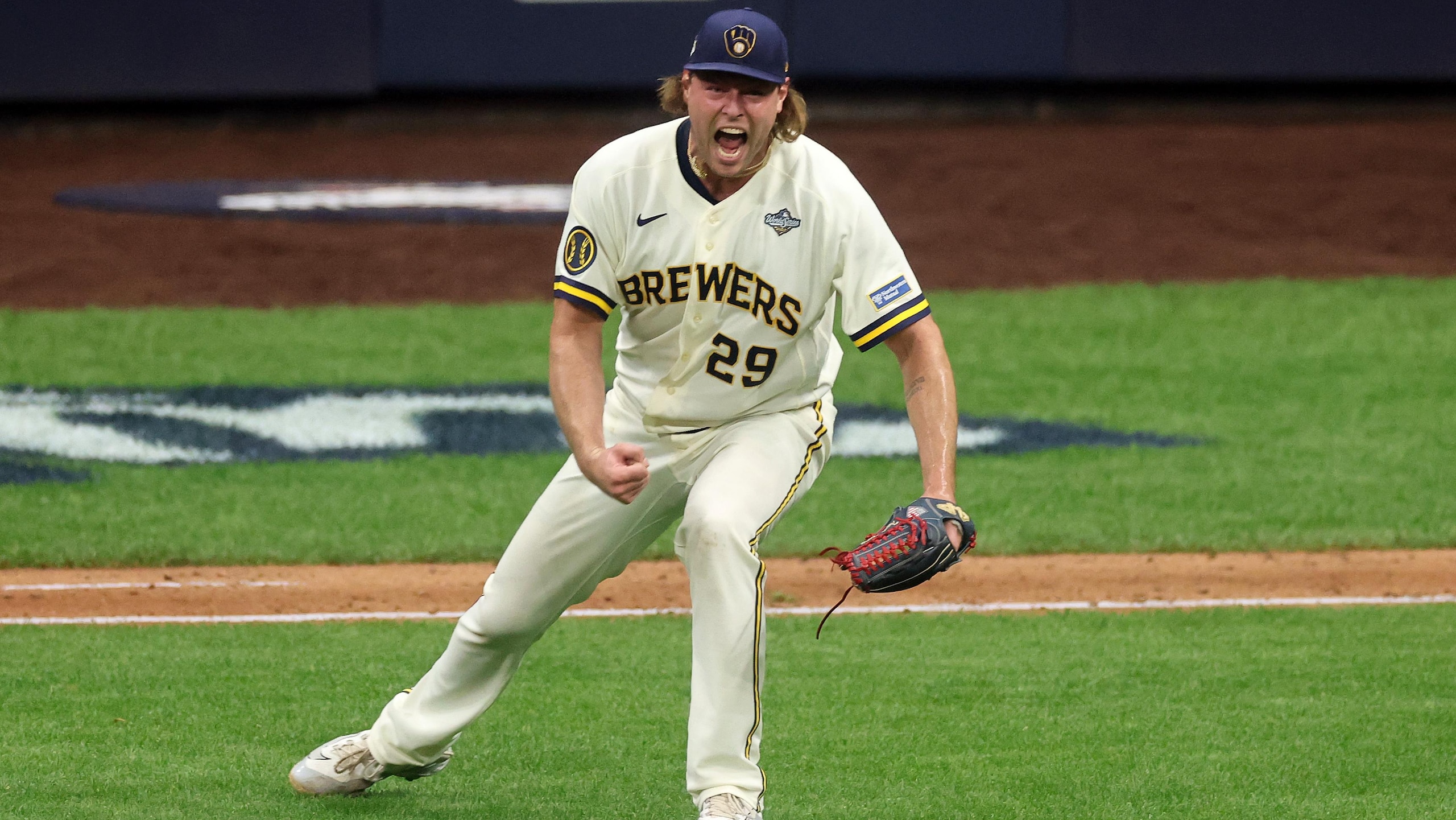
Brewers Get 1st WS Win Since 1982 💪
Perhaps the best way of comparing hurlers of different eras is by using Adjusted ERA+. A pitcher's earned run average (ERA) is adjusted for park factors, then divided into his league's average ERA.
A 100 score is average, with an ERA+ of 110 being 10 percent above average. A mark of 90 indicates a performance 10 percent below the norm.
Lincecum's 187 ERA+ this season overshadows that of any great pitcher in any of his first three seasons of 50 innings or more. His league-leading 167 ERA+ in 2008 is fifth-best, behind also Cy Young's 176, Roger Clemens' 169 and Warren Spahn's 168.
Only two other single season scores are above Lincecum's career average 150 ERA+.
The 16 top pitchers plus Lincecum have a combined 51 seasons among their first three. The Freak is on his way to two of the top five seasons among them. If Lincecum had pitched the required 1000 innings he would rank second in the career rankings among all these great pitchers, behind only Pedro Martinez's 154 career mark.
Over his first three seasons, Lincecum has pitched half again as productively as his peers. Others have had lower pure ERA's, but they played in lower-scoring eras and didn't stand above their peers to the extent that Lincecum has.
How about winning and losing? The Franchise is also near the top in that area.
Clemens' .755 winning percentage (40-13) in his first three seasons leads the pack, but Lincecum's .731 (36-13) is close behind. Lincecum put up that impressive winning percentage playing for a mostly losing team that ranked near the bottom of the National League in runs scored.
Among the other greats, only Grover Cleveland Alexander (.645), Tom Seaver (.640), Young (.637), Martinez (.636), Warren Spahn (.620) and former Giant Carl Hubbell (.608) exceeded .600 in their three formative seasons. Walter Johnson (.400), Bob Gibson (.452) and Sandy Koufax (.486) didn't even reach .500.
How about dominating the pitcher's own league?
Lefty Grove, considered by many to be the top southpaw of all time, led his league in key categories nine times in his first three seasons, more than any other retired pitcher on this list. He led his league in both strikeouts and strikeouts per nine innings(K/9) three times. In addition, he paced his league in ERA, ERA+ and hits per nine frames (H/9).
Lincecum is tied with Grove, also leading nine times in the various categories. He has led or is leading his league in strikeouts and K/9 twice each. He has also topped his circuit in winning percentage, ERA, ERA+, H/9 and homers per nine innings (HR/9).
Lincecum might lead even more areas when the 2009 season is complete. He is tied for the 2009 National League lead in both complete games and shutouts this season.
The other top pitchers topped the subject categories as follows: Young and Clemens five each, Alexander four, Spahn and Bob Feller three apiece, Seaver and ex-Giant Christy Mathewson two each, and Walter Johnson and Gibson once apiece. Martinez, Greg Maddux, Hubbell, Koufax, Steve Carlton and Randy Johnson failed to lead in any major category during any of their first three seasons.
In nearly every category or group of categories we wish to measure, Lincecum ranks at or near the top. The sole area in which he hasn't come close is his walk rate.
In that one deficient area he has been steadily improving from 4.0 walks per nine innings in his rookie season to 2.4 this year. Surprisingly, his walk rates in his first three seasons compare closely to those of Maddux, who went on to become one of the best control pitchers in history.
Could Lincecum continue to make control improvements similar to Maddux? Wouldn't that be freaky!
Lest we think that Lincecum's start guarantees he will ultimately become the best hurler or even one of the all-time greats, we must not forget that most of these great pitchers achieved their greatness in later seasons. Walter Johnson is considered by many to be the best of all time, and he barely made a dent among the league leaders in his first three seasons.
Koufax and Martinez went on to post two of the greatest peaks of any pitchers ever, even though neither got off to a spectacular start to his career. Randy Johnson overcame a slow start to win 300 games. The others also went on to post many great seasons, or they wouldn't have reached our list.
Nor should we forget Dwight Gooden. Gooden burst onto the major league scene with a fire that engulfed any and all of these greats, including The Franchise. Not only did he tie Lincecum and Grove by leading in nine categories, he posted an amazing 228 ERA+ at the age of 20 in just his second season. That figures ranks as the 12th best season of any pitcher in any season in history and dwarfs even this elite company during their first three seasons.
We haven't read about Gooden among these 16 greats because drugs and arm trouble limited him to being a very good pitcher, not an all-timer. As Lincecum himself would be the first to tell us, three marvelous seasons do not a great career make.
Yet Lincecum's drug of choice seems to be his youthful effervescence. His "nose to toes" delivery has been designed to minimize the pressure on his arm and reduce the chance of injury. Perhaps he will continue to make the improvements that have reduced his ERA from 4.00 his rookie season to 2.62 in 2008 and 2.30 in 2009.
When President Barack Obama asked Lincecum at this year's All-Star Game how Tim does what he does, The Franchise told him that underneath his thin skin he had big muscles.
Will he continue to muscle his way into history? Will The Freak forge on to become truly the Ace of Diamonds, or will he, like Gooden, renege into a joker? Will dominance continue to be his calling card?
Will his special delivery trump the injury bug that can too easily become the bidding of the vulnerable arms of pitchers? Will Lincecum's ability to continue to learn the art of pitching remain his strong suit?
Here's the deal. A great career is built over a decade or more, not merely years. History will have to wait, and sadly so will we.
Meanwhile, Seabiscuit is giving us one heck of a ride.
.png?w=2560)


.jpg?w=2560 "NFL House in Paris Closes for Protests")

.jpg?w=2560 "Trevon Diggs Cut by Seahawks")