In Greek mythology, the goddess Thetis attempted to bestow power on her susceptible son by dipping the boy's body into the River Styx, which supposedly possessed the miraculous capability of making people invulnerable.
But Thetis missed a spot. She was holding her child by the left heel. And one day, after Thetis' son had become a Trojan War hero, it was a poisonous arrow to that heel that killed Achilles.
Since taking office in January 2013, Philadelphia Eagles head coach Chip Kelly has attempted to soak this championship-starved franchise in the football version of the River Styx. And at times, especially with the offense clicking at an unprecedented speed and the pass rush rolling, it's looked close to invulnerable.
TOP NEWS
Bears' Santos Wanted to Kick 58-Yarder
Picking Each NFL Division Winner 🔮
.jpg?w=2560 "Chargers Chiefs Football")
Reported Details of Seahawks-K9 Split ⛓️💥
But like Achilles, this Eagles team has a weak spot. If the wrong arrow hits its feeble defensive backfield at the wrong time—and Green Bay Packers quarterback Aaron Rodgers discovered this with a total of 22 shots at that vulnerable unit last Sunday—it could kill Philadelphia's season.
But before Achilles' demise, the dude helped the Greeks defeat the Trojans. And while this excessive take on a cliched metaphor has probably run its course—I rewatched Troy recently and couldn't help myself—the reality is there's a strong chance the Eagles still win this year's war despite their Achilles' heel.
A breakdown of Philly's secondary...
It's been bad for a while
First, the bad news. The Eagles generally suck at defending against the pass.
| Eagles | 7,266 | 17-9 |
| Cowboys | 6,987 | 15-11 |
| Vikings | 6,847 | 9-16 |
| Falcons | 6,709 | 8-18 |
| Jaguars | 6,581 | 5-21 |
They've been better at times this year than they were last year, but they still rank 28th in the NFL in terms of passing yards allowed per game and lead the league (or are at least tied for the league lead) with 12 40-yard completions against, 20 30-yard completions against and 41 20-yard completions against.
| 1st | Eagles (41) | Eagles (20) | Eagles (12) |
| 2nd | Giants (41) | Texans (20) | Falcons (11) |
| 3rd | Jaguars (40) | Steelers (19) | Texans (11) |
| 4th | Steelers (40) | Falcons (16) | Jets (11) |
| 5th | Patriots (38) | Jets (16) | Bears (9) |
That's despite the fact they've hardly faced any so-called elite quarterbacks this season. Here's a rundown of the starters they've faced, complete with my editorial input:
| 1 | Chad Henne | 89.9 rating, 2 TD, 0 INT | Has since been benched |
| 2 | Andrew Luck | 89.3 rating, 3 TD, 1 INT | Playing at Pro Bowl level |
| 3 | Kirk Cousins | 103.4 rating, 4 TD, 1 INT | Was a backup, now benched |
| 4 | Colin Kaepernick | 87.9 rating, 2 TD, 1 INT | Up-and-down season |
| 5 | Austin Davis | 103.7 rating, 3 TD, 0 INT | Was a backup, now benched |
| 6 | Eli Manning | 76.5 rating, 0 TD, 0 INT | Up-and-down season |
| 8 | Carson Palmer | 90.3 rating, 2 TD, 0 INT | Up-and-down season |
| 9 | Ryan Fitzpatrick | 82.8 rating, 2 TD, 1 INT | Has since been benched |
| 10 | Cam Newton | 71.5 rating, 2 TD, 3 INT | Having a miserable season |
| 11 | Aaron Rodgers | 120.3 rating, 3 TD, 0 INT | MVP candidate |
Four of the quarterbacks they've faced are no longer starting, and only two are likely to make the Pro Bowl. One of those two, Rodgers, toasted them in embarrassing fashion in Week 11. And that's why everybody's beginning to panic.
It got worse in Week 11
Eagles defenders spent time this week begrudging the fact Rodgers was quite literally laughing at them.
"Hell, yeah. That [stuff] pissed me off," outside linebacker Brandon Graham said, per CSN Philly. “I wanted to get him. But at the end of the day, shoot, he was doing his job. More power to him. I guess we would be laughing if we were sacking him."
That'll happen when you carve up a defense like an early Thanksgiving turkey, which is precisely what Rodgers was doing to Philly at Lambeau Field. At halftime, the quarterback had completed 18 of 25 passes for 279 yards (11.2 yards per attempt) and two touchdowns. The Packers had already scored 30 points.
On third down with seven or more yards to go, Rodgers had a 146.8 passer rating. He completed first-down passes in six of those scenarios, including a 3rd-and-9, a 3rd-and-10 and a 3rd-and-18 on Green Bay's first touchdown drive and another 3rd-and-10 in the second half.
You just had to watch and say, "Why?"
Why was safety Malcolm Jenkins giving Packers receiver Jordy Nelson this much room on what turned out to be an insanely easy catch to convert a 3rd-and-2?

And why had Jenkins not learned his lesson after leaving receiver Randall Cobb this much pad at the point of the catch on a 3rd-and-7 earlier in the same quarter?

Why was Packers tight end Andrew Quarless left all alone in the middle of the field on a 3rd-and-freakin'-18? And more specifically, why was safety Nate Allen so deep and so slow to react to Quarless' route?

Why was Allen still helping out with a well-covered receiver deep downfield instead of coming back to pick up running back Eddie Lacy in the left flat on what wound up being a 32-yard touchdown play, despite the fact it had become obvious to everyone watching that Rodgers was going elsewhere several seconds earlier?
Why is a fairly experienced cover man like Brandon Boykin allowing himself to be blindsided by accidental, yet obvious picks, as he did when he lost track of Cobb on a 20-yard catch-and-run in the third quarter?
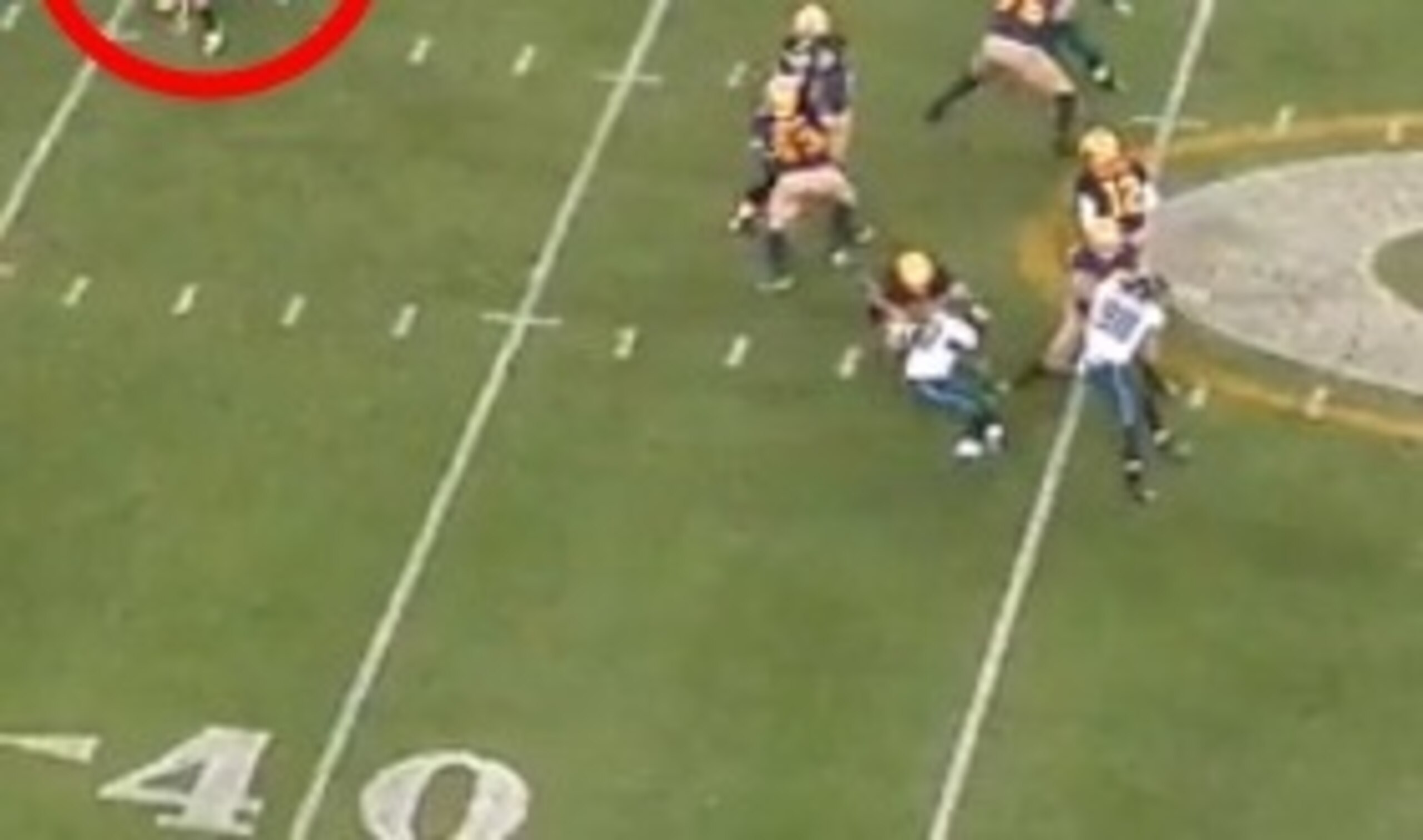
And why did an experienced cornerback like Bradley Fletcher cheat with his hips while covering Davante Adams near the goal line, selling out for a fade route before being burned inside for an easy touchdown on a slant?

I could go on and on, but...
The Eagles have to hope that what Rodgers did to them will merely serve as a wake-up call, not an omen. They have to go up against Pro Bowl-caliber quarterbacks Tony Romo (twice) and Russell Wilson (once) in the final six weeks of the season and will likely have to deal with guys like Romo, Wilson, Rodgers, Kaepernick, Drew Brees and Matthew Stafford in January, if they survive to see that month.
But if they do, they'll still have a fighting chance, with or without a Trojan horse.
But it won't kill them
I've painted an ugly picture. And that was without even picking on Fletcher, who was a complete mess in Green Bay. The veteran corner was beat eight times—twice for touchdowns—and single-handedly surrendered 169 yards in coverage, according to Pro Football Focus (subscription required). Entire defenses have given up fewer passing yards on 47 occasions this year.
On the season, Fletcher hasn't been as bad as No. 1 corner Cary Williams, who—according to PFF—has been beaten for five touchdowns and has allowed opposing quarterbacks to post an average passer rating of 107.2 when throwing in his direction.
Still, despite the fact the quarterbacks facing them weren't always top-notch, the Eagles held it together in pass coverage just enough to prevent a panic situation before Week 11. The league-wise passer rating this season is 88.5, and seven of the 10 pivots the Eagles have worked against this year have posted ratings within two points of that range. Prior to Sunday, they had only been lit up by Cousins and Davis.
To consider:
1. Rodgers is the highest-rated passer in NFL history and is on an MVP-type tear right now. In fact, his passer rating in this game (120.3) was virtually the same as his rating for the season (120.1). This was only the 25th-best game of his career when it comes to passer rating. He's that good.
Point being, the Eagles aren't alone. And they might not have to face a quarterback that good again until next season.
2. Eagles defensive coordinator Bill Davis screwed up against Green Bay. He figured the Packers would emphasize the run, loaded up the box, forced his shaky corners to work on islands in man coverage with only a single-high safety and—rather amazingly—didn't adjust until Rodgers had already lit them up throughout most of the first half.
It's easier to fix scheme- or strategy-related flaws than it is a systemic lack of talent.
3. The pass rush and takeaways have bailed them out. Between Week 4 and Week 10, Philly had a league-high 29 sacks and ranked tied for eighth in football with 12 takeaways. The team scored a league-high nine touchdowns on defense and special teams this season.
It's hard for quarterbacks to burn you if they aren't given time to work and their margin for error is kept low. Generally, that's been the case, which is why opposing signal-callers have completed just 55.8 percent of their passes against this supposedly bad pass defense in 2014.
And it might also account for why, when it comes to the Eagles' DVOA (defense-adjusted value over average) formula, the advanced stats gurus at Football Outsiders have the Philly D ranked 13th in the NFL against the pass.
Is that 28th-ranked pass D still probably more of a liability than an asset? Sure, but consider that the two teams sandwiching them on that list—the Indianapolis Colts and Arizona Cardinals—also lead their respective divisions.
Consider, too, that the AFC champion Denver Broncos ranked 27th against the pass last season.
Consider that when the New York Giants and New England Patriots met in the Super Bowl in 2011, they ranked 29th and 31st, respectively, in pass defense.
Consider that the 2011 Packers went 15-1 despite giving up more passing yardage than any defense in NFL history. And that same year, the New Orleans Saints ranked 31st in the league in that field, but they went 13-3.
As we've established, Philly's pass D was worse last year than it has been this season. And even without much of a pass rush, that team had the ability to make a Super Bowl run.
This is the NFL, and it's 2014. Your secondary can be an asset, but if you get good quarterback play and can generate enough pressure, it's almost impossible for it to become a season-destroying Achilles' heel.
Brad Gagnon has covered the NFC East for Bleacher Report since 2012.
.jpg?w=2560)
.jpg?w=2560 "Texans Jaguars Football")