Early Lessons from Carmelo Anthony's Performance Within Knicks' Triangle Offense

Carmelo Anthony and the New York Knicks are triangle-ing all over the place. Sometimes it's been pretty. Other times it's been ugly.
Each and every time has been a learning experience.
Especially for Anthony.
Early-season displays aren't licenses for reaching overly profound conclusions. Things will change as the days, weeks and months go by. But Anthony's performance has been enlightening so far, offering a glimpse into how he'll function as a card-carrying member of the triangle offense.
What's looked good? What's looked bad? What do he and the Knicks need to change?
Part of the challenge in evaluating new beginnings is unearthing takeaways that aren't solely the product of inexperience and underdeveloped execution. That's the difficulty we're charged with overthrowing here: finding meaning behind Anthony's new beginning.
He's Passing (Slightly) More
1 of 6
Although the Knicks haven't been running the triangle to perfection—or even consistently—its core tenets are having an obvious impact on their offense. They are, after all, passing more.
The Knicks are averaging 338 passes per game, which ranks fifth in the league, according to NBA.com. This represents an oh-my-god increase from last season, when they ranked 23rd in handoffs, passing the ball only 282.3 times a night. For the mathematically challenged and/or lazy, that means they're moving the ball nearly 20 percent more than last year.
Not much has changed for Anthony early on, though. Or so it seems.
He's making 36.5 passes per game, which, for now, is down from the 41.1 he averaged last season. His assist opportunities are basically identical as well; he's tallying 6.3 this year compared to 6.2 in 2013-14. If anything, it appears he's passing less—even though that's not true.
Overlooking the fact that the triangle is more about premier scorers moving without the ball than constantly deferring, Anthony is logging almost five minutes less per game (33.8) than he did last season (38.7). When we break down his metrics, we find he's averaging 1.08 passes and 0.19 assist opportunities per minute, up from 1.06 and 0.16 in 2013-14.
As the season wears on and the Knicks become more comfortable and consistent within the triangle, Anthony's passing numbers stand to increase even more. And while they might hold steady—or start to decline—there's no reason to question his commitment to team basketball.
Because...
Anthony Is (Sort Of) Bidding Farewell to Isolations
2 of 6
More important than Anthony's moving the ball is his moving without the ball. Rock-dominant scorers can thrive in the triangle but only if their self-sufficient ways become ancillary scoring devices. Anthony has thus far been answering that call to arms.
Almost 32 percent of his field-goal attempts (six) have come off catch-and-shoot opportunities. Last year only 26.7 percent of his shots were classified as spot-ups. Better still, more than half of his made baskets (52.9 percent) have come off assists. In the past he's been forced or more inclined to create for himself. Only 38.6 percent of his made baskets were the byproduct of assists last year.
This transformation has not bilked Anthony of his one-on-one sets. He's still dominating the ball, trying to score in isolation. Some of those situations are by design; others are borne out of systematic failure.
Chris Herring of The Wall Street Journal unpacks this further:
"Notwithstanding the fact that the triangle has built-in isolation looks for Anthony—much like it did for Michael Jordan in Chicago and Kobe Bryant in Los Angeles—it’s worth remembering that the Knicks often resort to those attempts when the shot clock is running down.
Desperation situations have occurred more this season—16% of the team’s shot attempts have come in the final four seconds of the shot clock, up from 7% last year, according to NBA.com—because the Knicks have sometimes tried, and failed, to get clean looks from the new system.
"
Isolations will never completely disappear from Anthony's offensive arsenal, nor should they. You don't tell one of the league's best shot-creators to stop creating shots. It would be like asking Stephen Curry to remove three-pointers from his repertoire.
Still, it's clear that Anthony isn't being asked to fend for himself as much. The manner in which he's scoring barely resembles that of last year. And by season's end, assuming the Knicks stay true to the system, it should be completely unrecognizable.
There's Still Some System-Shaping to Be Done
3 of 6
Growing pains were inevitable for the Knicks. The triangle cannot be introduced, learned and then mastered overnight. The system is far too complex to grasp that quickly. But much of what plagues Anthony and the Knicks goes against modern-day analytics and, unlike passing and interpretational miscues, won't vanish with time.
At its heart, the triangle is a well-intentioned guide that demands ball movement and promotes free-flowing improvisation. One of the most concise yet accurate descriptions to date comes from The New York Times' Scott Cacciola:
"The triangle — and there is an actual triangle formed by the post, wing and corner players on the strong side of the court — revolves around seven guiding principles that include maintaining proper spacing (about 15 to 20 feet between players), penetration by passing and the interchangeability of positions. Every player ought to be able to score, and from different angles.
"
That sounds all well and dandy in theory. But a bulk of the scoring opportunities created by this spacing and movement are mid-range jumpers. The Knicks already lead the league with 34.5 mid-range attempts per game, of which they're hitting just 43.5 percent. Anthony, meanwhile, is throwing up nine mid-range shots every night, the fourth-most among all players.
This uptick in long twos has come at the expense of three-pointers. The Knicks are jacking up just 15 treys per game, down from 24.9 last year. That's a dangerous trend.
No team attempted more than 26.8 mid-range shots a night in 2013-14. Only eight teams—including the Knicks—attempted more than 25. Of those eight squads, just one ranked in the top 10 of offensive efficiency (Portland Trail Blazers). Five of them finished in the bottom eight (Boston Celtics, Orlando Magic, Cleveland Cavaliers, Charlotte Bobcats (now Hornets), Chicago Bulls).
The Knicks are on the verge of following suit. They rank 20th in offensive efficiency through five games and aren't exploiting Anthony's three-point prowess enough. Not only is he coming off a season in which he buried a career-high 40.2 percent of his deep balls, but he's hitting 50 percent of his bombs this season, including 44.4 percent as a spot-up shooter.
Mid-range jumpers have always been a strength of Anthony's, but good offenses typically shoot threes. Five of the league's top-six offenses put up at least 26 long balls last season. If the Knicks—they of absolutely no defense—wish to maximize their offensive potential, they need to adjust the triangle's shooting proclivities and, most importantly, Anthony's role within it.
Rest Is an Actual Thing
4 of 6Since the triangle is supposed to create open shots and make scorers out of everyone, Anthony isn't seeing as much burn on a nightly basis. There will be games—like in the Knicks' loss to the Washington Wizards—when head coach Derek Fisher cannot bench Anthony for extended periods of time. By and large, though, he hasn't showed a propensity for running him ragged like Mike Woodson was wont to do.
Don't underestimate the impact of an additional 4.9 minutes of in-game respite. Anthony already looks like a different player in the fourth quarter. Last year he was visibly tired and prone to clanging shots off the rim late in games. This season has been different.
Take a look at Anthony's shooting splits by quarter:
| 47.9% | 49.3% | 45.2% | 38.0% | |
| 43.5% | 41.7% | 50.0% | 44.4% |
If the Knicks are able to limit Anthony's playing time and prevent him from logging 38-plus minutes regularly, they'll get a rejuvenated scorer with fresher legs late in games. And that's something they need.
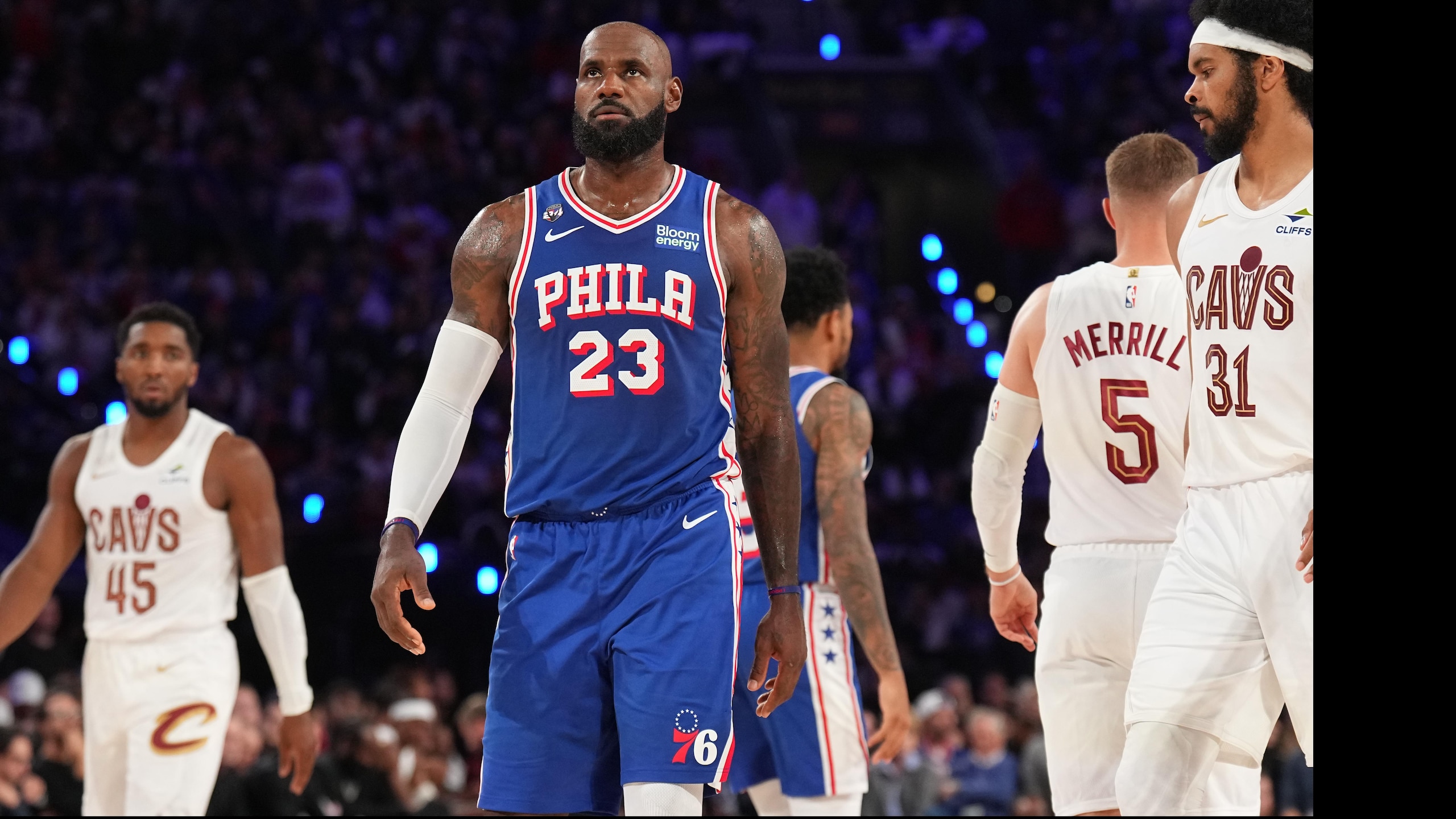
Look no further than their upset of the Cleveland Cavaliers—captured above—to see how important it is for the triangle to help keep Anthony spry and functioning at a high level when it matters most.
Scoring Title Is Probably Out of Reach
5 of 6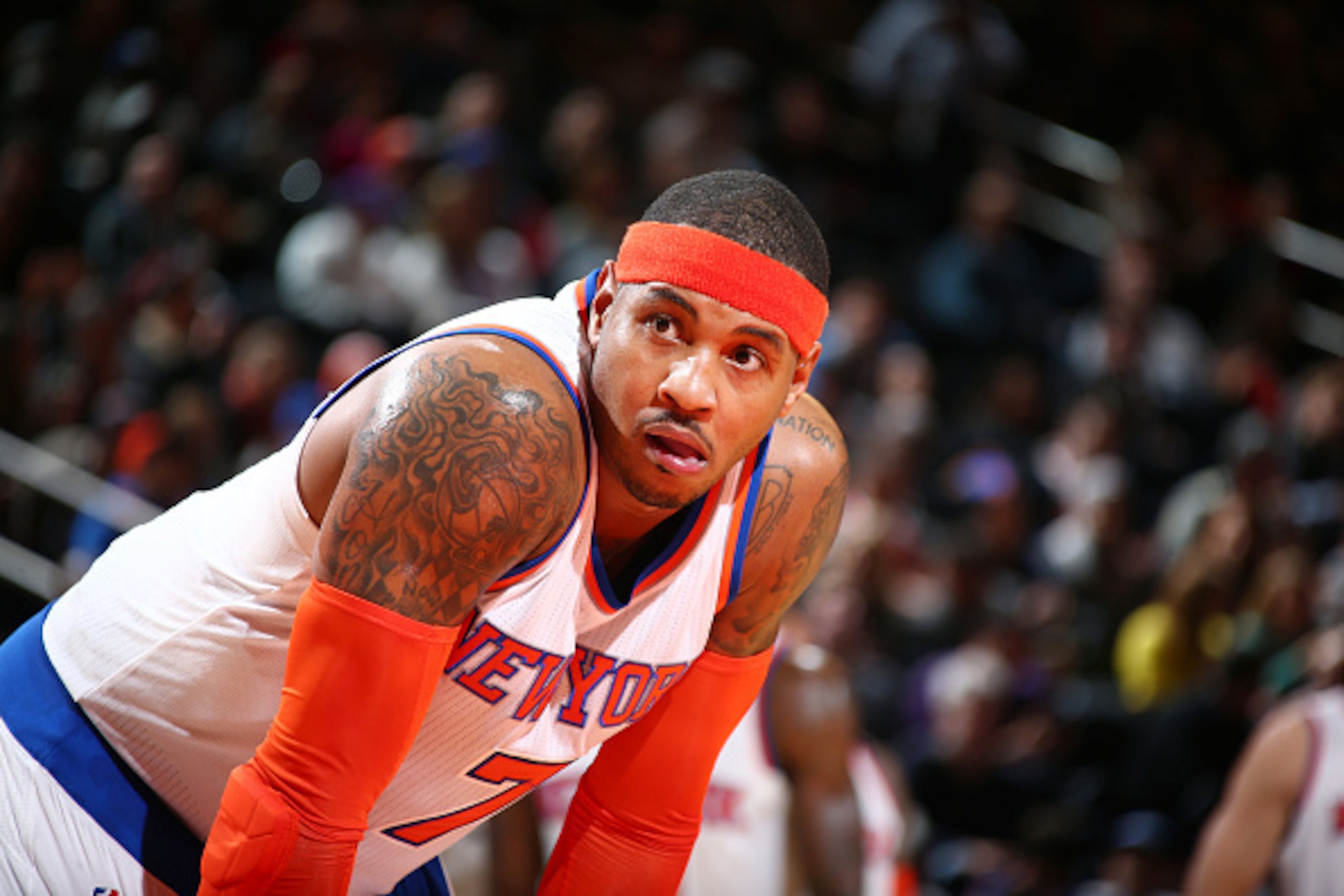
"I don't think I'll be the scoring champ," Anthony said ahead of the 2014-15 crusade, per ESPN New York's Ian Begley. "Especially with this system, the way we're playing—the way that it's going to be well-balanced, the style of play we're going to have, I don't think I'll have to lead the league in scoring this year."
At least half of this is true.
Given how turbulent the Knicks offense has been, Anthony may need to lead the league in scoring if the team is to go anywhere. The colossal caveat: He probably won't.
Through four games, Anthony is averaging just 21.3 points, tying him with LeBron James for 18th among all players. If his numbers hold, this will be his lowest-scoring season since 2004-05, when he was a sophomore.
Logic dictates those numbers will inevitably rise. Anthony is a born scorer. Scorers score. He will score more. But there are already 8.4 points per game separating him and the league's leading point-piler (Klay Thompson). With Anthony making a concerted effort to exist within the triangle—while also playing fewer minutes and taking fewer shots—it's unlikely he wins his second scoring title.
It's a good thing he seemed to brace himself for this exact scenario.
'Melo Still Needs a Sidekick
6 of 6
Chief among the triangle's many purposes is its ability to alleviate individual scoring burdens. Anthony has yet to reap such spoils.
Two other Knicks are averaging double-figure point totals–Amar'e Stoudemire and Iman Shumpert—and no one other than Anthony himself is pumping in more than 12.8 points a night. That's going to be an issue moving forward. A big one.
Defenses are zeroing in on Anthony more than they should because his teammates are neither taking nor hitting shots in excess. The Knicks still have a detrimental knack for standing around when he has the ball and have been sapping so much time off the shot clock that Anthony (still) frequently enters bailout mode.
In the end, this only hurts the offense by increasing the difficulty of Anthony's shot attempts. Per NBA.com's box-score database, 57.3 percent of his shots (43) have been contested. He's made only 37.2 percent of them (16). In the team's most recent loss, 14 of his 23 shots came with a hand in his face; he made just five.
On those rare occasions when he's open, Anthony has been spectacular, putting in 56.3 percent of his uncontested looks (18-of-32). Ergo, the Knicks need him to get more open shots. That's about as easy as giving him a legitimate sidekick, something he hasn't enjoyed since coming to New York in 2011.
So, it's not easy.
"Anytime you don't make shots, you're not scoring the basketball...it makes it hard, it makes it strenuous," Anthony told reporters following the Knicks' loss to the Wizards. "Then the opposing team is denying it and taking away a lot of your options. It can get frustrating at times."
Frustrations will continue to mount until a real, live, genuine No. 2 option emerges or arrives. Only then will Anthony's potential within the triangle be realized and subsequently met.
*Stats courtesy of Basketball-Reference and NBA.com unless otherwise cited.