A "Desert Sweep" cemented the 2014 Pac-12 football power as centered in the South. Arizona State has the division lead heading into November, while UCLA, the near-unanimous preseason pick, sits in fifth, its postseason hopes alive after barely averting a stunning collapse in Boulder.
As the South enters a month of round-robin knockout play, the North will be decided this Saturday in Eugene by the usual suspects, Stanford and Oregon.
Last weekend's least-heralded games provided the most notable results. Arizona head coach Rich Rodriguez must have wondered why he hears so much about the trip to Pullman. On a fall afternoon prescribed for football (60 degrees, light overcast), Arizona dominated Washington State in a manner that left too many questions hanging over the Cougars' program (see below).
.jpg?w=2560)
Building a 31-0 lead before the halfway point of the second quarter, the Wildcats deflated an enthused Pullman crowd. By the fourth quarter, those same fans were decimated. The Spokesman-Review ran a picture in its Sunday edition of a half-empty section in Martin Stadium.
For WSU football, it was not a sales pitch.
Anu Solomon was the best quarterback on the field in Pullman, throwing for five touchdowns while leading a turnover-free offense. By passing so efficiently and striking for big plays (four completions of 20-plus yards), Arizona set up its run game to take over in the second half.
Here is an oddity: Washington State has not scored a point on its first possession this year; zero points in eight games. Connor Halliday's first two drives Saturday: three-and-out, punt. By then, the Cougars were playing straight uphill. And Arizona's defense was fine in allowing the "'imaginative" sideways passing game that builds stats more than points.
It was the first time I had seen Scooby Wright in person this season, and he impressed. The Wildcats often used four rush men spread wide (a technique often called Wide 9), and it helped sack Halliday four times.
Announcers often gauge a defensive player's impact by how many times that name is mentioned during a game. It isn't a perfect measure, but in this contest, Wright was involved in every significant Arizona defensive play.
There was no welcoming weather for Arizona State, as Puget Sound was buffeted by brutal winds and rain. Thus, the Sun Devils and Washington produced little offense. Every level of football preaches the same bad-weather formula: no mistakes and sound special teams. ASU won the turnover battle, forcing three from the Huskies. And Washington's punt game struggled, averaging only 30 yards on eight punts.
Quarterback Taylor Kelly returned for ASU and generated the night's most important offense with a pair of touchdown passes, the second a game-clincher to Gary Chambers in the fourth quarter.
One man's guess: ASU coach Todd Graham believes his team's best chance to beat Utah and Notre Dame in the next two weeks is with Kelly.
If the Sun Devils do that, they will force their way into the College Football Playoff conversation.
Arizona holds similar hopes. This year’s Territorial Cup, November 28 in Tucson, could hold both conference and national significance for each school.
Biggest Disappointment of the Season
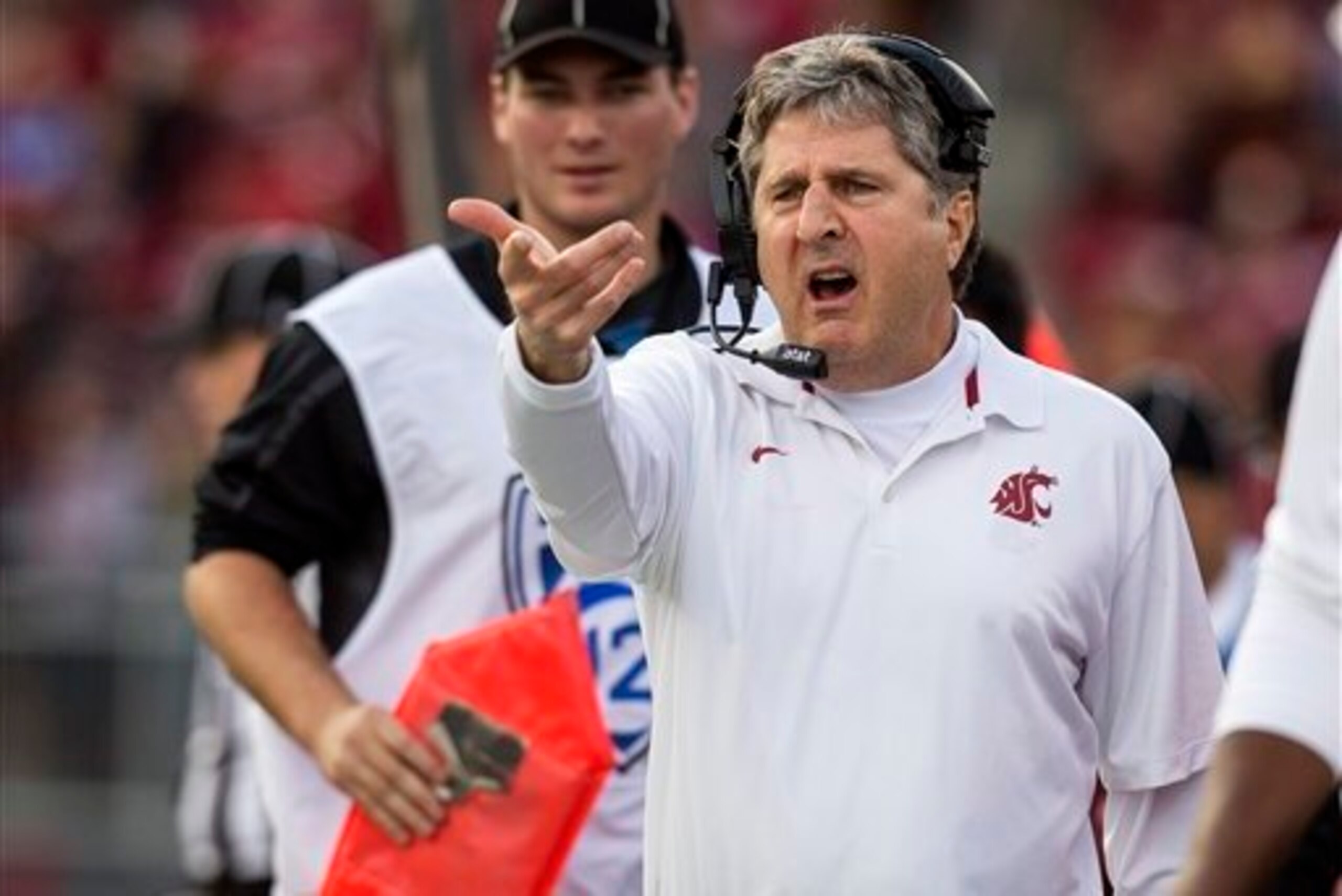
Washington State fooled me. A six-win season with the return of a fifth-year quarterback running an offense for the third year was enough to convince me the Cougars, as I posted here in August, could win seven or eight and play in a respectable bowl.
Saturday's game in Pullman was a major downturn for Cougar fans. There is no semblance of a running game, with only the slightest hint of an effort to establish one. The pass game is too often sideline-to-sideline.
A candid takeaway from a play-by-play announcer: I left Martin Stadium with no idea how to describe the Cougar offense. How is it trying to score points? Wise football men I asked share some of my thoughts. Now, I know Mike Leach has a plan. But if I can't see one—and this is the only Pac-12 team about whom I have said this—then how do the Cougar fans/boosters?
They are the ones Leach should care about.
Another takeaway: Leach often uses "inexperience" as an explanation for the Cougars' play. As reported by The Spokesman-Review Sunday, Leach said of his defense's struggles in stopping Solomon: "I think (the inexperience affected us) quite a bit. We've got a lot of inexperience out there and I think that's part of why we're erratic."
Fair enough. Now, the questions: In Year 3, where are Leach's recruits in the position groups he most cites for their youth, offensive line and defensive backfield? Does Paul Wulff receive credit for last year's six-win team that featured three graduated O-line starters, defensive back Deone Bucannon (a first-round NFL pick) and Halliday—all players recruited by Wulff?
Washington State has supported Leach like no other coach. A completed football facility and renovated stadium have bred tremendous hope for Cougar faithful. What they are seeing this year is a blizzard of numbers for Halliday and receivers, none of which can obscure the only numbers that matter: 2-6.
USC Losing Control
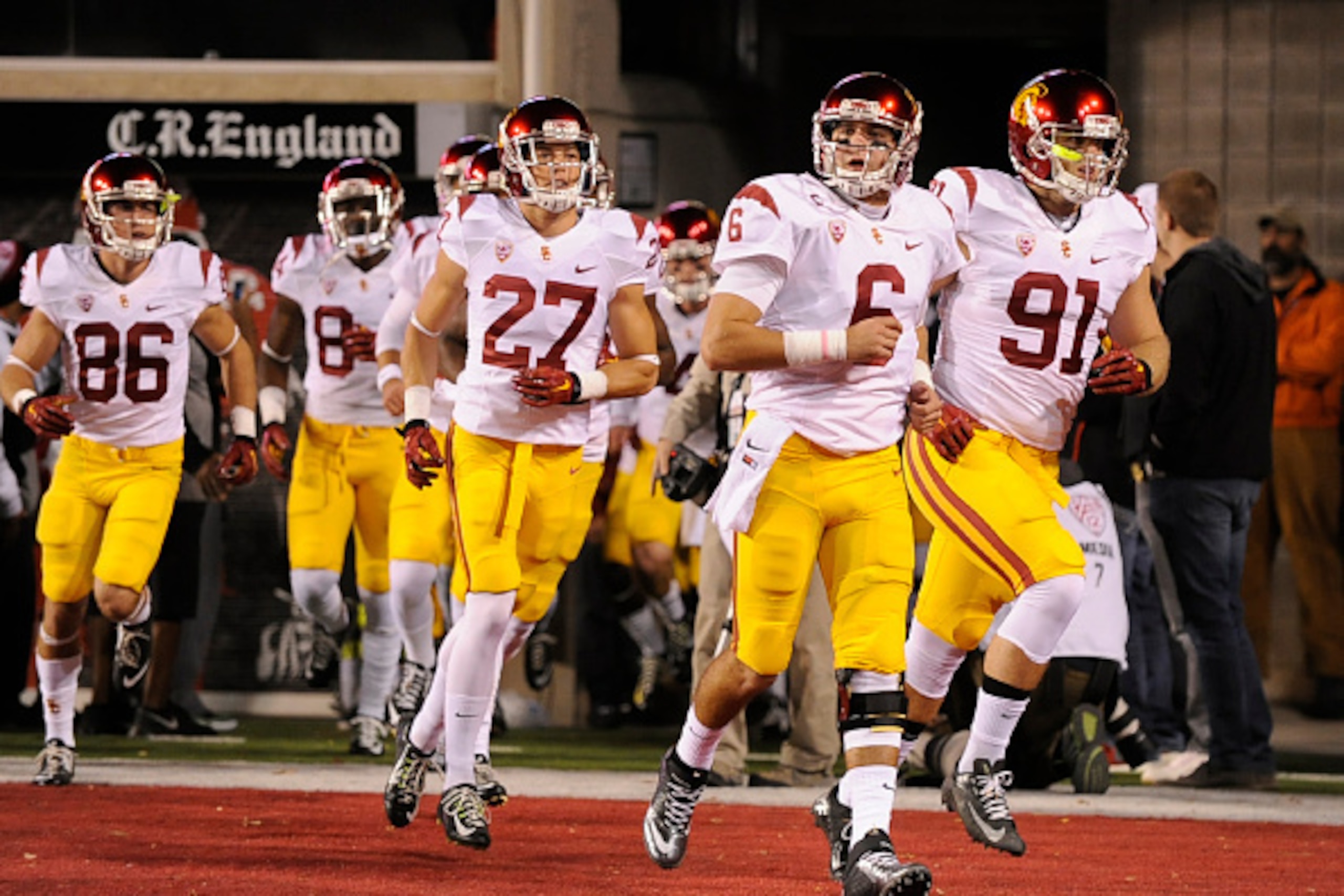
Utah received its best stretch of quarterback play this season when it was most needed. Travis Wilson doesn't look stylish, but he led a strong two-minute drive to beat USC last weekend.
Wilson's legs provided the penultimate play, a head-strong dash in the closing 30 seconds that left the ball a foot short of the goal line. Strong defense and special teams have been Utah's main ingredients, but that drive proved with certainty that the Utes need something from Wilson to beat the best teams.
But watching this in Spokane left me puzzled by the Trojans for the second time this year. On the game's second play, Darreus Rogers did not catch a pass CLEARLY thrown backward. He allowed the ball to clank off his shoulder pads and carom forward. (In fairness, a number of other players did not react.) Davion Orphey finally picked up the ball and ran it back for a touchdown.
The problem? Rogers had no idea the football was live.
If your offense feature sideways and backward passes, then the players must know the rules. That is the responsibility of the coaches.
Second: USC faced fourth-and-two inside the Utah 30 with just over two minutes to play. Forty-five-yard field-goal try? No. Pooch punt? No. The Trojans lined up and ran a play. They ran a toss to the tailback. After a moment frozen in horror, I realized the runner was Nelson Agholor. He stretched to the sideline but couldn't maintain balance and stepped out short of the line to gain.
The problem? USC chose a fourth down running play with a wide receiver! Buck Allen? No.
A former Trojan told me this week that he felt USC wanted to deceive Utah by using Allen as the “up” back in the I-formation. A toss to Agholor would be unexpected. The result was devastating, as echoed by the former player, who said, “And he couldn’t stay in bounds.”
Stanford vs. Oregon
The twist in this game was outlined in last week's post.
Royce Freeman is an offensive force Oregon has not presented in recent years. Not only does Stanford have to defend Freeman, but also its offensive plan doesn't involve a dominant runner in the mold of Stepfan Taylor and Tyler Gaffney.
Stanford, however, added a previously unseen wrinkle last Saturday. David Shaw unveiled a no-huddle offense.
Yes, the Cardinal of huddles. Tight ends and fullbacks actually spread the field. The offense was new, and the results were welcome. Stanford scored 38 points against Oregon State and totaled 438 yards of offense.
Why the change though?
Here's a thought: Kevin Hogan has poor numbers against the blitz.
| Kevin Hogan Stanford | 52.8 (47/89) |
| Travis Wilson, Utah | 58.0 (29/50) |
| Connor Halliday, Washington State | 58.9 (43/73) |
| Sefo Liufau, Colorado | 60.5 (75/124) |
| Sean Mannion, Oregon State | 61.3 (49/80) |
Note: (minimum 20 attempts)
He has a longer (read: slower) delivery thus pressure has disrupted Stanford's pass game. Mix in a young offensive line that isn't at the standard of Stanford's recent years with the lack of a dominant running back and defenses ramp up the blitz.
If teams don't fear being punished by big plays, they will blitz endlessly.
Thus, Stanford's response. Does it bring this offense to Eugene? Can the Cardinal find a new way to deny the Ducks a spot in the Pac-12 championship?

.jpg?w=2560 "NFL House in Paris Closes for Protests")

.jpg?w=2560 "Trevon Diggs Cut by Seahawks")