
10 Most Valuable Players in College Football
There are good players, and then there are players a team just can't do without. With the college football season just past the halfway point, it's time to examine the most valuable athletes in the game.
Again, this is a list of the most valuable players, not necessarily the best players or the guy with the most eye-popping stats—though there is some crossover, and a few Heisman contenders are featured.
Take Georgia running back Todd Gurley, for example. Gurley is outstanding and identified as "the nation's best back" by Bleacher Report's Matt Miller.
Is he valuable to the Bulldogs? Absolutely. Is he irreplaceable? No, as evidenced by the fact that Georgia is 2-0 without him and his backup, Nick Chubb, has shown he's more than capable of handling the responsibility of being an every-down back.
Rather, this is a list of players whose teams would be—or, in some cases, already are—lost without them. These are players who lead their squads (or the nation) in a specific statistical category, sometimes by a long shot. In other words, the offense or the defense basically goes through them.
Which players are the most valuable? The answers are in the following slides.
10. Texas Tech Linebacker Pete Robertson
1 of 10
It's odd timing to name Texas Tech linebacker Pete Robertson as a valuable player—or any Red Raider defender, for that matter—after his team gave up a whopping 82 points to TCU last Saturday.
Without Robertson, though, things might be even worse for Texas Tech. Robertson has tallied eight sacks on the year, which is tied for first in the Big 12 and accounts for just over half of Texas Tech's 15 team sacks. In other words, he basically is the Red Raiders' presence in the backfield.
Tech's defense is statistically one of the worst in the country in points allowed at 42.5 per game (thanks again, Frogs). However, the Red Raiders are also minus-12 in turnover margin and have given the ball away 20 times this season. That's not going to help a defense out. Ever.
Robertson leads the team with 58 tackles and five quarterback hurries. Texas Tech's defense is bad—the team is simply not very good this year—which is why Robertson checks in at No. 10. But Robertson is out there making plays for his school. Things would look even worse on defense without him.
9. Virginia Tech Cornerback Kendall Fuller
2 of 10
Virginia Tech has slumped to become one of the more disappointing teams in the country after knocking off Ohio State on the road early in September. The Hokies offense is still rough, averaging 25.6 points per game.
The defense has still been solid, though, and has been decent, but not great, against the pass (No. 47 in the nation). Generally, opposing offenses don't attempt a ton of passes against Virginia Tech—about 28 per game. How those numbers would look without star cornerback Kendall Fuller would be interesting.
Fuller has 13 pass breakups on 14 passes defended for Virginia Tech. He also had a 47-yard pick-six against North Carolina. Only a sophomore, Fuller is already one of the best at his position. Just think: He feels he's still getting better
"I think last year [2013] at times, I would get too lazy and give up a play," Fuller said, via Mike Huguenin of NFL.com.
That's a scary thought, considering he was a freshman All-American.
8. Stanford Wide Receiver Ty Montgomery
3 of 10
Stanford's offense has been an adventure, and by adventure we of course mean it's been borderline unwatchable at times. The Cardinal rank among the worst teams in the nation in touchdowns scored in the red zone. In general, Stanford is not a high-scoring offense, nor is it an explosive offense capable of picking up huge chunks of yards.
Now imagine that offense without wide receiver Ty Montgomery, who has 49 catches for 514 yards. Both of those numbers lead the team by a country mile. His 49 catches more than double the receptions of the next-leading receiver, Austin Hooper (22 catches). The next closest receiver in terms of yards is Devon Cajuste with 293 yards, nearly 43 percent fewer.
Add in Montgomery's special teams contributions in the kick/punt return game and he averages 145.4 all-purpose yards a game. Stanford's offense lacks even with Montgomery, which is why he checks in at No. 8, but the Cardinal would be worse off—way worse—without him.

.jpg?w=2560)
7. Kansas Linebacker Ben Heeney
4 of 10
Kansas football is in the dumps, but there is a bright spot for the Jayhawks. His name is Ben Heeney.
The linebacker is a tackling machine, registering 12 a game, and his 84 tackles on the season are more than twice the number of the next leading tackler, safety Isaiah Johnson. (That, in itself, is another problem.)
Kansas can't do anything offensively, scoring 16.6 points a game, which puts tremendous stress on a defense. The fact that the Jayhawks only give up 28 points a game is probably a miracle.
The Jayhawks may not win another contest this year, but Heeney's importance cannot be overstated. Without him, things would look even uglier than they already do. As a senior, Heeney's days with the Jayhawks are numbered. Kansas fans will definitely notice when he's gone.
Heeney won't get a lot of national attention because he plays on a team with a bad record (2-5), but his numbers show he's one of the best in the country at his position.
6. BYU Quarterback Taysom Hill
5 of 10
This one seems obvious, given we've seen how BYU looks without quarterback Taysom Hill. The Cougars have lost four straight games (after starting 4-0) since Hill went down with a season-ending leg injury.
Would BYU still be undefeated if Hill was healthy? Not necessarily, since the Cougars have allowed at least 30 points in the past four games.
Still, Hill was the cornerstone of the offense, leading the team in rushing before his injury. His absence has exposed other weaknesses. BYU's scoring total has also gone down 10 points, from 37.5 points per game before his injury to 27.25 since.
Additionally, Hill was one of the more improved players from a year ago. He's always been a powerful and decisive runner, which made him effective carrying the ball. However, he also improved his ball placement on throws this year. Jungkyu Lee of ESPN Stats and Info also noted Hill's increased completion percentage but attributed that to shorter passes:
"Hill’s passing game should not be overlooked. He completed 58.3 percent of his passes from inside the pocket last season; in two games (against Connecticut and Texas) this season, he has completed 78.8 percent of such passes.
"
Hill’s increased accuracy can be attributed to shorter passes. This season, Hill’s passes have traveled an average of 6.7 yards downfield, 3.5 yards per attempt shorter than last season. He has thrown six passes that traveled more than 15 yards downfield this season. He averaged 7.2 such passes per game in 2012.
In any case, Hill was the total package for BYU and had a chance to be a Heisman dark horse. Instead, he's out for the year, and the Cougars haven't been able to overcome the loss.
5. Florida Cornerback Vernon Hargreaves III
6 of 10
At 3-3, Florida has to win three of its next five games to make a bowl. Given how poor the Gators have looked, that may not happen for the second straight year.
But that's hardly cornerback Vernon Hargreaves III's fault. Hargreaves had one "so-so" game: against Alabama and wide receiver Amari Cooper. In the 42-21 loss to the Tide, Hargreaves was targeted eight times and allowed five catches for 40 yards, according to Thomas Goldkamp of 247Sports (two more catches were called back because of penalties).
In all other games, Hargreaves allowed just three catches on 16 targets for 18 yards.
That's even better when you consider the Gators don't have much of a pass rush, ranking ninth in the SEC in sacks and tackles for loss.
When the offense struggles as much as it does, it puts even more pressure on the defense. In short, Hargreaves has been outstanding on what is otherwise a disappointing team. There's definitely talent elsewhere on Florida's defense, but Hargreaves has had a great season.
4. Alabama Wide Receiver Amari Cooper
7 of 10
As October turns into November, three wide receivers have already eclipsed 1,000 receiving yards: Colorado State's Rashard Higgins, Alabama's Amari Cooper and West Virginia's Kevin White.
Of the three, Cooper is the most valuable to his offense.
White has been a breakout star and is toe-to-toe with Cooper as far as Heisman chatter is concerned. However, the Mountaineer offense, while more balanced than perhaps it's given credit for, still throws the ball about 48 percent of the time. Alabama, on the other hand, has about a 60-40 run-to-pass ratio and runs 12 fewer plays a game on average (85-73).
Yet Cooper accounts for roughly half of Alabama's passing yards per game. With 1,132 receiving yards, Cooper is 889 yards ahead of the Tide's next-best receiver, DeAndrew White. West Virginia has two preferred receivers in White and Mario Alford, but quarterback Clint Trickett also spreads the ball around more. That's also the nature of the Mountaineers offense.
Alabama's offense is still run-first, but it's far more explosive with first-year offensive coordinator Lane Kiffin. One of the results of that is Cooper getting loose for nearly 16 yards a catch. In terms of having both a deep threat and a guy who can pick up yards after the catch, Cooper does it all for Kiffin.
No. 3 Florida State Quarterback Jameis Winston
8 of 10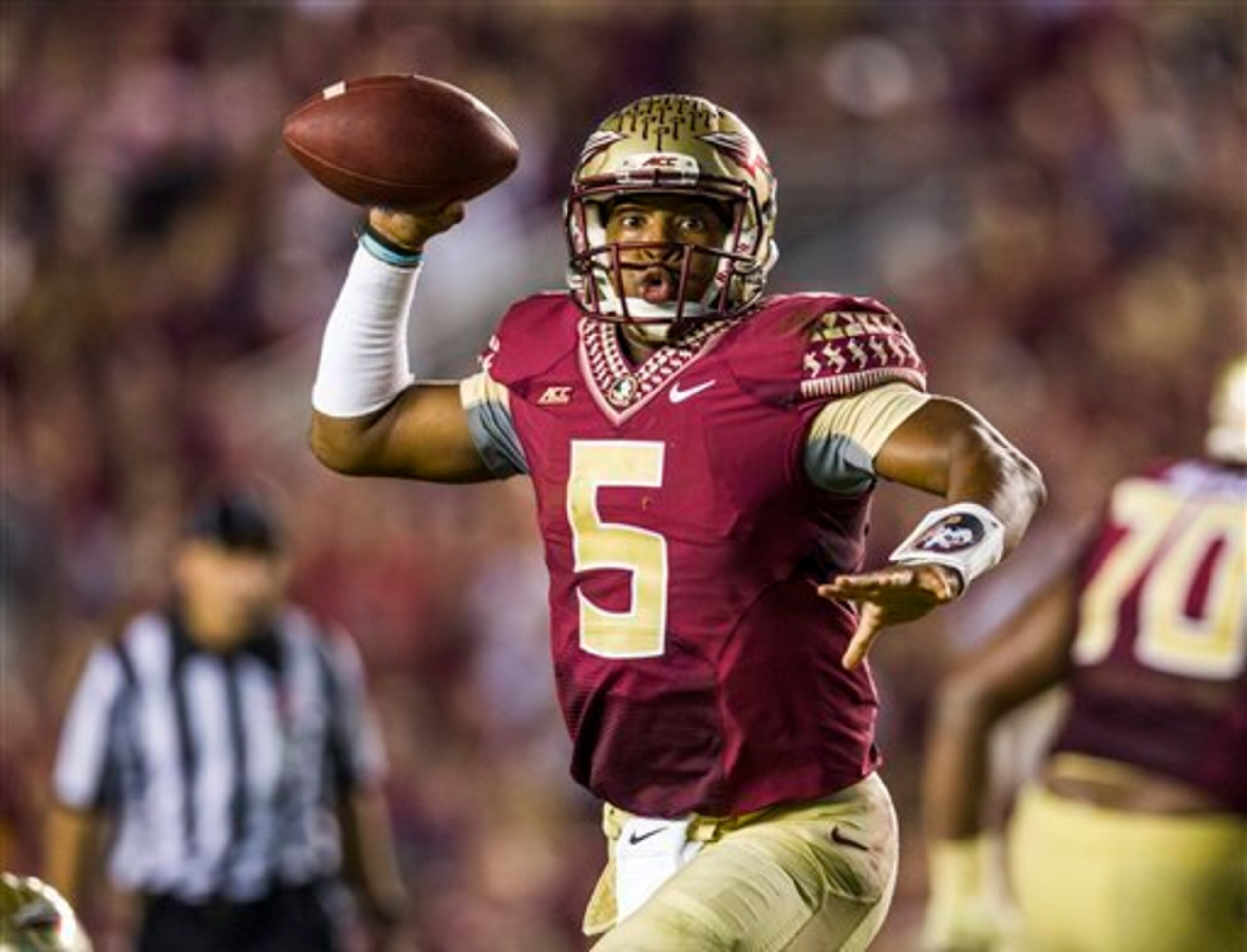
Technically, Florida State has shown it can win without star quarterback Jameis Winston. It did so earlier this season in a 23-17 overtime win against Clemson with backup Sean Maguire. Because of that, it's hard to put Winston at, say, No. 1.
However, it wasn't pretty without him. Florida State lost the turnover battle 2-1, was outgained 407-317 in total yards, couldn't run the ball and converted just four of 15 third downs.
Granted, Clemson has an excellent defense, which allows just 18.3 points a game, but it's also clear the Seminoles missed Winston.
The reigning Heisman winner has even more responsibility to shoulder than last year. Florida State, as mentioned above, has not had a great running attack. In terms of plays called, the Seminoles are fairly balanced with a 46-54 run-to-pass ratio. In terms of yards gained, however, Florida State gets about 72 percent of its offense through the air.
Wide receiver Rashad Greene has been Winston's go-to guy with 52 receptions, which is roughly twice as many as Winston's second-favorite receiver, tight end Nick O'Leary, who has 27.
Now compare that to last year when Florida State had four legitimate receiving options—Greene, O'Leary, Kelvin Benjamin and Kenny Shaw—and a near-1,000-yard back in Devonta Freeman.
With so many off-field storylines surrounding Winston, it can be easy to forget about him as a player. As he showed by completing 14 of 15 passes in the second half of a 31-27 win over Notre Dame, there's a reason he was considered the best player in college football in 2013.
2. Oregon Quarterback Marcus Mariota
9 of 10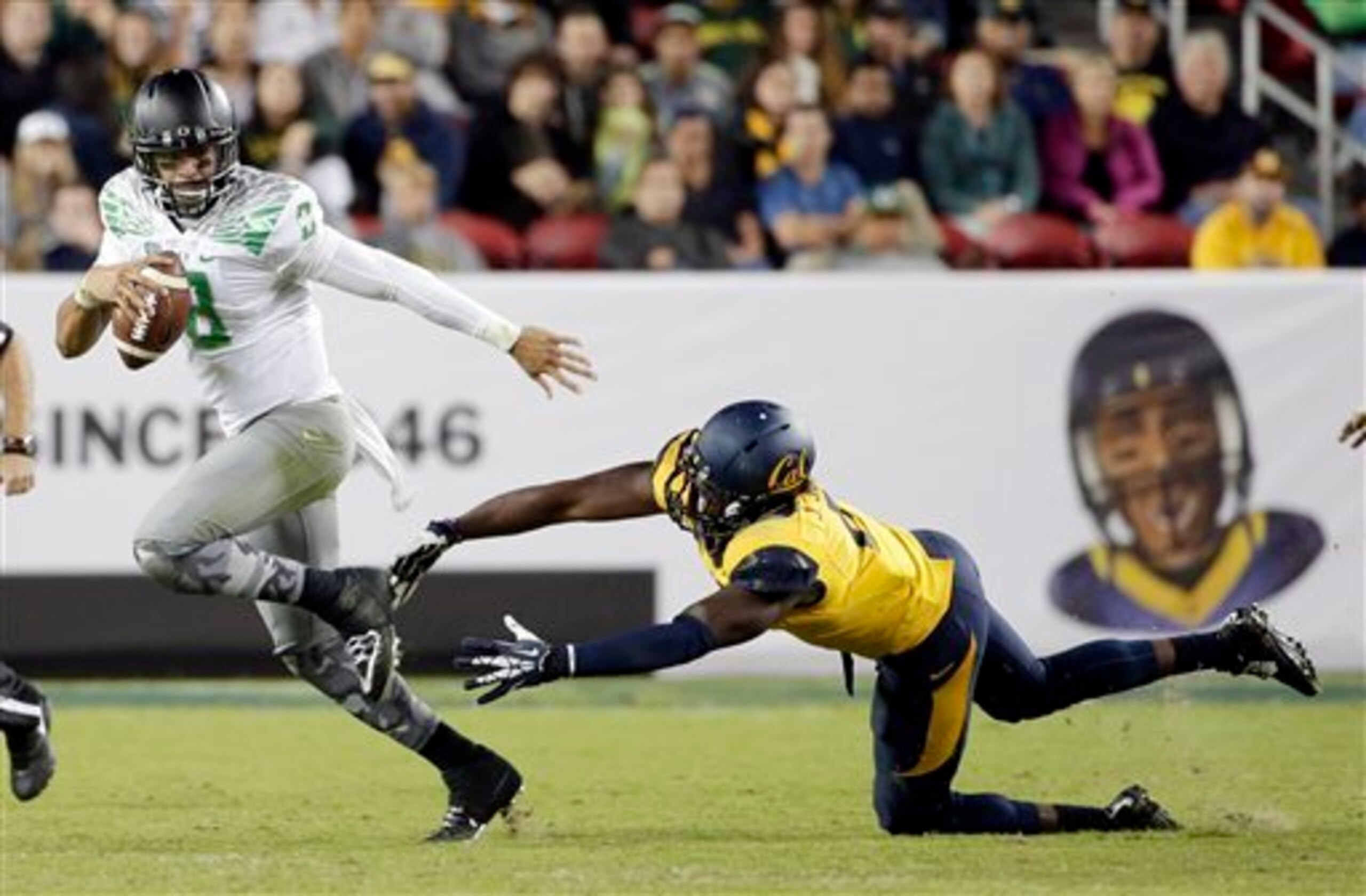
There's been an ongoing storyline throughout the college football season about which quarterback is better: Florida State's Winston or Oregon's Marcus Mariota.
It's not a hot enough take to say they're both outstanding, but they are. They just bring different things to the game.
If there's one thing that binds them, however, it's that they are each the cornerstone of their offense. Mariota isn't the leading rusher for the Ducks, but he is an important part of the ground game with 325 yards and five touchdowns.
What are more impressive, though, are his passing numbers: 2,283 yards (at 10.47 yards per attempt), 24 touchdowns and one interception. Those stats stand on their own merit, but they're even better when you consider Oregon's offensive line has been a question mark through various parts of the season. While things have shored up recently, there was a two-game stretch against Washington State and Arizona when Mariota was sacked 12 times.
Not all of that is on the O-line, but it gives you an idea about what Mariota was working with.
The Ducks defense has also been average, especially against the pass. How would Oregon look if Mariota was held out because of, say, an injury? Backup Jeff Lockie has looked good in limited time and could probably operate the offense well enough. However, the guess here is that no one wants to find out for sure.
1. Nebraska Running Back Ameer Abdullah
10 of 10
The term "do-it-all player" gets thrown around a lot, but perhaps no player actually embodies it like Nebraska running back Ameer Abdullah.
Nebraska's offense and special teams run through Abdullah, which is why he gets the No. 1 spot.
Through eight games, Abdullah leads the nation with 211.3 all-purpose yards a game. Abdullah actually ranks third in the country in rushing yards per game at a modest 156.1 yards—behind Indiana's Tevin Coleman (190.3) and Wisconsin's Melvin Gordon (211.3)—but he has more receiving yards than either and 272 kick return yards. (Coleman and Gordon do not have kick return yards.)
In all, Abdullah has participated in 204 plays—42 more than Gordon.
Abdullah is the workhorse on the offense with 180 carries. No other running back on the team has more than 49 (Terrell Newby). Compare that to Gordon, who has 154 carries while his backup, Corey Clement, has 92 rushes. Similarly, Coleman has 135 carries while his backup, D'Angelo Roberts, has 83.
That's not to take anything away from Gordon or Coleman. Both are excellent running backs in their own right. But in terms of which back means the most to his team, Abdullah gets the nod.
Ben Kercheval is a lead writer for college football. All stats courtesy of cfbstats.com.

.jpg?w=2560 "NFL House in Paris Closes for Protests")

.jpg?w=2560 "Trevon Diggs Cut by Seahawks")