Key Takeaways from NY Giants GM Jerry Reese's 'State of the Giants' Q&A
New York Giants senior vice president and general manager Jerry Reese met with reporters on Monday to address a variety of questions regarding the team’s 3-4 record and his expectations moving forward.
While Reese usually measures his words very carefully, he did offer a few thoughts of interest.
Let’s recap some of his comments that stood out and determine if his expectations and perceptions will offer Giants fans hope in the final nine games of the season.
TOP NEWS
.jpg?w=2560 "NFL Paris Football")
NFL House in Paris Closes for Protests
.jpg?w=2560 "Seahawks Chiefs Football")
Trevon Diggs Cut by Seahawks
.jpg?w=2560)
B/R's Expert Week 7 NFL Picks 🔮
It Ain’t Over 'til It’s Over
Despite being firmly entrenched in third place in the NFC East—don’t forget the Giants have also lost one game apiece to both Dallas and Philadelphia, who are ahead of them in the division—Reese insisted that there is a lot of football still to be played.
"It is still early. There are still a lot of teams that have chance to get back in the picture. We think we are one of the teams that can do that. We have to start right here, right now, on Monday night [against the Colts]...We feel like if we play good football down the stretch, we can claw our way back into this thing.
"
Can they really?
In head coach Tom Coughlin’s first 10 seasons, the Giants have finished with a second-half record above .500 four times: 2005, 2008, 2010 and 2013. The Giants qualified for the postseason in two of those seasons (2005 and 2008) only to make a first-round exit.
A closer look at the Giants' won-loss activity in their final eight games of the last two seasons, New York is a combined 8-8 in those games.
Of those 16 games played, eight opponents qualified for the playoffs, the Giants finishing 2-6 against upper-echelon competition that qualified for the playoffs.
What does all this mean?
Of their remaining nine opponents this year, the Giants will face four teams that currently have a won-loss record above .500.
If history repeats itself this year—and granted nothing is a given—the Giants could be facing an uphill battle in their quest to be one of those slow-starters that finishes strong.
There Are No Excuses but…
While Reese was busy trying to avoid making excuses for the Giants’ disappointing start, he did concede that the implementation of the new offense has been a factor in how things have gone:
"I think it takes time when you implement any new offense. Any phase of your football team is going to take some time...We have a new play-caller [and] a lot of new faces, and it takes some time for those things to gel a little bit. [During] the second half of the season, I expect us to play a lot better and be more comfortable in what we are trying to do.
"
The only way the Giants are going to start to feel comfortable with what they are doing on offense is if they build continuity.
Thanks to injuries, that hasn’t really happened.
Here is a look at two key skill players the Giants have lost on offense. Note their production and the production from their replacements to date:
| WR Victor Cruz | 14.7 avg. yards per reception | WR Rueben Randle | 9.4 avg. yards per reception | -5.3 yards/reception |
| RB Rashad Jennings | 4.4 avg., 2.2 avg. yards after contact | Andre Williams | 3.2 avg., 2.0 avg. yards after contact | -1.2 avg., -0.2 avg. yards after contact |
Reese is correct that injuries shouldn’t be used as an excuse. If there is little or no drop-off in talent behind the starters, a team should be able to overcome injuries.
This year, the Giants have been forced to rely more heavily on rookies—talented first-year players who are still adapting to the speed of the NFL game—and young veterans who are short on experience to pick up the slack for more experienced veterans slated to play ahead of them.
While an argument can be made that rookies and young players need live snaps to develop that comfort level in the NFL, there is a reason why teams practice: and that is to determine who is ready to perform when it counts.
The speed and complexity of the NFL is a lot different from the college game.

While there are exceptions among rookies—those who come in on Day 1 and hit the ground running—it’s generally not the best idea to toss a young player into the deep end of the pool until he has shown in practice that he's able to swim.
If a team rushes a young player on the field, it runs the risk of damaging that player’s confidence.
Reese did acknowledge that the inexperience behind some of the missing starters has been a factor.
“I think that could be part of it,” he said.
But?
“You can’t make excuses. Everybody is on the team. They go out and they practice," he said.
"We expect those guys to come out and play at a high level. It is a little different for rookies at some times, but we expect rookies to come out and contribute and make plays for us.”
Too bad that plug-and-play mentality isn’t that simple.
More Moore
Second-year defensive end Damontre Moore is a perfect example of the young players that Reese insists need to step up and contribute in the final nine games.
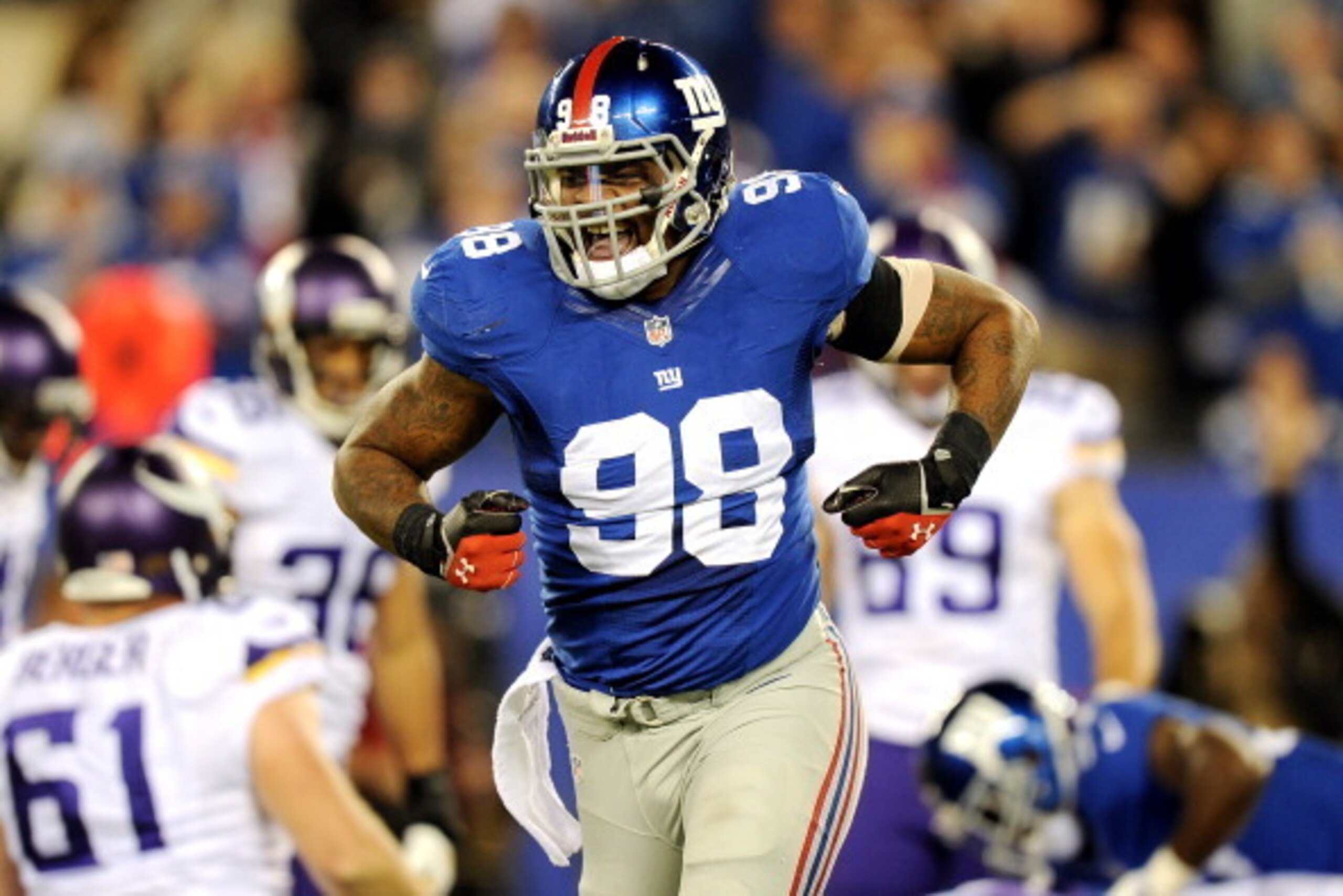
Reese, who acknowledged during his press conference that he’s not a coach, did wonder aloud as to why Moore hasn’t seen the field more often.
"I think he needs to be more of a contributor with the amount of snaps that he plays. It seems like when he gets in the game, he makes something happen. I think he’s progressing, but I think he needs to play a little bit more.
"
So why isn’t Moore receiving more snaps? Giants defensive line coach Robert Nunn, who met with reporters last week, offered this explanation:
"Damontre needs to continue to improve and continue to stay focused on what we are doing on first and second down. He can do it. He is a lighter body, not ideal, but he can play it. He has to stay focused and continue to improve in that area and he will get more at-bats. He is going to get more opportunities on third down, and so he just has to keep coming along and improve on first and second down. If he does that, then he is going to get those opportunities in pass-rush situations.
"
According to the latest Giants defensive stats in the team’s weekly game release, Moore has nine tackles (seven solo), two sacks, two tackles for loss, five quarterback hits and one pass defensed in the 115 snaps he has taken so far this season.
Of that snap total, Moore has just 36 against the run, which would be the “first- and second-down” stuff that Nunn is likely referencing as an area of improvement.
The Offense Needs to Be More Aggressive
Miss the days when quarterback Eli Manning use to chuck the ball down the field?
So does Reese, who wants to see the offense take more chances.
"I think at times we’re a little bit almost too cautious with what we’re doing offensively. This is the National Football League. You’ve got to go out there and you have to win the game. You can’t think something’s going to fall into your lap. You’ve got to go out and take the games. I think we have to be more aggressive offensively.
I appreciate Eli taking care of the ball and not turning it over because that correlates to wins a lot of the time, but you can’t be too cautious. You’ve got to throw the ball down the field. You’ve got to score points in this league to win.
"
Here is a look at Manning’s passes thrown this year and last year, as broken down by distance. Note: I did not include pass attempts that that targeted receivers at or behind the line of scrimmage (zero or negative yards).
| 20+ yards | 21-of-70, 725 yards, 6 TDs, 7 TDs | 5-of-22, 136 yards, 1 TD, 1 INT | ||
| 10-19 yards | 80-if-145, 1,362 yards, 8 TDs, 9 INTS | 38-of-61, 580 yards, 7 TDs, 1 INT | ||
| 0-9 yards | 41-of-51, 198 yards, 1 TD, 2 INTs | 21-of-24, 152 yards, 0 TDs, 0 INTS |
Of note in these stats is that in 2013, eight of Manning’s career-high 27 interceptions came on passes of 20 or more yards.
What Reese might be overlooking here is that Manning and company have been trying to get the hang of a new offense, a process that takes time for the main components to come together. It is still a work in progress.
Manning has demonstrated that he can sling the ball down the field with good results, but when one is learning a new offense—a process that includes changing one’s footwork—it makes sense to have the offense walk before it sprints.

To add to Reese’s sentiments about “scoring points in this league to win..." what teams also have to do to win is not turn the ball over, not let opponents march up and down the field, not have stupid and ill-timed penalties and not have breakdowns on special teams.
Advanced statistics courtesy of Pro Football Focus (subscription required) unless otherwise noted. Salary cap information via Over the Cap. All quotes and other information obtained firsthand unless otherwise sourced. Follow me on Twitter @Patricia_Traina.
.jpg?w=2560 "Colts Football")