What Does Jeremy Kerley's New Contract Mean for the New York Jets?
One by one, the New York Jets are stockpiling receivers for their formerly weaponless offense.
In the offseason, it was free-agent wide receiver Eric Decker who was added to the arsenal. Last week, the Jets made a trade with the Seattle Seahawks to acquire wide receiver Percy Harvin. Now the Jets have taken care of one of their own with a contract extension for wide receiver Jeremy Kerley.
The new deal is worth $16 million with $5.4 million guaranteed, according to Adam Caplan of ESPN.
TOP NEWS
.jpg?w=2560 "NFL Paris Football")
NFL House in Paris Closes for Protests
.jpg?w=2560 "Seahawks Chiefs Football")
Trevon Diggs Cut by Seahawks
.jpg?w=2560)
B/R's Expert Week 7 NFL Picks 🔮
The Jets' trade for Harvin, combined with Kerley's recent slump (he's caught seven passes for 60 yards in the past four games), make the timing of the extension seem a little off. With such a small amount of guaranteed money, however, the Jets won't be too hamstrung by the contract.
Harvin and Kerley may both be similar receivers in that they both spend a majority of their time in the slot (both men have lined up in the slot on exactly 74.3 percent of their routes), but their contract situations are independent of each other. Just like trading for Harvin didn't mean that Kerley would leave the fold, Kerley's contract extension does not signal a looming finish to Harvin's time with the Jets.
Kerley's playing time has dipped during his slump, and he played on only 61.9 and 58.6 percent of the Jets' offensive snaps in the past two weeks, respectively, but Harvin's arrival also doesn't mean Kerley will spend a majority of his time on the bench. In fact, there are even ways for the Jets to get both men on the field at the same time as slot receivers.

On this play, the Jets lined up in a four-receiver set with three receivers on the left, which means two receivers in the slot.
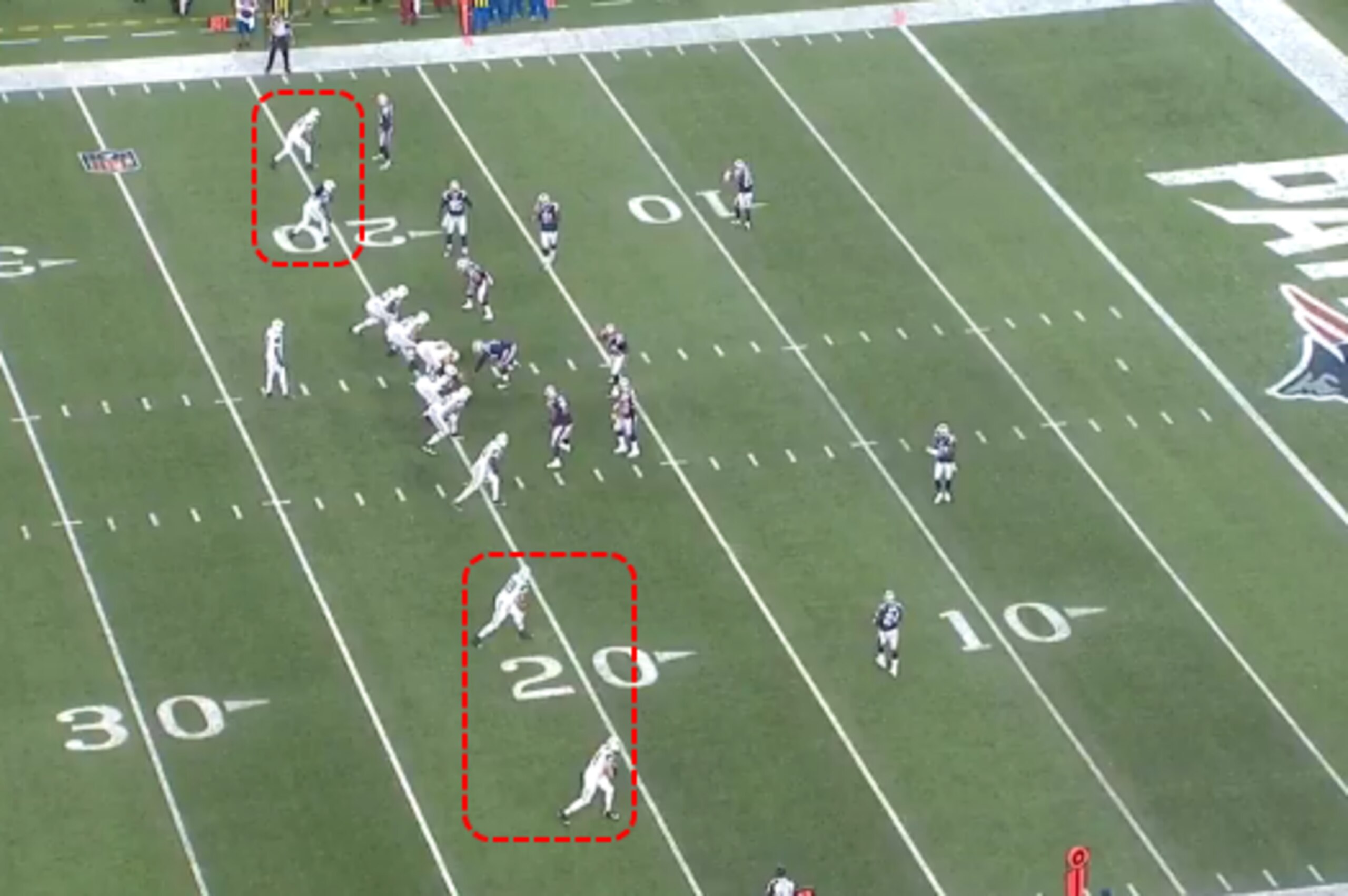
On this play, the Jets lined up in a two-by-two formation with one slot receiver on each side.
These formations could become more prevalent for the Jets with both Kerley and Harvin in the fold.
Either Kerley or Harvin could run a vertical route up the seam to clear out space for the other to work underneath, which is a strength of both. That ability to keep an opponent guessing could be a major weapon for the Jets this season.
The Jets offense features Kerley, Harvin and Decker at receiver, Jace Amaro and Jeff Cumberland at tight end, and running backs Chris Ivory and Chris Johnson in the backfield.
That's not enough to make Denver Broncos quarterback Peyton Manning green with envy, but it may be enough to have that effect on former Jets quarterback Mark Sanchez, who watched the skill position talent in New York erode and deteriorate into a colossal disaster toward the end of his time with the Jets.
Kerley's value on special teams as a punt returner only makes the contract that much more valuable. He has seen his role on special teams decrease in each of his four years in the NFL—29 returns in 2011, 19 in 2012, 13 in 2013 and two through seven games in 2014—but he could resume that role if wide receiver Walt Powell continues to struggle with ball security in that area.
So what's next? Well, besides Bentleys for everybody?
If the Jets are doing things right, Kerley won't be the only one with enough money to buy his teammates nice cars.
| David Harris | ILB | 2015 |
| Willie Colon | G | 2015 |
| Kyle Wilson | CB | 2015 |
| Muhammad Wilkerson | DE | 2016 |
| Quinton Coples | DE | 2016 |
| Chris Ivory | RB | 2016 |
Linebacker David Harris, an eight-year veteran, is in the final year of a four-year, $36 million contract he signed in 2011. His value to the team can't be overstated; he calls the signals for the defense with the green-dot helmet and plays on nearly every snap for the Jets, with snap percentages of 99.5, 99.8 and 98.7 over the past three years.
Running back Chris Ivory has been a revelation for the Jets' "ground-and-pound" style of offensive football over the past two seasons since being traded from the New Orleans Saints. The 26-year-old back has six touchdowns and an average of 4.7 yards per carry since joining the Jets.
But the biggest and highest-priority upcoming free agent is Muhammad Wilkerson.
As a first-round pick in the 2011 NFL Draft, Wilkerson was among the first group of first-rounders with a fifth-year team option in their contracts. That means that Wilkerson will remain a Jet through the 2015 season, but that doesn't mean a signing can't still happen in the near future.
The Jets still have plenty of cap room this season ($15.4 million, according to Spotrac) that they can roll over to next year to help with the re-signing, in addition to a stockpile of roughly $30 million in cap room for next year.
If anything, Kerley's contract should be seen as a positive for Wilkerson's future outlook with the team. The Jets clearly value the idea of re-signing their homegrown talent.
Kerley's contract is obviously a huge positive for the offense, though, which now has plenty of weapons in its arsenal. Once they get more consistent play at quarterback, the Jets offense could be tough to stop.
Unless otherwise noted, all quotes obtained via team news release, and all advanced statistics provided by Pro Football Focus' premium section (subscription required).
.jpg?w=2560 "Titans Colts Football")