The revamped Cleveland Cavaliers may simultaneously employ the NBA's best No. 1 option, second fiddle and third wheel this season. That is one of the many luxuries stemming from a summer that witnessed LeBron James' return, Kevin Love's arrival and Kyrie Irving's max-contract commitment.
But three players does not an NBA champion make—not even if those three have All-World credentials.
The strength of Cleveland's championship stock may hinge on the diversification of this team's production. James, Love and Irving can (and have) put the Cavs in title talks, per Odds Shark, but it's going to take more to close that conversation.


Specifically, it's going to take consistent and efficient production from a supporting cast featuring a mix of aging vets and still-developing prospects. And those prospects in particular—Tristan Thompson and Dion Waiters—will be critical to putting an end to The Forest City's decades-long championship drought.
Sure, the Cavs will need Mike Miller's three-point cannon and the spacing it creates, but they could lean on James Jones, Matthew Dellavedova and rookie Joe Harris for the long ball if they have to. Plus, Cleveland may yet add Ray Allen's historically prolific perimeter touch to the mix.
The Cavs will also undoubtedly benefit from the energy and intelligence of veterans Anderson Varejao and Shawn Marion. But it's hard to peg Varejao for an important role after seeing him miss 166 games over the past four seasons to injury. As for the 36-year-old Marion, he figures to be a part-time player at best as Father Time's grip tightens around him.
Those guys are Cleveland's helpers. Waiters and Thompson, though, could be Cleveland's real difference-makers.

From a statistical standpoint, Waiters has the chance to show as well as any non-Big-Three Cavalier.
The explosive scoring guard erupted for 14.7 points and 3.0 assists as a rookie in 2012-13. For an encore, he bumped his scoring average (15.9), effective field-goal percentage (47.9, up from 45.1) and player efficiency rating (14.0 from 13.7) during his sophomore campaign, according to Basketball-Reference.com.
He can create his own scoring chances—66.4 percent of his career two-point field goals have been unassisted—and his ability to wreak havoc off the bounce can keep pressure on opposing defenses even when Cleveland's talented trio catch a breather. Waiters is also a capable setup man when he's willing to share the basketball.
All of those are good traits to have, and seeing that he won't turn 23 until December, the future looks incredibly bright if he can build around them.
As for the present, well, that's a lot murkier. With Irving, Love and James on board, the Cavs don't need a lot of what Waiters has to offer. As soon as James signed on the dotted line, Waiters knew this season would be one of adaptation.
"I have to make adjustments," Waiters told reporters in July. "I have to find ways to impact the game without having the ball. I'm planning to go watch tape to see what [Dwyane Wade] did when he played with LeBron. I need to learn how to be effective out there with him."
Waiters is on the right track, but the Cavs don't need him to recreate the role Wade played alongside James with the Miami Heat. The spot set aside for Waiters is much further removed from the spotlight and far more limited in terms of touches. Bleacher Report's Jared Dubin provided insight on how Waiters needs to improve:
Whether Cavs coach David Blatt decides to start Waiters or not, the former Syracuse star should see major minutes with the second team. Cleveland's reserves need his offensive creativity, whereas that gift would feel redundant given the Big Three are better scorers and passers than Waiters.
He'll still see time with Cleveland's big boppers, but his responsibilities will change dramatically from what they have been.
"The Cavaliers don't necessarily need Waiters to drop 15-20 points a game," wrote Bleacher Report's Jonathan Wasserman. "They need him to be timely, efficient and consistently threatening."
Waiters has the tools to succeed in such a role. Last season, he converted 41.6 percent of his catch-and-shoot threes, per SportVU player tracking data, which put him ahead of long-range snipers Danny Green (41.5), Vince Carter (40.1), Dirk Nowitzki (39.9) and the aforementioned Allen (39.9), among others.
But taking full advantage of that talent means leaving behind the ball-dominant skills responsible for getting him to the league. His NBA reality changed this summer as much as anyone on the roster, and it could take him all season (or longer) to catch up.
He has held or shared the lead in field-goal attempts during each of Cleveland's first four preseason games. While he has made the most of these shots (47.2 percent shooting), the volume is still surprising with all of the weapons now around him.
Eventually, these personnel changes and the adjustments they bring out of Waiters will be a good thing. But for now they could put too many bumps in his road to comfortably consider him Cleveland's fourth-most important player.
"This should result in a more efficient and less volatile player, but who knows," SportsOnEarth's Michael Pina wrote. "Context is everything here, and a scorer who's used to having the ball in his hands all the time must adapt when better players are brought into the fold."
On the surface, Cleveland's moves seem to negatively impact Thompson as much as anyone. After all, his natural power forward position can now be filled by the greatest player on the planet (James), a perennial All-Star (Love) or a former world champ (Marion).
Yet, this influx of talent actually puts Thompson in position to simplify his task list and focus on areas in which he has excelled in the past. And if he can pull this off, he should easily emerge as the fourth-most important piece of the puzzle.
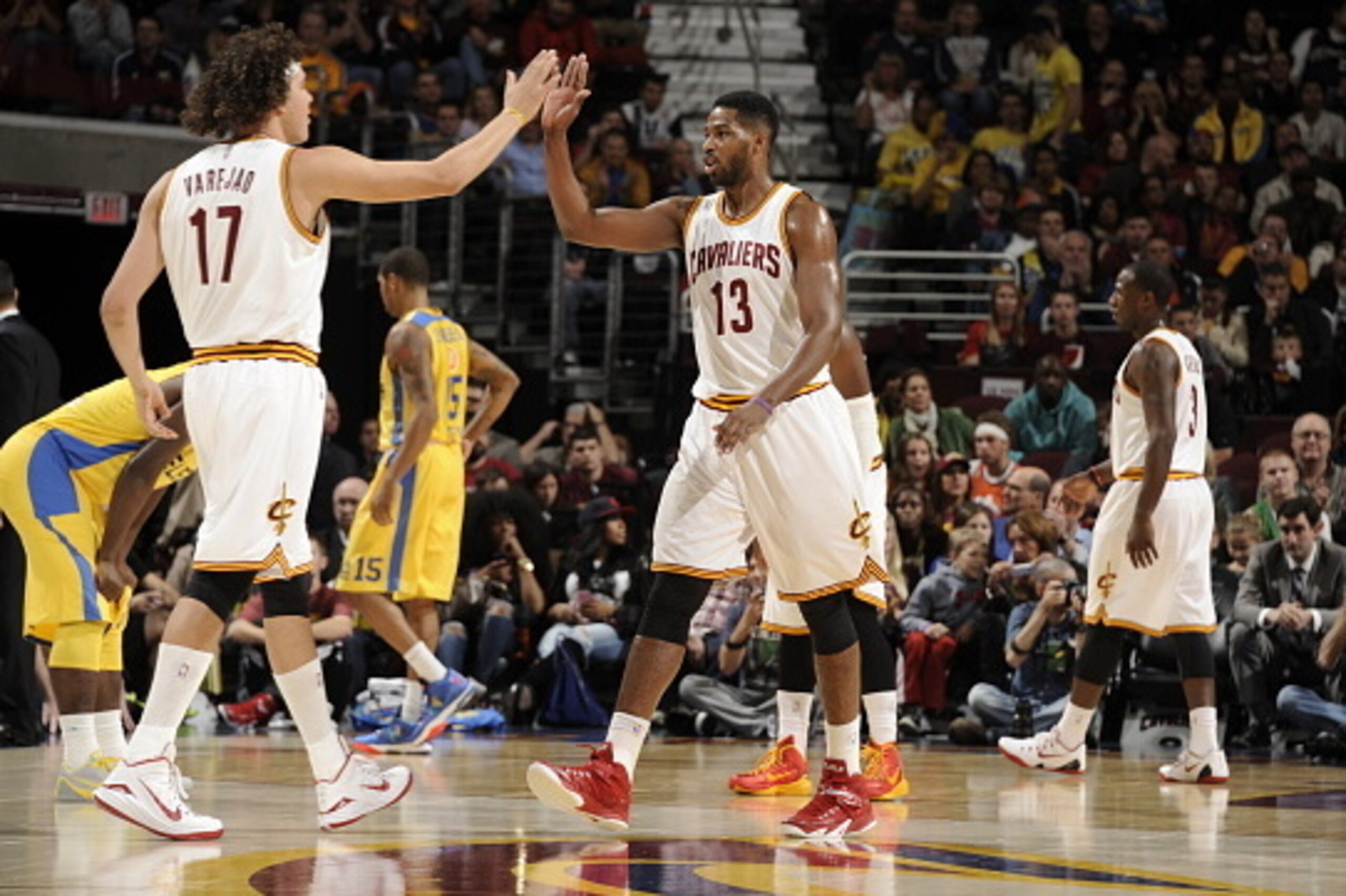
"James, Love and Irving will grab the headlines, but it'll be how Thompson controls the paint on defense that could really tell the story of most games," wrote Bleacher Report's Greg Swartz. "Cleveland needs Thompson to transform into the elite defender and shot-blocker many believed he'd become in the league."
The Cavs badly need a rim protector. They have leaks on the defensive perimeter, and Love and Varejao don't offer much insurance behind them. Brendan Haywood missed all of last season with a broken foot, and he hasn't posted even an average PER since 2009-10, according to Basketball-Reference.com, so he won't be much help, either.
To date, Thompson has hardly been a rim deterrent at this level. He averaged 0.4 blocks per game last season. Opponents shot 58.0 percent against him at the rim, per SportVU, which was the second-worst rate of the 75 defenders to face at least five such attempts per game.
This was never supposed to be an issue. In fact, he entered the league overflowing with potential as an interior defender.
Thanks to a massive 7'2" wingspan, per ESPN Insider (subscription required), Thompson averaged 2.4 blocks during his lone season at Texas and posted a 7.2 block percentage there, according to Sports-Reference.com. To put that second number into perspective, Anthony Davis and Serge Ibaka led the league with a 6.7 block percentage last season (minimum 20 minutes per game).
"Tristan is a high-energy guy that gets his hands on the ball at both ends of the court," Blatt told reporters earlier this month. "He has a very, very high motor. He's active."
If Thompson can rediscover his old shot-blocking form, he could go a long way toward addressing arguably the team's biggest weakness. And if guys such as James, Love and Marion force him to find most of his minutes at the center spot, he says that it's even better for him, per Cavs.com's Joe Gabriele:
"I think playing the 5 is an advantage for me. I’m much quicker than a lot of the other centers in our league. So, I’ll give them havoc and at the same time, I’ve got stronger over the summer where I can guard the 5’s and body up against them.
And if you look at it, our league is changing. You don’t really have the prototypical centers anymore—like the Shaqs, the Ewings, the Mutombos. Everyone’s more mobile and athletic, so a 4 or 5 in this league isn’t as big a difference.
"
Whether at the 4 or 5, Thompson simply needs to stay in his lane. And, unlike Waiters, Thompson should feel extremely comfortable with his role.
The Cavs aren't looking for more than interior activity out of him. Judging by his production through three preseason games—12.7 points, 10.3 rebounds, 1.3 steals and 0.7 blocks in 23.7 minutes—that is precisely what he is prepared to give.
Thompson doesn't need the ball to be effective. And his work as an off-ball cutter, above-the-rim finisher and offensive rebounder should all mesh well with the Big Three.
Not only can he coexist with that trio, his length, athleticism and defensive effort should also make it even better.
The Cavs, like any other championship hopefuls, will need everyone to make a successful title run. But Thompson will play the biggest role of Cleveland's support staff due to the uniqueness of his talents and the way they will complement the rest of this roster.
Unless otherwise noted, statistics used courtesy of Basketball-Reference.com and NBA.com.


.jpg?w=2560 "NFL House in Paris Closes for Protests")
.jpg?w=2560 "Trevon Diggs Cut by Seahawks")