Jimmy Butler's Defensive Ability Takes Pressure off of Derrick Rose
The return of Derrick Rose to the Chicago Bulls lineup has been much awaited. Multiple knee injuries have sidelined him for most of the past two seasons, and the Bulls' once promising future among the NBA's championship contenders fizzled without him.
A few acquisitions this offseason—namely Pau Gasol, Doug McDermott and Nikola Mirotic—in addition to the return of Rose has quickly vaulted the team back into the title conversation.
But with Rose's elongated absence came a fortunate development that has been an added bonus: The rise of Jimmy Butler, and specifically his defensive versatility in the Bulls backcourt.

It will take time for Rose to adjust to the NBA game. His play with Team USA this summer aided in the transition, but nothing will simulate NBA competition and the grind of an 82-game season.
The Bulls, considering their conservative approach to his recovery thus far, could keep his minutes down to preserve him for the long run.
But that's not the style of Bulls head coach Tom Thibodeau. He's known to work his key players to the bone.
In his preseason remarks about Rose thus far, he's avoided any talk of minutes restrictions. On the surface, it would appear that he's sticking to his usual minutes-heavy approach.
Via the Chicago Sun Times' Joe Cowley, Thibodeau said, "The big thing for [Rose] is he has to get used to playing again. There’s only way to get used to playing again—play. I know one thing: If he’s playing, each game he’ll get better."
As the floor general and primary ball-handler, it will be hard to limit Rose's touches and impact on the offensive end even if he's playing 5-10 fewer minutes per game. He's a score-first ball-dominator at heart and most successful when things revolve around his play.
Not that that's a bad thing. He's a proven workhorse and skilled enough to play the role of primary scorer and creator. Still, his teammates should ease the burden because Chicago has one of its most talented offenses in recent memory.
Joakim Noah has morphed into an elite passer and a quietly clever finisher around the rim. Pau Gasol is a seasoned post player with a solid mid-range shot and a team-ortiented style of play. Mike Dunleavy, Kirk Hinrich, Butler, McDermott and Mirotic provide a nice mix of off-ball cutting and shooting to complement the primary threats.
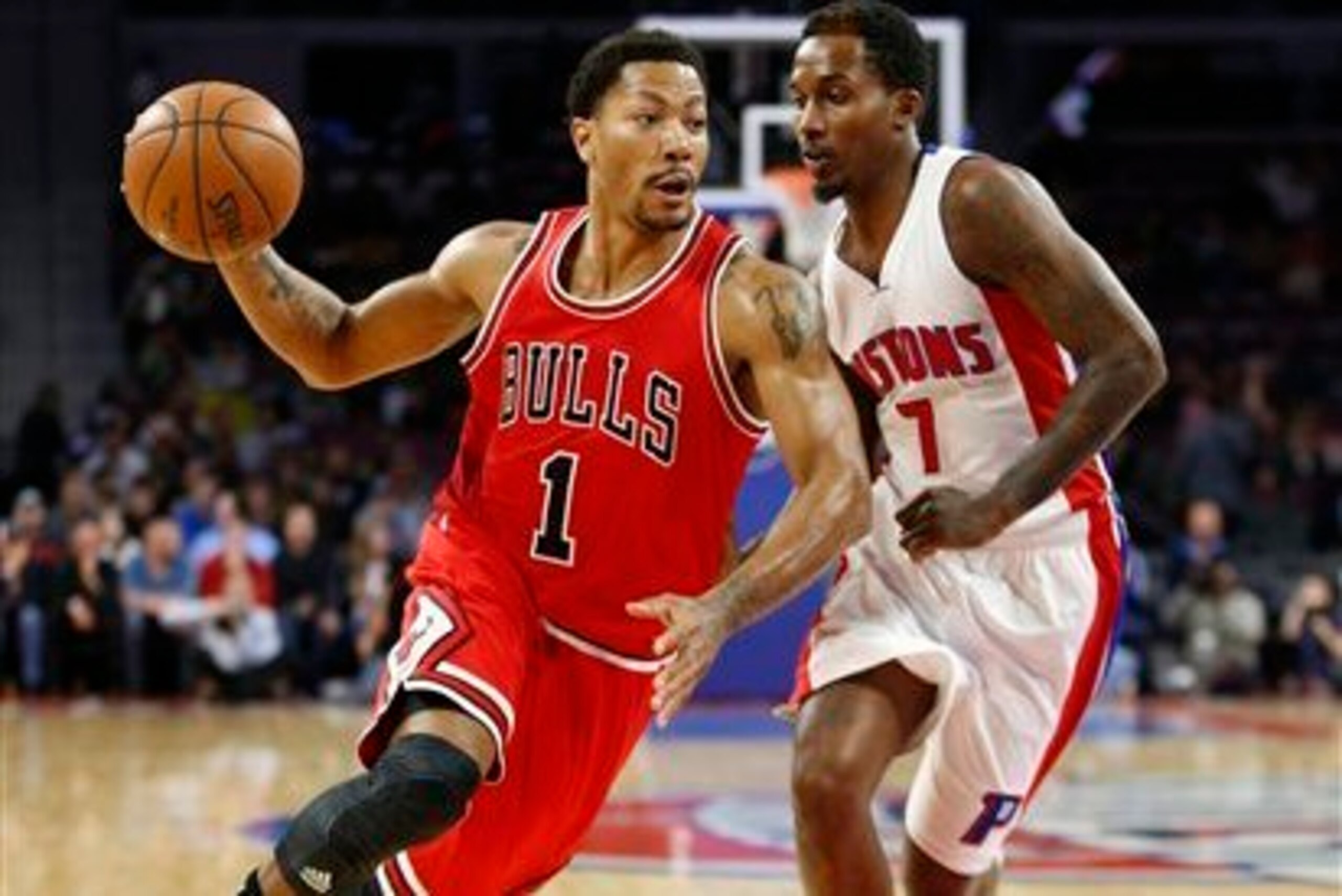
This is a long way of saying that the offense will still be good even if Rose is only a muted version of his former MVP self.
The defense is a more important question. Not on the interior, of course, where the Noah-Taj Gibson front line is among the NBA's best and the swapping out of Carlos Boozer for Gasol only strengthens that core.
It's on the perimeter that the Bulls have typically struggled, using a ragtag bunch of offense-first fill-ins such as D.J. Augustin, Nate Robinson and Kirk Hinrich.
Thibodeau did an admirable job whipping them into shape. After a bit of time in the Bulls' system, they were flying around with great effort, which in turn somewhat masked their inherent flaws as defenders.
Butler's emergence, however, has changed things for the better. His build is similar to that of Luol Deng: long, smart and capable of guarding multiple positions. Deng's offensive game is a bit more refined, but Butler is still young. With time, he'll tighten up his shooting and become a greater threat as a slasher.
But Butler is more key for Rose than Deng ever was. Even at the height of his powers, Rose was never the world's greatest defender. He was prone to lunging for steals and tried to use his quick hands to swipe at the ball instead of squaring up his man.
He basically trusted his athleticism a bit too much. Rose almost willingly let ball-handlers get hip-to-hip with him on drives to the rim, prowling for a strip or block once the offensive player exposed the ball.
This was particularly true when he defended on the wings. The Bulls principles sent pick-and-rolls baseline in such situations, with the big ready to defend basket attacks. Yet Rose loved to send his man baseline anyway in non-pick-and-roll situations, literally giving up an entire side of the floor.
There is a fine line between forcing an offensive player left and completely giving up that side. Rose teetered on it often.
Sometimes it worked:
Other times it didn't:
Either way, the Rose of two years ago was usually tasked with guarding the opposing point guard. This made sense, after all; he was (and is) the Bulls' point guard and cross-matching can be unnecessarily complicated.
Not to mention that the Bulls couldn't functionally cross-match anyway back then. Rip Hamilton was the team's staring 2 by the end of the year, and his advanced age limited his defensive capabilities. Deng was an option, but he's more of a rangy wing stopper than a player built to deal with PG-like quickness.
With the 2014-15 Bulls, however, cross-matching is ideal for a number of reasons—mainly because the 1 is arguably the league's deepest position, and it's a nightly battle on the defensive end to contain these elite players.
Just in the Eastern Conference, Rose will be dealing with Deron Williams, Kyle Lowry, Brandon Jennings, Kyrie Irving, Brandon Knight, John Wall and Jeff Teague. That doesn't even include the West or the handful of other solid, if not spectacular Eastern Conference floor generals.
This does not seem ideal with Rose coming off two serious knee injuries.
What could work is having Butler slide over to guard better 1s. With the three-point shot now emphasized in almost every NBA offense, shooters with limited creativity and ball-handling dot the floor.
Assuming the Bulls start Rose, Butler and Dunleavy on the perimeter, there exists a careful reorganization of man-to-man matchups that should work most nights.
Dunleavy, limited athlete that he is, can sneak up on opponents with his physicality as a defender. He'll do just fine against the majority of the league's 2s, which is quietly one of the weaker positions in today's NBA anyway.
That means Rose guards the weakest of the opponent's three perimeter players while Butler guards the strongest.
On nights when greatness appears in the form of the point guard, Butler can step in because he possesses a rare combination of length, agility and recovery speed.
No one can legitimately expect Butler to completely stay in front of opposing PGs. They'll get to the rim because of slippery ball-handling and greater quickness.
Yet whatever advantage they do get against Butler when attacking the rim is minimized by his length and timing. While he might not be able to keep his chest in front of his man, he always remains in range to make a play.
On pick-and-rolls, having Butler provides the unique advantage of his physicality busting through screens. Smaller players can get caught up in picks a bit too often, but Butler's size allows him to easily brush aside the weaker stuff. In a pick-and-roll-driven league, this makes Butler guarding PGs especially valuable.
With the greater length, he can also bother ball-handlers from behind as they try to slice through the lane after turning the corner on picks.
Look at how Dorell Wright of the Portland Trail Blazers doesn't even want to set a pick on Butler here—he quickly releases to the three-point line because it's clear that Butler will throw him out of the way with any type of minimal contact.
Butler is assigned to Damian Lillard—a late-game cross-match that might become even more utilized this year—and is hounding him on the perimeter.
Lillard is able to drive left against Butler's overzealous play with a clear lane to the rim. Yet once he crosses the elbow after having gained a clear half-step on Butler, he mysteriously steps back for a jumper.
That's the Butler effect. Even after having ceded some ground, he's still in a favorable position. So Lillard tries to catch him off guard by changing course with his lateral quickness.
Again, no inch is gained. Look at how close Butler is when Lillard releases the shot. The pure athleticism required to slide his feet with a downhill Lillard, change course on a dime and explode forward and up to bother the shot is nothing short of astounding.
Whether or not Thibodeau implements this cross-matching strategy remains to be seen. He's more of a blue collar defensive teacher: Two traditional, physical and defensive bigs on the floor at all times and perimeter players guarding their position.
He also might want to throw Rose into the fray from the start just to get his legs going a bit. Rose isn't a bad defender by any means, so it's not like the Bulls are sacrificing anything by having him defend his counterpart.
Flip-flopping these matchups can get tricky during game situations anyway. Transition opportunities and the quick pace of play sometimes dictate less convoluted matchups for defenders—which is to say, it's usually easier to guard who guards you because you're next to him on the offensive end already.
It's also more challenging for Butler to stick with the opponent's quickest player for four quarters. Getting into a low stance can be brutal for taller players, and chasing around quickness is a tiring gig. Even though Thibodeau pushed Butler with extended minutes almost all the time last year, his body cannot take that type of beating forever.
That's why, for example, LeBron James only guarded Tony Parker in the fourth quarter during the Finals. It was a form of energy conservation to maximize his defensive impact in the moments that counted without fatiguing him offensively during earlier parts of the game.
Similar to LeBron and his defensive prowess, Butler provides options. Rose isn't stuck positionally because Butler isn't, and it's that type of versatility that could save Rose in the long run.
The Bulls are looking to make a deep playoff run this year, and they'll likely need Rose for 100-plus games. Since he hasn't played even a full regular season in over two years, there has to be some sort of Plan B.
At least defensively, it's Butler.

.jpg?w=2560 "NFL House in Paris Closes for Protests")
.jpg?w=2560 "Trevon Diggs Cut by Seahawks")