NFL Comparisons for Top 10 College Football Players
A handful of the best players in college football are only two years out of high school, which means they will not become eligible for the NFL draft until 2016. But why should we wait that long to start making pro comparisons?
In fact, why should we wait until the run-up to the 2015 draft, either? If a fan of pro football wants a primer on the current batch of college superstars, we should give it to him or her. Hooray for context!
In picking the top 10 players for this list, I went back to my top 50 player rankings from early September and adjusted for the intervening weeks. Players from the old top 10 that dropped due to performance regression were Texas A&M offensive tackle Cedric Ogbuehi and Oregon cornerback Ifo Ekpre-Olomu.
After that, one player from just outside the top 15 has been playing well enough to skate into the top 10. Feel free to disagree with the included players if you want—the rankings are inherently subjective, and I suspect any two people would have differing opinions on whom to include—but this is the 10 we went with.
As for the comparisons themselves, they were based on physical similarities and where each player excels as a prospect. The latter was more important than the former—that is, attributes such as speed or strength were preferred over height and weight—but in an ideal scenario, a comparison could be made to satisfy both.
Sound off below with your own comparisons.
10. Robert Nkemdiche, DT, Ole Miss
1 of 10
NFL Comparison: J.J. Watt, Houston Texans
High praise? Yes. But undeserved praise?
Heck no.
Robert Nkemdiche makes the biggest, fastest, strongest players in college football look small and slow and weak. Just look at how he manhandled Alabama guard Leon Brown in the first quarter of last week's landmark victory (albeit on a positive offensive play).
Listed at 6'4", 280 pounds, Nkemdiche shares Watt's ability to play 3-technique on the inside or 5-technique on the outside, and he's capable of carrying as much weight as needed for either position. He also has surprisingly quick feet and hand coordination, which is why he, like Watt, has been used in certain offensive packages.
A player ranked higher than Nkemdiche on this list (because he's been the more productive college player) has also shown Watt-like tendencies but has not quite filled out his frame enough yet. Nkemdiche is already there. He is the rare prospect one can call a "man among boys" without feeling cliche for using hyperbole.
That's honestly what Nkemdiche is.
9. Melvin Gordon, RB, Wisconsin
2 of 10
NFL Comparison: Jamaal Charles, Kansas City Chiefs
Before the season, I compared Melvin Gordon to Chris Johnson over Jamaal Charles because Gordon had not proved himself enough as a pass-catcher to earn the latter comparison.
With five receptions this season, that still appears to be the case, but Gordon has at least shown the ability to catch the ball when needed. Moreover, he has been stronger than expected picking up steam and running downhill between the tackles, an area in which Charles excels despite having a taller, leaner frame.
Aesthetically, there are a lot of similarities between Gordon and Charles, both of whom are angular runners who stand up straight but maintain good balance. There is also the obvious—the fact that they are both exceptionally fast and capable of scoring from anywhere.
8. Joey Bosa, DE, Ohio State
3 of 10
NFL Comparison: Jason Pierre-Paul, New York Giants
Joey Bosa is listed at the exact same size and weight (6'5", 278 lbs) as Jason Pierre-Paul, and both players carry that size and weight well.
Bosa might not have the same top-end speed as JPP, but he has more than enough quickness and burst off the line to shoot past slower lineman. He also has the freak athleticism to do standing backflips in the weight room—something I have never seen Pierre-Paul do but would not be shocked to learn he can do with ease.
Bosa earned mini-J.J. Watt comparison from Todd McShay of ESPN.com (subscription required), but even McShay admitted that it was projecting a little bit. In his current frame, he looks more like a sophomore version of Watt than a professional version, which is fine because he is only a sophomore. There's a chance he can get there at some point.
For now, though, his athleticism, motor and ability to contribute against both the run and the pass remind more of Pierre-Paul.

.jpg?w=2560)
7. Vernon Hargreaves III, CB, Florida
4 of 10
NFL Comparison: Joe Haden, Cleveland Browns
Vernon Hargreaves III was bested by the player on the next slide in Florida's game against Alabama, but it wasn't as bad as the box score made it look. Especially after destroying Tennessee in the Gators' following game, VHIII has done enough to retain his spot at No. 7.
As a player, he is actually quite similar to the last first-round cornerback to come out of Florida, Joe Haden. Both check in at a shade under 6'0", but their length and athleticism allow them to go against receivers of all sizes and usually find success in doing so.
Furthermore, Hargreaves and Haden both excel with mirroring skills in coverage—something that can be improved with coaching but never really taught. It is one of the most important innate skills a defensive player can have, and VHIII and Haden both have it.
6. Amari Cooper, WR, Alabama
5 of 10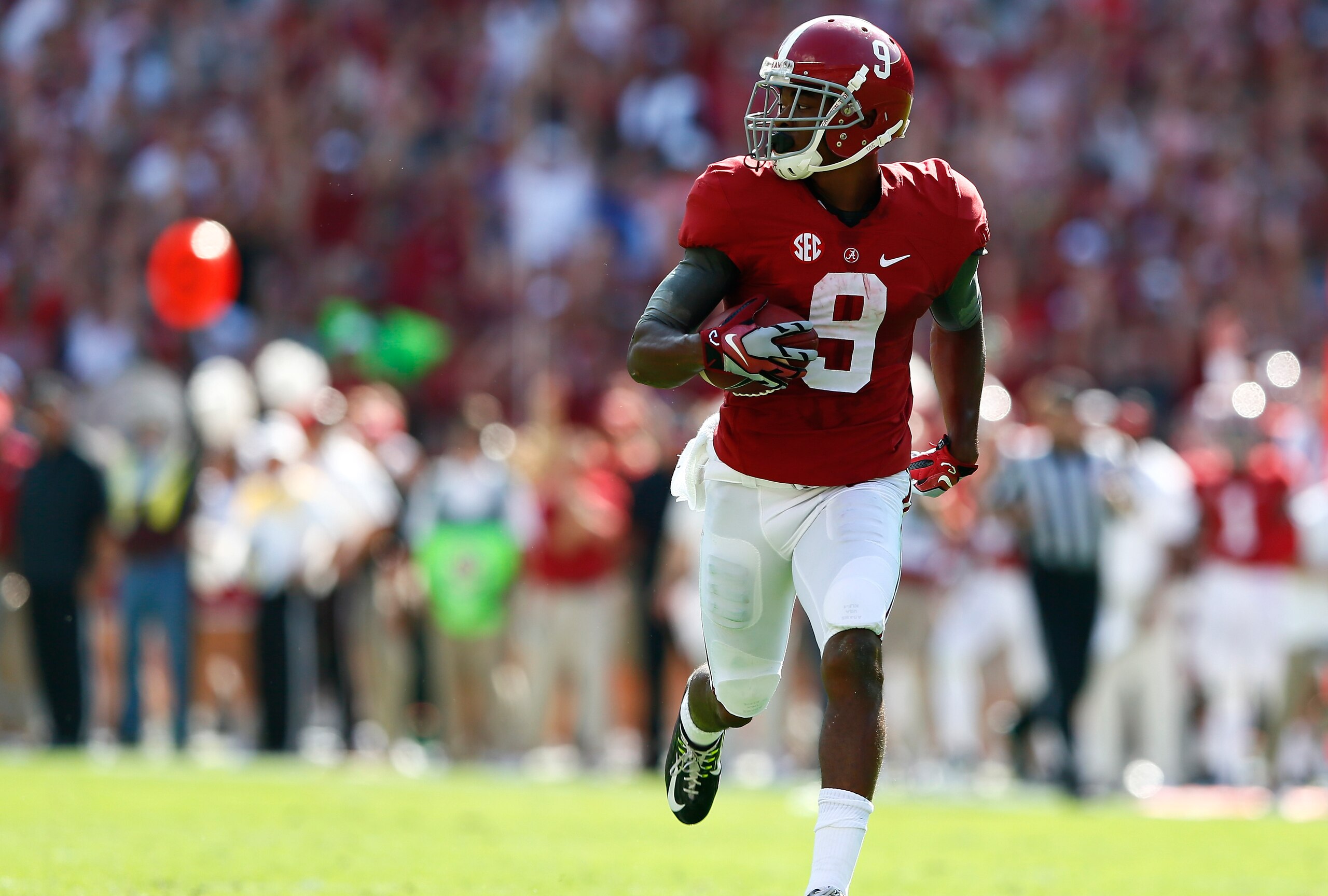
NFL Comparison: Santonio Holmes, Chicago Bears (circa 2009)
Amari Cooper is the best version of Santonio Holmes—the version that won Super Bowl MVP with the Pittsburgh Steelers instead of the one that most people forgot is still in the league.
Cooper (6'1") is two inches taller than Holmes (5'11"), but they are similar in that their signature talent is fluidity. Whether it be striding down the field on a streak or gliding across the field on a drag, they come in and out of routes without losing any speed or momentum.
One of five league executives polled by NFL.com agreed with my assessment, comparing Cooper to Holmes because "they are both smooth athletes with outstanding football instincts."
The other four execs compared Cooper with Odell Beckham, Marqise Lee, Jordy Nelson and Roddy White, respectively. All of those are fair assessments, too.
5. Vic Beasley, DE, Clemson
6 of 10
NFL Comparison: John Abraham, Arizona Cardinals
Vic Beasley is a pass-rush specialist who is capable of defending the run but doesn't do as well in that regard as one might like.
His primary trait is quickness off the edge, which makes him a good comparison for John Abraham of the Arizona Cardinals, one of the most underrated players in the NFL over the past decade. Even though he plays defensive end in college, Beasley looks more like an end/outside-linebacker hybrid at the next level.
According to Mike Huguenin of NFL.com, Beasley said the thing he worked the most on this offseason was "dropping back into coverage," an obvious allusion to the position change he anticipates having to make. At 240 pounds, he is big enough to play some end when needed but won't be able to sustain himself against the run on standard downs.
Abraham has vacillated between the positions these past few seasons and found success because his one elite skill—getting to the passer—is so hard to defend that he can't be taken off the field. Beasley projects in much of the same mold.
4. Leonard Williams, DL, USC
7 of 10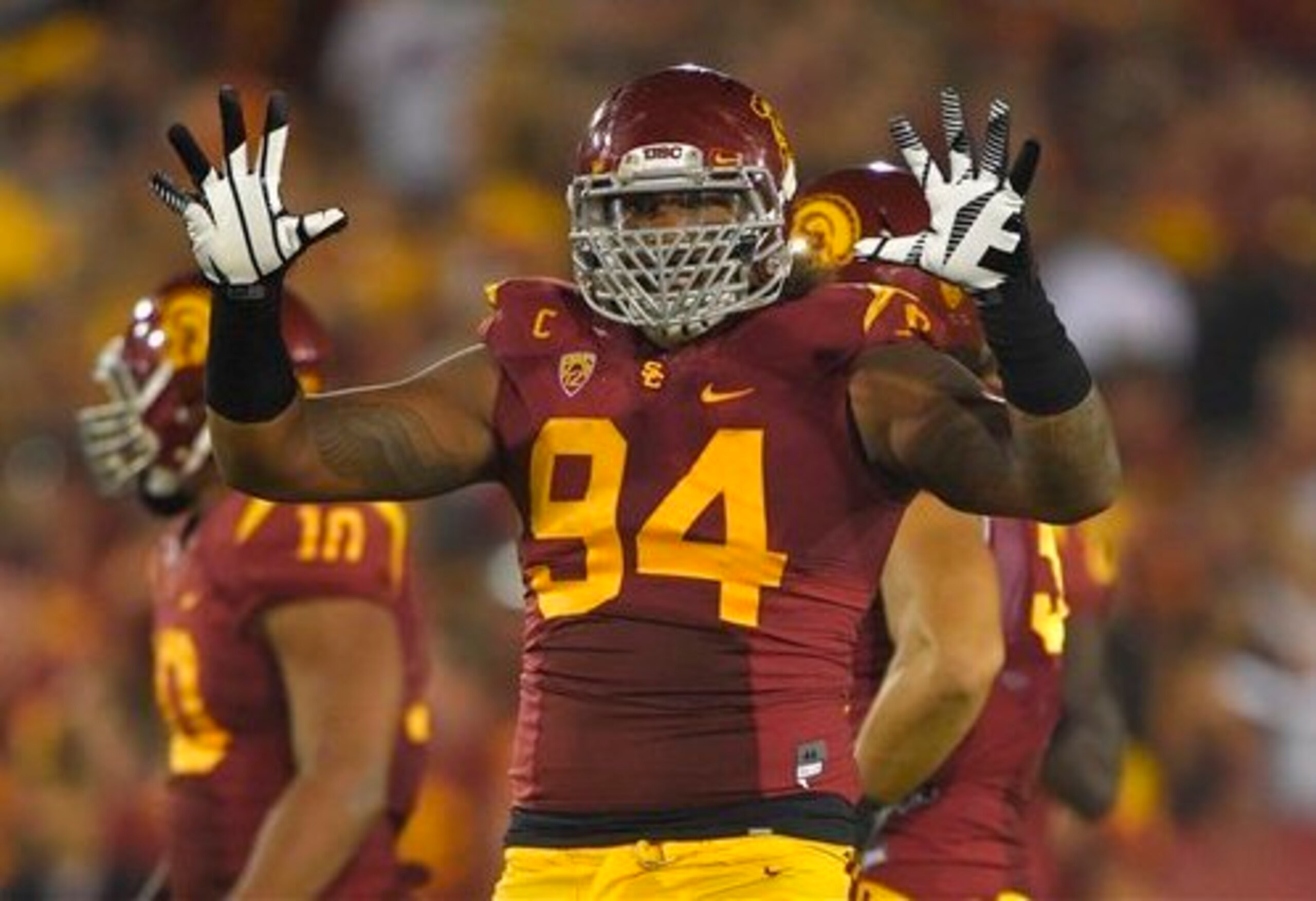
NFL Comparison: Sheldon Richardson, New York Jets
Leonard Williams has the size of a defensive tackle (6'5", 300 pounds), the hands of a defensive end and the speed of an outside linebacker.
In other words, he is Sheldon Richardson.
Bleacher Report's Matt Miller made the same comparison in an article that called Williams "the most dominant defensive prospect in college football," lauding the USC lineman for his "freakishly long arms" and his Richardson-esque speed for a player his size.
Williams is two inches taller than Richardson and might have an even brighter future, which is scary considering Richardson won the Associated Press Defensive Rookie of the Year award in 2013. Both should be Pro Bowl-level players for at least the next decade.
3. Jameis Winston, QB, Florida State
8 of 10
NFL Comparison: Ben Roethlisberger, Pittsburgh Steelers
Spare me, commenters, by insinuating this has anything to do with their checkered off-field histories. It doesn't. Jameis Winston's comparison is Ben Roethlisberger because of how each plays.
To wit, Winston and Roethlisberger are imposing physical specimens, the former checking in at 6'4", 230 pounds, the latter at 6'5", 241 pounds. They are both able to make plays with their legs but prefer to throw out of the pocket, where their best attributes are decision-making, field awareness and powering the ball down the field.
Also of note, Winston is undefeated in his college career—a measure of early team success that Roethlisberger can relate to.
Things have gotten dicier in recent years, but when Big Ben first entered the league, he showed leadership and command that belied his years and led the Steelers to a Super Bowl in his sophomore NFL season. Winston led Florida State to a national title when he was only a redshirt freshman.
2. Marcus Mariota, QB, Oregon
9 of 10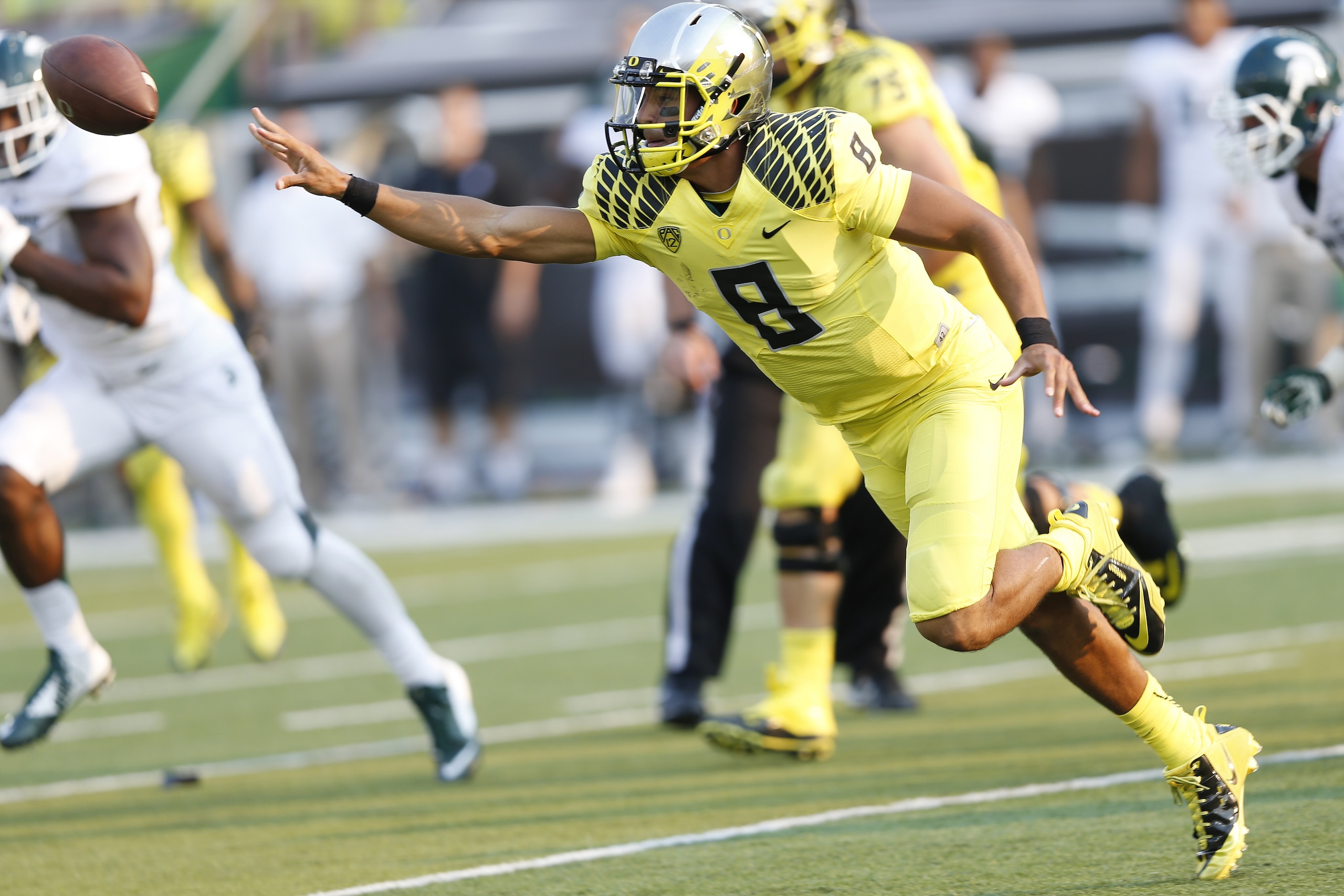
NFL Comparison: Steve Young, Retired
Marcus Mariota is difficult to find a comparison for. He is in many ways a composite of so many other quarterbacks, skewing close to Aaron Rodgers, Andrew Luck, Randall Cunningham, Donovan McNabb, et al., along with the player I went with.
Ultimately, Steve Young was my choice because of how he balanced running with passing. All four players mentioned above are capable of doing both, but one is clearly their strong suit over the other. For Mariota and Young, things are essentially equal.
Mariota (6'4") is two inches taller than Young (6'2") and his ceiling is proportionally higher. He has a chance to be even better with his arm than Young was, which is no small feat. Young did not make the college and NFL Hall of Fames on the strength of his legs alone.
If he follows suit, Mariota will not have, either.
1. Todd Gurley, RB, Georgia
10 of 10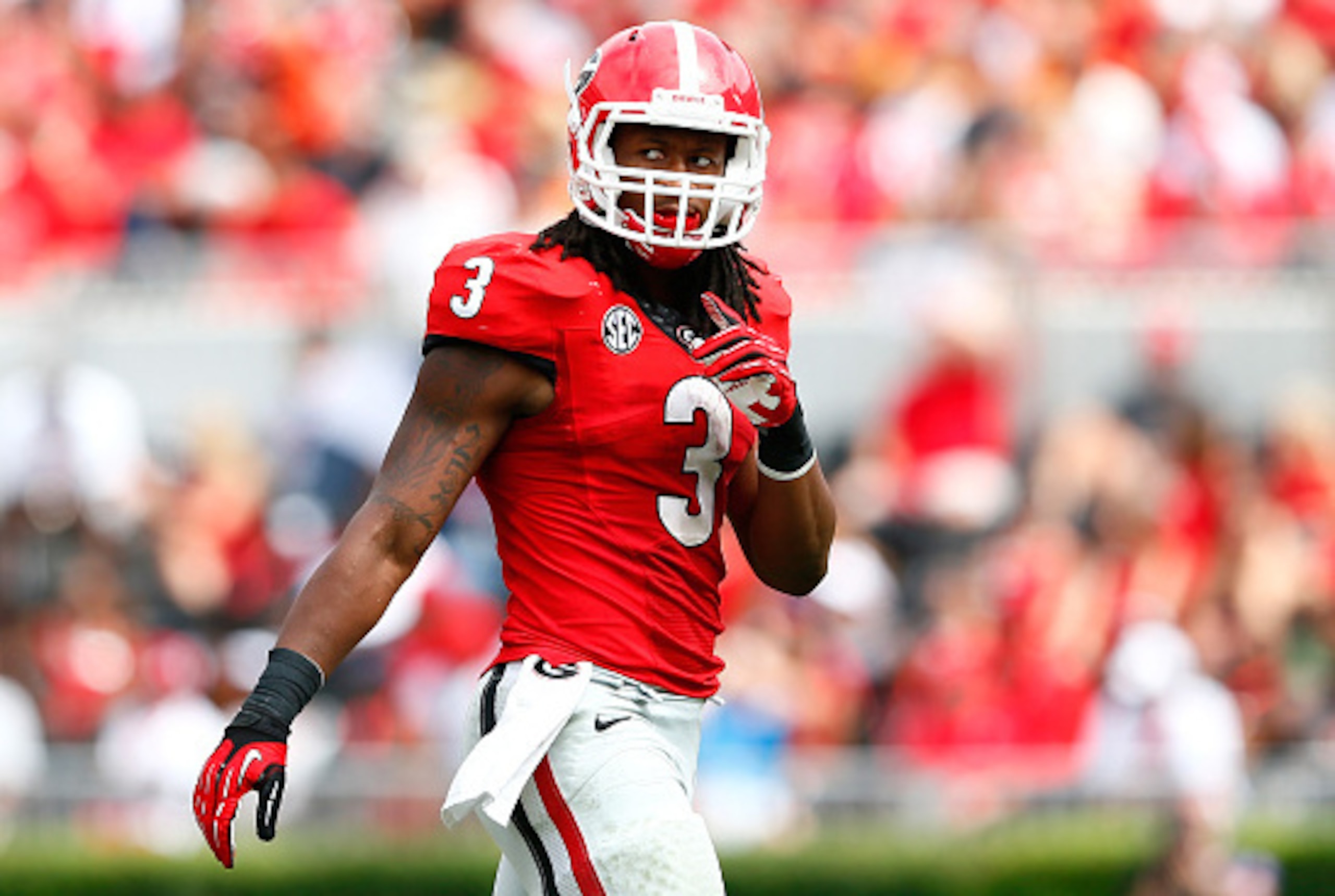
NFL Comparison: Marshawn Lynch, Seattle Seahawks
Todd Gurley is the best college running back since Adrian Peterson, but that does not make Peterson the proper pro comparison.
The reason for that has less to do with Peterson and more to do with the uber-strong comparison between Gurley and Marshawn Lynch of the Seattle Seahawks. Lynch is known for his insatiable power and ability to finish runs—something Gurley is known for as well—but is also deceptively fast and capable of breaking long gains.
Against Clemson in 2013, Gurley even broke out a distinctly "Beast Mode" touchdown celebration—the type that is not preordained or choreographed but a feral reaction to willing his way into the end zone. Bonus points for both players having dreadlocks.

.jpg?w=2560 "NFL House in Paris Closes for Protests")

.jpg?w=2560 "Trevon Diggs Cut by Seahawks")