Vikings Must Get Cordarrelle Patterson Involved in Offensive Game Plan
Ever since his explosive Week 1 performance, second-year receiver Cordarrelle Patterson has almost become an afterthought in the Minnesota Vikings offense.
The fanfare around Patterson before the season began raised expectations for an often underused receiver as a rookie. His 128 offensive yards against St. Louis didn’t flame those flames at all. That display only stoked the fire.
Then his touches started to dwindle as Minnesota turned over the quarterback position more than once. Patterson expressed his concerns after seeing little of the ball last week in Green Bay, as quoted by Brian Murphy of the Pioneer Press:
TOP NEWS
.jpg?w=2560 "NFL Paris Football")
NFL House in Paris Closes for Protests
.jpg?w=2560 "Seahawks Chiefs Football")
Trevon Diggs Cut by Seahawks
.jpg?w=2560 "Colts Football")
Jonathan Taylor Landing Spots
"I want to be more involved. I don't know what's going on. We have a plan. I'm sticking to the plan. I trust coach (Norv) Turner and the whole staff with what they're doing. It's going to turn around. Hopefully I get more touches.
"
To his credit, Patterson has been quite diplomatic with his responses, not drawing unnecessary attention to himself while the ball has gone elsewhere. Fans aren’t thrilled about it, though, and they may be justified.
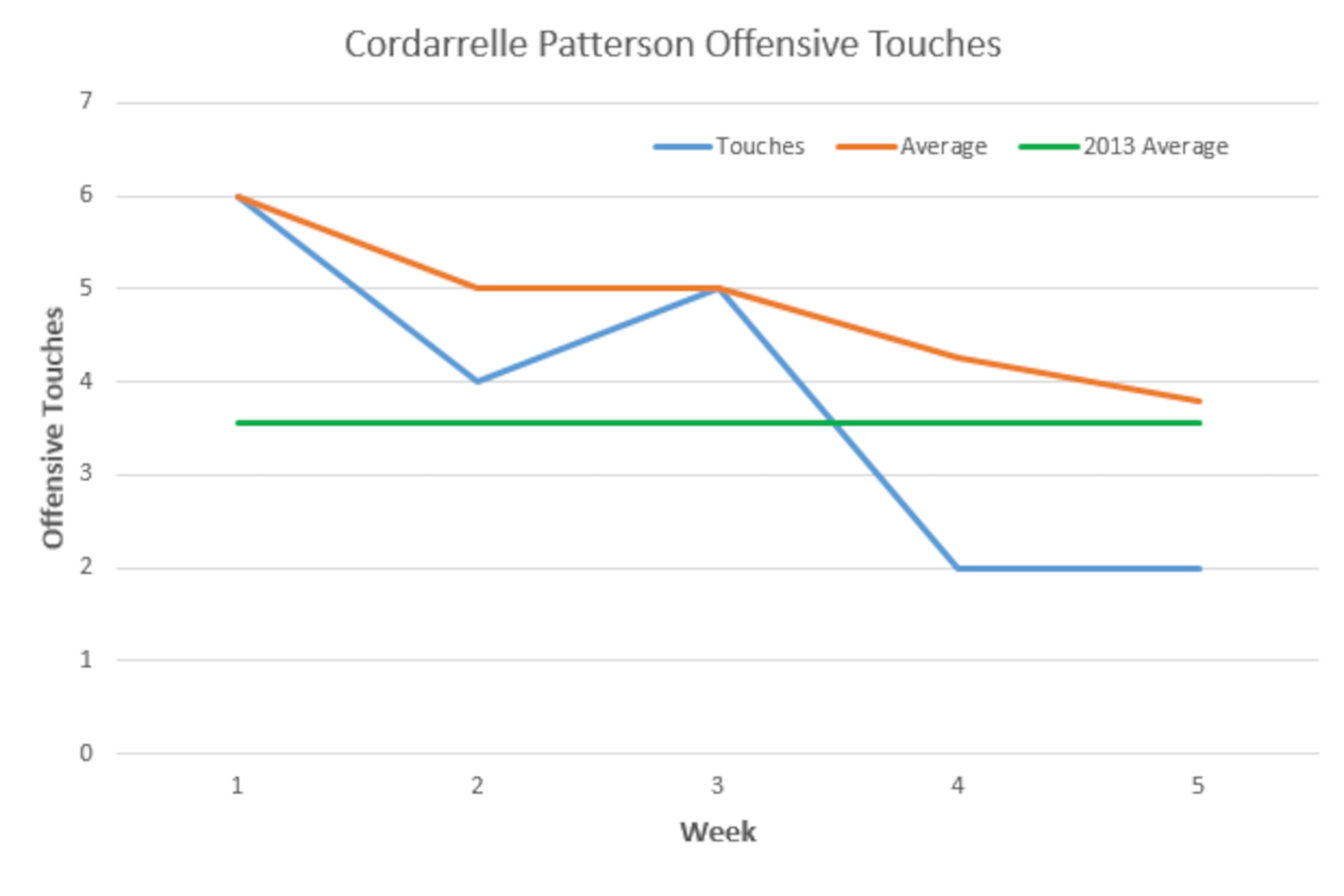
Just how infrequently is Patterson getting touches? This graph shows his offensive touches, defined by carries plus receptions, in terms of weekly totals, 2014 average after each week, and the average number of touches from his 2013 season.
Last year's offensive coordinator Bill Musgrave was the originator of the Patterson suppression, but Norv Turner is doing his best to catch up this year.
The last two weeks, Patterson’s touches dropped below the 2013 average. His 2014 average is quickly approaching the 2013 average as well. The Vikings integrated Patterson slowly a season ago, likely due to his inexperience playing high-level football and his relative rawness as a young player. That brought down his average touches from a season ago, but that reason doesn’t stick to the wall the same way it did before.
Now Patterson must be a focal point of the Minnesota offense. He possesses the potential for explosive plays in ways unmatched by other offensive options on the current roster.
Measuring what kind of effect Patterson actually has on the offense can be accomplished in numerous ways. For now, let us highlight the effect his actual touches have on games to drive home just how important it is that the ball ends up in his hands.
First, feeding the ball to Patterson in the past has paid off for the Vikings offense. In the five games where the dynamic receiver has touched the ball six or more times offensively in his NFL career, Minnesota averages 28.2 offensive points.
In the 16 games where he touched it less than six times, the average drops to 20.8 offensive points. A heavier workload meant a touchdown worth of offensive production, but those stats are quite simplistic.
A more appropriate way to measure the impact of each of Patterson’s touches is to gauge how each affects scoring. Sports-Reference uses a measure called expected points that quantifies how individual plays affect how many net points the offense can expect to score. The net expected points (expected points after the play minus expected points before the play) provides useful information for measuring specific plays.
Averaging the net expected points for Minnesota’s skill players per touch yields these results:
| NEP Per Touch | |
| Cordarrelle Patterson | 1.22 |
| Greg Jennings | 1.21 |
| Kyle Rudolph | 0.88 |
| Jarius Wright | 0.79 |
| Jerick McKinnon | 0.14 |
| Matt Asiata | 0.09 |
*Players with less than 10 touches are omitted.
Note that receivers receive an almost automatic bump over running backs in this statistic because their touches usually occur some distance down the field, and the statistic doesn’t include the net expected points for incompletions thrown to the receiver.
Patterson has been the most impactful offensive player per touch in 2014. Only Greg Jennings comes close. In fact, Patterson’s average net expected points on his carries alone comes out to 1.71, though the small sample size downplays the stat’s usefulness.
The sample size isn’t as big as preferable for the above table. Going back to 2013, though, the stats show how often Patterson changes the game when he touches the ball on offense.
| Number | Total Touches | Percentage | |
| Jarius Wright | 4 | 26 | 15.4% |
| Cordarrelle Patterson | 5 | 57 | 8.8% |
| Kyle Rudolph | 2 | 30 | 6.7% |
| Greg Jennings | 4 | 68 | 5.9% |
| Matt Asiata | 0 | 49 | 0% |
*Only players on the active roster are displayed.
This statistic is sensitive to chunk plays that move the ball well down the field and/or into the end zone. That’s why the scales tip in favor of Patterson and Jarius Wright, who both ripped off long gains somewhat regularly.
Even though Patterson didn’t often catch balls over the top of the defense the way Wright did, he was able to pick up big gains that affected points in a similar way. It’s a testament to his game-breaking ability, so long as he has the ball in his hands.
In numerous ways, statistics point to how important it is that Patterson gets touches. The tape says the same thing. He has an uncommon combination of size, speed and quickness. He runs like a deer in the open field but will stop on a dime to make a defender miss and then accelerate back to top speed in a hurry. He simply does things no other offensive option is capable of.
The coaching staff in Minnesota is not dumb. They know that Patterson changes games with enough chances to do so. The Vikings are no stranger to analytics either, so they have probably come to similar statistical conclusions.
Why then is Patterson getting shortchanged? A few different explanations explain the trend to some degree.

The first is Norv Turner outthinking himself by trying to outthink opponents. Patterson carried the ball three times in Week 1. He racked up 102 yards on the ground with two speed sweeps and a toss after being motioned into the backfield. Turner has only given him one carry since, an end around that was snuffed out by New Orleans for a loss of seven yards.
Patterson has predominantly been used as a decoy instead. Turner was especially keen on using him this way against New England, faking tosses to Patterson from the backfield more than once. At some point the Vikings have already breached; the decoy strategy became more costly than beneficial.
Defenses are also making a point to limit Patterson’s opportunities. Restricting space for screen passes has been common. Other times, defenders have increased awareness of his whereabouts when playing zone coverage. Opposing defensive coordinators know that letting Patterson get loose is the quickest way to be torn apart, so measures has been taken to prevent that from happening.
The final reason is one Mike Zimmer pointed to, per Matt Vensel of the Star Tribune:
"Zim said the coaching staff needs to get Patterson more involved but also that he needs to get open. He felt Patterson did that last night.
— Matt Vensel (@mattvensel) October 3, 2014"
Route running is the last hurdle for Patterson as an NFL receiver. The results are still inconsistent. Too often he gets caught up in the contact cornerbacks initiate, not properly using his size to bully smaller defenders and to free himself.
Other times he fails to accelerate off the line of scrimmage with urgency or breaks off his routes with sloppy footwork. Creating separation and being consistently available for the quarterback is still a work in progress for Patterson.
While all three points are legitimate factors, they don’t fully excuse the lack of touches Patterson is getting. Turner needs to further emphasize Patterson’s involvement to steer the offense back onto the right track.
Going back to the ground game is one way to accomplish that. But instead of end-arounds, reverses or other slow-developing plays, Turner needs to get the ball to Patterson in more advantageous positions. When he had success against St. Louis, Patterson had the ball in space with blockers out ahead, almost recreating kick-return scenarios.
The speed sweeps were also effective. Those gave the ball to Patterson at full speed, while the defense had yet to flinch, a big advantage for the ball-carrier if the edge can be sealed. Either way, finding more appropriate running plays for Patterson could spark an otherwise inconsistent ground game for the Vikings.
Packaged plays are also an effective way for Minnesota to put stress on a defense in ways that keeps it from accounting for Patterson so heavily. These plays that give the quarterback defined reads were a staple against Atlanta with Teddy Bridgewater at the helm.
This play from the third quarter of that game demonstrates how these plays make it difficult on defenses to account for multiple options, including Patterson.
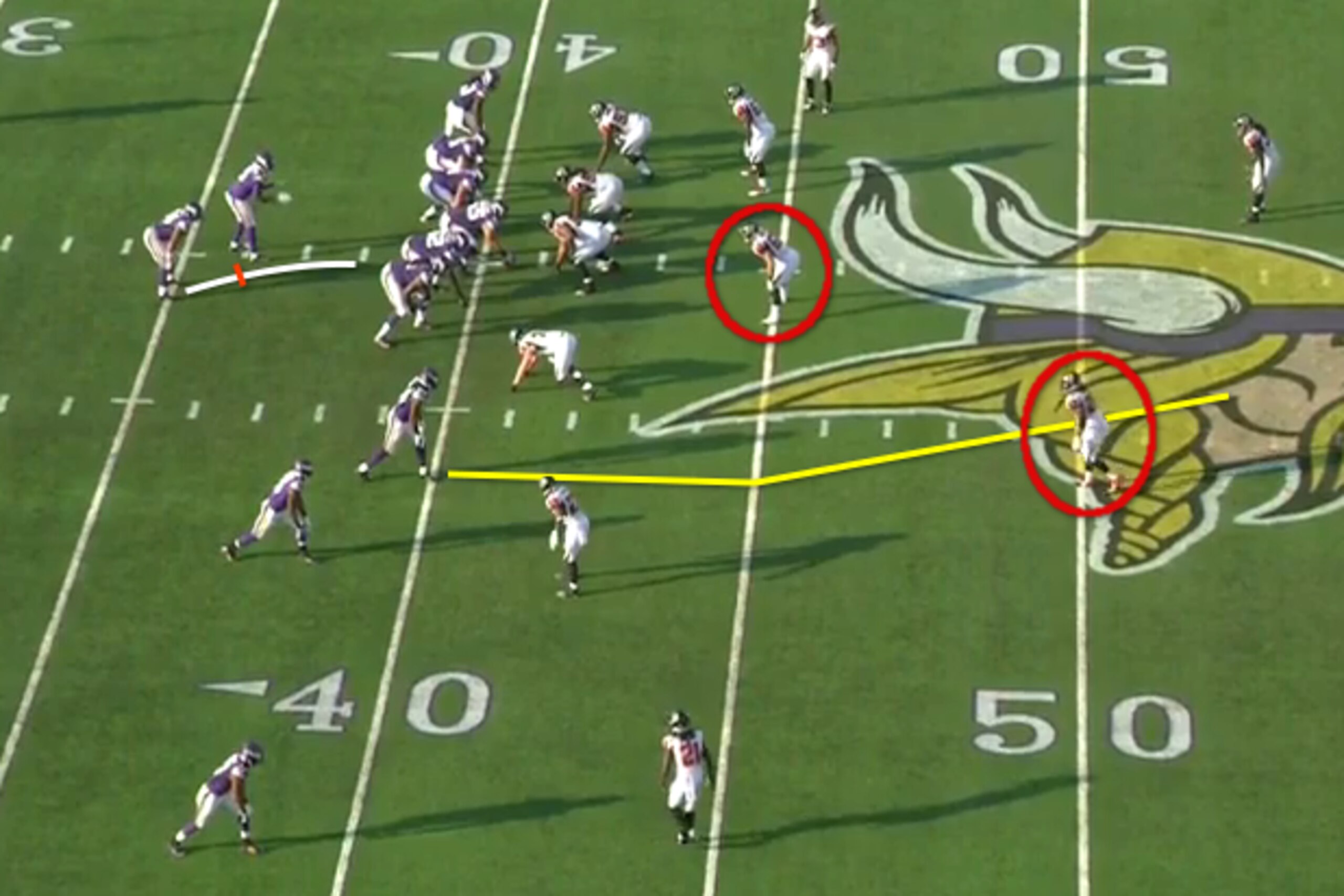
Bridgewater will read the way the defense reacts after he takes the snap. If the safety and the linebacker suck in to respect the run, he dumps it behind them to Patterson over the middle. If the two of them respect Patterson in the slot, especially if the linebacker bails, it’s a simple inside give to Matt Asiata. He reads the play while in the act of giving the ball to the back, so the defense is in an especially difficult situation.

Both key defenders bite, leading to an easy pitch-and-catch between Bridgewater and Patterson.
The next example gives the quarterback the option to throw it to Patterson underneath in a screen, a play where he can pick up explosive gains behind sufficient blocking.

Bridgewater eyes the safety again, determining which option he’s in better position to make a play on. Bridgewater may even have an option to keep it himself.
Because the safety floats to the outside to respect the threat of the screen, the rookie quarterback gives to Asiata for a touchdown run. The important point is that the quarterback has the option to throw the screen to Patterson.
These plays stretch the defense horizontally and force it to pick its spots. If he's able to outflank the defense in a pre-snap alignment with this play in any other game situation, Patterson could be off to the races. Opposing defenses will struggle to keep numbers on the perimeter to contend with the receiver screen if the Vikings are able to successfully read defenders with packaged plays.
Some of the burden falls on Turner’s shoulders to scheme ways to involve Patterson. Some burden also falls on Patterson to grow as a route-runner, making himself an available receiver more often. Bridgewater has shown a propensity for finding the open receiver, whoever that may be, so creating separation is a quick ticket to more frequent touches for Patterson.
Picking up explosive gains will get Minnesota’s offense back on track in a hurry. As the statistics show, Patterson is the avenue to accomplish that. Now the onus falls on Turner to adapt his play-calling to maximize yardage and on Patterson to start getting himself open.
Stats accumulated from ESPN.com unless noted otherwise.
.jpg?w=2560)