Breaking Down Minnesota Timberwolves' Shooting Guard Position for 2014-15 Season
With only a few weeks until the 2014-15 NBA season, it's time to break down the Minnesota Timberwolves' position that's seen the most change: Shooting guard.
Not only did the Wolves bring in the freakishly athletic Andrew Wiggins and Zach LaVine, but they still have Kevin Martin and Shabazz Muhammad.
Before we discuss the future, let's take a look back at how the position played out last season.
Grading Last Year's Performance at the Shooting Guard Position
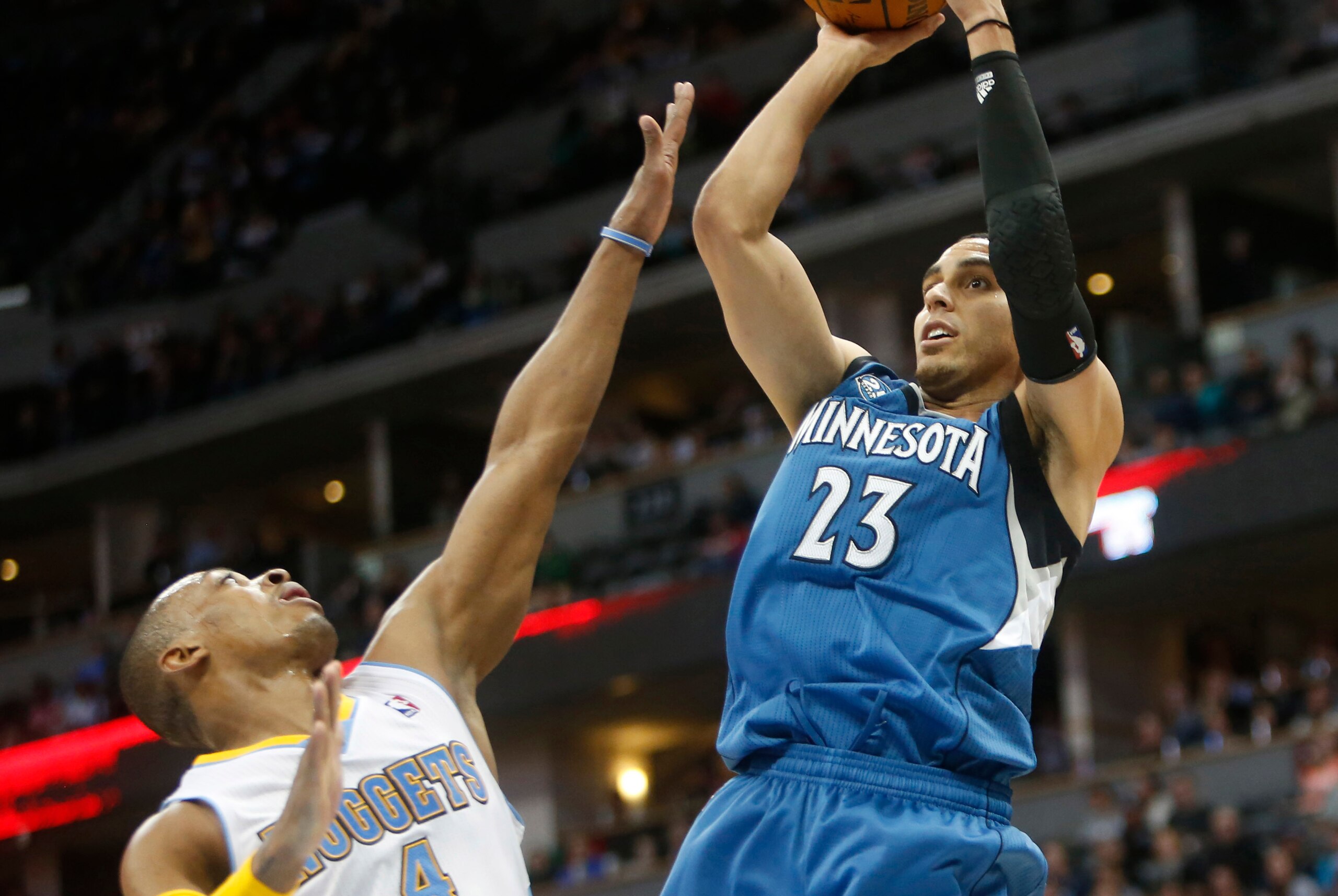
In 2013, Martin was the Wolves starting 2-guard. The 10-year veteran started 68 games last year at this spot, and he was very productive.
After a poor season with the Oklahoma City Thunder, where he scored only 14 points per game, Martin bounced back and proved to be one of the Wolves' biggest offensive threats.
He averaged 19.1 points per game in 2013 and continued to be efficient from long range, shooting 38.7 percent. Martin also recorded an impressive 16.37 player efficiency rating (PER), which ranked 11th in the NBA out of all shooting guards, according to ESPN.
The backup role last season usually belonged to Alexey Shved. The 25-year-old played in 63 games in the 2013-14 season, but averaged only 10.5 minutes per game.
Shved was wildly inefficient for the Wolves, shooting a bleak 32.1 percent from the field.
After being recalled by the Timberwolves from the NBA Developmental League, Muhammad started to take floor time away from Shved. Per 36 minutes, Muhammad put up very impressive numbers:
| Year | FG% | TRB | PTS |
| 2013-14 | .460 | 6.6 | 17.8 |
Muhammad's performance was a pleasant surprise, but with only 7.8 minutes per game over a 37-game span, he was unable to make a considerable impact.
Martin proved to be a very capable scorer even in his 30s, but the Wolves lacked depth at this position for most of the season.
According to 82games.com, the Wolves shooting guards recorded a 14.8 PER, which is fairly adequate.
Grade: B-
How the Position Has Changed this Offseason
The Wolves went from no depth to possibly too much depth in one summer, but that's a good problem to have.
Their only loss was Shved, who was traded to the 76ers in a three-team trade.
The two big additions for the Wolves were rookies, Wiggins and LaVine. Both players are very raw offensively, but they bring tremendous athletic potential.
This summer, these two rookies showcased their elite leaping abilities via a Twitter dunk contest:
"just accepted @GRIII challenge at the @PaniniAmerica shoot and now challenge @22wiggins to beat this! https://t.co/KBw6hO0Y11 #hoopsrookie
— Zach LaVine (@ZachLaVine) August 3, 2014"
"challenge accepted @ZachLaVine. @tdot_ennis now I challenge you. https://t.co/18PDzF56bO #hoopsrookie
— andrew wiggins (@22wiggins) August 3, 2014"
LaVine was drafted as a point guard, but with Mo Williams, Ricky Rubio and J.J. Barea still on the roster, he will most likely be moved to the 2-guard spot.
Not to mention, LaVine struggled in college at being facilitator and creating his own shot. Matt Kamalsky of DraftExpress had a similar opinion:
"Using 9.7 possessions per-game, he ranks as the lowest usage player in this group, and as the least efficient scorer in both one-on-one and pick and roll situations. On the positive side, LaVine's athleticism shows here, as 32.1% of his possessions came in transition, more than any other player, and while he scored an above average 1.148 points per-catch and shoot jump shot, the team drafting him probably won't be overly concerned with how he looked on paper this past season as focused as they'll be on putting him in position to reach his lofty potential a few years from now.
"
LaVine's athleticism and catch-and-shoot ability are prototypical attributes for any successful shooting guard.
Not only did they bring in LaVine and Wiggins, but they still have Muhammad, who showed potential in his rookie season. Now that Muhammad has some experience under his belt, he will most likely spend the entire year in the NBA, not in the Developmental League.
What Will the Shooting Guard Position Look Like in 2014-15?
Martin is still a consistent scorer even in his 30s, and he is guaranteed over $6 million this season, which means he will most likely remain the starter.
However, how the minutes get spread at this position is still a big question coach Flip Saunders must figure out.
Currently on ESPN, the Timberwolves depth chart has Wiggins as the backup, followed by LaVine as the third stringer, and Muhammad is set as the third-string small forward.
It seems that Wiggins will get the most playing time out of the three, while LaVine and Muhammad mostly ride the bench. Wiggins, however, still needs to fix a few holes offensively.
According to NBA.com, in the Las Vegas Summer League Wiggins shot 40.5 percent from the field and an abysmal 15.4 percent from long range, but he did manage to average 1.2 steals and 1.5 blocks a game.
Wiggins' offensive game is still very raw, but his athleticism and defensive intensity will allow him to be an immediate impact.
LaVine also struggled this summer, shooting only 26.3 percent from beyond the arc. The rookie out of UCLA will benefit from riding the bench so he can take the time to mature and perfect his game.
Wiggins and LaVine may be the future of the Timberwolves, but right now they will both see limited floor time.
Playing-Time Breakdown
Kevin Martin: 27 minutes per game
Andrew Wiggins: 19 minutes (could play small forward if an injury occurs)
Shabazz Muhammad: 10 minutes (majority of time will be at small forward)
Zach LaVine: 7 minutes (could play point guard if an injury occurs)
All stats are courtesy of Basketball-Reference.com unless otherwise noted.
Love the T-Wolves? Follow me on Twitter: @SupermanJZ

.jpg?w=2560 "NFL House in Paris Closes for Protests")
.jpg?w=2560 "Trevon Diggs Cut by Seahawks")