

Will Gerald Green Be the Odd Man Out on the Phoenix Suns This Season?
When the Suns traded Luis Scola in the summer of 2013, many thought that they were mostly interested in the future first-round pick they acquired from the Indiana Pacers (a pick that was recently used to draft Bogdan Bogdanovic from Serbia). Gerald Green and Miles Plumlee were simply seen as filler in the deal.
But Green and Plumlee proved all of their doubters wrong. Both posted career-high numbers in virtually every statistical category in 2013-14 and established themselves as major contributors on a roster that managed to earn 48 wins.
Green started 48 games while Eric Bledsoe was injured and averaged 15.8 points and 3.4 rebounds on 45 percent shooting from the field and 40 percent shooting from three-point range. When he was in the starting lineup, he became one of the team's go-to scorers (averaging 17.4 PPG as a starter).
TOP NEWS

LeBron's Special Helicopter Deal

MJ Makes Record-Setting Donation 🙌
Shams: KAT, Hart Could Be Trade Names
On the bench, he was still an offensive spark plug who became nearly impossible to stop once he was hot. In addition to dazzling crowds with his emphatic dunks, Green became a master of the transition three-point shot.
Perhaps his greatest performance of the season came in March, when his 41-point game led the Suns over the Western Conference powerhouse Oklahoma City Thunder. By then, Green had proved himself as a key player for Phoenix.
But what about now? The Suns added a few more guards over the summer, including former Sacramento Kings starter Isaiah Thomas.
Thomas, who scored 20 points per game last season, is likely to become the team's sixth man and command at least 25-30 minutes per game. Other guards such as Zoran Dragic, Archie Goodwin and Tyler Ennis will also be hungry for playing time. And don't forget about the two starters, Goran Dragic and Bledsoe.
So where does Green fit in all of this? Is he guaranteed the same amount of playing time he got last season? And will he even be able to sustain the same level of production for another full year?
Let's address some of the factors that will determine Green's success in the 2014-15 season.
Playing Time
The Suns' backcourt is going to be highly competitive this season. If one player doesn't perform, he'll run the risk of having his playing time quickly taken by someone else.
However, even though there is a perceived logjam at the guard positions, there is no reason why Green shouldn't conceivably be able to play as much as he did last year if he remains productive on the court.
Firstly, prospect development in the backcourt will not be a priority this season, at least not to the same degree it was in the past. The Suns have a number of valuable, established players whom they hope can lead the team to the playoffs.
Tyler Ennis and Archie Goodwin can take a back seat, at least for now. In fact, it would not be surprising to see one or both of those players sent down to the D-League for more playing time.
Trying to feature Bledsoe, Dragic, Thomas and Green all at once does not mean that the bench players—Thomas and Green—should have their minutes decreased. Rather, it should mean that Dragic and Bledsoe are the ones with less playing time and therefore less pressure placed on their shoulders.
Dragic spent the summer of 2013 playing for the Slovenian national team in the EuroBasket tournament. He then went on to post career-high numbers in the NBA and after that chose to represent Slovenia again in the 2014 FIBA tournament.
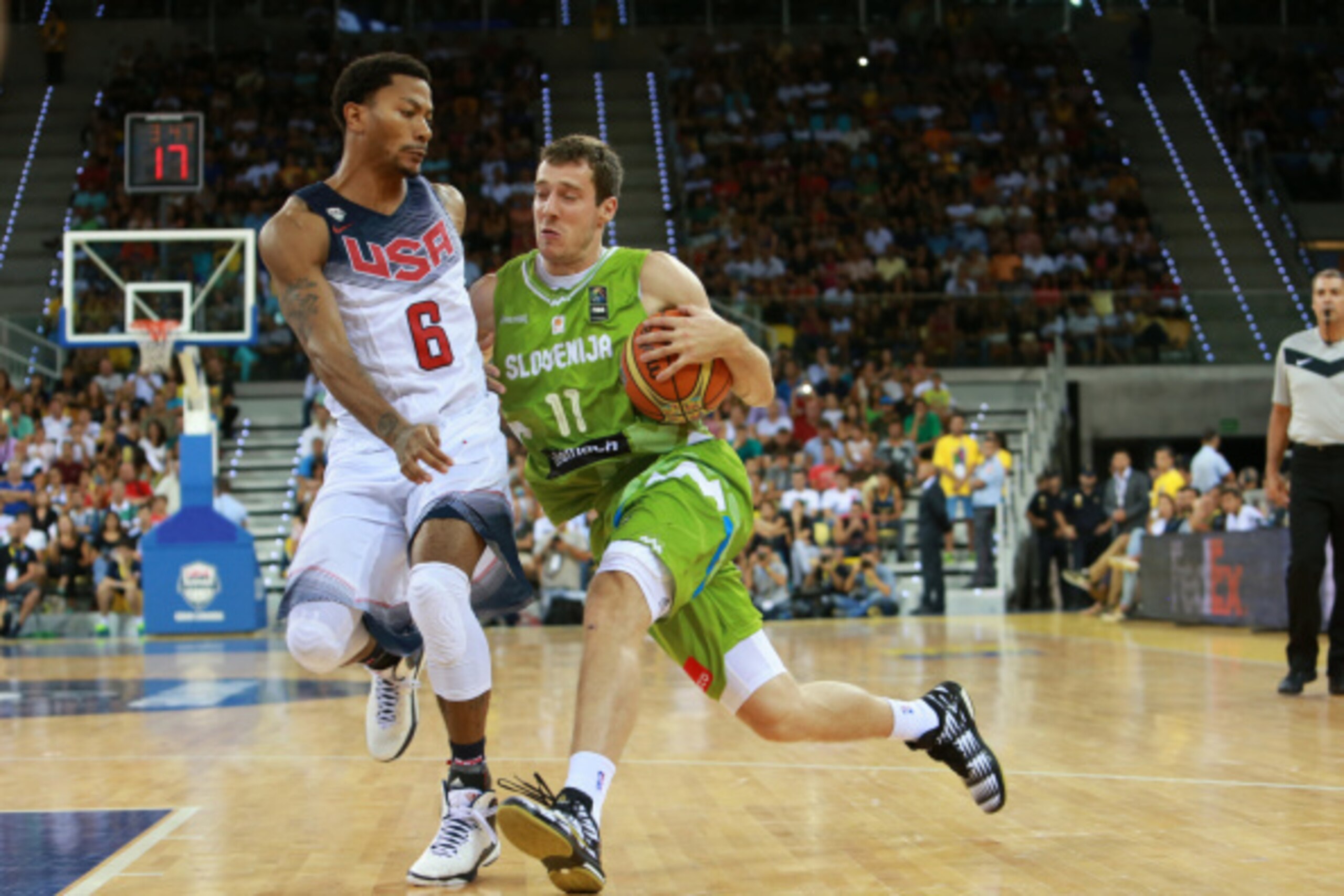
In other words, he could use some rest. If Dragic plays for around 30-32 minutes per game rather than 35-40 minutes, he has a greater chance of staying healthy. Also, he should be well-rested whenever he enters the game, an obvious advantage of extra depth.
The same strategy should be applied to Bledsoe. He is a player who just missed half of last season with a knee injury. If the Suns can remain just as effective by playing him 30 minutes instead of 36, that is the best course of action to take.
With both Dragic and Bledsoe playing slightly over 30 minutes per game, there should be enough time for Green to receive somewhere in the realm of 20-30 minutes per game off the bench. Because he is 6'8", he is not limited to the shooting guard position and could also earn some minutes at small forward, a position with less talent (though still featuring P.J. Tucker, Marcus Morris and T.J. Warren).
Here's a mock depth chart just to show that Green could easily play 25 minutes per game between shooting guard and small forward. Because no team has a 14-man rotation, it is assumed that Dragic, Goodwin and Ennis will not be a part of the regular rotation. The minutes, of course, have to add up to 240.
| PG | Bledsoe (30) | Thomas (25) | ||
| SG | Dragic (30) | Green (25) | ||
| SF | Tucker (25) | Warren (10) | ||
| PF | Markieff (30) | Marcus (20) | Tolliver (10) | |
| C | Plumlee (25) | Len (10) |
Who knows what the actual depth chart and playing time distribution will look like when the season starts? But the point is that the Suns can afford to allot more than 96 minutes to their four backcourt players only because Green can also play small forward.
If Green plays well, the minutes will become available to him. But the question is: How will he build on his 2013-14 campaign?
Regression Candidate?
First, take a look at the following graph, which tracks Green's shooting efficiency in the form of field-goal, three-point and true shooting percentages and plots data throughout his career, spanning from 2005 to 2014:
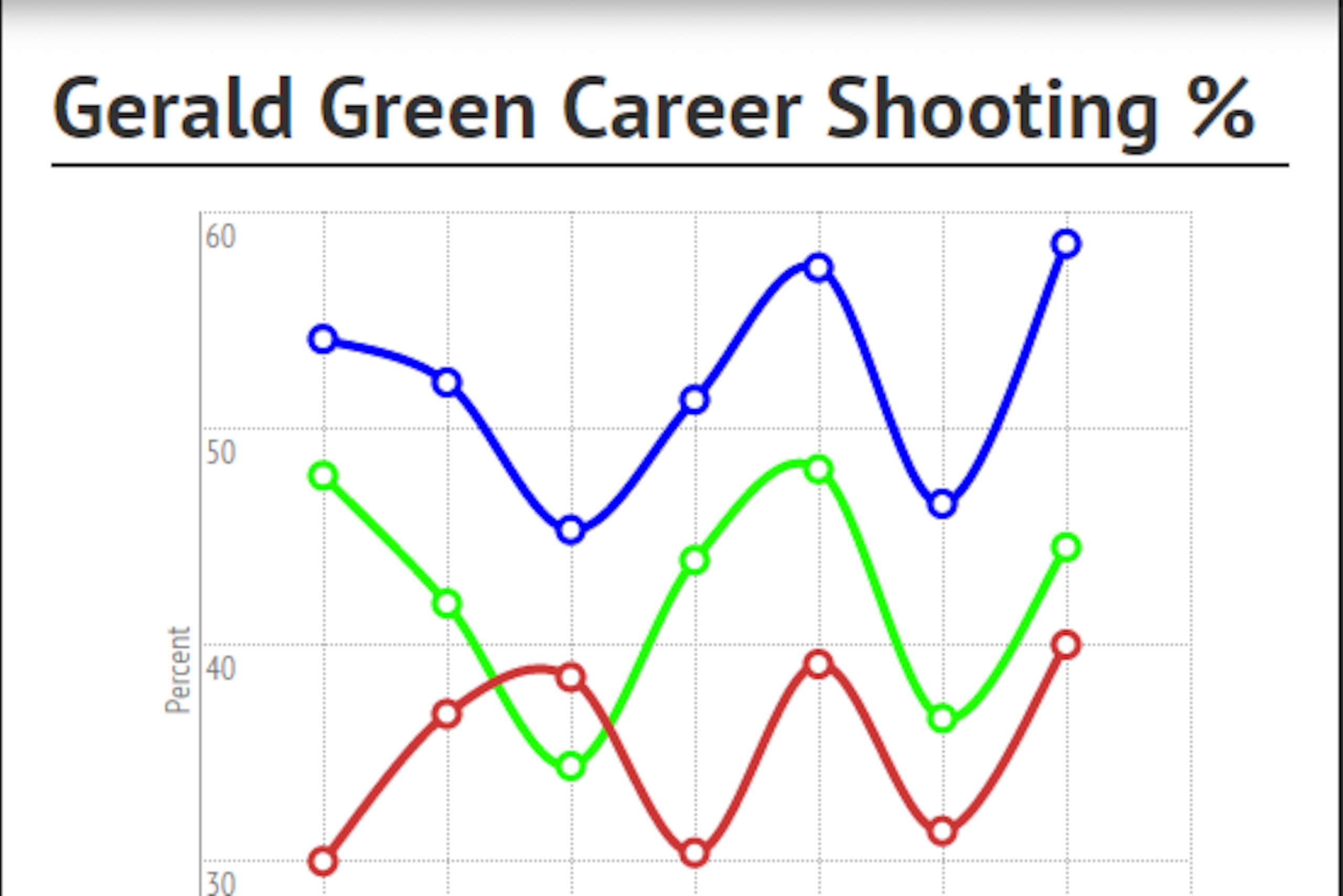
Notice any clear-cut pattern or trend?
There really isn't any. On the court, Green is an incredibly streaky, inconsistent shooter. That has applied throughout his career.
During the 2012-13 season, Green was extremely efficient, as he shot 48 percent from the field and 39 percent from three-point range. The following season with Indiana, he shot just 36 percent from the field and eventually became a benchwarmer.
Which Gerald Green will we see this season?
One might say that Green's career-best season has instilled a new confidence in him which will allow him to continue to succeed. Or one could point to the fact that Green is now on a winning team contending for a playoff spot, whereas the 2011-12 Nets (who were 22-44) did not have the same chemistry or desire to win.
Those are valid arguments, but unfortunately there's no way of knowing for sure. It's hard to even make a reasonable prediction with Green, as statistically he is about the worst person to bet on having a great season.
That does not mean that Green is sure to have a bad season, but out of all the team's players, the 28-year-old is the most likely to either stay stagnant or actually get worse. When so much of your game relies on difficult transition threes and jump shots, a fair amount of luck is involved.
Remember the case of Shannon Brown, another "chucker" on the Suns. In his first season with Phoenix, Brown shot 36 percent from three-point range in addition to being a high-flying dunker. He wasn't as successful as Green but seemed to be generally liked by the fanbase.
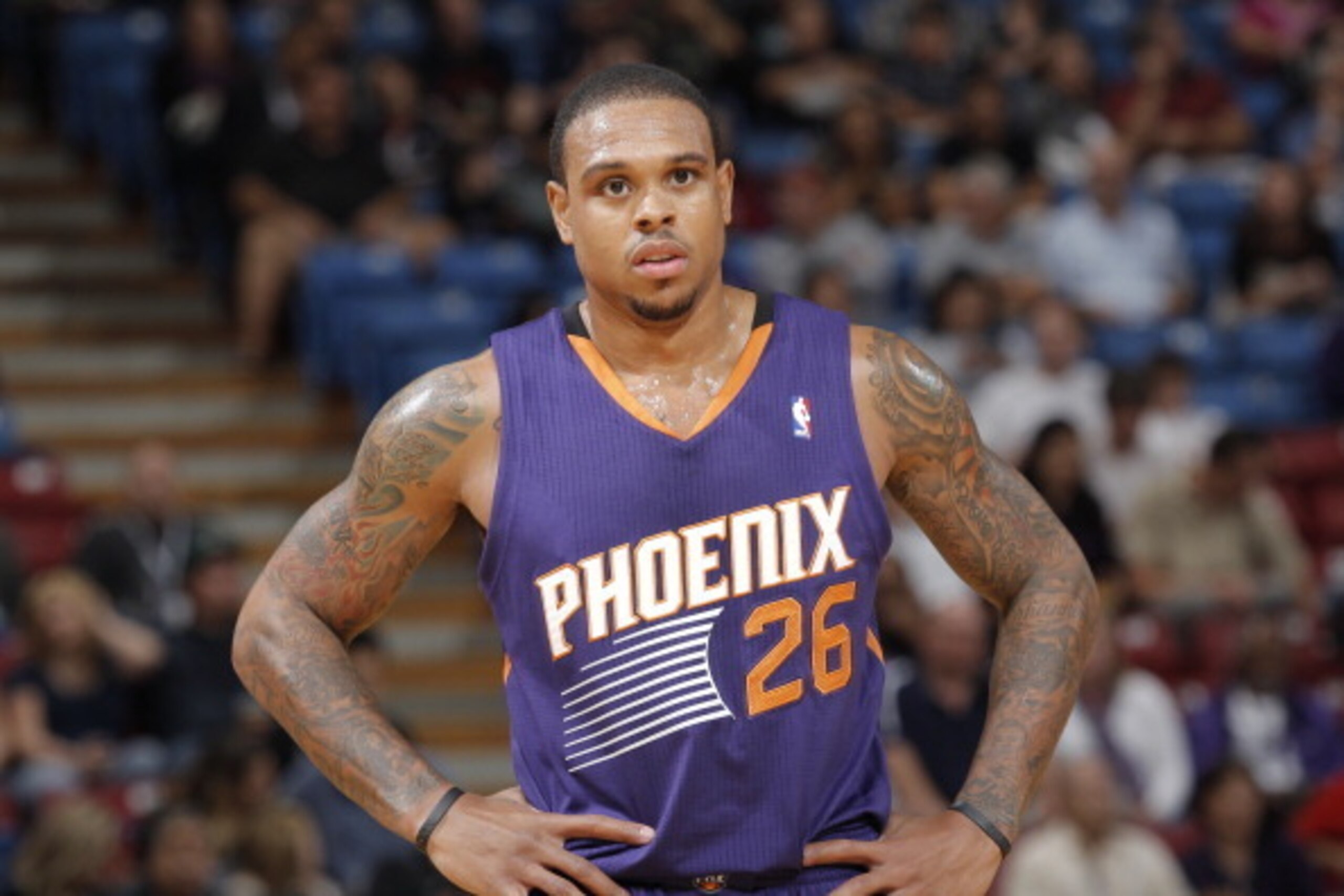
That all changed in his second season when his three-point efficiency suddenly dropped to just 27 percent, though he took the same number of shots per game. It's easy to love a high-volume scorer when he's hot, but also easy to turn on him when he's cold.
Contract Year
Green is making $3.5 million this season and will be an unrestricted free agent in the summer of 2015.
On the one hand, that could be a factor that motivates him to have a better season. The more he flourishes as a bench player, the better chance he has of earning a long-term contract in the offseason.
But here's the thing: It is very difficult to envision that lucrative new contract coming from Phoenix.
If Green regresses so much that he becomes the next Shannon Brown, he is not worth keeping in the first place. But, if he remains just as successful or even gets better, he could easily command $6-7 million on the open market, if not more.
That's money that the Suns may not want to pay their seventh man, and may not have in general.
It has been a busy week for Phoenix, a team that just re-signed Eric Bledsoe and the Morris twins and brought in Dragic from Europe. After all of those moves, here is an updated look at the guaranteed money they will be spending in 2015-16.
| Player | Contract | |
| Eric Bledsoe | $13,500,000 | |
| Markieff Morris | $8,000,000 | |
| Isaiah Thomas | $6,912,869 | |
| P.J. Tucker | $5,500,000 | |
| Marcus Morris | $5,000,000 | |
| Alex Len | $3,807,120 | |
| Miles Plumlee | $2,109,194 | |
| T.J. Warren | $2,041,080 | |
| Zoran Dragic | $1,750,000 | |
| Anthony Tolliver | $400K Guaranteed | |
| Tyler Ennis | $1,662,360 | |
| Archie Goodwin | $1,160,160 | |
| Michael Beasley (stretch provision) | $777,778 |
All of that to about $52.5 million is guaranteed money. The only free agents the team will have are Dragic, Green and Shavlik Randolph.
It should be noted that the NBA salary cap is continually increasing and over the next couple of years will increase at a much quicker pace due to the NBA's new lucrative TV contracts with ESPN and Turner (the latter of which owns Bleacher Report).
But here's a problem, as noted by Grantland's Zach Lowe:
"One problem: No one knows when, or how, that cap jump will happen. It’s at $63 million for this season, and teams are projecting it could leap as high as $80 million for the 2016-17 season — the first under the new TV contract. Depending on how the league and its TV partners structure the inflow of cash, there could be one or two more mini-jolts before the cap settles into a new normal around $90 million.
"
All we know right now is that the NBA salary cap is currently $63 million and could likely be $80 million in two years. What happens in between is a bit of a mystery.
One solution to prevent a major cap increase in one year, according to Lowe, is to raise the current projection for the 2015-16 season to around $70 million, allowing for a more gradual increase.
If the NBA salary cap is approximately $70 million, the Suns would have slightly more than $17 million in cap space. That's enough to re-sign fan favorite Dragic, but it doesn't leave room to do much else.
Unless Green dazzles this season, he just might not be in the Suns' future plans. With so many players on the team getting pay increases in restricted free agency all at once (Bledsoe, Thomas, Markieff and Marcus Morris, Tucker), the Suns are now loaded with expensive contracts and have to start choosing which role players they can afford to keep and which ones are expendable.
Green has a lot of work to do if he wants to stay in Phoenix, though some other team would gladly snatch him up. Without another great season, he might become the odd man out in the backcourt.



.jpg?w=2560 "Viral Rams Coach Vid 🖕")
.jpg?w=2560 "Injury-stricken Seahawks signing veteran RB")
.jpg?w=2560 "2 NFL Officials Suspended")
.jpg?w=2560 "Grading WWE Raw 🔠")
.jpg?w=2560 "Mahomes' Wife Trolls Kubiak 💀")
