

Risky Contract from Phoenix Suns Means Major Pressure for Eric Bledsoe
General manager Ryan McDonough and his front office finally relented.
After months of unproductive contract negotiations, Yahoo Sports' Adrian Wojnarowski now reports, "Restricted free-agent guard Eric Bledsoe has reached agreement on a five-year, $70 million contract extension with the Phoenix Suns, league sources told Yahoo Sports."
Wojnarowski also cites a source, adding, "The deal will include no player options, and the $70 million will be fully guaranteed."
TOP NEWS

LeBron's Special Helicopter Deal

MJ Makes Record-Setting Donation 🙌
Shams: KAT, Hart Could Be Trade Names
It's the kind of payday that instantly creates tremendous expectations for the 24-year-old.
Thus far, his numbers have done most of the talking, and they almost certainly played a central role in commanding such a lucrative deal. Last season, Bledsoe averaged 17.7 points, 5.5 assists and 4.7 rebounds in 32.9 minutes per game—thereby proving a capable complement to starting point guard (and 2014 Most Improved Player) Goran Dragic.
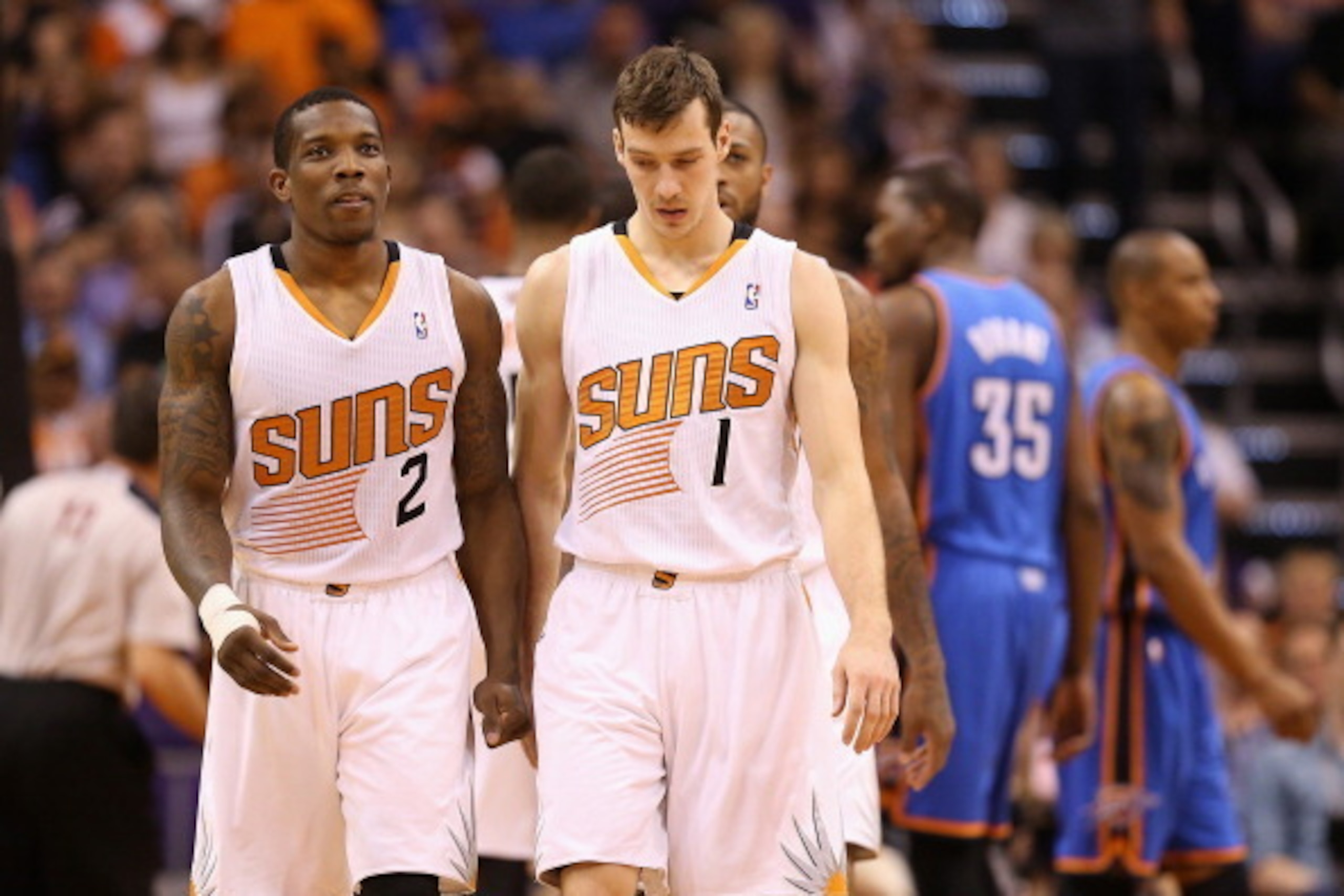
Though the Suns' favorable pace (eighth-best league-wide) certainly helped pad that production, there's no denying Bledsoe's considerable skill. He made 47.7 percent of his field-goal attempts, including 35.7 percent from three-point range—both vast improvements over inconsistent outputs that plagued him during his first two seasons.
From his willingness to exert himself on both ends of the floor to his exceptional speed, there's plenty to like about Bledsoe.
While his restricted free agency failed to attract an offer from another team, the Minnesota Timberwolves' recent attempt to acquire him via sign-and-trade demonstrated a legitimate demand for the four-year veteran's services.
And Phoenix's willingness to lock him up after initially offering just four years and $48 million suggests the organization was in no hurry to part ways with Bledsoe despite already having a deep backcourt comprised of Dragic, Isaiah Thomas and rookie Tyler Ennis.
Holding out for more money proved wise for Bledsoe's camp. This is a big win for the Kentucky product, a highly visible testament to his value and the difficulty Phoenix might have had in replacing him—even with a platoon of skilled guards at the ready.
But the newfound wealth will bring with it the kind of pressure that rarely accompanies a rookie-scale contract.
At bare minimum, there will be concerns about whether Bledsoe can remain healthy.
He played in just 43 games last season thanks primarily to a torn meniscus suffered in January. Bledsoe had previously undergone surgery for a torn meniscus in the same knee back in 2011, establishing a worrisome pattern for an emerging star who won't turn 25 until December.
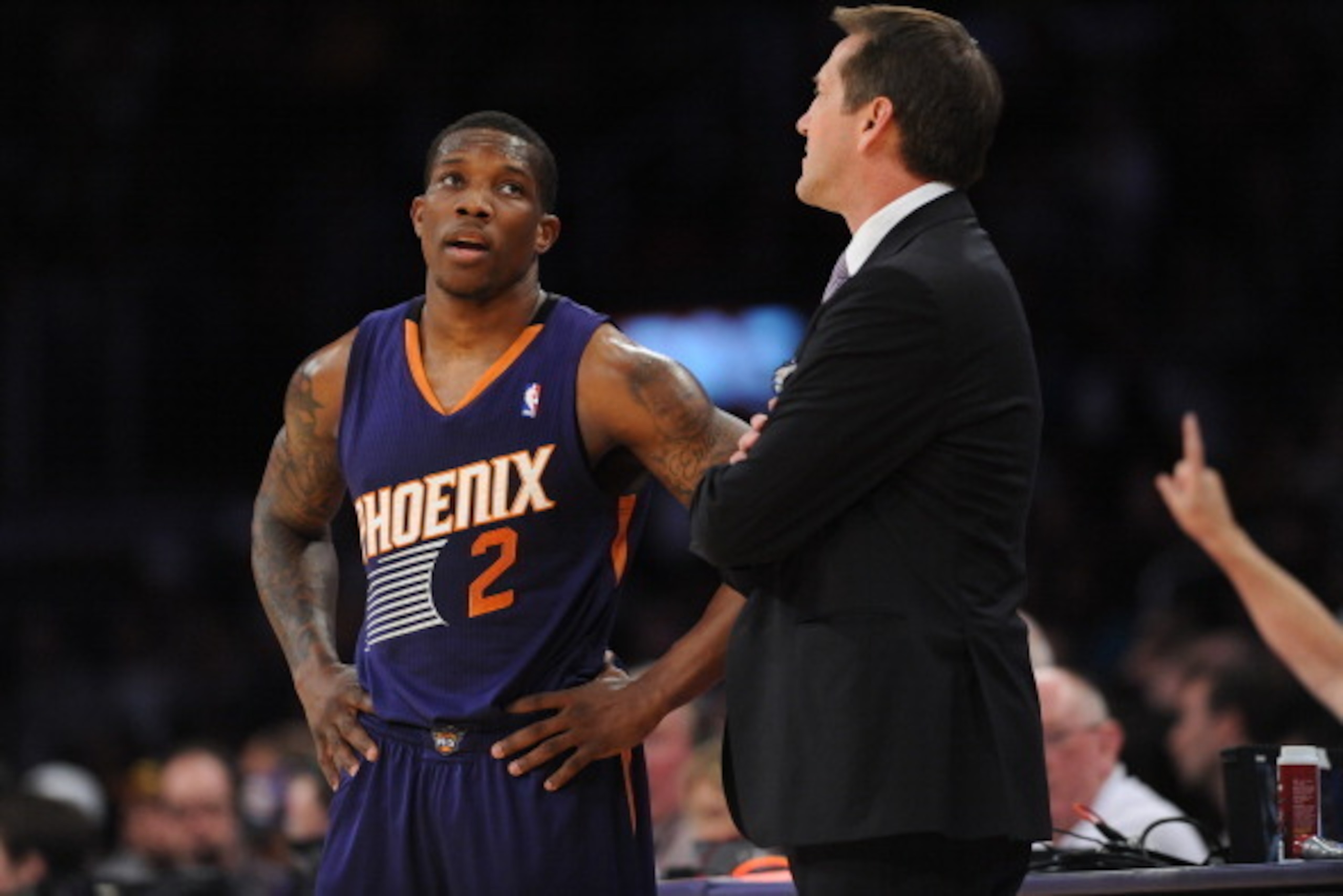
Two seasons without incident (2010-11 and 2012-13) may ease those concerns, but it's perhaps worth remembering that Bledsoe carried a much smaller load during his first three seasons with the Los Angeles Clippers. He never averaged more than 22.7 minutes per game in L.A., so gauging his durability isn't an exact science.
Indeed, the limited sample size of Bledsoe's work adds further intrigue to the Suns' sizable investment.
Even if Bledsoe remains healthy, there's little guarantee he'll continue to produce at the rate exhibited a season ago. One exceptional season (or 43 games thereof, anyway) rarely translates to immediate and substantial reward—at least when cooler heads prevail.
There's a very real risk that Bledsoe's a one-hit wonder. Even if the eye test suggests otherwise, there simply isn't enough evidence to indicate this is a guy who can carry a team.
Intangibles like leadership also factor into that kind of equation, and it remains to be seen whether Bledsoe is in fact a franchise player or merely a very good complementary piece.
These aren't reasons to doubt Bledsoe at face value. They are reasons he still has something to prove, though—and all the more so after demanding such a hefty raise.
Understanding the heightened pressure on Bledsoe also requires us to frame how he went about demanding that raise.
As ProBasketballTalk.com's Brett Pollakoff notes, "Bledsoe had threatened to play next season under a one-year qualifying offer [worth $3.7 million], which would have given him the ability to become an unrestricted free agent next summer."
In other words, resolution of these negotiations had as much to do with posturing as it did a constructive meeting of the minds.
There was no prospect of a discount. No sense that loyalty had anything to do with Bledsoe's calculations. And it certainly didn't help that the Alabama native steered clear of Phoenix itself throughout the summer.
Suns fans might not forget that.
Bledsoe will also have to contend with the perception that the four years and $48 million he initially turned down were more than enough.
As The Arizona Republic's Paul Coro reported in August, "Four current NBA executives and two prominent agents were anonymously unanimous in their belief that the Suns made a fair offer to Bledsoe and that he does not merit a maximum-salary contract now."
"I'm surprised that they would offer him that much," one executive told Coro of the initial offer. "They don't need to. It is really fair and, in fact, generous. He is talented, but he has never put it together very long, and he hasn't been healthy. It's hard to turn your team over to him."
"There is no way anyone in a million years could say the Suns are being unfair," an agent added. "Nobody can blame the Suns at all."
Of course, that isn't to say we should blame Bledsoe instead.
This is a business, and he used every ounce of leverage he had to extract maximum profit.
In turn, McDonough and Co. were content to wait this summer, giving Bledsoe's agent, Rich Paul, every opportunity to land an offer sheet from another team—an offer sheet that never came.
So what changed for the Suns front office? One explanation is that players of Bledsoe's caliber aren't getting any cheaper in the near future.
As NBA.com's David Aldridge observed via Twitter, "With new TV contract $, salaries likely to explode in next 3-5 years. No chance PGs will sign for $12M/per. That's why this works for both."
From that perspective, Phoenix may one day look back on this deal as something of a bargain—at least if Bledsoe does his part.
In the meantime, however, the onus will be on Bledsoe.
The Suns did their part, saying all the right things from the outset.
"We'll continue to work as hard as we can within that restricted free-agency system established by the collective bargaining agreement," president of basketball operations Lon Babby told reporters in July. "We continue to hope and expect that he will remain in a Suns uniform."
Those even higher on the Phoenix food chain sounded a similar tune.
"We think it's a fair offer. I think you could argue, you know, I mean some would say it's maybe a little high, some would say it's low," owner Robert Sarver told the Burns & Gambo Show on Arizona Sports 98.7 FM, via Basketball Insiders' Alex Kennedy. "What's fair is important to us, and also important to him—him and his agent."
Bledsoe's take on the situation?
He's remained quiet for most of the summer, but in July he told WVTM Birmingham's Kyle Burger, "First off I'm going to let my agent handle it. I can understand the Phoenix Suns are using a restricted free [agency] against me. But I understand that."
Hardly a sign of close ties with the organization.
Both sides will look to put the past behind them, but the future is anything but certain.
We do know this much, though: Bledsoe is no longer a novelty item. He'll be paid like a star from now on.
And he'll be expected to play like one, too.


.jpg?w=2560 "Grading WWE Raw 🔠")
.jpg?w=2560 "Viral Rams Coach Vid 🖕")
.jpg?w=2560 "Injury-stricken Seahawks signing veteran RB")
.jpg?w=2560 "2 NFL Officials Suspended")

.jpg?w=2560 "Mahomes' Wife Trolls Kubiak 💀")