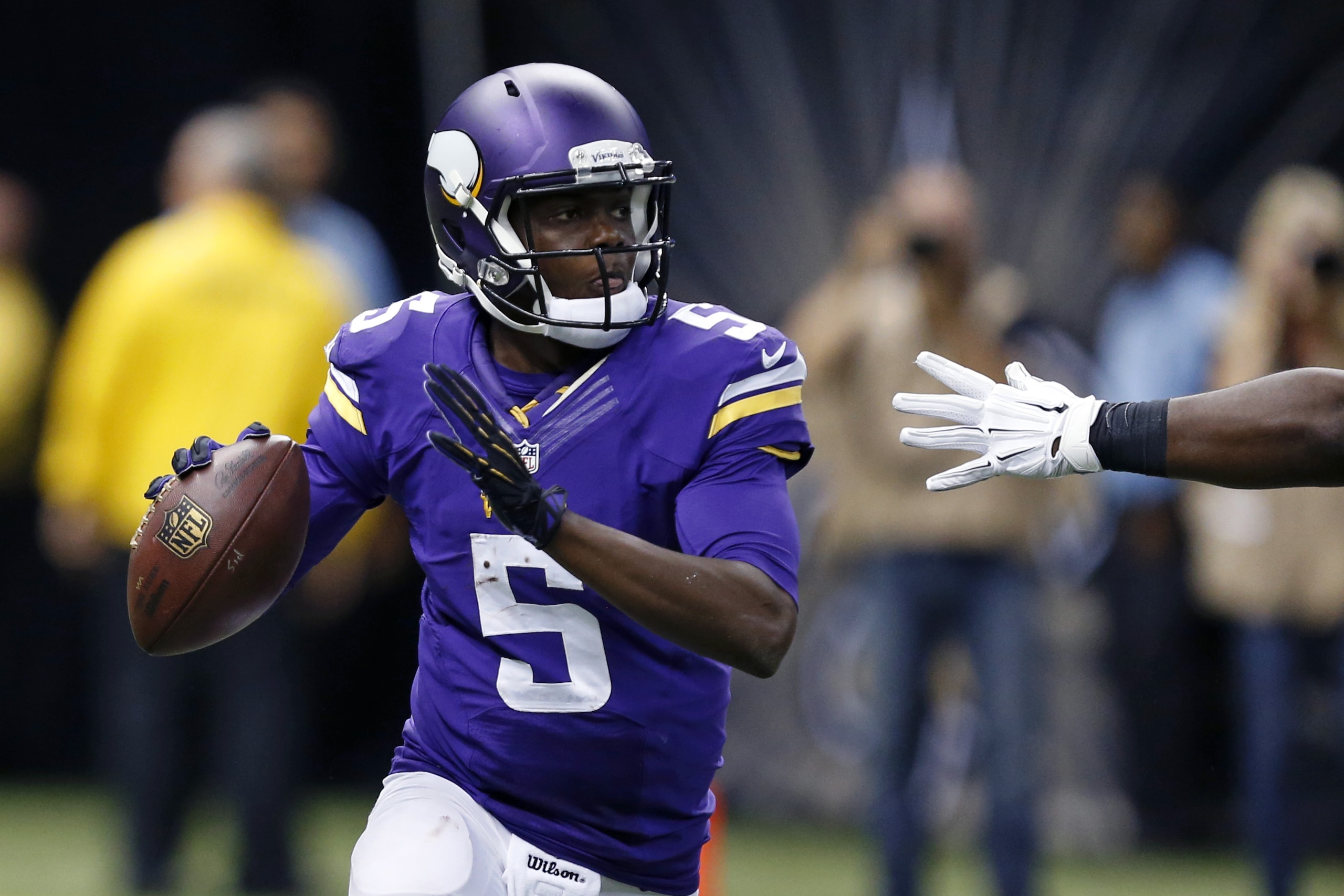

Teddy Bridgewater's Vikings Debut Provides Encouraging Signs for Future
Despite being thrust into one of the most inhospitable environments in the NFL, Minnesota Vikings rookie quarterback Teddy Bridgewater handled himself just fine—showing off his trademark traits of poise and pocket presence—during an encouraging debut against the New Orleans Saints on Sunday.
After entering the game early in the second quarter for an injured Matt Cassel, Bridgewater completed 12 of 20 passes for 150 yards and no turnovers. The Vikings lost, 20-9, but Minnesota still outscored the Saints 9-7 after Cassel's injury.
While wins are still the ultimate currency of the NFL, Bridgewater's final results Sunday have to be uplifting for the Vikings—a team desperately in need of some good news.

.jpg?w=2560 "Rams Eagles Football")
.jpg?w=2560 "Texans-Mixon Released Football")
The initial setting for Bridgewater's rookie debut looked ripe for disaster: down by 10 points in the boisterous Superdome, with no first-team preparation during the week and Drew Brees on the other sideline. A number of negative results were conceivable. But Bridgewater made the most of his opportunity, using awareness in the pocket and mobility to escape trouble in his first-ever regular-season appearance.
Now, his three-quarter cameo in New Orleans will likely become a long-term gig, as Cassel reportedly broke several bones in his foot, per Albert Breer of NFL.com.
Bridgewater completed the final six drives for the Vikings Sunday. Here's a look at how he fared over those six series and why the Vikings should be pleased with his debut.
Series 1: Field Goal
After Cordarrelle Patterson was dropped for a seven-yard loss on the first play of the drive, Bridgewater hung tough in the pocket on second down and hit Greg Jennings on a deep-out route to pick up 10 yards. He did not anticipate the throw particularly well, but he still completed the long attempt despite not having his entire body behind the throw.
Provided a more manageable third down a play later, Bridgewater calmly went through his reads and then hit Matt Asiata out of the backfield for a catch-and-run of 41 yards.
Two scrambles—one after he climbed the pocket and escaped pressure and another on third down when it appeared the shotgun snap surprised him—set up 1st-and-goal. But a sack caused by Matt Kalil and a blown-up screen play forced the Vikings to settle for the field goal.
Bridgewater: 3-of-3 for 46 yards; two rushes, 11 yards.
Best play: First completion to Jennings. You'd like Bridgewater to step into the throw and anticipate Jennings coming open, but he still put plenty of zip on an otherwise difficult outbreaking attempt. Anticipation should come with game experience and work with the first-team offense. The completion helped extend the drive.
Series 2: Punt
On the drive's first play, Bridgewater escaped out of the pocket against a Saints blitz and picked up 15 yards. Rookie running back Jerick McKinnon helped pick up the extra rusher, and Bridgewater again climbed the pocket and took off through the free lane.
The series stalled when Bridgewater threw high for McKinnon in the right flat on second down and too far in front of McKinnon on a short dump-off to the left flat on third down. Both were bad throws that wouldn't have amounted to much in terms of yards, even if they had been completed.
Bridgewater: 0-of-2 for 0 yards; one rush, 15 yards.

Best play: 15-yard scramble. Bridgewater is a pocket passer first, but he's also athletic enough to get out of the pocket and make plays with his legs. There was no panic against a Rob Ryan blitz. He also smartly slid down to avoid a hit after picking up a first down.
Series 3: End of Half
Given the ball inside their own 5-yard line with just 37 seconds left in the half, the Vikings ran once with Asiata and had Bridgewater kneel twice to get to the break.
Series 4: Field Goal
Bridgewater's first attempt of the second half found Kyle Rudolph in the right flat for 10 yards and a first down. After leading another swing pass to the left flat too far, Bridgewater scrambled away from pressure on third down. A holding penalty gave the Vikings a new set of downs.
The rookie made the mistake hurt.
On first down, he rolled out to his right and fired a frozen rope to Patterson, who made the catch along the sideline for 14 yards. The play was a carbon copy of Bridgewater's first preseason passing attempt.
Two plays later, he connected with Jennings on an underneath dig route for seven yards.
The drive ended when Bridgewater threw high for Asiata on a drag-angle combo route with Patterson. Asiata took a nasty hit and wouldn't have had first-down yardage even if he had made the reception. The better decision would have been to give Patterson, who found a sliver of space as he crossed the formation, a chance to make a short catch and run with the football.
Bridgewater: 3-of-5 for 31 yards; one rush, four yards.
Best play: 14-yard completion to Patterson. Here's a look back at Bridgewater's preseason debut. Check out his first passing snap. The completion to Patterson on Sunday was the exact same play and had the exact same result. Bridgewater can be deadly accurate when throwing on the run. Expect the Vikings to continue trying to find ways to get him out of the pocket and on the move.
Series 5: Punt
On the drive's second play, a coverage breakdown against a smart route combination allowed Bridgewater to find Jennings for 30 easy yards. The Saints were caught undermanned while playing Cover 2. Cornerback Keenan Allen came up to cover the flat, which left Jennings—who was running a deep out—wide open between Allen and safety Jairus Byrd.
The Vikings went downfield a play later. After using play-action, Bridgewater let loose down the right sideline, again to Jennings. Coverage was there, but it was not a poor throw. In fact, Jennings appeared to mistime his jump, and the ball went through his outstretched arms.
After Asiata rushed for five yards on second down, Bridgewater moved the pocket to his right but couldn't complete his pass to Jennings beyond the sticks. He threw a touch behind Jennings, which allowed Lewis to make a play on the ball.
Bridgewater: 1-of-3 for 30 yards
Best play: 30-yard completion to Jennings. While Cassel failed to complete a pass over 20 yards during his nine quarters of play, Bridgewater needed just five series to find his first. Jennings was wide open, but Bridgewater delivered an accurate ball despite some late pressure.
Series 6: Punt
Bridgewater's five-yard scramble on the first play was wiped out by a holding penalty. Again, the rookie hung around in the pocket and only took off after he had completed scanning through his reads.
An easy pitch-and-catch from Bridgewater to Patterson picked up 17 yards on 1st-and-19. Two plays later, he went back to Patterson to get the first down. Ryan sent a zero-blitz (no safety, just man-to-man coverage), but Bridgewater backed away from the pressure and made a clever throw to move the sticks.
A play later, Saints defensive end Cameron Jordan blew past guard Charlie Johnson for an easy sack. Again, Bridgewater responded. He found Jennings for 15 yards after stepping up into the pocket to avoid pressure from an edge blitz (see video below). On third down, McKinnon ran a successful angle route and Bridgewater made the short throw for seven yards and a first down.
Mistakes eventually ended the drive.
On first down, safety Kenny Vaccaro made an athletic play to break up a pass intended for Rhett Ellison. After a false start, McKinnon's two-yard gain off a screen play set up 3rd-and-long.
While Bridgewater did not convert, his final play of the contest was still impressive. He avoided three different sack attempts, including two from Jordan. While he eluded the negative play, he was still forced to throw the football away. The Vikings punted and never saw the ball again.
Bridgewater: 5-of-7 for 43 yards
Best play: Both completions against the blitz. You don't expect a rookie to handle pressure situations as well as Bridgewater did twice on his final drive. He easily could have made a hurried decision against Ryan's zero blitz. Instead, he created himself some room and delivered an accurate throw. His completion to Jennings was equally impressive, as he stepped into the pocket to avoid a pursuing rusher and make the throw.
Conclusion
Bridgewater led the Vikings to just six points, but context matters. He was thrown into a road game at New Orleans—after being given zero first-team reps during the week—with Minnesota already down 10 points. The Vikings essentially needed him to outgun Drew Brees over the final three quarters to win the game. Tough assignment, especially with no running game and shaky pass protection.
Bridgewater didn't blow the doors off his debut, and the Vikings lost a second straight game. But his poise, pocket presence and mobility are encouraging signs for the future.
According to Pro Football Focus (subscription required), Bridgewater completed 62.5 percent of his passes and did not take a sack against nine blitzes from the Saints. Against no pressure, the rookie averaged 8.4 yards per attempt. He also scrambled six times for 27 yards.
As in-game experience and first-team reps increase, expect Bridgewater to become more comfortable. The same goes for Norv Turner, the Vikings play-caller who called a simple call once his rookie quarterback entered the game. Patience is required, but Bridgewater's debut Sunday in New Orleans showed the foundational elements of what could make him a successful NFL quarterback.
Zach Kruse covers the NFC North for Bleacher Report.
.jpg?w=2560 "Commanders Eagles Football")



.jpg?w=2560 "Mahomes' Wife Trolls Kubiak 💀")

.jpg?w=2560 "Grading WWE Raw 🔠")