

5 Adjustments New York Jets Must Make in Week 4
After back-to-back mistake-laden losses to NFC North opponents, the New York Jets are spiraling in the wrong direction.
Second-year quarterback Geno Smith is on pace to eclipse his lead-leading mark of 26 turnovers from his rookie season. Leading receiver Eric Decker removed himself from Monday night's loss with a hamstring injury, according to Jane McManus of ESPN New York, and is "iffy" for Week 4. The Jets' defensive backfield also remains a mess.
The Jets won't make excuses for themselves, though. They need to improve in a hurry if they're going to avoid an ugly tailspin that could see this season get out of control before the midway point.
With games upcoming against the Detroit Lions, San Diego Chargers and Denver Broncos, it isn't inconceivable for the Jets to find themselves supplanted in last place in the AFC East with a 1-5 record heading into Week 7 against the New England Patriots.
For the Jets to right the ship and at least escape the murderer's row portion of their schedule at the .500 mark, they must make several key adjustments.
The following slideshow examines five changes the Jets must make to improve their chances of winning beginning in Week 4:
5. Don't Abandon the Run
1 of 5
Early miscues forced Jets offensive coordinator Marty Mornhinweg to dial up the passing game more than the Jets would have ideally liked on Monday night against Chicago, especially against an opponent that flaunts several dynamic playmakers on offense.
The Jets' 14-point first-quarter deficit seemingly caused Mornhinweg to hit the panic button. The Jets ran a no-huddle offense for three plays on the ensuing drive after the Bears' second touchdown. Smith took eight snaps from the shotgun, dropping back to pass six times.
The drive ultimately resulted in a field goal after Smith was forced to take a 13-yard loss on a sack on 2nd-and-9 from the Bears' 15-yard line.
The early aggressiveness the Jets showcased on offense could be perceived as a good thing, considering that they averaged just 18.1 points per game in 2013. But the approach runs counter to their offensive identity. When the Jets are right, they're able to effectively run the football between the tackles and catch defenses off guard on play action.
New York does not boast the type of playmaking talent needed to consistently excel in four- and five-receiver sets.
For the Jets to increase their red-zone efficiency, they need to rely mostly on their second-ranked rushing attack. They should never have abandoned the run, even while staring down the barrel of an early two-score deficit.
4. Fake the Jailbreak Blitz
2 of 5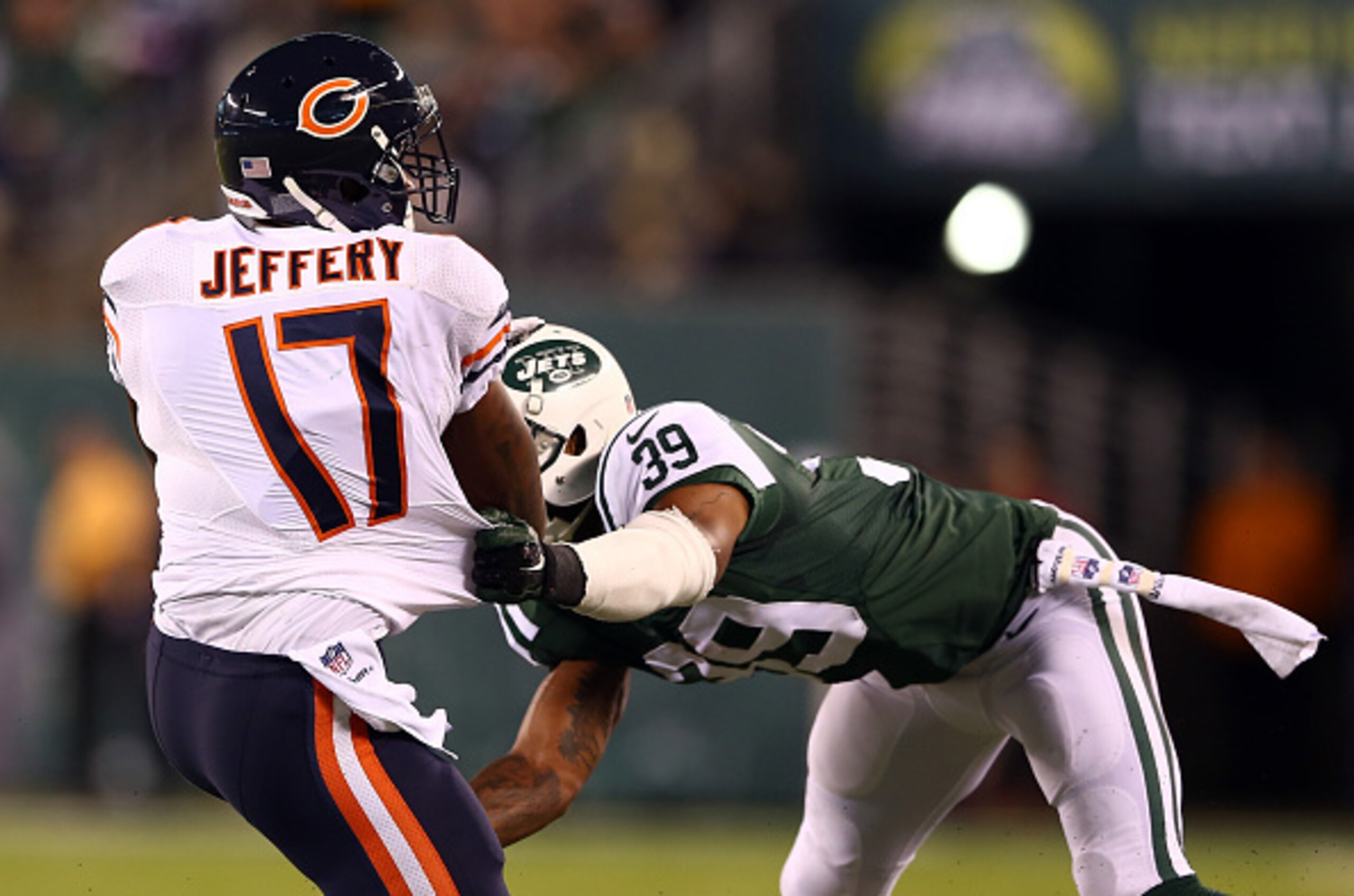
The Jets did a solid job of forcing pressure on Bears QB Jay Cutler in Week 3, recording four sacks. According to ESPN Stats & Information (h/t ESPN New York), Cutler was under duress 14 times in the Monday night matchup.
Cutler was able to complete 60.5 percent of his attempts (23-for-38) despite consistent pressure from the Jets' front seven, though.
Head coach Rex Ryan is renowned for his ability to mix and match different defensive formations to confuse opposing quarterbacks, but the Jets weren't able to force Cutler into making multiple costly mistakes.
Cutler committed just one turnover against the Jets, a controversial fumble recovery that seemingly resulted in a Jets touchdown, but a premature whistle ruled the play dead. Antonio Allen had an opportunity to snag what could have been a game-changing interception in the second half, but failed to corral the wobbling pass after Cutler's arm was hit as he released the ball.
Otherwise, the Bears' signal-caller was on point, repeatedly recognizing from where the Jets pressure was coming and making the adjustments to beat New York's pass rush.
Ryan's famed jailbreak blitz is a staple of his philosophy on defense, but the Jets don't have the talent in the secondary to prevent big plays when the pass rush fails to disrupt the quarterback.
Ryan sometimes shows all-out blitz before rushing just three defenders. This tactic could yield the Jets additional takeaways in the coming weeks if they're able to effectively fool opposing quarterbacks.
3. Exploit Opponents' Weaknesses
3 of 5
Entering Week 3, the Bears had endured some difficulty in stopping the read-option offense, which figured to be part of the Jets' game plan heading into Monday night.
The Jets typically run the read-option at least a few times per game, as noted by Rich Cimini of ESPN New York, but they didn't attempt to exploit Chicago's weakness in defending the play as much as they should have in Week 3.
The Jets scored just one touchdown in six trips to the red zone against Chicago, which serves as evidence that coordinator Marty Mornhinweg needs to abandon the shotgun in the red zone. Smith completed five of 10 red-zone pass attempts for 40 yards with one touchdown against one interception, taking 11 red-zone snaps from the shotgun formation.
With his offense within striking distance of paydirt, Mornhinweg opted not to exploit a Bears defense that entered the contest ranking 27th against against the run. For whatever reason, it seemed as though Mornhinweg was merely attempting to outwit Bears defensive coordinator Mel Tucker.
The Jets need to do a better job of exposing an opponent's weaknesses in order to win. They failed to do that against the Bears in Week 3 and ultimately paid the price because of it.

.jpg?w=2560 "Rams Eagles Football")
.jpg?w=2560 "Texans-Mixon Released Football")
2. Use Chris Johnson in Open Space
4 of 5
The Jets have struggled over the past two weeks to get explosive running back Chris Johnson in open space. CJ2K recorded just 34 rushing yards on 10 carries in Week 3. His longest rush was a six-yard spurt that happened on a direct snap.
For the Jets offense to be successful in 2014, Johnson must be effectively deployed in the running game.
At 203 pounds, Johnson isn't the kind of back who can consistently pound the football between the tackles. For him to be efficient in the ground game, he needs to get the ball in space.
The tandem of Johnson and Chris Ivory fulfills the Jets' run-first mantra on offense, but it's important for both backs to be utilized in a manner that plays toward their strengths.
Johnson is arguably the most formidable playmaking threat the Jets have on offense, which makes it imperative for coordinator Marty Mornhinweg to create opportunities for him to bust loose for big gains. Johnson was targeted just twice on Monday night, failing to record a catch, despite the fact that QB Geno Smith connected with nine different receivers in New York's loss.
If Johnson is going to get 10 to 12 touches per game, those touches need to happen outside of the tackle box.
1. Simplify the Gameplan for Geno Smith
5 of 5
The Jets need better red-zone efficiency from Smith if they're going to compete for a playoff berth in 2014. Even though last year's second-round pick has completed 63.1 percent of his passes, he's already committed five turnovers, including two costly red-zone giveaways.
The Jets aren't going to coddle Smith and relegate him to a "game manager" role, but it might not be a bad thing to simplify the offense. Smith's downfield vision remains suspect, despite a noticeable improvement in his ability to complete passes.
Rather than forcing Smith to read through his progressions to find a target when the pocket begins to collapse, the Jets need to use a tailback as a receiver in the flat when nothing is open for Smith downfield.
Smith has to some extent shown greater awareness in these situations in 2014, using his mobility to get outside the pocket to extend plays or gain yards with his legs, but running isn't always an option, particularly when the rush comes from both ends.
According to Rich Cimini of ESPN New York, Smith was just 1-of-11 passing when under duress against the Bears. That nine percent completion percentage was the worst mark among all NFL quarterbacks in Week 3.
The Jets don't boast the most exceptional offensive line in the league, so giving Smith a dump-off option in the flats could prove helpful in alleviating his turnover problem.
.jpg?w=2560 "Commanders Eagles Football")
.jpg?w=2560 "Chiefs Dolphins Football")

.jpg?w=2560 "Grading WWE Raw 🔠")


