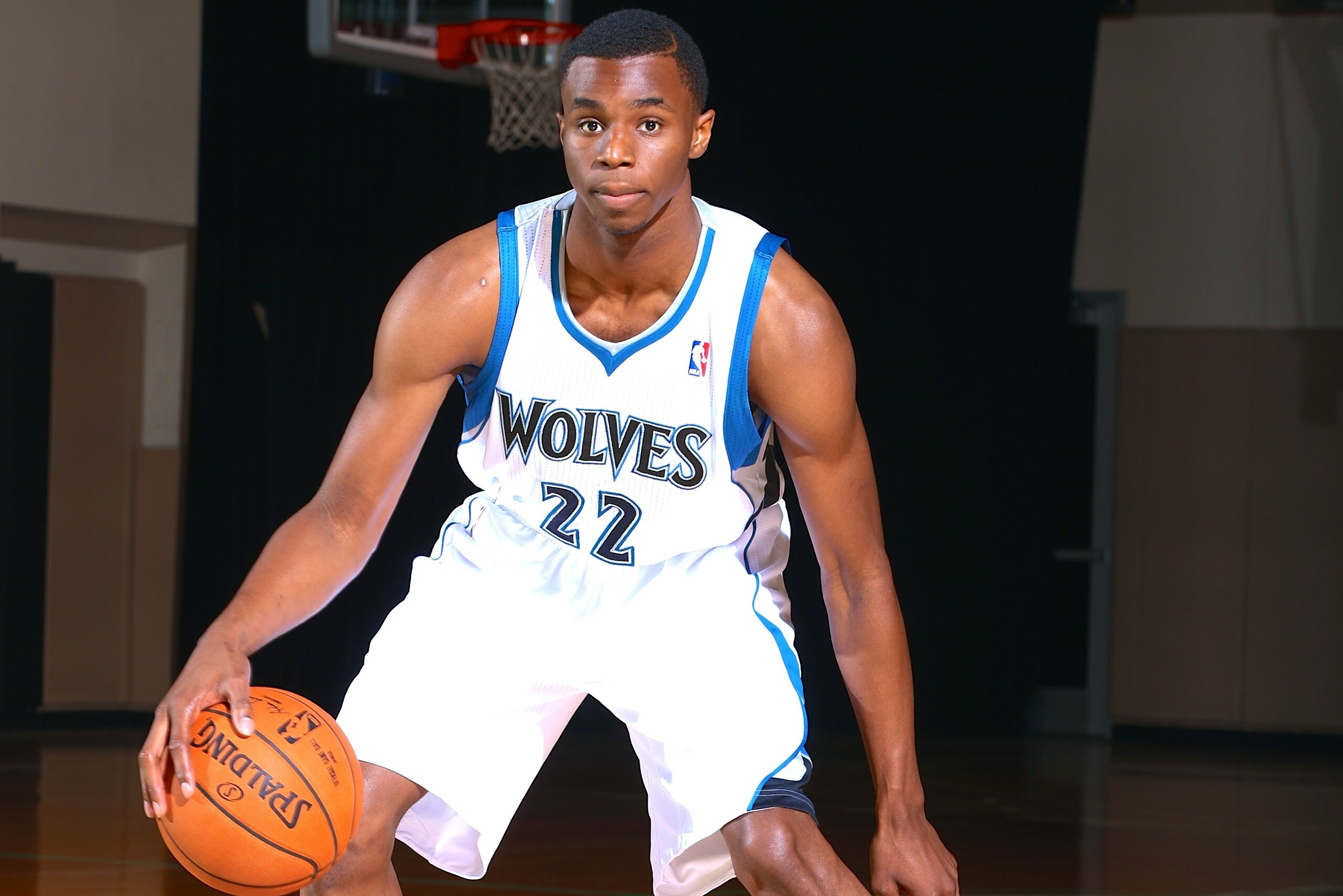


The Minnesota Timberwolves should have their ticket to NBA relevance in tantalizing prospect Andrew Wiggins, but only if the rookie can cash in on his massive potential.
With the right complementary cast, an offensive system suited to his skills and demands that can challenge without frustrating, the franchise can fast-track its phenom for stardom.
In some ways, the Wolves already improved his odds of delivering. Wiggins needed a fresh start, even before his NBA career had officially tipped off.
TOP NEWS

Power Ranking Every NBA Team's Starting Lineup 🔢
Luka 50 Piece in Win 🔥
Worst NBA Predictions 🫣
The No. 1 pick in June's draft, a freakish athlete who generated LeBron James-type buzz at Huntington (West Virginia) Prep School, Wiggins' NBA path took an unexpected turn almost out of the gate. Despite his spotlight-ready physical gifts and centerpiece potential, he was deemed expendable by and eventually traded from James' Cleveland Cavaliers to the Timberwolves.
Before his first real exposure to the basketball on this stage, Wiggins learned about the league's business side. Amid these twists and turns, though, he may have found a setting more conducive to his development inside the lines.
"It's been a crazy summer, really up and down. Kind of lost, not really knowing where I'm going," Wiggins said at his introductory press conference. "But I wanted to play for a team that wanted me. I felt the love as soon as I got off the plane at the airport, so it's all good now. I'm excited for this season."

The Timberwolves are nothing less than ecstatic to get things started with their potential franchise face.
After tightrope walking with an openly frustrated Kevin Love these past few seasons, the Wolves can now breathe easy with a young core that seems legitimately enthusiastic about its surroundings. And that electricity has carried over to the fanbase, which saw the departure of a perennial All-Star and responded with a record level of activity at the box office.
The Wolves were supposed to be handcuffed by Love's desire for greener pastures. By landing Wiggins, though, Minnesota actually gave itself a chance to come out ahead in the transaction.
"In Wiggins, the Wolves managed to reel in a rare talent with a ceiling that technically exceeds the height of the hot shot they just dealt," wrote Bleacher Report's Jonathan Wasserman. "If it clicks for Wiggins, Minnesota could be looking at one of the game's top two-way wings as a dynamite scorer and lockdown defender."
Of course, that's a massive "if" for a 19-year-old without a second of NBA experience to his name. His raw skills are so impressive, it's sometimes hard to remember that superstardom isn't actually guaranteed for the explosive 6'8" swingman.
The Wolves wouldn't make that mistake. History wouldn't allow them to. They have thrown enough lottery darts that didn't connect in recent years—Derrick Williams second overall in 2011, Wesley Johnson fifth the year prior, Jonny Flynn sixth in 2009—to understand how quickly these bubbles can burst.
But the Wolves cannot let this rising star fade away. They must get Wiggins on track to realizing his potential, a process that is already underway.
Luckily, this franchise started building a complementary core long before the phenom's arrival. The Wolves are built to run, and the son of an Olympic sprinter should be a perfect piece for that puzzle, as Bleacher Report's Jim Cavan observed:
"Looking at Minnesota’s likely rotation, a few hallmarks in particular stick out: speed, length and quickness (Nikola Pekovic’s beastly brawn notwithstanding). Wiggins, [Thaddeus] Young, Ricky Rubio, Kevin Martin, J.J. Barea, Corey Brewer, Gorgui Dieng: These are guys tailor-made for pushing the tempo.
"
The Wolves need both a system and a roster that are compatible with Wiggins' talents. They struggled finding the right formulas with Love, which helps explain how a franchise employed an All-NBA-caliber player for six seasons and still sits mired in a 10-year playoff drought.
Love tried to make it work in Minnesota, but multiple failings of the front office prevented him from finding anything close to the success he desired. As Bleacher Report's Howard Beck explained, Love's departure had the franchise's fingerprints all over it:
"The Timberwolves failed Kevin Love, thoroughly. They earned this fate.
For six years, Love waited for help that never arrived—a worthy co-star, a stud backcourt scorer, an enforcer in the paint, a reliable bench. Indeed, no current NBA star has had less help over the course of his career, according to ESPN statistical ace Tom Haberstroh.
Love has not played with a single All-Star or even, as Haberstroh termed it, a single "fringe All-Star" in his six NBA seasons. "From a supporting-cast standpoint, Love has probably been dealt the worst hand of any star in the league," Haberstroh concluded (subscription required).
Love kept performing Herculean tasks—going for 30 points and 15 rebounds, or 30 and 20, even 30 and 30—only to miss the playoffs every year. He alone has carried the burden.
"That killed his morale," said the longtime confidant.
"
Clearly, the Timberwolves need to do better.
They already seem like they have. While the roster still features some win-now veterans left over from the last-ditch effort to prove this team's potential to Love, the nucleus is now mostly made up of youth, athleticism and length.
Wiggins, as drool-worthy as his natural ability is, might not even be the best athlete on the team. That honor could fall on fellow rookie Zach LaVine, a high-flying combo guard out of UCLA.
With the slick-passing Ricky Rubio leading the break, the Timberpups should be looking to push the tempo at every opportunity. With simple reads and reactions in the open court, Minnesota's young specimens should enjoy their smoothest conversion to the big stage out in transition.
It's important to make Wiggins both comfortable and confident, and putting him in areas where he excels should allow that to happen. Add in the fact he jumped from a pressure-packed championship race to a more relaxed environment where development trumps win totals, and this might be the ideal setting to foster his growth.
"It's a great situation," Wiggins said, via KSTP TV. "It gives me more freedom. I'm surrounded by young guys that have the same intentions and determination as me to win, get better every day."
Wiggins' development is as important as anything in the organization's present and future, so he should be given every opportunity to sink or swim in a featured role. But he needs to earn that chance first, and it sounds as if coach-president Flip Saunders will make him do just that, per Andy Greder of the Pioneer Press in St. Paul:
The Timberwolves know how valuable Wiggins is, so they need to strike a balance between challenging him to reach his ceiling and protecting him from getting overexposed.
Saunders must figure out early in the year how much Wiggins can handle. Some have questioned whether he can be a No. 1 option, as he was good offensively in college but not exactly dominant (17.1 points on 44.8 percent shooting).
Bringing out his aggression will be key in unlocking his production, but the Wolves can't put too much on his plate too quickly.
Wiggins isn't part of basketball's most polarizing story in Cleveland anymore, but he still finds himself under a microscope. His direction going forward will likely determine that of an entire franchise. He would have been one of many pieces for the Cavaliers, but he is already a cornerstone for the Wolves.
Publicly, Minnesota can't allow him to be seen that way. He needs to be portrayed as part of a new identity, not the entire identity himself. He'll have enough eyes on him as it is. The Wolves can't afford to point any more in his direction.
They have to set him up for success, but do it discreetly. His teammates can't feel as if he is being given more than he has earned, but this offense can—and should—cater to his strengths and maximize his opportunities.
The Wolves can only point him to the star path in front of him. From there, it falls on Wiggins to traverse that trail, carrying both himself and the franchise up the NBA ladder.

.jpg?w=2560 "Mahomes Told Teammate to Leave Meeting")
.jpg?w=2560 "Rodgers Iced Out on Plane 💎")
.jpg?w=2560 "🚨 Week 8 AP Top 25 Poll")


.jpg?w=2560 "Lamar Being Out Shocked Ravens")
.jpg?w=2560 "Raiders Could Start Mendoza")