

Scott Brooks Will Tweak His Way to OKC Title or Lose Job Trying
Back in 2012, ESPN.com's Beckley Mason described Oklahoma City Thunder head coach Scott Brooks as an "emotional leader," writing that he "still has a ways to go as an X's and O's coach."
Mason argued that "Brooks has yet to show much in the way of creativity, and his teams rarely make dramatic in-game adjustments. He keeps things basic and trusts the talent on the floor to do the rest."
That characterization had already begun to stick just four seasons into Brooks' tenure with OKC, and two years later little has changed.
TOP NEWS
Luka 50 Piece in Win 🔥
Embiid Out vs. Pistons

Power Ranking Every NBA Team's Starting Lineup 🔢
But despite disappointment with Brooks' coaching pedigree, a truly fair assessment of his prowess isn't easy. His team ranked seventh in offensive efficiency last season and fifth in defensive efficiency, per NBA.com. OKC wasn't eliminated until the conference finals in two of the last four seasons and advanced to the NBA Finals in 2012.
Similar results might have followed in 2013 were it not for Russell Westbrook's untimely torn meniscus.
Hardly signs of failure.
And yet Brooks seems to be the consensus explanation for why the Thunder still aren't champions. Even with his record of sustained excellence, there remains a belief held by many that Oklahoma City should be even better—that this roster boasts enough talent to prevail against teams like the San Antonio Spurs and Miami Heat.
Brooks apologists will note a few things. His team is young, a fact often forgotten on account of its rapid ascendance to the top of a crowded Western Conference. Serge Ibaka missed two games in last season's conference finals due to a leg injury. OKC's trip to the NBA Finals was spoiled by a well-oiled Miami Heat machine in its prime.
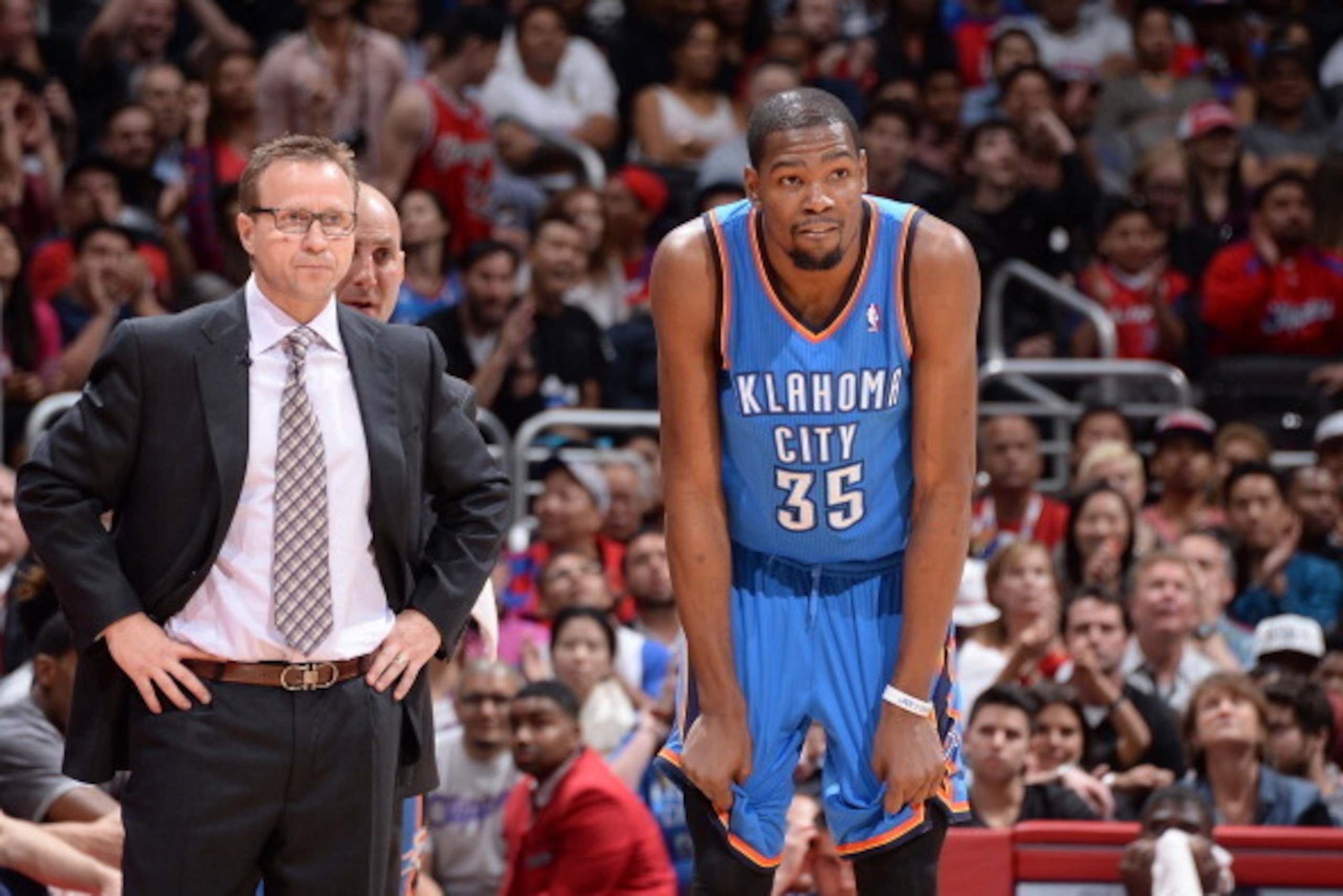
For what it's worth, Brooks' players have been steadfast in their support for their maligned leader.
General manager Sam Presti also told reporters at season's end, "Scotty, I think, did an excellent job."
Even when Westbrook's brother Ray tweeted during the playoffs, "We need a new coach ASAP like rocky!!!!!!," the three-time All-Star came to his coach's aid.
"I took care of that, man," Westbrook told reporters at the time. "We don't conduct business like that. Me and Scotty got a great relationship. I've never once mentioned that I want Scotty to leave here ever since I've been here. We created a bond with each other that's grown and got older with."
Others have praised Brooks' personality and penchant for inspiration.
The New York Times' Billy Witz credited him with "a combativeness that neatly embodies the feistiness of his team," adding, "The same tenacity he showed as a player is now evident in the team that Brooks runs."
All legitimate defenses. If they don't fully mitigate Brooks' culpability, they certainly serve as reminders that he's doing something right.
Critics maintain, however, that the Thunder's impressive resume has essentially been built in spite of Brooks.
"What makes Brooks' comparative faults so frustrating is that he's got a team capable of rendering them irrelevant," wrote Sports on Earth's Tomas Rios in May. "If Westbrook and Durant put up four collectively dominant games in any series, that series ends in the Thunder's favor."
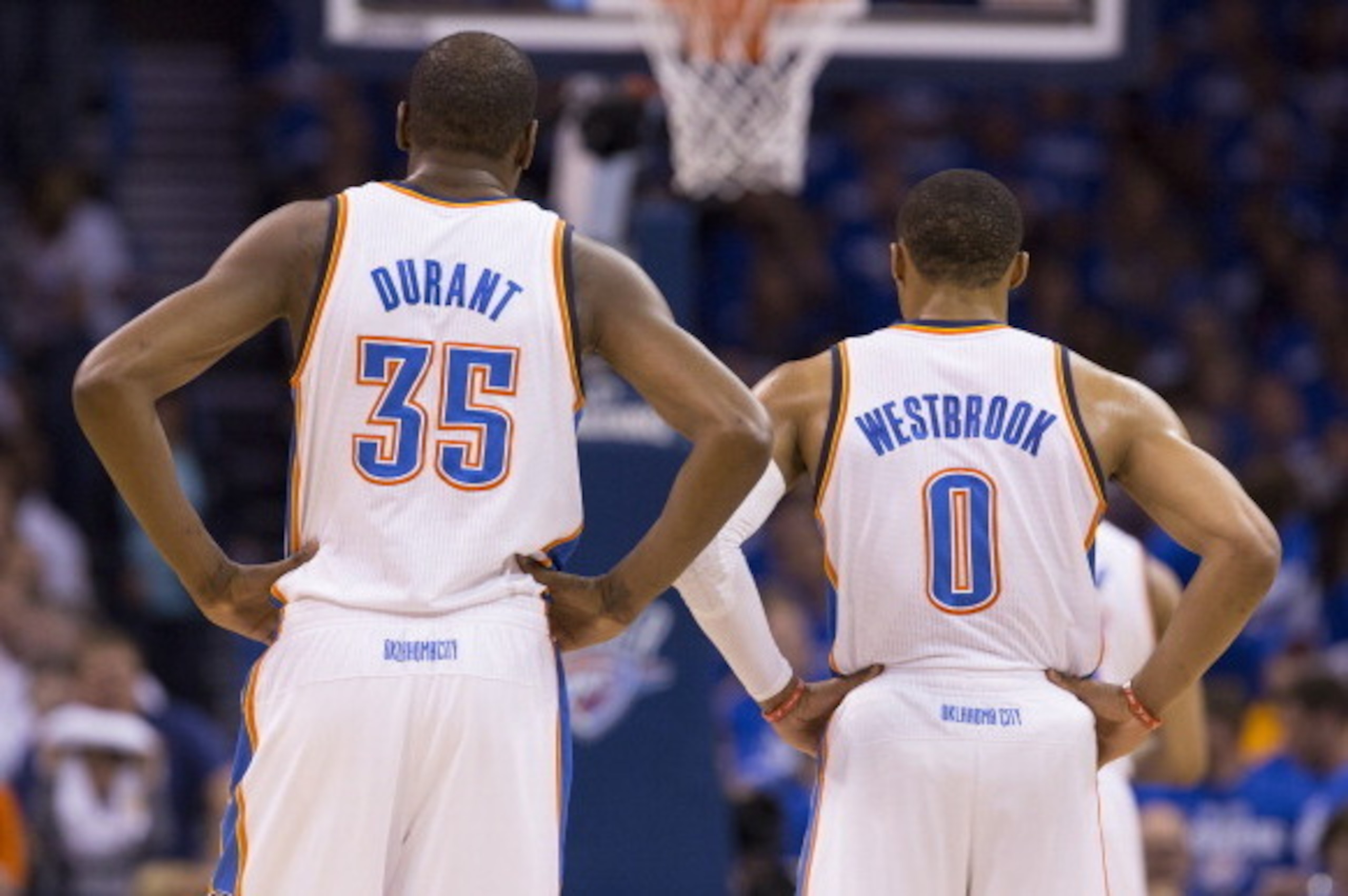
Rios adds, "Watching any Thunder game is just a fresh chance to realize that Brooks' coaching philosophy is best summed up as 'I have Durant, Westbrook and Ibaka, come do something about it.'"
That philosophy—such as it is—still translates into the same unimaginative game plan Mason bemoaned in 2012.
As NBCSports.com's Kurt Helin put it in April, "Brooks runs fairly simple sets, and when Memphis has taken away the first option—as any good defensive team will do in the playoffs—the Thunder offense has broken down. There is a whole lot of Durant or Westbrook against the world while the other watches."
Grantland's Jared Dubin ultimately concluded "that Brooks has taken this team as far as he can, that this is the end of the line, and that it's time to move on."
Media reaction isn't always a perfect barometer of a player or coach's merits. Sometimes it more resembles hasty groupthink than a carefully formulated adjudication.
Unfortunately for Brooks, there's a reason everyone else seems to be on the same page.
His reliance on "hero ball" has unsurprisingly corresponded with Oklahoma City only going so far as its protagonists can carry it. Against well-coached competition, that's a recipe for second-best results. The Thunder's attack on offense has become predictable and—at the highest levels—surmountable.
Compounding those difficulties last season was a stubborn reliance on veteran defensive specialists like Kendrick Perkins and Thabo Sefolosha. Sefolosha was eventually benched in the conference finals in a bid to inject additional offensive punch—this time in the form of Reggie Jackson.
Reliance on the 29-year-old Perkins has been more perplexing, particularly with the emergence of backup center Steven Adams and the time-tested reliability of reserve Nick Collison. Perkins played 19.5 minutes per contest last season, 20.2 minutes per game during the playoffs.
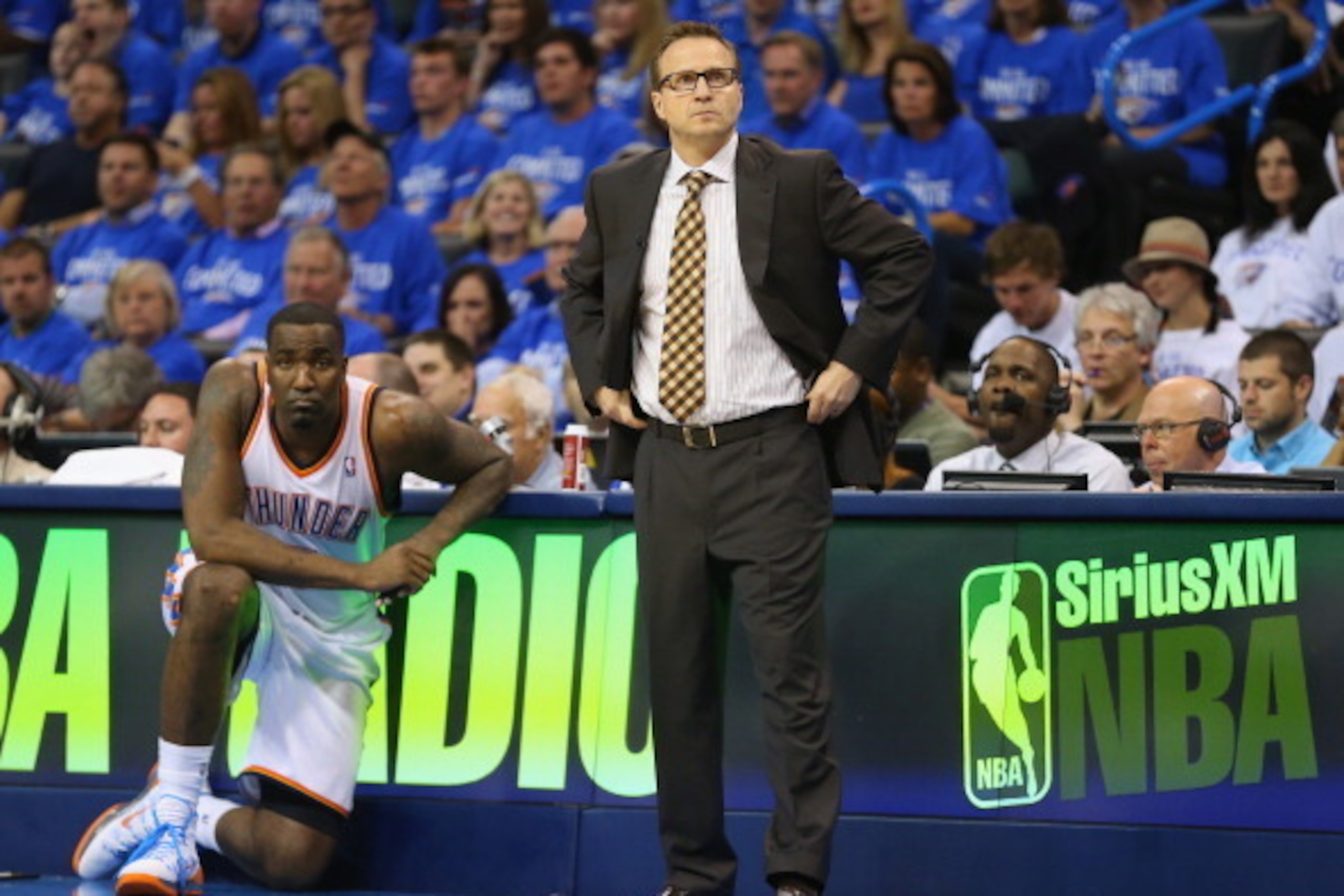
Once beloved for his defense, intangibles and ability to set a tone, Perkins is now OKC's latest scapegoat. The data shows that the Thunder scored 6.9 fewer points per 100 possessions when he was on the floor last season according to Basketball-Reference.com, numbers that roundly refute his ostensible value.
Some fixes will be easy enough to make. Adams is entering his second season and poised to adopt a more prominent role—perhaps even a starting one. Sefolosha is gone. Jackson is coming into his own, and third-year swingman Jeremy Lamb may be right behind him.
The offense itself remains in dire need of improved ball movement and complexity. Until Brooks implements a system with more motion off the ball (cuts to the basket, running off screens, etc.), there remains a very real danger that this roster's abundant talent won't be enough against more polished operations.
For now, the ball remains in Brooks' court. This remains his job to lose.
As The Oklahoman's Berry Tramel put it regarding the head coaching gig, "The Thunder is not a reactionary organization. The Thunder doesn't make rash decisions. Doesn't give in to popular demand."
Indeed, this is an organization that privileges culture and continuity. And Brooks has accomplished just enough to render any apocalyptic suggestions moot.
But with Durant eyeing free agency in 2016, Oklahoma City's aversion to change could be tested soon enough. Much as KD has proclaimed his loyalty to Brooks, it's hard to imagine he's entirely comfortable with the status quo—and even harder to imagine he'd remain patient after coming up short once again.
Perhaps it's too soon for "title or bust" proclamations.
Then again, this is a league that asks, "What have you done for me lately?"—a league that's wondering what Scott Brooks will do next.

.jpg?w=2560 "Rodgers Iced Out on Plane 💎")
.jpg?w=2560 "Raiders Could Start Mendoza")
.jpg?w=2560 "Mahomes Told Teammate to Leave Meeting")
.jpg?w=2560 "🚨 Week 8 AP Top 25 Poll")


.jpg?w=2560 "Lamar Being Out Shocked Ravens")
.jpg?w=2560 "Packers Safety Slams Refs 🤬")