Singapore Grand Prix 2014 Preview: Start Time, TV Times, Weather, Schedule, Odds
The Singapore Grand Prix will be the 14th round of the 2014 Formula One season.
Held at the Marina Bay Street Circuit close to downtown Singapore, this is F1's only true night race. Starting and finishing under floodlights in one of the world's most vibrant, wealthy cities, for sheer spectacle it's difficult to beat.
Only six drivers have competed in every Singapore Grand Prix, and of them only three have stood on the top step of the podium.
Sebastian Vettel has three wins around the city streets, Fernando Alonso has two and Lewis Hamilton one.
Can the Brit add to his tally in 2014, or will Nico Rosberg become the first man to win in Singapore without first claiming a world championship?
Read on for a full preview of the race, including TV times, current standings, a track map and circuit guide, weather forecast, tyre and DRS information, odds and session times.
Current Standings
1 of 6
Nico Rosberg's lead at the top of the drivers' championship is now 22 points after Lewis Hamilton won in Italy.
Daniel Ricciardo's grip on third appears more secure than ever.
The current top 10 are:
| 1 | Nico Rosberg | Mercedes | 238 |
| 2 | Lewis Hamilton | Mercedes | 216 |
| 3 | Daniel Ricciardo | Red Bull | 166 |
| 4 | Valtteri Bottas | Williams | 122 |
| 5 | Fernando Alonso | Ferrari | 121 |
| 6 | Sebastian Vettel | Red Bull | 106 |
| 7 | Jenson Button | McLaren | 72 |
| 8 | Nico Hulkenberg | Force India | 70 |
| 9 | Felipe Massa | Williams | 55 |
| 10 | Kimi Raikkonen | Ferrari | 41 |
In the constructors' standings, Mercedes have five more points than second and third combined.
Sauber and Caterham remain pointless. The standings are:
| 1 | Mercedes | 454 |
| 2 | Red Bull | 272 |
| 3 | Williams | 177 |
| 4 | Ferrari | 162 |
| 5 | McLaren | 110 |
| 6 | Force India | 109 |
| 7 | Toro Rosso | 19 |
| 8 | Lotus | 8 |
| 9 | Marussia | 2 |
| 10 | Sauber | 0 |
| 11 | Caterham | 0 |
All data from Formula1.com.
Marina Bay Street Circuit
2 of 6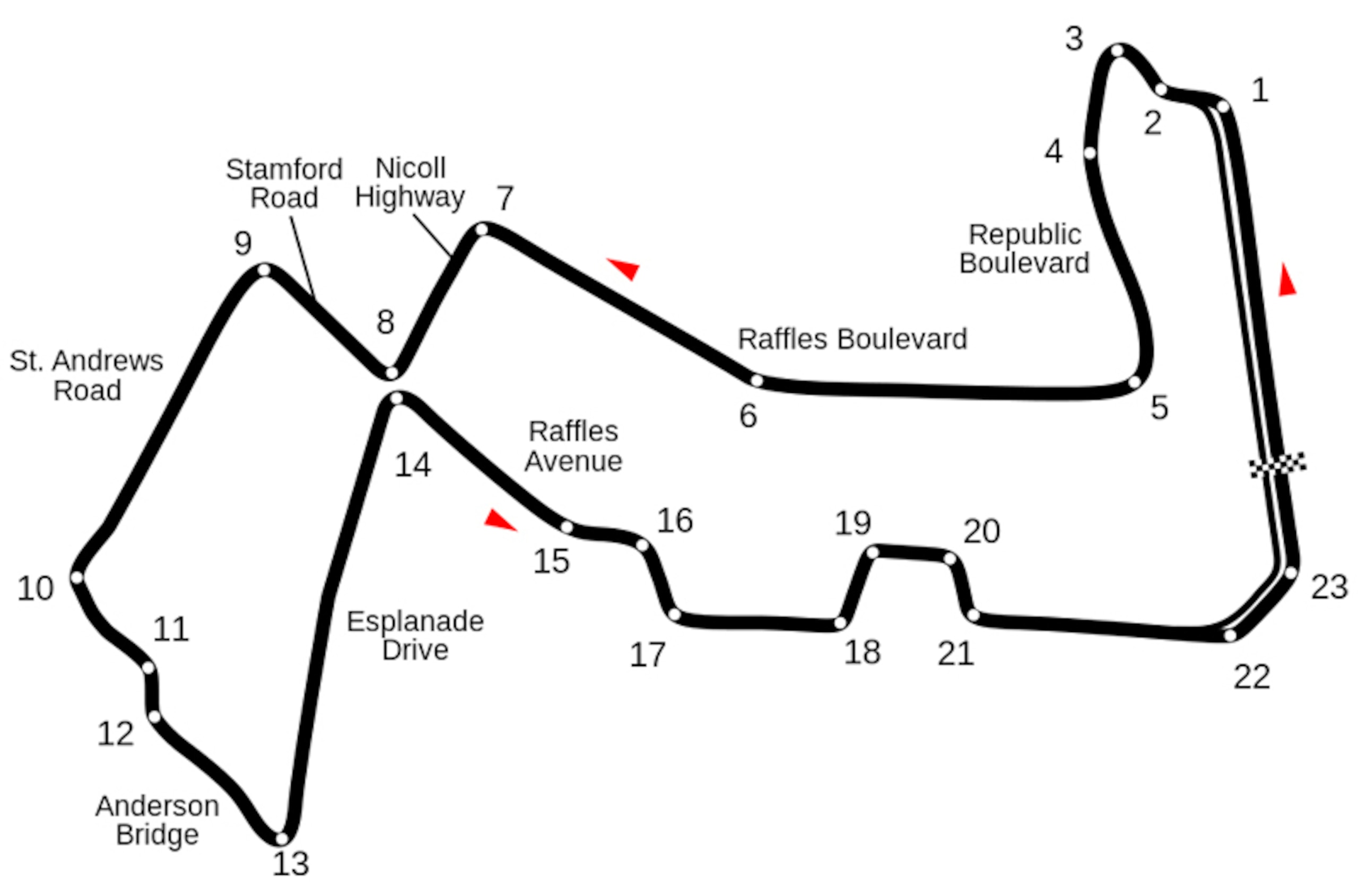
The Marina Bay Street Circuit lies close to the southern shore of Singapore Island. Much of the course is made up of genuine public roads which were there long before a grand prix was even dreamed of, but there's a small purpose-built section around the pit lane area.
Of its 23 corners, 13 are near-enough "90-degreers," but crucially no two are identical. This provides sufficient variety and challenge to keep the drivers occupied through what is usually the longest race on the F1 calendar.
But for once, maybe they'd like a break. This sweltering night race regularly sees temperatures of 30 degrees Celsius, and the high humidity can make it feel warmer still.
Turns 1, 2 and 3
A lap begins with a relatively short run down to Turns 1 and 2, which form a medium-speed left-right chicane.
It can get hairy here on the opening lap, but with plenty of run-off around the outside it's quite easy to avoid a collision.
As soon as they exit the chicane, the drivers brake for Turn 3, a slow left-hand hairpin. It's one of the slowest parts of the track, and another spot which can be troublesome on the opening lap.
The corner opens out a touch at the exit, and the cars come close to the wall on the outside as they accelerate out onto a short, curved straight.
Turns 4, 5 and 6
Turn 4 (the gentle meander out of Turn 3) isn't really a corner at all, but Turn 5 most certainly is—probably the most important of the whole lap.
The drivers approach the slightly curved braking zone at 240 kilometres an hour and run over the kerb on the outside before turning into this tricky medium-speed right-hander.
Precision is everything here, because it leads out onto the circuit's longest straight. On an ideal qualifying lap, the left wheels will be just inches from the wall on the outside.
It leads out onto the long Raffles Boulevard, and Turn 6 is the right-hand kink halfway along.
Turns 7, 8 and 9
After hitting DRS-assisted speeds in excess of 300 kilometres an hour, the drivers brake hard at the end of the straight for Turn 7, a a slow- to medium-speed 90-degree left.
This is one of the few corners with a lot of spare tarmac at the exit, so the drivers can attack this turn with a little less fear than the others. It's considered one of the circuit's best overtaking spots.
A quick throttle squirt (there are a lot of these at Singapore) later, it's braking again for the slow, 90-ish-degree (and these) right of Turn 8.
The drivers hit the loud pedal at the exit for another few seconds before slowing again for Turn 9, a slow-medium 90-degree left.
This corner opens out at the exit and fires the cars onto a medium-length straight.
Turns 10, 11, 12 and 13
Speeds in excess of 270 kilometres an hour are attained as the cars speed toward the medium-speed left of Turn 10. The barriers seem to close in a little through the braking zone here, but the corner itself is straightforward enough.
A few seconds on the throttle later it's braking again, this time for a slow, fiddly chicane (Turns 11 and 12). It's first right, then left.
The chicane serves the very important purpose of slowing the cars before they enter one of the narrowest pieces of track in F1, the Anderson Bridge.
Only a very brave man would try to pass here.
As soon as they come off the bridge it's braking again, this time for the tight, slow left-hander of Turn 13.
A good line and exit through here is key, as it leads out onto the track's second-longest straight.
Turns 14, 15, 16 and 17
There's a slight hump in the road close to the end of the straight, then it's braking hard for the slow right-hander of Turn 14. Passing here is tough, but by no means impossible.
It's back on the throttle at the exit for a short run to Turn 15. Halfway through this left-hand kink, the drivers start to brake for the slow 90-degree right of Turn 16. This corner is the first part of a right-left chicane.
Having cleared the apex, the drivers feather the throttle through the more open left of Turn 17, waiting for the right moment to put the power down. Again the wheels come perilously close to the wall on the outside—sometimes too close.
This was the corner at which Nelson Piquet Jr. crashed in 2008, sparking off the Crashgate scandal.
Turns 18 and 19
A brief throttle squirt follows before braking for the track's most interesting corner, Turn 18—a tight, narrow and slow 90-degree left.
The track passes below the grandstand at the corner exit, and the barriers have a habit of attracting anyone who pushes just a little bit too hard.
There's a handy escape road straight on from the corner, but anyone taking it will lose a lot of time.
Turn 19 is a slow 90-degree right as the cars emerge from under the grandstand. This one is a little more open and forgiving than the preceding corner.
Turns 20, 21, 22 and 23
Yet another throttle squirt later comes another chicane, comprising Turns 20 and 21. The first part is a right-hander, tight and slow, before a more open, medium-speed left sends the cars out onto a short straight.
This is where Piquet Jr. practiced his 2008 crash, on the formation lap.
The cars stream past the Singapore Flyer toward the final two corners, a pair of quick lefts.
The first is taken after a brief stab of the brakes, while the second is flat out and leads the cars back onto the start-finish straight.
Pit Lane
The pit lane entry is on the inside at Turn 22, and the exit is on the outside of Turn 2.
Tyres and DRS
3 of 6
The Singapore track presents a problem common to many street circuits. The roads are used all year round by normal cars and covered in various pollutants, and that leaves them dirty and lacking grip.
The track will "evolve" (become grippier) over the course of the weekend, but even at the end of the final lap the grip levels won't be good.
In addition, normal roads are not laid out with F1 in mind. Manhole covers, drains, bumps and white lines are dotted around all over the place.
High-grip tyres are needed, so Pirelli are bringing the red-marked supersoft and yellow-marked soft compounds.
Two stops should be the optimum strategy, but safety cars could change that.
DRS
There will be two DRS zones for the Singapore Grand Prix.
The first will have its detection point at Turn 4. The activation point is just after the exit of Turn 5, and the zone runs all the way down Raffles Boulevard, ending with braking for Turn 7.
The second zone will have a detection point between Turns 20 and 21. The activation line is immediately after the exit of the final corner (Turn 23) and runs the length of the pit straight, ending at Turn 1.
The pit straight zone doesn't look like it'll be much use at all so far as passing is concerned—it's just too short. The other, longer zone might produce a few opportunities, but overtaking is never easy at Marina Bay.

.jpg?w=2560 "Commanders Eagles Football")
.jpg?w=2560 "Texans-Mixon Released Football")
Weather Forecast
4 of 6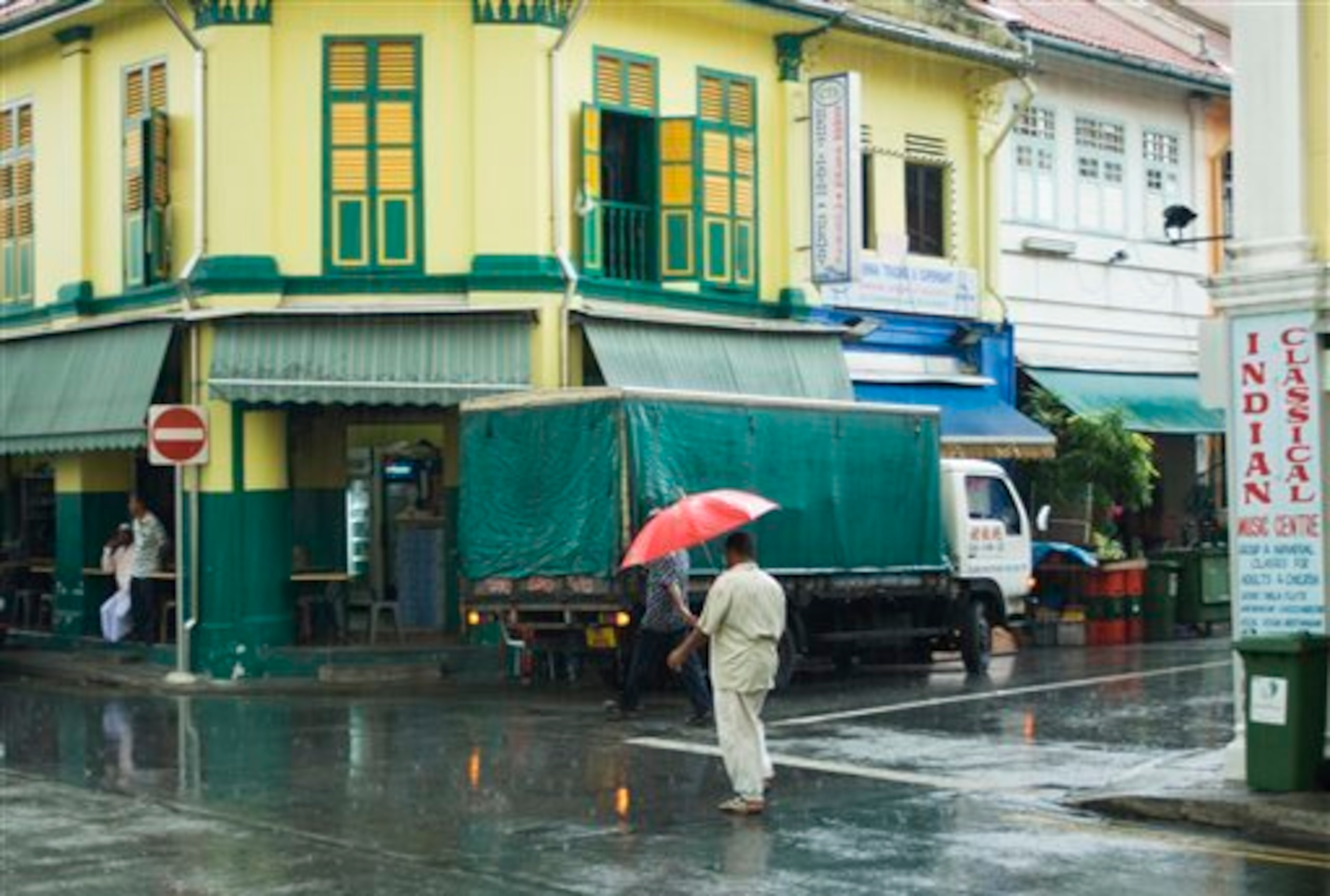
Singapore has a tropical rain orest climate, with hot, rainy weather all year round. The northeastern monsoon brings even higher precipitation around the turn of the year.
October just misses the monsoon, but still sees more wet days than dry ones—and when it rains in Singapore, it really rains. The downpours often dump massive quantities of water in a short space of time.
It's impossible to know this far in advance when or where they may strike, so the current forecast—possible heavy showers on all days—doesn't tell us a great deal.
But at least we know it's going to be hot, even at night when the racing takes place.
BBC Weather will have the latest as we get closer to the weekend.
Odds
5 of 6
Lewis Hamilton goes into his 14th consecutive race as the pre-qualifying favourite. Nico Rosberg goes into his 14th as second favourite.
Daniel Ricciardo is heavily tipped ahead of last season's dominant winner—and odds-on favourite—Sebastian Vettel.
What a difference a year makes, 8,760 little hours...
The top 10 favourites are:
| Lewis Hamilton | 4-5 |
| Nico Rosberg | 2-1 |
| Daniel Ricciardo | 12-1 |
| Sebastian Vettel | 25-1 |
| Valtteri Bottas | 25-1 |
| Fernando Alonso | 40-1 |
| Felipe Massa | 40-1 |
| Kimi Raikkonen | 150-1 |
| Jenson Button | 250-1 |
| Kevin Magnussen | 250-1 |
Selected Others
The safety car has made an appearance at every Singapore Grand Prix to date, and the odds reflect this. It's 1-5 for a bit of SLS AMG action, 10-3 for none.
Hamilton scored a hat-trick at the last race—pole, fastest lap and race win. He's 11-4 to do it again here, with Rosberg 13-2 and Ricciardo 50-1.
Sauber, still pointless, will again be desperately chasing a top-10 finish. It's 11-1 for Adrian Sutil to get the job done, 16-1 for Esteban Gutierrez.
And poor old Romain Grosjean is again, for whatever reason, considered most likely to retire first (10-1). Pastor Maldonado is 16-1, with a somewhat optimistic no retirements at just 33-1.
All odds sourced from Oddschecker.com and correct at the time of publication.
TV Times and Session Times
6 of 6
As always, the Singapore Grand Prix weekend will consist of three free practice sessions, qualifying and the race.
The session times are as follows:
| Practice One | Friday | 6 p.m. |
| Practice Two | Friday | 9:30 p.m. |
| Practice Three | Saturday | 6 p.m. |
| Qualifying | Saturday | 9 p.m. |
| Race | Sunday | 8 p.m. |
All times are given in Singapore local time (SGT). Formula1.com has a handy one-click tool (right-hand side of the homepage) to convert them to your own timezone.
TV Times
In the United Kingdom, live coverage will be provided by Sky Sports F1. The times (BST) are as follows:
| Practice One | Friday | 10:45 a.m. | 11 a.m. |
| Practice Two | Friday | 2:15 p.m. | 2:30 p.m. |
| Practice Three | Saturday | 10:45 a.m. | 11 a.m. |
| Qualifying | Saturday | 1 p.m. | 2 p.m. |
| Race | Sunday | 11:30 a.m. | 1 p.m. |
In the United States, live coverage of selected sessions will be provided by the NBC network. Live coverage of practice two starts at 9:30 a.m. on Friday (NBCSN), with qualifying on air at 9 a.m. on Saturday (CNBC). Live race coverage begins at 7:30 a.m. on Sunday (NBCSN). All NBC times are given in Eastern time.
Enjoy the weekend!
Follow me on Twitter for occasion updates on new articles, if you have any comments or questions or to share any thoughts and views about F1.


.jpg?w=2560 "Mahomes' Wife Trolls Kubiak 💀")