Who Is the Best Under-25 Point Guard in the NBA?
The NBA's point guard hierarchy is a complicated beast due to the massive influx of talent we've seen at the position over the past decade.
But for the most part, we know who sits atop the throne. The list includes Chris Paul, Tony Parker and Russell Westbrook. Not to mention Stephen Curry, Derrick Rose and Rajon Rondo.
However, each of those players is at least 25 years old.
TOP NEWS

LeBron's Special Helicopter Deal

MJ Makes Record-Setting Donation 🙌
Report: Embiid Down to Rookie Weight
Which left us wondering: Among the league's top under-25 floor generals, who's furthest ahead on the developmental curve?
While there's no shortage of worthy candidates (Ricky Rubio, Eric Bledsoe and Jrue Holiday come to mind), three names stick out above the rest.
Kyrie Irving (22), Damian Lillard (24) and John Wall (24) boast All-Star credentials, while Lillard and Irving are former Rookie of the Year winners. Additionally, Irving just took home FIBA World Cup MVP honors while Lillard and Wall watched stateside.
But despite their ascensions into the realm of superstardom, each member of that esteemed trio still has considerable work to do if he wants to challenge Paul atop the floor-general pecking order.
In order to gain more clarity on the question at hand, we decided to compare and contrast the strengths and weaknesses of each player's game to determine which point guard possesses the most complete skill set.
Kyrie Irving

There are few off-the-dribble penetrators more lethal than Irving.
And now that LeBron James and Kevin Love are flanking him on the wings, Irving should be able to showcase even more distributive competence when probing opposing defenses.
But it's not like he was a slouch in the passing department to begin with, according to Bleacher Report's Adam Fromal:
"Irving gets a lot of credit for his scoring and his fantastic ball-handling skills, but perhaps it's time to praise him a bit more for the quality of his passes. They may not be as flashy as Ricky Rubio's or as consistent as Chris Paul's, and he certainly has his fair share of bad-pass turnovers, but he does tend to hit his teammates in the right spots.
When this particular No. 1 pick was on the court (if there's any team with which you have to be specific about No. 1 selections, it's this one), Irving's teammates shot 44.14 percent from the field. But after receiving a pass from him, they shot an incredible 52.14 percent.
"
As things stand, Irving's progression into a more established tier of passers is inevitable.
In a system that's going to stress quick side-to-side ball movement and opportunities in transition, look for Irving to maximize each and every touch under head coach David Blatt.
Perhaps more important, though, will be Irving's advancement as a shooter.
As you'll notice in the chart below, Irving's field-goal and three-point percentages have declined every year since entering the league, with marks of 43.0 and 35.8 representing career lows in those two categories, respectively, last season.
It's hardly all bad, though.
Not only is Irving a steady mid-range shooter, as the following short chart from Nylon Calculus illustrates, he's perfectly capable of knocking down pull-up jumpers.
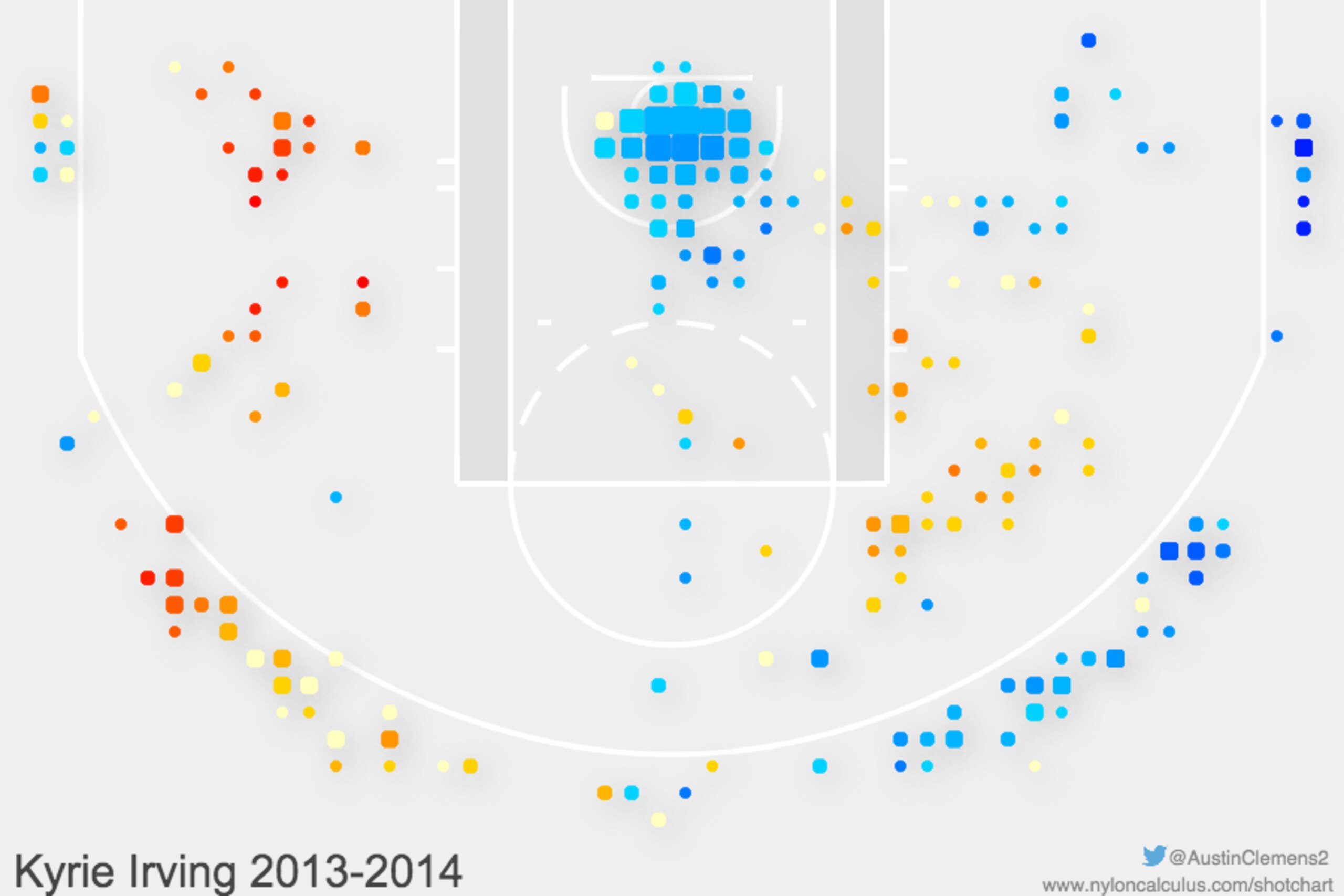
According to SportVU player tracking data, Irving ranked among the league's top 15 (minimum five attempts per game) in terms of pull-up field-goal percentage (40.7) last season. Not only that, but he ranked just decimal points behind Kevin Durant when it came to pull-up three-point field-goal percentage (40.9).
And as mentioned previously, the arrivals of James and Love should have an overwhelmingly positive influence on Irving's development. With more operating room available as a result of less defensive attention, Irving's efficiency figures to spike in concert with the Cleveland Cavaliers' stylistic renaissance.
But what are we to make of Irving's spotty track record on defense?
Between Irving, Lillard and Wall, Cleveland's point man ceded the worst player efficiency rating (17.8) to opposing point guards last season, per 82games.com.
Additionally, the Cavaliers were 5.4 points better per 100 defensive possessions when Irving was off the floor last season, according to NBA.com. A portion of that gaudy total can be attributed to the state of Cleveland's subpar defense under Mike Brown, but it's still valuable information worth considering.
While it would be unfair to label him a defensive liability, Irving still has plenty of room to grow. Defending pick-and-roll ball-handlers, Irving ranked 81st among all players, surrendering 0.76 points per possession, according to Synergy Sports (subscription required).
When one compares the efforts made by Wall and Irving on those plays, it is clear that Wall showed more consistent commitment when fighting through screens and chasing opposing ball-handlers after encountering physically imposing screeners.
Nevertheless, Irving is poised for a huge year. His per-game numbers aren't guaranteed to hold steady now that a star-studded cast is joining him in Cleveland, but Irving's efficiency on both ends of the floor is bound to improve as a result of the revamped roster.
Damian Lillard
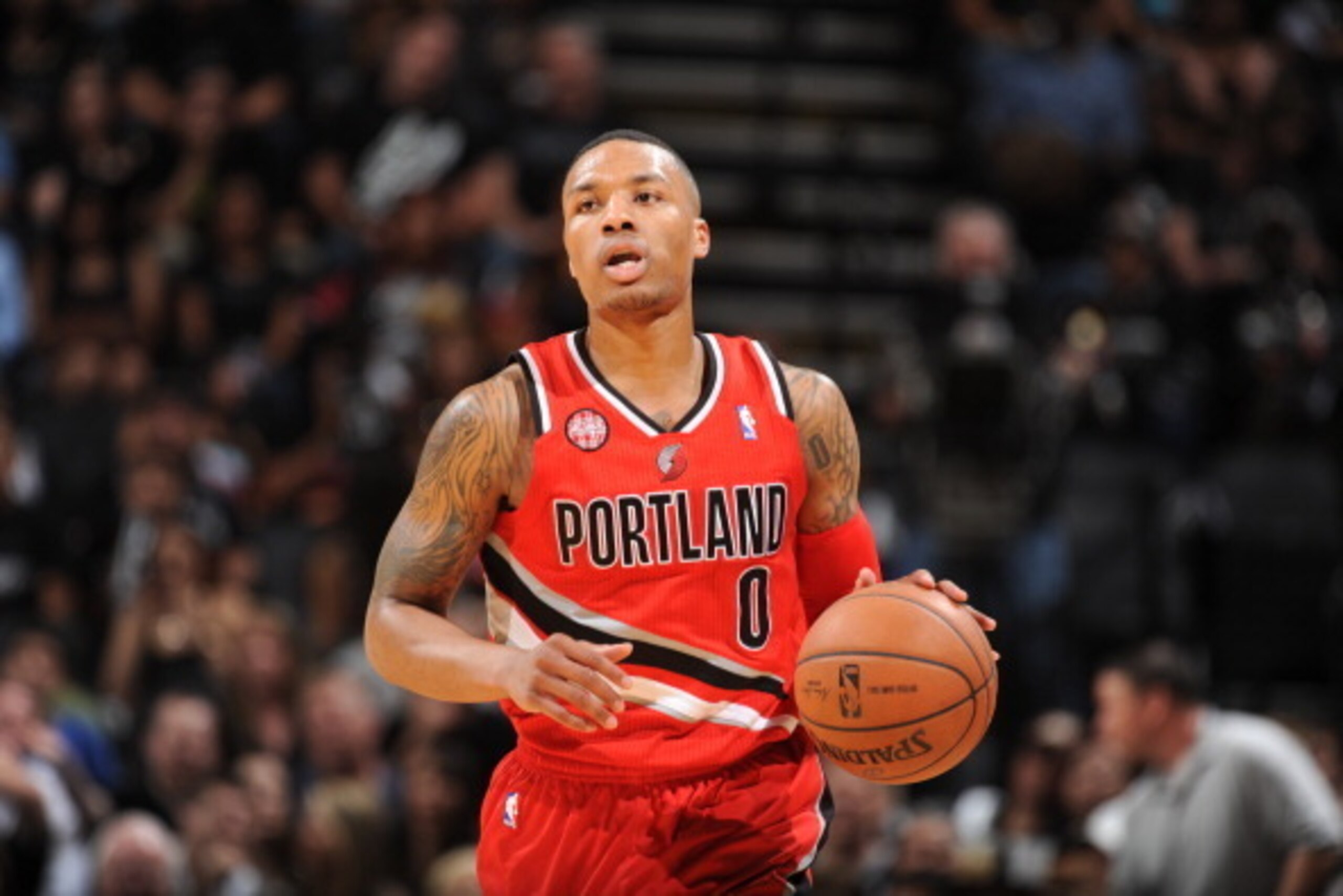
Labeled a scoring machine prior to the 2012 NBA draft, Lillard has lived up to that billing in a big way since beginning his professional journey.
The most prolific shooter of the group, Lillard flashed elite scoring chops throughout the 2013-14 season. Specifically, Lillard knocked down 39.4 percent of his three-point attempts, making him one of 11 players (along with Irving) to average at least 20 points and sink more than 35 percent of his triples, according to Basketball-Reference.com.
But what's really fascinating is where Lillard did his damage.
While corner threes are considered the most efficient shots in the game, Lillard scorched the nets from above the break. In fact, Lillard attempted 500 shots from that area, more than any other basic zone on the floor, according to NBA.com.
That proficiency is exemplified in this shot chart from Nylon Calculus:
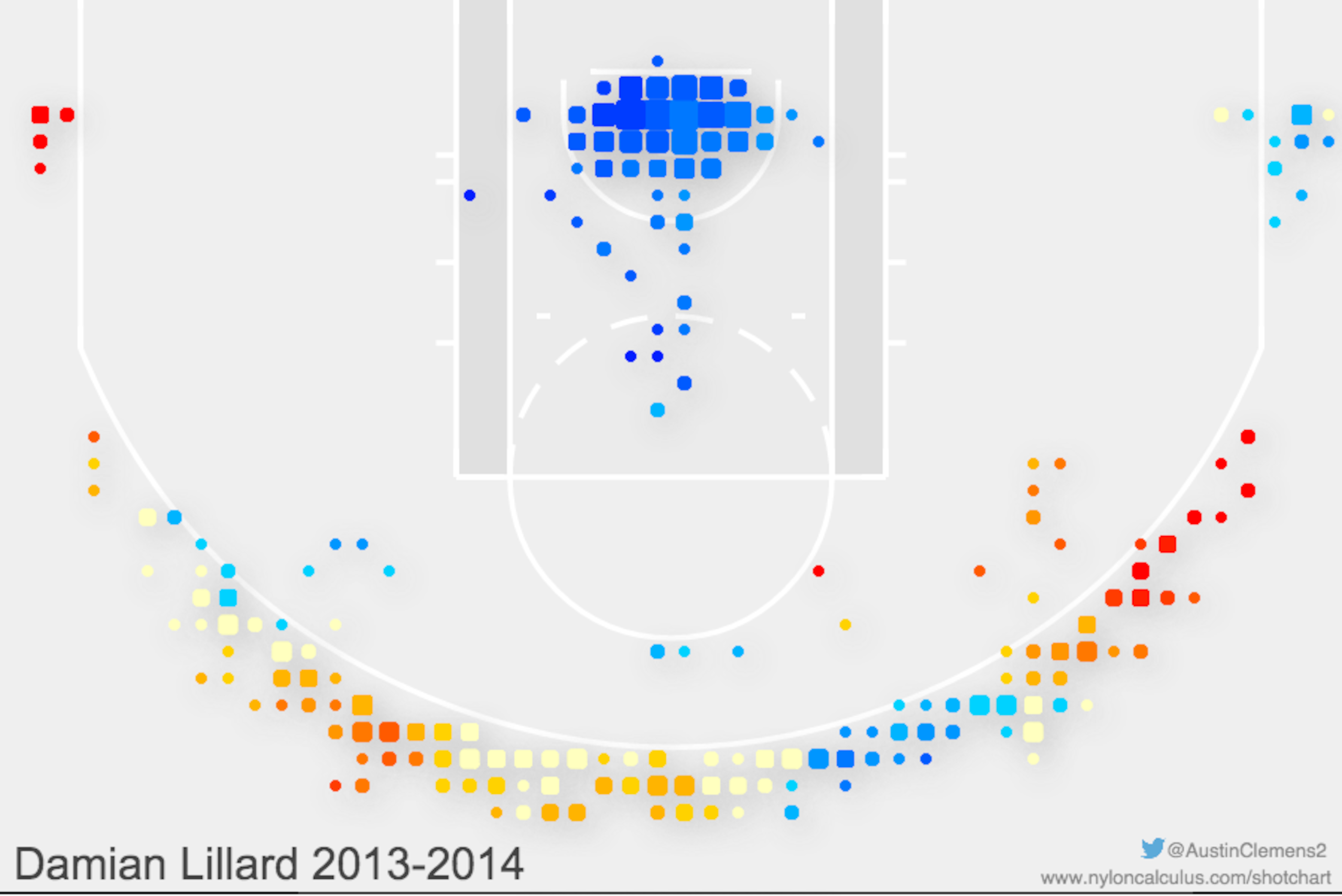
Lillard was also a mid-range dynamo, knocking down an above-average 44.3 percent of his looks between 16 and 24 feet, per NBA.com.
Those are numbers of which Wall can only dream.
However, Lillard's still learning to defend the heavy number of pick-and-rolls the pro game has to offer. He admitted as much in a March Q&A with The Oregonian's Jason Quick:
"Of course, pick and rolls, let me see somebody come out here, chase people over pick and rolls, get screened, on offense you coming off pick and rolls, and play 35 minutes. Not that I’m going to wear down, or that I’m tired, but it’s tough. Every game, for a whole season. It’s tough for every point guard.
"
In that regard, Portland's point man still has plenty of work to do before he catches up to an athletic freak like Wall.
Like Irving, Lillard's club was superior on defense when he was off the floor—a full 1.3 points better per 100 possessions, to be exact.
Furthermore, we're hesitant to group Lillard among the league's premier passers after his per-game total dropped nearly one full assist from Year 1 to Year 2. With a nightly average of 5.6 helpers, Lillard tied Raymond Felton at No. 19 overall among point guards, ranking one spot ahead of Mario Chalmers and Brandon Knight.
Lillard's achievements as a scorer are undeniable, but some defensive and distributive refinement could do wonders for his status as an elite floor general.
John Wall
John Wall separates himself from the competition in three areas.
First, he was a more efficient finisher at the rim last season. Compared to his primary counterparts, Wall finished 49.1 percent of his drives, while Irving and Lillard converted 46.2 and 40.1 percent of theirs, respectively, according to SportVU.
The funny thing is, Wall could stand to penetrate more than he does. Although his conversion rate on drives approached 50 percent, he finished behind both Lillard and Irving in terms of drives per game and points scored on those possessions.
Second, Wall is the most consistent defender of the bunch. Among the trio, Wall was the only player to make a positive statistical influence when defending opposing point guards.
According to NBA.com, the league's ninth-ranked defense was 2.8 points better per 100 defensive possessions with Wall on the floor, posting a defensive rating of 101.7 in the process. If that mark spanned the entire season, it would have ranked No. 7 overall.
Wall also demonstrated his progression as a pick-and-roll defender, surrendering a meager 0.67 points per possession to ball-handlers on such plays, per Synergy.
Here's how Wall stacked up against his primary competition in that regard:
Lastly, Wall has displayed more advanced court vision than Lillard or Irving.
According to a new passer-rating metric developed by Bleacher Report's Adam Fromal and Kelly Scaletta, Wall ranks No. 3 among the league's top distributive maestros, while Lillard and Irving ranked 24th and 18th, respectively.
And remember when we said Wall could stand to drive more? Well, some of those opportunities are lost when he takes the unselfish route and dishes to open spot-up shooters after collapsing opposing defenses. Fromal explains:
"Even when he's blazing by defenders and leaving them gasping for breath in his wake, he's able to keep his head up and scan the court to find players in advantageous spots. If he can score for himself, he'll do so, but Wall has also developed into a true master of finding corner-three opportunities for his teammates.
"
Supporting Fromal's point, Wall (21.3) ranked third behind Paul (24.5) and Rondo (23.0) in terms of points generated via assists per game last season, according to SportVU data.
For all of that prosperity, though, Wall did wind up leading the league in turnovers with 295.
But the biggest knock on Wall's game remains his jump shot. Unlike Irving and Lillard, Wall's mid-range jumper could use considerable work.
As the following shot chart from Nylon Calculus indicates, Wall was by and large a below-average shooter beyond the free-throw line last season:
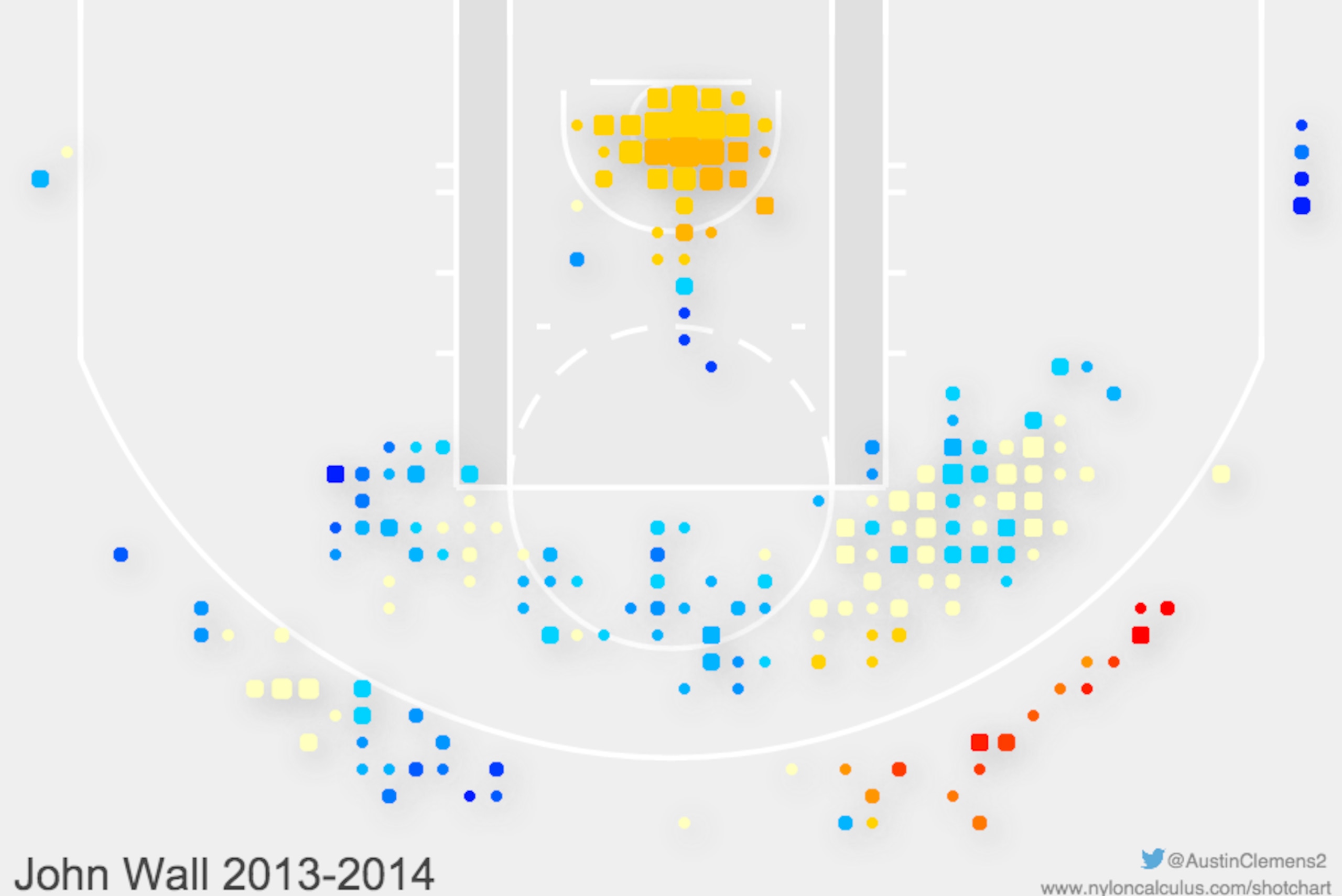
However, it's worth noting Wall continued to gain comfort from the right elbow and surrounding areas, which emerged as a trend two seasons ago.
And beyond the arc, Wall showed dramatic improvement last year. After shooting triples at a sub-30.0 percent clip during each of his first three seasons, Wall finally broke through—particularly from the right wing—and knocked down 35.1 percent of his attempts.
But the real trick will be mastering those shots between 16 feet and the three-point line. Each of the past two seasons, a plurality of Wall's field-goal attempts have come within that range. However, he has yet to cross the 40 percent threshold for a single season.
And yet, there are so many positives to glean from Wall's play last year.
While consistency may elude him from time to time, Wall's developed into a full-fledged two-way threat capable of wreaking havoc like few players at his position can.
Verdict

In the end, this comes down to Irving and Wall. And that's really not a knock on Lillard, because Irving and Wall have one- and two-year head starts on him, respectively. For Lillard to have entered the discussion after just two seasons is a remarkable achievement in its own right.
Ultimately, though, this is a matter of identifying the most complete product. And in that vein, Wall's evolution into a multidimensional weapon is worthy of effusive praise.
With a jump shot that's improving steadily and the burst necessary to torture defenses as a finisher or facilitator, it's hard not to marvel at his ceiling.
There's also the matter of Wall's defensive aptitude, which has proved to be higher than the competition's to date.
As for Irving, his sensational arsenal of offensive weaponry can't be ignored. That said, we haven't seen enough from him as a defender to justify ranking him ahead of Wall. At least not yet.
Extended time spent with LeBron figures to work wonders on Irving's two-way maturation, but every projection regarding his development comes laced with that qualifier at this stage in the game.
Irving may wind up being the superior two-way player down the line (remember, he's just 22), but Wall's tangible impact on Washington's ascent up the Eastern Conference ranks has been too special to ignore.

.jpg?w=2560 "2 NFL Officials Suspended")

.jpg?w=2560 "Injury-stricken Seahawks signing veteran RB")
.jpg?w=2560 "Mahomes' Wife Trolls Kubiak 💀")