

The NBA's Lost Souls: Which Players Have Outdated Games for Today's League?
Stylistically, the NBA is constantly in motion.
Although there are always outliers on both ends, the bulk of the herd generally moves as one, rapidly making new innovations the norm. Riding on this rollicking sea are players with games much more static than the landscape around them. With each change, someone is left behind.
These players are often still respected and productive. Many are even stars.
TOP NEWS
Luka 50 Piece in Win 🔥

Embiid Out vs. Pistons

Power Ranking Every NBA Team's Starting Lineup 🔢
But some particular aspect of their skill set creates an incongruity with the league around them. Building a successful team is about integration, and the time-warp uniqueness of how these players approach the game of basketball often makes them incredibly difficult to wrap a successful roster around.
These are the NBA's lost souls:
Greg Monroe
In today's NBA, the responsibilities of big men have become increasingly specific.
They are floor spacers. They are rim protectors. They are dynamic scorers in the post or as the screener in a pick-and-roll. Occasionally, a team gets lucky and finds someone in whom those skills overlap. But almost every big man who plays regular minutes in this era contributes in one of those ways.
Greg Monroe is none of those things. His average shot distance was 5.0 feet last season, and he made just 27.2 percent of the 335 jump shots he took.
He ranked 115th out of 170 qualified players in Seth Partnow's per-minute rim protection statistics, saving -0.83 fewer points per 36 minutes than an average big man.
As for dynamic scoring, Monroe was the 104th most efficient post scorer in the league last season, 107th as the screener in the pick-and-roll, according to mySynergySports. You can see from Monroe's shot chart just how limited his offensive area of activity is:
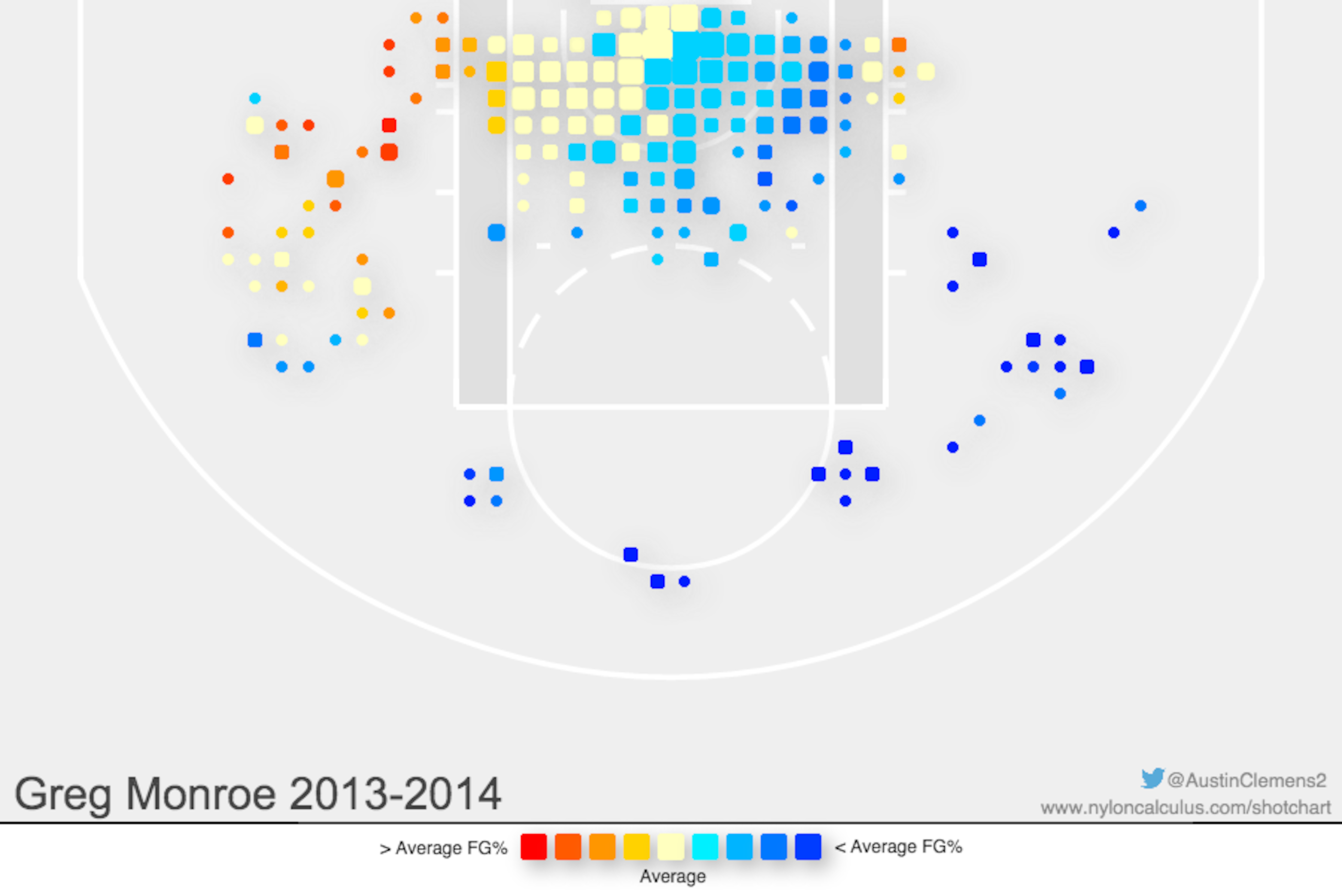
There is probably more offensive potential in Monroe's game than is shown in that shot chart. He undoubtedly suffered from the systemic spacing problems in Detroit last season, specifically when he shared the floor with Andre Drummond and Josh Smith. But ultimately, the things he does well—score moderately efficiently in the post, rebound, pass the ball—provide more value in a vacuum than they do when he's actually surrounded by four teammates.
Earlier this summer, Zach Lowe wrote at Grantland about Monroe and the difficulty of effectively fitting his skills into a team context:
"Monroe is a tricky player around which to build. An ideal roster would surround him with at least one big man who can both shoot from range and protect the basket, and there are maybe a half-dozen guys who can do both of those things at an elite level. They are expensive and very hard to get.
Monroe also needs the ball to maximize the things he does well. He is like a younger and lesser Al Jefferson — not as good a post player, and not quite as bulky and physical battling opposing centers down low.
"
In many ways today's NBA teams are built around spacing, shooting and a hyper-efficient offensive engine. The nature of Monroe's skills—playing in the post or passing from the elbows—means he has more to offer as an offensive engine than as a complementary player. But he's not quite efficient enough at this point to reasonably function as the engine of an elite, or even good offense.
Monroe is a skilled big man. For many years, that alone would have qualified him as an invaluable NBA asset. But times have changed, and now it is a very specific mix of skills that guides values for an NBA big, skills that Monroe just doesn't have.
Over the past few seasons, NBA offenses have slowly gravitated, with increasing intensity, towards the paint and the three-point line. As awareness grows about the generalized inefficiency of mid-range jump shots, teams have worked to make them a smaller and smaller portion of their shot distributions.
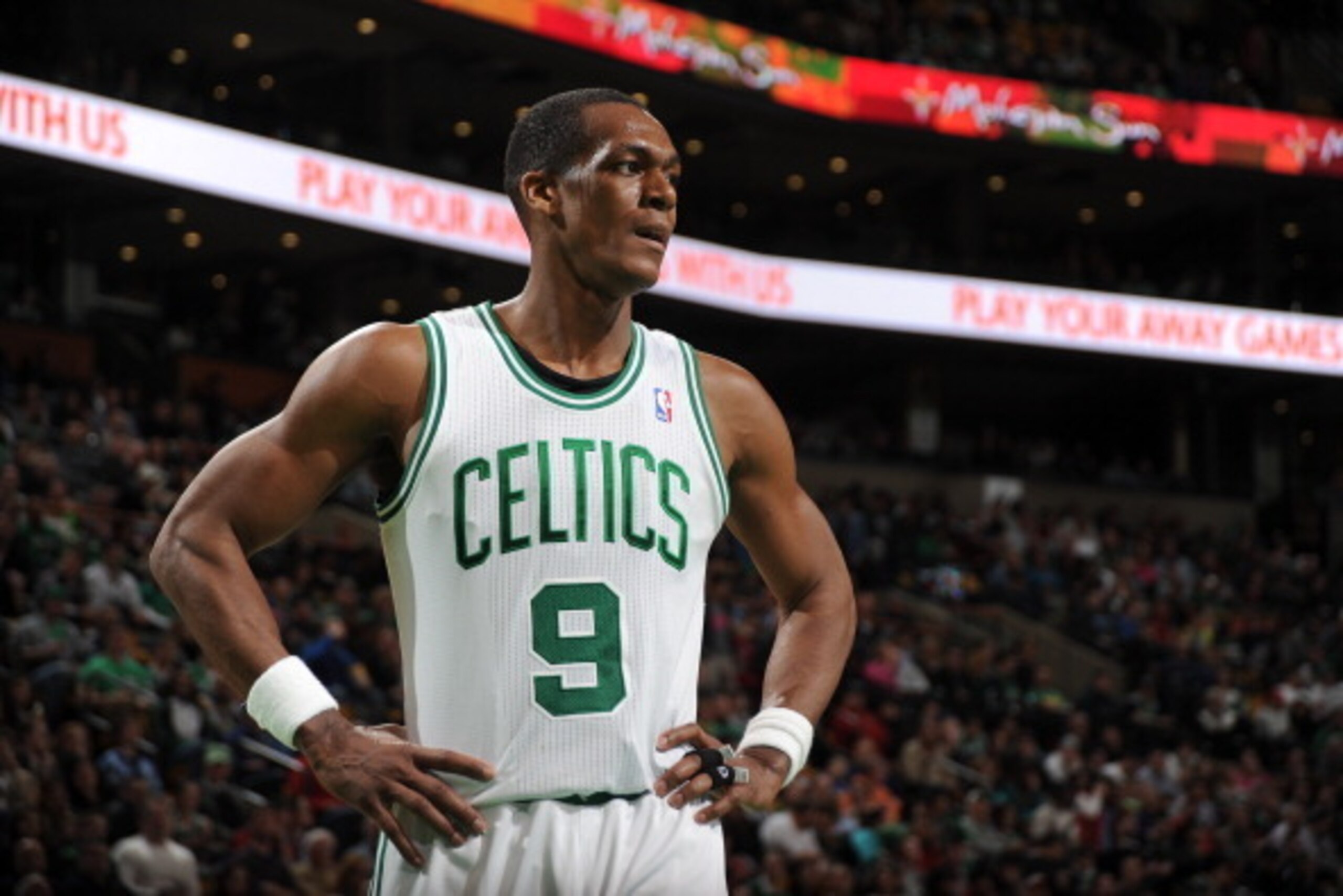
In that regard, Rajon Rondo generally fits. Last season, 80 percent of his total shot attempts came from inside the paint or behind the three-point line. However, his efficiency was abysmal from both areas. Rondo made 44.4 percent of his shots in the paint, about 10 percentage points below the league average. He made just 28.9 percent of his three-pointers, compared to a league average of 36.2 percent.
Rondo has always had a reputation as a poor shooter, but his performance has changed over time. While three-pointers have never been his specialty, he has gradually become much less effective at the rim and more effective in the mid-range.
The fact that his shooting efficiency is trending in the opposite direction of the rest of the league is not the only thing that sets him apart.
By True Usage, a metric that incorporates assists and passing into traditional Usage Rate, Rondo was the second-most involved player last season, trailing only Russell Westbrook.
Of the 13 players with a True Usage Rate above 48.0 percent last season, no one derived a smaller portion of their offensive involvement from shots, turnovers and trips to the free throw line—just 20.6 percent of Rondo's touches resulted in one of those three scenarios.
In the not too distant past, it was common for teams to employ a "floor general" at point guard. This was someone whose major offensive contributions would be in organizing their teammates and initiating their offense. However, it has become increasingly rare to see a point guard so limited in their focus these days.
The league has zigged and Rondo has zagged.
Those skills are still important, but teams also need you to be at least a small threat from the perimeter or able to get some offense for yourself at the basket. It is harder and harder to be successful in today's NBA with a single skill backcourt player if that single skill isn't defending or shooting. Rondo exists in-between, paying homage to Eric Snow, Rod Strickland, Norm Nixon and Mark Jackson—the pass first, second and third point guards.
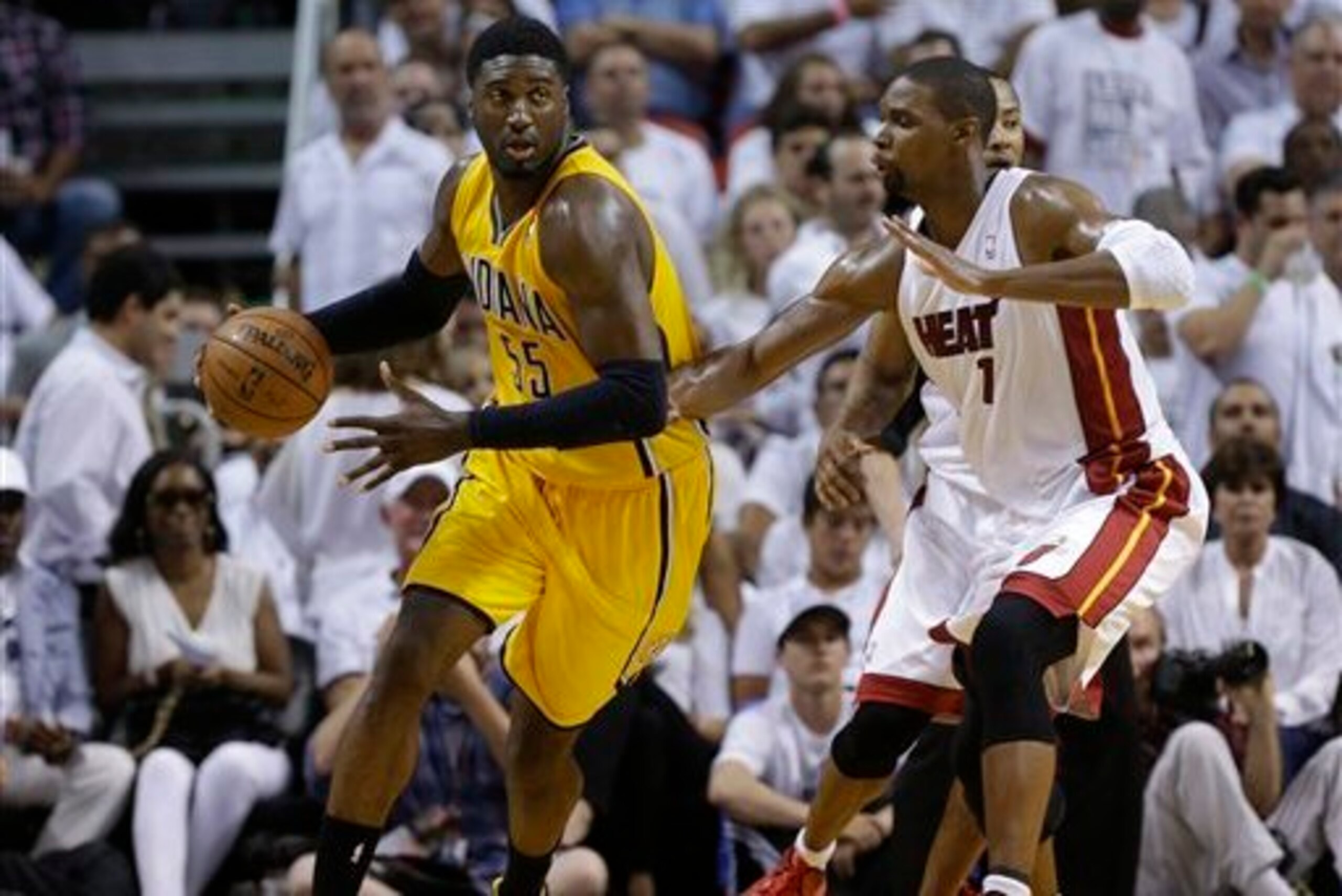
Hibbert does exactly one thing at an elite level—protect the rim. By Seth Partnow's rim protection statistics, he was by far the most effective rim defender in the league last season. Hibbert's presence has helped elevate the Indiana Pacers' defense to enormous heights, and for much of last year they were on a potentially historic track.
His value as a defender is unquestioned, but that value comes at a significant cost at the offensive end.
There was a time when defense-first centers were the norm.
If you couldn't find a center who scored in the post, you found one who stopped them. Ervin Johnson, Theo Ratliff, Greg Ostertag and Marcus Camby all played on elite teams who made deep playoff runs. They blocked shots and controlled the paint, offering almost nothing at the other end but the ability to dunk a ball that found its way into their hands.
The sophistication of both offenses and defenses has grown over the past two decades and spacing has become the absolute currency of offensive efficiency. In that regard, Hibbert's inability to do anything away from the basket makes him a dinosaur from another era.
Hibbert's average shot distance was 8.0 feet last season, more a function of his inability to get deep post position than any sort of offensive preference. He's laughably non-threatening from the mid-range and provides next to nothing in the pick-and-roll. Whenever he finds himself on the court, he's usually not a threat to score while simultaneously dragging an extra defender closer to the basket.
If spacing is the currency for NBA offenses, then Hibbert is consistently draining the Pacers' bank account.
There are other defense-only centers in the NBA, but none who play as often as Hibbert have such an unbalanced resume of skills. In many ways, he'd probably be a better fit for the 2000 Pacers' than for the current iteration.
Rudy Gay
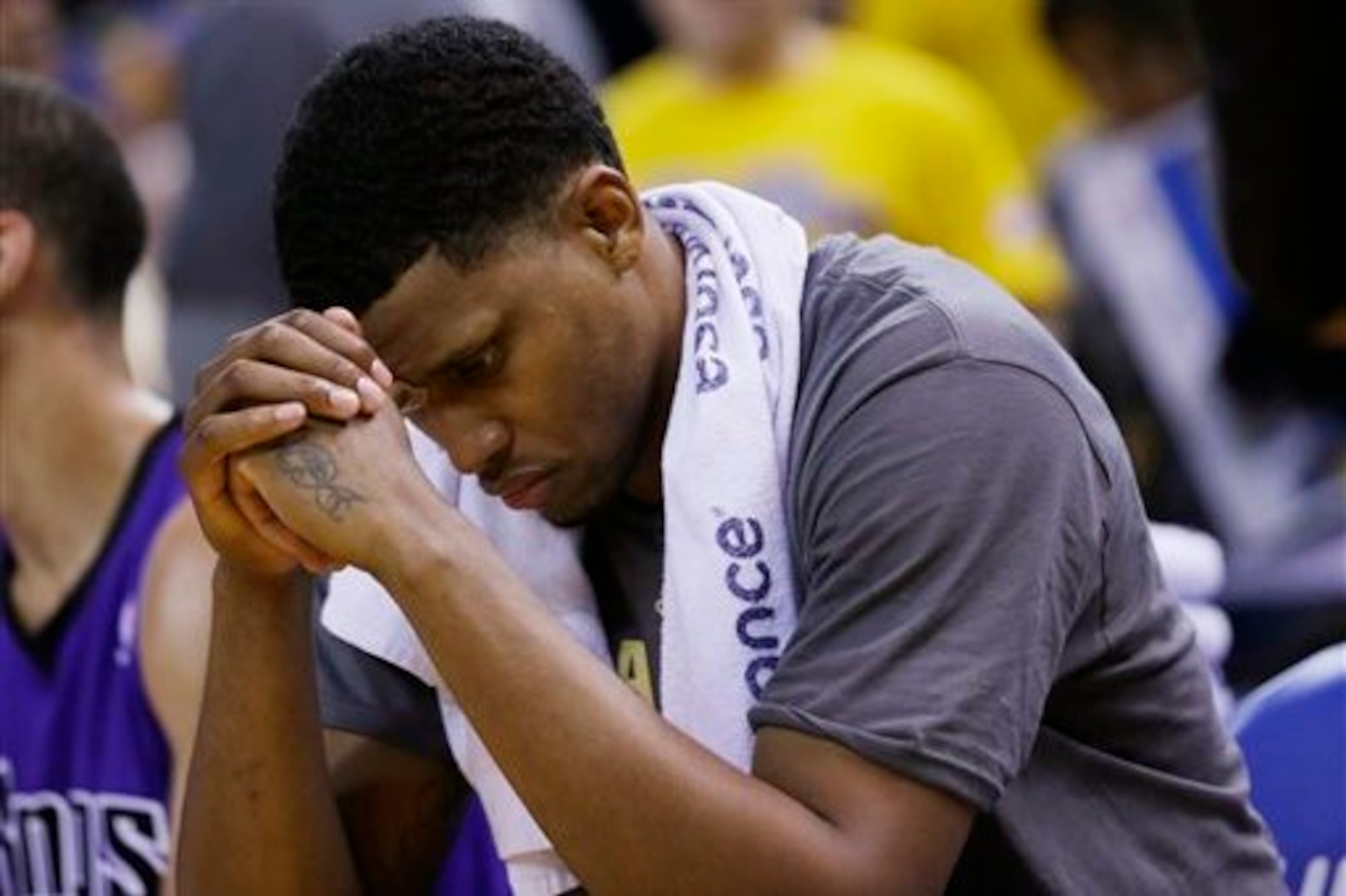
The NBA has a rich legacy of scorers, and those on the wing hold a special place in our memories.
The advantage of someone like Kareem Abdul-Jabbar, Shaquille O'Neal or Wilt Chamberlain was obvious. But watching a great wing scorer is to be treated to a feast of athleticism, skill, strength, shooting, versatility and adaptability. There is something unique in the way that watching a great scorer operate 20 feet from the basket captures our imagination.
Rudy Gay looks the part of a great wing scorer. He has the physique and physical tools, he has the moves, the style and the aesthetic. What he doesn't have is efficiency.
Over the past two seasons it has become widely acknowledged, and proven in practice, that Gay is not the kind of elite offensive player a good team can build around. As close a copy as he appears to be of players like Carmelo Anthony and Tracy McGrady, his efficiency is far enough off the mark that asking him to carry an offense is a recipe for mediocrity.
In the late-1990s and early-2000s that may not have been the case. In that era, physical defenses were allowed to operate with much greater impunity, and a slog ensued at the offensive end. The margin between what an offense could create collaboratively and what a single potent scorer could create on his own was much smaller.
Changes to the hand-checking rules, the skill sets of big men and an understanding of spacing and shot value have flipped that equation on its head. Defenses have become more sophisticated, but they are more prone to destructive distortion by precise execution. Now an isolation for all but the three or four most efficient players in the league is seen almost invariably as a losing proposition.
As the league has changed, Gay's value has plummeted.
Working alone on the elbow in a one-on-one isolation now often undermines team success in ways that we understand more and more deeply. He can still do it, he can score and make a defender look silly in the process. But not nearly often enough for this day and age.
As the game changes, so too does the emphasis and value placed on certain skills. These players—Monroe, Rondo, Hibbert, Gay—all have contributions to make on the basketball court. It just so happens that the ones the do have are not the ones teams are looking for right now.
Statistical support for this story from NBA.com/stats

.jpg?w=2560 "Rodgers Iced Out on Plane 💎")
.jpg?w=2560 "Raiders Could Start Mendoza")
.jpg?w=2560 "Mahomes Told Teammate to Leave Meeting")
.jpg?w=2560 "🚨 Week 8 AP Top 25 Poll")


.jpg?w=2560 "Lamar Being Out Shocked Ravens")
.jpg?w=2560 "Lions Outlast Packers")