

San Francisco 49ers: How to Stop Brandon Marshall and Alshon Jeffery
The last time the San Francisco 49ers took on the Chicago Bears, in 2012, the Bears were a very different team. Jay Cutler missed the game after suffering a concussion the week before, leaving Jason Campbell starting in his place. Alshon Jeffery was a reserve receiver behind Devin Hester. The head coach was Lovie Smith, who has since been sent off to Tampa Bay.
What the Bears did still have, of course, was Brandon Marshall, and therein lies the key to shutting the Bears down. With Marshall and Jeffery, the Bears have a pair of 6’4” receivers, each one of the top receivers in the league in his own right. Together, they form one of the toughest receiving duos in the league.

.jpg?w=2560 "Steelers Saints Football")
.jpg?w=2560 "Rams Raiders Football")
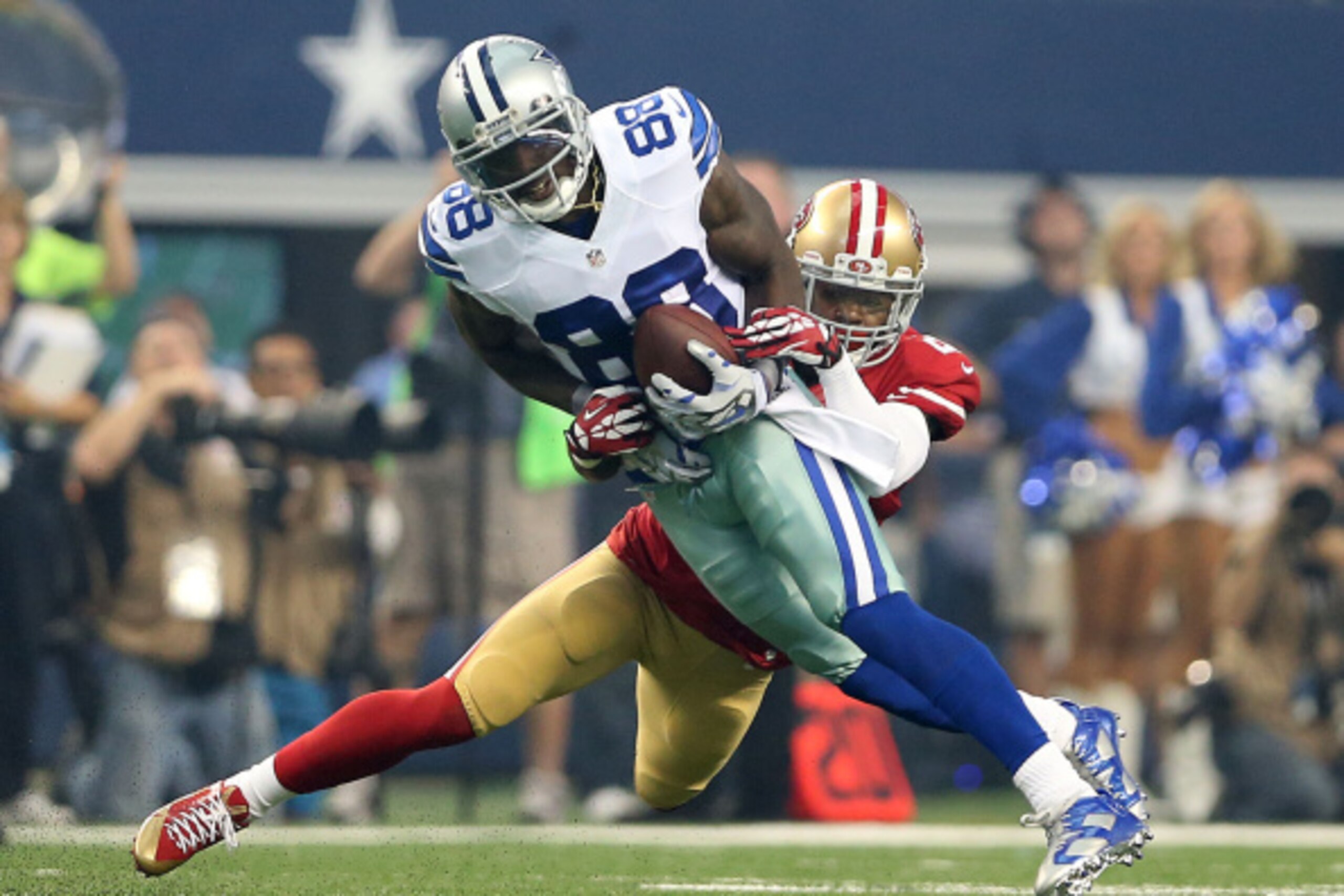
The 49ers’ defensive backs don’t measure up—literally. Tramaine Brock is 5’10”, Chris Culliver is 6’0” and Jimmie Ward is 5’11”. The tallest members of the secondary are reserve strong safety Craig Dahl and rookie depth cornerback Dontae Johnson, and they’re only 6’2”. Marshall and Jeffery tower over anyone the 49ers can possibly throw at them.
That didn’t hurt San Francisco in the game two years ago, but that was mostly due to a ferocious pass rush. Aldon Smith alone brought Jason Campbell down five-and-a-half times. It’s probably fair to assume, after the 49ers only got three sacks against Dallas, that they won’t be doing the same this year.
When Campbell was upright enough to target Marshall or Jeffery, he had fairly solid results. According to Pro Football Focus (subscription required), Jeffery and Marshall were targeted eight times and had four catches for 36 yards and a touchdown. Considering Marshall alone averaged nearly 95 yards a game that year, that’s pretty good, though some of that can be attributed to the lower-quality quarterback play.
All in all, however, the 49ers have had a mixed bag of success against the elite tall receivers in the league. In 2012 and 2013, the 49ers had 15 games against the following receivers:
- Jordy Nelson (6’3”)
- Calvin Johnson (6’5”)
- Roddy White (6’1”)
- Brandon Marshall (6’4”)
- Marques Colston (6’4”)
- Andre Johnson (6’3”)
- Larry Fitzgerald (6’3”)
The end results? The 49ers have allowed completions on 64.6 percent of passes thrown toward these elite, tall receivers, resulting in 1,125 yards and six touchdowns.
Comparing that to each receivers per-game average in the seasons in question, we find the 49ers have given up 49.3 yards more than expected or about 3.3 yards extra per game. It’s not consistent, though—sometimes, the 49ers have shut players down, and sometimes they’ve let them soar:
| Brandon Marshall | 2012 | 11 | 4 | 2 | 21 | 1 | -73.3 |
| Marques Colston | 2012 | 12 | 5 | 4 | 36 | 1 | -36.1 |
| Larry Fitzgerald | 2012 | 17 | 5 | 2 | 13 | 0 | -36.9 |
| Andre Johnson | 2013 | 5 | 10 | 3 | 39 | 0 | -43.7 |
| Jordy Nelson | 2013 | 1 | 10 | 7 | 130 | 1 | +49.9 |
| Larry Fitzgerald | 2013 | 6 | 11 | 6 | 117 | 1 | +57.4 |
| Roddy White | 2013 | 16 | 15 | 12 | 141 | 1 | +86.3 |
| Larry Fitzgerald | 2013 | 17 | 10 | 6 | 113 | 0 | +53.4 |
You’ll note that the four worst games all came in 2013. The 49ers allowed about 29 more yards per game than expected to tall receivers last season, while 2012 saw them hold receivers about 19 yards less than expected.
The 49ers were worse in general in pass defense last year; Carlos Rogers fell off a cliff, and Tarell Brown regressed notably as well. Both those players have something else in common: Neither are on the team anymore.
When Larry Fitzgerald went off against San Francisco in Week 17 last season, Rogers was most responsible for it. According to Pro Football Focus (subscription required), Fitzgerald caught five of six passes with Rogers in coverage. The rest of the team combined allowed him one reception on five targets.
Rogers and Brown allowed five of Roddy White’s 12 receptions the week before, per PFF, Rogers was the victim against Fitzgerald back in Week 6 and it was the also-departed Nnamdi Asomugha who was victimized by Jordy Nelson back in the opener.
There’s certainly no guarantee that Brock or Culliver will do better, but they don’t have a very high bar to clear.
We can get some idea as to how the 49ers will try to handle Marshall and Jeffery by looking at how they covered Dez Bryant on Sunday. While Bryant isn’t as tall as either player, he’s still a decent test case to see the 49ers’ strategy.

The 49ers were stuck without either starting cornerback for huge stretches of Sunday’s game, as both Brock and Culliver left in the first half with injuries. Brock has a sprained toe, while Culliver suffered from a concussion. That left Perrish Cox and rookie Dontae Johnson with the job of covering Bryant—and they did a decent job.
Bryant only caught four passes in the game for 55 yards, catching one pass each against Brock, Johnson, Jimmie Ward and Ray McDonald. It was the coverage by Eric Reid, however, that resulted in two interceptions.
Taking a look at the first interception—the one actually brought down by Reid—we can see the general strategy the 49ers had: swarming Bryant with as many players as possible.
The 49ers dropped both middle linebackers into coverage and had safety help over the top. Reid, operating as the cornerback in this case, played under Bryant, while Antoine Bethea was there over the top, to lay a crushing blow on Bryant had he actually come down with the ball.
It was a similar story on Perrish Cox’s interception—Bryant found himself sandwiched between a cornerback and a safety, bracketed and unable to use his speed and jumping ability to get an advantage. The fact that the pass is not perfectly thrown hurts, but if Bryant’s not bracketed, he can adjust and make that catch; he’s done it before.

Now, this strategy of constant double coverage does bring with it some drawbacks. Obviously, it’s harder to commit that many players to covering both Marshall and Jeffery, and if they did, that would just leave Josh Morgan and Martellus Bennett with favorable matchups.
In addition, I have a sneaking suspicion, watching the tape, that that explains some of DeMarco Murray’s big day.
When the 49ers got out to a 21-3 lead, the competitive part of the game was essentially over. Combine that with the loss of both starting corners and the 49ers decided to devote nearly all their resources to stop big pass plays, as that was the only way Dallas could really get back into it.
They were sort of fine with Dallas eating up chunks of yardage on the ground, draining the clock. If they do the same against the Bears, you’ll see Matt Forte rush for 150 yards—and they can’t always count on so many turnovers in the opening quarter.
Honestly, however, what might be the biggest factor in shutting Marshall and Jeffery down isn’t in the secondary; it’s in the pass rush. Jay Cutler got an overall Pro Football Focus grade of plus-13.4 last season, but he struggled under pressure. Under any kind of pressure, his grade dropped to minus-4.4. Get pressure to Cutler and his receivers don’t have time to get into position to make great athletic plays.
If the 49ers can semi-consistently get to Cutler in 2.5 seconds or less, the threat of Marshall and Jeffery will plummet. That’ll be hard with Aldon Smith sidelined, but the 49ers have enough remaining talent to generate a pass rush.
One final note for thought: The 49ers are 14-1 in the 15 games they’ve played against those taller elite receivers listed earlier, with only last year’s loss to the New Orleans Saints blemishing their record.
Whether they’ve held receivers to tiny gains or saw them run wild, they’ve done enough to come out on top nearly every time. While the Bears offer a double threat at receiver, the 49ers have had success in similar situations in the past.
Bryan Knowles is a featured columnist for Bleacher Report, covering the San Francisco 49ers. Follow him @BryKno on Twitter.
.jpg?w=2560 "Chiefs Giants Football")

.jpg?w=2560 "🚨 Week 8 AP Top 25 Poll")

.jpg?w=2560 "Lamar Being Out Shocked Ravens")
.jpg?w=2560 "Packers Safety Slams Refs 🤬")