Denver Broncos Film Study: Breaking Down Their Running Backs in Week 1
The Denver Broncos won the season-opening game on Sunday night against the Indianapolis Colts. In the game, the Broncos offense dominated through the air in the first half. With a 24-7 lead at halftime, the Broncos decided to turn the ball over to the ground game in an effort to hold strongly on to the lead.
That lead slipped away from the Broncos, and starting running back Montee Ball struggled to make much of an impact. For the game, Ball finished with 23 carries for 67 yards and one rushing touchdown. That’s good for a paltry average of 2.9 yards per carry.


.jpg?w=2560 "Commanders Eagles Football")
The Broncos second back, C.J. Anderson, looked fantastic on only four carries. He rushed for 27 yards against the Colts—an average of 6.8 yards per carry. That’s almost four yards more per carry than what Ball averaged on the night.
So what went wrong? The Broncos have been talking about having a more balanced offense all offseason. Why did Ball struggle with running the rock?
Let’s take a look into what went wrong with the ground game in Week 1—and how the Broncos can fix any problems.
Montee Ball

The second-year runner enters 2014 as the Broncos' lead back. The team allowed last year’s starter, Knowshon Moreno, to move on in free agency to the Miami Dolphins. On a day that Ball averaged 2.9 yards per carry and rushed for fewer than 70 yards, Moreno (a backup in Miami) rushed 24 times for 134 yards and one rushing touchdown. Broncos fans have certainly taken note of this difference.
Ball’s rookie season started off slowly. He had a chance to win the starting job out of training camp in 2013, but he failed to do so. Fumbling and pass-protection problems caused him to play as the third-string back behind Moreno and Ronnie Hillman for about the first half of the season.
He turned things around eventually, and Ball was one of the most effective backs over the final six games of the 2013 season. During that time, Ball rushed for an average of 6.5 yards per carry—second in the league behind Jamaal Charles (6.6). Ball was also the No. 1 back in the NFL in terms of rushes that went for a first down (40 percent).
The team was hoping that momentum could carry over to this year, but an unexpected appendectomy forced Ball to miss the first two preseason games and most of training camp.
Ball did get a handful of reps in the team’s Week 3 preseason game against the Houston Texans. The team monitored him closely as he came back from the noninvasive procedure.
It was clear in Week 1 that Ball has some rust to shake off. He did not look like the same player he did at the end of last year.
Here we see Ball’s best run of the night against the Colts. Tight end Virgil Green first motions to the left side of the formation. At the snap, Green goes back to the right side to help lead the way for Ball on the edge. Ball does a good job of pressing the edge and breaks off a 15-yard gain.

This play went for a two-yard gain. As Ball gets the rock in his hands, there is plenty of space to run to on the right side of the field, and Green is moving to get in front of him as a lead blocker. Ball is slow to the line of scrimmage, and once there the defense is on top of him. He tries to juke the oncoming defender, loses all momentum and gets tackled, falling forward for only a couple of yards.
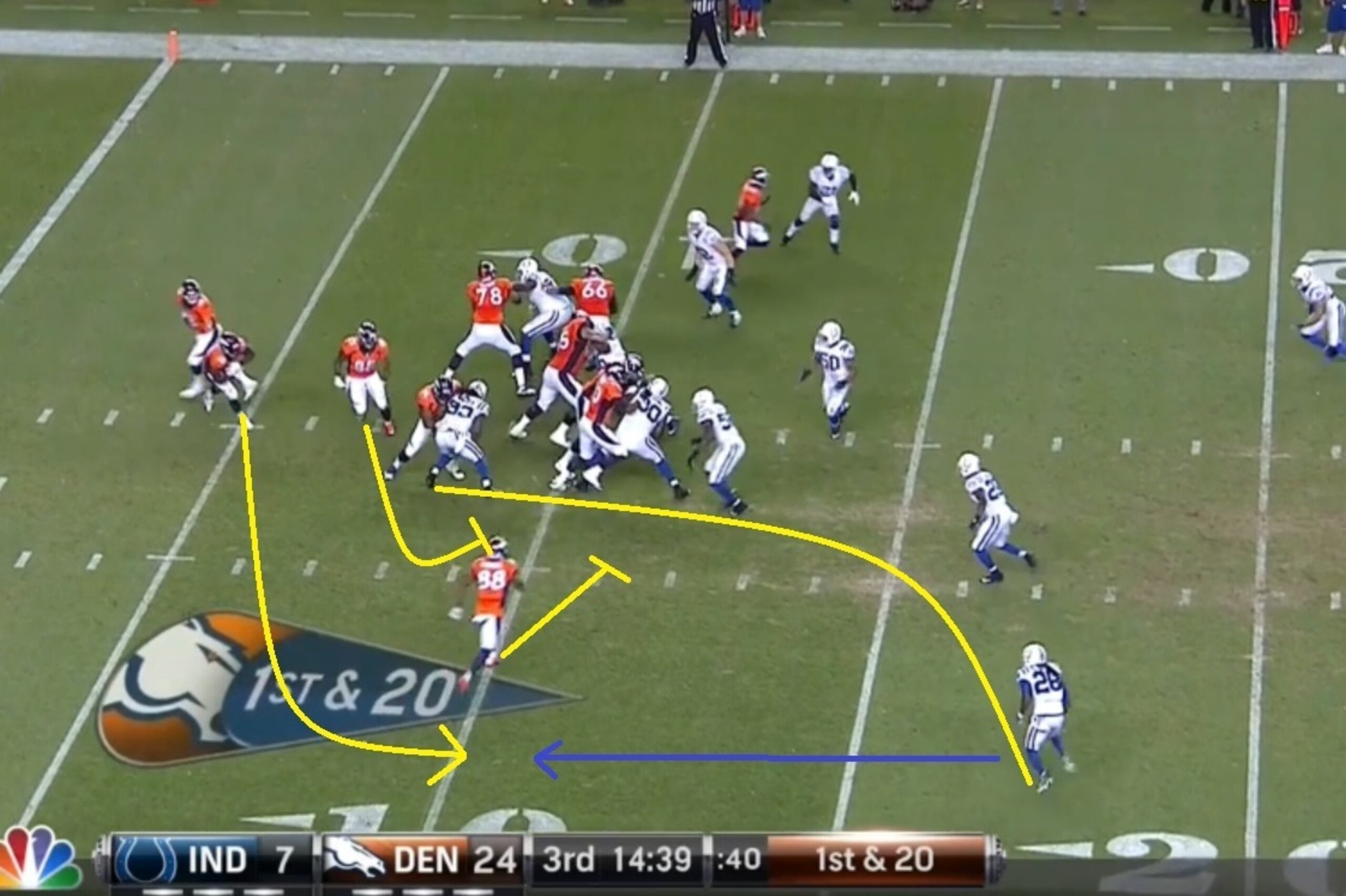

This play went for no gain. Defensive end Bjoern Werner goes unblocked right down the line of scrimmage to tackle Ball before he can gain any yards. Ball’s timing seemed off when he received the handoff, and that could have led to him getting to the point of attack slower than anticipated.

This is another play that went for no gain. Cornerback Vontae Davis is initially blocked—for just a second—by wide receiver Demaryius Thomas. As you can see, Thomas moves on quickly to another player downfield. This frees up Davis to make the open-field tackle cleanly.

C.J. Anderson
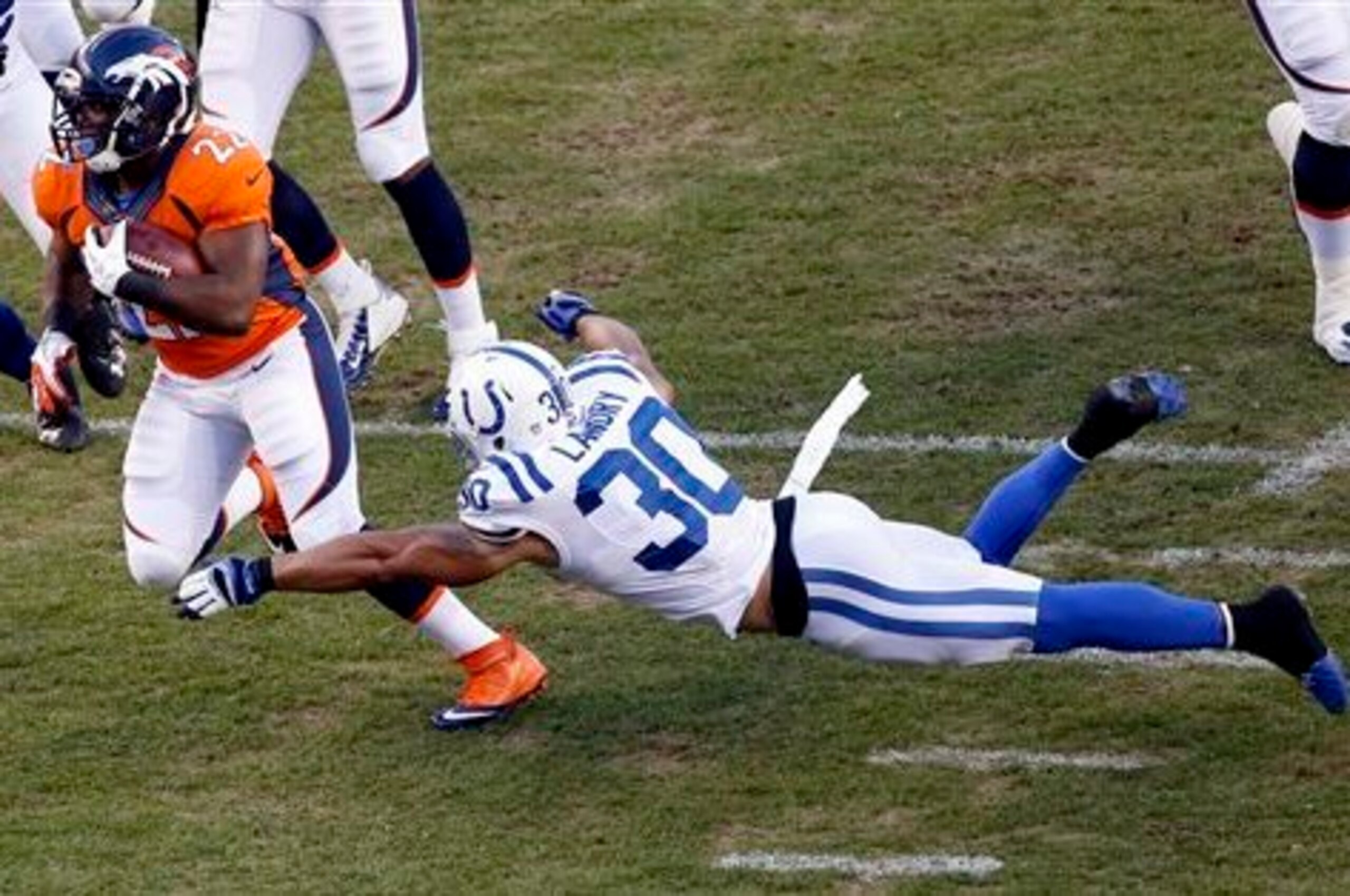
Like Ball, Anderson enters his second year in the league with the Broncos. Unlike Ball—a second-round pick in 2013—Anderson came into the league as an undrafted free agent out of the University of California. He worked as a reserve runner for the Broncos last year, and he begins this year in a similar—but a bit larger—role.
Anderson has a powerful lower body and arguably has the fastest 10-yard split of any back on the roster. In addition to running with power and getting to top speed in a hurry, Anderson uses the jump cut effectively to make defenders miss in cramped spaces.
In the game against the Colts, Anderson looked really good in limited duty.
Here’s Anderson’s biggest run of the night. The play begins with Peyton Manning and Anderson lined up next to each other in the shotgun. Manning holds the ball like he’s going to pass it after catching the snap. This move holds the two linebackers highlighted so they don’t immediately sniff out the run.

Once Anderson gets the ball, there are clearly two rushing lanes for him to choose from. Notice how the linebackers have now moved up to make a play.

This next picture shows an incredibly subtle but oh-so-effective move that Anderson uses to create his own space. Anderson shows a dead leg to the left, holding the defensive tackle, linebackers and free safety that are peeking into the backfield.

This picture shows the end-zone view of the same dead-leg move by Anderson. You can clearly see that defensive tackle Arthur Jones and safety LaRon Landry bite/hesitate just a little when Anderson breaks off that move.

Once at the second level of the defense, Anderson then spots a crease to run to the outside. His burst and dead-leg move have already helped him beat Landry to the point of the play. Anderson now stares at his two wide receivers who are engaging in run-blocking downfield.

In this picture, we see how quickly Anderson was able to get to the first-down line. He’ll split the two defenders to pick up an extra three yards at the end of his run.
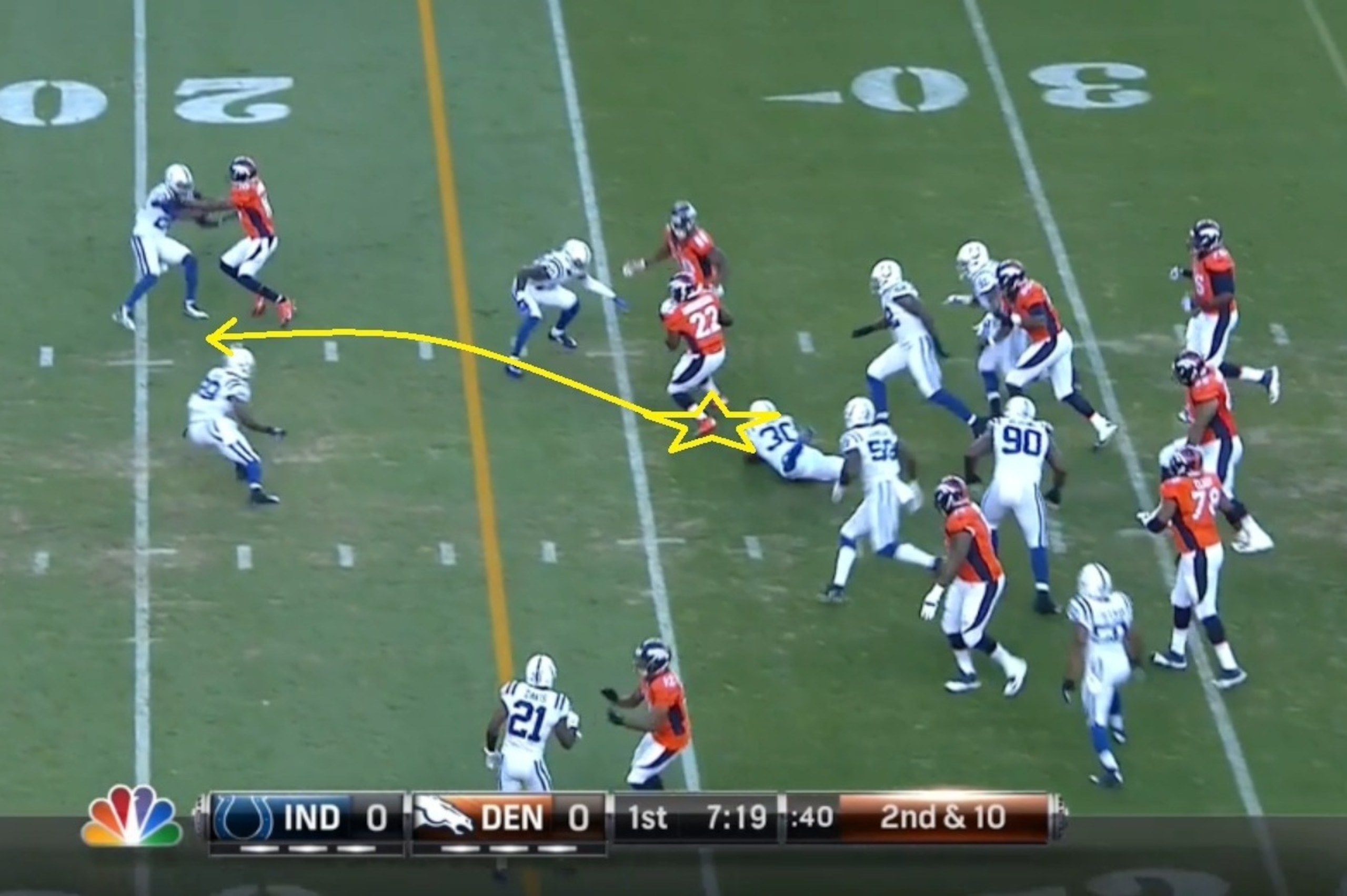
This play is a run up the gut that Anderson pushed ahead for a nine-yard gain. Manning does no ball fake this time around, and he instead gives the ball immediately to Anderson after gathering in the snap. Notice how right guard Louis Vasquez has pulled to the left and is ready to engage at least one Colts defender.

This picture shows that Anderson gets to—and through—the hole quickly. Vasquez has effectively taken out two defenders with one block and with Anderson’s burst to get by him quickly.

Line Blocking
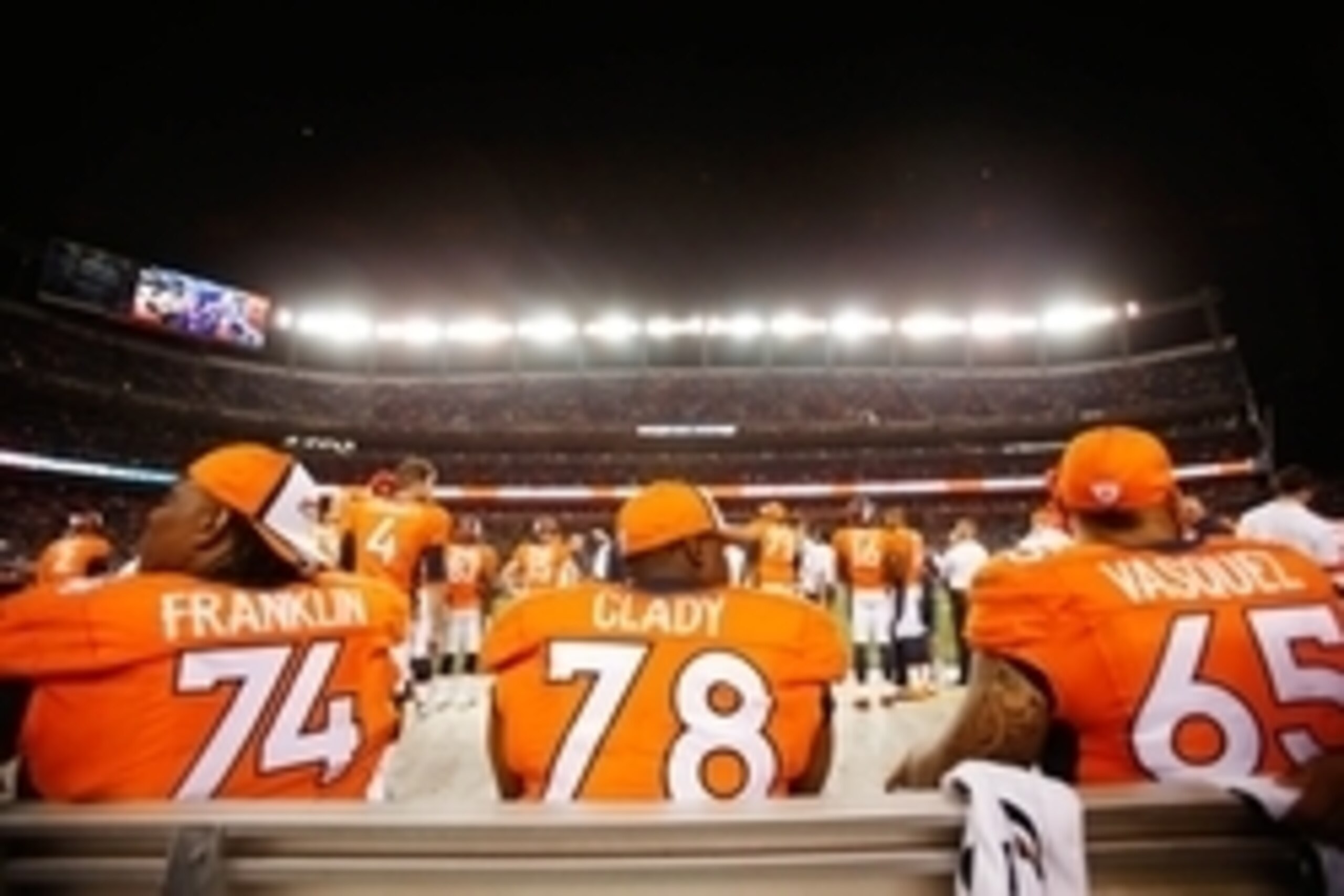
The offensive line was upgraded this offseason with only one player lost in free agency. The Broncos decided to let last year’s starting left guard, Zane Beadles, move on to the Jacksonville Jaguars. To take his spot, the team moved last year’s starting right tackle, Orlando Franklin, inside to left guard.
Franklin is a road-grader as a run-blocker, and guard seems to be a better fit for him. However, in the game against the Colts, he struggled to be a sticky blocker at the second level of the defense. Franklin needs his opponent right in front of him to dominate. The Broncos want a little more interior movement from their guards, so Franklin needs to clean up this part of his game.
Vasquez is nearly perfect at right guard. As seen on the play above, Vasquez can pull into space with ease to take out defenders. He’s got the strength to push defenders out of his way, and Vasquez plays with a necessary mean streak for the position.
Center Manny Ramirez has a powerful base and can control his opponent at the point of the play. He has historically struggled with more athletic interior defensive linemen, but Ramirez has brute strength and will rarely get pushed off his spot up front.
Right tackle is now occupied by Chris Clark. He started 14 regular-season games last year at left tackle, but he’s a better fit on the right side. Clark can struggle to handle elite edge-rushers, and on the right side he’ll see fewer of those elite-level players. In the game against the Colts, Clark did have a couple of plays where he didn’t block his man long enough. He’s never going to be a guy that blots out his opponent, but Clark’s a good athlete and has functional strength.
Left tackle Ryan Clady is healthy and back in the starting lineup. He missed most of last year after a Lisfranc injury knocked him out in Week 2. The All-Pro is one of the best pass-blockers in the league, and he’s technically sound as a run-blocker. In the game against the Colts, Clady did a good job of helping out Franklin against tougher opponents. Clady also handled his own man in one-on-one situations.
"Studying #Broncos Montee Ball's Week 1 performance vs #Colts -- runs stopped for no gain/little gain seem to be caused by timing issues.
— Cecil Lammey (@cecillammey) September 10, 2014"
The Broncos need to show better timing when Ball is running the rock. Ball himself needs to get to and through the hole more quickly. The offensive line needs to understand that Ball runs with a different rhythm than Anderson does.
This chemistry and timing will come with time. The time that Ball missed in training camp and the preseason certainly showed through in Week 1. One would have to rationally expect that with more playing time this problem will clear up.
Summary
The Broncos have to get more out of their ground game if they want to make a push through the playoffs. The team is striving for more balance offensively, especially when they build a lead.
The Broncos have to be cautious when they take their foot off the gas. A 24-7 lead is one thing against Jake Locker and the Tennessee Titans, and that same lead is a totally different ballgame when facing a quarterback like Andrew Luck.
Ball is locked in as the starter, and he will get every opportunity to prove himself as the starter in 2014. Anderson is a valuable backup who has the ability to start for other teams in the league. His role could grow in 2014 if he continues to produce at a high level with limited opportunities.
The offense flows through Manning and the passing game. The running game can help control games when the Broncos get ahead. Getting a more efficient and more effective ground game could help the Broncos work as a stronger overall offense in 2014.
All quotes and injury/practice observations obtained firsthand. Record/statistical information provided via email from the Denver Broncos unless otherwise noted. Contract and salary-cap information provided by Spotrac.com. Transaction history provided by ProSportsTransactions.com.
.jpg?w=2560 "Chiefs Dolphins Football")


.jpg?w=2560 "Love's Body Already 'Tired'")