Is Elite Rim Protection or Perimeter Defense More Important in Today's NBA?
Inside or outside?
Defense is tricky business at the NBA level. It won't win teams a title on its own, but no champion has ranked outside the top 10 in points allowed per 100 possessions since the 2000-01 Los Angeles Lakers .
While its value can be overstated, it cannot be disregarded.
TOP NEWS
_0.png?w=3840)
Summer League Takeaways ✍️

LeBron's decision is impacting NBA's plans
Riley Teases Another Heat Move
Impregnable defense can be the mainstay of successful teams and seasons. Anyone who has watched the Memphis Grizzlies, Chicago Bulls or Indiana Pacers (pre-implosion) over the last few years has seen it.
But three-point shooting has changed the NBA. Talented big men used to be the be-all, end-all of defensive livelihood, but now there are players such as Stephen Curry—and teams such as the San Antonio Spurs—changing the rules.
Long-range scoring is hot property. Teams need to guard against three-pointers.
The mission: to find out whether the rise in distance shooting—and the subsequent requisite emphasis on perimeter defense—has eclipsed the time-honored virtue of rim protection.
Rim Protection

Rim protection is not obsolete.
More shots were taken at the rim—which NBA.com defines as coming within five feet of the basket—than beyond the arc.
Teams combined to shoot a total of 204,172 shots last season, per NBA.com. Exactly 71,701 of those attempts came within five feet of the basket, while 52,974 were three-pointers.
Shots at the rim, then, outnumbered long balls nearly 1.3 to one, accounting for more than 35 percent of all field-goal attempts.
Simply put: Protecting the rim is still vital to success. It's also about more than just blocking shots.
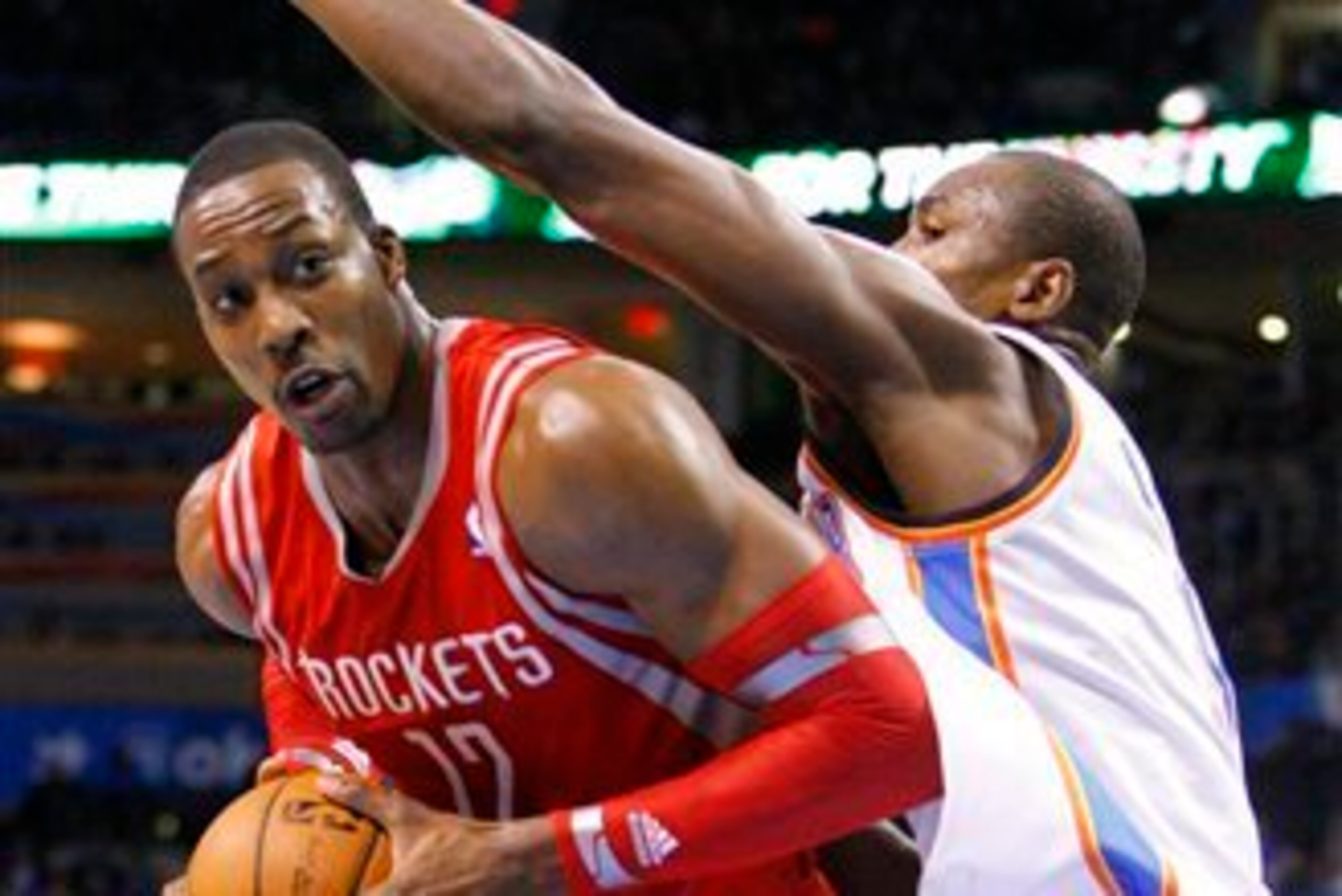
Having Serge Ibaka, Dwight Howard or DeAndre Jordan on the court helps, but shots at the rim don't need to be rejected or swatted into the stands, JaVale-McGee-on-a-sugar-high style.
They need to be contested; ball-handlers must be hassled.
Anything or anyone that forces the shot-taker to adjust his attempt can be considered rim protection, hence the importance of looking beyond just blocks. A team devoid of any true shot-blocking fiend—like the Toronto Raptors, who ranked eighth in opponent field-goal percentage within five feet last year—can still guard against point-blank opportunities.
How important is such prevention in the scheme of defensive performance?
In a word: Very.
Eight of the top 10 defensive teams for the 2013-14 season also ranked in the top 10 for rim protection. Comparatively, six of the bottom 10 teams finished within the bottom 10 of rim protection.
This is not just some massive aberration. There's clearly a correlation here for last season. One-year patterns are the bane of foresight.
Sample sizes need to be bigger than that.
Below, you'll see the number of top-10 defenses that ranked inside and outside the top 10 in rim protection, beginning with the 2009-10 campaign:
With the exception of one year (2010-11), the number of top-10 defenses that also ranked in the top 10 of opponent field-goal percentage at the rim wins out.
And with the exception of two years (2010-11, 2012-13), they represent at least 70 percent of the league's best overall defenses.
When combining the five years of data, our ratio climbs slightly higher:
This is a staggering disparity considering our narrow focus. Thirty-six—or 72 percent—of the most recent top-10 defenses have also finished in the top 10 of rim protection. That's insane.
And telling.
Three-Point Defense

We're not trying to discount the importance of rim protection. It's important at a time when three-point shooting has become a hot on-court commodity.
Look at how the total number of three-point attempts has increased over the last five years. Note that the results from 2011-12 have been extrapolated to reflect how many three-pointers would have been attempted over the course of 82 games:
Big jumps over the last two years or so say it all. The disparity between 2009 and now is incredible.
In 2009-10, there were 44,622 threes launched. Last season's 52,974 marks an increase of 8,352 attempts, or 18.7 percent.
Mark Branch of The New York Times offered a great explanation for this sudden, yet somehow gradual, shift of mentality back in 2013:
"Teams, historically built around the center, began to turn themselves inside out behind the shooting touch of big men like Dirk Nowitzki of the Dallas Mavericks. Slowly, power forwards within a couple of inches of 7 feet began to hover near the 3-point line, pulling defenders with them.
The rise of the 'stretch 4,' as power forwards who play mostly far from the basket are called, may have propelled the proliferation of the 3-pointer more than anything. The defensive slogs of the 1990s gave way to persistent motion and more long jumpers. Defend too close, and the shooter has more room to drive past. Stay too far back, and he has room to shoot something that, in the case of Curry, he makes about 45 percent of the time.
"
Noticeable jumps and all, it's still easy to overlook the supreme importance of three-point defense. How pivotal can it be when there are still more shots—tens of thousands—being taken elsewhere?
One needn't look any further than last season.
As we know, shots at the rim came in higher volume for 2013-14. The difference between point-blank attempts and three-point shots stood at 18,727, a huge number by itself. Yet consider the value differential in each shot.
Attempting 71,701 shots at the rim—assuming there are no and-1 opportunities—leaves 143,402 possible points on the board. Hoisting 52,974 threes—once again assuming there are no and-1 moments—paves the way for 158,922 possible points.
Teams aren't going to hit 100 percent of their threes. The league average was roughly 36.1 percent last season, according to NBA.com. That so many possible points are coming from behind the rainbow speaks to the importance of contesting those shots.
It's unsurprising, then, to learn that six of the NBA's top 10 three-point defenses also ranked in the top 10 in overall defense. But over the last five years, the relationship between three-point prevention and general defense differs from that of rim protection:
Stronger correlations existed four years ago, when not as many three-pointers were being taken. It's 2009-10 and 2010-11 that help skew the results we'll see below:
Even with past years to help bolster results, the 64 percent of teams that ranked in the top 10 of three-point protection and defense overall fall short of the 72 percent that held top-10 finishes in rim protection and general prevention during that same time.
There's even more of a contrast when looking at just the last three years:
Our findings still show that a majority of top-10 defenses were also elite three-point deterrers, but the gap between them and others is markedly smaller.
That, in theory, diminishes the importance of perimeter armor—specifically that from beyond the arc—as it pertains to overall defensive performance when compared to barricading the iron.
Rendering a Verdict
Perimeter defense isn't solely about three-point shooting.
Mid-range jumpers from inside the arc come into play. More than half of the league's total shot attempts came away from the rim and outside the paint last year, per NBA.com. The volume with which jump shots are being attempted increases the need for players who effectively guard against them.
But there's another element of rim protection that complicates the comparison.
"Good rim protection starts on the perimeter," wrote HoopsHabit's Mika Honkasalo. "If an offensive player is able to just blow by the defender, it’s difficult to help quickly enough without leaving your man open for a dump-off pass near the basket."
This keeps in theme with our "rim protection is more than shot-blocking" mantra from before.
Consider that three of the top six shot-blocking teams from last season—New Orleans Pelicans, Denver Nuggets and Lakers—were bottom-10 defensive squads. Two of those contingents—Lakers and Pelicans—finished in the bottom six.
Consider, too, the frequency with which close-range shots are drilled.
Opponents still hit 51.4 percent of their shots within five feet against the Pacers, who held the league's best mark. Even when we use the NBA's player tracking data to look at field goals near the rim where a defender was within five feet of the shooter, the Pacers—who ranked first in protection here again—still allowed a 45.9 percent conversion rate.
That difference matters.
No team hit more than 44.8 percent of its shots between eight and 16 feet last season. No team buried more than 42.7 percent of its attempts between 16 and 24 feet. No team connected on more than 40.1 percent of its looks beyond 24 feet.
Nine teams, meanwhile, drilled at least 60 percent of their shots within five feet. Twenty-one drained at least 58 percent.
Not one team posted a success rate below 54.8 percent.
Opportunities closer to the basket are easier to hit. It's that simple.
“You want to build your identity,” Bulls coach Tom Thibodeau said last season of establishing strong defenses, per The Denver Post's Christopher Dempsey. “...I think that you have to build your foundation first, and then you can add layers onto it once guys get comfortable and understand what you’re trying to get done."
Close-range shielding can be that identity, that initial and primary building block.
Players are more likely to carom an open 16-, 20- or 24-footer off the rim than they are to blow an unimpeded layup, dunk or any kind of close-range field-goal attempt, making interior protection that much more pressing.
It doesn't matter where it comes from or where it starts. Fending off rim attacks—however they come—is imperative.
Truly elite teams will adequately defend the perimeter and rim. Take all the top-five defenses since 2009:
Over the last five years, 17 of the league's 25 teams (68 percent) that ranked in the top five of defensive efficiency finished in the top 10 of opponent field-goal percentage at the rim and from deep. That's not coincidence. Defensive balance is critical.
But there's ample reason why a bigger chunk of the best defensive teams since 2009 ranked higher in point-blank guardianship.
There's a reason 17 of the last 18 Defensive Players of the Year were big men predominantly tasked with patrolling the paint.
Rim protection, even during the golden age of shooters, uninhibited chuckers and three-point shellings, remains that important to defensive success.
*Stats courtesy of Basketball-Reference, NBA.com and the NBA's media site (subscription required) unless otherwise noted.
.jpg?w=3840 "Watch: Jerry Rice Chases After Heckler")
.jpg?w=3840 "1 Word to Describe Pre-Camp Vibe of All 32 NFL Teams")