Throughout the history of the NBA, the art of stockpiling superstars has raised championship banners, spawned once-in-a-generation dynasties and, on occasion, led to some spectacular flameouts.
Collecting top-tier talent alone isn't enough. There are egos to massage, personalities to blend, offensive opportunities to divide and spotlight time to split.
Ideally, an alpha dog emerges, commands the biggest portion of all of the above and establishes a clear pecking order behind him. The rest of the roster then finds its place, and the club starts acting as one cohesive unit.
TOP NEWS
Jaylen Brown Calls Out Tatum 🧢
LeBron on President Trump's Criticism
Knicks Staff Didn't Get Rings 🤔
True NBA superpowers seem to follow the Big Three model, but those setups almost always feature a deferring third wheel. That third player isn't the one we're interested in here.
We want to look at the two superstars at the top, the two team leaders who need to figure out how to divvy up shots, share the media attention and guide the organization together.
Is it possible to employ dual franchise faces, or does a chain of command need to be put in place?
Several of today's top teams—the Los Angeles Clippers (Chris Paul and Blake Griffin), Portland Trail Blazers (LaMarcus Aldridge and Damian Lillard), Oklahoma City Thunder (Kevin Durant and Russell Westbrook) and Houston Rockets (James Harden and Dwight Howard)—need those answers.
Luckily, history has already offered its input on the subject, both through stat sheets and storylines. Past teams with multiple superstars—defined for historical-research purposes here as players with seven or more All-Star appearances—have left cautionary tales and wild success stories in their wake.
What has made the two-star setup work for some and fall apart for others? How important is having a hierarchy (a discernible distinction in the levels of on-court involvement, off-court leadership or a combination of both) in the handling of two elite talents?
Following the breadcrumbs of the numbers, experiences and quotes left by yesterday's star-studded squads should help us solve the problem every team would be lucky to have.
Personality Management
The margin for error on the title trail is so incredibly thin that the slightest bit of in-house turmoil can derail an entire franchise. Conversely, strike the chemistry balance just right, and there is dynasty potential.
Why did the San Antonio Spurs cap their 15th consecutive 50-win season with the franchise's fifth world title in 2013-14? Coach Gregg Popovich credited the selflessness of his superstars.
"They've gotten over themselves. (That) is what we always talk about," Popovich told USA Today's Jeff Zillgitt. "It's absolutely not about any one of them, and they know that."
Not every team boasts Hall of Fame talent with blue-collar mentalities, though.
But what every championship roster does feature is star power. Teams almost never take the title without one, and most need a pair of legitimate stars to claim the game's greatest hardware.
| San Antonio Spurs | 2014 | Tony Parker (6), Tim Duncan (14) |
| Miami Heat | 2012, 13 | LeBron James (10), Dwyane Wade (10) |
| Dallas Mavericks | 2011 | Dirk Nowitzki (12), Jason Terry (0) |
| Los Angeles Lakers | 2010, 09 | Kobe Bryant (16), Pau Gasol (4) |
| Boston Celtics | 2008 | Paul Pierce (10), Kevin Garnett (15) |
| San Antonio Spurs | 2007 | Tim Duncan (14), Tony Parker (6) |
| Miami Heat | 2006 | Dwyane Wade (10), Shaquille O'Neal (15) |
| San Antonio Spurs | 2005 | Tim Duncan (14), Tony Parker (6) |
| Detroit Pistons | 2004 | Richard Hamilton (3), Chauncey Billups (5) |
| San Antonio Spurs | 2003 | Tim Duncan (14), Tony Parker (6) |
| Los Angeles Lakers | 2002, 01, 00 | Shaquille O'Neal (15), Kobe Bryant (16) |
| San Antonio Spurs | 1999 | Tim Duncan (14), David Robinson (10) |
| Chicago Bulls | 1998, 97, 96 | Michael Jordan (14), Scottie Pippen (7) |
| Houston Rockets | 1995 | Hakeem Olajuwon (12), Clyde Drexler (10) |
| Houston Rockets | 1994 | Hakeem Olajuwon (12), Otis Thorpe (1) |
| Chicago Bulls | 1993, 92, 91 | Michael Jordan (14), Scottie Pippen (7) |
| Detroit Pistons | 1990 | Isiah Thomas (12), Joe Dumars (6) |
Superstars win, and win often. Of the 37 players who have made at least 10 All-Star teams, 31 own championship rings and 17 have more than one.
Pairing premier players together has a rich track record, but it almost always requires one of the two stars to sacrifice something—statistics, stature or oftentimes both—for the team to find success.
Kobe Bryant and Shaquille O'Neal are both the exception to, and evidence of, the rule.
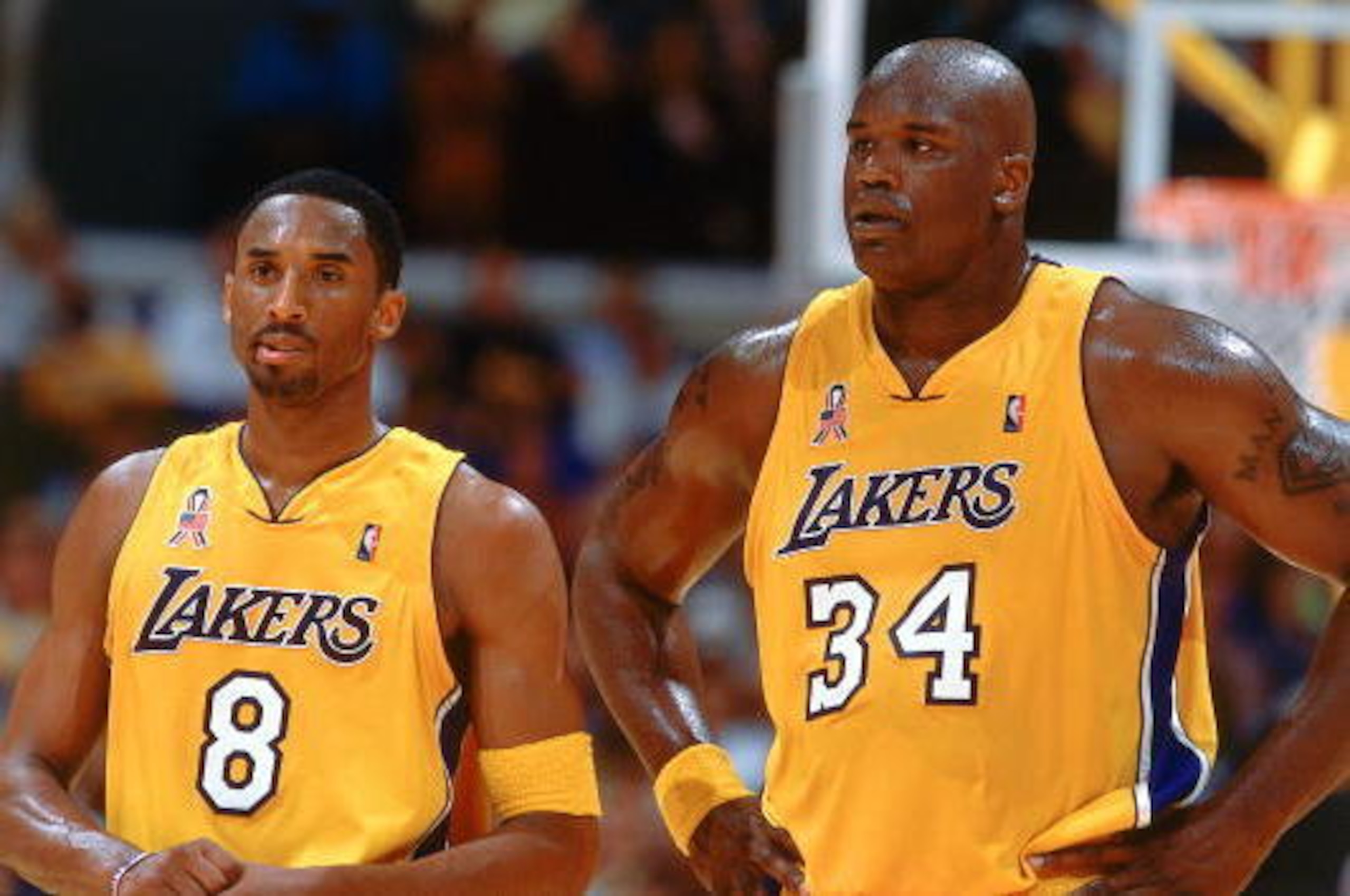
The two played nice long enough to lead the Los Angeles Lakers on a wildly productive eight-year run, during which the Purple and Gold won 69.7 percent of their regular-season games and three consecutive world titles (2000-02). And they did that without either ceding control to the other, both megastars in one of the world's mega-markets.
As Bleacher Report's Kevin Ding explained in an email exchange, the Lakers made it work for a time due to their supreme skill, Bryant's public patience and some masterful personality management by former Lakers coach and current New York Knicks president Phil Jackson:
"The team was so great that it could afford to let discord hover near the surface, especially when it came to Shaq's disdain for—and fear of—Kobe's relentless pursuit of more. Kobe tried to ignore it publicly and believe people would see Shaq's insecurities without Kobe having to go on the offensive, which Kobe ended up regretting. He told me that he didn't give fans enough info to draw the right conclusions. ... Phil Jackson's brilliant touch and high-character role players (and Kobe's will to win) helped get the guys on the same page when it counted, letting Shaq dominate as the amazing force he was. But Phil would come up with ways to engage Kobe, including making him the "quarterback" of the team so he felt like he was in control, too.
"
But the formula couldn't last. Bryant, cut from the same ruthless competitive cloth as Michael Jordan, and O'Neal, who Jackson said "had a clown role he had to play," couldn't survive on the same stage.
Talent overcame for a little while, but eventually personality problems proved more trouble than the talent was worth. O'Neal was sent off to the Miami Heat in 2004, and the Lakers didn't raise another championship banner until the deferential Pau Gasol was brought in as a clear sidekick to Bryant.
As if finding stars isn't hard enough, executives have to be conscious of finding ones that can not only coexist, but also push each other toward greatness.
One of the biggest challenges for NBA executives is that no superstar-handling manual exists. However, one infallible truth is the importance of getting those top-tier players to buy whatever the coaching staff is selling.
Jackson, who coached both the Jordan-Scottie Pippen Chicago Bulls and the O'Neal-Bryant Lakers, explained that significance in a 2013 interview with NPR's Steve Inskeep: "[Those players] are what make the atmosphere, and they are what make the esprit de corps what it has to be to be a genuine team effort. Because if they're pulling the wrong direction, if there's jealousy or there's just not the right attitude, it will eventually work its way into the group. And it's a cancer."
Championship clubs come in all sorts of different models, and the leaders of those teams are no different. Some are vocal, others are quiet. Some push buttons, others stick to their own keyboards.

Larry Bird helped guide the Boston Celtics to five NBA Finals and three world titles between 1981 and 1987. His secret? Leading by example and picking up teammates as opposed to putting them down.
"What set Larry apart from Magic and Jordan was he wasn't an in-your-face leader like they were," former teammate Robert Parish told ESPN Boston's Jackie MacMullan. "He had too much respect for us. If you weren't having a good night, he was more inclined to encourage you, or not say anything at all."
Would Bird's quiet approach have worked anywhere? Possibly, although the stoic Parish and the hard-nosed Kevin McHale seemed like the perfect recipients of Bird's message.
Similarly, Jordan's brash, uber-competitive style needed the right audience to have maximum effect. He found that in Pippen.
The versatile forward could have challenged Jordan for Chicago's throne. Pippen, a 47.3 percent shooter for his career, could have chased the sexy stat columns that would have raised his individual profile.
He didn't. As Sam Smith explained in a piece for ESPN.com, Pippen sought out ways to make his team—and his far more celebrated teammate—better:
"Pippen did what Jordan couldn't, or wouldn't. Pippen usually guarded the toughest offensive player, enabling Jordan to freelance in the lanes for steals and the fast break that broke most teams. While most regard those champion Bulls for Jordan, it was their aggressive defense that produced its offense and created the fear.
"
The Bulls made six title runs between 1991 and 1998.

One star leads, one star supports. That's the winning formula for just about every championship team.
It's a veteran Oscar Robertson letting a young Kareem Abdul-Jabbar (then Lew Alcindor) tap into his massive potential and the Milwaukee Bucks collecting their first (and only) title in 1971. It's David Robinson sliding the keys to the Spurs over to Tim Duncan, and Duncan later passing them on to Tony Parker. The franchise clears room in the rafters for five championship banners.
The Heat wouldn't have their last two rings had Dwyane Wade not ceded control to LeBron James. As Bleacher Report's Ethan Skolnick, who covered the Heat throughout the Big Three era, said in an email exchange, Wade's decision to put James into the driver's seat allowed the four-time MVP to find his comfort zone and the franchise to find its championship form behind him:
"When Wade reportedly gave James the keys during the next offseason in the Bahamas, it wasn't a matter of Wade acknowledging that James was the clearly superior player. It was about allowing James, who had admittedly struggled to adjust to his new surroundings, more room to be himself. Again, by nature, James is more boisterous. He views himself as a "chameleon" who can adjust to all different types of personalities. So, with James talking before the 2011-12 season about wanting to get back to having fun and being himself, it made some sense for Wade to step back and let that play out.
"
There has to be a second fiddle—a major reason that Howard is with the Rockets and not Bryant's Lakers—and it must find a rhythm with the No. 1 option.
That balancing act isn't always easy to execute.
Handling a New Reality
Guys we know as role players grew up dominating different levels of the sport. And the players we've been discussing aren't role players—they are the elites of an already super-exclusive club.
Telling one to fall in line behind another is like employing two five-star chefs and having one cook while the other does the dishes. Both jobs are important, but try telling that to the culinary artist elbow-deep in soap suds.
Praise is hard to distribute equally among two premier players, and production has proven even more difficult to evenly split.
Put the last 25 championship teams under the microscope, and it's easy to see the different loads carried by first and second options.
Categories like rebounds, assists, steals and blocks can be filled by either the headliner or the supporting actor. That's dependent on the style of play.
But No. 1 options are easily detectable when it comes to points and field-goal attempts. On average, they tallied 25.6 of the former and 19.1 of the latter. Their costars, meanwhile, saw only 19.2 and 14.8, respectively.
For some of these tandems, that was simply the life they knew as NBA professionals. Some of the game's great duos—Bird and McHale, John Stockton and Karl Malone, Durant and Westbrook—were formed over successive drafts.
That early exposure to a two-man power structure can help the pecking order grow organically. Of course, not every general manager is able to pull two names out of the league's annual talent grab and emerge with a pair of perennial All-Stars.
Some of these stars need more action—a blockbuster trade or a front-page free-agent signing—to properly align.
There is no fool-proof way to make this work, but history shows two things that seem to help that process: complementary skill sets and veteran experience.
Guard-big combos powered some of the finest dynasties in league history. Think Bob Cousy and Bill Russell for the Celtics (six titles between 1957 and 1963), Magic Johnson and Abdul-Jabbar for the Lakers (five between 1980 and 1998), Bryant and O'Neal in L.A. (three from 2000 to 2002) and Duncan and Parker for the Spurs (four between 2003 and 2014).
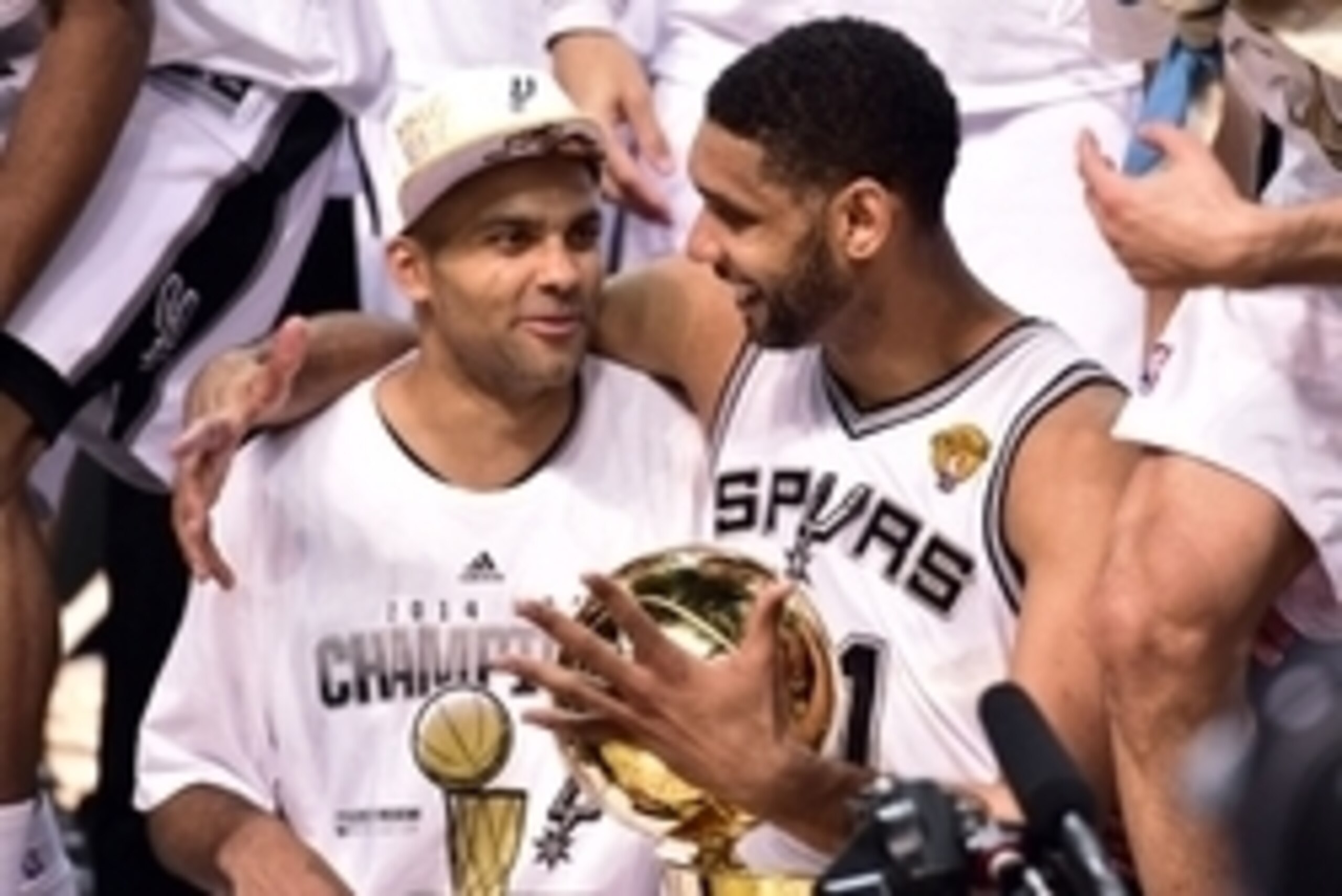
Successful superstar wing tandems aren't quite as common, although the Bulls made it work with Jordan and Pippen (six between 1991 and 1998) and the Heat had a nice run with James and Wade (two in 2012 and 2013).
Pairing bigs has proven even harder to win with, though Bird and McHale formed a strong forward tandem (three between 1981 and 1986), and the Spurs found some success with Duncan and Robinson (titles in 1999 and 2003).
Where experience can come into play is properly processing the sacrifices that must be made for an organization to progress. Priorities don't always change over time, but whenever players are willing to take box-score hits to make strides in the standings, championship hopes start evolving into something more tangible.
Chris Bosh described the process after going from being the Toronto Raptors' primary scorer to being the third member of Miami's Big Three, via Shandel Richardson of the Sun Sentinel:
"With all due respect to those guys, I didn't want to be [Charles] Barkley [and Malone]. They were great players, one of the best at their positions to ever play the game. They came up short. They both came very close but close isn't close enough. That's something I really learned about. You've got to kind of really sacrifice what you want to do. There comes a time you figure out what's important to you.
"
Bosh averaged 22.8 points and 15.9 field-goal attempts over his final five seasons with the Toronto Raptors. During his first four years with the Heat, those figures fell to 17.3 and 13.0.
Robertson averaged 25.3 points the year before teaming up with Abdul-Jabbar, and only 19.4 their first season together. Moses Malone tallied 31.1 points on 22.5 shots in 1981-82 and just 24.5 on 16.7 the following year. The difference between the two campaigns? He went from running with an aging Elvin Hayes to an in-his-prime Julius Erving after signing with the Philadelphia 76ers, world champs in 1983.
For today's Clippers, Trail Blazers, Thunder and Rockets, this is what they need to ascertain.
Are they one of the fortunate franchises who can win with two faces? Or do their stars need to split their roles into more structured ones?
Applying the Lessons Learned
None of the aforementioned teams will be asking for any pity.
They understand the importance of employing superstars in a superstar's league. They know they have the foundational pieces to form a championship contender.
Yet, that doesn't make the road ahead any more comfortable.
That's why the Trail Blazers, as The Oregonian's John Canzano put it, will "be more conscious of how it markets and promotes" both Aldridge and Lillard this upcoming season. The last thing this budding contender needs is for one of its stars to feel the other is getting preferential treatment.
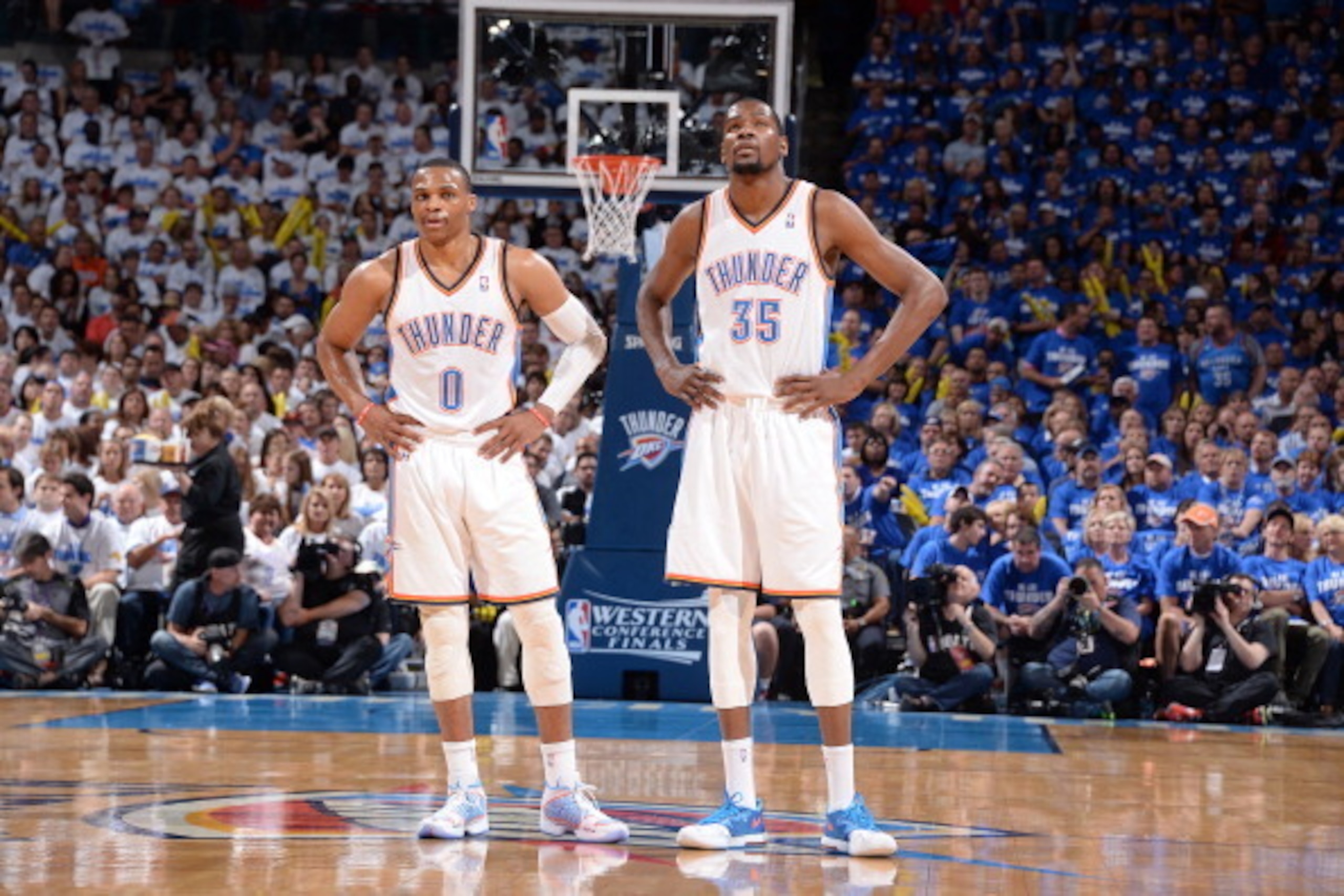
It's also the reason behind the questions of whether Westbrook and Durant can coexist at a championship level.
"This is always going to be like Kobe and Shaq because you have two guys who both want to be the best," Denver Nuggets guard Arron Afflalo said of Durant and Westbrook, via Bleacher Report's Ric Bucher. "It's the nature of their personalities."
Despite having the most recently constructed dyad, the Rockets may already be in the worst shape. Houston has time to figure things out between Harden and Howard, but as Ding observed in April, the Rockets' stars have yet to hit the same note:
"As of now, there's no true mutual respect between Houston's two All-Stars.
Harden, 24, and Howard, 28, clearly have their own priorities. Those include Howard getting his touches in the post—and Harden getting Howard out of the lane for room to drive. So the Rockets look like great players but don't even look like a good team.
"
The Clippers, on the other hand, sound ready to proceed on the daunting task of following two leaders. The important thing for L.A. is that the pair is working in conjunction.
"I know that he can't do it alone and I can't do it alone," Paul said, via J.A. Adande of ESPN.com. "And then ... I just want to win. Winning conquers all."
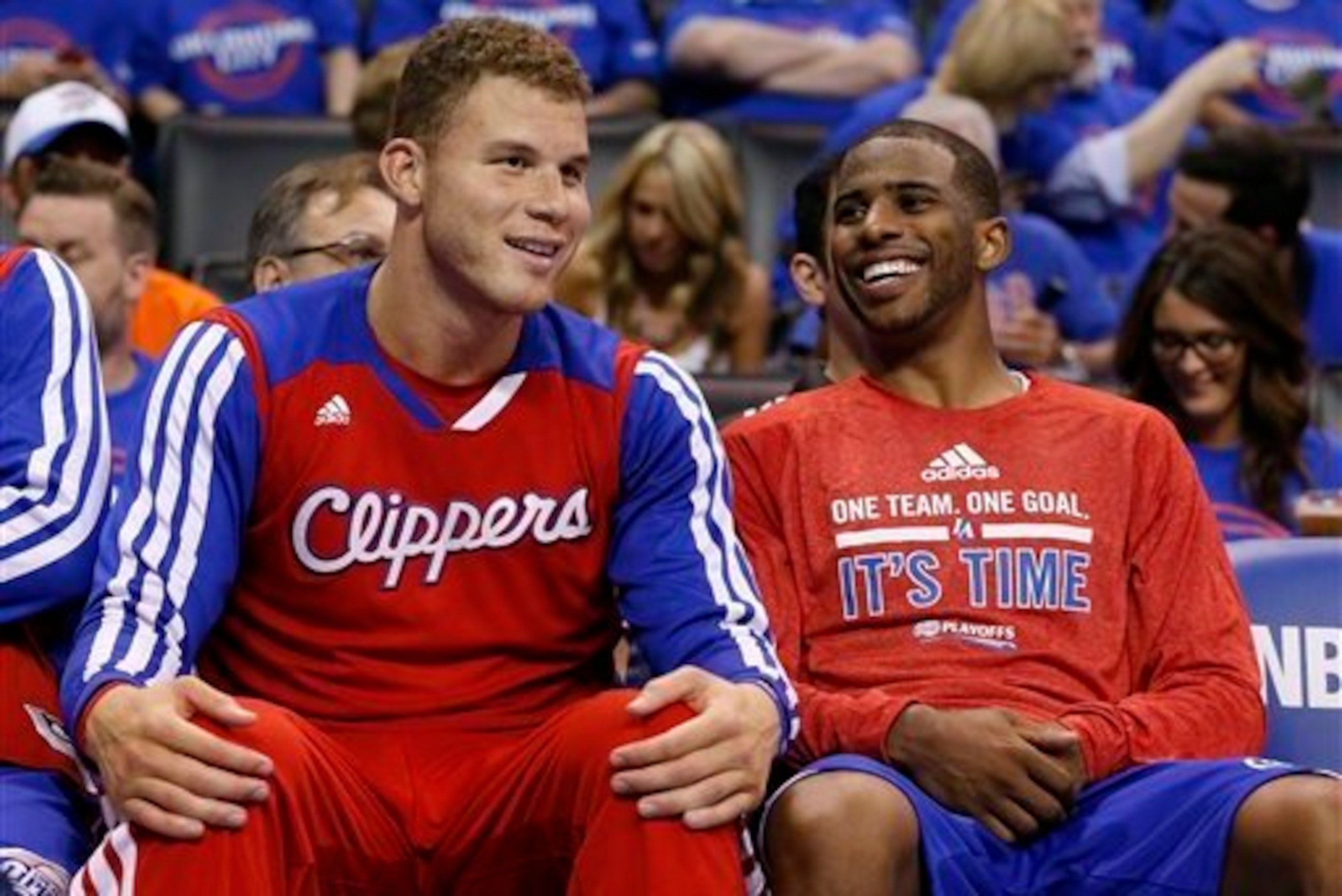
Paul is right—up to a point. Winning should conquer all, but it doesn't.
As Bryant told Sports Illustrated's Chris Ballard, championships don't create chemistry on their own:
"When players look in the distance and see us winning championships and see us celebrating and having a good time, they think, 'Oh, this is what leadership is, this is how you win, everyone gets along, we’re all buddy-buddy, we all hang out, blah, blah.'
No it’s not like that. You talk to Lamar [Odom], Adam Morrison. We were at each other’s throats every day. Challenging each other, confronting each other. That’s how it gets done.
"
Winning is the ultimate pursuit, but that doesn't mean it's fun. If egos go unchecked and common goals aren't forged, these organizations cannot proceed.
Again, these are all good problems to have, but they are problems, nonetheless. Solutions are needed, and history doesn't offer a miracle-cure road map.
Winning with multiple stars requires the right balance of cohesive personalities, maturity and a willingness to place others above self. That, or employing a pair of all-time greats like the Lakers did with Bryant and O'Neal.
Typically, the "problem" is solved by creating some type of hierarchy. And that could lead to some uncomfortable conversations coming for the Blazers, Thunder, Rockets and Clippers.
But with the potential reward of a world title at stake, those are talks worth having.
Unless otherwise noted, statistics used courtesy of Basketball-Reference.com and NBA.com.