

Will Injuries Keep Rafael Nadal from Becoming the Greatest of All Time?
Rafael Nadal exploded onto the tennis scene in 2001, skidding across courts in capris and slashing his racket like a machete through jungle brush. He played so hard that one had to wonder: How long can that body take that kind of a pounding?
His legs have weakened with recent injuries to his (right or left or both) knees, but now the injury bug has moved up his body and claimed his wrist. It’s the right wrist for a lefty with one of the more bruising two-handed backhands on tour. And his play proves Nadal isn’t the type of player to take a little off his fastball.
.jpg?w=2560)
.jpg?w=2560 "Texans Titans Football")
.jpg?w=2560 "Cardinals Giants Football")
This raises the question: Is Nadal’s climb up the summit as the greatest tennis player ever over? If not, does he have enough left in those legs to catch Roger Federer?
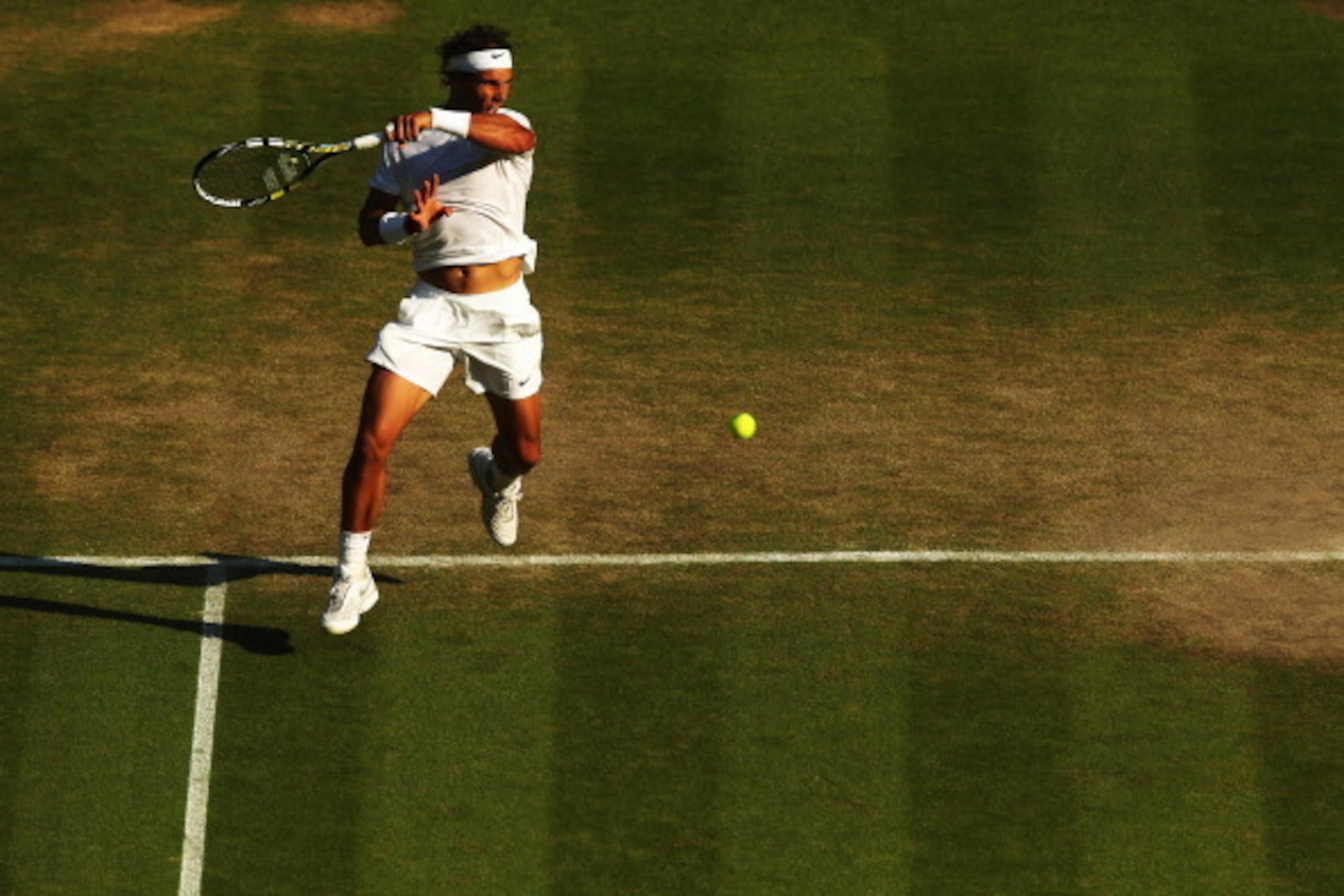
As it stands, Roger Federer, who some consider the greatest tennis player in history, sits atop a pantheon of legends with 17 Grand Slam titles. Nadal is tied for second with 14. The people who argue Federer isn’t the greatest are the same people in total mourning over Nadal’s withdrawal from the U.S. Open, as reported by the Associated Press (h/t ESPN.com). Nadal is 23-10 all-time against Federer. For some that’s hook, line and sinker.
Nadal has owned Federer for much of their career overlap, so it’s hard to fully endorse Federer as the greatest ever when many believe he’s not the best of his generation. Federer merely got the jump on Nadal, turning pro three years earlier and being five years older than Nadal.
He’s not the only athlete sitting on 14 majors chasing down a historically high number. For anyone following the fringe sports of tennis and golf, those numbers are the big numbers, familiar specters in the canon of country-club athletics.
Jack Nicklaus, golf’s Golden Bear, has 18 major championships on his mantle, and he’s being chased by Tiger Woods, who has been stuck on 14 majors since 2008.
Woods and Nadal have one terrible thing in common: They’re fragile.
The AP story recounts Nadal's injury history:
"But Nadal will be skipping the tournament for the second time in three years. He did not enter the US Open in 2012, part of an extended absence because of a problem with his left knee.
This will be the second time Nadal failed to try to defend a Grand Slam title. A year after winning Wimbledon in 2008, he chose to not enter that tournament, citing knee tendinitis.
"
Like Woods, Nadal is hard on his body. Dating back to 2006, Nadal has missed five majors due to injury. He missed the 2006 Australian Open with a foot injury and Wimbledon in 2009 with a knee injury. For three years running Nadal has missed a major tournament. In 2012 he missed the U.S. Open with a knee injury, missed the 2013 Australian Open with an illness and now the 2014 U.S. Open due to his wrist.
From head to toe, inside and out, Nadal’s body hasn’t been cooperative.
Of all players who benefit most from Nadal’s withdrawal, it’s his archrival Federer. Courtney Nguyen of Sports Illustrated wrote:
"With Nadal out, No. 3 Roger Federer has secured the No. 2 seed at the U.S. Open, which means he cannot face No. 1 Novak Djokovic until the final. It also means that Federer, who won his first ATP Masters 1000 title in two years on Sunday at the Western & Southern Open, will move to No. 2 in the rankings if he wins the tournament.
"
If Federer wins that makes 18 majors and puts him ahead of Nadal by four.
And, as Matt Wilansky of ESPN.com noted, the concern for Nadal’s future has everything to do with the nature of Nadal’s injuries, namely that most are to his lower body:
"If there is one common denominator in the litany of Nadal’s injuries, it is—with the exception of an abdominal ailment in 2009 against Juan Martin del Potro—the fact they were all in the lower body. Oh, that blasted knee, which first impaired him a decade ago at the French Open and then again at the 2010 Aussie Open. A knee injury also kept Nadal out of action for 7½ months in 2012. And if you’re keeping track, he has also suffered hamstring and foot setbacks throughout his career.
"
For a time, Woods seemed destined to eclipse 18 majors. Despite injuries to his knees and swing changes that stemmed from an altered and sometimes weakened body, 19 felt preordained.

Nadal, like Woods in golf, plays with such ferocity that it was incredible to see Nadal reach 14. Nine of those came on the French clay. As the body ages, it doesn’t bounce back with the same speed it once did at age 21. Not without performance enhancing drugs anyway, or Canadian doctors performing platelet therapy.
In order for Nadal to catch Federer, he needs to be, at the very least, playing in these tournaments. Should Nadal keep missing one major every year (especially majors that Federer has a greater probability of winning—read: not clay), Nadal’s tenuous grip on the claim to be the greatest tennis player ever will continue to slip.
Just like Woods, Nadal’s biggest enemy is twofold: time and the effect time has on his body.
Nadal is a historically great tennis player, and it appears that the most monumental threat to his title of greatest ever may never have been Federer or Novak Djokovic, Bjorn Borg or Pete Sampras.
Rather, it was his own body and the war Father Time won over him in a five-set classic.
.jpg?w=2560 "Broncos Chargers Football")

.jpg?w=2560 "MHJ Bought Own Jugs Machine")