On a gloomy December day in 2011, under overcast Eugene skies, Oregon conducted a secret test, which was actually more of a science experiment.
With the Rose Bowl just weeks away, the now-infamous “LiquidMetal HydroChrome” metallic helmets hit the practice field for the first time under observant eyes.
The entire project remained surreptitious—a feat that has grown increasingly difficult in an era built on access and information. With scattered clouds overhead, and not a single camera phone or public opinion in sight, the operation proved successful.
TOP NEWS
FSU fires head coach Mike Norvell
Week 9 CFB AP Top 25 Poll
FSU's Options to Replace Norvell 🔎
They were ready. The 12-step process to create this headwear—most of which took place with the aid of water or underwater testing—had worked. The unique helmets were packed and shipped to Pasadena, California, awaiting their master reveal.
When the Ducks finally took the field on Jan. 1, 2012, however, a rush of concern hit those tucked behind the neon curtain.
The cloudless sky and bright California sun provoked a much different reaction. The helmets shined—unlike anything we had seen before—and our televisions struggled to keep up. Early on, there was genuine concern that the spaceship-infused, magnificent chrome creations were not going to be allowed because of the reflection they cast.
“I was nervous for that game,” Oregon’s football equipment administrator Kenny Farr said. “We were worried about the legality of it, blinding our quarterbacks and thinking about a Plan B if we couldn’t wear them. But thankfully everything worked out.”
The helmets sizzled, chameleon-izing throughout the day as the sun hit the headgear from various angles. On the field, the Ducks provided a high-octane attack that seemed fitting of the Daft Punk-ian attire.
As the sun went down and the reflective properties faded, Oregon capped off a 45-38 win over Wisconsin to earn its first Rose Bowl title in 95 years.
"None of us were around 95 years ago, and we never talked about it," former Oregon coach Chip Kelly said after the game. "We're a forward-thinking operation, and we're always looking ahead."
It’s this mentality that has helped drive Oregon football into another stratosphere over the past decade. Metallic helmets can’t score points—and they didn’t account for a single portion of the 621 total yards—but their role in the Ducks’ dramatic rise to football power is undeniable.
It’s why 4-star guard Zach Okun, a 2015 commit and one of the best players at his position, according to 247Sports, visited Eugene and committed before he headed home.
“I don’t know how you visit Oregon and don’t commit,” Okun said.
Some of the nation's premier recruits from the 2014 class shared a similar sentiment. While parity was prevalent when they were tasked to name the best fans and coaches in the country, the question on uniforms required no further debate.
In a sport that rarely produces a consensus, we have found one. The Ducks have won college football's "Cool Contest."
| Question |  Mama |  Garrett |  Settle |  White |  Shaw |
Which school has the hottest girls? |  |  |  |  |  |
Who is the NCAA's scariest coach? | Saban |
| Saban | None | None |
Should college players be paid? | Some should | For retail sales | Yes | Yes | Yes |
Which school has the craziest fans? |  |  | | |  |
Which school has the best uniforms? |  | | | | |
One word to describe the SEC | Manly | Exhilarating | Best | Athletic | Dominant |
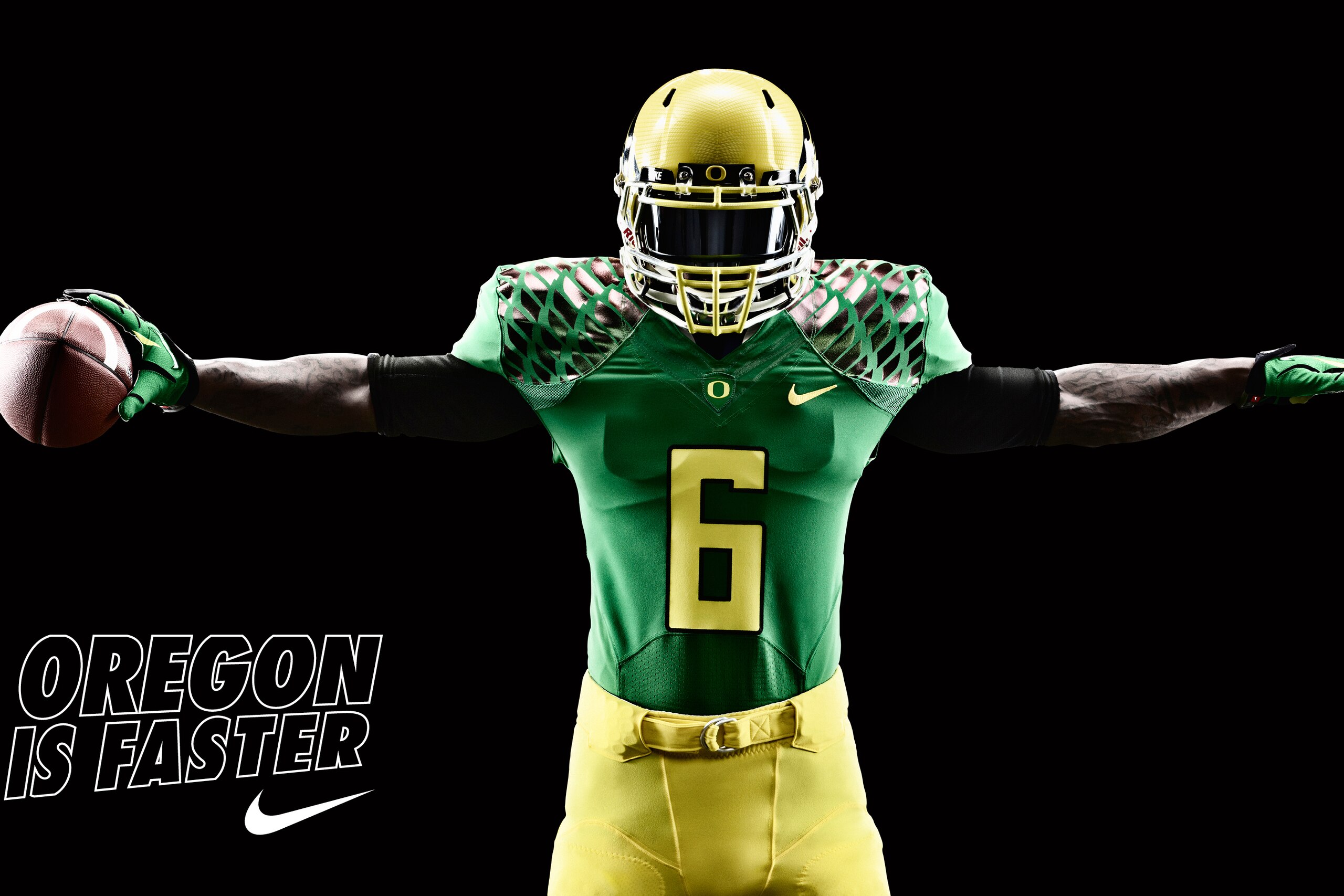
Oregon’s rise goes beyond winning football games at an incredible rate. It’s the product of a bold blueprint built around loud, attention-grabbing uniforms and facilities so good you won't want to leave.
And the entire process, with a helping hand from a very rich man and his very rich and creative company, has worked out brilliantly.
Abandoning Tradition: The Chameleons and Trendsetters of College Football
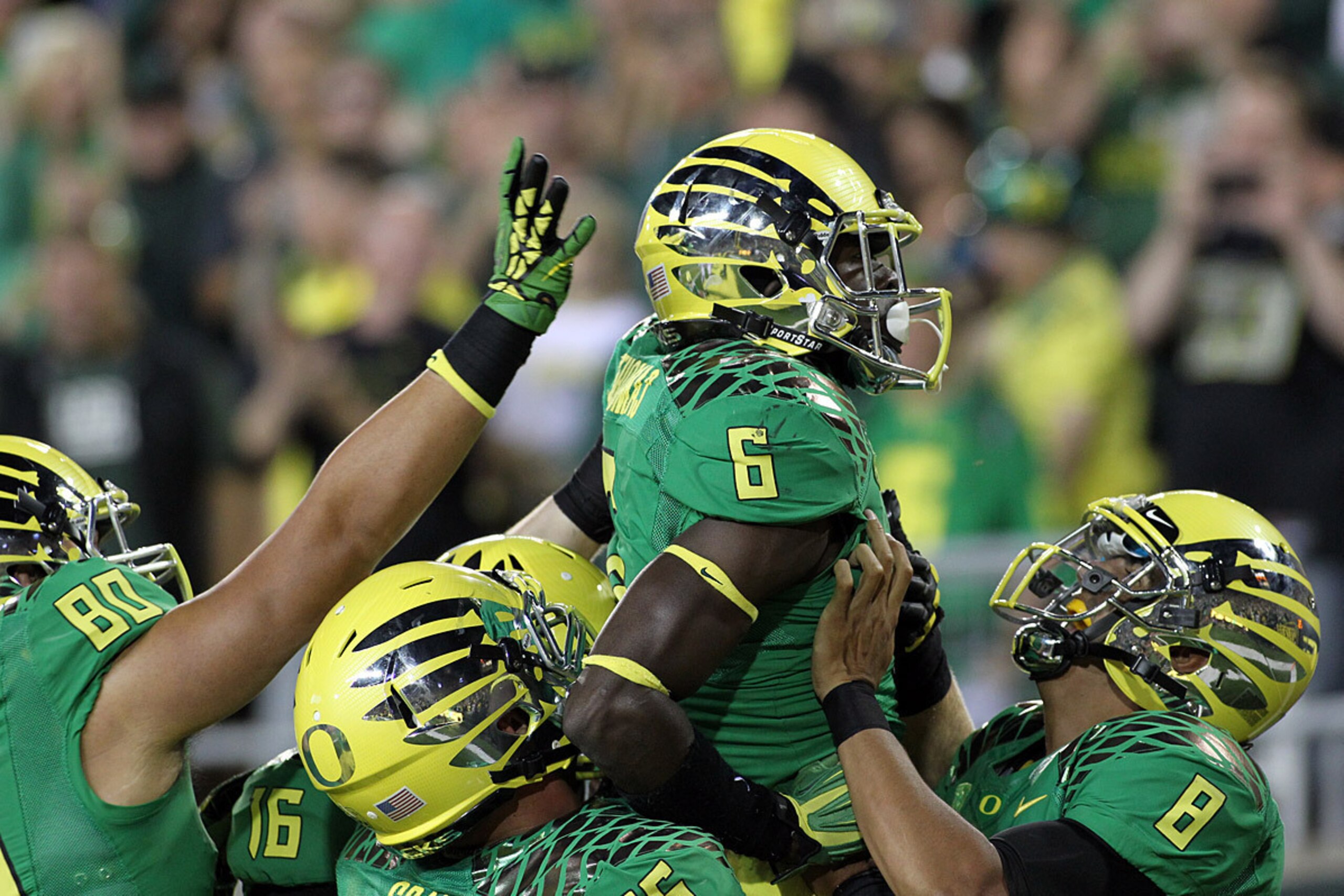
Only three years later, Oregon is off chrome. The godfathers of this wide-spreading helmet fad—the architects who pushed televisions to their very brink—have had enough. And quite frankly, it’s our fault.
“Everybody’s doing it, and we’re kind of moving on because of it,” Farr said regarding the chrome helmets. “It’s onto the next thing.”
To seek out the next great thing, you must first abandon your past. In a sport built on tradition, sights, songs and smells, hitting the reset button is almost never encouraged. It might as well read “self-destruct.”
But Oregon saw what we saw: three nine-win seasons before 1994, none of which occurred after 1950. The Ducks needed a change.
“Our tradition is that we’re willing to push the envelope when it comes to uniforms and branding,” Farr said. “There are a lot of schools that are based on tradition, and I understand and respect that. But Oregon embraces not having tradition.”
Farr, who has been with the school since 2008—the football program, specifically, since 2009—has watched the program go through its various stages. Before he was the team’s football equipment administrator, he was a student in Eugene.
As the equipment manager, it’s his job to ensure that the team is always dapper and ready to play to the cameras. He’s in charge of ordering and coordinating—from the helmet to the socks to the neon-splashed mouthguards (which are more popular than you would imagine, according to Farr). He also plays a prominent role in the creative process.
Farr graduated from Oregon in 2002, which served as an integral time in the program’s history. It was during his tenure as a student that he saw, specifically, a change in the branding.
“Between the 1998 and 1999 season, we went from our traditional interlocking U-O to the O,” Farr said. “When we went to that, we also went to a mallard green helmet. That kind of started the whole process.”
Slowly but surely, it expanded. Oregon took on new looks—pushing the envelope a bit further each time—and it has succeeded in doing so. The brand change in 1999 may seem subtle compared to the unbelievable advancements on display weekly, although it has been a gradual, calculated climb to reach this point.
Surprisingly, Farr's “wow” moment didn’t come at the Rose Bowl. His moment actually came a year prior when Oregon competed against Auburn for the national championship in socks you could see from space.

“I got the most contacts from people I hadn’t heard from in a long time when we wore the carbon-fiber helmet, the neon “O” and the neon socks in the national championship against Auburn,” Farr said. “That reminded me of what an impact this stuff can have.”
Although the neon socks are still matched by few, the chrome helmets and alternate uniforms have become common practice. Once-unexplored waters have now grown crowded.
Oklahoma, a program proud of its timely look, just released its bright and boisterous alternate threads.
"Bringin' The Wood! #BringTheWood #Unmatched #0to100RealQuick / http://t.co/WxZ75hVqpZ pic.twitter.com/Y56rzyx9v3”
— Bob Stoops (@OU_CoachStoops) July 1, 2014"
Other teams with rich traditions, such as Ohio State, Michigan and Notre Dame, have also dabbled with new ensembles. Closer to home, Oregon’s direct competition is now thoroughly invested in thread experimentation.
“There aren’t many schools in the Pac-12 that don’t have multiple jerseys and multiple helmets,” Farr said. “It’s taken on a life of its own.”
Because of this, Oregon has to stay in front of a booming market. Thus far, it has done so.
It’s not easy (or cheap), but it is worth it. More importantly to Oregon, there’s a reputation to uphold about being the mad scientist that always delivers just the right amount of mad.
“It’s cool to be the trendsetter,” Farr added.
Bringing Neon Together: Oregon’s Melting-Pot Approach to Uniform Design
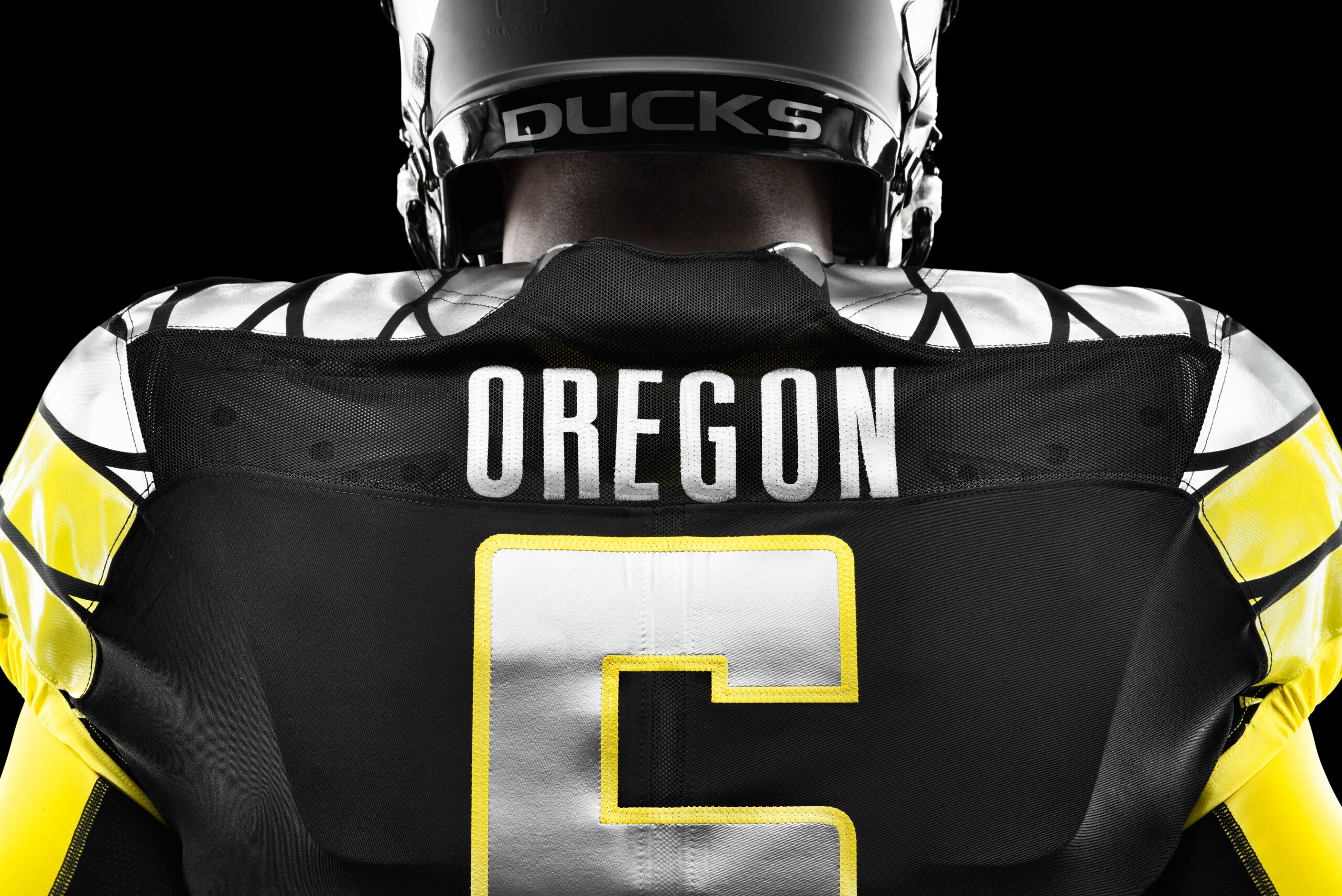
It’s all about speed.
When Nike announced Oregon’s 2014 Nike Mach Speed Uniform—as seen against Texas in last year’s Alamo Bowl—those were the first words used in its release.
Speed is, without question, Oregon’s currency. Nike knows this, which is why terms like “laser-perforated mesh” and “heavy-duty stretch-woven panels” are bullet points to describe football attire and not components of nuclear missiles.
But the process of creating these uniforms—from the now-infamous spring-game digs to a potential championship game ensemble—requires more of an Alabama-esque approach. It takes time and patience, and most importantly, it involves more than just a few Nike fabric savants destroying a whiteboard with various shades of green.
“The ideas come from so many places,” Farr said. “Nike will send their creative teams to meet with our players. Our golf coach might have an idea, or maybe somebody’s wife will suggest something at a party. We’ll throw all the ideas into a bucket and talk about each one.”
The player involvement is integral; it’s also incredibly rare.
This isn’t simply a gesture of courtesy on Nike’s behalf; it’s genuine interest. Those who wear the uniforms will have a say, not just in when they wear them, but how they will look going forward. That’s a recruiting pitch in and of itself.
It’s an open line for innovation, which was evident with the latest Oregon creations. The players wanted the focus to be on comfort and performance.
Nike listened.
“We meet with the team on a regular basis to gain insights into what they need on the field,” said Nike Football VP and Creative Director Todd Van Horne, when the uniforms were revealed. “They’ve told us that uniform fit, range of motion and airflow make a drastic difference on the field, and we are excited to provide them with a uniform that solves those problems and helps them perform on the field.”
It all sounds so simple, although the alterations are anything but. The colors are outlined accordingly, and the technology undergoes vigorous testing in order to determine if it’s functioning as planned.
It takes months. Before a uniform can be deemed game-ready, it is sent down various avenues for approval.
“Everything has to be approved through Nike, the football program and coach [Mark] Helfrich,” Farr said of the process. “I won’t just get a call that we’re making a new uniform and it will be there in two weeks. It’s a much longer process than that.”
While it’s ultimately Nike’s job to craft Oregon’s gear, the path to the final product involves as many insiders as are willing to get involved. It’s a collaborative attack that begins with the simplest, most experienced and most knowledgeable source.
"Our relationship with Nike is unique and continues to be incredibly beneficial to our program and our players," Helfrich said when the Mach Speed Uniforms were announced. "To see their feedback translate directly into improved uniform and equipment design is awesome, and it will only add to their level of confidence and performance on the field."
It has, and it will. Players will continue to shape the way the Oregon uniforms are crafted moving forward, and the products will only continue to improve thanks to this insider help.
The Man, the Swoosh and the Willingness to Spend

In 1978, Phil Knight, co-founder of Blue Ribbon Sports, decided it was time to change the name. He settled on Nike—the Winged Goddess of Victory—and paid a student $35 to draw up an edgy logo.
That logo has become iconic, the company a giant, and Phil Knight was recently recognized at No. 43 on Forbes’ list of the world’s richest people. His net worth is reportedly $19.1 billion.
In his Forbes profile, the Oregon alum was featured in a sport coat at a Ducks sporting event, with a trendy Oregon “O” T-shirt in place of a suit and tie.
This, in many ways, is the elegance and edginess that mirrors the Oregon football team’s attire. Knight’s influence is felt in what the Ducks wear, but it’s not exclusive to just that. The branding that has taken place within the program is an extension of his creativity and an enormous bit of generosity.
“The relationship with Nike, Mr. Knight and all the former Oregon players and alums working up the road in Beaverton has created a great partnership,” Farr said. “They’re [Nike] pushing the envelope in terms of innovation and style, and we’re willing to try those things. It’s a great marriage between the two.”
We’ve known of this marriage for quite some time. It’s why the masses will push their East Coast bedtimes back on Saturday nights, just to see what Nike has drawn up this time. But Nike’s (and Knight’s) influence on the football program is more than just the threads. In fact, the endless neon clothing designs are the tip of the iPad-equipped, self-navigating iceberg.

Knight recently donated nearly $70 million so Oregon could build the nation’s most elaborate football operations building. It is a state-of-the-art electronic football playground with Brazilian hardwood, a barbershop, custom foosball tables, Ferrari leather chairs and a lobby equipped with 64 flat-screen televisions.
The players reacted to the opening of the facility as you might imagine.
“It’s indescribable, and it’s even better in person,” Helfrich told Bleacher Report when the facility first opened.
The business chairs come with yellow trimming. The comfortable “war room” leather seats feature a giant “O” in the middle of each one. In the cafeteria, “Eat Your Enemies” is etched in enormous neon writing on the wall followed by “And the Other Food Groups” on the other side.
It is a football palace built for the player, by the man who has the means and appetite to provide. For his contribution, Knight was given a permanent parking spot at the facility and, yes, his very own locker.
"Yes, Phil Knight has his own locker #goducks pic.twitter.com/7uSALjUwto
— Jen Beyrle (@JenBeyrle) August 5, 2013"
Over time, Knight has donated more than $500 million to the school, spreading that money through various avenues and departments. Nike's influence on the university as a whole is undeniable, and Knight’s generosity within the football program has shaped the dramatic climb.
The timing isn’t just coincidence.
He might not direct each and every stripe on a proposed helmet or suggest ways to improve airflow through mouthpieces, but he’s still deeply involved with the happenings of the program.
Passion and business have come together, all at once.
The Art of the First Impression: How Oregon Sells Itself

Before Zach Okun was one of the nation’s premier guards, he was a high school freshman touring the Oregon campus. This was long before Phil Knight’s starship was complete, of course, although the California native was intrigued by the Ducks even before he knew it would be a real option.
On his second visit in March of this past year, he was given the full mallard green carpet treatment and shown everything the Ducks had to offer.
He verbally committed before heading home.
It was the coaches, the players, the campus and the education that led Okun to his decision, as it should be for recruits. He found comfort in Eugene, something he recognized early.
But it was also the power of the visit—the wave of neon enticement that hits you when you step inside the program and see the array of technology that is just a signature away.
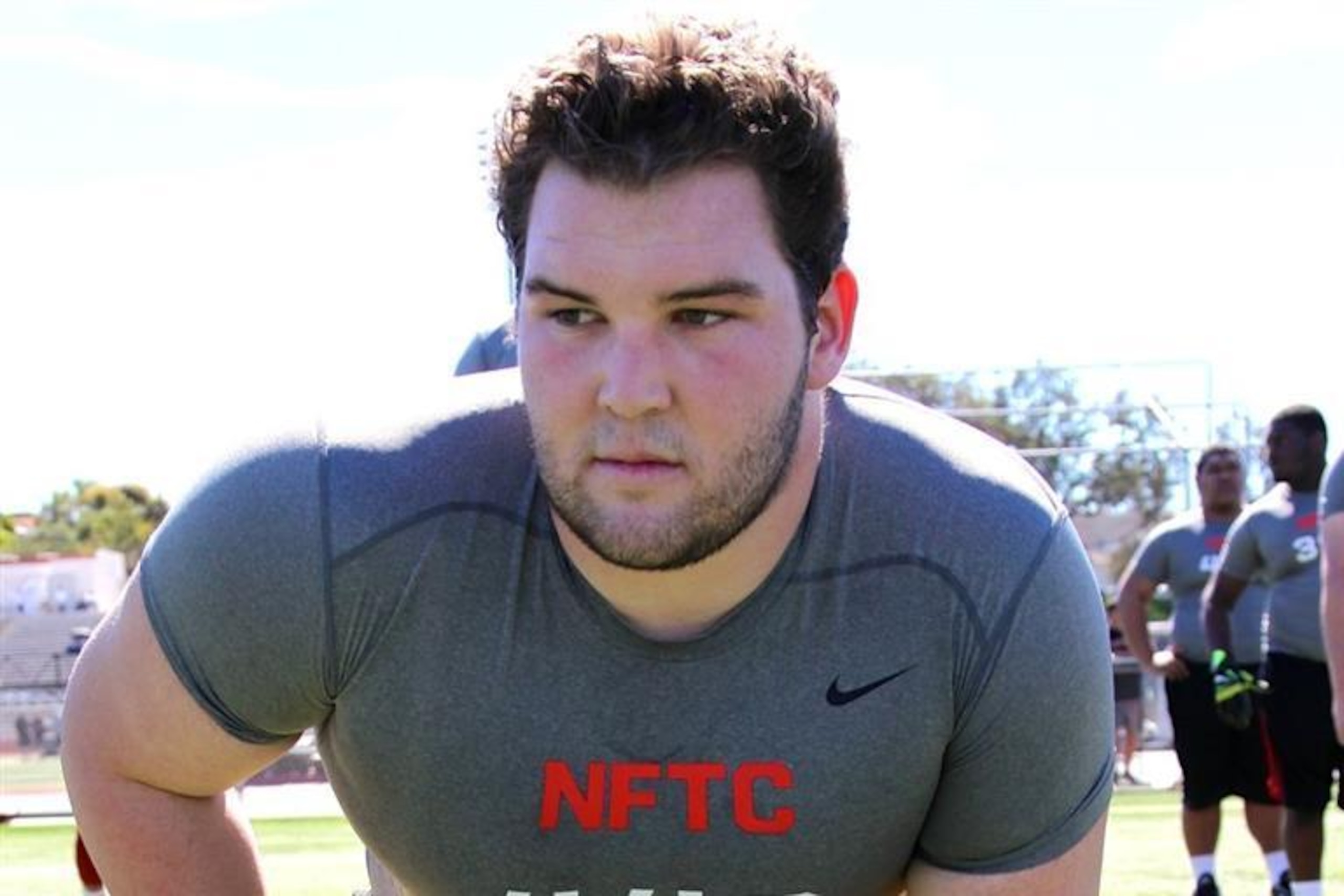
“I visited a bunch of schools, but the whole package at Oregon was incredible,” Okun said. “Every facet of the program is just top-notch.
“It’s unreal. Everything there is for you.”
The helmets didn’t directly lead to his commitment. Neither did the immaculate facilities. It plays a role in the process—especially in courting the player—but the fit has to be right first. When it is, the gorgeous amenities within the program start to take over.
The look and feel of a football program—from the uniforms to the locker room to the overall vibe—can serve as a kicker in a decision. For Oregon, showcasing these perks early on is even more important than it is for most.
"It's quite a trip to Eugene, Oregon, from most places, so there has to be a hook and motivation to get prospects there and expose them to the brand as the Ducks," 247Sports’ national recruiting director JC Shurburtt said. "Things like uniforms and facilities can help Oregon get its foot in the door with top recruits across the country."
Only 17 players on the Ducks’ current roster come from the state of Oregon. From Hawaii to New Jersey, Oregon’s courting hinges on successful first impressions and on-campus encounters.
Okun’s future teammate, 4-star quarterback Travis Waller, recently announced his verbal commitment to the school, picking the Ducks over Notre Dame. Like Okun, the California product came away dazzled after getting the grand tour.
“It was definitely the best one hands down,” Waller said on his visit to Oregon. “It’s going to be hard to beat that visit.”
For Waller, it was more than just the visit. As the nation’s No. 4 dual-threat quarterback, according to 247Sports, he saw an opportunity to a) play in a system suited for his physical gifts and b) perhaps play early—if all goes well—with an opening at quarterback next year.
The little things mattered, but Waller also approached his decision with a realistic understanding of the situation.
“You have to be a little mature about it, and it can’t just be about how crazy the uniforms are,” Waller said. “They’re great, but it’s a great school overall.”
Still, even with this astute, levelheaded approach, Waller—like his future teammate—was hypnotized as he was given the grand tour. One of the greatest recruiting tools in the country struck again.
“It’s like the future basically,” Waller said on Oregon’s football operations building. “It feels like 2035 in there.”
The Bottom Line: What It's Meant and Where They’re Headed
In 2013, 66.6 percent of Oregon’s athletic revenue came from football. The next-highest revenue-generator for the program was basketball, which produced 12.4 percent of all revenue. What’s most intriguing about this discrepancy is that it is not the least bit surprising.
Over the past nine years, Oregon has watched its athletic revenue skyrocket, which, again, should come as no surprise. The appearance in the BCS National Championship—as outlined by the enormous outlier in the graph below—prompted a surge of momentum, one that has further propelled the brand and performance to another level.
Now Oregon is on a steady path, cracking the top 10 in total national revenue this past year. This upward trend, especially after a $21 million jump in only one season, speaks volumes about where the program is headed.

In front of our very eyes, Oregon has transformed itself into a football power. A club that rarely accepts newcomers has embraced the Ducks with open arms. Quite frankly, it has had no other choice.
It hasn’t come through the typical path of rich tradition and decades of football success. It instead has been a product of winning, unmistakable speed, original, bold branding and a helping hand from the world’s most successful provider of athletic apparel.
Nike’s influence has been critical. And Oregon has done its part to help The Swoosh on the other side.
Thanks in large part to the brand recognition that has come with Oregon—and also a long history of delivering eye-popping, quality materials—Nike now provides attire for 88 colleges.
From a financial standpoint, Nike, Inc. just announced that revenues totaled $27.8 billion for the fiscal 2014 year, up 10 percent from 2013. Of course, Oregon's football look isn't the sole reason for Nike's incredible success, but the Ducks have done wonders to enhance Nike's reputation in the business.
The two are the best-working, most-convincing and best-looking couple in college football today. The relationship has resulted in money, success and a recruiting device that is unmatched in college football.
What's perhaps most intriguing about the relationship is not where they've come from, but where they're headed. As much as progress has been made in the past decade—pushing others to alter their traditional approaches entirely—Oregon and Nike are only scratching the metallic, tantalizing surface on what can be done.