
Dallas Cowboys Mock Draft: Instant Contributors Cowboys Can Find in Every Round
The Dallas Cowboys need instant contributors from the 2014 NFL draft, so this mock draft will focus on the players most likely to become immediate impact guys from each round. The Cowboys have 11 draft picks this year—at least one in every round except the sixth.
This particular Cowboys mock draft won’t include every pick, but rather the player from each round in which the ‘Boys have a selection who is most likely to help Dallas from day one. We’re not necessarily looking for the most likely path, or even players to whom the Cowboys have been linked, but just a player in every round except the sixth who could be available, who fills a hole and who would make an immediate impact in Big D.
To determine which prospects are potentially the most impactful, both talent and need will be considered. The Cowboys want the best players possible, of course, but the ones with the greatest immediate potential will almost certainly be at positions of need.
Round 1: Aaron Donald, DT, Pitt
1 of 6Will Pitt defensive tackle Aaron Donald fall to Dallas? Probably not, but there’s a decent chance that he falls into the teens, in which case the cost for the Cowboys to move up wouldn't be prohibitive. He’s the one player it makes sense for Dallas to trade up for in this draft.
The big concern with Donald is that he has just 32.6-inch arms. That's short for a defensive tackle. Although some players have thrived at the position despite a lack of elite arm length (Warren Sapp, for example), there’s still a trend there suggesting quality short-armed players are the exception to the rule.
When a player records college production as impressive as Donald’s, however, you can put up with short arms to a greater extent. With 11 sacks and 28.5 tackles for loss in 2013 alone, you could argue Donald was the top defensive lineman—not just defensive tackle—in the nation. He has a four-year history of elite production.
The addition of Henry Melton certainly decreased the Cowboys’ need for a 3-technique defensive tackle, but it’s hard to ignore the potential of a Donald-Melton duo. Neither is a 1-technique, but defensive coordinator Rod Marinelli should be able to work wonders with an interior pass-rushing duo with such ridiculous upside.
Round 2: Davante Adams, WR, Fresno State
2 of 6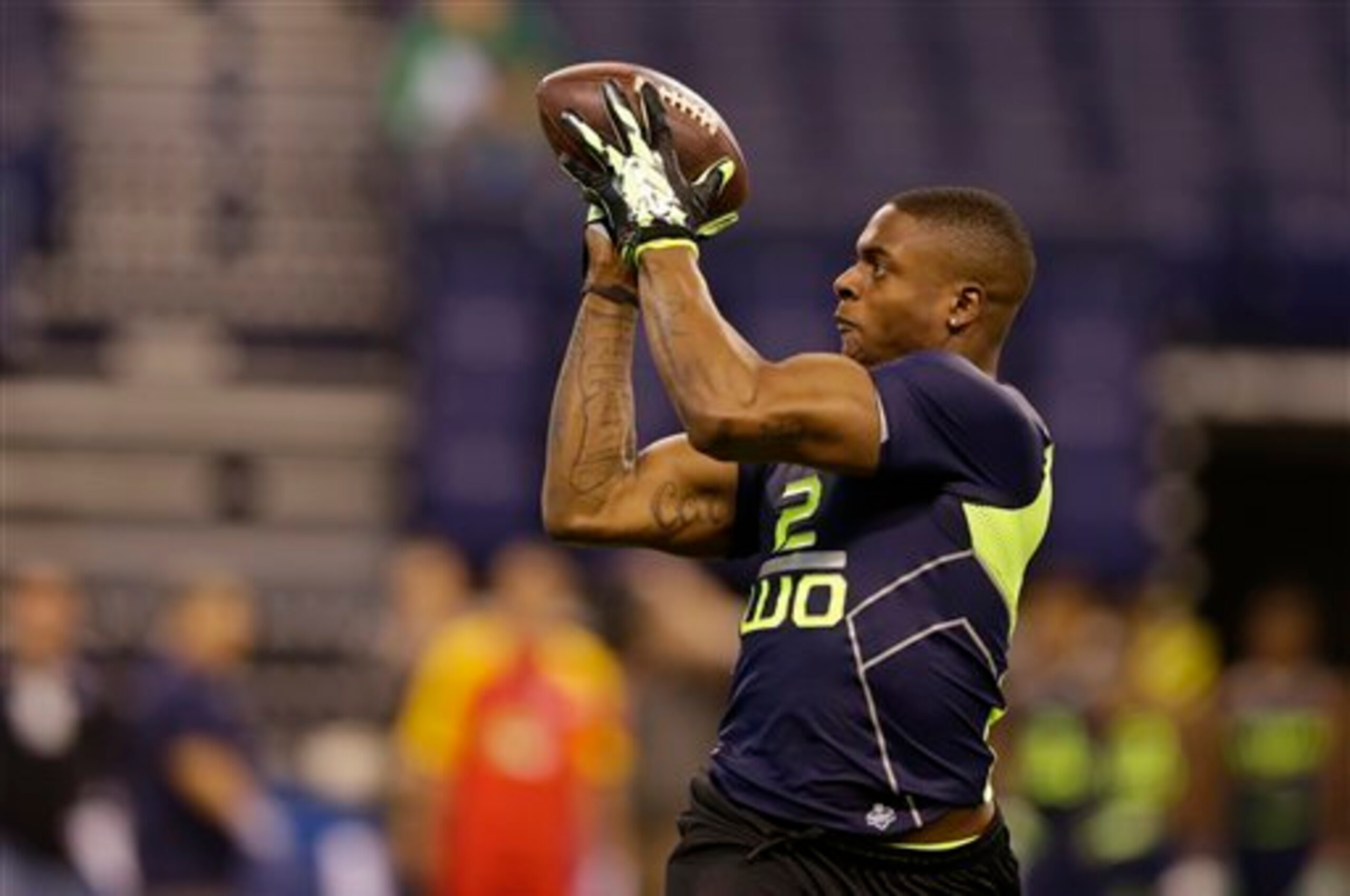
The Cowboys need a wide receiver. That’s not a popular opinion, but there are few positions at which bringing in an early-round pick could have a bigger impact. Outside of the defensive line and perhaps safety, wide receiver is the Cowboys' biggest potential area for improvement.
What will a quality rookie receiver do? First, he can help the Cowboys score. Terrance Williams showed promise in his rookie year, but he’s not the sort of player who will consistently dominate in the red zone. The ‘Boys should use tight end Gavin Escobar way more, but adding another red-zone-relevant pass-catcher will help this offense.
Second, wide receivers help quarterbacks nearly as much as quarterbacks help receivers. With quarterbacks getting the ball out quicker than ever, the value of the offensive line has decreased in recent seasons. Quarterbacks are just as responsible for their sacks as the linemen, and having big, physical wide receivers who can be trusted is of massive importance.
Finally, the Cowboys already have pretty good offensive personnel, but 1) offense is more important than defense and 2) they have a really big potential leak: a Dez Bryant injury. The ‘Boys shouldn’t draft a receiver simply because of how much they rely on Bryant, but it should factor into the equation. If Bryant were to get injured (or even see more frequent double-teams), the Cowboys offense would be stagnant.
Fresno State’s Davante Adams is one of the most underrated receivers in this draft. At 6’1”, 212 pounds, he ran a 4.56 in the 40-yard dash. That’s plenty fast enough for his size, but his time won’t cause him to rise up boards like what might happen with Vanderbilt’s Jordan Matthews.
Most important, Adams dominated in college. In two years at Fresno State, he averaged 116 catches, 1,515 yards and 19 touchdowns per year. That’s insane.
Round 3: Jackson Jeffcoat, DE, Texas
3 of 6Texas defensive end Jackson Jeffcoat has all the makings of an undervalued player. Despite being projected in the third round, he has long arms (33.9 inches), explosiveness (10’3” broad jump) and a history of production (13 sacks and 19 tackles for loss last year).
Jeffcoat’s potential impact will come down to whether or not the Cowboys re-sign Anthony Spencer. If that happens, Spencer and George Selvie will likely be the team’s starting defensive end duo. If the ‘Boys don’t re-sign Spencer, though, chances are they’ll start a rookie at defensive end in 2014. Jeffcoat might not be the most likely first-year player to fill that role, but he’ll be the best option in the third round.
.jpg?w=2560 "Commanders Cowboys Football")
Round 4: Dion Bailey, FS, USC
4 of 6No one really knows who is going to start at free safety for Dallas in 2014, and that probably includes the coaches. The two most likely options at this point seem to be J.J. Wilcox and Matt Johnson.
If he can stay healthy, Johnson is an underrated player with the same physical profile as 2013 first-round pick Kenny Vaccaro.
There isn’t much left on the free-agent market, so if the Cowboys want to add serious competition to that shortlist of potential free safeties, they’ll need to do so via the draft. USC’s Dion Bailey is a mid-round option who would immediately compete with Wilcox, Johnson and Jeff Heath for playing time.
Round 5: Trai Turner, G, LSU
5 of 6
LSU’s Trai Turner is a 6’3”, 310-pound interior lineman with long 34-inch arms and good athleticism (4.93 in the 40-yard dash). CBS Sports compared him to current Cowboys left guard Ronald Leary, although Turner is more athletic.
The Cowboys don’t necessarily have an immediate need at guard, but the position isn’t a strength, either. With Leary and right guard Mackenzy Bernadeau, the team could benefit from adding competition at the position.
Turner’s long arms give him a ton of upside, as does his youth, as he is only 20 years old.
NFL teams still ignore age way too often in prospect evaluation. The main benefit in drafting young players isn’t that they have more years in the league, like many people think, but rather that they have lots of room for improvement. When a young player dominates at the college level against older competition, it’s a really strong sign that he’s going to excel in the pros. Because NFL teams more or less treat a 22-year-old the same as a 20-year-old, it creates a value situation.
Round 7: Jerick McKinnon, RB, Georgia Southern
6 of 6
If forced to predict whether or not the Cowboys will find a starter in the seventh round of this year’s draft, I’d actually guess that they will.
Seventh-round picks are glorified undrafted free agents and don’t typically contribute much in the NFL, but the ‘Boys have six picks in the round. We’ll probably see them package some of those picks to move up at some point, but they’re almost certainly going to have multiple seventh-round “darts” to try to hit a bull's-eye. Where should they look?
There’s one position that continually outperforms others in the late rounds: running back. Late-round running backs excel for two reasons. First, NFL teams are horrible at evaluating running back talent, emphasizing size when they should be looking for speed. Second, running backs are notoriously hard to project because their production is so dependent on their teammates.
It’s incredibly difficult to isolate running backs from their situation, so teams make a lot of mistakes. The running back market is more or less random, meaning teams should minimize the cost by drafting them late.
Within the running back position is a certain profile of back that has overachieved: the small-school prospect. Again and again, small-school running backs offer more value than their BCS counterparts. Georgia Southern’s Jerick McKinnon, who actually played as an option quarterback, is a small-school prospect to watch.
There’s a decent chance that McKinnon won’t be available in the seventh round because, at 5’9” and 209 pounds, he ran a 4.41 in the 40-yard dash. He also jumped 40.5 inches vertically and 11’0” in the broad. That’s crazy explosion. Still, he’s a small-school player who doesn’t have much running back experience, so there’s a chance that he falls to the end of the draft.
Even in the fifth round, McKinnon is the sort of player who is going to offer a ton of value. Depending where he goes, he could be this year’s Zac Stacy.
.jpg?w=2560 "49ers Seahawks Football")

.jpg?w=2560 "WWE Raw Live Grades 🔠")
.jpg?w=2560 "Harbaugh's Jameis Comps 🤨")