What Hurry-Up, No-Huddle Decision Means for Alabama vs. Auburn Rivalry
The now-tabled vote, per Brett McMurphy and Chris Low of ESPN.com, on slowing down hurry-up, no-huddle offenses perhaps would have affected no rivalry more than Auburn-Alabama.
It’s no surprise, then, that the coaches of the two programs found themselves at the center of the debate. Battle lines were drawn on the up-tempo offense debate long before discussion began.
Alabama coach Nick Saban, one of the great defensive minds in the country, continues to build his Hall of Fame credentials around extraordinary defenses.
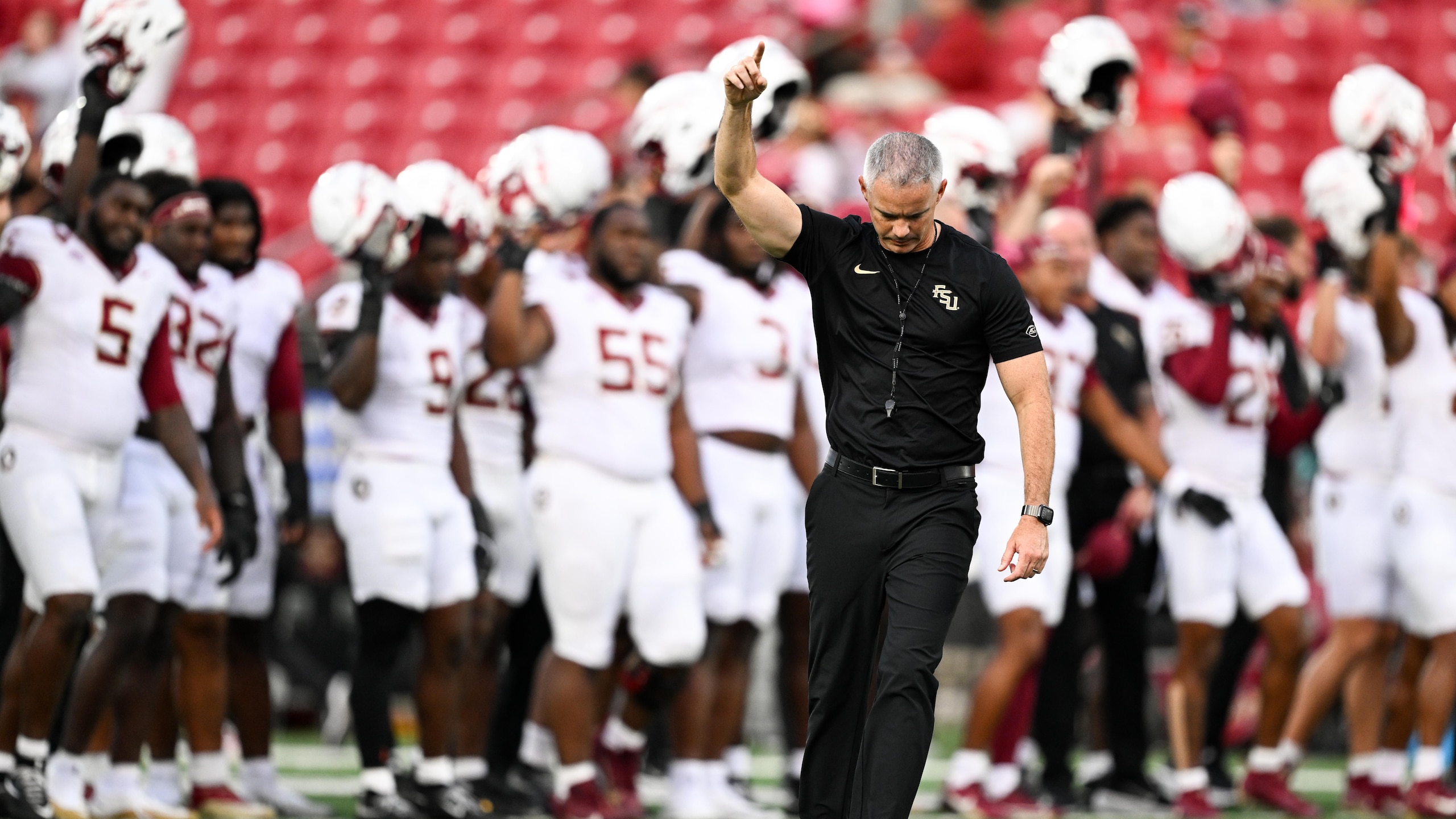
Auburn coach Gus Malzahn, an offensive guru, wrote the book on the hurry-up, no-huddle offense.
Both coaches have the same offensive goal—to wear down the opponent. They simply take opposite viewpoints as to how to accomplish the feat.
Saban employs a powerful, deliberate attack designed to beat opponents into submission.

Malzahn prefers to leave defensive players breathless and on edge, rushing his offense to the line to quickly snap the ball.
Sometimes, that means after 20 seconds have ticked off the play clock. Other times, it means not even 10 seconds have rolled off the clock.
If the rule eventually comes to pass, offenses would be charged with a five-yard “delay of game” penalty for snapping the ball before the 40-second play clock reaches 29 seconds.
The proposed rule drew national headlines immediately because of the myriad programs—Auburn, Oregon and Baylor, to name a few—that prefer the up-tempo approach.

That Saban and Arkansas coach Bret Bielema flew to Indianapolis to back the proposed rule while coaches from the hurry-up, no-huddle school of thought weren’t represented added fuel to an already blazing inferno.
For Saban and Bielema, not only would the rule take away an advantage specific to the offense, it would weaken the strength of several offensive-minded rivals in their division.
For coaches like Malzahn—and many others, including Texas A&M’s Kevin Sumlin, Ole Miss’ Hugh Freeze, Arizona’s Rich Rodriguez and Oregon’s Mark Helfrich—such a rule essentially threatens their way of life.
Naturally, it didn’t sit well with those coaches.
Even coaches who don’t utilize hurry-up attacks spoke out in opposition.
South Carolina coach Steve Spurrier went as far as to call the proposed rule the “Saban Rule,” according to USA Today (via ESPN.com).
Spoiler alert: The Ol’ Ball Coach, who has built his empire on dynamic offenses, didn’t like a defensive-minded coach trying to take away a built-in advantage for offenses.
Therein lies the fundamental issue with the hurry-up, no-huddle debate: Coaches—and worse, fans—of both sides are far too in the “what’s best for me” mindset to think rationally.
And as long as sweeping rules changes that would threaten to wipe out offensive strategies are on the table, the condition won’t improve.
With the coaches so entrenched in a philosophical war of words, the hurry-up, no-huddle conversation rages on as the fiercest debate between Alabama and Auburn fans.
Proof can be seen by those who've checked message boards or al.com over the past few months.
The arguments drifted from talk of Chris Davis and Alabama’s kickers to Auburn failing to extend the SEC’s streak of BCS national championships.
All those discussions are in the past now—or at least on hold. In their place rushed the offensive tempo conversation.
And no, they can’t all just get along.
Neither can the coaches.
Saban and Bielema spoke on the player safety issues that have come to the forefront as a result of hurry-up, no-huddle systems. (Saban mostly eloquently and Bielema...well, not so much.)
Saban’s case, in particular, makes sense.
If one accepts the premise that injuries occur on an average basis of X number of plays, then increasing the number of plays in a game would increase the likelihood of injuries.
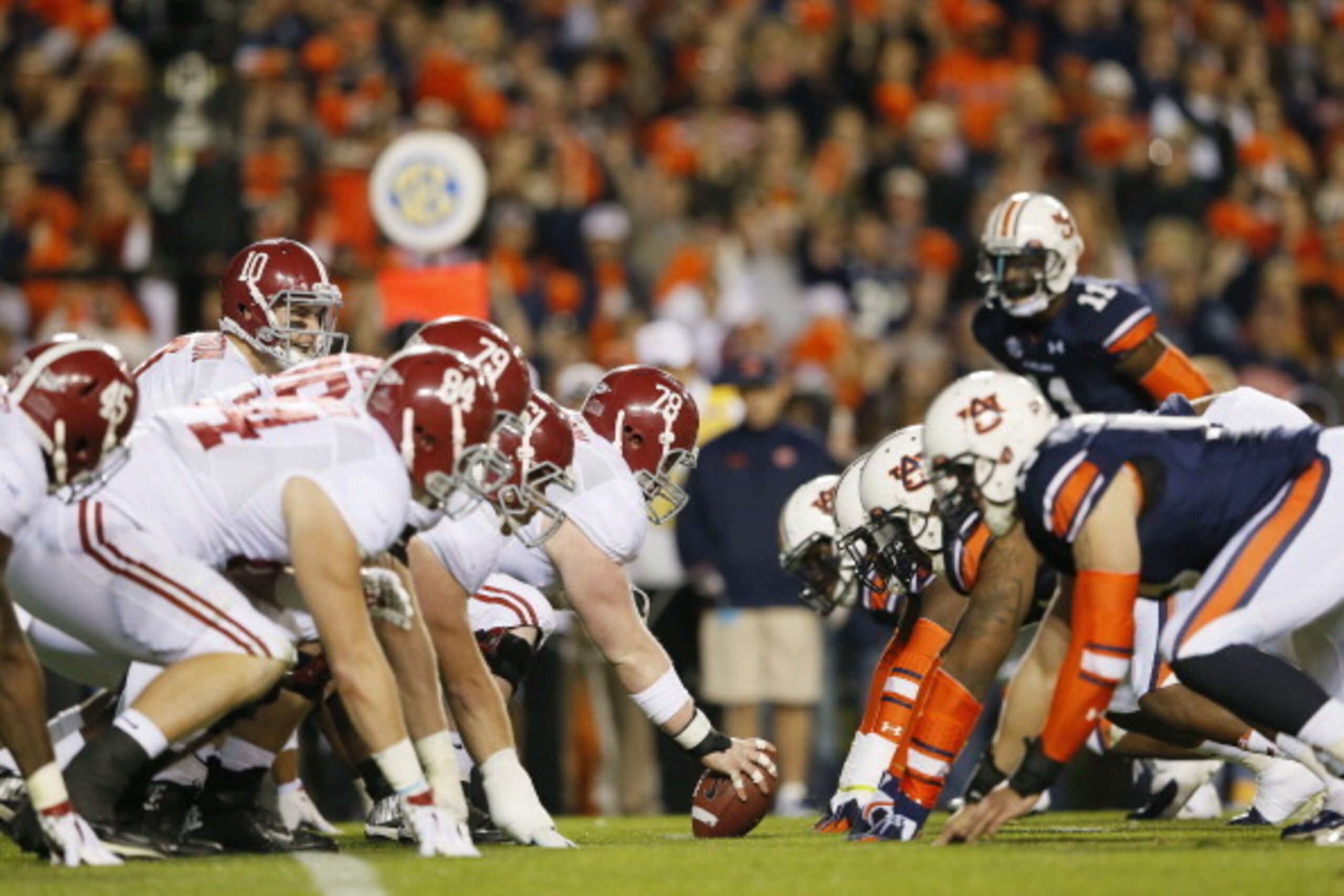
“I don’t care about getting blamed for this. That’s part of it,” Saban told ESPN.com (h/t: USA Today). “But I do think that somebody needs to look at this very closely.
“The fastball guys (up-tempo coaches) say there’s no data out there, and I guess you have to use some logic. What’s the logic? If you smoke one cigarette, do you have the same chances of getting cancer if you smoke 20? I guess there’s no study that specifically says that. But logically, we would say, ‘Yeah, there probably is.’”
At some point, that becomes a slippery slope, though.
Football is a dangerous game on the first play of the game, too. So why play that?
Or why add a game to the end of the season, as in the case of the four-team College Football Playoff set to launch this season?
Or why doesn’t the NCAA go back to 10- or 11-game schedules?
Hurry-up, no-huddle proponents won’t even grant the premise submitted by Saban and Bielema.
“Once again, I don’t think we need to lose sight of the fact that the only way you can change a rule is the health and safety of our players,” Malzahn told a pool of reporters, per al.com. “And it’s got to be documented, and there’s got to be proof. And there’s not.”
The hurry-up, no-huddle vote might be sidelined for now, but the debate will continue to rage on strong.
It will hover over the Alabama-Auburn rivalry with plenty at stake.